Tuesday, 15 May 2018

Love and transfiguration from the Cohen Ensemble

Jacques Cohen and the Cohen Ensemble
Composer and conductor Jacques Cohen is bringing his Cohen Ensemble (formerly the Isis Ensemble) to the Queen Elizabeth Hall on 17 May 2018 for a programme of string music which includes the world premieres of Cohen's Beginnings & Endings and For Angel, the world premiere of 19-year-old Scottish composer Zakia Fawcett's Lost in this Moment and the UK premiere of Norwegian composer Marcus Paus' Love's Last Rites [see my 2017 interview with Marcus]. The programme also includes Cohen's Love Journey's for soprano and strings, with soprano Marie Vassiliou, Schoenberg's Verklarte Nacht and Sibelius' Romance.

For Angel commemorates the violinist David Angel, the 2nd violin of the Maggini Quartet, who led the second violins of the Cohen Ensemble for many years.

Full details from the Southbank Centre website.


Monday, 14 May 2018

Queen Victoria's piano

Music & Monarchy: Erard Piano from Royal Collection Trust on Vimeo.

Last year, the Royal Collection Trust completed the restoration of Queen Victoria's piano, and created a video to celebrate the event. It is a fascinating film, well worth a watch, about a fascinating piano. Of course, Queen Victoria had a number of pianos but this one was ordered in 1856 from the London firm of S & P Erard. It was the founder of the firm, Sebastian Erard who invented the double escapement action which enabled pianos to repeat the same note very quickly (something demonstrated in the film).

The most noticeable feature of the piano is of course the decoration, and this was Queen Victoria's choice, it comes originally from a piano she ordered in the 1830s (and played with Lord Melbourne), and for the new piano the decoration was transferred. So by 1856 it must have looked very old fashioned, but it seems that she loved the monkeys!

The film gives the various personnel involved in the restoration a chance to explain the complexities of their work, and the background music is Howard Shelley playing on the piano.

You can find out more about the piano at the Royal Collection Trust website, and it normally sits in the White Drawing Room at Buckingham Palace.

Two City Music Foundation artists in an all Russian programme

All Russian programme - Cadogan Hall
Two City Music Foundation artists, Mihai Ritivoiu (piano) and Michael Foyle (violin), will perform concertos with the English Chamber Orchestra, conductor Michael Collins (himself making his conducting debut with the ECO) at the Cadogan Hall on 16 May 2018. In an all Russian programme, Michael Foyle will be the soloist in Prokofiev's Violin Concerto No. 1 in D major and Mihai Ritivoiu will be the soloist in Shostakovich's Piano Concerto No. 2 in F major. The programme will be completed with Tchaikovsky's Symphony No. 4 in F minor

Prokofiev's concerto was written in 1917 and premiered at the Paris Opera in 1923 with Serge Koussevitzky conducting the Paris Opera Orchestra and violinist Marcel Darrieux. Shostakovich's concerto was composed in 1956 for his son, Maxim's 19th birthday and Maxim premiered the piece during his graduation from the Moscow Conservatory.

Romanian pianist Mihai Ritivoiu won the Dinu Lipatti National Competition in Bucharest in 2010 and was awarded the Gold Medal in the Beethoven Piano Society of Europe Intercollegiate Competition in 2016. Michael Foyle won the 2016 Netherlands Violin Competition and his performance of Szymanowski’s Violin Concerto No. 1 with the Rotterdam Philharmonic Orchestra led to an immediate invitation to give his debut recital at The Concertgebouw, Amsterdam.

Full details from the Cadogan Hall website.

Saturday, 12 May 2018

A reaction to World War One - Andrew Nethsingha talks about the new recording of Vaughan WIlliams' Mass from St John's College

Andrew Nethsingha and the choir of St John's College, Cambridge, singing RVW's 'Lord, thou hast been our refuge' (Photo James Beddoe)
Andrew Nethsingha and the choir of St John's College, Cambridge, singing RVW's Lord, thou hast been our refuge
(Photo James Beddoe)
Andrew Nethsingha and the choir of St John's College, Cambridge have recorded Vaughan Williams' Mass in G minor as part of an all-RVW disc which is being issued on the St John's College label this month, and forms a follow-up to the choir's Poulenc, Kodaly and Janacek disc which came out last year [see my review]. Whilst I was in Cambridge for the college's Michael Finnissy day, earlier this year [see my article], I took the opportunity to catch up with Andrew to find out more about the new recording.

Andrew Nethsingha rehearsing in the chapel of St John's College, Cambridge (Photo James Beddoe)
Andrew Nethsingha rehearsing in the chapel of St John's College, Cambridge
(Photo James Beddoe)
Whilst Andrew felt drawn to the RVW Mass, one of the reasons for recording it was that the choir has not recorded it before. Christopher Robinson, who was the choir's director of music from 1991 to 2003, was going to record it as part of his sequence of British choral discs which the choir recorded for Naxos, but the RVW recording never happened. And as the choir has made 98 discs (they recorded over 60 CDs or LPs with George Guest who was director of music from 1951 to 1991), Andrew points out that there are not many works which it hasn't recorded at some point.

In fact, Andrew was previously director of music at Gloucester Cathedral, a place which has strong links with RVW including being the venue for the premiere of the Tallis Fantasia. But RVW also played a significant role in the history of the choir of St John's College as in the 1950s, when the college was considering closing the choir school, it was a telegram from RVW which was highly influential in keeping the school open.

Andrew was also intrigued that though RVW's music is much written about, musicologies tend to concentrate on the symphonies rather than the choral music. He feels that there used to be a similar issue with RVW's songs, but these are being re-assessed. Andrew regards the mass as a hugely significant piece and thinks that we sometimes forget just how innovative the work was with little like it previously in English choral music. And in the way RVW orchestrates the vocal parts, Andrew detects hints of RVW's period of study with Ravel.

Friday, 11 May 2018

Complete Haydn cycle at the Bath Festival

Roman Rabinovich
Roman Rabinovich
The pianist Roman Rabinovich returns to the UK in May to perform all 41 of Haydn's keyboard sonatas in 10 hour-long recitals during the Bath Festival. Roman has performed partial Haydn cycles before, at the Lammermoor Festival in Scotland in 2016 [see my interview with Roman] and in Israel, but this will be the first time he has performed all of Haydn's sonatas.

Roman returned to the Wigmore Hall in October 2017 where his programme included Haydn’s Sonata in G HXVI:39, and Michael Church, writing in International Piano said that Roman "drew things I had never heard before out of that unassuming little work. Most young pianists learn to play the Allegro then move on fast, as though nothing could be more trite, more anodyne. Rabinovich gave it a pantherish quality…".

Roman Rabinovich was born in Tashkent, Uzbekistan; raised in Israel; and is now based in the USA. Not only a pianist, he is also a composer and visual artist and has created a series of images inspired by Haydn’s music and imagining the composer engaged in different pursuits, such as humorously sharing a pint. [see my interview with Roman for samples]

Full details from the Bath Festival website

Thursday, 10 May 2018

The Elliott Carter Effect

Elliott Carter (photo Pascal Perich)
The American composer Elliott Carter was born in 1908 and died in 2012. Not only did he have a long life (dying at the age of 104), but he had a productive one and continued composing until his death, in fact he seems to have written music every morning. The last premiere of Carter's lifetime was Dialogues II, written for Daniel Barenboim's 70th birthday and conducted in Milan in October 2012 by Gustavo Dudamel. In a posting on his blog The Rest is Noise at the time of Carter's death, Alex Ross referred to Carter's 'landscape of memory that included Stravinsky, Nadia Boulanger, Ives, Gershwin, even Gustav Holst.'

Elliott Carter is probably unique in the Western classical canon for the remarkable length of his composing career. A number of major composers have reached ripe old age, but that does not mean that they continued being as productive as Carter was. Giuseppe Verdi died at the age of 87, but his final opera Falstaff was premiered when he was 74. Gabriel Faure died at the age of 79, and despite ill health did in fact work on his string quartet which was complete in September 1924. RVW died at the age of 86 and was indeed productive to the end. Richard Strauss was 85 and like RVW, had a remarkably productive old age. Both RVW and Strauss died with songs on their desk, so both produced posthumous four last songs. Igor Stravinsky died at the age of 88 though wrote little in the final few years. Perhaps the closest to Elliott Carter are Havergal Brian and Alan Bush. Brian who died at the age of 94, produced his final symphonies four years before his death, whilst Bush died at the age of 95 and continued to compose privately into old age.

But it is still fascinating to apply the Elliott Carter effect to past composers.

Chipping Campden Welcomes the World

 The gate and East Banqueting House of Campden Court and St James's Church in Chipping Campden (Photo Saffron Blaze, via http://www.mackenzie.co)
 The gate and East Banqueting House of Campden Court and St James's Church in Chipping Campden
(Photo Saffron Blaze, via http://www.mackenzie.co)
Chipping Campden International Music Festival (12-26 May 2018) offers two weeks of classical music and outstanding young musicians in the lovely setting of Chipping Camden in Gloucestershire. The Festival President, pianist Paul Lewis will join the Chipping Campden Festival Academy Orchestra and conductor Thomas Hull for three Mozart piano concertos, Piano Concerto in C major K503, Piano Concerto in B flat major K595 and Piano Concerto in A major K414, and violinist Ruth Rogers will perform Bruch’s Violin Concerto No.1.

Pianist Lucy Parham and actor Henry Goodman perform Elegie exploring the life and art of Sergei Rachmaninov, and Tenebrae and the Academy of Ancient Music conducted by Nigel Short perform Bach's Mass in B minor. There are recitals from pianists Steven Osborne, Imogen Cooper, Stephen Hough, violinist Alina Ibragimova & pianist Cédric Tiberghien, a lecture from Alfred Brendel, chamber music from the Nash Ensemble, the Aquinas Trio, the Jerusalem String Quartet and London Winds and Schubert's Winterreise from Christopher Maltman and Julius Drake.

Full details from the festival website.

Wednesday, 9 May 2018

The Modern Prometheus - Frankenstein in 15 minutes

Frankenstein - The Modern Prometheus
Tête à Tête is joining forces with the Royal College of Music to produce Frankenstein - The Modern Prometheus. Five 15-minute operas will be presented on 12 and 13 May 2018, created by the college's composers and performed by the college's singers, directed by Bill Bankes-Jones, with conductor Natalie Murray and designer Sarah Booth. Based on the themes of monstrosity and scientific idealism, and marking 200 years since Mary Shelley’s novel Frankenstein, each opera promises to pack a punch in just 15 minutes.

JOE KIELY – AMIRA
SOPHIE SPARKES / DEBORAH MCMAHON – OUR PERFECT CHILD
MAEVE MCCARTHY / GARY MATTHEWMANJOHN HENRY
LENTE VERELST / LENA VERCAUTEREN – BEAR AND FRIENDS
LARA POE / RAPHAEL RUIZTHE FERMI PARADOX

Full details from the Royal College of Music's website.

Tuesday, 8 May 2018

Bach's Cello Suites from Sophie Webber

Sophie Webber - Bach cello suites - Gimpy
Bach Solo Cello Suites; Sophie Webber; Gimpy
Reviewed by Robert Hugill on 13 Mar 2018 Star rating: 3.5 (★★★½)
A vibrant & passionate modern take on Bach's solo cello suites

Bach's six suites for solo cello are an icon for all cellists and this new disc from the UK-born, USA-based cellist Sophie Webber on Gimpy Records is inevitably one of many such recordings. But the fascination of the suites is that they bring out different features in different cellists. Many players nowadays record either on Baroque cellos or use period style techniques on modern instruments, but Bach's music is strong enough and wide enough to take a whole variety of performing styles.

In fact the instruments for which Bach wrote his suites were significantly different to modern cellos, and he probably wrote sixth suite for a five-stringed instrument. The modern revival of the pieces owes a ot to the great Spanish cellist, Pablo Casals whose playing of them, intense, vibrant, personal, owes nothing to period practice, instead he re-creates Bach for a modern technique and gives us a creative dialogue.

Max Richter and Yulia Mahr's Sounds & Visions at the Barbican

Max Richter (Photo Yulia Mahr)
The Barbican's Sounds and Visions is a marathon weekend of classical and contemporary music, and film curated by Max Richter and Yulia Mahr at the Barbican Centre from 11 to 13 May 2018. Composer Max Richter and artist Yulia Mahr's programme includes concerts and film screenings taking place across the Barbican Hall, foyers, cinemas, and the neighbouring venues of LSO St Luke’s, Milton Court Concert Hall and St Giles’ Cripplegate.

Richter’s Infra and Three Worlds: Music From Woolf Works receive a UK and London premiere respectively in new, full orchestral versions, and Chineke! join him to perform a live soundtrack alongside a screening of the Golden Globe Winning Waltz With Bashir, marking the 10th anniversary of its release.

Icelandic pianist Vikingur Ólafsson and The Will Gregory Moog Ensemble will be presenting two very dffrent taks on Bach, American saxophonist Colin Stetson (best known for his work with rock band Ex Eye) makes his London debut, and Caterina Barbieri's trance-like music demonstrates her minimalist mastery of synths old and new. Roomful of Teeth will perform the UK premiere of Caroline Shaw’s Pulitzer Prize-winning composition Partita for 8 Voices.

Full details from the Barbican website.

@caroshawmusic
@YuliaMahr
@maxrichtermusic's  
 

Monday, 7 May 2018

Celebrating 70 years, the Bath Festival

Bath Festival
This year is the Bath Festival's 70th anniversary, and between 11 and 26 May the festival is presenting more than 180 events over an extended period of 17 days, bringing some of the world’s leading writers, musicians and cultural figures into the iconic buildings and onto the streets of Bath.

Baritone Roderick Williams and pianist Ian Burnside will be performing all three of Schubert's great song cycles, and Bath's Camerata choir will be performing Williams' own choral music. And there will be a series of Haydn piano sonatas across 10 Coffee Concerts from pianist Roman Rabinovitch.
The orchestra Spira Mirabilis will be bringing its unique collaborative approach to a conductorless performance of Beethoven's Symphony No 7. Pianist Lars Vogt will be directing the Royal Northern Sinfonia from the piano in a cycle of Beethoven piano concertos.


There is a performance of Bernstein's West Side Story with Jason Thornton conducting the Bath Sinfonia with soloists from the Guildhall School of Music and Drama. And Thornton and the Bath Philharmonia return for a concert featuring BBC Young Musician of the Year, Sheku Kanneh-Mason in Shostakovich's Cello Concerto No. 1, and BBC Cardiff Singer of the World, Catriona Morison in Elgar's Sea Pictures.

Other events include the Gould Piano Trio focussing on Schubert and Shostakovich, the Marian Consort, the Vision String Quartet, pianist Jean-Efflam Bavouzet in Schumann, Debussy and Prokofiev,   and pianist Stephen Hough in Debussy, Schumann and Beethoven.

Full details from the Bath Festival website.

Sunday, 6 May 2018

The Felicja Blumental International Music Festival celebrates 20 years

Felicija Blumenthal International Music Festival
The Felicja Blumental International Music Festival was founded in Tel Aviv, Israel by Annette Celine in memory of her mother, the Polish pianist. This year the festival celebrates 20 years, as well as marking the first festival since Celine's death in 2017. Running from 7 to 12 May 2018 at Tel Aviv Museum of Art, this year's festival features Christina Pluhar and Arpeggiata returning for the fourth time with a programme of ancient music from the Mediterranean. Also visiting the festival this year are soprano Gillian Keith and the Armonico Consort in a programme of secular cantatas by Bach.

Other events include a programme of songs sung by and associated with the festival founder Annette Celine, performed by soprano Yael Levita accompanied by Daniel Gortler. There will also be music from three leading Israeli women composers Chaya Czernowin, Shulamit Ran and Betty Olivero.

Full details from the festival website.

Saturday, 5 May 2018

Deepening the listener's experience: I talk to Paweł Łukaszewski about his inspirations

Paweł Łukaszewski
Paweł Łukaszewski
The Polish composer Paweł Łukaszewski is 50 this year and in celebration Nigel Short and Tenebrae is releasing a disc of Łukaszewski's sacred choral music, Daylight Declines, on the Signum Classics label in June this year. Whilst Paweł Łukaszewski's output includes music in a wide variety of genres, with four symphonies, it is for his choral music that he is best known in the UK. I spoke to him by telephone from Warsaw, where he is based, to find out more about his inspirations.


When I commented about Paweł's choral music being known in the UK, he commented that choral music, notably sacred music, was the goal of his life. He virtually always writes Latin settings and is aware of following on from fantastic composers of the past.  He has been writing sacred music for 30 years, and clearly differentiates between sacred music (which is how he refers to a lot of his repertoire) and liturgical music.
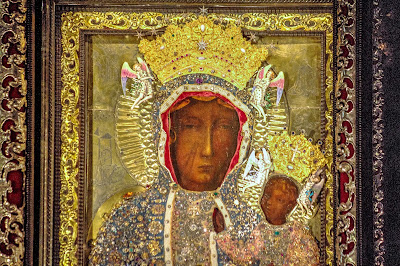
The Black Madonna of Częstochowa with crown (Photo Robert Drózd)
Paweł's own religion is important to him, a Roman Catholic born in Częstochowa which is notable for its famous Jasna Góra Monastery with its image of the Black Madonna of Częstochowa, whom Paweł refers to as the Queen of Poland, a religious image of the Virgin as famous in Poland as those of Lourdes in France and Fatima in Portugal. Paweł was born just a mile from the monastery and lived there until he left for Warsaw in 1987 to pursue his studies.

He has had a strong relationship with the church and was a member of the choir of the Academy of Catholic Theology in Warsaw, a choir which gave a number of first performances including Henryk Górecki's motet Totus Tuus written for the visit of Pope John Paul I to Poland and which the choir (including Paweł) premiered at the airport for the Pope's arrival. In complete contrast, Paweł notes that there is a fantastic recording of the motet by the Kings Singers.

Henryk Mikołaj Górecki (1933-2010) is one of Paweł's notable predecessors; Paweł notes that Górecki did not write a lot of Latin sacred music, though there are some big titles such as Beatus Vir and Miserere. But it isn't just this variety in output which reflects the difference between the two composers, Paweł feels that he composes with a bigger difference in harmony and melody to Górecki.

Paweł adds that he takes inspiration from a lot of sources, not just the music of his great predecessors, and Gothic architecture is one notable inspiration, particularly cathedrals such as the one in Rouen. But writing sacred choral music, Paweł is aware of his big relationship with the music of great masters of the past.

Friday, 4 May 2018

Never miss another review

Get Planet Hugill in your inbox each month - sign up to our mailing list and receive our monthly newsletter :-

#LoveOpera

This weekend (4-6 May 2018) is the third #LoveOpera weekend when Twitter users are asked to use the #LoveOpera tag to celebrate opera and music theatre. This year the Opera and Music Theatre Forum (OMTF) is asking the sector – how are we communicating, developing, recreating or subverting opera traditions? The weekend is part of the European Opera Days involving companies from 20 countries which run from May 4 – May 12 and this year are focusing on cultural heritage.

To take part, use the hashtags #loveopera or #LoveOpera (OMTF) and #operadays (Opera Europa)

Sonorous debut: Neil Ferris & Sonoro in Frank Martin & James MacMIllan

Passion and Polypony - Sonoro, Neil Ferris - Resonus Classics
Frank Martin Mass for double choir, James MacMillan Miserere & motets; Sonoro, Neil Ferris; Resonus Classics
Reviewed by Robert Hugill on 24 April 2018 Star rating: 4.0 (★★★★)
Bucking the trend, debut recording from a choir which sings with great vibrancy of tone

It sometimes seems as if London might have a finite pool of professional singers, with familiar faces cropping up in a variety of different ensembles. But the combination of conductor and a particular line-up of personnel can create striking differences [see my interview with Suzi Digby for an interesting discussion on this subject].

The choir Sonoro (made up of 20 professional singers), conducted by Neil Ferris, with the explicit intention of creating a very particular sound quality. As might be expected from its name, Sonoro is designed to have a rather more sonorous sound quality with a greater use of vibrato.


This is Sonoro's debut disc, on the Resonus Classics label, under Neil Ferris's direction they perform a programme of music by James MacMillan and Frank Martin, pairing Martin's 1922 Mass for Double Choir with seven of MacMillan's sacred pieces including his large-scale Miserere. It is an interesting, and perhaps surprising, pairing yet it works because the two composers owe an inspiration to polyphony with each brings his own distinctive twist to the mix.

The Martin mass is given in a big, vibrant performance with some vividly created textures and tonal colourings. But that is not to say that subtlety is lacking, and the smaller scale sections with just one or two voices created moments of beauty and calm. The use of such vibrant individual voices requires careful blending in the choir, and this Ferris does superbly whilst urging his singers to a passionate, sometimes almost operatic articulation of the passion of the music. But this contrasts finely with the intense feeling of control, these singers known when let go and when not to.

Vale of Glamorgan Festival reaches the 50th festival

Penarth Pier Pavilion (Photo Ben Salter - from Flickr)
Penarth Pier Pavilion (Photo Ben Salter - From Flickr)
This year's Vale of Glamorgan Festival, which runs from 9 to 16 May 2018 is the 50th festival, a milestone indeed. The festival was founded by composer John Metcalf and is unique in the UK, being devoted entirely to the music of living composers.

This year will see performances of works by 21 composers from across the world. Particular themes include an exploration of the music of the Danish composer Bent Sørensen who celebrates his 60th birthday this year, the European premiere of a major new work by the Chinese composer Qigang Chen performed by BBC National Orchestra and Chorus of Wales, and world and UK premieres of works by four Welsh composers: John Metcalf, Helen Woods, Matthew Jones and David Roche.

Works by Bent Sørensen will be featured across the festival, beginning with his 2013 Trumpet Concerto performed by Philippe Schartz and BBC National Orchestra of Wales at BBC Hoddinott Hall on Thursday 10 May at 7.30pm, and the same concert will include the the European premiere of Qigang Chen's Jiang Tcheng Tse, the result of a pan global joint commission by the China National Centre for the Performing Arts, Sydney Symphony Orchestra, BBC National Orchestra and Chorus of Wales and Vale of Glamorgan Festival  Written for solo voice (soloist Meng Meng), chorus and orchestra, the work is based on the texts of 11th century Chinese poet Su Shi.

The festival takes place at venues across the Vale of Glamorgan and Cardiff, each chosen for their setting and atmosphere, including Penarth Pier Pavilion, Ewenny Priory, BBC Hoddinott Hall and St David’s Hall.

Full details from the Vale of Glamorgan festival website.

Thursday, 3 May 2018

Gilbert and Cellier - The Mountebanks

The Mountebanks - John Andrews, BBC Concert Orchestra - Dutton
Gilbert & Cellier The Mountebanks; Soraya Mafi, Thomas Elwin, James Cleverton, Sharon Carty, John-Colyn Gyeantey, Catherine Carby, John Savournin, Geoffrey Dolton, BBC Singers, BBC Concert Orchestra, John Andrews; Dutton
Reviewed by Robert Hugill on 30 Apr 2018 Star rating: 4.0 (★★★★)
Gilbert without Sullivan, yet a work of real musical personality

W.S. Gilbert, in his librettos, rather liked using a device to turn everything upside-down to provide a topsy-turvey mirror to examine the mores of society, and three times he offered to Arthur Sullivan a libretto which Sullivan referred to as the 'lozenge plot'. Sullivan found such devices, which they had used in The Sorcerer, rather unsatisfactory and refused to set the libretto thus forcing Gilbert to search elsewhere, and the result was Iolanthe, The Mikado and The Yeomen of the Guard, where the topsy-turveydom is handled in a more imaginative manner.

But Gilbert never let go of his lozenge libretto and following the break with Sullivan would try other composers. The result was The Mountebanks, written with the composer Alfred Cellier and premiered in 1892. The complete recording of The Mountebanks has been made possible by the re-discovery of Cellier's score (which had gone missing). On this two-disc set from Dutton Vocalion, John Andrews conducts the BBC Concert Orchestra with a strong cast, Soraya Mafi, Thomas Elwin, James Cleverton, Sharon Carty, John-Colyn Gyeantey, Catherine Carby, John Savournin, Geoffrey Dolton, Madeleine Shaw and Martin Lamb, with the BBC Singers.

Cellier was a theatre composer with a number of other theatrical works to his name, as well as becoming music director for the D'Oyly Carte company. The Mountebanks is clearly in the Sullivan-style but with a definite sense of a different musical personality. Cellier has a great melodic gift, without perhaps hitting the real highs as some of Sullivan's melodies are capable, but then again we have had Sullivan's hits playing to us regularly since they were premiered whereas Cellier's music has all but disappeared.

There is, in fact, a delightful freshness to Cellier's writing and a very distinct sense to his orchestration. In some ways, his orchestral writing seems a little more varied than Sullivan's, or perhaps that is just because of the novelty. Certainly, the disc makes lovely listening.

Celebrating David Matthews

David Matthews
David Matthews
To celebrate the composer David Matthews (who is 75 this year), two ensembles are creating a year long festival, David Matthews in the Heart of England. The Worcester-based English Symphony Orchestra and the Stratford-upon-Avon-based Orchestra of the Swan, both under conductor Kenneth Woods, are joining forces with musicians, venues and festivals across the region to celebrate David Matthews.

The project opens on Wednesday 9 May 2018 at St George’s Bristol when the English Symphony Orchestra (ESO) gives the World Premiere of Matthews’ Ninth Symphony as the second work in the orchestra’s ‘21st Century Symphony Project’. The premiere of Matthews’ Ninth also sees him becoming the ‘John McCabe Composer-in-Association’ at the ESO, succeeding Philip Sawyers, who becomes Composer Laureate. Matthews’ Ninth Symphony, which is being recorded for Nimbus, is a thirty-minute work in five movements which grew out of a short Advent carol Matthews wrote for his wife Jennifer.

On 2 June 2018, Matthews will be Visiting Composer at the new Elgar Festival in Worcester. There will be performances Matthews’ Sixth String Quartet and the premiere of his new quartet arrangement of Elgar’s Sospiri in the afternoon concert and Matthews’ orchestration of the Elgar String Quartet performed by the ESO in the evening. In between, Matthews presents the bi-annual A. T. Shaw Lecture, entitled ‘Elgar’s Voice’, presented by the Elgar Society and the Elgar Festival.

In Autumn 2018, ESO will be performing and recording Matthews' Double Concerto for Violin, Viola and Strings, and his Variations for Strings. Then in 2019 the project moves to Stratford-upon-Avon ArtsHouse and the Royal Birmingham Conservatoire for concerts by the Orchestra of the Swan (OOTS), including Matthews’ Winter Remembered for Viola and Strings, and his new song cycle Le lac based on poetry of Alphonse de Lamartine (with soprano April Fredrick)

Wednesday, 2 May 2018

Vivica Genaux & Sonia Prina recreate the music sung by two great castratos at the Wigmore Hall

Senesino & Farinelli
Handel, Bononcini, Hasse, Porpora, Giacomelli, Ariosti, Torri, Gasparini, Lotti; Sonia Prina, Vivica Genaux, Concerto Copenhagen, Lars Ulrik Mortensen; Wigmore Hall
Reviewed by Robert Hugill on 1 May 2018 Star rating: 4.0 (★★★★)
Rare repertoire in a concert focused on Senesino and Farinelli

Take pair of star singers, a distinguished early music group and a programme of Baroque arias and you usually have a standard recipe for a quick canter through some good old favourites. But clearly Sonia Prina, Vivica Genaux and Concerto Copenhagen, director Lars Ulrik Mortensen thought rather differently about programming as their concert at the Wigmore Hall on Tuesday 1 May 2018 was full of unusual delights with music by Handel, or course, but also Porpora, Giacomelli, Bononcini, Ariosti, Hasse, Lotti, Torri and Gasparini. Whilst there were familiar items, many were completely unfamiliar; the link between them all was the pairing of the star castratos Farinelli and Senesino.

Senesino sang around 18 roles for Handel,as well as appearing in other composer's works during the London seasons. The rather younger Farinelli managed to avoid performing Handel's company (it rather seems deliberate, there are tales of him keeping Handel waiting), and when he did come to London to sing for a rival company the results were a sensation.

The programme concentrated mainly on the 1720s with operas the two could have sung in London but many have disappeared into the mists of time. Who has now heard of Porpora's Eliza, Giacomelli's Scipione in Cartagine Nuova and Gianuir, Bononcini's Astarte, Ariosti's Vespasioano,  Hasse's Siroe re di Persio, Lotti's Ascanio and Giove in Argo, Torri's Nicomede and Gasparini's Eumene, but there was certainly plenty of music worth exploring.

Popular Posts this month
