Franco Alfano: Songs; Anna Pirozzi, Emma Abbate, Bozidar Vukotic; Resonus Classics Reviewed 28 November 2023
Alfano's rather dim reputation as a 20th century opera composer does not prepare you for the surprisingly rich and rewarding sound-world of his songs
You cannot help but feel that the Italian composer Franco Alfano (1876-1954) has received a poor deal from musical history. Despite his 1904 opera, Risurrezione, retaining a toe-hold in the repertoire, Alfano remains best known as the man who completed Puccini's Turandot, yet the completion of the opera that we commonly hear today was heavily revised by the conductor Arturo Toscanini, and Alfano's original rarely gets an outing.
This disc from soprano Anna Pirozzi and pianist Emma Abbate with cellist Bozidar Vukotic on Resonus Classics takes a different look at Alfano, featuring a programme of his songs, from his Cinq mélodies, written when he was a 21-year-old student at the Leipzig Conservatoire right through to Due liriche per canto, violoncello e pianoforte from 1949.
Emma Abbate seems to be making something of a project of reviving unjustly neglected 20th century Italian song and previous on Resonus she has released discs of Ildebrando Pizzetti's songs with Hanna Hipp [see my review] and Mario Castelnuovo-Tedesco's settings of Shakespeare's sonnets with Ashley Riches [see my review]. This disc reveals another, rather striking Italian 20th-century voice.
The musical life of King George III and Queen Charlotte does not seem promising for an evening's entertainment at first, but the two were highly cultured with music playing a big role in their private and public lives. Ensemble Hesperi's 2022 project, Then I play'd upon the Harpsichord interwove music of the period with diary entries from the period. At a performance at Six Fitzroy Square, Ensemble Hesperi, Mary-Jannet Leith (recorders), Magdalena Loth-Hill (Baroque violin), Miriam Kazcor (Baroque flute), Florence Petit (Baroque cello), Elias Sibley (theorbo/guitar) and Thomas Allery (harpsichord), were joined by Rowan Pierce (soprano), Nathaniel Mander (fortepiano) and actor Miranda Keeling, when the evening was filmed, and the resulting film is available from Ensemble Hesperi's website.
Metanoia - Ensemble K & Simone Menezes at Milan Cathedral (Photo Maxime Patrick Hans Chatillon)
In Christian theology, metanoia is commonly understood as "a transformative change of heart, especially a spiritual conversion". But what does it mean in a musical context? The conductor Simone Menezes has recently produced a film, Metanoia, with her Ensemble K and Emmy-winning film director Paul Smaczny, described as a celebration of the power of beauty which invites the viewer to contemplate the question of transcendence.
When I ask what the film is about, Simone laughs and says that the subject was so complicated that she had to make a film about it to answer the question. The project simply began as a concert at Milan Cathedral where she wanted to bring an element of introspection and contemplation to the programme. The music was to include Puccini's Messa di Gloria, the Sarabande from Bach's Violin Partita No. 1 in B minor and Villa Lobos' Prelude from Bachianas Brasileiros No. 4, also in B minor. But things happened, COVID happened, the dates changed. Also, she became interested in the question of what do some composers have, that they can make magic. What happens in music that makes it go beyond intellect and makes something transcendent.
It was this issue of thinking about transcendence which led to the film, which is set in Italy where the Renaissance was created. She wanted to open the discussion to include other arts and philosophy, to ask the question what is transcendence in both art and music. In order to give the concert in Milan Cathedral, the authorities had wanted them to perform just sacred music, which led to the question what was sacred music? But it helped that metanoia, which Simone translates as beyond intellect, a way of seeing the world beyond the intellect, also has the theological meaning described above.
Metanoia - Ensemble K & Simone Menezes at Milan Cathedral (Photo Maxime Patrick Hans Chatillon)
For the film, they included the music from the concert, Puccini, Bach and Villa Lobos, and alongside put Arvo Pärt's In Spe. Simone also wanted to include an element of dance and so included Borodin's Polovtsian Dances which Ensemble K performed on their Accents disc [see my review]. There was also a small homage to Ennio Morricone, the film composer who died whilst the film was being planned.
In the film, each piece of music is performed in a different place, and each has an associated philosophical discussion, and Simone describes it as a series of tableaux. Among those appearing in the film are the conductor Antonio Pappano, the painter Michael Triegel, a Jesuit father, Father Alessandro, the director of the Michelangelo Foundation, Alberto Cavalli and the choreographer Valerio Longo,
By including a philosophical element, the intention was to replace a musicological/historical approach to the music with a philosophical one. She also wanted to bring music into a broader context, alongside other arts. The film tries to examine what is special about art and music, but in a non-academic way using simple language. It asks what is essential and tries to show that art is essential.
The film's director, Paul Smaczny is known for his musical films include a documentary about Daniel Barenboim and the first film about El Sistema. Simone says that Smaczny has a wonderful team behind him, and she feels that the photography in the film is a work of art in itself.
This month, Simone and Ensemble K will be performing their Metanoia programme in London, for an invited audience and looking ahead there are concerts in Paris and USA. She wants the film to have a life, and it will be on Medici TV and is available on Vimeo on demand, you can also buy the DVD or Blu-ray (on Accentus) whilst the associated CD from Accentus has also developed a life of its own.
Simone is also still working on her Amazon project with photographer Sebastiao Selgado (based around Villa Lobos' Floresta do Amazonas and Philip Glass' Aguas da Amazonas) with concerts planned in Madrid, Zurich and Brussels. And with Ensemble K, she is just finishing a project based around Holst's The Planets orchestrated by George Morton.
The Spanish ensemble El Gran Teatro del Mundo specializes in the performance of music from the 17th and 18th century. Named after the Baroque mystery play of the same name from 1655 by the Spanish poet Pedro Calderón de la Barca, the idea of single protagonists as representatives of the existential human conditions in the theatrum mundi also represents the aesthetic concept of the ensemble. Recent winners of the Diapason d’Or for their first album Die Lullisten, the ensemble won the Cambridge Early Music Prize at the York Early Music International Young Artists Competition in 2019.
El Gran Teatro del Mundo is now about to embark on its first UK tour from 14 to 20 November 2022. Promoted by the National Centre for Early Music and supported by the Creative Europe EEEmerging+ programme and The Ministry of Culture of Spain through the (INAEM), The National Institute for Performing Arts and Music, the tour will take the ensemble to St John’s Smith Square, London (14/11/2022); Turner Sims Concert Hall, University of Southampton (15/11/2022); Cambridge Early Music (16/11/2022), Lakeside Arts, Nottingham (17/11/2022); St George’s Bristol (18/11/2022); National Centre for Early Music (20/11/2022)
For the tour, the six-piece ensemble (violin, recorders, oboe, cello, archlute, harpsichord) will celebrate the musical genius of Vivaldi, Telemann and Fasch in a programme entitled The Art of Conversation.
Scott Wollschleger: Outside Only Sound; Anne Leilehua Lanzilotti : with eyes the color of time; String Orchestra of Brooklyn, Eli Spindel; New Focus Recordings 26 August 2022 (★★★★)
One work delayed by lockdown, the other created specifically for lockdown conditions, yet both display a dazzling use of texture and timbre with vividly imaginative use of a contemporary string orchestra
This new disc from the String Orchestra of Brooklyn features two works written specifically for the orchestra, one takes us to a day in October 2020, to the height of Lockdown in New York when the orchestra played outside, the other takes us to the day in 1980 when the first contemporary art museum opened in Honolulu.
At the height of the 2020 lockdown in New York, indoor concerts were cancelled and even having an orchestra rehearsing together was problematic. The String Orchestra of Brooklyn's solution was to commission work specifically tailored to the needs of the moment, out of doors performances and minimal rehearsal. One of the results was Scott Wollschleger's Outside Only Sound for strings and percussion. On enfolding, their new disc from New Focus Recordings, the String Orchestra of Brooklyn, conductor Eli Spindel, performs Scott Wollschleger's Outside Only Sound with one of the works that were due to be premiered at cancelled performances in 2020, Anne Leilehua Lanzilotti’s with eyes the color of time.
Wollschleger’s solution to the orchestra's commission for 2020 was "to structure music material in which each player was like a single cicada and there was never a need for a conductor. Instead, each player used a stopwatch and functioned as one of a group of insects in a field, or like a gaseous cloud of sound." The recording is intensely atmospheric and we hear an extended sequence of ambient sounds, with remarkable clarity, before the music starts. And it starts gradually, as if arising from the ambient, the situation creating the art. Wollschleger writes for string orchestra and six percussionists, who bow a variety of large metal mixing bowls, but the orchestral players themselves play a series of small bells, thus creating an element of fairy magic in this remarkable cloud.
Francesco Pirrone is an award-winning composer of fantasy music and was recently awarded the Premio Troisi 2022 for his activity as an up-and-coming media composer. Following on from his previous two releases, Beyond the Portal and The Forbidden Path, he has a new single out in a similar vein, The Hero. And he describes his work as being inspired by film soundtracks, epic metal and cinematic music.
i bērzs, i smilgas... (and a birch and grasses...) - songs by Emils Melngailis, Kristaps Pētersons; Ieva Parša, Andrejs Osokins; SKANI Reviewed 7 June 2022, (★★★½)
Best known as a folklorist and writer of choral music, Latvian composer Emils Melngailis was an early supporter of Mussorgsky, and this new disc pairs his intriguing songs with those of a younger generation Latvian composer
Emils Melngailis was a Latvian composer and folklorist, perhaps best known for his choral music and his involvement with the Latvian Song and Dance Festival. A new disc from Latvian label Skani, i bērzs, i smilgas... (and a birch and grasses...) brings out another side to the composer as mezzo-soprano Ieva Parša and pianist Andrejs Osokins perform a selection of songs by Emils Melngailis alongside music by contemporary composer Kristaps Pētersons.
Emils Melngailis is an intriguing figure. Born in Latvia (then part of the Russian Empire), he studied at the St Petersburg Conservatory. But as a student Melngailis came into conflict with his teacher Rimsky Korsakov as Melngailis condemned the way Rimsky Korsakov was adjusting (correcting) Mussorgsky's harmonic language in his ground-breaking edition of Mussorgsky's Boris Godunov. As a result Melngailis had to leave the conservatory and complete his studies privately. At the time, Mussorgsky's original orchestration was considered lost, and Melngailis would premiere his own orchestration in Riga in 1924, attempting to return the work to something like what the composer intended.
So, whilst folk-music and folk-idioms play a strong role in Melngailis' songs, there are also other elements. Some songs seem to shade into a style which is not that remote from folk-influenced English song of the early 20th century (and of course Melngailis belonged to the same generation as composers such as RVW). But whilst, the folk melodies weave their way around, it is often the words that we notice. Some are traditional but many are not, and clearly for Melngailis the words and the Latvian language are important.
Dario Salvi and I have finished the first draft of our new operetta, Ademdai - or the Necessary and the Superfluous, and to celebrate Dario has produced this fun little video [on YouTube], pairing music from the beginning of the opera (in a computer synthesisation) with a charming old cartoon. Our story is based on one from The Thousand and One Nights, based on a story by the Austrian dramatist Ignaz Castelli (1781-1862).
Our operetta is in two acts with five solo roles (Scheherazade - spoken, Ademdai - tenor, Caliph - baritone, Jaffar - bass-baritone, Naima - soprano), chorus and orchestra and follows the adventures of our hero Ademdai, a poor young man from Baghdad who wishes nothing more than what is essential for his simple life!
The score includes pantomime, melodrama, narration and dance episodes alongside songs and ensembles, with plenty of good tunes. Find out more on my website.
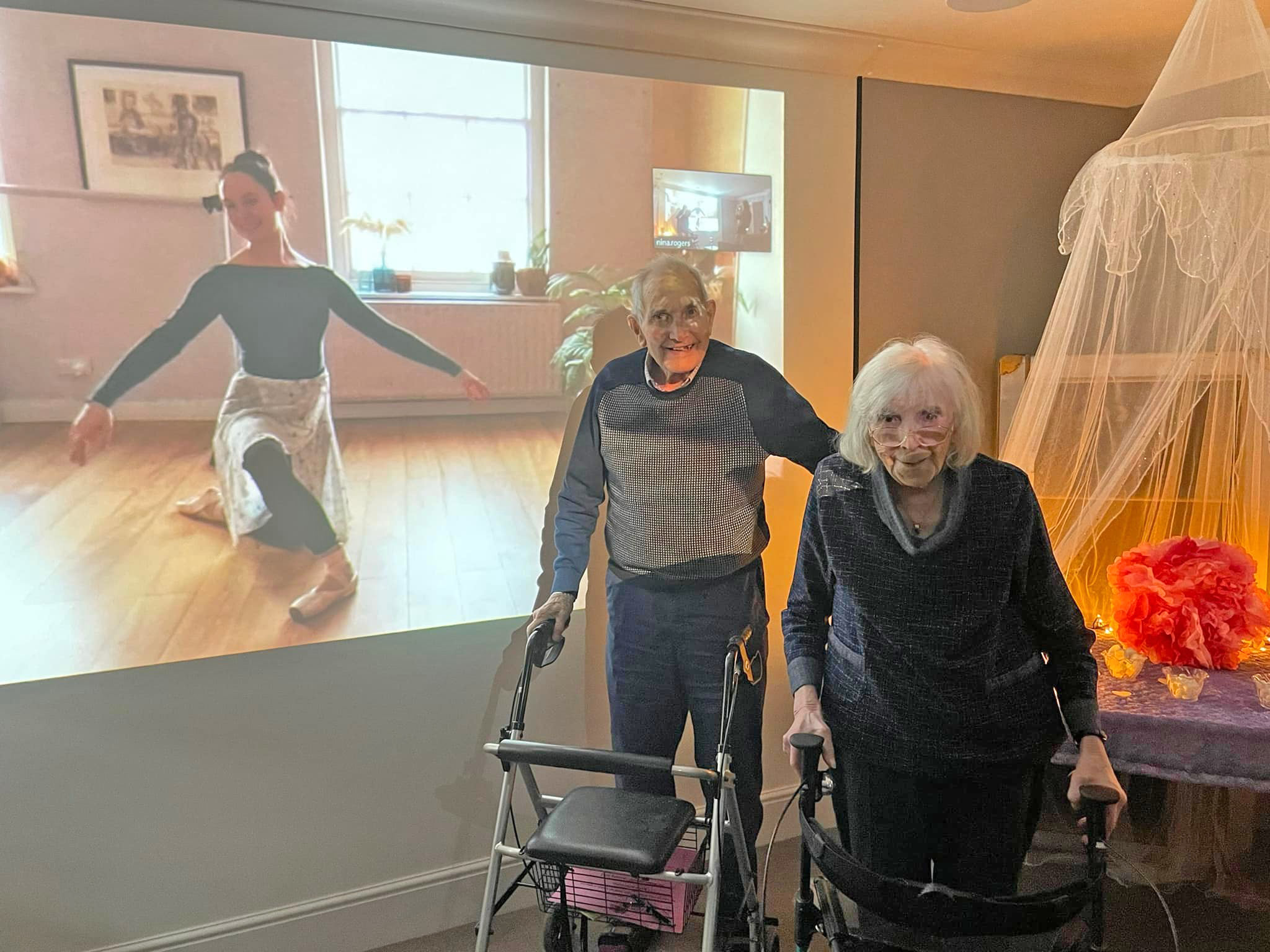
During the first weeks of the pandemic, in 2020, Leo Geyer (artistic director of Constella OperaBallet) was chatting to his grandmother via Zoom and decided to play his bassoon for her to cheer her up. From this small seed grew Constella's Connecting Stars project where they provide live, virtual, interactive performances for residents in over 100 care homes, bringing high-quality performances to elderly and disabled care home residents, many of whom are still isolated. And the project has brought nearly nearly a thousand music and dance performances to people in care homes across the UK, and is set to continue in the future.
Leo said:
"Virtual technology makes it possible to bring brilliant musicians and dancers to people who wouldn’t otherwise be able to benefit from such top-quality performances. Although it was our response to the exceptional situation at the time, it has become apparent that this is a successful model for the future."
"As well as watching a performance which has been specially tailored for the audience, the care home residents have the opportunity to chat to our artists and make requests, as well as join performances with clapping, singing and even dancing"
The scheme has been expanded from care homes for the elderly to include to include disabled people and others who are isolated due to health conditions. Care home residents have watched performances from artists who work with the Royal Opera House, the National Theatre and Glyndebourne, including mezzo-soprano Rachel Maby, clarinettist Antanas Makštutis, violinists Henry Rankin and Philippa Mo, accordionist Ilona Suomalainen, and dancer Alice Oakley-Jones.
The use of Zoom means that the artists can perform from their own home or other convenient venue, thus making the performances more economically viable. Connecting Stars performances are currently free, thanks to funding from Arts Council England, and can be booked via Constella’s website. To continue providing free performances, the company has launched a donations campaign
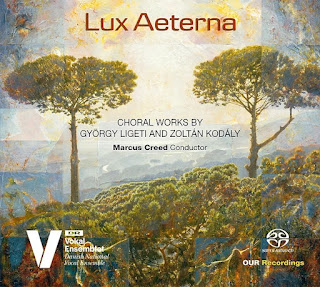
Lux Aeterna - choral music by György Ligeti and Zoltán Kodály; Danish National Vocal Ensemble, Marcus Creed; Our Recordings
Reviewed by Robert Hugill on 16 March 2022 Star rating: 4.0 (★★★★) The striking juxtaposition of two major 20th century Hungarian voices, completely different in style but arising from the same background, in stunning performances
You don't tend to think of György Ligeti and Zoltán Kodály though both were Hungarian and effectively came from the same musical background.
A striking new recording, Lux Aeterna, from Marcus Creed and the Danish National Vocal Ensemble on Our Recordings places music by the two composers side by side with Kodály's Matra Pictures and two shorter pieces alongside Ligeti's Lux Aeterna and Drei Phantasien nach Friedrich Hölderlin plus works that he wrote whilst still in Hungary in the 1950s.
Kodály was amongst Ligeti's teachers at the Franz Liszt Academy in Budapest, afterwards Kodály tried to get Ligeti interested in his ethnomusicological research, but this failed and Ligeti was appointed a teacher of harmony, counterpoint and musical analysis at the academy. Until Ligeti fled to the West in 1956, his knowledge of contemporary Western classical music was limited, though Ligeti did manage to have some modern music sent from Vienna and when he came to the West he was clear where his interests lay, he wanted to explore this new world. The relationship between the two composers was a somewhat tricky one, the Hungary of 1940s and 1950s was very different, culturally and politically, to place where Kodály grew up, and the age difference also caused problems.
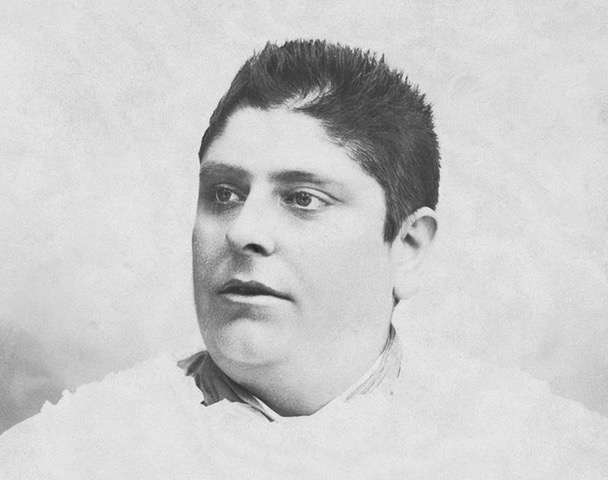
The British-Swiss director Max Hoehn created Opera21 last year. A response to the pandemic, the new company aimed to offer a laboratory for developing new works and is designed to support composers and the sector by offering a new commissioning model and using the website as a digital showcase for works-in-progress. One of the new works is The Last Castrato, an opera based on the life of the last castrato, Alessandro Moreschi, with a libretto by Max and music by the German composer Torsten Rasch. Torsten has written 18 minutes of music, and this has been recorded by countertenor Andrew Watts and soprano Rebecca Bottone, with CHROMA Ensemble conducted by Gerry Cornelius, and is available on Opera21's YouTube channel and the Opera21 website. And Max hopes this sample of the work can tempt producing partners to commission the full work from Torsten in the future. I recently spoke to Max and Torsten about the new project.
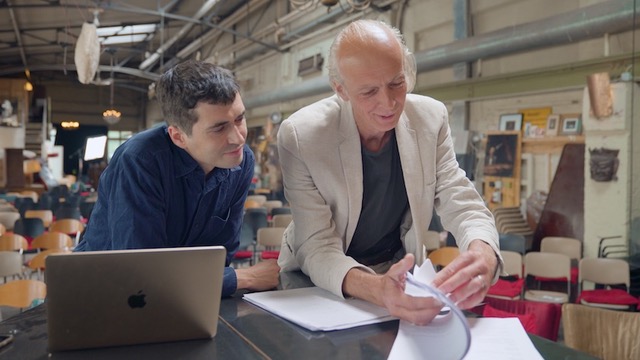
Max Hoehn and Torsten Rasch
Max's idea for Opera21 came directly out of two libretti that he was writing, but the idea also sprang from the pandemic. His thoughts were "what was useful for opera now?". He was thinking about contemporary opera, and despite a plethora of good composers, there is still quite a low hit rate with new operas. In Max's view, the problem often stems from the libretto. But also, the commissioning process is rarely artist-led and ideas for operas frequently arise with the commissioners, the intendants rather than with the artists. The Last Castrato is not Opera21's only project, they are also planning a new piece which will be digital, more of a radio opera, by Joe Cutler.
Torsten has written a number of operas, and many of these came about because people came to him with ideas. He has been very happy with the subjects so far, but he admits that it would be very hard to say no if he was genuinely not inspired by the subject, so he finds Max's ideas exciting. By writing 18 minutes of the opera and recording it, they have effectively created a pilot version of the work; this is common in television but less so in new opera and Max loves the music Torsten has written. They came together in London last year to create the recordings, despite restrictions.
On 22 February, Kamerorkest van het Noorden (the string orchestra based in Groningen, The Netherlands) is releasing SATARSA an EP that features SATARSA by the Ukrainian/Dutch composer Maxim Shalygin alongside Shalygin's string orchestra arrangement of music from Schnittke's Choir Concerto.
Shalygin's SATARSA is inspired by the writings of Argentine-French novelist Julio Cortázar (1914-1984) and his ingenious use of palindromes. The composer describes it thus:
"Palindromes in music are just as normal as the Fibonacci numbers in the structure of leaves on the trees. Therefore, when I read the story of Cortazar "Satarsa", I immediately felt the mysterious musical current in it. Surprisingly, for more than 15 years, I periodically return to his unusually rich work and find sources of inspiration for myself. My SATARSA is a desert of pleasure. A desert with gardens of paradise, crooked mirrors and an endless horizon, from which the melodies of our past lives are heard." - Maxim Shalygin
Shalygin (born in the Ukraine in 1985) started studying composition at the age of 16, and went on to study at the St Petersburg Conservatory and the National Music Academy in Kiev, then at the Royal Conservatory of The Hague (NL), where he studied with Cornelis de Bondt and Diderik Wagenaar. Shalygin now lives in the Netherlands.
The orchestra is a relatively new professional, young, international and dynamic ensemble founded by Guillem Cabré Salagre (violinist and violist) and Teodora Nedyalkova (cellist) in 2016 and based in the city of Groningen, capital of the north of The Netherlands. The ensemble consists of 14 to 16 string players, including occasionally wind and percussion, working without a conductor and sharing the vision of an extended version of a string quartet. Emblematic of this belief is the collaboration with the Spanish ensemble, Cuarteto Quiroga.
Kamerorkest van het Noorden & Maxim Shalygin
The EP is released on all major streaming platforms on 22 February 2022, further information from the orchestra's website.
Ryan Summers is a musician based in Marshfield, Wisconsin. His album, Deeply Divided, is his latest instrumental release, and it blends his musical first love, the piano, with an arsenal of modern synthesizers. Written during the 2020 pandemic chaos, he intends the music to serve as a metaphor reflecting the divided reality we now face. The video we feature is the last track from the album, Unplanned Escape, available on YouTube.
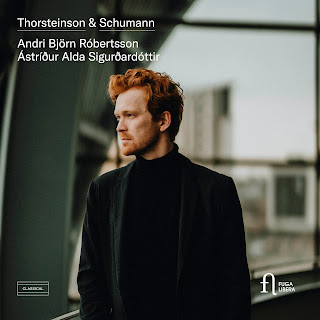
Robert Schumann Liederkreis Op. 24 & Op. 39, Árni Thorsteinson songs; Andri Björn Róbertsson, Ástríður Alda Sigurðardóttir; Fuga Libera
Reviewed by Robert Hugill on 17 December 2021 Star rating: 4.0 (★★★★) Schumann combined with the Icelandic composer Árni Thorsteinson in this darkly poetic and highly imaginative disc
Robert Schumann's Liederkreis Op. 24 and Op. 39 are two of the astonishing products of his year of song, 1840.
On this disc from Icelandic bass-baritone Andri Björn Róbertsson and pianist Ástríður Alda Sigurðardóttir on the Fuga Libera label, Schumann's Liederkreis Op. 24 (setting poetry by Heinrich Heine) and Liederkreis Op. 39 (setting poetry by Joseph von Eichendorff) are paired with a selection of songs by the Icelandic composer Árni Thorsteinson.
Schumann would turn to Heine both for the Liederkreis Op. 24 and for Dichterliebe Op 48; the poet's extremes of elation and despair, mingled sentimentality, self-pity and ironic self-mockery, drew a strong response from Schumann. Liederkreis Op. 24 comes first, to be followed by the other great cycles, Myrthen, Liederkreis, Op. 39, Frauenliebe und -leben and Dichterliebe. The nine poems have a clear thematic and narrative sense, though Schumann's title (Circle of Songs) is rather abstract. The love affairs that inspired Heine's poems were all blighted, and Schumann's music is gentler than one might expect from text (the composer would similarly smooth Heine's bitter irony in Dichterliebe). But we should remember that though 1840 culminated in his marriage to Clara, success was not obvious and much of the music from the year alternates between elation and despair.
The pianist AyseDeniz Gokcin is continuing her mission to bring the worlds of classical music and rock together and has joined forces with actor Leo Roberts to produce a cover of the latest James Bond song, Billie Eilish's No time to die, which is included on their latest EP [link tree].
There is a chance to hear AyseDeniz and Leo together at a concert on 17 December 2021, at St James's Sussex Gardens, London, a Christmas special mixing music from the movies to musicals, all with an operatic twist. Full details from EventBrite.
David Yardley The Lost Codex of Avalon; David Yardley, The Song Company, Sydney Chamber Choir, Sam Allchurch, Jess Ciampa, Pastance, Cristina Alís Raurich; Talisman
Reviewed by Robert Hugill on 1 November 2021 Star rating: 3.5 (★★★½) An intriguing mix of old and new as the Australian composer/performer David Yardley weaves old-style modern music around a mix of ancient and modern texts evoking the world of King Arthur
If you go to the website Australian government's Department of Foreign Affairs and Trade, there is a page for Mr David Yardley, currently High Commissioner to Kiribati and previously Counsellor at Australia’s Mission to the United Nations, New York. But David Yardley has a parallel career as musician and composer, mixing a love of Medieval and Renaissance music with a love of fantasy stories. His first disc was New Carols and Songs For Chaucer’s Pilgrims, taking existing texts which survive without music and giving them giving them an historically-informed vehicle to sing again.
With his latest disc, The Lost Codex of Avalon, David Yardley has taken a mix of Medieval and modern texts and created a new/old sound-world to evoke that of the Arthur of Sir Thomas Malory's 1485 poetic epic, Le Morte d'Arthur. Yardley sings to his own accompaniment on Medieval harp whilst other pieces are performed by The Song Company, Sydney Chamber Choir, conductor Sam Allchurch, period ensemble Pastance, percussionist Jess Ciampa, medieval keyboard player Cristina Alís Raurich. The texts move between Medieval ones which survive without their original music and more contemporary pieces by Anne Casey, Monique Bouchard, FC Leverett, and Clark Ashton Smith.
David Yardley
As something of a prelude, the disc begins with Yardley accompanying himself on the harp in a setting of words by the troubadour (and later a lawyer) Peire de Lunel (fl.1326-1384) in which the poet laments the plague of 1348, but with music written by Yardley in another plague year, 2020. The musical style is completely traditional, and to my relatively untutored ear, sounds both convincing and evocative.
Opera Lab Berlin is an independent free-form ensemble "dedicated to creating interdisciplinary music theatre that is tightly bound to its contemporary surroundings". One of the projects it launched last year was Im Feld, a series that that brings together a composer, a director, and a small ensemble in Berlin’s Acker Stadt Palast for one week, providing an open space for the creation of a new experimental production where artistic creativity can meet open-minded, curious audiences.
Now, we can get a chance to experience Opera Lab Berlin's work on-line as it launches Who's Afraid of Pop Culture? Starting on 29 October 2021, a new music video will premiere each week for five weeks on Opera Lab Berlin's YouTube channel.
Each film will be based around a pop classic, re-invented as opera with cinematic treatments that are designed to be as important as the music. Five directors were chosen to shoot in strategic, decidedly “non-operatic” locations in Berlin. The resulting films evoke drama and intrigue with lysergic visual treatments.
The idea of the composer / creator is an old one and whilst the concept has a great deal of resonance today with many young contemporary composers, the role of composer / pianist is one which still holds an aura of the past, from Liszt through Grainger to more recent names such as Ronald Stevenson.
The young Argentinian pianist and composer, Uriel Pascucci is one who combines a pianistic career with that of composer, performing both his own and other composers' music. With his latest album on iMD-Classics, Pascucci wants to bring back an approach of interpreter and creator, and the disc combines Beethoven's Piano Sonata no. 30 in E major and Mussorgsky's Pictures at an Exhibition with his own Prelude, Tango and Fugue. [Link tree]
If you are interested in sampling Pascucci's pianistic talents further, then I can recommend his YouTube video of him performing his own transcription of Astor Piazzolla's Invierno Porteño.
Composer Graham Fitkin pictured on the original album cover his 1990 album, Flak
Graham Fitkin's album Flak was originally released in 1990, his debut disc as composer and performer alongside pianists Eleanor Alberga, Errollyn Wallen and Shelagh Sutherland in what have become some of his classic works for multiple pianos. Popular at the time, the album has continued to be played and now Graham has released a new digitally re-mastered version created by Real World Studios' Tim Oliver. I recently caught up with Graham, from his studio in Cornwall, to talk about Flak, how the music and the album came about and how, 30 years on, he feels about the music.
The impetus for the new, digital release, was partly that the album has never been available online, if you wanted to listen to it you had to buy a CD (or a cassette), and this rather bothered Graham who is still fond of the album. The second reason for the project was to improve the sound quality of the original, to remove some aspects of the sound which he doesn't like (and has never liked). The original recording was made at Southfield Park with two grand pianos on a stage where the backdrop was breeze-block with no curtains. The result was a very live sound, with a distinct ping to the sound of the pianos coming off the concrete blocks. This was improved for the completed recording, but to Graham's ears there was still too much ping to the sound, and now he is pleased that Tim Oliver has been able to do something about it.
Graham Fitkin today
The disc is all music for piano, four pieces for four pianists at two pianos (Sciosophy, Flak, Untitled 11, There Is A Great Weight On My Head Tonight) and six pieces for solo piano (The Cone Gatherers, Piano Piece 90, From Yellow To Yellow, Piano Piece Early 89, Piano Piece Mid 89, Piano Piece Late 89), a reflection of Graham's fascination with the piano at the time. He loves the piano, he plays it and he likes the fact that you can get all the polyphony you want from one mono-timbral instrument; putting two or three pianos together seemed a good idea. The first time he came across multiple pianos was in Steve Reich's 1967 piece Piano Phase, a work that Graham still plays. And after exploring music for multiple pianos, Graham then looked at other instruments such as multiple saxophones and two harpsichords.
The young German trumpeter, Simon Höfele, has a new disc out on the Berlin Classics label. Titled New Standards, the disc features music for trumpet and piano by six significant 20th-century composers, Arthur Honegger (1892-1955), Karl Pilss (1902-1979), Georges Enescu (1881-1955), Paul Hindemith (1895-1963), Jean Françaix (1912-1997) and Alexander Arutjunjan (1920-2012) with pianist Elisabeth Brauß. The disc is a companion piece to Simon's first disc for Berlin Classics, Standards (released in early 2020), where he played the Haydn and Hummel trumpet concertos, along with the trumpet concerto by Arutjunjan and A Quiet City by Aaron Copland (1900-1990), accompanied by the BBC National Orchestra of Wales and the BBC Scottish Symphony Orchestra conducted by Duncan Ward (a testament to Simon's time as a BBC New Generation Artist). I caught up with Simon recently to find out more about the repertoire on his new disc.
Whilst not all the music on New Standards is well known and probably the names of two of the composers will be unfamiliar to many listeners, Simon explains that for a trumpeter these works are the core essentials of chamber music. Honegger, Enescu, Hindemith and Francaix are all established 20th-century figures, but the names of Karl Pilss and Alexander Arutjunjan are less well known. Arutjunjan was a Soviet Armenian composer who wrote both the Aria et Scherzo, which is on the disc, and a Trumpet Concerto [which is on the previous disc and is also on YouTube]. These were written for a major Russian trumpeter and the concerto is very much a virtuoso showpiece. Simon describes Arutjunjan's music as fantastic, and the Aria et Scherzo is in a style similar to, but not as strident as Hindemith's Sonata which is also on the disc. In fact, Simon describes Arutjunjan's Aria et Scherzo as refreshing, and adding that it is fun to play.
Elisabeth Brauß and Simon Höfele (Photo credit Michael Winkler)
The other lesser-known name is that of Karl Pilss (1902-1979), an Austrian composer who studied with Franz Schmidt (1874-1939). Pilss is a recent discovery for Simon.






.jpg)


