
Showing posts with label Gabrieli. Show all posts

Monday, 13 December 2021

A festive feast of Bach for Christmas: Gabrieli Consort & Players at Wigmore Hall

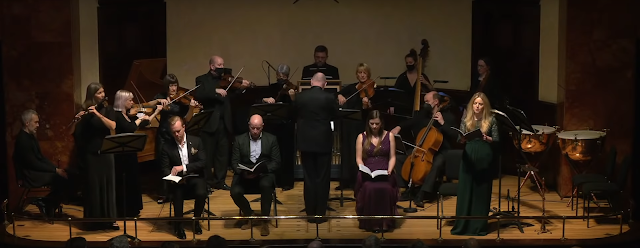
Bach: Süsser Trost, mein Jesus kommt BWV151 - Rowan Pierce, Morgan Pearse, Daniel Norman, Anna Harvey, Gabrieli Consort & Players, Paul McCreesh at Wigmore Hall
Bach: Süsser Trost, mein Jesus kommt BWV151 - Rowan Pierce, Morgan Pearse, Daniel Norman, Anna Harvey, Gabrieli Consort & Players, Paul McCreesh at Wigmore Hall (image taken from live-stream)

Bach Süsser Trost, mein Jesus kommt BWV151, Mass in G BWV236, Christen, ätzet diesen Tag BWV63; Gabrieli Consort & Players, Paul McCreesh; Wigmore Hall

Reviewed by Robert Hugill on 10 December 2021 Star rating: 5.0 (★★★★★)
The Gabrieli Consort & Players is sparkling form present a delightful selection of Bach's music for Christmas, from a mass re-using cantata movements to a festively grand cantata with four trumpets

In a suitably festive concert at Wigmore Hall on Friday 10 December 2021, Paul McCreesh and Gabrieli Consort & Players presented a programme of the music Bach wrote for Christmas services in Leipzig. Singers Rowan Pierce (soprano), Anna Harvey (alto), Daniel Norman (tenor, replacing Jeremy Budd at very short notice) and Morgan Pearse (bass) joined an instrumental ensemble including three oboes and four trumpets, performing the cantatas Süsser Trost, mein Jesus kommt BWV151 and Christen, ätzet diesen Tag BWV63, plus the Mass in G BWV236 and two organ solos.

Unlike in modern times, the Advent period in Bach's churches in Leipzig would have been anything but festive, the season was one of contemplation and penitence and music was austere. All this changed with the music for the Christmas period, running strictly from Christmas Day to Epiphany. And music played a significant role; services lasted around three hours with a sermon of about an hour and Bach's music lasted for an hour too, with pieces chosen or created to complement the theme of the sermon.

The concert began with William Whitehead playing an organ solo, the Allemande: Allegretto grazioso from Pastorale in F BWV590; lyrical and pastoral but with elaborate textures and contrapuntal lines.

For the third day of Christmas in 1725, Bach wrote his small-scale cantata Süsser Trost, mein Jesus kommt BWV151 for four soloists, flute, oboe and strings, with the vocal ensemble only being needed for the final chorale.  It is about the comfort that Jesus' birth brings, and though there are no explicit Nativity references the pastoral feel is significant. The gently lilting opening aria featured a lovely pastoral flute complementing Rowan Pierce's poised soprano, bringing out both the words and the sense of thoughtful joy. A vivid recitative from bass Morgan Pearse, led to the second aria for mezzo-soprano Anna Harvey. Here she and a solo oboe duetted vigorously, in a robust dance, Harvey's warm mellow sound complementing the rich timbre of the oboe. Tenor Daniel Norman's slower recitative led to the final choral with all four soloists and both wind players.

Bach's Cantata 169, featured an opening sinfonia which duplicates material from his Harpsichord Concerto in E major, though both are probably based on a lost oboe concerto. We heard the sinfonia, with the perky solo line played on the organ by William Whitehead, the whole being delightfully toe-tapping.

Luther allowed the use of Latin settings of the Kyrie and Gloria on major feasts, and such settings were used in Leipzig at Christmas (in Advent the Gloria was usually omitted), and Bach wrote several. His Missa brevis in G BWV236 dates from 1738 or 1739 is made up of music recycled from earlier cantatas, though whether from a shortage of time or simply a desire to not allow good music to go to waste, we don't know. Written for four soloists, strings and two oboes (one doubling oboe da caccia), the work features arias for tenor and bass plus a duet for soprano and alto. The Kyrie was a substantial, sober fugue, the instruments doubling the voices and adding brilliance and colour. The Gloria opened with a busy ensemble movement. This went with a swing, rich textures, full of character and enjoyment. Morgan Pearse sang the 'Gratias agimus' full of lilt and swagger, but with busy passagework too. 'Domine Deus' was a duet for Rowan Pierce and Anna Harvey, the voices flowing easily over a rhythmic violin line. Daniel Norman's aria 'Quoniam tu solus sanctus' was a duet with oboe, and the final 'Cum sancto spirito' moved from a stately introduction to a madly vigorous main section.

The second half opened with another organ solo, this time based on Luther's hymn Vom Himmel Hoch BWV701 and surprisingly perky with cascades of notes surrounding the basic melody.

In 1723, for Bach's first Christmas in Leipzig he re-used a cantata that he had written nine years earlier, for the court at Weimar. Christen, ätzet diesen Tag BWV63 has lavish scoring, three oboes (one doubling oboe da caccia) and four trumpets.  Its scoring very suitable to launch the Christmas celebrations, and with its reference to dance in clear sympathy with Luther's regard for dance. The trumpets only appear in the opening and closing choruses, and in between is a sequence of more intimate arias, duet and recitatives.

There was a joyful zest to the opening chorus, with the voices almost alternating with the orchestral ritornelli. This was followed by a striking slow accompanied recitative, where Anna Harvey's mellow voice was very expressive. Next came duet, for Rowan Pierce and Morgan Pearse; lyrical voices in a secular feeling not quite love duet, and a busy solo oboe wandering in and out. A dramatic recitative from Daniel Norman led to a duet between him and Anna Harvey; a piece with a lovely lilt to it sung with joyful enjoyment. A vivid accompanied recitative from Morgan Pearse led to the final chorus where the trumpets returned to striking effect.

The concert is available online at the Wigmore Hall website.


Never miss out on future posts by following us

The blog is free, but I'd be delighted if you were to show your appreciation by buying me a coffee.

Elsewhere on this blog

  • Dancing a pas de deux with Tchaikovsky and holidaying in North Africa: rumours swirled around Saint-Saens even before his death - feature
  • Being able to see Brahms as he was at the time: I chat to Jérémie Rhorer about recording historically informed Brahms with Le Cercle de l’Harmonie - interview
  • La Bonne Cuisine: Lotte Betts-Dean and Harry Rylance at Fidelio Cafe on OnJam Lounge - concert review
  • Christmas disc round-up: from Christmas Matins in Bavaria & Nine Lessons & Carols at King's College, Cambridge to festive brass from Canada & the Wexford Carols - record review
  • A story to tell: the new recording of Handel's Messiah from Eboracum Baroque - record review
  • Zest and energy: New Sussex Opera revives Offenbach's La princesse de Trébizonde - opera review
  • Grappling with the unknowable: James MacMillan's remarkable new Christmas Oratorio receives its UK premiere at the Southbank Centre - concert review
  • Written for London and his second most performed work, Leoncavallo's Zingari has fallen out of the repertoire but Opera Rara aims to change all that - opera review
  • We give a nod to contemporary music but don't relish it: conductor Zvonimir Hačko aims to change that with the founding of the International Centre for Contemporary Music - interview
  • Fiesta: the Autumn season of Dylan Perez' Re-Sung ends with an engaging evening of 20th-century Spanish song - concert review
  • Unsung Heroine: The Telling in music of Hildegard of Bingen and troubadour songs - record review
  • Virtuoso instrumental focus: in Handel's Unsung Heroes, David Bates & La Nuova Musica highlight Handel's brilliant instrumental solos in his arias - record review
  • Home

Friday, 1 November 2019

'The first great example of British exceptionalism' - Purcell's King Arthur re-thought in an engaging performance and accompany CDs from Paul McCreesh and Gabrieli

Purcell: King Arthur - Paul McCreesh & Gabrieli in rehearsal at St John's Smith Square (Photo Gabrieli)
Purcell King Arthur; Gabrieli Consort & Players, Paul McCreesh; St John's Smith Square
Reviewed by Robert Hugill on 30 October 2019 Star rating: 5.0 (★★★★★)
Purcell's semi-opera re-thought in terms of content and performing style, to create something graceful, elegant and vividly theatrical

17th century English semi-opera, that mix of drama, operatic scenes and sheer spectacle which so delighted the audiences in Stuart London, remains rather tricky to pull off today and it is perhaps only the sheer beauty and vitality of Purcell's music that keeps works such as King Arthur or The Fairy Queen alive. For The Fairy Queen we have pretty good documentation for what Purcell actually wrote, because the score was lost (and subsequently re-discovered) and so was not gradually destroyed during the process of performance and revival in the theatre. For King Arthur, things are somewhat different and the original score has been largely lost, probably it fell to pieces at a certain point thanks to ill use in the theatre, and our surviving copies all date from well after Purcell's death.

Purcell: King Arthur - Paul McCreesh & Gabrieli in rehearsal at St John's Smith Square (Photo Gabrieli)
Purcell: King Arthur - Paul McCreesh & Gabrieli in rehearsal
at St John's Smith Square (Photo Gabrieli)
So, presenting King Arthur provides companies with a number of conundrums, namely how to present a semi-opera in concert and what music to use. Recently, Paul McCreesh and Gabrieli decided to re-think King Arthur after experience of performing the work for over 20 years, and the results are a new recording which is issued on the ensemble's own label [see below]. This was launched on Wednesday 30 October 2019 at St John's Smith Square, where Paul McCreesh conducted the Gabrieli Consort and Players with soloists Anna Dennis, Mhairi Lawson, Rowan Pierce, Jeremy Budd, James Way, Robert Davies (replacing an ailing Marcus Farnsworth), and Ashley Riches.

King Arthur was planned as part of a group of royal operas commissioned by or for King Charles II (between 1681 and 1684). Two were small scale, performed at Court - John Blow's Venus and Adonis and Henry Purcell's Dido and Aeneas (and both were subsequently revived at Josiah Priest's girls school, though the dating of Purcell's opera remains disputed). Two were large scale pieces, designed for the public theatre, both with librettos by John Dryden. Charles' death disrupted things, and Dryden's libretto for King Arthur lay unused. But in 1690, the theatre in Dorset Gardens had a hit with Purcell's semi-opera Diocletian and, casting round for a follow-up, hit upon King Arthur. The problem is politics intervened, the ending had to be changed because of the Glorious Revolution in 1688 (when William and Mary displaced Charles II's brother James II). And we are left with something of mystery, because the final solo song, 'St George' survives only in music which does not seem to be by Purcell.

In terms of what to perform, Christopher Suckling and Paul McCreesh have created a new edition of the work, borrowing instrumental movements from other works by Purcell so that King Arthur now has its full quota of act tunes and act preludes which come before the drama starts and which help to punctuate things, delineating the acts. For the ending Suckling and McCreesh have dropped 'St George' entirely and replaced it with a celebratory piece from Diocletian with adjusted words. As the music for King Arthur is arranged in a series of discrete scenes, simply separating them with instrumental music works well. Inevitably we focus on the quality of the music, and have to take for granted that dramatically the piece is more incidental. Knowing the plot of Dryden's text does not really help, because the strange nature of semi-opera was that the music was provided by the smaller, incidental characters!

Gabrieli played the work at low pitch, reflecting that Playhouses in 17th century London used this sort of pitch, and it means that instead of altos we had high tenors so that the solo line up was sopranos, high tenor, tenor, basses. There was no chorus, the soloists were joined by two further singers, high-tenor Christopher Fitzgerald-Lombard [whom we last saw singing in the chorus of the Dead in my opera The Gardeners!] and tenor Tom Castle, to create a vocal ensemble of nine singers who did all the choruses.

As reflecting the resources available to Playhouses, the instrumental ensemble was similarly tight with 10 strings (including the work's editor Christopher Suckling on bass viol). The strings played with what was then a new French bow-hold which had just been taken on board in London, and for many of the instrumental items the strings were without continuo. It is thought that the main body of strings were in the music room above the stage of the Playhouse, whilst the continuo was on or beside the stage so it could accompany soloist, thus leading to a clear split.

Friday, 21 June 2019

Focus, concentration, engagement and enthusiasm: Gabrieli Roar in An English Coronation

Gabrieli Roar, Gabrieli Consort & Players - St Andrew's Church, Holborn
Gabrieli Roar, Gabrieli Consort & Players
St Andrew's Church, Holborn
An English Coronation 1902-1953; Gabrieli Roar, Gabrieli Consort & Players, Paul McCreesh; St Andrew's Church, Holborn Reviewed by Robert Hugill on 5 February 2019 Star rating: 5.0 (★★★★★)
The young people of Gabrieli Roar join with Gabrieli Consort & Players for an evening that was both thrilling and inspiring

Earlier this year Gabrieli released its An English Coronation: 1902-1953 recording [see my review], the latest Gabrieli Roar project in which hundreds of young people joined professional singers and instrumentalists from the Gabrieli Consort and Players to perform music from the four 20th century coronations. By way of a slightly belated CD launch, Gabrieli performed music from the disc last night with reduced forces.

At St Andrew's Church, Holborn (which re-opened in May this year after a year-long restoration programme) on Thursday 20 June 2019, singers, brass players and percussionists from Gabrieli, and organist Robert Quinney were joined by nearly 70 young singers from Gabrieli Roar, comprising the Tiffin Boys' Choir, director James Day, and the David Ross Education Trust Youth Choir, director Simon Toyne, conducted by Paul McCreesh, to perform music from the four 20th century coronations, with works by Parry, Elgar, RVW, Handel, Parratt, S.S.Wesley, Merbecke, Stanford, Gibbons, Walton and Britten.

The Tiffin Boys' Choir, founded in 1957, is based at the Tiffin School in Kingston, whilst the David Ross Education Trust Youth Choir was formed in 2018 and is made up of children from secondary academies from the David Ross Education Trust with children from across the East Midlands (Grimsby, Skegness, Spilsby, Tattershall, Boston, Loughborough, Corby, Northampton).

The programme was structured like a coronation, with the Entrance into the Abbey, the Recognition, the Communion, the Anointing, the homage, the Te Deum and the Recessional, and between each part Paul McCreesh engagingly explained what was going on, as well as introducing Gabrieli Roar and its work. The music was split between the professional singers and the young people, with some works like Elgar's O Hearken Thou and the Creed from RVW's Mass in G minor being performed just be the professionals. But the young people were certainly challenged, not only singing large scale items like Parry's I was glad, Handel's Zadok the Priest, and Walton's Coronation Te Deum but also quieter items such as Merbecke's Lord's Prayer and S.S. Wesley's Thou wilt keep him in perfect peace.

Sunday, 5 May 2019

Palpable enthusiasm & engagement: An English Coronation from Paul McCreesh, Gabrieli & Gabrieli Roar

An English Coronation
An English Coronation: 1902-1953; Gabrieli Consort & Players, Gabrieli Roar, Chetham's Symphonic Brass Ensemble, Paul McCreesh; Winged Lion   
Reviewed by Robert Hugill on 5 May 2019 
Star rating: 5.0 (★★★★★)
The young people of Gabrieli Roar bring amazing freshness and engagement to Paul McCreesh's 'fantasy coronation' programme

We might think that we are familiar with the music from the Coronation Service, but the sheer size of the service meant that there was a considerable amount of music required. And so the four 20th century coronations, those of King Edward VII (1902), King George V (1911), King George VI (1937) and Queen Elizabeth II (1953), present a remarkable assemblage of British music of the 20th century.  From these, Paul McCreesh has selected what he sees at the best music from these four and assembled it into a coherent liturgical structure, a fantasy Coronation if you will. Giving us the opportunity to hear some fine music and some neglected music in this striking context.

The disc An English Coronation 1902-1953, on Gabrieli's Winged Lion imprint, is very much a showcase for Gabrieli Roar, Gabrieli's choral training programme for young British singers, and they are joined by the Gabrieli Consort and Players, conductor Paul McCreesh, plus the Chetham's School Symphonic Brass Ensemble with Simon Russell Beale (as the Archbishop of Canterbury), Rowan Pierce (soprano), Matthew Martin (organ) and Ellie Slorach (Assistant conductor).

McCreesh has structured the disc as per the Coronation Service, largely following the 1937 service, with just a few small cuts. The choirs are divided into two, as they were at the Coronation, the smaller Westminster Choir which performed the unaccompanied music and the Coronation Choir which sings the larger scale music, combining the Gabrieli Consort and the 250 strong Gabrieli Roar, made up of singers from eleven partner choirs. The orchestra, of course, plays on period instruments (including Nicholas Daniels on Leon Goossens' early 20th century oboe) so one of the joys of the disc is being able to hear this music sung by the type of large-scale forces used at the Coronations and with the right sort of transparency in the orchestra. With the fanfares (an important part of the occasion), being provided by Chetham's School Symphonic Brass.

Popular Posts this month