Monday, 17 April 2023

Celebrating Rachmaninoff & Ligeti: the eighth London Piano Festival

London Piano Festival - two piano marathon at Kings Place

Katya Apekisheva and Charles Owen's London Piano Festival returns to Kings Place from 5 to 8 October 2023 for the festival's eighth iteration. This year's festival features performances from the co-artistic directors, Katya Apekisheva and Charles Owen, plus Clare Hammond, Vadym Kholodenko, Danny Driver, Lucy Parham and Leszek Możdżer.

Katya Apekisheva and Charles Owen open the festival with a celebration of Rachmaninoff with his two suites, Fantaisie Tableaux and Symphonic Dances alongside Eleanor Alberga's Two-Piano Suite. The Rachmaninoff theme continues as the festival closes with Lucy Parham and actor Tim McInnerny in Parham's Elégie – Rachmaninov: A Heart in Exile.

Ukrainian master pianist and 2013 Van Cliburn winner Vadym Kholodenko makes his festival (and Kings Place) debut with a solo recital including music by Handel, Haydn, Beethoven, Liszt, Silvestrov and Ades, and there is a celebration of Ligeti with Katya Apekisheva, Danny Driver, Clare Hammond and Charles Owen. Danny Driver will also be giving a masterclass on Ligeti's Études. And there is jazz too with an improvised set from Leszek Możdżer.

Full details from the festival website.

Stamford International Music Festival

Stamford International Music Festival - Freya Goldmark at Stamford Arts Centre
Stamford International Music Festival
Freya Goldmark at Stamford Arts Centre

Under any circumstances, Stamford in Lincolnshire is a delightful town to visit, but the presence of the Stamford International Music Festival makes it even more of a draw. Founded by violinist Freya Goldmark, who grew up in Stamford, the fourth festival takes place from 18-20 May 2023.

The festival is bringing together 13 of Europe's award-winning young musicians, who will be treating audiences to an eclectic program of chamber music, featuring some of the most beloved works in the classical repertoire alongside undeservedly underperformed works. This festival's performers include Freya Goldmark, Director/Violin; Charlotte Saluste-Bridoux, violin; Sofia Gomez Alberto, violin/viola; Edgar Francis, viola; Connie Pharoah, viola; Maxim Calver, cello; Peteris Sokolovskis, cello; Eliza Millett, cello; Anna Webster, clarinet; Joseph Havlat, piano, Jâms Coleman, piano; Milo Harper, harp and Sofia Castillo, flute.

And their programme for the festival includes Mendelssohn’s Quintet No.1, Chausson’s Concerto for Violin, Piano and String Quartet, Messiaen’s Quartet for the End of Time, Beethoven’s String Quartet Op.131, Ligeti’s Solo Cello Sonata, Thomas Ades' Court Studies from The Tempest and Ravel’s Introduction and Allegro.

Full details from the festival website.

A festival of youthful music making: the National Youth Orchestra on cracking form for their immersive NYO Ignite programme

Stravinsky: The Firebird - National Youth Orchestra of Great Britain, Andrew Gourlay - Royal Festival Hall (Photo Mark Allen)

NYO Ignite - Jessie Montgomery, Judith Weir, Andy Akiho, Simon Dobson, Stravinsky: The Firebird; National Youth Orchestra of Great Britain, Andrew Gourlay; Southbank Centre
Reviewed 15 April 2023

A richly luxuriant account Stravinky's The Firebird performed with remarkable finesse crowns a remarkably immersive evening with superb performances all round from the young players

The National Youth Orchestra of Great Britain's evening at the Southbank Centre on Saturday 15 April 2023 began in the foyer at 7pm and the music was still continuing there as we left at 10pm. Notionally, we were there to hear Andrew Gourlay conduct a programme that mixed four contemporary pieces, Jessie Montgomery's Source Code, Judith Weir's Fresh Air, Simon Dobson's Incandenza, and Andy Akiho's Karakurenai, with Stravinsky's complete ballet, The Firebird. But there was a lot else besides in a festival of youthful music making

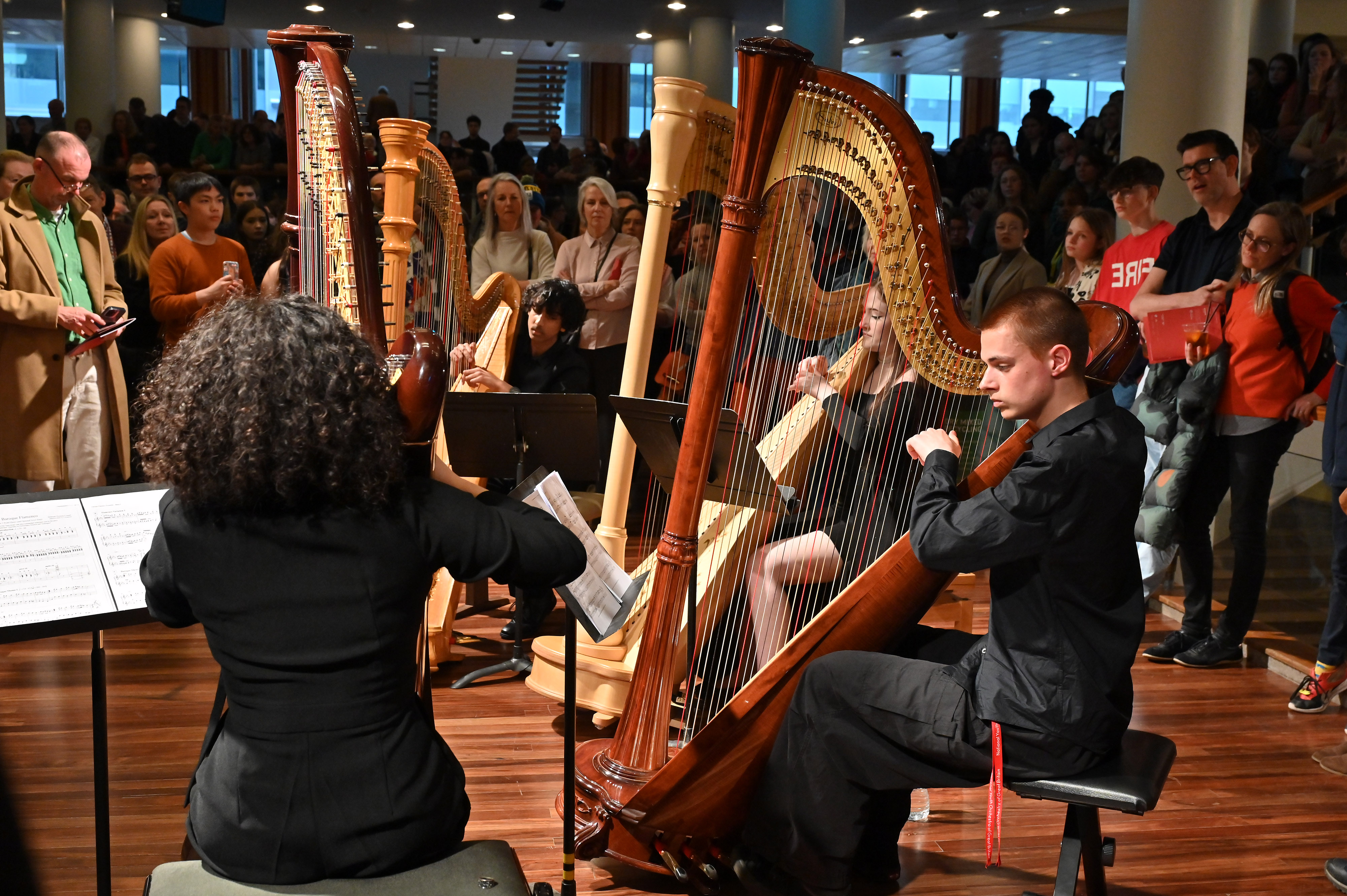
Deborah Henson-Conant: Baroque Flamenco - NYO Harps - Clore Ballroom (Photo Mark Allen)

There were two performing groups, the 150-plus players of the NYO itself and the eleven NYO Associates (part of the NYO Inspire programme), this latter group playing a series of pieces that they had devised themselves. We began in the Clore Ballroom, with a remarkably coordinated series of performances showcasing the various sections of the NYO.

The members of NYO brass began things with Ignite, a fanfare devised by the NYO musicians, and then some of the strings played the third movement of Bacewicz's Concerto for string orchestra (conducted by Constanca Simas, who conducted all the large ensemble pieces in the foyer), a performance that made you wish we were hearing the whole work. Then it was the turn of the NYO's four harps in Deborah Henson-Conant's wonderfully engaging Baroque Flamenco. Adam Gorb's Omaggio a Giovanni from the brass, was an homage to Giovanni Gabrieli, the older composer's music drifting in and out of focus in a work that was perhaps slightly too quietly sophisticated for a noisy foyer. The engaging gavotte from Richard Strauss' Suite for Woodwind, and a second group of strings in Sammy Singh's Flippen completed the foyer entertainment, and finally, Drum Line, a drum piece devised by NYO musicians, led the audience into the Royal Festival Hall. This latter process took some time, and whilst we filed in the NYO Associates played their devised piece Spring Way Back, eventually joined by members of the orchestra.

Sunday, 16 April 2023

What happened next

Dionysios Kyropoulos - Teaching acting to singers: harnessing historical techniques to empower modern performers
I first met Dionysios Kyropoulos in 2013, whilst he was doing an MPhil in Cambridge, when we met to chat about his ideas on the use of historical stagecraft in modern performances, see my interview Man in a Misson

These ideas had developed considerably when Dionysios and I met up again in 2022 to chat further, see my interview Not an additional ornament, in advance of his staging of Handel's Tamerlano for Cambridge Handel Opera Company [see my review].

Anyone who saw that production of Tamerlano will perhaps note that the costumes and the staging were modern, and Dionysios has developed his interest in the usefulness of teaching historical techniques to modern performers, not just recreating historical productions. 

This has now come to full fruition with Dionysios' doctoral thesis at the University of Oxford. His thesis is available from the Oxford University Research Archive website, the thesis' title says it all:

Teaching acting to singers: harnessing historical techniques to empower modern performers


Saturday, 15 April 2023

The trumpet being reimagined: trumpeter Lucy Humphris chats about her debut disc, Obscurus,

Lucy Humphris & Harry Rylance (Photo foxbrush.co.uk)

Trumpeter Lucy Humphris' debut disc, Obscurus, on Rubicon Classics with pianist Harry Rylance, features music by Janáček, Maxwell Davies, Messiaen, Filippos Raskovic, Respighi and Takemitsu, in what is described as an exploration of the obscured; a programme which showcases some of the most incredible trumpet writing of the 20th and 21st century, as well as several re-imaginings of older, more mainstream works for other instruments. Lucy was recently selected as a Rising Star by Classic FM and named as One to Watch by Scala Radio.

Lucy Humphris
Lucy Humphris

Lucy enjoys creating recitals that have a theme, particularly one of a more abstract nature. Obscurus features pieces that are all staples of her recital programmes, but all of them also link to the idea of something veiled or hidden, either hidden in the mists or worn away by time. Indeed, the disc started simply as a selection of pieces she loved but she then realised that they were connected. 

There is also another structure, the two arrangements (of Janacek's In the Mists and Respighi's Ancient Airs and Dances) are with piano whilst the rest are for solo trumpet. Again, something she realised after creating the programme and rather liked. The Janacek and Respighi are her own arrangements. She finds that so many pieces for trumpet and piano have a particular sound, with the piano relegated to the background. With her arrangements, she tries to feature the piano more.

The standard repertoire for the trumpet is rather curious, there is lots of fantastic Baroque repertoire and then nothing during the Classical and Romantic eras, but the late 20th-century and 21st centuries have become something of a new golden age, there is so much wonderful music; there are trumpet concertos by Maxwell Davies, Turnage and H K Gruber. Contemporary repertoire is her bread and butter, it is what she performs, and she finds it interesting to see the trumpet being reimagined.

Friday, 14 April 2023

Celebrating young talent: The Martin Read Foundation's Annual Festival

Joe Jolliffe, Josh Clark, Felix Sladen-Jewell, William Dear with Joseph Spooner
Joe Jolliffe, Josh Clark, Felix Sladen-Jewell, William Dear
with Joseph Spooner
The Martin Read Foundation (MRF) was set up in memory of the composer and educator Martin Read who died suddenly in 2012. It has an annual young composers' scheme which provides support for aspiring young composers including commissioning, expert tuition and workshops, performance and recording opportunities. 

The MRF's Annual Festival takes place on Saturday 23 April 2023 at the Church of St Lawrence, in Alton, Hampshire, where Martin Read taught music for so many years. The festival provides a chance to hear music from the four young composers awarded bursaries for 2023. The festival's theme is War, past and current and the young composers, William Dear, Felix Sladen-Jewell, Josh Clark, and Joe Jolliffe, have all been commissioned to write a work for solo cello on the theme of war.

Also in the programme will be Martin Read's Civil War cantata: The Death of Colonel Boles, with cellist Joseph Spooner and baritone Paul Sheehan conducted by David Gibson. The Death of Colonel Boles is Martin Read's setting of the true story of the murder of Colonel Boles in St Lawrence Church in 1643 during the Civil War’s Battle of Alton.  Commissioned as part of Hampshire’s Millennium celebrations, and premiered in St Lawrence in 2000, this 2023 performance of the cantata will take place on that same spot where the Civil War murder took place. The work is scored for double choir, baritone solo (representing Boles), solo cello, recorder ensemble and solo drum. Additionally, there will be a new work for Flexible Ensemble composed by one of MRF's alumni.

The four young composers have already participated in two workshops with Joseph Spooner, the festival's performer in residence, exploring writing for the cello and the starting points of their pieces. They are now working hard with their mentors to complete their compositions ahead of the festival.

Full details from the foundation's website.


Expand your experience of music: courses and more for the over-18s

Alex Laing conducting at a Benedetti Foundation session (Photo: Simon Gough)

There seems to be plenty going on at the moment for those non-professionals wanting to learn or expand their experience of music. The Benedetti Foundation is hosting its first in-person Adult Learner Strings Day, whilst the Guildhall School has a whole range of online and in-person, drama, literature, music and marketing April-May evening courses for 2023.

The Benedetti Foundation is hosting sessions for adult string players on Sunday 28 May from 11am – 4pm at Studio 1, City Halls, Glasgow. Established in 2019 by Nicola Benedetti to deliver transformative experiences through mass music education, the foundation's move on-line in 2020 resulted in a new strand, adult learning. 

This community has continued to grow and develop with regular online activity and now adult string learners have the opportunity to attend a one-day session in person led by foundation tutors including Alex Laing (conductor and violin) Andrea Gajic (violin) and Su-a Lee (cello).  The session is open to players of grade 4 or above (recommended playing level – no grades need to have been taken) and participants will work on George Walker’s Lyric for Strings and the first movement of Elgar’s Serenade for Strings.  Details from the Benedetti Foundation website.

The Guildhall School's evening courses (for ages 18 years and up) include three drama courses, one drama and literature course, five music courses and three marketing courses, two of which are brand-new (How to Write a Marketing Plan in Six Weeks and Digital Strategies for Creative Professionals).

Music courses include two in-person ones, Singing for Beginners, led by vocal coach Esi Acquaah-Harrison and Writing for Orchestra, with Peter Longworth, Guildhall Professor of Orchestration and Conducting, whilst the Film Music Composition, Music Production in Logic Pro and Arranging & Reharmonisation for A Cappella all take place on-line.

Writing for an Orchestra - Guildhall School of Music & Drama

Full details from the Guildhall School website.

Andrew Parrott's The Pursuit of Musick: an exploration of music and music's place in society over 500 years looked at through the words and images of contemporaries

Andrew Parrott: The Pursuit of Musick: musical life in original writings & art c1200-1770; Taverner
Andrew Parrott: The Pursuit of Musick: musical life in original writings & art c1200-1770; Taverner

Andrew Parrott's The Pursuit of Musick: musical life in original writings & art c1200-1770, published by Taverner, is a somewhat deceptive book. Its substantial size and generous illustrations seem to suggest a coffee table book, but Parrott's name as the author implies deeper scholarship and you might think it a book of his collected writings. Both ideas are wide of the mark. It is rather an amazing book, full of deep scholarship but without a single word of Parrott's own its 544 pages, apart from the Introduction.

Instead, it is an exploration of music and music's place in society over 500 years looked at through the words and images of contemporaries. In his Introduction, Parrott explains that the book arose originally from a commission for an 'Early Music' book, but that he struggled to bring together original images and modern text. Finally, he dropped the modern text; what we have is a consideration of music using the images and words of the time. 

One of Parrott's themes is that music during the period of consideration, roughly 1200 to 1770, is more varied and more surprising than might first be thought. And what better way to explore than to read what others had to say about it. His net is cast very wide indeed, so for instance to take just one section ('Virtues & Vices' within Voices), there is Verelst's portrait of Handel's soprano, Anna Maria Strada, and writings by Jacopo da Bologna (c1350), John Dowland's 1609 translation of Ornithoparcus (1517), Hermann Finck (1556), Giovanni de'Bardi (c1580), Christoph Praetorius (1581), Bacilly (1668), J-J Rousseau (1753), Conrad von Zabern (1474), Zacconi (1592), Tosi (1723), Mattheson (1739), Quantz (1752), Francesco Bagnacavallo (1492, writing to Isabella d'Este), Zaarlino (1558) and John Evelyn (1685). 

The images are as fascinating as the text and of course, the truism that a picture is worth a thousand words comes to mind. Some I was familiar with, others not - Charles II's private music, ten-year-old Mozart playing whilst Princesse de Conti had tea in Paris. Images of music and performance, performers and theatricality, manuscripts and documents, that all tell us a little about how people thought about music at the time.

The foreign language texts have all been translated, whilst the English texts are left unmodernised. There is a full image list at the back of the book, but full bibliographic information for the texts is held on the Taverner website along with the original language texts.

Thursday, 13 April 2023

Half Baroque, half contemporary, half French, half British: Le Concert de l'Hostel de Dieu brings its 50/50 programme to the UK

In December last year, I interviewed Franck-Emmanuel Comte of the Lyons-based ensemble Le Concert de l'Hostel de Dieu [see my interview], and we chatted about their 50/50 project, a programme that mixed Baroque and contemporary music. In May 2023, the ensemble is coming to the UK and bringing the project to three concerts in London, Oxford and Ludlow.

The concert presents something of a challenge - half Baroque, half contemporary, half French, half British. A bridge between two countries and two eras, the concert features music by two contemporary composers, David Chalmin and Martyn Harry, and music by Purcell and Lully. The French composer, David Chalmin has written music inspired by Purcell, whilst the British composer, Martyn Harry has written music inspired by Lully. Both combine the sounds of the Baroque instrumentation with their own language, opening up a dialogue between times, languages and borders.

Le Concert de l'Hostel de Dieu and Franck-Emmanuel Comte, with mezzo-soprano Axelle Verner, will be presenting 50/50 at the London Festival of Baroque Music at St John's Smith Square (15/5/2023), Ludlow Assembly Rooms (17/5/2023) and Holywell Music Room, Oxford (19 May 2023)

What came after: Schütz' telling of the Resurrection story in Historia der Auferstehung Jesu Christi proves masterly

Henrich Schütz: Historia der Auferstehung Jesu Christi; Ensemble Polyharmonique, Alexander Schneider; Accentus

Henrich Schütz: Historia der Auferstehung Jesu Christi; Ensemble Polyharmonique, Alexander Schneider; Accentus
Reviewed 11 April 2023

Schütz' less well-known telling of the Resurrection story proves to be a concentrated, understated masterpiece in this performance from the distinguished vocal ensemble

The post-Reformation vernacular recitation from the Bible during Holy Week wasn't just restricted to the Passion story. There was a parallel recitation of the Resurrection story, the discovery of the tomb by the disciples and by the Marys. The first such musical version dates from 1550, and the standard text wasn't strictly from the Gospel, instead it was a reconciliation of the narrations from all four Gospels. The handiwork of Luther’s colleague Johann Bugenhagen in 1526, it was widely read in Lutheran churches of the sixteenth and seventeenth centuries.

It is this text which forms the basis for Henrich Schütz' Historia der Auferstehung Jesu Christi. On this new disc from Ensemble Polyharmonique, director Alexander Schneider, on Accentus, Schütz' Resurrection Story is given centre stage.

Wednesday, 12 April 2023

Music at Paxton: nine days of music-making in Georgian and Regency splendour in the Scottish Borders

The Regency Picture Gallery at Paxton House

Music at Paxton presents nine days of music at Paxton House, the historic Georgian mansion in the Scottish borders from 21 to 30 July 2023. The festival is opened by the Piatti Quartet in a programme that includes the Scottish premiere of Charlotte Harding's Iorsa plus music by Smetana and Mendelssohn. Music at Paxton Associate Ensemble, Consone Quartet, make their festival debut as part of a three-year residency programme, performing Haydn, Mozart, Mendelssohn, Sibelius and Puccini.

There are song recitals from soprano Rowan Pierce with Christopher Glynn and bass William Thomas with Malcolm Martineau, and instrumental recitals from Paul Lewis (piano), Chlöe Hanslip (violin) and Danny Driver (piano), the Katona Twins (guitar duo), and Guy Johnston (cello) and Melvyn Tan (piano) in Beethoven's complete Cello Sonatas.

Scottish harpist, Siannie Moodie, plays the clàrsach, exploring the historical and modern folk traditions from her childhood home in the Highlands, and there is music and storytelling from Ruaridh Geddes (fiddle) and Neil Sutcliffe (accordion) in Traditional Tunes for Tiny People, designed to introduce traditional Scottish tunes and songs to young children, aged 3–7, and their families. BBC Radio Scotland Young Traditional Musician 2022 winner Amy Laurenson (keyboard) and duo partner Portuguese guitarist Miguel Girão explore the music traditions and folklore of Scotland, Scandinavia and Eastern Europe which have been influenced by classical, contemporary music and jazz .

Amateur pianists are invited to participate in a Masterclass with Melvyn Tan, featuring Variations for Judith’ specially written to Grade 5/6 standard by some of Britain’s finest composers, including Judith Weir, Peter Maxwell Davies, Tarik O’Regan, Thea Musgrave and Richard Rodney Bennett. Pianists of any age are encouraged to apply.

Full details from the festival website.

Starry, starry night: Islington Festival of Music and Art 2023

Islington Festival 2022 (Photo Marc Gascoigne)

The Islington Festival of Music and Art returns with a festival themed around Van Gogh's Starry Night over the Rhône with ten days of concerts from 13 to 22 July 2023 in iconic venues around Islington. The opening concert features festival artists in Schoenberg's Verklärte Nacht and Mozart's Sinfonia concertante for violin & viola, and the night theme continues with pianist Dmitri Kalashnikov's performance of the complete Chopin Nocturnes.

There is a Bastille Day celebration, featuring miniatures for violin and piano by Pauline Viardot, Cecile Chaminade, Germaine Tailleferre and others from Joana Ly and Martin Andrew, and French song from tenor John Gyeantey, flautist Simon Channing and pianist Martin Andre.

Kati Debretzeni presents a programme of unaccompanied music for violin including Bach, cellist Miguel Andre Villeda Ceron plays three of Bach's unaccompanied cello suites, chamber version of Mozart Piano Concertos are paired with Zemlinsky's String Quartet No. 1, Robert Kahn's Piano Quartet no. 2, and Schubert's String Quartet No.15. Kensington Winds perform Mozart's Gran Partita alongside music by Gounod.

There is yoga with live harp music, a street photography workshop, live sketching during the concerts, and a photography exhibition showing how Islington has changed over the years. And all concerts are free to children.

Full details from the festival website.

Filmic vividness: Bjørn Morten Christophersen's Darwin-inspired oratorio The Lapse of Time is a complex, large-scale piece of writing

Bjørn Morten Christophersen: The Lapse of Time; Ensemble 96, Telemark Chamber Orchestra, Ditte Marie Bræin, Frank Havrøy, Inger-Lise Ulsrud, Nina T. Karlsen, Per Kristian Skalstad; SIMAX CLASSICS

A considerable achievement, Christophersen's large-scale oratorio sets his own poetic distillation of Darwin to music of thrilling and filmic scale

The Lapse of Time is Norwegian composer Bjørn Morten Christophersen's oratorio based on Charles Darwin's iconic 1859 book, On the Origin of Species by Means of Natural Selection. On this new recording Nina T. Karlsen and Per Kristian Skalstad conduct Ensemble 96, Telemark Chamber Orchestra, soprano Ditte Marie Bræin, baritone Frank Havrøy, organist Inger-Lise Ulsrud on Simax Classics. The booklet does not make clear who conducts what, but as director of the choir, Ensemble 96, Nina T. Karlsen conducted the two unaccompanied movements.

Christophersen wrote the work in 2013 setting his own text which might be described as a poetic distillation of elements from Darwin's book. The work was premiered in 2013 in performances in Kristiansund and Ålesund by Ensemble Dali, Kristiansund Sinfonietta and Eirik Sørborg. Eight years were to elapse before Christophersen was able to find the finance for a further performance and after a year's delay because of the pandemic, it was performed and recorded at Frogner Church, Oslo.

Tuesday, 11 April 2023

Handel, G&S, Roald Dahl and more: Lichfield Festival 2023

Grimethorpe Colliery Band in Lichfield Cathedral

This year's Lichfield Festival runs from 6 to 16 July 2023 and features music of all kinds, from folk to classical, jazz to gospel, plus theatre, literary, community and family events. The classical programme includes the Liberata Collective and Ensemble Hesperi in Handel’s opera Orlando with period instruments, and Charles Court Opera in Gilbert & Sullivan’s The Mikado. For younger audiences there is Waterperry Opera’s music theatre version of Roald Dahl’s Little Red Riding Hood and The Three Little Pigs.

Visitors include the Brodsky Quartet, composer and producer Nitin Sawhney, BBC National Orchestra of Wales and conductor Ryan Bancroft in Berlioz and Sibelius, Grimethorpe Colliery Band, violinist Rachel Podger, and pianist Danny Driver. Lizzie Ball, violin and Miloš Milivojević, accordion present Coco Chanel & Igor Stravinsky: A Musical Portrait, whilst festival Patron Julian Lloyd Webber hosts and curates Bach by Candlelight, with his cellist wife Jiaxin Lloyd Webber, to close this year’s Festival.   
A mini-season It’s a Drag looks at gender and cross-dressing in theatre, opera and the arts. Author Janet Tennant and guests investigate this long tradition, mezzo soprano Polly Leech sings operatic 'trouser roles', and vocalist and associate artist Jessica Walker takes a cross-dressing musical tour through the decades.

Other events include The Lord Chamberlain’s Men in Shakespeare's Romeo and Juliet on the Cathedral Lawn in the way Shakespeare would have first seen it – with an all-male cast, in the open air, and with Elizabethan costume, music and dance - chant, music and dance of the Tibetan Monks of the Tashi Lhunpo Monastery, master musicians N’famady Kouyaté and Gasper Nali who fuse African, jazz, pop and indie elements, and Kabantu who play and improvise folk music from around the globe.    

Full details from the Lichfield Festival website.

BCMG continues blooming in Birmingham

BCMG IN BLOOM BANNER

Having recently celebrated the cherry blossom flowering with an outdoor concert, Birmingham Contemporary Music Group is continuing its BCMG in Bloom season with a pair of concerts celebrating the natural world. On 29 April 2023 there is Blossoming in Birmingham, a concert at the CBSO Centre to welcome Kazuki Yamada to the Birmingham, in his new role as Chief Conductor and artistic advisor for the City of Birmingham Symphony Orchestra. Then on 12 May 2023 comes the long-awaited T R E E concert with a premiere by Christian Mason and a modern classic by Helmut Lachenmann.

Blossoming in Birmingham features two works by Dai Fujikura, Perpetual Spring and Secret Forest, plus Toshio Hosokawa’s Blossoming, Lisa Illean’s Januaries and String Quartet No. 2 by György Ligeti. And there is a special post-concert event where the BCMG NEXT ensemble will perform pieces by Dai Fujikura, Toshio Hosokawa, Lisa Illean, and more.

T R E E, which was originally scheduled to be presented in 2021 but was delayed by COVID, will feature the premiere of Christian Mason’s new Sound Investment commission The Singing Tree with text by Paul Griffiths that takes the form of a tree. The piece focuses on the ‘natural’ series of overtones and features Neue Vocalsolisten Stuttgart and the Finchley Children’s Music Group, whose conductor Grace Rossiter has worked with Christian Mason on developing the score for young voices. Also in the programme is Helmut Lachenmann’s Concertini (2005), a seminal work that BCMG have hoped to perform for many years. BCMG will be conducted by Michael Wendeberg.

But there is more than just a concert, T R E E has grown from a simple idea for a new musical work, to a multi-faceted project with workshops for young musicians, extensive digital resources and real-life tree planting around Birmingham. Working in partnership with Birmingham Trees for Life, BCMG staff have planted saplings around the city.

Full details from the BCMG website.

A joyous Easter celebration from Florilegium at Wigmore Hall

Zelenka: Concerto a 8 concertanti in G - Florilegium in rehearsal at Wigmore Hall
Zelenka: Concerto a 8 concertanti in G - Florilegium in rehearsal at Wigmore Hall (Photo Florilegium)

Zelenka: Concerto a 8 concertanti in G,  Bach: Trio sonata in G; Telemann: Concerto in E minor for flute, recorder and strings, Bach: Easter Oratorio; Rowan Pierce, Helen Charlston, Andrew Tortise, Michael Craddock, Florilegium; Wigmore Hall
Reviewed 8 April 2023

Bach's glorious Easter Oratorio alongside three striking contemporary instrumental works highlighting unusual instrumentation and engaging musicianship

Bach's Easter Oratorio is far less well-known than his other Easter-related works. Starting out as a secular cantata, it gradually metamorphosed into a relatively short, strikingly imaginative work exploring the reactions of the two Marys and apostles to the empty tomb. But, with a final version that removed the characters' names, Bach's Easter Oratorio simply became a moving meditation on the themes of Easter Sunday. A remarkably apt piece of programming for the evening of Saturday 8 April 2023, when churches around the country would be having the first mass of Easter.

But what to programme with the work? At their concert at the Wigmore Hall, Florilegium, artistic director Ashley Solomon, focused on the Easter Oratorio's dates. Written originally in 1725, its final version dates from 1735. So, we had a selection of instrumental works from Bach, Telemann and Zelenka from the same period, with an emphasis on unusual instrumentation.

Norwich-based music writer, Tony Cooper, looks forward to the North Norfolk Music Festival coming round this Summer

St Mary's Church, South Creake - home of the North Norfolk Music Festival

Now in its 18th glorious year, the North Norfolk Music Festival - founded by world arts traveller Barry Cheeseman and the distinguished British viola player Simon Rowland-Jones - runs from Friday 11 August to Friday 18 August 2023. All of the concerts are held in the splendid surroundings of the medieval church of St Mary, South Creake, close by to Wells-next-the-Sea and the delightful market town of Fakenham. 

Opening the festival (Friday 11 August 4.00 pm) is the award-winning vocal ensemble, ORA, who’ll be offering a lovely and inviting programme featuring William Byrd’s Ave Verum Corpus, a motet he wrote for the Feast of Corpus Christi and one of his best-known compositions. This year he’s especially remembered as it’s the 400th anniversary year of his death. A distinguished organist/composer of the Shakespearean age, he’s renowned for developing the English madrigal.  

Also included in ORA’s delightful programme are works by Hildegard of Bingen (1179), Orlando de Lassus (1532) and Richard Dering (1580) as well as works by contemporary composers of the likes of Roxanna Panufnik, Caroline Shaw and Roderick Williams while ORA’s recently commissioned work All Shall be Well by Joanna Marsh, described by The Guardian as ‘one of today’s leading composers for the voice’, promises a big treat, especially for choral aficionados. 

Sunday, 9 April 2023

A tale of two passions: Sebastiani's St Matthew Passion at Wigmore Hall and Bach's St John Passion at St Martin in the Fields

Sebastiani: St Matthew Passion - Fretwork in rehearsal at Wigmore Hall (Photo Fretwork)

Johann Sebastiani: St Matthew Passion; Hugo Hymas, Jimmy Holliday, Lucinda Cox, Clare Wilkinson, Simon Wall, Fretwork; Wigmore Hall
Johann Sebastian Bach: St John Passion; Stephen Anthony Brown, Peter Edge, William Crane, St Martin's Voices, Academy of St Martin in the Fields, Andrew Earis; Church of St Martin in the Fields

Two very different passions. Sebastiani's mid-17th century account from Fretwork, concentrated and highly moving, and Bach's early-18th century more operatic version from the young voices of St Martin's Voices

Bach's Passions did not occur in isolation but arose out of a strong 17th-century tradition of musical recitations of the Passion in Germany. Such recitations are known to have happened during Holy Week from the 4th century, but the Reformation, with its move to vernacular German rather than Latin, seems to have provided an extra impetus for exploring new ways of telling the story, combining monophony with polyphony. Schütz's three Passion settings from the 1660s are still unaccompanied, but from the 1640s composers were introducing instruments. All these settings focus on the gospel text in quite a concentrated format, whereas the more oratorio-style Passion, familiar from Bach's Passions is a late-17th early-18th century development and the more operatic nature of Bach's writing was something that would come in for criticism in Leipzig.

At Wigmore Hall in the afternoon of Good Friday (7 April 2023), Fretwork (Richard Boothby, Jonathan Rees, Sam Stadlen & Joanna Levine viol, Bojan Cicic & Emilia Benjamin violin, Silas Wollston organ) with Lucinda Cox (soprano), Clare Wilkinson (alto), Hugo Hymas & Simon Wall (tenor) and Jimmy Holliday (bass) performed the St Matthew Passion by Johann Sebastiani (1622-1683).

Saturday, 8 April 2023

A multiplicity of possibilities: pianist Edna Stern on Bach and the art of Zen

Edna Stern
Edna Stern

Pianist Edna Stern's latest disc (on Audio Note Music) focuses on Book One of Bach's Well-Tempered Clavier, but the disc's title, Bach's Book of Zen, perhaps gives a hint at her particular approach to the music. This is expanded on in an accompanying book by Edna where she takes the reader/listener through each of the 24 preludes and fugues in Book One, giving an illumination both of the music and her approach to it.

Edna Stern
Edna Stern

Born in Belgium and growing up in Israel, Edna Stern began playing the piano at six. She began her studies in Israel with Viktor Derevianko, a student of Heinrich Neuhaus. She continued studying with Krystian Zimerman at the Basel Hochschule and with the late Leon Fleisher at the Peabody Institute and at the International Piano Academy Lake Como. She has been a professor at the Royal College of Music since 2009. 

Given that there are so many different versions of Bach's Well-Tempered Clavier on disc already, I wondered why Edna had felt she wanted to record it herself. She points out that it is such a great piece, and one that holds a multiplicity of possibilities, and each version illuminates the work differently. And this is not to mention the various styles of instruments and changing approaches over time. Across the 300 years of the work's existence, there have been different movements in the way the piece is interpreted as well as very different instruments. So, you cannot really compare the piano on which Edna recorded the piece, a Bösendorfer, with that used by Edwin Fischer in his classic recording from the 1930s. And that is not to mention the changes to performance practice that happened between the 1930s and today, with the huge influence of period performance practice.

Edna sees a performance as existing in a particular place and time, testimony not just to her as a musician but to the time she lives in, and each version of the music shows how a particular time illuminated the work of art.

Friday, 7 April 2023

The sheer sense of engagement from the young choral singers was a joy: Bach's St Matthew Passion from Choir of King's College, London at St John's Smith Square

Title page of Bach's autograph score of the St Matthew Passion
Title page of Bach's autograph
score of the St Matthew Passion
Bach: St Matthew Passion; Choir of King's College, London, Hanover Band, Joseph Fort; St John's Smith Square
Reviewed 5 April 2023

A young choir and young soloists bring a remarkable sense of engagement and exploration of Bach's monumental work

Bach's sons called it the Great Passion and when their father died, the score and the parts were divided so that two of them had the wherewithal to perform it. It represents a significant expansion of Bach's usual format as well as being around double the duration of typical passion settings of the previous generation of composers. Surviving evidence, including the church's two organ lofts, suggests that the forces used by Bach could not have been that large and that his singers were hard worked. The solo tenor 1, for instance, was expected to sing the role of the Evangelist, the tenor one solo, plus the chorales, choruses and turbae; that is still a big ask, even if there were ripieno singers to help in the choruses and chorales. 

The solo parts also seem to have been laid out so that the first quartet did all the heavy lifting, the second quartet have far fewer solo arias and are more involved in the chorale arias, where a soloist from choir 1 sings an aria alongside a chorale from choir 2. This layout of parts would be ideal for a line-up where not every singer was equally experienced. And that is the challenge for modern performances, how do you introduce singers to such a marathon gradually.

For the performance of Bach's St Matthew Passion on Wednesday 5 April 2023 as part of the St John's Smith Square Easter Festival, Joseph Fort conducted the choir of King's College, London and the Hanover Band with soloists Danni O'Neill (soprano 1), Ciara Hendrick (alto 1), Sam Harris (tenor 1), Alex Bower Brown (bass 1), Ruby Bak (soprano 2), Clare McCaldin (alto 2), Charlie Hodgkiss (tenor 2) and James Priest (bass 2). 

Sam Harris (tenor 1) sang the Evangelist and Alex Bower Brown (bass 1) sang Christus, as Bach would have expected, but choruses, turbae and chorales were sung by the separate choir, as is the modern style of performance. The soloists were all young, and in fact, Ruby Bak (soprano 2) was a member of the choir, whilst choir members also supplied the other solo roles.

Popular Posts this month