 |
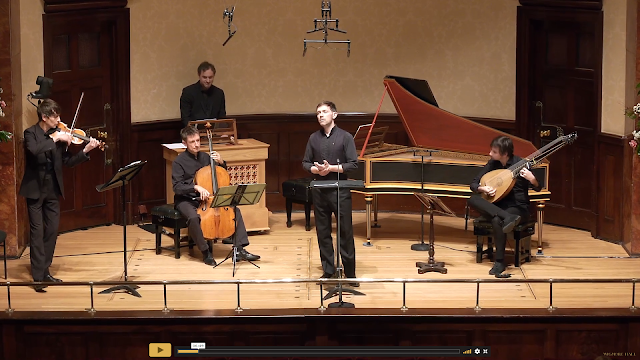
| Handel: Nine German Arias - Iestyn Davies, Arcangelo (Matthew Truscott, Jonathan Cohen, Jonathan Manson, Thomas Dunford - Wigmore Hall (image taken from live-stream) |
Handel Nine German Arias, Geminiani, Marais; Iestyn Davies, Arcangelo; Wigmore Hall
Reviewed by Robert Hugill on 14 December 2020 Star rating: 5.0 (★★★★★)
Food for the soul, Handel's contemplative vocal chamber music in wonderfully engaged performances
On the day that it was announced that London would be going into Tier 3 and that entertainment venues would be closing to live audiences, we managed to slip in one last live concert, Handel's contemplative settings of poetry expounding the joy and beauty of God's creation, thoughts that we rather need at the moment.
Counter-tenor Iestyn Davies and members of Arcangelo (Jonathan Cohen, organ/harpsichord, Matthew Truscott, violin, Jonathan Manson, cello, Thomas Dunford, lute) performed Handel's Nine German Arias alongside Francesco Geminiani's Cello Sonata in F Op.5 No.5, Handel's Violin Sonata in A Op.1 No.1 and Marin Marais' Les voix humaine at the Wigmore Hall on 14 December 2020.
Considering the polyglot nature of his talent and the profusion of his works, Handel did not set very much of his native language. There are only two mature works in German and both of these have links to Hamburg and to the poet Barthold Heinrich Brockes (1680–1747), who was a Hamburg town councillor, Handel's Brockes Passion and the Nine German Arias. The passion seems to have been written in around 1716 and performed, alongside settings of the same text by Keiser, Telemann and Matheson (Handel had worked for the first as a young man in Hamburg and was friends with the latter two) in Hamburg in 1719. Handel may have written the passion as a feeler towards a career in German if the political situation deteriorated (the Jacobite Rebellion had been in 1715, it many not have been completely obvious to those on the ground that the Hanover Dynasty would survive in England and Handel's fortunes were bound up with them).
In 1721, Brockes’s collection of poems Irdisches Vergnügen in Gott, bestehend in Physicalisch- und Moralischen Gedichten was published in Hamburg, it was arranged in a way to encourage musical settings and was so popular that the 1724 edition nearly doubled the number of pages. It seems to be from the second edition that Handel chose nine arias to set for voice, obbligato instrument and continuo. Handel's links to Brockes are fascinating, Brockes was at Halle University the same time as Handel (five years his junior) was registered there, and Brockes held weekly concerts in his apartment. The two must have interacted whilst Handel was working at the opera theatre in Hamburg, and in 1727 when Brockes published his second volume of Irdisches Vergnügen in Gott, he directly referred to Handel's settings of his poetry. And in a later publication, Brockes refers to family boating trips in which he and his children would perform some of these arias, which implies that Brockes possessed a manuscript copy of the settings.
We don't know why Handel set them, perhaps there was another project in Hamburg. From 1721 his connections there included his friend Telemann, and we know that around this time Telemann set Brockes' poetry. The music was not published, so we do not have a dedication (often the source of much information in 18th century music) and Handel's manuscript (which survives in the British Library) does not specify the obbligato instrument (but the range is such that a flute could not be used for all the arias). They were probably not conceived as a single cycle, and Handel would be perhaps surprised to find us performing all nine together.
At the Wigmore Hall, Matthew Truscott played the obbligato line (except in 'Süsser Blumen Ambraflocken' when it was played by Jonathan Manson) with continuo from Manson (cello), Dunford (lute) and Cohen (moving between organ and harpsichord). We heard the arias in four groups, three pairs and a trio at the end, interspersed with solo moments for the instrumentalists, Geminiani's Cello Sonata, Handel's Violin Sonata and a lute transcription of a Marin Marais solo.




.jpg)
%20(c)%20Chris%20Christodoulou.jpg)


.jpg)


