Showing posts with label GSMD. Show all posts

Tuesday, 9 June 2026

Every nuance tells: Missy Mazzoli's Proving Up receives its UK premiere at Guildhall School

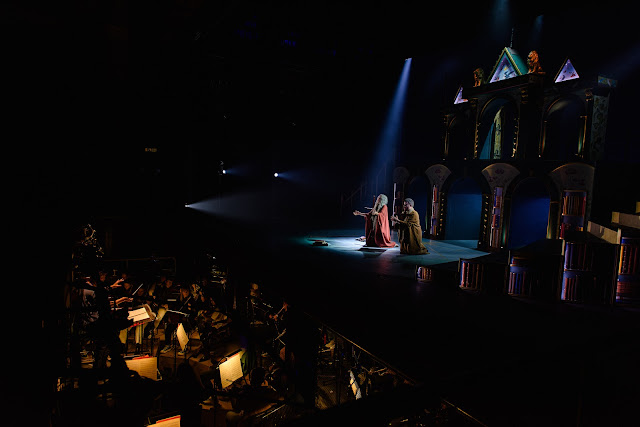
Missy Mazzoli: Proving Up - Sebastian Hill, Aidan O'Donnell  - Guildhall School (Photo: David Monteith-Hodge)
Missy Mazzoli: Proving Up - Sebastian Hill, Aidan O'Donnell  - Guildhall School (Photo: David Monteith-Hodge)

Missy Mazzoli: Proving Up; director: Amy Lane, conductor: James Henshaw; Guildhall School of Music & Drama
Reviewed by Edward Lambert (5 June 2026)

It was necessary to remind oneself that this was not a professional company. Amy Lane's production extracted every ounce of drama from the text and faithfully served the music

While student singers will understandably be keen to learn roles in ‘classical’ operas, there are advantages for them in performing new, unfamiliar works while in training. They can make such roles their own without regard to tradition or well-known interpretations. And the music colleges, with their resources and a huge amount of free labour at their disposal, may well consider it their duty to champion new opera when the larger houses can ill afford to take those risks. London owes a debt of thanks, therefore, to the Guildhall School of Music and Drama for bringing Missy Mazzoli’s 2018 opera Proving Up to the Milton Court Theatre recently and there was no doubt that the young cast gave it their all and a lot more besides.

Missy Mazzoli (b. 1980) is a major force to be reckoned with in the USA and her operas flourish in the fertile soil of the American contemporary-opera scene. New operas by her will be premiered later this year at the New York Met (October) and the Edinburgh Festival (August). Her music is a far cry from the ingratiating, easy-listening style of Mark Adamo’s Little Women (seen at Opera Holland Park in 2022, see Robert's review) or even Jake Heggie’s Dead Man Walking (ENO, 2025). So, what with Angel’s Bone at ENO Manchester/London this year, Einstein on the Beach and Mazzoli’s own Breaking the Waves (ENO, 2027), American opera is fast conquering the UK’s contemporary-opera scene as well. (Meanwhile, the Royal Opera hasn’t yet managed to stage a single John Adams opera - an omission which is barely credible). 

Missy Mazzoli: Proving Up - Laura LeVoir, Miranda Kettlewell, Lowri Probert - Guildhall School (Photo: David Monteith-Hodge)

Unlike Breaking the Waves which is set in Scotland, Proving Up is American to the bone, its action taking place on the prairies of Nebraska following the state’s admission to the Union in 1867. The federal Homestead Act allowed migrants to claim free land if it was settled and cultivated for a period of five years. The process of supplying the required affidavits was known as Proving Up. It goes without saying that the legalities and fees involved excluded participation in the scheme by Native Americans.

Thursday, 14 May 2026

New opera, electronic music, celebrating John Barry, cross-genre works: Guildhall School's Making It Festival returns

Guildhall School of Music & Drama’s Making It Festival returns from 8 to 26 June 2026

Guildhall School of Music & Drama’s Making It Festival returns from 8 to 26 June 2026: a three-week celebration of new, original work made by Guildhall School’s vibrant and multi-skilled community. The festival asks what it means to “make it” as an artist in the 21st century. 

Three new works written by composers and librettists on Guildhall’s MA in Opera Making & Writing in association with the Royal Ballet and Opera will be performed by singers and repetiteurs from the Opera Studies department. The works are:

  • A Bone to Pick, composed by Eluned Davies with libretto by Bess Still 
  • Elara Catching Sky, composed by Yotham Ben Yami with libretto by Ariella Stoian
  • The Vanishing Act, composed by Diego Jimenez with libretto by Stuart Lee 

And there will be a post-show panel discussion with the student composers and librettists of Opera Makers and the director, to explore the development of new operatic work and the transition from conservatoire study to professional practice in the industry. 

Other events include In Real Time, a distinctive immersive performance event integrating lighting, live sound and live video as equal, interdependent elements, developed through collaborative, cross-disciplinary practice; three evenings of new music by Guildhall School’s postgraduate Electronic & Produced Music artists, showcasing work across a wide range of specialist disciplines — from experimental sonic art to mainstream film scoring; A Celebration of New Cinematic Song, featuring original songs by Electronic & Produced Music students inspired by the legacy of John Barry. 

There are also self-led performance works for stage and screen by final-year actors – The Making of Us – created and performed entirely on their own terms and the return of GradEx – the annual exhibition of works by final-year artists on Guildhall School’s BA course.

Full details from the Guildhall School's website. 

Monday, 16 March 2026

Easter Music Course for 8 to 13s, new Movement for Musicians & Creative Writing: Guildhall School's programme of Easter Short Courses

Easter Music Course
Easter Music Course

The Guildhall School offers a wide range courses above and beyond full-time study. There are Summer Evening Courses, Easter Short Courses and Summer Schools, with many courses offered on-line. 

The Easter Short Course programme features 15 short courses, 6 of which are brand new. These include 4 drama courses, 2 new writing courses, 8 music courses and 1 new skills for the creative industry course. The deadline to book for all Easter short courses is 5pm, Thursday 2 April 2026, or when the course reaches full capacity.

The Easter Music Course is for young instrumentalists aged 8 to 13 playing any bowed string, wind, brass or percussion instrument (Grade 1 or above: equivalent to one year's experience), who are looking to gain some ensemble experience in different performance settings including orchestra, small ensembles, and choir. The course culminates in an informal concert for friends and family to showcase the work they have developed during the course, including a piece of original music, which will be created as a group. This course is taught by tutors from Junior Guildhall, led by Spencer Down – Brass Coordinator at Junior Guildhall and Creative Director of Guildhall Young Artists.  

New courses include two in-person three-day Acting Intensive courses, for ages 11 to 14, and 15 to 17, delving into modern industry practice, building upon traditional Stanislavsky-based methods. Another new, in-person course is Movement for Musicians, designed to inspire fresh enthusiasm and awareness for the importance of bodywork and movement in artistic practice.

There is a new Creative Writing for Ages 14-17 led by London writer Annie Hayter, and Writing a Solo Show (for 18+ ) designed to help you create a one-person performance from scratch. Focusing on Skills for Creative Industries, there is a new one-day masterclass, Creative Evaluation Methods.

Whilst all the acting courses are in-person, three of the music courses are on-line. Full details from the Guildhall School's website.


Wednesday, 25 February 2026

A 365 year old ghost story into a surreal fantasy epic where drums, voice and orchestra collide: Sean Noonan's The Drummer of Tedworth

Sean Noonan by Linda Pedroso

Sean Noonan describes himself as a speaking drummer; he is a composer, and rhythmic storyteller whose music defies categorization. Drawing on the traditions of wandering minstrels and African griots, he weaves imaginative narratives through a distinctive polyrhythmic language that blends voice and percussion into his "fifth limb".

His piece, The Drummer of Tedworth, is a wild, immersive journey blending rock opera and punk-
jazz energy, blurring concert, theatre, and ritual, and the recording of it with the London Symphony Orchestra was released on Friday 20 February.

The work's premiere takes place on Monday 30 March 2026 at Milton Court in London when Sean Noonan will be joined St Paul's Sinfonia and Darren Bloom. The music is described as a fusion of jazz, contemporary classical, and global folklore in an immersive zany performance.

A concerto for anyone who’s ever doubted existence… and laughed anyway. 

Academically accomplished, Noonan holds a Doctorate from the Guildhall School of Music & Drama, a Master’s in Composition from the Aaron Copland School of Music, and a Bachelor’s in Music Education from Berklee College of Music. His doctoral thesis, Rhythmic Storytelling with Drum and Voice (Guildhall School of Music & Drama), explores the intersection of narrative and percussion and is available via City, University of London’s open access archive. Early formative experiences included backing Hollywood legend Marni Nixon.

The recording of The Drummer of Tedworth is available from Sean Noonan's website,  tickets for the concert are available from the Guildhall School's website.

Friday, 13 June 2025

The one where Dido kills Aeneas: Oliver Platt radically refocuses Purcell's opera at Guildhall School

Purcell: Dido & Aeneas - Joshua Saunder - Guildhall School (Photo: David Monteith-Hodge)
Purcell: Dido & Aeneas - Joshua Saunders as Aeneas with the Witches - Guildhall School (Photo: David Monteith-Hodge)

Purcell: Dido and Aeneas; Julia Merino, Karima El Demerdasch, Manon Ogwen Parry, Joshua Saunders, director: Oliver Platt, Academy of Ancient Music, conductor James Henshaw; Guildhall School of Music and Drama
Reviewed 11 June 2025

Time travelling production of Purcell's masterwork recontextualises the drama without explaining or satisfying, but with some strong dramatic performances

Purcell's Dido and Aeneas is a challenge to directors and performers, to match its compact perfection yet bring the drama alive. The work was written for a very particular set of performing practices, and we don't even have the original manuscript, so we are left with gaps that have to be filled creatively.

At Guildhall School of Music and Drama, Purcell's Dido and Aeneas was their chosen opera and rather daringly it was presented on its own, without any accompanying works. Also, we were warned beforehand that the production involved contemporary music, so this was not going to be traditional, was it. Except that the project was also the latest one where players from the Academy of Ancient Music collaborated with the students.

We caught the second night of the production of Purcell's Dido and Aeneas at the Guildhall School on Wednesday 11 June 2025. The production was directed by Oliver Platt with designs by Alisa Kalyanova, movement by Caroline Lofthouse, lighting by Eli Hunt and video by Mabel Nash. James Henshaw conducted, with Julia Merino as Dido, Karima El Demerdasch as the Sorceress, Manon Ogwen Parry as Belinda, Joshua Saunders as Aeneas, Hannah McKay as Attendant/2nd Woman, Seohyun Go and Julia Solomon as witches, Gabriella Noble as the Spirit and Tobias Compos Santinaque as the Sailor.

Purcell: Dido & Aeneas - Joshua Saunders, Julia Merino - Guildhall School (Photo: David Monteith-Hodge)

The programme warned us that the 'production contains adult content with themes of physical and emotional abuse, including scenes of bloody violence, reference to suicide, themes of kidnap, coercion and threat, implied sexual themes, and gory interaction with depictions of dead animals'. So, not your average Dido & Aeneas then.

We entered the auditorium with electronic dance music pounding (the music was created by students of Guildhall School Electronic and Produced Music Department). Not the sort of music I would be tempted to dance to, but certainly it filled the theatre with an atmosphere. A woman was dancing, joined by another, the two having a strong connection.

Tuesday, 18 February 2025

Student and professor collaborations, music by Bacewicz, Beamish, Takemitsu, Turina, & more at the Guildhall School's Chamber Music Festival

Guildhall Chamber Music Festival. Photo by Paul Cochrane.
From 14 to 16 March 2025, Guildhall School of Music & Drama presents its annual chamber music festival at Milton Court Concert Hall, bringing together most talented current Guildhall students and world-renowned chamber professors in works ranging from Haydn and Brahms to Sally Beamish, Stravinsky and Takemitsu.

The weekend's events are opened by Elmore String Quartet, Guildhall School’s Hans Keller Chamber Fellows, in music by Imogen Holst and Benjamin Britten. Then over the weekend there is a chance to hear music by Barber, Bacewicz, Sally Beamish, Bruch, Dohnanyi, Guillermo Lago, Stamitz, Takemitsu, Turina, and much else besides with the Saturday Student Showcase featuring an abundance of talented current student groups - from string quartets to brass quintets.

Full details from the Guildhall School's website.

Tuesday, 3 December 2024

What are you waiting for: Guildhall School announces its Spring 2025 programme of evening courses

Guildhall School of Music & Drama - Introduction to Arts Evaluation (Photo: Dave Buttle)
Guildhall School of Music & Drama
Introduction to Arts Evaluation (Photo: Dave Buttle)

The Guildhall School of Music and Drama has announced its Spring 2025 programme of evening courses in drama, writing, music, creative industry, and other art forms. Many are online, so there is no excuse.

These evening courses are for ages 18 and up and include six drama courses, two drama/writing courses, one course on The Secrets of Stagecraft, three music courses and two creative industry courses. 

There is a new music course,  Writing for an Orchestra: Intermediate which is online, led by composer, teacher, music copyist, conductor and cinephile Peter Longworth, and the course includes a one-to-one session with the tutor. The other two music courses are Writing for an Orchestra: Beginners being in-person and the third music course is Film Music Composition: Intermediate.

Also of interest, perhaps for those hoping to pivot their career are the two Skills for the Creative Industries  courses, both online - Introduction to Arts Evaluation and Introduction to Event and Production Management.

Full details from the Guildhall School website.

Friday, 7 June 2024

A very modern sort of magic: Handel's Alcina at the Guildhall School of Music and Drama

Handel: Alcina - Yolisa Ngwexana - Guildhall School (Photo: David Monteith-Hodge)
Handel: Alcina - Yolisa Ngwexana (Morgana) - Guildhall School (Photo: David Monteith-Hodge)

Handel: Alcina; Georgie Malcolm, Yolisa Ngwexana, Samantha Hargreaves, Shana Moron-Caravel, Julia Merino, Jonah Halton, Alaric Green, director: John Ramster, conductor: James Henshaw; Guildhall School of Music and Drama
Reviewed 5 June 2024

Handel's sorceress gets a very modern take-over in this imaginative production full of engaging and impressive performances from the young singers and instrumentalists

The story Alcina continues to resonate with modern audiences because the heroine, building on a standard trope of the Baroque era of the wicked sorceress caught in her own toils and falling in love, is a remarkably three-dimensional modern character. Fallible and believable, Alcina combines danger, glamour with deep feeling, she is very much a cousin of the modern 'tart with a heart' and part of the opera's success is the way Handel evinces sympathy for her

Handel's opera provides a wealth of possibilities for directors using her magic as some sort of metaphor with recent productions highlighting glamour and celebrity [at Covent Garden, see my review or at Opera North, see my review], or the theatre itself [at Glyndebourne, see my review]. For the new production of the opera at Guildhall School of Music and Drama, John Ramster and designer Louis Carver chose to leave the metaphor to us, instead their Alcina was a sorceress commanding a very modern sort of magic allied to a performance which saw Guildhall School students sitting side-by-side with members of the Academy of Ancient Music in the pit.

Handel: Alcina - Georgie Malcolm and Shana Moron-Caravel - Guildhall School (Photo: David Monteith-Hodge)
Handel: Alcina - Georgie Malcolm (Alcina), Shana Moron-Caravel (Ruggiero) - Guildhall School (Photo: David Monteith-Hodge)

We caught the second performance of John Ramster's production of Handel's Alcina given by the Guildhall School at Milton Court Theatre on 5 June 2023. Designs were by Louis Carver with lighting by Andy Purves and video by Jonathan Strutt. Georgie Malcolm was Alcina, Yolisa Ngwexana was Morgana, Samantha Hargreaves was Oberto, Shana Moron-Caravel was Ruggiero, Julia Merino was Bradamante, Jonah Halton as Oronte, Alaric Green was Melisso and Harun Tekin was Astolfo. The conductor was James Henshaw and the orchestra featured members of the Academy of Ancient Music as section leaders alongside the Guildhall Opera Orchestra.

But despite the period manners in the orchestra and period style from the singers, this was a very modern production. Ramster and Carvel's designs were pure 21st century (or perhaps 20th century fantasy). And the forces used were not those Handel would have expected. The scale was different, for a start. The orchestra was significantly smaller than those typically used by Handel for his operas (a common feature of the economics of modern performance), but more significantly this performance had no chorus and no dance troupe, choruses and dances were done by the soloists themselves.

Wednesday, 22 May 2024

Making It at Guildhall School of Music & Drama

Making It at Guildhall School of Music and Drama
What does it mean to "make it" as an artist in the 21st century? From 11 to 28 June 2024, the Guildhall School of Music & Drama will be presenting Making It, a new festival celebrating new work created by Guildhall's eclectic and multi-skilled student community. Events include Guildhall School's final year actors in Kaleidescope, a celebration of the diverse perspective and boundless creativity, a showcase of work from final year production artists and video designers as they prepare to join the creative industry’s workforce. Guildhall School's costume artists will showcase specifically designed pieces for the festival in pop-up performances throughout the School.

There will be three new works written by composers and librettists on Guildhall School’s MA in Opera Making & Writing and performed by singers and repetiteurs from Guildhall Opera Course. The Plus-Minus Ensemble will be presenting seven new works by Guildhall composers, whilst the Harp Festival will include an exploration of the early harp and six world premieres. There will also be a showcase for the piccolo.

Issues considered include Diversity in Action: Diversifying production arts staffing in drama schools and conservatoires, and The Creative Practioner: Artists as Makers in Society, plus a Postgraduate research Summer symposium presenting discussion between performers, composers, actors, theatre makers and cross-disciplinary creatives.

Full details from the Guildhall School website.

Tuesday, 27 February 2024

Intense and disturbing, a story without any redemption: Stephen McNeff's new opera A Star Next to the Moon based on Juan Rulfo's novel Pedro Páramo

Stephen McNeff: A Star Next to the Moon - Jacob Harrison (Pedro Paramo) - Guidhall School of Music and Drama (Photo: David Monteith-Hodge)
Stephen McNeff: A Star Next to the Moon - Jacob Harrison (Pedro Páramo) - Guildhall School of Music & Drama (Photo: David Monteith-Hodge)

Stephen McNeff: A Star Next to the Moon; director: Martin Lloyd-Evans, conductor: Dominic Wheeler; Guildhall School of Music & Drama
Reviewed 26 February 2024

Stephen McNeff's powerful new opera tells a disturbing story with a performance that pulls no punches and outstanding contributions from the young cast

Stephen McNeff's opera, A Star Next to the Moon debuted at the Guildhall School of Music & Drama's Silk Street Theatre on Monday 26 February 2024. With a libretto by Aoife Mannix based Juan Rulfo's novel Pedro Páramo, the opera has had a long journey to fruition as Stephen McNeff discussed in my recent interview with him, but creating a large-scale new opera in two acts with a cast of eleven, chorus and orchestra is no small achievement indeed. Martin Lloyd-Evans directed and Dominic Wheeler conducted with designs by Anna Reid. Jacob Harrison was Pedro Páramo, Holly Brown was Susana, Steven van der Linden was Juan Preciado, plus Emyr Lloyd Jones, Rachel Roper, Joe Chalmers, Shana Moron-Caravel, Vladyslava Ionascu-Yokovenko, Jonah Halton, Yolisa Ngwexana and Ana-Carmen Balestra.

Following a death-bed promise to his mother, Juan Preciado (Steven van der Linden) travels to Comala to seek out his father, Pedro Páramo. In Comala, Juan finds people that knew his mother but he comes to realise that the town is populated by ghosts and he becomes more fevered and confused. The story is divided into two halves, for Act One we see Juan's search in Comala intercut with scenes from the early days of Pedro Páramo (Jacob Harrison). As we watch Juan becoming increasingly distraught, we witness Pedro manipulating those around him including Dolores (Shana Moron-Caravel), Juan's mother.

Stephen McNeff: A Star Next to the Moon - Steven van der Linden (Juan Preciado) - Guidhall School of Music and Drama (Photo: David Monteith-Hodge)
Stephen McNeff: A Star Next to the Moon - Steven van der Linden (Juan Preciado) - Guildhall School of Music & Drama (Photo: David Monteith-Hodge)

It becomes apparent that Comala is entirely inhabited by ghosts and that Pedro Páramo corrupted all around him, so that all those Juan encounters have something to atone for. At the end of Act One Juan undergoes a transformation and seems to join the ghosts. In Act Two, he and Dorotea (Rachel Roper) witness further scenes from Pedro's life as Pedro struggles with his childhood sweetheart, Susana (Holly Brown) from whom he has been parted for 30 years but who returns mad. The ending of the opera is bleak, as Pedro lays waste to the town and realises that he is unredeemed and unredeemable.

Saturday, 10 February 2024

A Star Next to the Moon: Stephen McNeff on his new opera, based on Juan Rulfo's Pedro Páramo, a seminal novel of magic realism

On 26 February 2024, the Guildhall School of Music and Drama gives the premiere of Stephen McNeff's new opera, A Star Next to the Moon,

On 26 February 2024, the Guildhall School of Music and Drama gives the premiere of Stephen McNeff's new opera, A Star Next to the Moon, in a production directed by Martin Lloyd Evans and conducted by Dominic Wheeler. The opera is based on the iconic novel, Pedro Páramo by the Mexican writer Juan Rulfo, with a libretto by Aoife Mannix.

Whilst the A Star Next to the Moon is new, it has a long and somewhat complex journey to fruition. Around 15 years ago, Stephen wrote some pieces for a festival in Mexico. The festival invited him there and he met the pianist Ana Cervantes who introduced him to pieces that she had commissioned and recorded based on the work of Juan Rulfo. Stephen became fascinated by Rulfo's work, particularly his only novel, Pedro Páramo. Pedro Páramo is an iconic novel in the Spanish-speaking world where people know of it from school, but outside of the Hispanic world, the novel remains unknown. 

Wednesday, 8 November 2023

First Person: soprano Holly Brown on rehearsing the Guildhall School's current double bill of Respighi operas

Respighi double bill in rehearsal - Guildhall School (Photo: David Monteith-Hodge - Photographise)

The Guildhall School of Music and Drama is currently performing a double bill of Respighi's Maria egiziaca and La bella dormente nel bosco. In this First Person article, Holly Brown reflects on her experiences rehearsing for the production.

My name is Holly Brown and I'm a soprano in my second year of Opera Studies at Guildhall School of Music & Drama. In the Respighi double bill, I am singing Maria in Maria egiziaca (8 and 13 November) and I'm playing La Fata Verde (the Green Fairy) in La bella dormente nel bosco.

I have wanted to be an opera singer probably for longer than the average performer; initially making the decision at eleven. My love for opera and singing began at school when my classmates started having singing lessons and I wanted to join in and try it too. When my sister decided that she wanted to be a doctor, all the conversations at home were about the steps she would need to take to do it. I think some part of me wanted the focus to be on my future career too and at that point I thought that singing sounded fun enough to do for a job. I’ve never re-evaluated that choice and fifteen years later, here I am. 

I had heard of La bella dormente nel bosco before, having watched the Guildhall Opera production online a few years ago (this was during the pandemic when students couldn’t give live performances). However, I had absolutely no knowledge of Maria egiziaca. I’d never heard of it before, and when Dominic [Wheeler] announced the production, it took me a while to find recordings online because I couldn’t work out how he was spelling it! When both opera casts were announced to our year group, I was quite concerned to find out that I had a speaking role for La bella dormente nel bosco – it’s a bit of a surprise when after seven years of music training and you get a part that doesn’t require singing! When Dominic announced my role as Maria in Maria egiziaca, it all started to make a bit more sense. From that point on, preparations began and the excitement (and nerves!) started to kick in.

I think the most rewarding part of performing in productions at Guildhall School is to the chance to collaborate and perform with your friends and classmates. We get the opportunity to work together for a really long time and to develop our relationships. I’m finding rehearsals for La bella dormente nel bosco incredibly enjoyable – you have frogs, fairies, a great big spindle - all sorts! As the Green Fairy, I get to be the ‘evil’ one playing opposite the ‘good’ Blue Fairy, performed by Yolisa Ngwexana. During the production, Yolisa and I engage in a sort of Fairy Wars, having to fight each other in the middle of the opera. During rehearsals, we’ve been holding conductors’ batons and pretending that CGI is going on around us, making it look a lot more epic than it actually is! It’s become such a notable moment in rehearsals that it’s even known as Fairy Wars on the call sheet… 

Maria egiziaca is different and the subject is far more serious. It’s a religious piece and a profound story. The source material doesn't necessarily give you a lot of laughs, so it has felt fairly important in the rehearsal room to try and keep the mood light, finding moments of relief where we can. 

Out of both operas, I have fallen in love with the romance of La bella dormente nel bosco - it's really perfect fairy-tale music. One of my particular highlights is the second aria sung by Yolisa as the Blue Fairy, who is singing these beautiful, high sparkly coloratura lines - it just sounds like pure magic. There are some beautiful chorus moments in Bella as well, each portraying different roles– they are mourners, stars and frogs (to name but a few!). The versatility of the chorus and the beauty of the music really brings these special moments together. The music of Maria, however, is a different story entirely. It’s difficult to imagine that the same composer has written both operas. Maria egiziaca’s music is also very beautiful, but there are moments of true pain in there, and dissonance. 

I think what I love most about the staging is that we have the most beautiful set [made by designer Laura Jane Stanfield] that houses both operas in creative and stunning ways. Victoria Newlyn, our director, has an incredible vision for this production. Newlyn’s approach made us question the imagery of both fairies and religious icons – it’s easy to look at them and not quite see the reality they are meant to portray, but on stage, it’s what you have to create; you have to show the audience someone they connect with on a human level. Mary of Egypt might be a holy saint now, but at one point she was a real woman, with lived experiences. The characters in Bella aren’t taken from history, but they still experience love, loss and pain like we do. All through the rehearsal process, Victoria has been reminding us of this and pushing us to see all these characters as real flesh-and-blood people, not just beautiful pictures in a storybook or church window. I hope that this will come across to our audiences and that, while experiencing some beautiful music, they might also recognise the humanity in the stories we're telling.  

I think audiences can expect to feel a range of emotions from the evening - from the gorgeousness of the fairy tale in Bella to the discovery and transformation found in Maria – both are human stories with a wide scope of emotion.

Performances of Respighi's Maria egiziaca and La bella dormente nel bosco directed by Victoria Newlyn and conducted by Dominic Wheeler are at Guildhall School of Music & Drama from 6 – 13 November. Details from the Guildhall School's website.


Thursday, 17 August 2023

Doing it on-line: a range of opportunities this Autumn from Guildhall School courses to Benedetti Foundation's Virtual Sessions

The Guildhall School has announced its Evening and Half-Term Courses for 2023,
Since the world changed in 2020, far more music information and tuition has been available on-line with providers being extremely creative about what is on offer. This Autumn, the Benedetti Foundation is offering a Baroque edition of its well-known Virtual Sessions, led by a team of specialists, whilst the Guildhall School is offering a range of arts-related evening and half-term courses, some on-line and some in person.

The Guildhall School has announced its Evening and Half-Term Courses for 2023, with subjects including Music, Drama, Creative Writing, Poetry, Arts PR, Event and Production Management and Introduction to Arts Evaluation. There are courses for age 13+ and courses for those age 18 and above. Some are in-person and some are on-line, so that Film Music Composition: Intermediate, for people with some experience, and Introduction to the Music Business are both on-line, whilst Singing for Beginners and Writing for an Orchestra are both in person. Other on-line courses of interest to all in the creative industries are A Guide to PR in the Arts and Introduction to Arts Evaluation. 

Full details from the Guildhall School website.

Over at the Benedetti Foundation, their Virtual Sessions resume in the Autumn providing a mix of fun and instruction for players via on-line sessions, some live, some not. From 2 to 13 October 2023, they are presenting the Baroque Sessions which will be led by a team of internationally acclaimed specialists including three musicians from Il Pomo D’oro - Zelfira Valova & Edson Scheid (violin) and Miguel Rincón Rodriguez (theorbo); Adrian Bending (percussion); Steven Devine (keyboard); Thomas Dunford and Elizabeth Kenny (lute); Clifton Harrison (viola); Margaret Faultless and Alina Ibragimova (violin) and David Watkin (cello).

For the weekend of 7 and 8 October, Benedetti Foundation’s Head of Creative Learning, Lucy Drever, will present the live sessions over the weekend. She is joined by a team of Baroque specialists who will deliver a series of live sessions on zoom across the weekend exploring the energetic and revolutionary world of baroque music. Participants may join as many sessions as they wish, and all sessions will be recorded and will be available to watch back within three months.

In addition, the Benedetti Foundation and music agency Askonas Holt are offering the opportunity for an early career baroque violinist to win a place with the Benedetti Baroque Orchestra as a member of the orchestra on its inaugural tour of Asia in 2024.

Full details from the Benedetti Foundation website.

Thursday, 22 June 2023

One of the towering masterpieces of the chamber music repertoire: violinist Simon Blendis introduces Enescu's Octet

Simon Blendis
Simon Blendis
As the Guildhall School prepares for its Chamber Music Festival, Simon Blendis, professor of violin at the Guildhall School, introduces George Enescu's Octet which features in the festival.

Each year Guildhall School of Music & Drama hosts a wonderful Chamber Music Festival in which groups are formed from a mixture of postgraduate students and teaching professors, giving students the opportunity to work alongside experienced chamber musicians and showcasing some of the great talent in the school. As a Professor of Violin at Guildhall School, this year I’m particularly excited to be performing one of the towering masterpieces of the chamber music repertoire, Enescu’s magnificent Octet, together with three other string professors and four students (on Sunday 9 July 2023).

Enescu was one of the great musical geniuses of the 20th Century, and yet somehow he has never been embraced by the mainstream, his name and his music usually pushed towards the rather specialised margins. Perhaps his problem was to have excelled at too many things - as a performer he was one of the world’s leading violinists (he was Menuhin’s teacher and mentor) as well as being a useful pianist and cellist. At the same time, he was a renowned conductor, a famous teacher, and of course the greatest composer Romania has produced. 

In his early works such as this Octet (written when he was just 18), one can hear influences of the music he was surrounded by, such as Debussy, Wagner, Richard Strauss, Chausson and Franck, but his own thumbprints are already easy to hear, such as his individual approach to tonality and modality, and the integration of Romanian folk music into his language. 

Although structurally the Octet is very complex, in fact the listening experience is surprisingly straightforward, thanks largely to the huge paragraphs of almost endless melody that comprise the work. The influence of Romanian folk music is never far away, and subtly reveals itself both melodically and harmonically in various ways. Some of the themes are clearly derived from the folk tradition, in particular those in the first movement, played by the first violin alone, that sound like a folk fiddler gently improvising. Within the themes, there are frequent modal inflections, such as flattened seconds and sevenths of the scale, that give a strong folky flavour, and these modal inflections also find their way into the harmonies. In particular, Enescu enjoys blurring the distinction between major and minor, so that sometimes within the same tune we find both major and minor chords in quick succession, turning us this way and that and leaving a strangely suspended, equivocal feel to the modality that is extremely beautiful.

Tuesday, 9 May 2023

Guildhall Young Artists: Guildhall School's network of centres that provides performing and production arts training for children and young people.

Students at GYA Norwich (Photo: Phil Barnes Photography)

The Guildhall School for Music and Drama has expanded its provision for training children and young people with the introduction of Guildhall Young Artists (GYA), a network of six centres that provides performing and production arts training for children and young people. Guildhall Young Artists is formed of six centres, Centre for Young Musicians based in Waterloo, London, Junior Guildhall based at Guildhall School’s Barbican site in London, Guildhall Young Artists King’s Cross, the newest GYA centre, Guildhall Young Artists Norwich, Guildhall Young Artists Taunton and Guildhall Young Artists Online for those who wish to join at GYA anywhere.

Each GYA centre is run and overseen by Guildhall School, in partnership with arts venues and local providers of education, including schools, local authorities and Music Hubs. Over 1500 students currently participate in GYA centre activities, including weekly Saturday courses and orchestras. Bursary support is offered to nearly 20% of participants across all GYA centres and almost 40% of participants are from the global majority. Students come from over 700 schools nationally, and from 23 counties, to attend each week. Taster sessions are offered at Guildhall Young Artists Norwich, Taunton and King’s Cross to give participants a better feel for the classes that they would like to take part in.

Regardless of their ultimate career direction, the professional artistic environment of Guildhall Young Artists provides students with valuable life skills and the means to develop their individual talents to the full. Many students go on to study their chosen discipline full-time at undergraduate level, with 132 students aged 16-18 from the network going on to study music or drama at higher education in the last three years. 

Full details from the Guildhall School website.

Friday, 24 February 2023

On 'Dead Man Walking': baritone Michael Lafferty on learning the role of Joseph de Rocher in Jake Heggie's opera for its Guildhall School performances next week

Michael Mayes as Joseph de Rocher in 2019

On 27 February 2023, the Guildhall School of Music and Drama presents Jake Heggie's opera Dead Man Walking in a new production directed by Martin Lloyd-Evans and conducted by Dominic Wheeler. In advance of the production, we hear from Michael Lafferty who is one of the two baritones sharing the role of Joseph de Rocher. Based on the book by Sister Helen Prejean, the opera premiered in 2000 in San Francisco, but only received its UK premiere in 2018 at the Barbican in a semi-staged performance with Joyce DiDonato and Michael Mayes. The Royal Conservatoire of Scotland gave the work's UK stage premiere in 2019. 

Here, Michael Lafferty talks about exploring the role of Joseph de Rocher.

This production of Dead Man Walking is certainly one of the most ambitious we’ve staged so far, and I think we all feel it too. It’s such a huge work. The opera is so intricate, from the complicated scene changes to the depth of the material. It’s an intensive rehearsal process, and it takes a vast amount of concentration. 

The two leading roles of Sister Helen Prejean and Joseph De Rocher require a big sing. In addition to the vocalism, range, dynamic colour and the musical writing, it is also an incredibly hard-hitting real-life story. To me, knowing that these characters were real hits home more than other works; there is something about performing the role of a death row inmate in the 80s that is more real than a Verdi or Mozart work set in the 18th or 19th century. Knowing that we are portraying characters based on real lives is a daunting task, but one with great privilege. 

Wednesday, 22 February 2023

Guildhall School's Easter Courses include Acting, Shakespeare for GCSE, Poetry Writing, Production Arts, Music Performance, Music Theory and Music Production.

Guildhall School of Music and Drama - Easter courses
The Guildhall School of Music and Drama has announced a range of in-person and on-line courses for the Easter holidays. The courses are aimed at a variety of age groups from eight years and up, and they run for a duration of two to five days during the Easter holidays.

In-person music courses include:

  • The Easter Music Course is for young instrumentalists (aged 8 -14) playing any bowed string, wind, brass or percussion instrument who are looking to gain some ensemble experience in a welcoming and supportive environment
  • Essential Music Theory: Grade 5 for those aged eleven and over, who are preparing for the ABRSM Grade 5 Music Theory exam and/or wanting to improve their knowledge of music theory
  • Music Production in Logic Pro is for beginners and those who have a basic understanding of music production (aged 14-17), who wish to gain the skills to independently write and produce music
  • Conducting & Ensemble Direction for music educators, professional musicians, and music students of any conducting ability who are aged 18 and over

On-line music courses include Mastering Aural Tests and Film Music Composition, whilst beyond music, there are courses on Writing Poetry, Audition Technique (Acting) and Shakespeare for GCSE: Mastering Macbeth.

The deadline for courses is 5pm, Wednesday 29 March 2023, full details from the Guildhall School website.

Tuesday, 3 January 2023

Guildhall Studio Orchestra perform Turnage and Scofield's 'Scorched'

Guildhall Studio Orchestra (Photo Matthew Ferguson)

Inspired by a Francis Bacon painting, Mark-Anthony Turnage's Blood on the Floor was his first work to include a significant amount of improvisation alongside a contemporary orchestra, with the premiere featuring jazz guitarist John Scofield alongside Ensemble Modern. This led to a closer collaboration between Turnage and Scofield, whose music Turnage loves, resulting in a new work by the two of them.

Scorched, for jazz-trio and orchestra, premiered in 2002 with Hugh Wolff conducting the Frankfurt Radio Symphony Orchestra (for whom it was commissioned) with John Scofield, John Patitucci and Peter Erskine. The work's title is a compression of Scofield Orchestrated, but the work is far more than an orchestration of Scofield's music and represents a synthesis of the two composers, Mark-Anthony Turnage and John Scofield.

On Wednesday 11 January 2023 at Milton Court Concert Hall, the Guildhall School of Music and Drama is presenting the Guildhall Studio Orchestra, conducted by Scott Stroman in John Scofield and Mark-Anthony Turnage's Scorched.

Full details from the Guildhall School website.

Wednesday, 10 August 2022

From 'Singing for Beginners' to 'Greek Plays', the Guildhall School's short courses programme returns this Autumn

Guildhall School's Short Courses - Writing for Screen (Photo: Dave Buttle)

The Guildhall School of Music and Drama has announced is Autumn programme of short courses for ages 18 and over. There are 12 evening courses (in person and on-line) including singing, music production, acting, theatre history and screenwriting, with five music courses. 

There is one new music course, Singing for Beginners (with voice and dialect coach Esi Acquaah-Harrison, lead singer of Cirque du Soleil's Totem from 2010–2019), plus two other returning courses Introduction to the Music Business, and Writing for an Orchestra and all three are delivered in person. Additionally, there are two online courses, Film Music Composition for Beginners, and In the Studio: Music Production with Glen Scott.

Other returning courses include Shakespeare: An Experiential Workshop, Level 1 with Guildhall School alumnus Mariah Gale, and Reading Theatre: A Play a Week with Guildhall School alumnus Charlotte Bate. Other new courses include Greek Plays: The Ritual of Theatre with Cheek by Jowl creative associate Lucinda Dawkins, who trained as a director at the Yale School of Drama and is currently working on a new version of Aeschylus’ Agamemnon at Theatre for a New Audience in Brooklyn, New York.

Full details from the Guildhall School website

Tuesday, 7 June 2022

Guildhall School of Music's Chamber Music Festival

Guildhall School of Music and Drama - Chamber Music Festival

The Guildhall School of Music and Drama's Chamber Music Festival is taking place from 8 to 10 July 2022 across a variety of venues at the Guildhall School as well as the Charterhouse Chapel. There will be performances from some of the Guildhall School's most accomplished chamber groups, student-professor collaborations featuring major performers from the chamber music faculty as well as distinguished guests.

The festival's opening performance is intriguing, the Coalitio Quartet joins forces with Levon Chilingirian for a lecture-recital, What is Functional Analysis?, looking at the musical analysis system propounded by Hans Keller. The opening concert features students and professors in music by Malcolm Arnold, Shostakovich, Coleridge Taylor and Dvorak. At Charterhouse Chapel on the Saturday, a variety of student ensembles bring together music by Britten, including his divertimenti and String Quartet No. 2, and Purcell. The evening concert features guest ensembles and chamber music fellows, the Mithras Trio, the Consone Quartet and the Fibonacci Quartet in music by Tchaikovsky, Mendelssohn and Boccherini. Sunday includes masterclasses, music by Martinu, Debussy, Silvestrov, Kapustin, Tailleferre, Beethoven and Prokofiev, and a closing concert that features music by Mozart, Brahms, Roussel and Bridge.

Full details from the Guildhall School website.

Popular Posts this month