
I see from this month's Opera Magazine that performances of Handel operas continue to crop up with pleasing regularity, if one is prepared to travel. The Opéra Royal at Versailles is presenting both Rinaldo and Giulio Cesare. Though neither production was actually created for the baroque theatre itself. Rinaldo comes from the National Theatre in Prague and is directed by Louise Monty. Giulio Cesare is directed by Christian Schiaretti and is a co-production between the Théâtre Lyrique de Tourcoing and Grand Théâtre de Reims. Still, just to see such opera in baroque surroundings would be great (in fact we are going to attend on of the Giulio Cesare performances). Versailles are also presenting Purcell's King Arthur (production from Opera de Montpelier) and Dido and Aeneas, Monteverdi's Coronation of Poppea, plus Gounod's opera based on Moliere's Le Medecin Malgre Lui, as well as Racine's play Berenice.
Further ahead, David Alden is doing a new production of Handel's Deidamia for Netherlands Opera in 2012 (conducted by Ivor Bolton), and Buxton are staging Handel's Saul next year, with Jonathan Best in the title role. The director will be Olivia Fuchs and the conductor Harry Christophers.

Sunday, 28 November 2010

Thursday, 25 November 2010
Review of Die Entführung aus dem Serail
To the Queen Elizabeth Hall last night for a concert performance of Mozart's Die Entführung aus dem Serail given by the Orchestra of the Age of Enlightenment under Bernard Labadie, who is the conductor on Ian Bostridge's recent Three Baroque Tenors disc.
Like Cherubini's Médée (which I have recently learned needs to be spelt with two acute accents), Die Entführung aus dem Serail has lots of spoken dialogue. And the Orchestra of the Age of Enlightenement (like Chelsea Opera Group at Saturday's performance of Médée) decided to use a narrator. In this case, Simon Butteris, who also wrote the narration and has in fact translated the opera (the singers sang in German but Butteriss's translation was broadcast as surtitles). Mozart's opera gives the poor narrator an added complication in that it is semi-serious.
18th century comic operas (both Italian and German) often mixed the comic and the serious; it was typical to have aristocratic characters who were always serious and provided the love interest, but surrounded by comic servants etc. (This was a style of comedy pioneered by Galuppi and Goldoni). This is true of Die Entführung aus dem Serail, where Konstanze and Belmonte are entirely serious, as is the spoken role of the Pasha, but their servants Blonde, Pedrillo and Osmin are comic.
So any narration had to take account of this. Butteriss opted for simple and direct, using verbal puns and such to provide comic relief. When the moment demanded it he shaded into seriousness in an entirely apposite way. The main draw backs of having a narration were that we lost the rather interesting juxtaposition of music and speech in the opening when Belmonte's spoken questions are ignored by a singing Osmin. More importantly, we lost an entire character as the Pasha never sings so his doings were only ever reported by Butteriss. But, if we had to have a narration (and I understand why concert promoters feel it would be better) then let it be one like Butteriss's, simple, direct and amusing, rather than that used during Médée on Saturday.
OAE had assembled a terrific cast who performed, by and large, without scores. Only Alistair Miles as Osmin used a score all the time and he was a last minute substitution, so it was understandable. Susan Gritton, who sang Konstanze, carried a score but used it more like a comfort blanket than for reference. All the others sang without. The result was a performance which had a surprising amount dramatic vitality.
Susan Gritton made a moving and dignified Konstanze, there were moments when she seemed to push the vocal line about a little, but Marten aller arten had all the power and firmness that could be required. Frederic Antoun as Belmonte was a name new to me. Antoun is a Canadian tenor whose lyric voice brought just the right combination of ardour and firmness to the role.
Malin Christensen was a delight as Blonde, combining focussed accuracy with a delightful pertness, only a badly placed high note in her opening aria marred things. Tilman Lichdi was a charming Pedrillo. Perhaps he mugged slightly too much, but its a tricky role when deprived of the dialogue, but musically he was entirely on form.
Alistair Miles made a slightly serious Osmin, but the part was so finely sung that you barely noticed.
All in all this was a beautifully balanced cast, one that would have done a great deal of credit to a full staging of the opera.
Under Bernard Labadie, OAE gave a lively performance, turning in some lovely instrumental solo moments. The overture seemed to scurry rather too much and seemed in danger of upsetting itself, but things settled down and the danger was averted.
Such a fine performance of the opera made me wonder why we don't seem to have a production of this lovely opera. I can't remember when we last saw Covent Garden's 1987 production, which was notable for having heart-throb Oliver Tobias as Pasha Selim. Lets hope we get a production soon.
Like Cherubini's Médée (which I have recently learned needs to be spelt with two acute accents), Die Entführung aus dem Serail has lots of spoken dialogue. And the Orchestra of the Age of Enlightenement (like Chelsea Opera Group at Saturday's performance of Médée) decided to use a narrator. In this case, Simon Butteris, who also wrote the narration and has in fact translated the opera (the singers sang in German but Butteriss's translation was broadcast as surtitles). Mozart's opera gives the poor narrator an added complication in that it is semi-serious.
18th century comic operas (both Italian and German) often mixed the comic and the serious; it was typical to have aristocratic characters who were always serious and provided the love interest, but surrounded by comic servants etc. (This was a style of comedy pioneered by Galuppi and Goldoni). This is true of Die Entführung aus dem Serail, where Konstanze and Belmonte are entirely serious, as is the spoken role of the Pasha, but their servants Blonde, Pedrillo and Osmin are comic.
So any narration had to take account of this. Butteriss opted for simple and direct, using verbal puns and such to provide comic relief. When the moment demanded it he shaded into seriousness in an entirely apposite way. The main draw backs of having a narration were that we lost the rather interesting juxtaposition of music and speech in the opening when Belmonte's spoken questions are ignored by a singing Osmin. More importantly, we lost an entire character as the Pasha never sings so his doings were only ever reported by Butteriss. But, if we had to have a narration (and I understand why concert promoters feel it would be better) then let it be one like Butteriss's, simple, direct and amusing, rather than that used during Médée on Saturday.
OAE had assembled a terrific cast who performed, by and large, without scores. Only Alistair Miles as Osmin used a score all the time and he was a last minute substitution, so it was understandable. Susan Gritton, who sang Konstanze, carried a score but used it more like a comfort blanket than for reference. All the others sang without. The result was a performance which had a surprising amount dramatic vitality.
Susan Gritton made a moving and dignified Konstanze, there were moments when she seemed to push the vocal line about a little, but Marten aller arten had all the power and firmness that could be required. Frederic Antoun as Belmonte was a name new to me. Antoun is a Canadian tenor whose lyric voice brought just the right combination of ardour and firmness to the role.
Malin Christensen was a delight as Blonde, combining focussed accuracy with a delightful pertness, only a badly placed high note in her opening aria marred things. Tilman Lichdi was a charming Pedrillo. Perhaps he mugged slightly too much, but its a tricky role when deprived of the dialogue, but musically he was entirely on form.
Alistair Miles made a slightly serious Osmin, but the part was so finely sung that you barely noticed.
All in all this was a beautifully balanced cast, one that would have done a great deal of credit to a full staging of the opera.
Under Bernard Labadie, OAE gave a lively performance, turning in some lovely instrumental solo moments. The overture seemed to scurry rather too much and seemed in danger of upsetting itself, but things settled down and the danger was averted.
Such a fine performance of the opera made me wonder why we don't seem to have a production of this lovely opera. I can't remember when we last saw Covent Garden's 1987 production, which was notable for having heart-throb Oliver Tobias as Pasha Selim. Lets hope we get a production soon.
Tuesday, 23 November 2010
Review of Medee
Labels:
cd review
My review of Chelsea Opera Group's concert performance of Cherubini's Medee is here, on MVDaily.com (Subscription site).
Monday, 22 November 2010
Cherubini anniversary
Labels:
opera
On Saturday we went to see Cherubini's Medee given by Chelsea Opera Group. This year is the 250th anniversary of Cherubini's birth but people do not seem to be beating a path to his door. It is disappointing that no opera companies seem to be planning a full staging of this opera. The last time we saw it in London was, I think, the 1989 production at Covent Garden with Rosalind Plowright on good form but in a very poorly conceived production. Having heard Yvonne Howard's assumption of the title role for COG, we are just crying out for someone to snap her up and stage the work, Grange Park, Opera Holland Park, English Touring Opera, anyone?
Having been taken with the opera all over again I went looking for a recording. There only seems to be one solitary recording of the piece in French, on Newport Classics with Phyllis Treigle in the title role, released in 1997. And this does not seem to have made it into The Gramophone so I have no idea what it is like. There is also a live recording with Iano Tamar which evidently has rather poor sound.
So not only do we want a production, but we need a decent recording from a period band as well!
This neglect is perhaps not so surprising. Carmen apart, opera companies seem nervous of doing operas which require lots of French dialogue, even in France! Adrian Noble's new production of Carmen at the Opera Comique trimmed the dialogue down to the bone. And when we saw Medee at the Chatelet a few years ago, in a production from Toulouse, it was performed in Italian with the recitatives!
Having been taken with the opera all over again I went looking for a recording. There only seems to be one solitary recording of the piece in French, on Newport Classics with Phyllis Treigle in the title role, released in 1997. And this does not seem to have made it into The Gramophone so I have no idea what it is like. There is also a live recording with Iano Tamar which evidently has rather poor sound.
So not only do we want a production, but we need a decent recording from a period band as well!
This neglect is perhaps not so surprising. Carmen apart, opera companies seem nervous of doing operas which require lots of French dialogue, even in France! Adrian Noble's new production of Carmen at the Opera Comique trimmed the dialogue down to the bone. And when we saw Medee at the Chatelet a few years ago, in a production from Toulouse, it was performed in Italian with the recitatives!
Sunday, 21 November 2010
Tess interrupted
Labels:
diary
I have always been fascinated by the idea Baron Frederic d'Erlanger's opera based on Hardy's Tess of the d'Urbervilles, though I've never heard a note of it. The libretto was written by Luigi Illica, who wrote librettos for Puccini. Now I find out from the latest British Music Society Newsletter that the opera was premiered in Naples in 1906, at the San Carlo, and the premiere was interrupted by volcanic eruption from Mount Vesuvius - surely a reason in itself for someone digging out the opera.
In fact Hyperion are recording d'Erlanger's Violin Concerto as a coupling to that of Frederick Cliffe. D'Erlanger's concerto was championed by Kreisler; Hyperion's disc will be issued in February so we'll be able to judge for ourselves then.
In fact Hyperion are recording d'Erlanger's Violin Concerto as a coupling to that of Frederick Cliffe. D'Erlanger's concerto was championed by Kreisler; Hyperion's disc will be issued in February so we'll be able to judge for ourselves then.
Friday, 19 November 2010
Review of Adriana Lecouvreur
Labels:
opera review
I first saw Cilea's Adriana Lecouvreur in the 1980's at the San Carlo Theatre in Naples, with Maria Chiara in the title role. It wasn't an opera that I knew, we'd gone because Puccini's La Boheme was promised, with Caballe (who in the event cancelled). As it turned out, we were entranced by Cilea's opera. People from English National Opera were seen in the audience, which led to gossip and rumour that ENO were considering a production of the opera with Valerie Masterson in the title role - which would have been extremely interesting had it come off.
As it happened, it was not until Opera Holland Park performed Adriana Lecouvreur in 2002, with Christine Bunning as Adriana and Rosalind Plowright as the Princess that I saw the work again. Whereas Plowright was wonderfully dramatic, Bunning was restrainedly elegant in the title role. This made me realise that, for the opera to work, it needed a real diva in the title role. Then in 2009, Chelsea Opera Group gave a concert performance with Nelly Miriocioiu and Rosalind Plowright. Here we had a nicely balanced casting, with Miriocioiu's performance restoring my faith in the work.
So now Covent Garden have presented a new production of Adriana Lecouvreur, their first since 1906! We saw it on Thursday 18th November, the first night.
David McVicar's production was entirely traditional, set firmly in the 17th century. Charles Edwards set was an entire delight. In Act 1, which is set back-stage at the Opera Comique, we see what seems to be the rear of the theatre, with the detritus of the back-stage dressing rooms in front. It gradually becomes apparent that what Edwards has created is a very large scale model of an 17th century theatre, one which almost entirely filled the Covent Garden stage. During Act 1 this model gradually rotated so that by the time Michonnet comes to describe Arianna's performance, we can actually see through the wings to the 'real' performance on the 18th century stage.
This model theatre stays central to the whole opera. In Act 2, the Prince de Bouillon's villa seems to be build out of the proscenium and fore-stage of the theatre. Then in Act 3, the ballet is performed on the model stage with the 18th century audience sat in front, their backs to us. Then finally in Act 4, Adriana's lodgings are in front of the theatre model, now stripped back to its basic wood. But it is at Adriana's death that McVicar presents his greatest coup; the main stage lights dim, leaving just the lights on the model stage and the member's of Adriana's acting troupe come forward on the model stage for one last time, the doff their caps and bow to Adriana. A truly magical moment, and one which makes sense of the dying fall of Cilea's opera.
But of course, all this would be for naught if we didn't have a diva in the title role. And Covent Garden have mounted the production around the diva de nos jours, Angela Gheorghiu. Gheorghiu's Adriana was a sensitive creature, not a temperamental monster, but one who could credibly hold the stage and fascinate all around, she looked fabulous, truly a cynosure for all eyes.
Musically the part revolves around the two big arias (her entrance aria in Act 1, Poveri fiori in Act 4). Here Gheorghiu did not disappoint, quite, but she sang Adriana with a quavery fragility, which was aided and abetted by Mark Elder's transparent accompaniment with the Royal Opera House orchestra. At her entrance she is supposed to appear, at the top of a staircase, rehearsing her part apparently unconscious of her audience back stage, this sets up a lovely dynamic for her opening aria. Of course, Edwards set meant that we were unable to have a grand staircase, so instead Gheorghiu was discovered in her dressing room, as supers moved away a screen; not quite the same thing, but effective and rather intimate.
The moment when Gheorghiu's performance disappointed most was in her big duet (duel?) in Act 2 with Michaela Schuster's Princesse de Bouillon. Schuster sang the Princess with a big, gleaming voice and you wanted Gheorghiu to match this, but she didn't.
By the end of the opera, I had started to warm to Gheorghiu's approach, but I did rather tire of her conscious emoting and the fragile quaveriness of her delivery. For me, Adriana is a spinto role and I would have liked more firmness and steel at times. In fact, having heard Rosalind Plowright twice as the Princess and heard her in the title role of La Gioconda, I just can't help wishing that someone would have asked her to sing Adriana when she was still singing soprano parts; her gleaming, passionate voice would have been perfect.
Adriana's love interest, Maurizio, was played by Jonas Kaufman. Now, I'd never heard Kaufman live before and his baritonal delivery took a little getting used to. On first hearing, you were surprised that he could deliver the top notes. But he did far more than deliver, Kaufman has a highly intelligent control of his idiosyncratic voice.
Somewhere in my archives I have a recording of the Act 1 love duet from Verdi's Otello, sung by Tiana Lemnitz and Torsten Ralf. The Swedish tenor shows himself willing and able to fine his upper voice down in ways that few Italianate tenors dare, so that the love duet for once is sung to a ravishing pianissimo. I was that that Kaufman did, supplying a series of gloriously shaded and finely performed moments.
Of course, he looked wonderful, every inch the soldier; glorious for once to have a tenor who is neither tubby nor tiny. And he rose effortlessly to the big moments, but it was his way with the quieter ones that counted, especially his duetting with Gheorghiu. I will still want to go back to Domingo's account of the role, with is glorious Italianate gleam, but Kaufman's intelligence in using his instrument won the day.
The other important role is Michonnet, the theatre manager; Adriana's friend who is in love with her, but never dare tell her. Alessandro Corbelli is adept at mixing comedy and pathos in comic roles, here the balance was adjusted slightly and we had a serious role with comic elements. Corelli can steal a scene without appearing to do anything and he brought comic timing and real pathos to the scene. In a way, he was the heart of the opera, without a central performance from Michonnet the piece will fail.
Michaela Schuster sang the Princesse with real relish, she ate the scenery but kept her voice within control so that it was never forced or over the top. It is a relatively short role, she only appears in 2 acts. But Schuster ensured that we remembered her for both musical and dramatic reasons.
The remaining cast were equally strong in the supporting roles. Janis Kelly, Sarah Castle, Iain Paton and David Soar as the four actors who animate the back-stage antics in Act 1 and re-appear in Act 4 to persuade Adriana to return to the stage. The four made a strong, vibrant ensemble. Maurizio Muraro was suitably authoritative as the Prince of Bouillon with Bonaventura Bottone as a delightfully camp Abbe.
The Act 3 ballet, The Judgement of Paris, was performed in Edwards' model 17th century theatre, with authentic, functioning 17th century scenery. The dancers had, by and large, authentic 17th century costumes (except for that of Paris which was closer to the 19th century). But Andrew George's choreography seemed to oscillate between camp send up, and 19th century period manners, which seemed to be a shame. Cilea wrote evocative 17th century style music for the ballet and we should at least take it seriously.
Cilea's score is beautifully melodic, as he makes full use of the melodies from his two hit numbers for Adriana. Mark Elder and the orchestra gave a sensitive and beautifully modulated account of the score, discovering in it far more than simple melodic bombast. Elder seemed concerned to bring out the fine textures of Cilea's orchestration; perhaps over concerned, there were moments when the performance could have taken a dose of something closer to high-voltage verismo.
Adriana Lecouvreur is quite a long opera, there's a lot of plot to get through and Cilea does it in 4 acts, lasting around 150 minutes. For some reason (probably to do with the logistics of the set), the Royal Opera chose to perform Acts 1 and 2 together, with a 5 minute pause between. There was a 25 minute interval after Act 2. Act 3 lasted just 30 minutes, then there was another 20 minute interval. This made a long-ish opera into something closer to a marathon. Thanks goodness the production was worth it.
I don't think the opera will ever be quite mainstream, but David McVicar and Charles Edwards have created a magical production and I do hope that the Royal Opera will bring it back and give other diva's the opportunity to sing Adriana's glorious arias in their proper context.
As it happened, it was not until Opera Holland Park performed Adriana Lecouvreur in 2002, with Christine Bunning as Adriana and Rosalind Plowright as the Princess that I saw the work again. Whereas Plowright was wonderfully dramatic, Bunning was restrainedly elegant in the title role. This made me realise that, for the opera to work, it needed a real diva in the title role. Then in 2009, Chelsea Opera Group gave a concert performance with Nelly Miriocioiu and Rosalind Plowright. Here we had a nicely balanced casting, with Miriocioiu's performance restoring my faith in the work.
So now Covent Garden have presented a new production of Adriana Lecouvreur, their first since 1906! We saw it on Thursday 18th November, the first night.
David McVicar's production was entirely traditional, set firmly in the 17th century. Charles Edwards set was an entire delight. In Act 1, which is set back-stage at the Opera Comique, we see what seems to be the rear of the theatre, with the detritus of the back-stage dressing rooms in front. It gradually becomes apparent that what Edwards has created is a very large scale model of an 17th century theatre, one which almost entirely filled the Covent Garden stage. During Act 1 this model gradually rotated so that by the time Michonnet comes to describe Arianna's performance, we can actually see through the wings to the 'real' performance on the 18th century stage.
This model theatre stays central to the whole opera. In Act 2, the Prince de Bouillon's villa seems to be build out of the proscenium and fore-stage of the theatre. Then in Act 3, the ballet is performed on the model stage with the 18th century audience sat in front, their backs to us. Then finally in Act 4, Adriana's lodgings are in front of the theatre model, now stripped back to its basic wood. But it is at Adriana's death that McVicar presents his greatest coup; the main stage lights dim, leaving just the lights on the model stage and the member's of Adriana's acting troupe come forward on the model stage for one last time, the doff their caps and bow to Adriana. A truly magical moment, and one which makes sense of the dying fall of Cilea's opera.
But of course, all this would be for naught if we didn't have a diva in the title role. And Covent Garden have mounted the production around the diva de nos jours, Angela Gheorghiu. Gheorghiu's Adriana was a sensitive creature, not a temperamental monster, but one who could credibly hold the stage and fascinate all around, she looked fabulous, truly a cynosure for all eyes.
Musically the part revolves around the two big arias (her entrance aria in Act 1, Poveri fiori in Act 4). Here Gheorghiu did not disappoint, quite, but she sang Adriana with a quavery fragility, which was aided and abetted by Mark Elder's transparent accompaniment with the Royal Opera House orchestra. At her entrance she is supposed to appear, at the top of a staircase, rehearsing her part apparently unconscious of her audience back stage, this sets up a lovely dynamic for her opening aria. Of course, Edwards set meant that we were unable to have a grand staircase, so instead Gheorghiu was discovered in her dressing room, as supers moved away a screen; not quite the same thing, but effective and rather intimate.
The moment when Gheorghiu's performance disappointed most was in her big duet (duel?) in Act 2 with Michaela Schuster's Princesse de Bouillon. Schuster sang the Princess with a big, gleaming voice and you wanted Gheorghiu to match this, but she didn't.
By the end of the opera, I had started to warm to Gheorghiu's approach, but I did rather tire of her conscious emoting and the fragile quaveriness of her delivery. For me, Adriana is a spinto role and I would have liked more firmness and steel at times. In fact, having heard Rosalind Plowright twice as the Princess and heard her in the title role of La Gioconda, I just can't help wishing that someone would have asked her to sing Adriana when she was still singing soprano parts; her gleaming, passionate voice would have been perfect.
Adriana's love interest, Maurizio, was played by Jonas Kaufman. Now, I'd never heard Kaufman live before and his baritonal delivery took a little getting used to. On first hearing, you were surprised that he could deliver the top notes. But he did far more than deliver, Kaufman has a highly intelligent control of his idiosyncratic voice.
Somewhere in my archives I have a recording of the Act 1 love duet from Verdi's Otello, sung by Tiana Lemnitz and Torsten Ralf. The Swedish tenor shows himself willing and able to fine his upper voice down in ways that few Italianate tenors dare, so that the love duet for once is sung to a ravishing pianissimo. I was that that Kaufman did, supplying a series of gloriously shaded and finely performed moments.
Of course, he looked wonderful, every inch the soldier; glorious for once to have a tenor who is neither tubby nor tiny. And he rose effortlessly to the big moments, but it was his way with the quieter ones that counted, especially his duetting with Gheorghiu. I will still want to go back to Domingo's account of the role, with is glorious Italianate gleam, but Kaufman's intelligence in using his instrument won the day.
The other important role is Michonnet, the theatre manager; Adriana's friend who is in love with her, but never dare tell her. Alessandro Corbelli is adept at mixing comedy and pathos in comic roles, here the balance was adjusted slightly and we had a serious role with comic elements. Corelli can steal a scene without appearing to do anything and he brought comic timing and real pathos to the scene. In a way, he was the heart of the opera, without a central performance from Michonnet the piece will fail.
Michaela Schuster sang the Princesse with real relish, she ate the scenery but kept her voice within control so that it was never forced or over the top. It is a relatively short role, she only appears in 2 acts. But Schuster ensured that we remembered her for both musical and dramatic reasons.
The remaining cast were equally strong in the supporting roles. Janis Kelly, Sarah Castle, Iain Paton and David Soar as the four actors who animate the back-stage antics in Act 1 and re-appear in Act 4 to persuade Adriana to return to the stage. The four made a strong, vibrant ensemble. Maurizio Muraro was suitably authoritative as the Prince of Bouillon with Bonaventura Bottone as a delightfully camp Abbe.
The Act 3 ballet, The Judgement of Paris, was performed in Edwards' model 17th century theatre, with authentic, functioning 17th century scenery. The dancers had, by and large, authentic 17th century costumes (except for that of Paris which was closer to the 19th century). But Andrew George's choreography seemed to oscillate between camp send up, and 19th century period manners, which seemed to be a shame. Cilea wrote evocative 17th century style music for the ballet and we should at least take it seriously.
Cilea's score is beautifully melodic, as he makes full use of the melodies from his two hit numbers for Adriana. Mark Elder and the orchestra gave a sensitive and beautifully modulated account of the score, discovering in it far more than simple melodic bombast. Elder seemed concerned to bring out the fine textures of Cilea's orchestration; perhaps over concerned, there were moments when the performance could have taken a dose of something closer to high-voltage verismo.
Adriana Lecouvreur is quite a long opera, there's a lot of plot to get through and Cilea does it in 4 acts, lasting around 150 minutes. For some reason (probably to do with the logistics of the set), the Royal Opera chose to perform Acts 1 and 2 together, with a 5 minute pause between. There was a 25 minute interval after Act 2. Act 3 lasted just 30 minutes, then there was another 20 minute interval. This made a long-ish opera into something closer to a marathon. Thanks goodness the production was worth it.
I don't think the opera will ever be quite mainstream, but David McVicar and Charles Edwards have created a magical production and I do hope that the Royal Opera will bring it back and give other diva's the opportunity to sing Adriana's glorious arias in their proper context.
Recent CD Reviews
Labels:
cd review
My review of volume four of Brilliant's Complete Schütz Edition is here.
At Brilliant’s prices it is easy enough to buy the set and dip in. The performances may sometimes be ordinary, but the music never fails to astonish.
And my review of a reissue of Pro Cantione Antiqua's recordings of Victoria motets is here. Both reviews are on MusicWeb International.
Do try this. I don’t think you will be disappointed.
At Brilliant’s prices it is easy enough to buy the set and dip in. The performances may sometimes be ordinary, but the music never fails to astonish.
And my review of a reissue of Pro Cantione Antiqua's recordings of Victoria motets is here. Both reviews are on MusicWeb International.
Do try this. I don’t think you will be disappointed.
Wednesday, 17 November 2010
Jean de Reske
Labels:
feature article
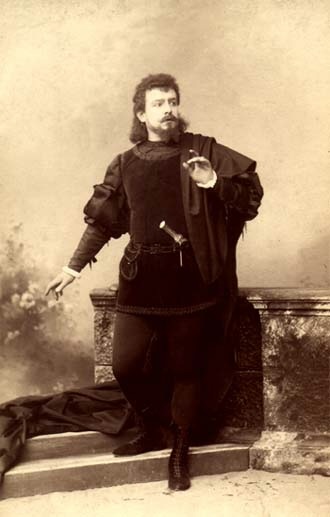
Having read in the programme for Saturday's performance of Gounod's Romeo et Juliette that Jean de Reske had sung the role of Romeo, with Melba as Juliette, at Covent Garden in 1889, I became curious because Reske was renowned for his Wagner singing.
Jean de Reszke was a Polish tenor, born in 1850 who became one of the most celebrated tenors of his day. Training initially as a baritone, he re-trained as a tenor and became one of the most notable performers of his day performing in Paris, London and New York. His repertoire covered the heavier roles and he sang significant numbers of Wagnerian roles, but also the French repertoire of his day (Meyerbeer, Gounod and Bizet). He sang his Wagner roles in both Italian and German.
We don't have many recordings of De Reske, there are a few live cylinder recordings of operatic performances, but no studio recordings seem to have survived. It is illuminating an instructive to look at how his repertoire changed over the years, the following is a list of his roles at Covent Garden (his Met roles were almost identical); it should be borne in mind that up to 1892, operas at Covent Garden were usually presented in Italian. I've not heard of Bemberg's Elaine, but the composer seems to have been South American, trained in Paris, De Reszke also sang the role of Lancelot at the work's American premiere at the Met in 1894. Esmeralda is by Arthur Goring Thomas and dates from 1883, it is based on the novel The Hunchback of Notre Dame; it was performed at Covent Garden in French.
1888: Vasco da Gama( L'Africaine - Meyerbeer), Raoul( Les Huguenots - Meyerbeer), Faust, Radames (Aida), Riccardo (Ballo in maschera), Lohengrin.
1889: Radames, Raoul( Les Huguenots), Lohengrin, Walter (Die Meistersinger), Romeo Roméo et Juliette - Gounod)
1890: Jean de Leyden (Le Prophète - Meyerbeer), Romeo, Faust, Don Josè (Carmen), Lohengrin, Walther, Phoebus (Esmeralda - Goring Thomas).
1891: Raoul ( Les Huguenots), Jean de Leyden (Le Prophète - Meyerbeer), Faust, Romeo, Don Josè, Otello, Lohengrin, Walter.
1892: Jean de Leyden (Le Prophète), Romeo, Don Jose, Lohengrin, Lancelot (Elaine - Bemberg)
1893: Raul ( Les Huguenots), Faust, Romeo, Lohengrin, Walter.
1894: Faust, Romeo, Werther, Radames, Lohengrin, Walter, Lancelot (Elaine)
1896: Faust, Romeo, Lohengrin, Walter, Tristan
1897: Romeo, Lohengrin, Walter, Tristan, Siegfried (Siegfried)
1898: Lohengrin, Walter, Tristan, Siegfried (Siegfried and Gotterdammerung)
1899: Faust, Romeo, Lohengrin, Walter, Tristan
1900: Romeo, Lohengrin, Walter
As with any helden-tenor, it is noticeable how the non-Wagner roles are reduced as the Wagner roles increase. But quite what defines a helden-tenor seems to have changed. Nowadays we would not really expect such a voice to sing Meyerbeer. But more remarkable is the way that the Gounod roles seem to persist in his repertoire. The idea of a tenor nowadays singing Siegfried, Faust and Romeo. De Reske was a re-trained baritone, which is often a help when it comes to singing Siegfried, but this is not a voice type that we would expect to hear in Faust or Romeo. As an example, think of the mature Domingo and then try to imagine him singing Faust or Romeo!
It was De Reske who suggested that Melba might sing Brunnhilde to his Siegfried in New York. Which she did with notable lack of success. But that she should attempt it at all is remarkable.
All this leaves me wishing that we had more record of De Reske's voice and technique. If fascinates me that he combined roles in ways that are not done nowadays, perhaps indicating that his approach to Wagner was far more bel canto than is done nowadays.
The picture at the head of this post is De Reszke as Romeo. There are many more pictures, plus information about his brother Edouard, here.
Review of Don Carlo from Midsummer Opera
Labels:
opera review
My review of Midsummer Opera's concert performance of Verdi's Don Carlo in the 4-Act 1884 version, is here, on Music and Vision (subscription site).
Tuesday, 16 November 2010
Review of Gounod's Romeo et Juliette
Labels:
opera review
On Saturday we attended Gounod's Romeo et Juliette at Covent Garden. My review is here, on Music and Vision (subscription site)
Sunday, 14 November 2010
Buxton Festival
Labels:
preview
This year's Buxton Festival looks as tempting as ever with Mary Plazas taking the title role in Donizetti's Maria di Rohan in a production by Stephen Medcalf and Jonathan Best as Handel's Saul in a staged performance directed by Olivia Fuchs and conducted by Harry Christophers. Staging Handel's oratorios is always tricky, but Saul is one of the more dramatic ones and it can be made to work. Annilise Miskimmon is staging Ambroise Thomas Mignon, definitely a rarity on these shores nowadays though it used to be extremely popular. The Wexford Festival staged the piece many years ago in a production by Richard Jones, but this does not seem to have started a revival.
Buxton have also announced their new artistic Director, Stephen Barlow, who takes over from Andrew Greenwood in 2011. We have seen Barlow conduct quite a number of times at Grange Park Opera, and his own opera based on Thomas Beckett and Henry II was premiered at Canterbury Cathedral. It will be interesting to see what mark he makes on Buxton
Buxton have also announced their new artistic Director, Stephen Barlow, who takes over from Andrew Greenwood in 2011. We have seen Barlow conduct quite a number of times at Grange Park Opera, and his own opera based on Thomas Beckett and Henry II was premiered at Canterbury Cathedral. It will be interesting to see what mark he makes on Buxton
Saturday, 13 November 2010
Critical (re)evaluation
This month's Opera Magazine has a review of ETO's premiere performance of Alexander Goehr's new opera Promised End by Andrew Porter. Porter gives the piece a long and thoughtful review which is very positive, quite a lot more positive than some of the reviews in the daily newspapers. I also found the work a little disappointing but Porter's valuable review has made me want to re-assess the work and hear it again. This is particularly true as ETO's performance will undoubtedly develop as their tour progresses.
Also in this month's Opera Magazine is a review of the CD of Michael Berkeley's latest opera, For You. For this opera Berkeley worked with Ian McEwen rather than David Malouf who had done the librettos for his previous operas. I have to confess that I have not seen For Your but have admired Berkeley's previous work. George Hall, in his review, seems unconvinced, describing the 'grey and anonymous ariosos', referring to the work as 'tiresome' and saying that Berkeley's two previous operas were more engaging.
Also in this month's Opera Magazine is a review of the CD of Michael Berkeley's latest opera, For You. For this opera Berkeley worked with Ian McEwen rather than David Malouf who had done the librettos for his previous operas. I have to confess that I have not seen For Your but have admired Berkeley's previous work. George Hall, in his review, seems unconvinced, describing the 'grey and anonymous ariosos', referring to the work as 'tiresome' and saying that Berkeley's two previous operas were more engaging.
Friday, 12 November 2010
Recent CD reviews
Labels:
cd review
My review of Ockeghem's Missa de plus en plus from the Orlando Consort on Brilliant Classics is here.
A superb recording of the mass and if you can live with the chansons, then I would go for it.
And my review of Donizetti's Lucia di Lammermoor from Bergamo on Naxos is here. Both reviews on MusicWeb International.
Too much of a danger that you will listen to it and wonder what all the fuss is about.
A superb recording of the mass and if you can live with the chansons, then I would go for it.
And my review of Donizetti's Lucia di Lammermoor from Bergamo on Naxos is here. Both reviews on MusicWeb International.
Too much of a danger that you will listen to it and wonder what all the fuss is about.
Saturday, 6 November 2010
Recent CD Review
Labels:
cd review
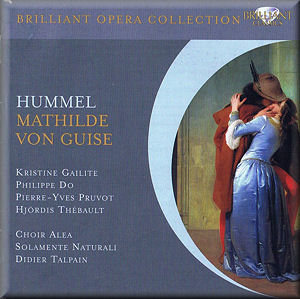
My review of Hummel's opera Mathilde de Guise, released on Brilliant Classics, is here, on MusicWeb International.
At Brilliant’s budget price, highly recommendable for anyone interested in what was happening to German opera in the period between Beethoven and Wagner.
Friday, 5 November 2010
New Mailing List
I am trying out new mailing list software, this comes with a web-form sign-up, so if you are not already on my mailing list then here you are:-
Saturday, 30 October 2010
Winner of the 2010 Ferrier Awards
Labels:
concert review
On Thursday night we were privileged to attend a private recital by Njabulo Madlala, the winner of the 2010 Ferrier Awards. Incidentally the awards will be celebrating the 100th anniversary of Kathleen Ferrier's birth in 2012.
Madlala, with accompanist James Baillieu, started with a group of Duparc songs. I must admit that I prefer these songs in the female voice, but Madlala's lovely baritone and nuanced way with the music had me convinced. He followed with a Schumann group which included a thrilling account of Belsazzar and a wonderfully narrative Die Beiden Grenadier. A group of Spirituals closed the first half.
The second half opened with a Strauss group. If a male voice singing Duparc is tricky, then male voices singing Richard Strauss is well nigh impossible. I heard Dieskau do en entire Strauss recital, and that never convinced me. Madlala's sheer passion and commitment brought off the first three songs, Zueignung, Allerseelen, Heimliche Aufforderung in a stunning manner. Morgen was less successful, Strauss gives the male voice an impossible task having to come in an octave lower than the long instrumental solo in the songs opening. But I have to admit that my companion felt that song worked well and that I was being too picky.
These were followed by an English group. A pair of Vaughan Williams songs and a pair of Butterworth, given evocative performances. Madlala has a lovely open personality which infused all the songs that he sang. But this really came to the fore in the final group of songs, all traditional songs from his native South Africa. An entrancing end to a lovely recital. Madlala is definitely a name to look out for.
Madlala, with accompanist James Baillieu, started with a group of Duparc songs. I must admit that I prefer these songs in the female voice, but Madlala's lovely baritone and nuanced way with the music had me convinced. He followed with a Schumann group which included a thrilling account of Belsazzar and a wonderfully narrative Die Beiden Grenadier. A group of Spirituals closed the first half.
The second half opened with a Strauss group. If a male voice singing Duparc is tricky, then male voices singing Richard Strauss is well nigh impossible. I heard Dieskau do en entire Strauss recital, and that never convinced me. Madlala's sheer passion and commitment brought off the first three songs, Zueignung, Allerseelen, Heimliche Aufforderung in a stunning manner. Morgen was less successful, Strauss gives the male voice an impossible task having to come in an octave lower than the long instrumental solo in the songs opening. But I have to admit that my companion felt that song worked well and that I was being too picky.
These were followed by an English group. A pair of Vaughan Williams songs and a pair of Butterworth, given evocative performances. Madlala has a lovely open personality which infused all the songs that he sang. But this really came to the fore in the final group of songs, all traditional songs from his native South Africa. An entrancing end to a lovely recital. Madlala is definitely a name to look out for.
Friday, 29 October 2010
Alice Coote and the English Concert
Labels:
concert review
Alice Coote's recital the the Wigmore Hall, on Wednesday 27th, with the English Concert directed by Harry Bicket, was a slightly uneasy mixture of vocal items. It was one of those programmes which seemed to have been constructed on the basis of 'things I'd like to sing' rather than a coherent narrative. So that Coote started with Monteverdi's Lamento di Arianna and then went on to sing a pair of Dowland songs before finishing with Handel's cantata La Lucrezia. In between these items the English Concert offered us Vivaldi's Sonata La Folia, Vivaldi's violin Concerts Il Grosso Mogul and a Vivaldi Cello concerto.
Now Coote is one of those singers who has managed to hang on to her period performance strand whilst still running an impressive career singing Strauss, Elgar and co. And when she performs it is never less than interesting, never. Her way with Monteverdi's Lament was mesmerising, detailed and large scale. She was accompanied by a substantial continuo group which included two fretted instruments, a harp, cello, double bass plus keyboard. The result was thrilling and vivid, but perhaps a little big boned.
Coote's way with the music was in fact so vivid, that you can't imagine her sustaining such a level of detail throughout an entire opera. And there is a case her for 'less is more'. This was definitely the case with the Dowland, where Coote seemed in danger of overshadowing her accompanist, William Carter. But it was in Handel's cantata that her approach brought immense dividends, actually using the music to drive the drama you almost felt that Coote was in danger of committing suicide herself. This was a coruscating performance. Can't someone persuade a record company to record this singer in Handel cantata's before her voice gets too big for the repertoire.
Before the concert started Coote was announced as having only recently recovered from 'flu but there seemed happily no sign of this in her singing.
The English Concert opened with the Vivaldi sonata in a thrilling performance led by Rachel Podger. And Podger shone even more in the cascades of notes which Vivaldi provides in his violin concerto, her performed with the surviving cadenzas so that we had an even closer idea of what it might be like to hear Vivaldi himself playing.
Jonathan Manson was the elegant soloist in the Vivaldi cello concerto.
After all the tumult of Handel's cantata had died down, the English Concert sent us home, toes tapping, with a delightful account of Pachelbel's Canon
Now Coote is one of those singers who has managed to hang on to her period performance strand whilst still running an impressive career singing Strauss, Elgar and co. And when she performs it is never less than interesting, never. Her way with Monteverdi's Lament was mesmerising, detailed and large scale. She was accompanied by a substantial continuo group which included two fretted instruments, a harp, cello, double bass plus keyboard. The result was thrilling and vivid, but perhaps a little big boned.
Coote's way with the music was in fact so vivid, that you can't imagine her sustaining such a level of detail throughout an entire opera. And there is a case her for 'less is more'. This was definitely the case with the Dowland, where Coote seemed in danger of overshadowing her accompanist, William Carter. But it was in Handel's cantata that her approach brought immense dividends, actually using the music to drive the drama you almost felt that Coote was in danger of committing suicide herself. This was a coruscating performance. Can't someone persuade a record company to record this singer in Handel cantata's before her voice gets too big for the repertoire.
Before the concert started Coote was announced as having only recently recovered from 'flu but there seemed happily no sign of this in her singing.
The English Concert opened with the Vivaldi sonata in a thrilling performance led by Rachel Podger. And Podger shone even more in the cascades of notes which Vivaldi provides in his violin concerto, her performed with the surviving cadenzas so that we had an even closer idea of what it might be like to hear Vivaldi himself playing.
Jonathan Manson was the elegant soloist in the Vivaldi cello concerto.
After all the tumult of Handel's cantata had died down, the English Concert sent us home, toes tapping, with a delightful account of Pachelbel's Canon
Wednesday, 27 October 2010
Piazolla
Labels:
concert review
Last night we attended a wonderful private recital by the Amor Quintet who play music by Astor Piazolla. They gave us a preview of their programme for their concert at St. James's Piccadilly, London on Thursday 28th October and they return to St. James's on 22nd December.
The quintet consists of Nikolai Ryskov - accordion, Anne-Marie Curran - violin, Gabriele Faja - piano, Milton Mermikides - guitar and Sam Ryan - double bass. The group plays Piazolla's original music rather than arrangements. They give wonderfully vivid and infectious performances, underlying which goes a great deal of artistry and virtuosity.
Their web-site has a sample of their playing and if you go to one of their concerts you'll be able to buy their first CD.
The quintet consists of Nikolai Ryskov - accordion, Anne-Marie Curran - violin, Gabriele Faja - piano, Milton Mermikides - guitar and Sam Ryan - double bass. The group plays Piazolla's original music rather than arrangements. They give wonderfully vivid and infectious performances, underlying which goes a great deal of artistry and virtuosity.
Their web-site has a sample of their playing and if you go to one of their concerts you'll be able to buy their first CD.
Saturday, 23 October 2010
When a Man Knows he needs Friends
Labels:
opera

As part of the run up to the performances next year of my opera When a Man Knows we have launched our friends scheme, When a Man knows he needs Friends, to encourage those interested to help support the performances of the opera.
There is more information here in an attractive pdf
Rare Rossini
Labels:
preview
As a complete contrast to the Lachenmann weekend at London's South Bank Centre, you can also visit the same venue this evening to hear a concert performance of Rossini's opera Aureliano in Palmira. Conducted by Maurizio Benini, a strong cast includes Catriona Smith, Kenneth Tarver, Silvia Trio Santafe and Andrew Foster Williams. The opera dates from 1813 and was premiered at La Scala, Milan. It comes between Tancredi, L'Italiana in Algeri and Il Turco in Italia. The role of Arsace was written for the castrato Velluti, the last of the great castrati. He also created the role of Armando in Meyerbeer's Il crociato in Egitto. In 1826 he took over the management of the Kings Theatre in London and appeared there in Aureliano. But after this the opera seems to have fallen into obscurity until the first modern revival in 1980.
The concert is at 7.00pm at the Royal Festival Hall.
The concert is at 7.00pm at the Royal Festival Hall.
Friday, 22 October 2010
Helmut Lachenmann at the South Bank Centre
Labels:
preview
Having devoted weekends to modernist composers such as Stockhausen, Messiaen, Nono, Xenakis, Berio, and Varèse the South Bank Centre are now turning their attention to Helmut Lachenmann. Now I must confess that Lachenmann's name is relatively unknown to me but his music is described as musique concrète instrumentale which is a term I've come across. In his music he uses instrumental sounds to emulate electronic music and has invented a wealth of techniques for instruments to use; naturally his music places strong demands on the players.
The South Bank Centre are devoting 2 days to Lachenmann. On Saturday 23rd October there are two concerts of his chamber music, along with a discussion between Lachenmann (now 75) and Ivan Hewett. Then on Sunday 24th October, the London Sinfonietta, under Brad Lubman give a concert of Lachenmann's orchestral music with pianist Rolf Hind.
The weekend presents a rare opportunity to get to know some of Lachenmann's music and enter the 'uncharted sonic realms free of habits of typical concert music' which it promises.
Saturday 23 October 2010: Queen Elizabeth Hall
Lachenmann Chamber Music Day
Tickets: £9–15
3PM – Arditti String Quartet
Lachenmann String Quartet No. 1, Gran Torso
Lachenmann String Quartet No. 3, Grido
4.15PM – Helmut Lachenmann discusses his music with journalist Ivan Hewett
5.30PM – Sarah Leonard (soprano), Rolf Hind (piano), Oliver Coates (cello)
Lachenmann Got Lost for soprano & piano
Lachenmann Pression for solo cello
Lachenmann Dal Niente for solo clarinet
Sunday 24 October 2010: Royal Festival Hall,
7.30PM - London Sinfonietta, Brad Lubman (conductor), Rolf Hind (piano)
Lachenmann Ausklang for piano & orchestra
Lachenmann Schreiben
If you are curious about Lachenmann's music then you can find some examples on his spotify playlist http://open.spotify.com/user/southbankcentre/playlist/4al6RuLlCOHngSAkPut8vo
The South Bank Centre are devoting 2 days to Lachenmann. On Saturday 23rd October there are two concerts of his chamber music, along with a discussion between Lachenmann (now 75) and Ivan Hewett. Then on Sunday 24th October, the London Sinfonietta, under Brad Lubman give a concert of Lachenmann's orchestral music with pianist Rolf Hind.
The weekend presents a rare opportunity to get to know some of Lachenmann's music and enter the 'uncharted sonic realms free of habits of typical concert music' which it promises.
Saturday 23 October 2010: Queen Elizabeth Hall
Lachenmann Chamber Music Day
Tickets: £9–15
3PM – Arditti String Quartet
Lachenmann String Quartet No. 1, Gran Torso
Lachenmann String Quartet No. 3, Grido
4.15PM – Helmut Lachenmann discusses his music with journalist Ivan Hewett
5.30PM – Sarah Leonard (soprano), Rolf Hind (piano), Oliver Coates (cello)
Lachenmann Got Lost for soprano & piano
Lachenmann Pression for solo cello
Lachenmann Dal Niente for solo clarinet
Sunday 24 October 2010: Royal Festival Hall,
7.30PM - London Sinfonietta, Brad Lubman (conductor), Rolf Hind (piano)
Lachenmann Ausklang for piano & orchestra
Lachenmann Schreiben
If you are curious about Lachenmann's music then you can find some examples on his spotify playlist http://open.spotify.com/user/southbankcentre/playlist/4al6RuLlCOHngSAkPut8vo
Thursday, 21 October 2010
Recent CD Reviews
Labels:
cd review
My review of the re-issue of the 1989 Kings College, Cambridge recording of Spem in alium is here.
An admirable re-issue and if you don’t already have a copy, go out and buy it at once.
And my review of a disc of sonatas by Giovanni Vitali is here. Both reviews on MusicWeb International.
Full of liveliness and charm.
An admirable re-issue and if you don’t already have a copy, go out and buy it at once.
And my review of a disc of sonatas by Giovanni Vitali is here. Both reviews on MusicWeb International.
Full of liveliness and charm.
Monday, 18 October 2010
CD Review
Labels:
cd review
William Grant Still:Danzas de Panama for String Quartet
Antonin Dvorak: String Quartet in F Major, Op. 96 (American)
Samuel Barber: String Quartet in B Minor, Opus 11
George Gerswhin: Lullaby for String Quartet
Serafin String Quartet
Centaur CRC 3050
The Serafin Quartet are a young American group who made their debut in 2004. The group's name comes from the 18th century violin maker, Sanctus Serfin, who made violinist Kate Ransom's violin. The group's line up is democratic, with both Kate Ransom and Timothy Schwarz taking turns as first violin. The remaining line up consists of Ana Tsinadze, viola, and Lawrence Stomberg, cello.
They have just released their first commercial CD on the Centaur label. This consists of an interesting programme which explores might make an American quartet, with works by William Grant Still, Dvorak, Samuel Barber and George Gershwin. This programme formed the core of the quartet's visit to London in September when they gave a recital at St. John's Smith Square.
The group open with William Grant Still's Danzas de Panama, a 4 movement suite for string quartet based on traditional melodies collected by Elisabeth Waldo. The cultural influences range from music of African Slaves to Spanish-Indian. Though Grant Still calls for some imaginative drum type beats, where the instrumentalist beats on the body of the instrument, the work is by and large quite traditional. Whereas in El Salon Mexico Aaron Copland (2 years younger than Grant Still) takes you physically into the Mexican dance hall, Grant Still is very much based in the salon or drawing room. His well-made arrangements are attractive and light, but they feel rather conventional and sanitised compared to Copland. But Grant Still's music is a relative rareity in the catalogue and the Serafin Quartet give his suite a lively and infectious performance.
They follow this with Dvorak's American Quartet, written in 1893 in response to meeting up with Czech immigrants in Iowa. Though the work does hint at Dvorak's inspirations in the New World, much of the piece is still based in Dvorak's old Czech world. The Serafin Quartet play with a pleasing melodiousness and a lightness of touch, but there were times when I would have liked more of an element of darkness to creep in. Theirs is a fine, slim tone, with a good emphasis on musical line. The Lento movement comes over particularly well, with some lovely singing lines. In the final Vivace, the group provide some nice perky rhythms, but you would not mistake them for a Czech group.
It is difficult to listen to Barber's Quartet (his only essay in the medium) without your listening being distorted by the subsequent fame the second movement found, independent of the Quartet, as the Adagio for Strings. In fact all three movements seems to struggle with the quartet medium and I did wonder what the quartet would sound like played by string orchestra. The entire work is a consciously retro piece, seeming to exist in an entirely different 1936 to reality. The opening movement is a big, old fashioned Romantic statement. Here the group's technical control remains admirable, but their sound just needs to be fatter. Barber's big, bold, passionate music calls for more experience of life than these youngsters seem to be able to give just yet. But the adagio is giving a poignant and sensitive reading, Barber's long, elegant lines shining beautifully. The final Molto Allegro, is a short almost perfunctory movement. It is fascinating to hear the Adagio in its original context; but as a complete work I wasn't quite so sure.
Finally, we get a delightful bon bouche, Gershwin's Lullaby for String Quartet, dating from 1919 and giving a fresh and charming reading by the Serafin Quartet.
This is a fascinating disc, showing 3 American composers all trying to come to terms, in their different ways, with the very European medium of the quartet. And a European showing how the New World could cross fertilise with the old. This is a highly impressive debut from the Serafin Quartet.
Antonin Dvorak: String Quartet in F Major, Op. 96 (American)
Samuel Barber: String Quartet in B Minor, Opus 11
George Gerswhin: Lullaby for String Quartet
Serafin String Quartet
Centaur CRC 3050
The Serafin Quartet are a young American group who made their debut in 2004. The group's name comes from the 18th century violin maker, Sanctus Serfin, who made violinist Kate Ransom's violin. The group's line up is democratic, with both Kate Ransom and Timothy Schwarz taking turns as first violin. The remaining line up consists of Ana Tsinadze, viola, and Lawrence Stomberg, cello.
They have just released their first commercial CD on the Centaur label. This consists of an interesting programme which explores might make an American quartet, with works by William Grant Still, Dvorak, Samuel Barber and George Gershwin. This programme formed the core of the quartet's visit to London in September when they gave a recital at St. John's Smith Square.
The group open with William Grant Still's Danzas de Panama, a 4 movement suite for string quartet based on traditional melodies collected by Elisabeth Waldo. The cultural influences range from music of African Slaves to Spanish-Indian. Though Grant Still calls for some imaginative drum type beats, where the instrumentalist beats on the body of the instrument, the work is by and large quite traditional. Whereas in El Salon Mexico Aaron Copland (2 years younger than Grant Still) takes you physically into the Mexican dance hall, Grant Still is very much based in the salon or drawing room. His well-made arrangements are attractive and light, but they feel rather conventional and sanitised compared to Copland. But Grant Still's music is a relative rareity in the catalogue and the Serafin Quartet give his suite a lively and infectious performance.
They follow this with Dvorak's American Quartet, written in 1893 in response to meeting up with Czech immigrants in Iowa. Though the work does hint at Dvorak's inspirations in the New World, much of the piece is still based in Dvorak's old Czech world. The Serafin Quartet play with a pleasing melodiousness and a lightness of touch, but there were times when I would have liked more of an element of darkness to creep in. Theirs is a fine, slim tone, with a good emphasis on musical line. The Lento movement comes over particularly well, with some lovely singing lines. In the final Vivace, the group provide some nice perky rhythms, but you would not mistake them for a Czech group.
It is difficult to listen to Barber's Quartet (his only essay in the medium) without your listening being distorted by the subsequent fame the second movement found, independent of the Quartet, as the Adagio for Strings. In fact all three movements seems to struggle with the quartet medium and I did wonder what the quartet would sound like played by string orchestra. The entire work is a consciously retro piece, seeming to exist in an entirely different 1936 to reality. The opening movement is a big, old fashioned Romantic statement. Here the group's technical control remains admirable, but their sound just needs to be fatter. Barber's big, bold, passionate music calls for more experience of life than these youngsters seem to be able to give just yet. But the adagio is giving a poignant and sensitive reading, Barber's long, elegant lines shining beautifully. The final Molto Allegro, is a short almost perfunctory movement. It is fascinating to hear the Adagio in its original context; but as a complete work I wasn't quite so sure.
Finally, we get a delightful bon bouche, Gershwin's Lullaby for String Quartet, dating from 1919 and giving a fresh and charming reading by the Serafin Quartet.
This is a fascinating disc, showing 3 American composers all trying to come to terms, in their different ways, with the very European medium of the quartet. And a European showing how the New World could cross fertilise with the old. This is a highly impressive debut from the Serafin Quartet.
Joan Sutherland
My history with Joan Sutherland is one of more missed opportunities than stunning performances.
I first saw her perform live at a recital, with Richard Bonynge at the piano, at the Free Trade Hall in Manchester in the 1970's. She looked very memorable, wearing what appeared to be a wrap-around, lime green dressing gown. And there was certainly no question over her technique, nor the ability to fill the Free Trade Hall with personality. The problem was that what we really wanted to hear was her operatic repertoire and the selection of Italian songs seemed to be very definitely second choice. In my memory, the only time that the evening really came alive was when she sang a selection from Offenbach's La Perichole.
Until 1981 I lived out of London (in Manchester and then in Scotland) and failed to get tickets for the Sutherland performances (such as her Maria Stuarda) that I tried to attend, though truth to tell, I probably didn't try too hard. So this means that the first time I heard La Stupenda in an opera was in 1983 when she sang the title role in Massenet's Esclarmonde. By 1983 Sutherland was in her late 50's, and not really in her prime. The performance was compromised by a security alert, when we all had to troop out of the opera house, mid-act. So if the performance was less than inspiring, there were mitigating circumsances. And, of course, Esclarmonde is hardly one of Massenet's strongest operas.
The final time I saw her was in Anna Bolena, also at Covent Garden in 1988. This was far stronger, both the role and the music seemed far more aligned to Sutherland's strengths at the period. Though we had to put up with a rather strange interval disposition, possibly to help the ageing diva.
Perhaps I should have gone to see one of her late Lucias at Covent Garden, which all got good reviews. But I was wary of hearing a soprano in the latter end of her career in such a role, preferring the Sutherland recorded in her prime to the live version in later years. Now, of course, I regret the decision greatly. That said, I still find it difficult to tie up some of the glowing reviews from her late career, with the actual sound I heard both live (in 1988) and from broadcasts.
I first saw her perform live at a recital, with Richard Bonynge at the piano, at the Free Trade Hall in Manchester in the 1970's. She looked very memorable, wearing what appeared to be a wrap-around, lime green dressing gown. And there was certainly no question over her technique, nor the ability to fill the Free Trade Hall with personality. The problem was that what we really wanted to hear was her operatic repertoire and the selection of Italian songs seemed to be very definitely second choice. In my memory, the only time that the evening really came alive was when she sang a selection from Offenbach's La Perichole.
Until 1981 I lived out of London (in Manchester and then in Scotland) and failed to get tickets for the Sutherland performances (such as her Maria Stuarda) that I tried to attend, though truth to tell, I probably didn't try too hard. So this means that the first time I heard La Stupenda in an opera was in 1983 when she sang the title role in Massenet's Esclarmonde. By 1983 Sutherland was in her late 50's, and not really in her prime. The performance was compromised by a security alert, when we all had to troop out of the opera house, mid-act. So if the performance was less than inspiring, there were mitigating circumsances. And, of course, Esclarmonde is hardly one of Massenet's strongest operas.
The final time I saw her was in Anna Bolena, also at Covent Garden in 1988. This was far stronger, both the role and the music seemed far more aligned to Sutherland's strengths at the period. Though we had to put up with a rather strange interval disposition, possibly to help the ageing diva.
Perhaps I should have gone to see one of her late Lucias at Covent Garden, which all got good reviews. But I was wary of hearing a soprano in the latter end of her career in such a role, preferring the Sutherland recorded in her prime to the live version in later years. Now, of course, I regret the decision greatly. That said, I still find it difficult to tie up some of the glowing reviews from her late career, with the actual sound I heard both live (in 1988) and from broadcasts.
Thursday, 14 October 2010
Celebrating Grainger
Labels:
preview
20th February 2011 will be the 50th anniversary of Percy Grainger's death and there are going to be a number of celebrations. There is a seminar on 20th February at the British Library, with the launch of a new Grainger Companion edited by Penelope Thwaites.
Plus a concert series at Kings Place, running from 17th February 2011 to 19th February. The concerts explore the full range of Grainger's work, ranging from folk song arrangements and pioneering editions of renaissance choral music, to The Warriors, an amazing piece which is described as music for an imaginary ballet. This will be performed at the concert on Saturday 19th February, in a fascinating programme which includes Grainger's arrangements of Javanese and Indian music, along with his versions of Mexican folk-songs collected by Natalie Curtis-Burlin
THURSDAY 17 FEBRUARY
6.00pm BAND BLAST-OFF Wind and Brass Ensembles, Guildhall saxophones & recorders
7.30pm THE HARMONIOUS SONGSMITH Addison Singers, cond. David Wordsworth, Stephen Varcoe, Penelope Thwaites, & Special Guest, Yvonne Kenny
FRIDAY 18 FEBRUARY
6.00pm PERCY GRAINGER AND THE PIANOLA Michael Broadway incl. Grainger himself playing
7.30pm WIND BAND SPECTACULAR The Royal Artillery Band, conductor, Maj. Neil Morgan
SATURDAY 19 FEBRUARY
1.30pm ROOM-MUSIC GEMS The Fitzwilliam String Quartet & friends
2.30pm SING GRAINGER Choral workshop for audience and choirs
4.45pm Experimenting with Grainger The “Electric Eye Tone Tool” & the Theremin
7.30pm EAST MEETS WEST Grainger Elastic Band, cond Roger Montgomery, Fitzwilliam Quartet, multi-pianos, Penelope Thwaites, John Lavender, Grainger Singers.
Plus a concert series at Kings Place, running from 17th February 2011 to 19th February. The concerts explore the full range of Grainger's work, ranging from folk song arrangements and pioneering editions of renaissance choral music, to The Warriors, an amazing piece which is described as music for an imaginary ballet. This will be performed at the concert on Saturday 19th February, in a fascinating programme which includes Grainger's arrangements of Javanese and Indian music, along with his versions of Mexican folk-songs collected by Natalie Curtis-Burlin
THURSDAY 17 FEBRUARY
6.00pm BAND BLAST-OFF Wind and Brass Ensembles, Guildhall saxophones & recorders
7.30pm THE HARMONIOUS SONGSMITH Addison Singers, cond. David Wordsworth, Stephen Varcoe, Penelope Thwaites, & Special Guest, Yvonne Kenny
FRIDAY 18 FEBRUARY
6.00pm PERCY GRAINGER AND THE PIANOLA Michael Broadway incl. Grainger himself playing
7.30pm WIND BAND SPECTACULAR The Royal Artillery Band, conductor, Maj. Neil Morgan
SATURDAY 19 FEBRUARY
1.30pm ROOM-MUSIC GEMS The Fitzwilliam String Quartet & friends
2.30pm SING GRAINGER Choral workshop for audience and choirs
4.45pm Experimenting with Grainger The “Electric Eye Tone Tool” & the Theremin
7.30pm EAST MEETS WEST Grainger Elastic Band, cond Roger Montgomery, Fitzwilliam Quartet, multi-pianos, Penelope Thwaites, John Lavender, Grainger Singers.
Tuesday, 12 October 2010
Promised End
Labels:
opera review
Alexander Goehr's new opera Promised End was much anticipated. Based on Shakespeare's King Lear and announced by Goehr to be his last opera (he is 78), the work received its first performance on Saturday 9th October at the Royal Opera House's Linbury Studio by English Touring Opera.
The libretto for Goehr's opera was taken directly from Shakespeare. Sir Frank Kermode, who died in August, had assembled a digest of the play which they reduced to some 24 scenes. Unlike Ades's The Tempest, Goehr decided to use Shakespeare's words directly and had evidently spent a lot of time declaiming the words before setting them.
The result was compact (two acts of just 45 minutes each) and direct, with the vocal line concentrating on a declamatory sense of the words. The problem seemed to be that the music scarcely had time to take hold. The scenes were all short and the opera seemed to be less than King Lear and more a sort of commentary on it. You probably needed to know the play to make sense of the opera. There didn't seem to be much space for the music to register or for the singers to develop character.
It didn't help that the diction was patchy so that not all the words came over. Roderick Earle's Lear was fine in the slower passages but some of the swifter (and important) dialogue got lost. But Julia Sporsen and Jacqueline Varsey as Regan and Goneril seemed to be unable to get much in the way of words across at all. A contributory factor may have been that the orchestra (the Aurora Orchestra) was placed at the back of the stage, with the singers in front, rather than being in a pit. Goehr's orchestration was lively and imaginative, but included 2 tubas, 2 trumpets and 2 horns.
The action in James Conway's production all took place in a relatively narrow strip at the front of the stage, with a setting consisting of some flexible screens and a podium which started off as Lear's throne and went on to double as the blasted heath and Olt Tom's hovel. In fact the acting area seemed rather cramped, especially as the entire cast remained on stage at all times and formed a sort of chorus, commenting on the action.
The cast all turned in strong performances and gave Conway's rather Noh-inspired production their full committment. Despite the generalised western european medieval costumes (designer Adam Wiltshire), the cast had white makeup, bare-feet and used a sand-box when walking onto the acting area.
But strong as the performances were, everything seemed to be over in a flash. No sooner had you struggled to comprehend what the singers were saying (no surtitles), than the scene was over. I felt that some of the strongest and most memorable moments were in the orchestral interludes. Only fleetingly did the sung music manage to achieve any sort of telling memorability, notably in Lina Markeby's accounts of the Fools songs (the roles of the Fool and Cordelia were doubled). The biggest failing seemed to be the lack of any strong emotional pull in the role of Lear, despite Earle's sterling work.
Nigel Robson was a noble Gloucester with Adrian Dwyer and Nicholas Garrett as his sons. Their plotting came off best, perhaps because Garrett was adept at conveying much by simple body language and Dwyer was the most incisive in getting the words over.
The Aurora Orchestra under Ryan Wigglesworth made a strong orchestral contribution.
I had been looking forward to this opera for some time and was profoundly disappointed that it did not have a stronger effect on me. The Brechtian cast of the work meant that I admired it rather than loved it; the piece was a voyage around Lear rather than being Lear.
The libretto for Goehr's opera was taken directly from Shakespeare. Sir Frank Kermode, who died in August, had assembled a digest of the play which they reduced to some 24 scenes. Unlike Ades's The Tempest, Goehr decided to use Shakespeare's words directly and had evidently spent a lot of time declaiming the words before setting them.
The result was compact (two acts of just 45 minutes each) and direct, with the vocal line concentrating on a declamatory sense of the words. The problem seemed to be that the music scarcely had time to take hold. The scenes were all short and the opera seemed to be less than King Lear and more a sort of commentary on it. You probably needed to know the play to make sense of the opera. There didn't seem to be much space for the music to register or for the singers to develop character.
It didn't help that the diction was patchy so that not all the words came over. Roderick Earle's Lear was fine in the slower passages but some of the swifter (and important) dialogue got lost. But Julia Sporsen and Jacqueline Varsey as Regan and Goneril seemed to be unable to get much in the way of words across at all. A contributory factor may have been that the orchestra (the Aurora Orchestra) was placed at the back of the stage, with the singers in front, rather than being in a pit. Goehr's orchestration was lively and imaginative, but included 2 tubas, 2 trumpets and 2 horns.
The action in James Conway's production all took place in a relatively narrow strip at the front of the stage, with a setting consisting of some flexible screens and a podium which started off as Lear's throne and went on to double as the blasted heath and Olt Tom's hovel. In fact the acting area seemed rather cramped, especially as the entire cast remained on stage at all times and formed a sort of chorus, commenting on the action.
The cast all turned in strong performances and gave Conway's rather Noh-inspired production their full committment. Despite the generalised western european medieval costumes (designer Adam Wiltshire), the cast had white makeup, bare-feet and used a sand-box when walking onto the acting area.
But strong as the performances were, everything seemed to be over in a flash. No sooner had you struggled to comprehend what the singers were saying (no surtitles), than the scene was over. I felt that some of the strongest and most memorable moments were in the orchestral interludes. Only fleetingly did the sung music manage to achieve any sort of telling memorability, notably in Lina Markeby's accounts of the Fools songs (the roles of the Fool and Cordelia were doubled). The biggest failing seemed to be the lack of any strong emotional pull in the role of Lear, despite Earle's sterling work.
Nigel Robson was a noble Gloucester with Adrian Dwyer and Nicholas Garrett as his sons. Their plotting came off best, perhaps because Garrett was adept at conveying much by simple body language and Dwyer was the most incisive in getting the words over.
The Aurora Orchestra under Ryan Wigglesworth made a strong orchestral contribution.
I had been looking forward to this opera for some time and was profoundly disappointed that it did not have a stronger effect on me. The Brechtian cast of the work meant that I admired it rather than loved it; the piece was a voyage around Lear rather than being Lear.
Review of Radamisto
Labels:
opera review
My review of the new production of Radamisto at the London Coliseum, is here on Music and Vision(subscription site).
Monday, 11 October 2010
Barber and Elgar
Labels:
performance,
preview

Tomorrow night (Tuesday October 12th), the Salomon Orchestra under conductor Dominic Grier give a programme devoted to Elgar and to Barber at St. Johns Smith Square in London. In addition to Barber's Adagio the orchestra are performing his Essay No. 2 for Orchestra ; concise single movement work lasting just 11 minutes which received its first performance in 1942. The concert concludes with Elgar's First Symphony and opens with his arrangement of a Bach Prelude and Fugue.
Saturday, 9 October 2010
On Thursday we attended the first night of Radamisto at the London Coliseum, a review will follow shortly. But the production did set me wondering about the effects of production sharing on the production styles. Radamisto was created for Santa Fe, a festival in the USA which has the reputation for interesting choices of repertoire. But, as we learned when we visited there, the audience still needs introducing carefully to rarities. And, of course, in many places Handel is still quite a rarity. You felt that director David Alden was at some pains to create an attractive stage product, that he only touched the work lightly. That if he'd been working only for ENO then the production would have been rather darker and less fun as Alden could rely more on carrying the audience with him, as ENO audiences have become accustomed both to his style and to Handelian opera seria. The production of the opera at Opera North,in 1999/2000 with Emma Bell, Alice Coote and David Walker, directed by Tim Hopkins, seemed to more successfully present the work's essential seriousness and darkness.
We have not seen the new ENO Faust yet (we see it next week), but at least 1 review has said that the production seems marooned mid-Atlantic, not dramatic and daring enough for the Coliseum and not elaborate enough for the Met (with whom it is shared). But I suppose that, in this economic climate, we'll have to put up with these compromises.
We have not seen the new ENO Faust yet (we see it next week), but at least 1 review has said that the production seems marooned mid-Atlantic, not dramatic and daring enough for the Coliseum and not elaborate enough for the Met (with whom it is shared). But I suppose that, in this economic climate, we'll have to put up with these compromises.
Labels:
diary
Last night we attended a private recital given by violinist Tamsin Waley-Cohen and pianist Simon Crawford-Philips. In a wide-ranging programme they gave us Handel's Sonata in D, Beethoven's Sonata Op. 30 no. 2, Delius's Sonata in B and Debussy's Sonata. One of the fascinating things that the recital pointed up was the difference and relationship between the violin and accompanying instrument over the period. Handel was born 85 years before Beethoven, Delius and Debussy were both born 92 years after Beethoven, a strikingly neat spacing of material. Perhaps the Debussy and Delius sonatas need to be rather more lived-in than these performances were, Waley-Cohen has the technique and style but not quite discovered the essence of these pieces, something that comes only gradually.
Earlier this year, at the same venue, we heard a performance of a Vivaldi violin concerto called Il Gran Mogul, so I rather did wonder about the relationship between this concerto and the recently discovered Flute concerto by Vivaldi of the same name.
Earlier this year, at the same venue, we heard a performance of a Vivaldi violin concerto called Il Gran Mogul, so I rather did wonder about the relationship between this concerto and the recently discovered Flute concerto by Vivaldi of the same name.
Friday, 8 October 2010
Recent CD Reviews
Labels:
cd review
My review of Eton College Choir's disc of French sacred music, including the Messe Solonnelle by Jean Langlais, is here.
Well worth investigating
And my review of Handel's Berenice from Alan Curtis and Il Complesso Barocco is here. Both reviews on MusicWeb International.
Plenty of interest here. An intelligently balanced performance which certainly does the piece justice.
Well worth investigating
And my review of Handel's Berenice from Alan Curtis and Il Complesso Barocco is here. Both reviews on MusicWeb International.
Plenty of interest here. An intelligently balanced performance which certainly does the piece justice.
Wednesday, 6 October 2010
Thou, O Christ
Labels:
performance
The choir of St. Botolph without Bishopsgate (London EC2M), conductor Timothy Storey, will be giving a performance of my anthem Thou, O Christ during the service at 1.10pm today. The anthem is a setting of words by St. Symeon the new Theologian whose feast occurs around this time.
Tuesday, 5 October 2010
Review of Madam Butterfly
Labels:
opera review
My review of Grange Park Opera's performance of Madam Butterfly at London's Cadogan Hall is here, on Music and Vision (subscription site).
Monday, 4 October 2010
Papal visit
Labels:
diary
It was heartening that the Papal visit included a number of pieces by James Macmillan. His Mass of John Henry Newman was commissioned for the visit and was heard at the open-air masses in Glasgow and in Birmingham; the mass is a congregational one, being scored for cantor, congregation and organ with optional SATB Choir, brass and timpani.
You can see the Papal mass at Westminster Cathedral here, it opens with a wonderfully loud Introit by James MacMillan.
You can see the Papal mass at Westminster Cathedral here, it opens with a wonderfully loud Introit by James MacMillan.
Saturday, 2 October 2010
Tristan und Isolde at the Royal Festival Hall
Labels:
opera review
I must confess that we originally booked tickets for the Philharmonia Orchestra's performance on Sunday of Tristan und Isolde, purely on the basis that Christine Brewer was to sing Isolde. In the event Brewer withdrew and was replaced by Violeta Urmana and the concert performance gained the added attraction of the Bill Viola videos designed for Peter Sellers production of the opera seen in LA and Paris.
As it happened, we were sitting at the side of the stalls so we did not have an optimal view, we could either see the soloists or the videos, but not both at the same time. Those sitting in the centre of the stalls would have seen the soloists with the video looming behind.
Though this was a concert performance, the singers were off the book and some attempts were made at entrances and exits and character interaction. Additionally much use was made of the RFH itself with many of the smaller solos coming from different parts of the hall. Some of this worked well such as having Tristan (Gary Lehman) and Kurwenal (Jukka Rasilainen) standing on the balcony above the stage during Act 1. But at other times this felt contrived, as in Act 2 for Tristan's entrance when Lehman and Urmana had to greet each other across the full width of the RFH stalls.
This was a very vivid urgent performance, thanks to the superb playing from the Philharmonia Orchestra with conductor Esa-Peka Salonen keeping the music moving. This Tristan und Isolde never felt fast, but it flowed along, a far cry from the magical stasis that some conductors aim for. Under Salonen's baton the Prelude wasn't quite in a slow 2, but was definitely in a defined tempo.
When I last heard Urmana, the top of her voice seemed a little unstable under pressure as if the move to soprano repertoire had still not settled. There were no such problems here. She sang Isolde with a wonderfully clear bright tone. She was clearly managing her voice, but this paid off as she seemed tireless, giving the closing Liebestod the same vividness she brought to the opening.
That said, I found Urmana a rather placid artist; one perhaps who needs a fully staged production with an enlivening producer, to give her most. She seemed at her best in Act 1, when her account of Isolde's curse was terrific (memories of Gwyneth Jones) and her dialogues with Lehman's Tristan fairly crackled.
But in the love duet her leisurely sensuality seemed to whip itself into erotic frenzy rather too late. And I have rarely heard the Liebestod so beautifully sung, but it didn't wring the withers the way it should.
Gary Lehman was quite a find as Tristan. Granted, we were sitting quite close to him in the RFH, so it is difficult to judge how his voice would sound if you were sitting in the gods of the Royal Opera House. But he seemed tireless and you never felt that he was obviously husbanding resources; like Urmana he managed to start just as he finished.
Lehman seems to be vivid artist and with the help of a producer could create a striking Tristan. Even in this semi-staged version he was eminently watchable, obviously thinking about his character. His closing scene was notable for the way he conveyed Tristan's delirium. That said, I did wish he had taken a few more risks at this point, his singing lacked danger.
Jukka Rasilainen was an ideal Kurwenal, a bluff soldierly presence who conveyed his car for his master. I'd like to encounter him on stage as he conveyed much even with the minimal resources available to him.
Anne Sofie von Otter was effective as Brangäne. If that sounds grudging it is because I have always thought it a pig of a part. Von Otter did what was needed of her, sang with warm tones and dramatic impetus.
I think that Matthew Best was a good King Marke. But I find the role to be a prosy bore and Best didn't quite convince me otherwise. The remaining cast, Stephen Gadd as Melot, Joshua Ellicott as the Shepherd and the Sailor, Darren Jeffrey as the helmsman were all well cast.
As for the accompanying video, it was at best a fascinating commentary and at worst a distraction. For me, it failed to achieve the status of parallel work of art to which it seemed to aspire. The generalised images, the sea at the opening of Act 1, the later images of forest, sunset etc., were evocative. The closing images of the dead Tristan were astonishing, the watery images of Tristan and Isolde were evocative but verging on the disquieting when the young couple (in Act 2) appeared to drown themselves.
But a major miscalculation was the sequence during Isolde's curse in Act 1. Viola had set this as purification, with the couple disrobing and being anointed with water, certainly not what the act is about. More serious, during Isolde's curse, when Urmana was at her most vivid, she was juxtaposed with images of the man and woman removing the last vestiges of clothing and standing naked - a profound and unnecessary distraction which did nothing to enhance the music.
The Philharmonia Orchestra filled the stage and played with gusto, quite a challenge for the singers. In face there were few balance problems. And the close of Act 1, with the extra trumpets at the back of the stalls and the chorus in the balcony was the most exciting I have ever heard.
This was one of the most beautifully sung and played accounts of Tristan und Isolde that I have heard in a long time. I do hope that Salonen and the orchestra manage to get one of the live performances to CD as it deserves to be heard again.
As it happened, we were sitting at the side of the stalls so we did not have an optimal view, we could either see the soloists or the videos, but not both at the same time. Those sitting in the centre of the stalls would have seen the soloists with the video looming behind.
Though this was a concert performance, the singers were off the book and some attempts were made at entrances and exits and character interaction. Additionally much use was made of the RFH itself with many of the smaller solos coming from different parts of the hall. Some of this worked well such as having Tristan (Gary Lehman) and Kurwenal (Jukka Rasilainen) standing on the balcony above the stage during Act 1. But at other times this felt contrived, as in Act 2 for Tristan's entrance when Lehman and Urmana had to greet each other across the full width of the RFH stalls.
This was a very vivid urgent performance, thanks to the superb playing from the Philharmonia Orchestra with conductor Esa-Peka Salonen keeping the music moving. This Tristan und Isolde never felt fast, but it flowed along, a far cry from the magical stasis that some conductors aim for. Under Salonen's baton the Prelude wasn't quite in a slow 2, but was definitely in a defined tempo.
When I last heard Urmana, the top of her voice seemed a little unstable under pressure as if the move to soprano repertoire had still not settled. There were no such problems here. She sang Isolde with a wonderfully clear bright tone. She was clearly managing her voice, but this paid off as she seemed tireless, giving the closing Liebestod the same vividness she brought to the opening.
That said, I found Urmana a rather placid artist; one perhaps who needs a fully staged production with an enlivening producer, to give her most. She seemed at her best in Act 1, when her account of Isolde's curse was terrific (memories of Gwyneth Jones) and her dialogues with Lehman's Tristan fairly crackled.
But in the love duet her leisurely sensuality seemed to whip itself into erotic frenzy rather too late. And I have rarely heard the Liebestod so beautifully sung, but it didn't wring the withers the way it should.
Gary Lehman was quite a find as Tristan. Granted, we were sitting quite close to him in the RFH, so it is difficult to judge how his voice would sound if you were sitting in the gods of the Royal Opera House. But he seemed tireless and you never felt that he was obviously husbanding resources; like Urmana he managed to start just as he finished.
Lehman seems to be vivid artist and with the help of a producer could create a striking Tristan. Even in this semi-staged version he was eminently watchable, obviously thinking about his character. His closing scene was notable for the way he conveyed Tristan's delirium. That said, I did wish he had taken a few more risks at this point, his singing lacked danger.
Jukka Rasilainen was an ideal Kurwenal, a bluff soldierly presence who conveyed his car for his master. I'd like to encounter him on stage as he conveyed much even with the minimal resources available to him.
Anne Sofie von Otter was effective as Brangäne. If that sounds grudging it is because I have always thought it a pig of a part. Von Otter did what was needed of her, sang with warm tones and dramatic impetus.
I think that Matthew Best was a good King Marke. But I find the role to be a prosy bore and Best didn't quite convince me otherwise. The remaining cast, Stephen Gadd as Melot, Joshua Ellicott as the Shepherd and the Sailor, Darren Jeffrey as the helmsman were all well cast.
As for the accompanying video, it was at best a fascinating commentary and at worst a distraction. For me, it failed to achieve the status of parallel work of art to which it seemed to aspire. The generalised images, the sea at the opening of Act 1, the later images of forest, sunset etc., were evocative. The closing images of the dead Tristan were astonishing, the watery images of Tristan and Isolde were evocative but verging on the disquieting when the young couple (in Act 2) appeared to drown themselves.
But a major miscalculation was the sequence during Isolde's curse in Act 1. Viola had set this as purification, with the couple disrobing and being anointed with water, certainly not what the act is about. More serious, during Isolde's curse, when Urmana was at her most vivid, she was juxtaposed with images of the man and woman removing the last vestiges of clothing and standing naked - a profound and unnecessary distraction which did nothing to enhance the music.
The Philharmonia Orchestra filled the stage and played with gusto, quite a challenge for the singers. In face there were few balance problems. And the close of Act 1, with the extra trumpets at the back of the stalls and the chorus in the balcony was the most exciting I have ever heard.
This was one of the most beautifully sung and played accounts of Tristan und Isolde that I have heard in a long time. I do hope that Salonen and the orchestra manage to get one of the live performances to CD as it deserves to be heard again.
Friday, 1 October 2010
Oliver's Euridice
Labels:
opera review
My review of British Youth Opera's performance of Stephen Oliver's Euridice is here, on Music and Vision (subscription site).
Thursday, 30 September 2010
Recent CD Review
Labels:
cd review
My review of a disc of music for the Feast of St. Peter from Westminster Abbey is here on MusicWeb International.
Not showy; instead you really feel that you are eavesdropping on a genuine liturgical event.
Not showy; instead you really feel that you are eavesdropping on a genuine liturgical event.
Wednesday, 29 September 2010
Singapore Symphony Orchestra
Labels:
preview
The Singapore Symphony Orchestra are making their first visit to the UK since 1991. Their concert feature's Debussy's La Mer, Rachmaninov's Isle of the Dead and a piece by Zhou Long. But the main reason for featuring it here is that the orchestra are releasing their recording of Mahler 10 on DVD so we get to play a preview of it.
Tuesday, 28 September 2010
Steffani's Niobe at Covent Garden
Labels:
opera review
Agostino Steffani was born some 30 years before Handel. A native of Italy but with a career based in Germany, he wrote a body of operas for the courts of Munich and Hanover before devoting his life to diplomacy and the church. Handel knew him and admired his music; Steffani may have helped get Handel his first job in Hanover.
Steffani's operas mix Italian and French styles. His training took him to Italy but he spent time in France absorbing the local musical mores; so that many of his arias utilise French dance forms. Covent Garden's production of Steffani's Niobe (written 1688) was designed by Raimund Bauer and Andrea Schmidt-Futterer, directed by Lukas Hemleb; it was originally seen at the Schwetzingen Festival and is being seen in a revised version at Covent Garden and Luxembourg. Thomas Hengelbrock directed his own period instrument ensemble the Balthasar Neumann Ensemble in the pit.
The problem with Niobe was simply its length. Act 1 lasted 85 minutes. Acts 2 and 3 had been cut so that combined they lasted 95 minutes. But, as far as I could tell, the cuts almost rendered the drama incoherent and reminded me of some of the drastic, drama inhibiting pruning that happened to some of Handel's later librettos. In the event, the evening started at 6.30pm, and finished at 9.4pm, so Covent Garden should have had the courage of their convictions and given us a 2nd interval and 20 minutes more music.
Steffani's arias are generally short and frequent (around 60 in a typical opera). His orchestration is lively and interesting, keeping the textures varied and moving. His operas need display, but his music matches this in inspiration so I was constantly being surprised and charmed.
A contributing factor to the opera's length was the sheer number of characters. They divided into three distinct groups, whose interactions fluctuated during the evening.
First there was Anfione, King of Thebes (Jacek Lazsczkowski) and his wife Niobe (Veronique Gens). Anfione has decided to retire from ruling and brings in Clearte (Tim Mead) to help Niobe rule. Clearte has been hiding in the wilds trying to forget his love for Niobe. Niobe's nurse Nerea (Delphine Galou) was the only comic character, injecting wry comments into the proceedings.
Then there was Tiberino (Lothar Odinius), son of the King of Alba and general he-man and warrior, who intends to attack Thebes. He kills a monster thus saving the life of Manto (Amanda Forsythe), priestess of Latona and daughter of Tiresia (Bruna Taddia), blind seer and high priest of Latona.
Finally there is the magician Poliferno (Alastair Miles), whose sister and brother-in-law were the previous King and Queen of Thebes and were killed by Anfione. Poliferno wants to be revenged on Anfione so he uses his black arts on Creonte, Prince of Thessaly (Iestyn Davies) so that Creonte desires Niobe and will do anything to get her.
Tiberino and Manto spent the entire opera havering before declaring their love. After Niobe and Anfione, Tiberino and Manto got the other significant share of air time and, frankly, we rather got tired of them and longed for them to get on with it. Similarly Clearte never does tell Niobe of his love for her.
In one astonishing scene, Anfione in retreat in the Palace of Harmony sings hauntingly of the music of the spheres, here Lazsczkowski's high counter-tenor, Steffani's gorgeous music and Bauer's designs combined into something special. Then, when Tiberino attacks Thebes, Anfione's singing raises Thebes walls.
In Act 2 Poliferno's arts create an artificial heaven (more stage spectacular) and he disguises Creonte as Mars so he can seduce Niobe - cue for more lovely music combining with spectacular stage pictures.
When order is restored, Tiberino and Manto give thanks to the goddess Latone (no, given that Tiberino was attacking Thebes, I've no idea how he comes to be celebrating his marriage in Thebes). In a fit of amazing hubris, Niobe declares that Latone's shrine should be pulled down and that people should revere her and Anfione as gods on earth. In retribution the Gods bring down fire and kill Niobe's children, Anfione commits suicide as a result. Niobe's tears flow and she turns to stone. Cleonte banishes Poliferno and becomes king of Thebes.
So, are you still with me?
Veronique Gens was a wonderful Niobe, definitely worth the visit just for her. Initially she seemed the heroine, in love with her husband and children. But we gradually detect other aspects to the character including her hubris and pride. Furious as being duped by Poliferno's magic, Gens conveyed the myriad facets of the character, though never made her likeable.
As her husband, Anfione, Lazsczkowski sang with a voice which went up beyond the stave. A remarkable voice, the very upper register was clear, pure and rather alarming, but the middle was cloudy and rather hollow and badly integrated to his chesty lower voice. In the high, lyrical passages you could be entrance, but in the lower lying dialogues and the faster bravura sections, he was less than impressive. Typically such high lying flasetto voices are not large and it was to Lazsczkowski's credit that, at his best, he filled the hall with such beauty.
Tim Mead's Clearte was a semi-comic role, as his character had to spend the opera never quite daring to tell Niobe that he loved her. Odinius's Tiberino was presented as a simple strong man (and he seemed to have no visible army). He and Amanda Forsythe were charming and lovely at first, but frankly I got a bit fed up with them. Taddia's playing of the blind Tiresia was impressive, combining a fine passionately focussed voice with an impressive ability to walk into furniture.
I did wonder whether Nerea should have been played by a man; if this had been a Venetian opera then she would have been. Anyway Delphine Galou was suitably acerbic and amusingly pert in the role, puncturing posturing nicely.
Alistair Miles and Iestyn Davies seemed to suffer rather in the costume department and Poliverno's magic seemed to consist of a giant amorphous blob which followed him about. Still, Davies got to sing a beautiful scene with Gens and he came out on top at the end.
Steffani's operas call for lots of stage effects. Hemleb and Bauer created some brilliant ones in a modern idiom. Good use was made of a mirrored back-drop which created some beautiful effects. This was a staging which was a feast for the eyes but you never felt that Hemleb was struggling to find another trick in order to keep us entertained. The production flowed nicely and Hemleb wasn't afraid of doing nothing. Moments like Anfione's moving scene when he thinks he has lost Niobe were played on a bare open stage.
After the unimpressive Tamerlano earlier this year, it was good to see and hear a baroque opera done well at Covent Garden. Crucially Hemleb kept his singers well forward at all important moments, there was not question here of the set swallowing sound. My only real complaint about the production (cutting apart) was that Hemleb seemed to have ignored the French influence in the piece. There were many moments when Steffani's music seemed to call for dance, real formal dancing, and this was not provided. Instead we had a couple of quasi-comic dance interludes which seemed entirely wrong in tone.
I can't say I found Niobe a forgotten masterpiece. But it was certainly a fascinating and important work, one I would love to encounter again.
Steffani's operas mix Italian and French styles. His training took him to Italy but he spent time in France absorbing the local musical mores; so that many of his arias utilise French dance forms. Covent Garden's production of Steffani's Niobe (written 1688) was designed by Raimund Bauer and Andrea Schmidt-Futterer, directed by Lukas Hemleb; it was originally seen at the Schwetzingen Festival and is being seen in a revised version at Covent Garden and Luxembourg. Thomas Hengelbrock directed his own period instrument ensemble the Balthasar Neumann Ensemble in the pit.
The problem with Niobe was simply its length. Act 1 lasted 85 minutes. Acts 2 and 3 had been cut so that combined they lasted 95 minutes. But, as far as I could tell, the cuts almost rendered the drama incoherent and reminded me of some of the drastic, drama inhibiting pruning that happened to some of Handel's later librettos. In the event, the evening started at 6.30pm, and finished at 9.4pm, so Covent Garden should have had the courage of their convictions and given us a 2nd interval and 20 minutes more music.
Steffani's arias are generally short and frequent (around 60 in a typical opera). His orchestration is lively and interesting, keeping the textures varied and moving. His operas need display, but his music matches this in inspiration so I was constantly being surprised and charmed.
A contributing factor to the opera's length was the sheer number of characters. They divided into three distinct groups, whose interactions fluctuated during the evening.
First there was Anfione, King of Thebes (Jacek Lazsczkowski) and his wife Niobe (Veronique Gens). Anfione has decided to retire from ruling and brings in Clearte (Tim Mead) to help Niobe rule. Clearte has been hiding in the wilds trying to forget his love for Niobe. Niobe's nurse Nerea (Delphine Galou) was the only comic character, injecting wry comments into the proceedings.
Then there was Tiberino (Lothar Odinius), son of the King of Alba and general he-man and warrior, who intends to attack Thebes. He kills a monster thus saving the life of Manto (Amanda Forsythe), priestess of Latona and daughter of Tiresia (Bruna Taddia), blind seer and high priest of Latona.
Finally there is the magician Poliferno (Alastair Miles), whose sister and brother-in-law were the previous King and Queen of Thebes and were killed by Anfione. Poliferno wants to be revenged on Anfione so he uses his black arts on Creonte, Prince of Thessaly (Iestyn Davies) so that Creonte desires Niobe and will do anything to get her.
Tiberino and Manto spent the entire opera havering before declaring their love. After Niobe and Anfione, Tiberino and Manto got the other significant share of air time and, frankly, we rather got tired of them and longed for them to get on with it. Similarly Clearte never does tell Niobe of his love for her.
In one astonishing scene, Anfione in retreat in the Palace of Harmony sings hauntingly of the music of the spheres, here Lazsczkowski's high counter-tenor, Steffani's gorgeous music and Bauer's designs combined into something special. Then, when Tiberino attacks Thebes, Anfione's singing raises Thebes walls.
In Act 2 Poliferno's arts create an artificial heaven (more stage spectacular) and he disguises Creonte as Mars so he can seduce Niobe - cue for more lovely music combining with spectacular stage pictures.
When order is restored, Tiberino and Manto give thanks to the goddess Latone (no, given that Tiberino was attacking Thebes, I've no idea how he comes to be celebrating his marriage in Thebes). In a fit of amazing hubris, Niobe declares that Latone's shrine should be pulled down and that people should revere her and Anfione as gods on earth. In retribution the Gods bring down fire and kill Niobe's children, Anfione commits suicide as a result. Niobe's tears flow and she turns to stone. Cleonte banishes Poliferno and becomes king of Thebes.
So, are you still with me?
Veronique Gens was a wonderful Niobe, definitely worth the visit just for her. Initially she seemed the heroine, in love with her husband and children. But we gradually detect other aspects to the character including her hubris and pride. Furious as being duped by Poliferno's magic, Gens conveyed the myriad facets of the character, though never made her likeable.
As her husband, Anfione, Lazsczkowski sang with a voice which went up beyond the stave. A remarkable voice, the very upper register was clear, pure and rather alarming, but the middle was cloudy and rather hollow and badly integrated to his chesty lower voice. In the high, lyrical passages you could be entrance, but in the lower lying dialogues and the faster bravura sections, he was less than impressive. Typically such high lying flasetto voices are not large and it was to Lazsczkowski's credit that, at his best, he filled the hall with such beauty.
Tim Mead's Clearte was a semi-comic role, as his character had to spend the opera never quite daring to tell Niobe that he loved her. Odinius's Tiberino was presented as a simple strong man (and he seemed to have no visible army). He and Amanda Forsythe were charming and lovely at first, but frankly I got a bit fed up with them. Taddia's playing of the blind Tiresia was impressive, combining a fine passionately focussed voice with an impressive ability to walk into furniture.
I did wonder whether Nerea should have been played by a man; if this had been a Venetian opera then she would have been. Anyway Delphine Galou was suitably acerbic and amusingly pert in the role, puncturing posturing nicely.
Alistair Miles and Iestyn Davies seemed to suffer rather in the costume department and Poliverno's magic seemed to consist of a giant amorphous blob which followed him about. Still, Davies got to sing a beautiful scene with Gens and he came out on top at the end.
Steffani's operas call for lots of stage effects. Hemleb and Bauer created some brilliant ones in a modern idiom. Good use was made of a mirrored back-drop which created some beautiful effects. This was a staging which was a feast for the eyes but you never felt that Hemleb was struggling to find another trick in order to keep us entertained. The production flowed nicely and Hemleb wasn't afraid of doing nothing. Moments like Anfione's moving scene when he thinks he has lost Niobe were played on a bare open stage.
After the unimpressive Tamerlano earlier this year, it was good to see and hear a baroque opera done well at Covent Garden. Crucially Hemleb kept his singers well forward at all important moments, there was not question here of the set swallowing sound. My only real complaint about the production (cutting apart) was that Hemleb seemed to have ignored the French influence in the piece. There were many moments when Steffani's music seemed to call for dance, real formal dancing, and this was not provided. Instead we had a couple of quasi-comic dance interludes which seemed entirely wrong in tone.
I can't say I found Niobe a forgotten masterpiece. But it was certainly a fascinating and important work, one I would love to encounter again.
Monday, 27 September 2010
The Makropoulos Case at the London Coliseum
Labels:
opera review
I was less than completely taken with Christopher Alden's production of Janaceck's The Makropoulos Case at the London Coliseum when it was new in 2006. Alden was on hand to rehearse this first revival of the production (seen 24/09/2010) and I don't think any major changes had been made. But a different cast combined with my own familiartiy with the staging seemed to combine to form a rather stronger, positive impression.
Amanda Roocroft was astonishing as Emilia Marty. Wearing a bobbed wig and dark glasses for her first entry she was almost unrecognisable. Her E.M. was at times closer to Lulu, brightly toned, accurately sung and sexily amoral. No ageless beauty, but a chic, sexy and entirely selfish and thoughtless creation. Musically Roocroft's E.M. seemed far more accurate and controlled than Cheryl Barker (who sang the role when the production was new). The moment when she first says her real name, Elina Makropoulos, was ravishing and the closing section had real beauty and power.
As Albert Gregor, Peter Hoare looked rather non-descript but sang with power, accuracy and clarity; conveying Gregor's obsession with E.M. without sounding demented from the outset. The remaining cast were equally strong, forming a fine ensemble Andrew Shore was a bluff Kolenaty, bringing a touch of warmth to the lawyer's dry asperity. Ashley Holland's strong stage presence gave suitable gravitas to Prus, even when he was stripped down to his underwear at the opening of Act 2.
Characters like Janek (Christopher Turner), Vitek (Alasdair Elliott) and Kristina (Laura Mitchell) have only a few short moments to make their mark, but this they did. Veteran tenor Ryland Davies gave a superb cameo as the elderly Hauk-Sendorf, rembering his youthful fling with E.M.
The Makropoulos Case is a strange and wonderful opera, highly compressed (each act lasting only 30 minutes) and very conversational, until the closing scene. But with an unusal and fascinating heroine whose lovely exterior conceils a heart of ice. Roocroft and Alden created for us an E.M. who did excercise this fascination, not as a cool icy character, but one who is tantalisingly amoral and heedless of others.
This performance did begin to match the performances I witnessed in the 1970's with Catherine Wilson and Elisabeth Söderström in the title role. For me these 1970's performances remain a touchstone in this opera.
Sir Richard Armstrong was in the pit. He and the ENO orchestra gave a dashing account of the score.
It is strange the way that this opera has been relatively neglected in London in the last few decades. ENO's production was welcome when it was new and more than welcome on its return. I must confess that I still find the production too cool and expressionist but I am coming to warm to it.
Amanda Roocroft was astonishing as Emilia Marty. Wearing a bobbed wig and dark glasses for her first entry she was almost unrecognisable. Her E.M. was at times closer to Lulu, brightly toned, accurately sung and sexily amoral. No ageless beauty, but a chic, sexy and entirely selfish and thoughtless creation. Musically Roocroft's E.M. seemed far more accurate and controlled than Cheryl Barker (who sang the role when the production was new). The moment when she first says her real name, Elina Makropoulos, was ravishing and the closing section had real beauty and power.
As Albert Gregor, Peter Hoare looked rather non-descript but sang with power, accuracy and clarity; conveying Gregor's obsession with E.M. without sounding demented from the outset. The remaining cast were equally strong, forming a fine ensemble Andrew Shore was a bluff Kolenaty, bringing a touch of warmth to the lawyer's dry asperity. Ashley Holland's strong stage presence gave suitable gravitas to Prus, even when he was stripped down to his underwear at the opening of Act 2.
Characters like Janek (Christopher Turner), Vitek (Alasdair Elliott) and Kristina (Laura Mitchell) have only a few short moments to make their mark, but this they did. Veteran tenor Ryland Davies gave a superb cameo as the elderly Hauk-Sendorf, rembering his youthful fling with E.M.
The Makropoulos Case is a strange and wonderful opera, highly compressed (each act lasting only 30 minutes) and very conversational, until the closing scene. But with an unusal and fascinating heroine whose lovely exterior conceils a heart of ice. Roocroft and Alden created for us an E.M. who did excercise this fascination, not as a cool icy character, but one who is tantalisingly amoral and heedless of others.
This performance did begin to match the performances I witnessed in the 1970's with Catherine Wilson and Elisabeth Söderström in the title role. For me these 1970's performances remain a touchstone in this opera.
Sir Richard Armstrong was in the pit. He and the ENO orchestra gave a dashing account of the score.
It is strange the way that this opera has been relatively neglected in London in the last few decades. ENO's production was welcome when it was new and more than welcome on its return. I must confess that I still find the production too cool and expressionist but I am coming to warm to it.
Saturday, 25 September 2010
SERAFIN STRING QUARTET
Labels:
preview
The Serafin String Quartet are making their London debut tonight, at St. Johns Smith Square with an interesting programme which includes William Grant Still's "Danzas de Panama", the London premiere of Jennifer Higdon's "Amazing Grace" as well as Barber's Adagio and Dvorak's American Quartet
Music from the Genome
Labels:
preview
Tonight at 10.30pm, BBC Radio 3 will be broadcasting a recording of a concert by the New London Chamber Choir. The choir will be performing Tallis's 40 part motet Spem in Alium alongside other contemporary 40 part motets by Gabriel Jackson and Michael Zev Gordon. Zev Gordon's piece Allele is inspired by the human genome - sounds fascinating
Friday, 24 September 2010
Kings Head to opera house
Labels:
preview
Adam Spreadbury-Maher, who has presented a chamber version of La Boheme at the Cock Tavern, where he is artistic director, became artistic director of the Kings Head in Islington earlier this year. He has announced that the Kings Head will be become a Little Opera House, producing small scale fringe productions of opera, opera up close. Plans for the new season include versions of Madam Butterfly and The Barber of Seville plus opera by Philip Glass. Playwright, Mark Ravenhill is associate artistic director; Ravenhill's first venture into opera was heard his summer at Tête à Tête: The Opera Festival
Wednesday, 22 September 2010
Emmanuel Despax
Labels:
concert review
On Sunday we were at the Wigmore Hall for a recital by Emmanuel Despax. In a generous and wide-ranging programme, Despax gave us and exciting and technically demanding programme. He started with a pair of Bach transcriptions, Busoni's Chorale prelude: Ich ruf'zu dir, Herr Jesu Christ and Myra Hess's Jesu Joy of Mans Desiring. These were followed by a stirring performance of Mussorgsky's Pictures at an Exhibition. Despax is one of those pianists who has an ability to play loudly whilst retaining subtlety, his performance had this quality in spades. It lacked the raw power and earthiness that can be brought to the piece; Despax's Pictures were highly sophisticated, but powerful nonetheless.
The second half started with a beautifully modulated account of Chopin's Barcarolle in F sharp minor. This was followed by the same composers 12 Etudes Opus 10. I must confess that I have never heard all 12 Etudes played continuously as a concert piece and in Despax's hands this worked well. His technical facility was admirable, though one or two of the early studies remained firmly rooted in the technical study. But gradually, the poetic nature of Chopin's inspiration took hold till we concluded with a bravura performance of the Revolutionary Study.
The second half started with a beautifully modulated account of Chopin's Barcarolle in F sharp minor. This was followed by the same composers 12 Etudes Opus 10. I must confess that I have never heard all 12 Etudes played continuously as a concert piece and in Despax's hands this worked well. His technical facility was admirable, though one or two of the early studies remained firmly rooted in the technical study. But gradually, the poetic nature of Chopin's inspiration took hold till we concluded with a bravura performance of the Revolutionary Study.
Tuesday, 21 September 2010
Anniversaries
Labels:
preview
BBC Radio 3 are celebrating the anniversaries of Rutland Boughton and Cecil Armstrong Gibbs next week. Paul Brough and the BBC Singers have recorded a series of items by the two composers which are being broadcast on Afternoon on 3 during the week. Rather tempting items include Boughton's Burglar Bill (!) and his cantata The City, which is evidently rather in post-Gerontius mode. For those, like me, who can't tune in live the programmes will be available on the web as well.
Monday, 20 September 2010
The Magi
Labels:
performance,
preview
London Concord Singers, conductor Malcolm Cottle will be premiering my cantata The Magi at their concert
on Thursday December 16th 2010 at the Grosvenor Chapel, London W1. Written for unaccompanied 8 part choir, the piece sets extracts from a sermon
preached by Lancelot Andrewes in 1622 (You can read the full sermon here). The sermon is perhaps best known as the inspiration behind T.S. Eliot's poem The Journey of the Magi, the opening lines of which are a direct quotation from Andrewes ('A cold coming they had of it at this time of the year, just the worst time of the year to take a journey, and specially a long journey.'). Andrewes uses a lot of Latin tags in his sermon and this makes for a very rich (and at times diffuse) text. The work is divided into three movement, in each of which Andrewes considers a different aspect of the Magi's journey, so that in the 2nd movement it is the difficulty of the journey and the danger of the lands they are crossing and in the last it is the weather and the cold.
on Thursday December 16th 2010 at the Grosvenor Chapel, London W1. Written for unaccompanied 8 part choir, the piece sets extracts from a sermon
preached by Lancelot Andrewes in 1622 (You can read the full sermon here). The sermon is perhaps best known as the inspiration behind T.S. Eliot's poem The Journey of the Magi, the opening lines of which are a direct quotation from Andrewes ('A cold coming they had of it at this time of the year, just the worst time of the year to take a journey, and specially a long journey.'). Andrewes uses a lot of Latin tags in his sermon and this makes for a very rich (and at times diffuse) text. The work is divided into three movement, in each of which Andrewes considers a different aspect of the Magi's journey, so that in the 2nd movement it is the difficulty of the journey and the danger of the lands they are crossing and in the last it is the weather and the cold.
Sunday, 19 September 2010
New Gabriel Jackson
Labels:
music news,
preview
Gabriel Jackson has a new piece being premiered by Red Note to open the 6th sound Festival in Aberdeen. Jackson's new work for strings is a joint commission from the Scottish contemporary music ensemble Red Note and sound festival. Jackson's piece is being given in a fascinating programme which includes Adams Shaker Loops and Gavin Bryars' Jesus Blood Never Failed Me Yet. The programme debuts in Aberdeen and then tours to Glasgow and Edinburgh. For those people living in the area, it will be a fascinating pairing of iconic pieces along with a welcome chance to hear Jackson in non-vocal mode.
Saturday, 18 September 2010
Jigsaws
Labels:
diary,
opera,
writing music
Following the performances of my opera this summer, I've ended up with a score covered in pencil marks, reflecting the ideas/changes/corrections which cropped up during the rehearsal period, plus musical clarifications from conductor David Roblou. Also Ian Caddy, the director of the staging (which premieres 31st March 2011), was present at the August performance and has come up with a number of ideas. These are designed to keep the drama flowing and correct the problems where tension sags. The trick is now to apply these cuts and changes to the score without losing the original structure. There are two sections based on a ground bass, which rather leaves little room for manoeuvre if you want to cut bars. Similarly there are other places where the accompaniment has musical and thematic reminiscences, so changes have to be clever. The other thing is, of course, that any change should feel like an improvement (or a movement in a particular direction) rather than change for changes sake. As we are staging the work for the first time, having just done it in concert, the revised version will be slightly less oratorio like in places, giving more scope for a fast paced, realistic drama. The revised score is still a work in progress but by the end of this month we should have something on which to base our staging.
Saturday, 11 September 2010
Monteverdi Vespers at the Proms
Labels:
concert review
On Friday we went to our final Prom to see John Eliot Gardiner conducting the Monteverdi Choir and English Baroque Soloists in Monteverdi's Vespers of 1610, a work which Gardiner first conducted in 1964 and conducted it a the Proms in 1968. Gardiner performed the work as a concert piece, pretty much as printed, with no attempt at liturgical reconstruction, without transposing movements down and with quite large scale forces. The Monteverdi Choir numbered some 35 singers and they were joined by the London Oratorio Junior Choir and the Schola Cantorum of the Cardinal Vaughan Memorial School.
Gardiner's speeds were quite spacious, so that the music had time to tell in the spaces of the Albert Hall. But the Vespers isn't all large scale music, a great deal of it is written for small forces, soloists accompanied by continuo, or choir and these worked well also. Gardiner used the space available, so that the echo effects came from the balcony, and the children's choir sang much of its contribution from there as well.
In fact, Gardiner's way with the music was positively Romantic at times, as he shaped paragraphs both in terms of speed and dynamics. But Gardiner has lived with the work a long time and the whole worked as one superb structure. It helped of course that he had the fine support of the Monteverdi choir producing some finely shaded singing. Generally I veer to the one voice per part school of thought in this style of music, but when the performance is as fine, and as well considered as then, then resistance crumbles. Solos were taken by members of the choir with some outstanding contributions from tenors Andrew Tortise and Peter Davorem and sopranos Emanuela Galli and Lenneke Ruiten.
Academically there is a strong case for performing the Magnificat transposed down. But, just like the Allegri Miserere, where I miss the top C in correct performances, even though I know it to be a modern creation; so with Monteverdi I love performances like this one, at high pitch with the bass duet rising to top F and the cornet soloists going to ultimate of their range.
Gardiner and his forces gave us a finely crafted and beautifully worked out performance which made the most of the venue, in terms of spacial placing and acoustics. Unlike some of the other period performances at the Proms, where I didn't feel the performances worked with the venue, the Monteverdi Choir and English Baroque Soloists gave us a stunning performance which was finely tailored to the venue. A very memorable last visit to this years Proms.
Gardiner's speeds were quite spacious, so that the music had time to tell in the spaces of the Albert Hall. But the Vespers isn't all large scale music, a great deal of it is written for small forces, soloists accompanied by continuo, or choir and these worked well also. Gardiner used the space available, so that the echo effects came from the balcony, and the children's choir sang much of its contribution from there as well.
In fact, Gardiner's way with the music was positively Romantic at times, as he shaped paragraphs both in terms of speed and dynamics. But Gardiner has lived with the work a long time and the whole worked as one superb structure. It helped of course that he had the fine support of the Monteverdi choir producing some finely shaded singing. Generally I veer to the one voice per part school of thought in this style of music, but when the performance is as fine, and as well considered as then, then resistance crumbles. Solos were taken by members of the choir with some outstanding contributions from tenors Andrew Tortise and Peter Davorem and sopranos Emanuela Galli and Lenneke Ruiten.
Academically there is a strong case for performing the Magnificat transposed down. But, just like the Allegri Miserere, where I miss the top C in correct performances, even though I know it to be a modern creation; so with Monteverdi I love performances like this one, at high pitch with the bass duet rising to top F and the cornet soloists going to ultimate of their range.
Gardiner and his forces gave us a finely crafted and beautifully worked out performance which made the most of the venue, in terms of spacial placing and acoustics. Unlike some of the other period performances at the Proms, where I didn't feel the performances worked with the venue, the Monteverdi Choir and English Baroque Soloists gave us a stunning performance which was finely tailored to the venue. A very memorable last visit to this years Proms.
Talking Music
Labels:
preview
BBC Scotland have produced a rather interesting new series called Talking Music. Its a 4-part series which goes behind the scenes at the BBC Scottish Symphony Orchestra, which is celebrating its 75th birthday in December this year. It features interviews with conductors composers, players and visiting soloists plus rehearsal footage, giving an interesting inside view into the process of how concerts are made.
There are 4 episodes each one devoted to a particular theme: Conductors, Players, Composers, Soloists. People interviewed include Donald Runnicles, Sir Peter Maxwell Davies, James MacMillan, Nicola Benedetti and Lisa Milne, along with the orchestras principle trumpet, 1st and 2nd violins plus a cello player who has been with the orchestra for 41 years.
The first episode is broadcast on BBC2 Scotland on Tuesday 14th September at 11.20pm, repeated 15th December 2.00pm, with subsequent episodes at the same time the following weeks. It is NOT being broadcast on UK BBC2 alas, so if you don't live in Scotland you will have to use BBC Iplayer to see the programme, or hope that the BBC see sense and broadcast the show on BB2 (or perhaps BBC4)
There are 4 episodes each one devoted to a particular theme: Conductors, Players, Composers, Soloists. People interviewed include Donald Runnicles, Sir Peter Maxwell Davies, James MacMillan, Nicola Benedetti and Lisa Milne, along with the orchestras principle trumpet, 1st and 2nd violins plus a cello player who has been with the orchestra for 41 years.
The first episode is broadcast on BBC2 Scotland on Tuesday 14th September at 11.20pm, repeated 15th December 2.00pm, with subsequent episodes at the same time the following weeks. It is NOT being broadcast on UK BBC2 alas, so if you don't live in Scotland you will have to use BBC Iplayer to see the programme, or hope that the BBC see sense and broadcast the show on BB2 (or perhaps BBC4)
Wednesday, 8 September 2010
Prom 70
Labels:
concert review
To the Albert Hall on Monday for the late night Prom, when French counter-tenor Philippe Jaroussky and Canadian contralto Marie-Nicole Lemieux gave a programme of baroque arias, accompanied by Ensemble Matheus directed by Jean-Christophe Spinosi. Spinosi and his ensemble were making their Proms debut and when it came to the Albert Hall acoustic, Spinosi took no prisoners. He and Jaroussky opened with Empiro, diro, tu sei, from Handel's Giulio Cesare, taken at an alarming pace. Jaroussky has proved in the past that he can sing this type of music very fast and with great bravura, but there was a feeling that the notes from him and the ensemble somehow came so fast they just skated off the tricky acoustic. This was followed by an aria from Vivaldi's opera La fida ninfa, sung by Lemieux; in this Spinosi and his ensemble spun a magically fine web of notes that was, at times, barely audible.
After these two acoustic shocks, my ears gradually attuned and I came to enjoy the performances, though I still felt as if I was listening at the wrong of the telescope so to speak.
The full programme consisted of just the one Handel aria, one aria by Porpora, four arias by Vivaldi from both La fida ninfa and Orlando Furioso, including Orlando's mad scene. The evening concluded with a pair of duets by Vivaldi. Interpolated into this was Telemann's concerto in E minor for recorder and flute, and Vivaldi's Concerto in D major for two violins.
Though there were many good things in the concert, somehow it did not quite hang together as an event. Perhaps we should have had all Vivaldi arias, or a rather better balance between composers. And I couldn't help feeling that if Lemieux sang Orlando's mad scene from Vivaldi's opera, then Jaroussky should have given us Handel's version of the same event. The cohesiveness of the evening was not helped by the yawning gaps between pairs of arias, there seemed a lot of going on and off for the soloists. Groups could learn a lot from William Christie's programmes of baroque excerpts where all the singers stay on stage and items pass seamlessly from one to another.
The group's performing style is highly coloured, with Spinosi a hyperactive stage presence, this led to many moments when I found his technique over invasive and simply wanted him to let the music alone. This was particularly true in the recitative opening Orlando's mad scene where the double bass player providing the continuo seemed to be encouraged to play in as highly coloured and stylised manner.
The evening finished with a pair of duets by Vivaldi which were delightful musically, but Jaroussky and Lemieux were encouraged to camp things up. This was much enjoyed by the small-ish audience, but I kept feeling that less would have been more. Or perhaps it was just the late hour getting to me.
After these two acoustic shocks, my ears gradually attuned and I came to enjoy the performances, though I still felt as if I was listening at the wrong of the telescope so to speak.
The full programme consisted of just the one Handel aria, one aria by Porpora, four arias by Vivaldi from both La fida ninfa and Orlando Furioso, including Orlando's mad scene. The evening concluded with a pair of duets by Vivaldi. Interpolated into this was Telemann's concerto in E minor for recorder and flute, and Vivaldi's Concerto in D major for two violins.
Though there were many good things in the concert, somehow it did not quite hang together as an event. Perhaps we should have had all Vivaldi arias, or a rather better balance between composers. And I couldn't help feeling that if Lemieux sang Orlando's mad scene from Vivaldi's opera, then Jaroussky should have given us Handel's version of the same event. The cohesiveness of the evening was not helped by the yawning gaps between pairs of arias, there seemed a lot of going on and off for the soloists. Groups could learn a lot from William Christie's programmes of baroque excerpts where all the singers stay on stage and items pass seamlessly from one to another.
The group's performing style is highly coloured, with Spinosi a hyperactive stage presence, this led to many moments when I found his technique over invasive and simply wanted him to let the music alone. This was particularly true in the recitative opening Orlando's mad scene where the double bass player providing the continuo seemed to be encouraged to play in as highly coloured and stylised manner.
The evening finished with a pair of duets by Vivaldi which were delightful musically, but Jaroussky and Lemieux were encouraged to camp things up. This was much enjoyed by the small-ish audience, but I kept feeling that less would have been more. Or perhaps it was just the late hour getting to me.
Tuesday, 7 September 2010
New Opera
Labels:
opera
New operas seem to be in the air, especially in smaller opera companies. All are coming to fruition whilst going through testing performances and workshops. Next month English Touring Opera kicks off its Autumn tour which includes the premiere of Promised End, Alexander Goehr's opera based on King Lear. The company workshopped the piece at Dartington early this year.
And Opera Circus have started a project called Naciketa, this is a work in progress and will lead to an opera by Nigel Osborne and Ariel Dorfman. They are giving 4 work in progress performances, starting on Sept 29th at Opera North in Leeds.
The child Naciketa poses death three questions about love, reconciliation and mortality, in a musical journey of hope.
Then Opera East are preparing the premier of Tarik O'Regan's Heart of Darkness which they will be performing at the Linbury Theatre at Covent Garden in 2011. The opera, a chamber piece in 1 act, is based on Joseph Conrad's novel of the same name and the libretto is by Tom Phillips
And Opera Circus have started a project called Naciketa, this is a work in progress and will lead to an opera by Nigel Osborne and Ariel Dorfman. They are giving 4 work in progress performances, starting on Sept 29th at Opera North in Leeds.
The child Naciketa poses death three questions about love, reconciliation and mortality, in a musical journey of hope.
Then Opera East are preparing the premier of Tarik O'Regan's Heart of Darkness which they will be performing at the Linbury Theatre at Covent Garden in 2011. The opera, a chamber piece in 1 act, is based on Joseph Conrad's novel of the same name and the libretto is by Tom Phillips
Monday, 6 September 2010
Concert free for all?
Labels:
diary
If you read Jane Austen's novels or Mozart's letters it becomes clear that audiences at concerts were more animated than is allowed today. Austen talks of comings and goings, people explaining the music etc., and Mozart makes it clear that when they heard a passage they enjoyed, the audience felt free to applaud. Also, Haydn's symphonies with their commanding openings, were calls to attention for inattentive audiences.
Some of these attitudes survive today in the theatre. Ballet audiences feel free to applaud whenever they see something they like, whether the music stops or no. Similarly in Italy the practice of applauding (or booing arias), and repeating them as necessary, seems to have survived. The English habit of sitting on their hands throughout a symphony is gradually being eroded by American (I think?) habit of applauding each movement.
There is, of course, the world of a difference between interrupting a performance to show genuine appreciation and simply talking or fidgeting through inattention or boredom. To a certain extent, audience behaviour is conditioned by the location of the concert; venues like the Royal Festival Hall do not encourage people to wander about or stretch their legs. Whereas if you are in the Albert Hall during the Proms, a limited amount of movement is acceptable, and if you have a box all to yourself, then you can get away with all sorts of shenanigans.
Performing groups are worried that the constraints of a classical concert are preventing young people from coming. So groups experiment with other formats; concerts at the Round House, late night events at the Queen Elizabeth Hall. The problem is mixing the two, as old fogies like me get rather comfortable with existing norms.
All this has popped into mind, because Jonathan Harvey has rather sparked a debate, but I'm rather with Fiona Maddocks in her comment in yesterday's Observer.
Some of these attitudes survive today in the theatre. Ballet audiences feel free to applaud whenever they see something they like, whether the music stops or no. Similarly in Italy the practice of applauding (or booing arias), and repeating them as necessary, seems to have survived. The English habit of sitting on their hands throughout a symphony is gradually being eroded by American (I think?) habit of applauding each movement.
There is, of course, the world of a difference between interrupting a performance to show genuine appreciation and simply talking or fidgeting through inattention or boredom. To a certain extent, audience behaviour is conditioned by the location of the concert; venues like the Royal Festival Hall do not encourage people to wander about or stretch their legs. Whereas if you are in the Albert Hall during the Proms, a limited amount of movement is acceptable, and if you have a box all to yourself, then you can get away with all sorts of shenanigans.
Performing groups are worried that the constraints of a classical concert are preventing young people from coming. So groups experiment with other formats; concerts at the Round House, late night events at the Queen Elizabeth Hall. The problem is mixing the two, as old fogies like me get rather comfortable with existing norms.
All this has popped into mind, because Jonathan Harvey has rather sparked a debate, but I'm rather with Fiona Maddocks in her comment in yesterday's Observer.
Sunday, 5 September 2010
Coming in April
Labels:
opera
We now have a full complement of singers and band for the staging of my opera When a Man knows at the Bridewell Theatre in April 2011. Dario Dugandzic, Sarah Barham and John Beaumont will be repeating their roles and the Woman will be sung by soprano Zoe South. So I am now busy revising the score ready for the new performances.
Proms Saturday Matinee 5
Labels:
concert review
To the Cadogan Hall on Saturday afternoon for the final Proms Saturday Matinee, given by the BBC Singers, the Arditti String Quartet and Endymion, conducted by David Hill. The concert had an old/new theme, in may ways similar to the Chapelle du Roi's concert at St. Johns Smith Square in December. BBC Singers and Endymion started with Judith Weir's All the Ends of the Earth, a wonderful piece which Weir bases on Perotin's Viderunt Omnes. Tenors and basses sing bits of Perotin, supported by harp and percussion, whilst sopranos and altos sing Weir's new composed music. I have heard the work before, when Hill and the BBC Singers did it at St. Giles Cripplegate and was pleased to renew acquaintance, though felt it a shame that we could not have heard the Perotin as well!
This was followed by the premiere of Thea Musgrave's Ithaca, a setting of an English translation of Cavafy's poem. Here the old/new reference was to the classical past and Musgrave created a wonderfully dramatic and quite dense piece, for unaccompanied chorus. One that I would want to hear again soon.
Bayan Northcott's Hymn to Cybele dated from the 1980's but was receiving its first performance at the Proms. Set for chorus, soloists, double bass and percussion, the text was based on Catullus and referred to a rather grisly episode where a young man, Attis, is drawn to the cult of Cybele and under the goddess's influence emasculates himself. Northcott's music rather reflected this, being quite dense and difficult.
Density continued to increase, with Brian Ferneyhough's Dum transisset I-IV for string quartet, played with devastating aplomb and accuracy by the Arditti String Quartet.
We then had John Taverner's Dum transisset sabbatum followed by Jonathan Holloway's setting of the same text. Both were written for a traditional cathedral choir, Holloway's piece for St. Paul's Cathedral Choir. In fact, the Holloway sounded quite challenging given its origins. I didn't quite feel that the BBC Singers had the purity of tone necessary to bring the music off, the sopranos and altos were certainly some way from boys and male altos.
This vocal difference was still noticeable in the Benedictus from Taverner's Missa Gloria Tibi Trinitas. The passage In Nomine Domini from this gave rise to numerous English imitations and Gabriel Jackson's In Nomine Domini emulated this. It was commissioned to conclude this concert, so that Jackson (who is the new Associate composer of the BBC Singers), was obliged to use the full forces of the concert, BBC Singers, Arditti String Quartet, Harp and percussion. Jackson set a poem by John Bradburne and interpolated In Nomine movements for the string quartet. The result was created with Jackson's usual facility and there were some luminous moments, but it had a rather contrived feel.
This was followed by the premiere of Thea Musgrave's Ithaca, a setting of an English translation of Cavafy's poem. Here the old/new reference was to the classical past and Musgrave created a wonderfully dramatic and quite dense piece, for unaccompanied chorus. One that I would want to hear again soon.
Bayan Northcott's Hymn to Cybele dated from the 1980's but was receiving its first performance at the Proms. Set for chorus, soloists, double bass and percussion, the text was based on Catullus and referred to a rather grisly episode where a young man, Attis, is drawn to the cult of Cybele and under the goddess's influence emasculates himself. Northcott's music rather reflected this, being quite dense and difficult.
Density continued to increase, with Brian Ferneyhough's Dum transisset I-IV for string quartet, played with devastating aplomb and accuracy by the Arditti String Quartet.
We then had John Taverner's Dum transisset sabbatum followed by Jonathan Holloway's setting of the same text. Both were written for a traditional cathedral choir, Holloway's piece for St. Paul's Cathedral Choir. In fact, the Holloway sounded quite challenging given its origins. I didn't quite feel that the BBC Singers had the purity of tone necessary to bring the music off, the sopranos and altos were certainly some way from boys and male altos.
This vocal difference was still noticeable in the Benedictus from Taverner's Missa Gloria Tibi Trinitas. The passage In Nomine Domini from this gave rise to numerous English imitations and Gabriel Jackson's In Nomine Domini emulated this. It was commissioned to conclude this concert, so that Jackson (who is the new Associate composer of the BBC Singers), was obliged to use the full forces of the concert, BBC Singers, Arditti String Quartet, Harp and percussion. Jackson set a poem by John Bradburne and interpolated In Nomine movements for the string quartet. The result was created with Jackson's usual facility and there were some luminous moments, but it had a rather contrived feel.
Recent CD Review
Labels:
cd review
My review of the disc of Tippett choral works from Christ Church Cathedral Choir is here, on MusicWeb International.
An interesting side-slant on this music
An interesting side-slant on this music
Saturday, 4 September 2010
Gut Immling
Labels:
opera review
Whilst we were on holiday in Bavaria we visited the Gut Immling opera festival, to see Wagner's The Flying Dutchman, my review of the performance is here, on Music and Vision (subscription site)
Friday, 3 September 2010
Harriet Cohen's Bach Book
Labels:
music news
I first came across A Bach Book for Harriet Cohen in the late 1970's when Ronald Stevenson included a couple of items from it in his fascinating lecture recital on Bach transcriptions. I remember Ronald playing RVW's Bach piece from Harriet Cohen's book and I think one other. It was an evening which concluded with Ronald giving a towering performance of the Bach/Busoni Chaconne, having covered a great deal of ground in between, including Grainger's Sheep may safely graze and, if memory serves me correctly, Chopin's Revolutionary Etude. I was rather tantalised by the idea of the other pieces in the book and I even managed to acquire the book myself and played through a few items. An odd few pieces from the book have occasionally cropped up. But now Jonathan Plowright has recorded the entire book, which sounds fascinating.
In his Guardian Review, Andrew Clements is a little more guarded in his welcome suggesting that the standard of the pieces is a little variable. But as a fascinating side-light on English musical history in the 1930's, this is invaluable. It would, of course, be interesting to learn how many of the contributors Cohen had had affairs with!
In his Guardian Review, Andrew Clements is a little more guarded in his welcome suggesting that the standard of the pieces is a little variable. But as a fascinating side-light on English musical history in the 1930's, this is invaluable. It would, of course, be interesting to learn how many of the contributors Cohen had had affairs with!
Thursday, 2 September 2010
Last night we heard a private recital by the young Romanian pianist Alexandra Dariescu, where she gave a programme mainly devoted to Chopin - two Nocturnes, the Ballade no 4 and the Sonata No 3. Also in the programme were Debussy's L'Isle Joyeuse and Constantin Sivestri's Bacchanale as encore. Her Chopin was poetic and robust, totally involving, with the Sonata giving due weight to both the romantic impulses and the classical form of the sonata. Alexandra will be giving a recital at the Wigmore Hall on 5th April next year.
Recent CD Review
Labels:
cd review
My review of Jonathan Dove's opera Tobias and the Angel is here, on MusicWeb International.
I took up the disc prepared to admire but in fact I was charmed and entranced. I hope you will be too.
I took up the disc prepared to admire but in fact I was charmed and entranced. I hope you will be too.
Wednesday, 1 September 2010
Theatre visit
Labels:
opera
The production of When a Man Knows took a step further last week when the director, Ian Caddy, and I visited the Bridewell Theatre for the first time. I have seen productions there, but some years ago; in 2001 I saw Tete a Tete there, giving one of their evenings of short 1-act operas. An evening memorable, partly because in the cast was Damian Thantrey, the baritone who went on to play the title role in my opera Garrett (in fact we were there to hear him for this reason).
Remarkably, Bridewell Theatre is in an old swimming pool, it is a sort of rectangular space and there is a balcony all around the playing area. It will make an admirable abandoned ware-house. There isn't a pit, of course, the band (4 instruments including piano) will be to one side of the stage. The balcony is held up with cast iron pillars, which gives the possibility of actually being able to chain up the male protagonist which is something the libretto calls for.
The dust having settled after 21st August's performance, I have now started the process of revising the opera. This process should taughten in dramatically, but also make some passages clearer for the singers. At least that's the idea at the moment!
Remarkably, Bridewell Theatre is in an old swimming pool, it is a sort of rectangular space and there is a balcony all around the playing area. It will make an admirable abandoned ware-house. There isn't a pit, of course, the band (4 instruments including piano) will be to one side of the stage. The balcony is held up with cast iron pillars, which gives the possibility of actually being able to chain up the male protagonist which is something the libretto calls for.
The dust having settled after 21st August's performance, I have now started the process of revising the opera. This process should taughten in dramatically, but also make some passages clearer for the singers. At least that's the idea at the moment!
Subscribe to:
Posts (Atom)
Popular Posts this month
-
.jpg) Bach: Mass in B Minor - Arcangelo - BBC Proms (Photo: BBC / Chris Christodoulou) Bach: Mass in B minor ; Jeanine De Bique, Eva Zaïcik, Hugh...
Bach: Mass in B Minor - Arcangelo - BBC Proms (Photo: BBC / Chris Christodoulou) Bach: Mass in B minor ; Jeanine De Bique, Eva Zaïcik, Hugh... -
.jpg) Britten: Violin Concerto - Simone Lamsma, Andrew Manze, Royal Liverpool Philharmonic - BBC Proms (Photo: BBC/ Chris Christodoulou) Vaughan...
Britten: Violin Concerto - Simone Lamsma, Andrew Manze, Royal Liverpool Philharmonic - BBC Proms (Photo: BBC/ Chris Christodoulou) Vaughan... -
 A drawing of Joyce (with eyepatch) by Djuna Barnes from 1922, the year in which Joyce began the 17-year task of writing Finnegans Wake Alast...
 -
 Bizet: Carmen - Asmik Grigorian - Salzburg Festival (Photo: Virginia Rota) Bizet: Carmen ; Asmik Grigorian, Jonathan Tetelman, Kristina M...
 -
.jpg) Berlioz: La Damnation de Faust - Les Siècles - BBC Proms (Photo: BBC/Mark Allan) Berlioz: La Damnation de Faust ; John Osborn, Véronique G...
Berlioz: La Damnation de Faust - Les Siècles - BBC Proms (Photo: BBC/Mark Allan) Berlioz: La Damnation de Faust ; John Osborn, Véronique G... -
 Handel's Italians : Italian castrati in the London oratorios - music from Handel's Esther, Deborah, Athalia, Belshazzar, Messiah,...
 -
 Patrick Lange Opera North 's forthcoming Autumn season has an interesting element of compare and contrast to it. Patrick Nolan's new...
 -
 CBSO in the City 2025 - New Street Station (Photo: Jonathan Ferro) This weekend (27-31 August) the City of Birmingham Symphony Orchestra (C...
 -
.JPG) Berlioz: Requiem - Sir Antonio Pappano, London Symphony Orchestra, London Symphony Chorus, BBC Symphony Chorus - BBC Proms (Photo: BBC/Chri...
Berlioz: Requiem - Sir Antonio Pappano, London Symphony Orchestra, London Symphony Chorus, BBC Symphony Chorus - BBC Proms (Photo: BBC/Chri... -
 The Tempest (the masque in Part Two) - Vache Baroque (Photo: The Photography Shed) The Tempest - Shakespeare, Matthew Locke, Henry Purcel...