Friday, 19 August 2016

Funny, lively and vivid: Le nozze di Figaro at Grimeborn

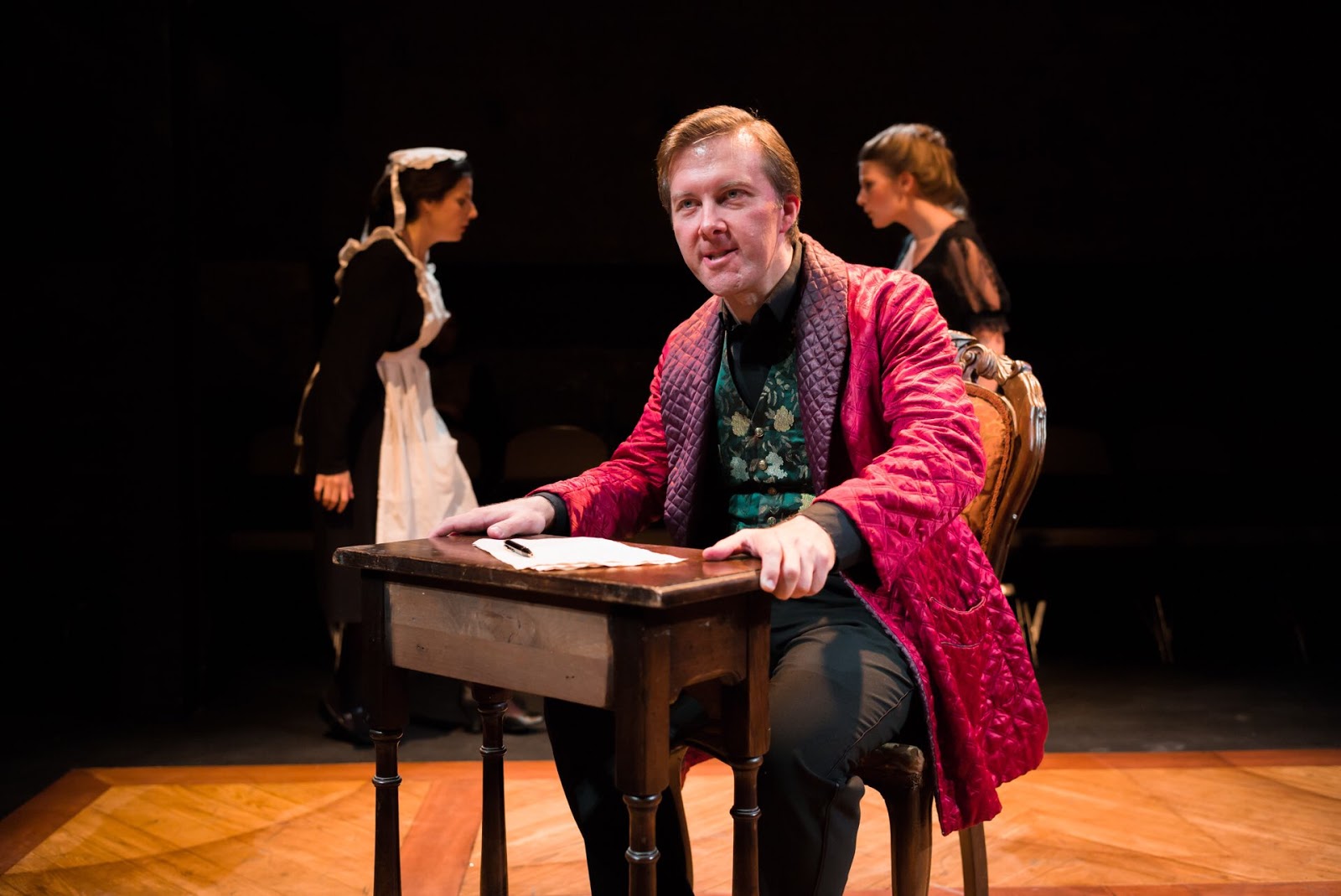
Heather Caddick, Cheyney Kent and ensemble - Mozart Marriage of Figaro - Grimeborn Festival - photo Nick Rutter
Heather Caddick, Cheyney Kent and ensemble - Mozart The Marriage of Figaro - Grimeborn Festival - photo Nick Rutter
Mozart Le nozze di Figaro; Cheyney Kent, Heather Caddick, Dario Dugandzic, Sofia Troncoso, Katie Slater, dir: Lewis Reynolds, cond: John Jansson; Grimeborn Festival
Reviewed by Robert Hugill on Aug 16 2016
Star rating: 3.5

Lively small-scale production of Mozart's opera which brings out the funny side

Sofia Troncoso, Cheyney Kent, Heather Caddick - Mozart The Marriage of Figaro - Grimeborn Festival - photo Nick Rutter
Sofia Troncoso, Cheyney Kent, Heather Caddick
photo Nick Rutter
The Grimeborn Festival at the Arcola Theatre has developed a reputation for presenting innovative small-scale productions of established classics. This year's festival included Bartok's Duke Bluebeard's Castle, Cav and Pag and Mozart's Le nozze di Figaro. We caught Mozart's opera on 16 August 2016 in a production by Opera 24 and Darker Purpose. John Jansson conducted his own orchestration for an ensemble of eight, and Lewis Reynolds directed a cast which included Cheyney Kent as the Count, Heather Caddick as the Countess, Dario Dugandzic as Figaro, Sofia Troncoso as Susanna, Katie Slater as Cherubino, Esther Mallett as Barbarina, Elizabeth Graham as Marcellina, Simon Masterton-Smith as Bartolo and Antonio, Edward Saklatvala as Basilio and Don Curzio. Designs were by Alexander McPherson and lighting by Davy Cunningham.

Mozart's Le nozze di Figaro is a big ask of any company, the opera's very perfection demands similar perfection from its performers, even before thinking about staging and dramaturgy. The production at Grimeborn was played in the round, in a studio theatre which put an even bigger onus on the singers. Lewis Reynolds' production used a simple square of parquet flooring as playing area, with lighting to delineate areas and rooms. This was particularly effective in creating multiple playing areas, such as corridors next to rooms, and for Act Two we were able to see both the Countess's room and inside the closet next door. There were a minimum of props and just two chairs, the result was admirably unfussy and focussed in terms of visuals.

Wednesday, 17 August 2016

A pilgrimage to Santiago: To the Field of Stars

To the Field of Stars - Nonsuch Singers - Convivium Records
To the Field of Stars, Jackson, Victoria, Pärt, Byrd, Dove; Nonsuch Singers, Kate Gould, Tom Bullard, Convivium Records
Reviewed by Robert Hugill on Jul 25 2016
Star rating: 3.5

Gabriel Jackson's cantata for Victoria and Pilgrimage Trail to Santiago de Compostela recorded by the choir which gave the work's UK premiere

The main work on this new disc from Convivium Records is Gabriel Jackson's cantata for choir, cello and percussion, To the Field of Stars, recorded by the choir which gave the work's UK premiere, the Nonsuch Singers, conducted by Tom Bullard, with cellist Kate Gould and percussionists George Barton and Stefan Beckett. The programme is completed by Arvo Pärt's O Morgenstern (from Sieben Marian Antiphonen), Victoria's Vidi Speciosam, Jackson's Creator of the Stars of the Night, Byrd's Laudibus in Sanctis and Jonathan Dove's Seek him that Maketh the Seven Stars.

Jackson's To the Field of Stars was premiered in 2011 to celebrate the 400th anniversary of Victoria's death and the Pilgrimage Trail to Santiago de Compostela. The work has already been recorded by the St Jacob's Chamber Choir from Stockholm, one of the work's co-commissioners. The present disc represents the debut recording of the Nonsuch Singers, a non-professional choir based in London.

The work is in seven movements separated by refrains setting texts taken from a medieval pilgrims' hymn. In addition to the medieval texts, Jackson also mixes in texts by John Adams (the second President of the USA), William Cowper, Walt Whitman and Emily Dickenson. The piece contemplates the idea of pilgrimage in the wider sense and in  his booklet note Jackson says he wanted to avoid a more literal approach.  The work's title comes from the possibly etymological origin of Compostela as 'campus stellae' (field of stars), and the seventh movement of the work includes a list of star names. The final movement ends with Jackson's re-working and expansion of Victoria's motet O Quam Gloriosum, so it is appropriate that the choir begin the disc with this motet.

Tuesday, 16 August 2016

Why not an afternoon at the opera?

West Green Opera
The gardens of West Green House, setting for West Green Opera
Last month we attended a performance of Gounod's La Colombe (see my review) at West Green House as part of the annual West Green Opera season. The performance was a matinee, so we arrived early enough to have a delightful lunch, followed by a walk round the garden. After the opera there was time for a further perambulation and afternoon tea. Altogether a lovely way to attend the opera. All this set me thinking, why is opera-going so resolutely an evening activity.

Perhaps it is all Wagner's fault, with his insistence that audiences should sit in the dark? Or perhaps it is the association of opera going with aristocratic social activity. The Grand Seasons at Covent Garden happened during the Season and were part of the aristocratic social round.

But many operas do not easily fit into this mould. Witness the fact that baroque opera has to be routinely cut to fit the evening time slot, or suffer the indignity of having the act structure re-shaped with just a single interval.

Paul Nilon, Simeon John-Wake - Handel Tamerlano - Buxton Festival - photo Robert Workman
Paul Nilon, Simeon John-Wake - Handel Tamerlano
Buxton Festival - photo Robert Workman
Covent Garden does offer matinee performances of operas occasionally, and for the longer works these prove to be very popular indeed when booking opens for members of the Friends of Covent Garden. But there will be, at most, a single matinee during the run of an opera. Yet attending a matinee starting at 3pm and finishing at 8pm is attractive to many, and would seem to make a great deal of sense for a longer opera.

I have never understood why more summer festivals do not embrace this model. Do we really need a 90 minute dinner interval inserted into an opera, thus unbalancing the act structure considerably. At Buxton this summer, Handel's Tamerlano (see my review) was performed cut, with just one interval, so it fitted into a three hour time slot. A significant number of the attendees were in Buxton for a few days, so how much more civilised to offer performances relatively uncut with two intervals, running from 3pm to 8pm.

Like baroque opera, Wagner is a particular problem and performances in the theatre have to start very early or finish very late. It has always struck me that it would seem to be far more civilised to start Gotterdämmerung after lunch and run on into the evening.

As society becomes far more varied, with the standard nine to five job replaced by more flexibly working, surely it is time for opera companies to experiment with opera presentation. But audiences need to get out of the mind set that opera must be an evening out.

Monday, 15 August 2016

A day at Harpa in Reykjavik - Ponce, Piazzolla and Icelandic song

Harpa - the atrium inside
For the visitor to Reykjavik in Iceland, Harpa the concert hall on the harbour, is a striking sight, consisting of two uneven rhomboids covered in a cellular structure made of glass, and containing a concert hall and two smaller halls, two restaurants and much more. For those wanting to experience the fine concert halls, there is a regular programme of shorter classical concerts during the summer. Whilst we were in Iceland on holiday we caught a pair of concerts on 13 August 2016 (we could also have seen How to be a Viking, or dropped into some of the events of the Reykjavik Jazz Festival). Guitarist Svanur Vilbergsson and pianist Nina Margret Grimsdottir performed music by Manuel Ponce and Astor Piazzolla as part of the Reykjavik Classics lunchtime series, and then in an early evening concert we heard soprano Heiðdis Hanna Sigurdarðottir, baritone Kristjan Johannesson and pianist Astridur Alda Sigurðardottir in a programme of Icelandic songs as part of the Pearls of Icelandic Song series.

Harpa is the sort of pace where people come and simply hang about, chat, have coffee and use the wifi. The interior is a very stylish combination of black and yellow, with two excellent restaurants to feed the inner concert goer (and we managed to try both during our visit).

Harpa, Reykjavik, Iceland
Harpa
The lunchtime recital took place in the largest concert hall, Eldborg. Perhaps too big for recital by guitar and piano, but it gave us a chance to experience the strikingly dramatic dark red auditorium. Vilbergsson and Grimsdottir opened with Manuel Ponce's Sonata for Guitar and Piano (the Sonata for Guitar and Harpsichord in another guise). A striking, highly neoclassical piece, the lively first movement was followed by a striking Andantino where both guitar and piano developed a rather folk-like melody. The perky final Allegro had hints of Poulenc in it. Using piano rather than harpsichord gave the piece some lovely textures and made for an interesting approach to guitar music, though the balance sometimes favoured the piano somewhat.

Vilbergsson followed this with a guitar solo, La muerte del angelo. Surprisingly romantic for Piazolla, but a beautifully varied piece superbly played. We were treated to two encores, Ponce's Estrellita which was very much a song without words, and Morning Dance by the Serbian composer Dusan Bogdanovic.

The day was somewhat a Harpa day for us, as after the concert we had a lovely lunch and then explored the building with its superb views across Reykjavik and over the harbour from the upper levels.

Mendelssohnian charm: Sir Arthur Sullivan's Macbeth and The Tempest

Sullivan - Macbeth, Tempest - Dutton Epoch Sullivan Macbeth (Incidental music), Marmion Overture, The Tempest (Incidental music); Mary Bevan, Fflur Wyn, BBC Singers, BBC Concert Orchestra, John Andrews, Simon Callow; Dutton Epoch
Reviewed by Robert Hugill on Jul 20 2016
Star rating: 4.0

Sullivan's music for two Shakespeare plays on disc complete for the first time

That this disc from Dutton Epoch contains three first recordings is quite surprising when the composer of the works is Sir Arthur Sullivan. But John Andrews and the BBC Concert Orchestra give first recording of the incidental music to Shakespeare's Macbeth, the first complete recording of the incidental music to Shakespeare's The Tempest, and the first complete recording of the Marmion Overture. The orchestra is joined by the BBC Singers, sopranos Mary Bevan and Fflur Wyn, and the actor Simon Callow reads selections from the plays between the movements.

I have always been fascinated by Sir Henry Irving's Shakespeare productions. Lavish in scale and luxurious of setting, they are a far cry from modern attitudes to stage production. Sullivan's music for Macbeth was written for Irving's production of the play in 1888. It featured Irving as Macbeth and Ellen Terry as Lady Macbeth. The play was cut and re-arranged, but there was a chorus of 60 and an orchestra of 46 players.

Ellen Terry as Lady Macbeth - John Singer Sargent
Ellen Terry as Lady Macbeth
John Singer Sargent
It was, of course, for this production of Macbeth that Ellen Terry wore the famous beetle-wing dress, which is preserved by the National Trust at Smallhythe Place, and captured by John Singer Sargent in his portrait of Terry. You can see images of the dress and read about its recent conservation at The Glass of Fashion website, and there is an engraving of the production on the V&A website, The dress also gave rise to Oscar Wilde's famous quip 'Lady Macbeth seems to be an economical housekeeper and evidently patronises local industries for her husband's clothes and servant's liveries, but she takes care to do all her own shopping in Byzantium.'

Sullivan's orchestral suite is known but this is the first time that the complete incidental music has appeared on disc. There are some 13 numbers, performed here with selections of the play spoken by Simon Callow. What is immediately obvious, looking at the contents of the disc, is that much of the play is missing. Sullivan wrote hardly any music for Lady Macbeth and virtually nothing for the second half of the play. The climax of the incidental music is the Act Four scene between Macbeth and the witches.

We know that some music has been lost, chorus and melodramas probably written during rehearsals and never copied into the autograph score; the fire at the Lyceum Theatre in 1898 destroyed much. But what we have is a finely atmospheric sequence, music by Sullivan at his peak. The play came between The Yeomen of the Guard and The Gondoliers, and represented Sullivan's biggest stage success without Gilbert.

The witches are given much music and the rest is highly atmospheric scene painting. This receives a lovely performance from John Andrews and the BBC Concert Orchestra with Andrews bringing out the fine-grained Mendelssohnian cast of Sullivan's music. They shape each of the movements into a beautiful miniature. The prelude to Act Two, with its two harps, is just one example. The music for the witches is brilliantly atmospheric, though perhaps politer than we might expect. You have to put out of mind later styles of theatrical representation, Sullivan was completely attuned to Irving's requirements.

Regarding Simon Callow's spoken passages I am more conflicted.

Sunday, 14 August 2016

Somewhere for the weekend: Rye Arts Festival

Rye
Rye
You never really need an excuse to visit Rye, but the Rye Arts Festival (17 September to 1 October 2016) just makes the prospect more tempting. Euphonia (which we saw recently in Gluck's Iphigenie en Tauride) are performing Britten's The Turn of the Screw and Donizetti's Don Pasquale. Rather aptly The Turn of the Screw is based on the story by Henry James, who lived in Rye. ( And this year is the centenary of Henry James' death. Plus Myfanwy Piper, who wrote the libretto, was married to John Piper, who also lived in Rye for a spell - see comments)

Other events include light opera, comedy and song from Perfect Fifth (Harriet Jones (soprano), Caroline Jones (Alto), Greg Tassell (tenor) and Rupert Reid (baritone)), accompanied by Belinda Jones (piano)) including songs by local composer George Newson, Kaleidescope Saxophone Quartet, plus recitals from Polish soprano Anna Szalucka, the Busch Trio (Anthony Marwood (violin) and Aleksandar Madžar (piano)), Adrian Chandler and La Serenissima, Tzu-Yin Huang (piano), and the Wihan Strng Quartet.

Choral events include evensong in St Mary's Church, Rye, sung by Chichester Cathedral Choir and Peter Philips conducting a choir made of performers from The Cantate Choir, Straight 8 and Tongswood Chamber Choir in large scale polyphonic music including Tallis's Spem in alium

Non-musical events include a tour of churches in Romney Marsh, a tour of cellars in Winchelsea and a walk through World War II Rye

Saturday, 13 August 2016

Towards a more historically informed view of performances of Bellini's Norma

Cecilia Bartoli and John Osborn in 'Norma' - Photo: Hans Jörg Michel
Cecilia Bartoli and John Osborn in Norma - Photo: Hans Jörg Michel
The two most influential female singers in early 19th century Italian opera were perhaps Rossini's muse (and later wife) Isabella Colbran for whom Rossini wrote a series of roles including Desdemona in Otello, and the title roles in La donna del Lago, Armida, and Semiramide, and Giuditta Pasta, who inspired Bellini's Norma and La sonnambula and Donizetti's Anna Bolena. what the two have in common is our uncertainty about what their voices sounded like, what vocal category we would place them in nowadays.

Our view of the roles they inspired has been coloured by the 20th century experience of the works. So that the relative neglect of Rossini's serious operas has allowed both sopranos and mezzo-sopranos to explore Isabella Colbran's roles, and for performers to look at at period practice in these operas without the weight of history behind them. Joyce DiDonato has sung the title role in Rossini's La donna del Lago, and Opera Rara is recording Semiramide with the Orchestra of the Age of Enlightenment this summer.

But Giuditta Pasta's roles have entered the operatic canon, and any performance of Bellini's Norma gets judged by the standards of Callas, Caballe and Sutherland. The problem is, of course, that these three performed Bellini in the way he has come to be performed in the 20th century with larger, heavier voices and louder orchestras. And the towering achievement of iconic performances such as Callas's Norma, makes it difficult for other performance ideas to take root.

Giuditta Pasta as Norma
These thoughts were prompted by some of the critical reaction to Cecilia Bartoli's recent performances in Norma at the Edinburgh International Festival in the Salzburg Whitsun Festival production with John Osborn as Pollione, and Gianluca Capuano conducting the period instrument ensemble I Barocchisti. I did not attend the performances, I was in Santa Fe, but read the critics views of the performance with great interest.

Some of the critical comment seems to have concentrated on the 20th century perception of the role, comparing the relatively modest size of Bartoli's voice to those of Callas, Caballe and Sutherland, and paying mere lip service to Bartoli's interest in exploring different ways of performing Norma. One critic mentions the idea that at the period women's voices were not classified, before making it clear that their critical yardstick was still Callas et al. Other comments included the relative lightness of the performance, the lack of weight in tenor John Osborn's Pollione. These are comments which prompt me to want to respond, 'well of course, given what we know of early 19th century Italian operatic performance practice.'

For all the possible faults with the performance, there as been insufficient engagement in a critical discussion about how the music sounded in the early 19th century and how this might inform our performances. Undoubtedly Callas's performance in Norma is an immeasurably great one, but it does not tell us much about what Bellini heard when Giuditta Pasta performed, and that is surely something worth exploring.

Giuditta Pasta undoubtedly had a 'dramatic' voice, and famously found 'Casta Diva' almost impossible to perform in its original high key. But this is dramatic in a world before Wagner's Brunnhilde, Puccini's Turandot and Ponchielli's La Gioconda. If you perform Bellini's Norma with gut strings, early 19th century bows and lower bridges, and with brass using narrow bore instruments, then the resulting orchestral sound is inevitably lighter, more transparent and a modern highly dramatic sounding soprano would be out of place. (You can hear Bartoli singing 'Casta Diva' on YouTube, and you can get her recording from Amazon.co.uk).

What we need when talking about this type of performance is consideration of what, if anything, the performance can tell us about re-discovering alternative performance practices where it is successful in its own terms.

The period instrument and HIP movements have often been very much instrument led, but early 19th century opera with its emphasis on the voice does not lend itself to this approach. If we are to bring to Rossini, Donizetti and Bellini, the sort of revelation which Roger Norrington brought to his performances of Beethoven symphonies, then we need more singers to experiment, and for critical comment which takes an historically informed view of the results.

Update: Correspondents have been generating some interesting information around this subject. The theatre at La Scala, Milan, where Bellini's Norma was premiered, is essentially the same auditorium as today. When built in the late 18th century it was a large theatre, holding 3000 people! But, the performances were different to those given today, the downstage area would be outside of the stage box (in front of the proscenium) where we have the pit today, and the orchestra would be where the first two rows of the stalls are. So the effect of the singers, far more forward into the auditorium, would be very different and more immediate, requiring less heavy voices. And the singer who premiered Pollione was famous for his Almaviva and Ramiro, so a far lighter voice than we consider nowadays.


Friday, 12 August 2016

WAM - music for clarinet by Michael Finnissy


Michael Finnissy, Michael Norsworthy - WAM
Michael Finnissy Clarinet Sonata, L'Union Libre, Mike, Brian, Marilyn and the Cats, WAM, Giant Abstract Samba; Michael Norsworthy, Michael Finnissy, William Fedkenheuer, New England Conservatory Wind Ensemble, Charles Peltz; New Focus Recordings
Reviewed by Robert Hugill on Jul 29 2016
Star rating: 4.5

Intriguing and absorbing music for clarinet by Michael Finnissy, a reflection of a 20 year friendship and a continuous dialogue with musical culture

This disc, on New Focus Recordings, of music for clarinet by Michael Finnissy performed by clarinettist Michael Norsworthy includes three piece specifically written for Norsworthy. Michael Norsworthy (clarinets and percussion) and Michael Finnissy (piano and percussion) perform Finnissy's Clarinet Sonata, L'Union Libre and Mike, Brian, Marilyn and the Cats and are joined by violinist William Fedkenheuer for WAM. Finally Norsworthy is joined by the New England Conservatory Wind Ensemble, conductor Charles Peltz for Giant Abstract Samba.

The Clarinet Sonata is one of four sonatas that Finnissy wrote in 2006/2007, each taking a different historical model. For the Clarinet Sonata Finnissy used Beethoven's Piano Sonata Op.110. The right-hand line of Beethoven's sonata appears bar for bar in the piano part of Finnissy's sonata, but each bar is reversed, occasionally with edits and substitutions. Finnissy's own note on the piece refers to the clarinet surfing across the top of the piano part. The sonata is in one movement but its different sections reflect the markings of Beethoven's sonata.

The clarinet part is lyrically expressionist but with some jagged edges, and it intertwines with the piano to create a rather absorbing, almost dialectical, discourse. On first listening the differentiation between the different sections was not always obvious, but the latter part of the piece is rather intense leading to a quiet ending.

Thursday, 11 August 2016

Bringing a touch of Brazil to Europe - the São Paulo Symphony Orchestra

Marin Alsop - Photo: Grant Leighton
To keep us in the mood, following the Olympic Games in Rio de Janeiro, Brazil, another Brazilian city will be sending its orchestra over to Europe. The São Paulo Symphony Orchestra (OSESP), under conductor Marin Alsop, will be returning to Europe to give concerts at the Edinburgh Festival (22 August), the BBC Proms (24 August) and the Lucerne Festival. In 2012 the orchestra became the first Brazilian orchestra to play at the BBC Proms.

In Edinburgh the orchestra plays a programme combining Villa-Lobos' Choros No. 10 with Bernstein's Chichester Psalms and Shostakovich's Symphony No. 5. At the Proms the orchestra gives two concerts. The first features music by Villa-Lobos and Rachmaninov, with the UK premiere of Kabbalah by the Brazilian composer Marlos Nobre, and Grieg's Piano Concerto with the Venezualan pianist Gabriela Montero. The second, late-night prom, members of the orchestra join the São Paulo Jazz Symphony Orchestra for a celebration of Brazilian music. The orchestra's programme in Lucerne repeats its prom concert.

Wednesday, 10 August 2016

World premiere of John Joubert's Jane Eyre

John Joubert - Jane EyreKenneth Woods and the English Symphony Orchestra will be celebrating the 200th anniversary of Charlotte Brontë's birth in 2016 and the 90th birthday of composer John Joubert in 2017 with the world premiere of Joubert's opera Jane Eyre, based on Charlotte Brontë's novel. The performance takes place on 25 October 2016 at the Ruddock Performing Arts Centre in Birmingham. The cast includes Katherine Manley as Jane and David Stout as Rochester, with Clare McCaldin as Mrs Fairfax, and Mark Milhofer as Revd. St John Rivers. The performance is being recorded for release on the SOMM label.

Jane Eyre is John Joubert's eighth and final opera which was completed in 1988. A number of Joubert's other operas have literary origins, and Joubert's engagement with the work of the Brontë sisters includes a song-cycle based on Emily's poems.

The novels of the Brontë sisters seem to be a popular source of material for opera composers, Michael Berkeley's opera Jane Eyre was premiered by Music Theatre Wales in 2000, whilst Carlisle Floyd's 1958 opera on Wuthering Heights has just received its first recording (see my review) and film composer Bernard Hermann's Wuthering Heights was written in 1951 but had to wait until 2011 for a complete staged performance.

Full details from the English Symphony Orchestra website.

Tuesday, 9 August 2016

Signs, Games & Messages

Signs, Games & Messages - Resonus
Kurtág Signs, Games & Messages, Bartók Sonata for Solo Violin; Simon Smith; Resonus Classics
Reviewed by Robert Hugill on Jul 22 2016
Star rating: 4.0

Virtuosic works for unaccompanied violin by two Hungarian composers, in striking new performances

This new recital disc from violinist Simon Smith on the Resonus Classics label pairs works for unaccompanied violin by two major 20th century Hungarian composers. Smith plays Bela Bartók's Sonata for Solo Violin, Sz 117 and György Kurtág's Signs Games and Messages.

Kurtág's music is known for its concision, tendency to aphorism and concentration on small gestures. Starting from the 1970s he wrote a series of short pieces, collectively called Jatekok (Games), for a variety of instruments. From the 1980s onwards he wrote Signs, Games and Messages for solo violin. The 18 short pieces (the shortest lasting around 45 seconds, the longest nearly 5 minutes with the majority at around a minute) provide a remarkable digest of Kurtág's art.

Though short, each is concentrated and Smith's performances bring out the intensity of the gestures. The opening Perpetuum mobile (one of three in the set) does wonders with the violin's opening strings, whilst the second movement builds something striking from a simple sequence of semi-tones.

Many of the works have personal connections or other links. Hommage a J.S.B is notable for the elegance and clarity of Kurtág's inspiration based on Bach, whilst Hommage a John Cage is austere and rather equivocal, the violin seemingly unsure or unable to achieve its goal. In memoriam Blum Tamas is notable for its slow intensity and anguished harmony.

Monday, 8 August 2016

Marking the 350th anniversary of the Great Fire of London

Amongst other things, 2016 marks the 350th anniversary of the Great Fire of London. The fire started on 2 September 1666 at the bakery of Thomas Farynor in Pudding Lane and raged for three days, to be finally put out  as it reach the Temple. In charge of the fire-fighting operations was James, Duke of York. To celebrate these events the Temple Music Foundation has commissioned a new opera And London Burned, to be premiered at Temple Church on 27, 28 and 29 October 2016.

And London Burned is written by composer Matt Rogers and librettist Sally O'Reilly, and their work has included The Virtues of Things which premiered last year at Covent Garden's Linbury Studio. And London Burned will be directed by Sinead O'Neill, who is a staff director at Glyndebourne, and the conductor is Christopher Stark, founder of Multi-Storey. The cast includes Gwilym Bowen, Alessandro Fisher, Aoife O'Sullivan, Robyn Allegra Parton, and Andrew Rupp.

Further information from the Temple Music website.

Sunday, 7 August 2016

Elegiac modernism: Richard Strauss's Capriccio at Santa Fe

Amanda Majeski in 'Capriccio' (c) Ken Howard for Santa Fe Opera, 2016
Amanda Majeski in Capriccio (c) Ken Howard for Santa Fe Opera, 2016
Joshua Hopkins, Amanda Majesk and Ben Bliss in 'Capriccio' (c) Ken Howard for Santa Fe Opera, 2016
Joshua Hopkins, Amanda Majesk and Ben Bliss
(c) Ken Howard for Santa Fe Opera, 2016
Richard Strauss Capriccio; Amanda Majeski, Susan Graham, Craig Verm, Ben Bliss, Joshua Hopkins, David Goversen, dir: Tim Albery, cond: Leo Hussain; Santa Fe Opera
Reviewed by Robert Hugill on Aug 5 2016
Star rating: 4.0

A stylish 1940's modernist setting for Richard Strauss' elegiac operatic swansong

For our final opera this year at Santa Fe Opera, on 5 August 2016, we caught Tim Albery's production of Richard Strauss's Capriccio designed by Tobias Hoheisel, a production which travels to Garsington next year. Amanda Majeski was Countess Madeleine, Susan Graham was Clairon, Craig Verm was the Count, Ben Bliss was Flamand, Joshua Hopkins was Olivier, David Govertsen was La Roche, Allan Glassman was Monsieur Taupe, Shelley Jackson and Galeano Salas were the Italian Singers, and Adrian Smith was the Major Domo. Leo Hussain conducted.

Hoheisel's spectacular set consisted of a modernist, Mies van der Rohe-style house with the panelling from an 18th century room at its centre, like a collected object. The rear wall was glazed and looked out onto a terrace with the views across the hills West of the Santa Fe Opera House. The weather denied us the spectacular sunset for which the set seemed to have been designed, but was striking nonetheless. Costumes were loosely 1940's with Amanda Majeski wearing a pair of extremely striking outfits.

Susan Graham and Joshua Hopkins  in 'Capriccio' (c) Ken Howard for Santa Fe Opera
Susan Graham and Joshua Hopkins  in 'Capriccio'
(c) Ken Howard for Santa Fe Opera
The opera was sung in German, with the usual subtitles in the seat-back in front of you, but Tim Albery had clearly been concerned to bring out the meanings in this most text heavy of operas. The performance was highly gestural, with each performer bringing a vivid sense to their dialogue, though it has to be admitted that the German occasionally sounded a bit effortful. This very visual style seemed to encourage the audience to laugh; Albery had not directed it as a comedy as such, but the production style rather invited this. The problem for me was that the audience laughed at the jokes in the subtitles rather than at what the singers were saying, and I longed for the opera to be done in English. The cast were almost exclusively native English speakers, as was the majority of the audience and when Santa Fe Opera gave the USA premiere of the work in 1958 it performed it in English. Frankly, I feel that this is what they should have done this time.

In the second half of the opera, when the members of the house-party all gang up on La Roche for his rather over the top ideas for the theatrical event for the Countess's birthday, the gestural language rather pushed the piece into physical comedy. So that instead of being a witty dialogue about what theatre and opera really are, it became a comic set-piece which obscured the work's message. Capriccio is a work which treats a serious subject in a relatively light way, and getting the balance right is tricky, especially with a cast all of whom are having to work hard on the vast quantity of German dialogue.

Amanda Majeski looked stunning as the Countess, tall and elegant she wore her costumes well and epitomised the witty intelligence of the part. You really could imagine this Countess having long, intense and sometimes funny discussions about the nature of art.

Friday, 5 August 2016

Becoming a lirico-spinto soprano: I continue my encounter with Elizabeth Llewellyn prior to her debut as Tosca

Elizabeth Llewellyn - photograph Shirley Suarez
In this second part of my interview with soprano Elizabeth Llewellyn  (see part one of our interview on this blog) we talk in more detail about the lirico-spinto voice sitting between a lyric and a dramatic soprano, as well as looking in more detail at the title Tosca, and how beautiful singing is just a base-line from which to build the drama. Elizabeth will be making her debut as Tosca at Theater Magdeburg in October.

Elizabeth sees her voice as a Straussian one, one which loves long lines. She can give outbursts of real power, but is not able to sing a role which requires sustained power. Elsa, Tosca and Giorgetta (roles she has sung at Theater Magdeburg and the Royal Danish Opera) are written in a way which is right for her, Elizabeth finds them well-paced with powerful moments. This she feels is Puccini's and Wagner's genius, and thinks that there is a case for a lirico-spinto voice singing the roles because that is how they were written. She has always taken to heart the soprano Isobel Baillie's motto 'Never sing louder than lovely', and adds that there are so many other beautiful roles out there that she should, and hopes to sing, rather than looking at the more dramatic roles.

Momentary outbursts of real power are something she can do, and she finds it amazing that it does not cost her anything. She cites as an example Act Three of Lohengrin which she finds very much Elsa's act.  A singer needs to have physical and vocal stamina for it, and needs to have the strength in reserve to nail the top B which is the climax of the scene.


Elizabeth feels that with characters like Elsa and Tosca, a dramatic soprano can sound a bit too matriarchal and the roles lose their charm. In their different ways, Elizabeth sees both as characters who are not always in control and this needs to show in performance. After all Elsa is a just a young girl who knows nothing about the world and she does not have cunning in her arsenal. At the beginning of the opera Elsa is just a child, and we need to believe this, and then during the opera she grows before our eyes.

Supremely tragic moments: Gounod's Romeo and Juliet in Santa Fe

Stephen Costello & Ailyn Pérez  in 'Roméo et Juliette' (c) Ken Howard for Santa Fe Opera, 2016
Stephen Costello & Ailyn Pérez  in Roméo et Juliette (c) Ken Howard for Santa Fe Opera, 2016
Stephen Costello & Ailyn Pérez  in 'Roméo et Juliette' (c) Ken Howard for Santa Fe Opera, 2016
Stephen Costello & Ailyn Pérez  in Roméo et Juliette
(c) Ken Howard for Santa Fe Opera, 2016
Gounod Roméo et Juliette; Ailyn Perez, Stephen Costello, Emily Fons, Raymond Aceto, Elliott Madore, dir: Stephen Lawless, cond: Harry Bicket; Santa Fe opera
Reviewed by Robert Hugill on Aug 4 2016
Star rating: 4.0

Santa Fe channels Gone with the Wind in Gounod's elegiac telling of Shakespeare's tragedy

The second opera which we caught at Santa Fe Opera this year was Gounod's Roméo et Juliette, on Thursday 4 August 2016 in a production directed by Stephen Lawless and conducted by Harry Bicket. Stephen Costello was Roméo and Ailyn Perez was Juliette, with Elliot Madore as Mercutio, Emily Fons as Stéphano, Deborah Nansteel as Gertrude, Raymond Aceto as Frère Laurent, Nicholas Davis as Grégorio, Tim Mix as Capulet and Soloman Howard as the Duke. Designs were by Ashley Martin-Davis with lighting by Mimi Jordan Sherin, and choreography by Nicola Bowie.

Gounod's opera, written in 1867, was his biggest hit after Faust. The libretto by Jules Barbier and Michel Carré stays relatively close to Shakespeare, but re-casts the piece as a French grand opera, complete with large-scale choral scenes, grand processions, and a ballet. Gounod wanted to use spoken dialogue but was overruled, and as a result the pacing of the recitative combined with the music for grand ceremonial makes the general pace of the opera quite stately. For all the great beauty of the four duets for Roméo and Juliette, you sometimes wish that Gounod had injected a bit more youthful elan and pace into the piece.

Deborah Nansteel (Gertrude) in Roméo et Juliette (c) Ken Howard for Santa Fe Opera, 2016
Deborah Nansteel (Gertrude) in Roméo et Juliette
(c) Ken Howard for Santa Fe Opera, 2016
That said, Harry Bicket kept the music flowing admirably, and there was little of the stopping too long to admire the melodic beauties which can impede the flow of the work. The production, set during the American civil war with the Montagues and Capulets as on opposing sides in this conflict, was full of telling moments and felicitous detail. Lawless' detailed direction added a layer of extra interest, with such moments as Juliette's swigging of illicit champagne at the Act One ball, and her nurse Gertrude's flirtation (and more) with the servant Grégorio during the balcony scene. And it was nice to see a period production where the importance of gloves (the putting on, and taking off) was recognised.

The period setting gave the women vast crinolines, which looked attractive though perhaps made the action a little more stately. And it was hard for Ailyn Perez to convey Juliette's youth when she was in a dress which made her look mature, still the evocation of Gone with the Wind was rather effective. Though perhaps less care had been taken with the men's tailoring and their trousers looked as if they had been bought by the yard, even Stephen Costello's were rather unflattering.

The opera started and finished in the same place, the Capulet mausoleum, a huge dark curving wall engraved with names. This formed the fixed set for the whole opera, with openings, staircases and balconies appearing. A central lift in the floor meant that a huge statue of Eros appeared for the balcony scene and also created the bier for Juliette. This was a neat piece of stagecraft as she faints during the wedding with Paris, is laid on the floor and remains in place as the central plinth rises to create a bier for the final scene.

Thursday, 4 August 2016

Hollywood noir: Samuel Barber's Vanessa at Santa Fe

5. Zach Borichevsky (Anatol) and Virginie Verrez (c) Ken Howard for Santa Fe Opera, 2016
Zach Borichevsky (Anatol) and Virginie Verrez (c) Ken Howard for Santa Fe Opera, 2016
Samuel Barber Vanessa; Erin Wall, Virginie Verrez, Helene Schneiderman, Zach Borichevsky, James Morris, dir: James Robinson, cond: Leonard Slatkin; Santa Fe Opera
Reviewed by Robert Hugill on Aug 3 2016
Star rating: 4.0

Samuel Barber's fascinating yet rarely performed opera in lush new production

Zach Borichevsky (Anatol) and Erin Wall (Vanessa) in 'Vanessa' (c) Ken Howard for Santa Fe Opera, 2016
Zach Borichevsky and Erin Wall in Vanessa
(c) Ken Howard for Santa Fe Opera, 2016
Samuel Barber's 1958 opera Vanessa still has not quite found a place in the repertory, existing on the fringes. In London the opera has recently only appeared in concert so it was a delight to find Santa Fe Opera doing a production, the first time that the New Mexico festival has produced the opera. Interestingly Wexford Festival is also doing a production of Vanessa this year (directed by Rodula Gaitanou with Claire Rutter in the title role), so perhaps the opera's time has finally come.

We caught James Robinson's production on Wednesday 3 August 2016, an evening which was cool and cloudy with torrential rain, perhaps an apt environment for Gian Carlo Menotti's rather gothic libretto. Leonard Slatkin conducted, with Erin Wall as Vanessa, Virginie Verrez as Erika, Helene Schneiderman as the Baroness, Zach Borichevsky as Anatol, James Morris as the Doctor, Andrew Bogard as the Major-Domo and Andrew Simpson as the Footman. Sets were by Allen Moyer, costumes by James Schuette, lighting by Christopher Akerlind and choreography by Sean Curran.

Gian Carlo Menotti's libretto has its rather melodramatic side (someone once commented that he had written it using the Oxford Book of Cliches), and James Robinson's production built on this by staging the work in the context of a Hollywood Noir film, complete with a set inspired by Hollywood Regency designs. Apart from the costumes for the ball scene in Act Two, the entire production was in shades of grey with  Allen Moyer's striking box set, lit by Christopher Akerlind's lighting, having real sense of coolness about it. As light comes back into Vanessa's life, the set imaginatively fractured and expanded, but retreated back with Erika's retreat into solitude at the end. James Schuette's costumes were similarly stylish, all 1940's glamour.

The result was to give the production a lushness which matched Samuel Barber's music. At its best the production really made sense of the staginess of Menotti's text and the rather melodramatic quality to the story. But you felt that a more austere, critical production style might have brought out some more of the psychological depth of the piece, rather than simply echoing the gorgeous lush quality to the music. And there are interesting undercurrents, is Erika in fact Vanessa's daughter, how does the plot echo elements on Barber and Menotti's personal life, Vanessa's great affair with Anatol's father clearly took place whilst the man was married with at least one child.

Samuel Barber: Vanessa at Santa Fe Opera - photo Ken Howard
The Ball Scene
Robinson took the piece at face value, and did not dig too much beneath the surface, and occasionally I kept wondering what a director like David Pountney would make of the opera.


The title role was written for a dramatic soprano capable of great lyric beauty. Erin Wall showed superb control and poise as Vanessa, and her opening aria 'Do not utter a word' was superbly controlled with a perfectly fine sense of line and intensity. Throughout the opera, Wall showed this combination of lush beauty of tone and sense of line, matched by the very stylish figure she cut on stage. I cannot think of ever hearing the role more beautifully sung, but I felt that a slightly more dramatic voice might have been able to dig a bit deeper into the psychological complexities of the piece and make Vanessa a rather more meatily intense character.

Wednesday, 3 August 2016

Somewhere for the Weekend - North Norfolk Music Festival

12th North Norfolk Music Festival
This year's North Norfolk Music Festival is the 12th festival. Running from 15 to 27 August 2016 at St Mary's Church, South Creake, artistic directors Barry Cheesman and Simon Rowland-Jones have put together their usual attractive mix of recitals and concerts with a strong line up of performers.

The festival opens with James Gorick and Floreat Sonus in music for the Feast of the Assumption including Byrd's Great Service and concludes with a sequence of events celebrating the 100th anniversary of Yehudi Menuhin's birth, including a recital from violinist Benjamin Baker, and a programme of chamber music from former pupils at the Yehudi Menuhin School including the premiere of Simon Rowland-Jones new Piano Quintet.

Three concerts feature tenor Joshua Ellicott; Ellicott and Simon Lepper's Your ever loving son Jack based around Ellicott's great uncle Jack who died at the Battle of the Somme, Joshua Ellicott joins the Carducci Quartet for Simon Rowland-Jones's Pianto antico, and finally Ellicott joins forces with guitarist James Boyd for songs by Lennox Berkeley, Reynaldo Hahn and more.

A pair of baritones give contrasting programmes, both accompanied by pianist Gary Matthewman. Gareth Brynmor John and Gary Matthewman perform a programme based around Housman's A Shropshire Lad with music by Butterworth, Somervell, Ireland and Gurney, whilst Andrei Bondarenko (baritone) and Gary Matthewman perform an all Russian programme with songs by Glinka, Borodin, Rubenstein, Rachmaninov and Tchaikovsky.

Pianist Tim Horton gives an all Beethoven recital, the Doric Quartet perform Haydn, Beethoven and Debussy, pianist Alexander Melnikov performs Shostakovich's Preludes and Fugues, Op.87 alongside Schubert and Brahms. Then Melnikov joins the Doric Quartet for piano quintets by Brahms and Shostakovich. Melvyn Tan plays Beethoven, Czerny and Liszt, and the Gould Piano Trio play Mozart & Rachmaninov alongside Simon Rowland-Jones' Piano Trio No.2 ‘Eidfjord’ in the Marble Hall of Holkham Hall. Other artists include the Ferio Saxophone Quartet, Van Kuijk Quartet.

Ingibjörg Guðjónsdóttir (soprano), Einar Jóhannesson (clarinet) and Benjamin Frith (piano) give an all-Icelandic programme with music from the Middle-Ages to the present day. The Icelandic theme continues with Voces Thules, the Icelandic Medieval vocal and instrumental ensemble, performing Of Odin’s Mead Let Draught In England Now Be Quaff’d.

Full details from the North Norfolk Music Festival website.

Tuesday, 2 August 2016

Hugill on the Airwaves

Testament of Dr Cranmer
Art work by Alison Cross
My Faith, Hope and Charity (for violin and strings) and The Lord Bless Thee (for tenor and strings), with Chris Watson (tenor), Simon Baggs (violin), Chameleon Arts Orchestra and Paul Brough ( from the Testament of Dr Cranmer disc on Divine Art Recordings) is being broadcast on Marvin Rosen's Classical Discoveries programme on WPRB 103.3 FM Princeton NJ, or on the Internet at: http://wprb.com/ on Wednesday 3 August 2016

You also will be able to listen to archived programs for over two weeks after each show at:

Quirky combination: Haydn and Ligeti from Shai Wosner

Shai Wosner - Haydn, Ligeti - Onyx Classics
Haydn Capriccios, Piano Concerto No. 4 in G, Piano Concerto No. 11 in C, Ligeti Capriccios, Piano Concerto; Shai Wosner, Danish National Symphony Orchestra, Nicholas Collon; Onyx Classics
Reviewed by Robert Hugill on Jul 20 2016
Star rating: 4.0

Piano solos and concertos by Haydn and Ligeti, linked by a sense of wit

The combination of Haydn and Ligeti might seem an unusual combination for a CD, but this new disc from pianist Shai Wosner, the Danish National Symphony Orchestra and conductor Nicholas Collon on the Onyx Classics label makes an interesting case for the pairing. Both composers wrote Capriccios for solo piano, and so on we hear Ligeti’s two works in this genre alongside Haydn’s Capriccio (Fantasia) in C, Hob XVII:4 and Capriccio in G ‘Acht Sauschneider müssen sein’ Hob XVII:1

This latter work’s subtitle, ‘It takes eight of you to castrate a boar’ brings another link, the composers’ sense of humour. We also hear Ligeti’s Piano Concerto alongside Haydn’s Piano Concerto No. 4 in G, Hob XVIII:4 and Piano Concerto No. 11 in D, Hob XVIII:111.

I have to confess that when listening to the CD blind, I rather wondered what I was in for as a Haydn piano concerto is followed by a Ligeti piano solo, then a Haydn piano solo (single movement, not a sonata), then the Ligeti Piano Concerto. At this point I was completely unaware of Haydn’s Capriccios, works which are notable for their mix of imagination with humorous intent. There is frankly as much contrast between the composers are there is commonality, but this works too as the one composer seems to complement the other.

Monday, 1 August 2016

Club Inégales travels to Korea

Gamin playing the saengwhang
Korean music & improvisation; Gamin, Hyelim Kim, Notes Inégales, Peter Wiegold; Spitalfield's Music Summer Festival
Reviewed by Hilary Glover on Jun 15 2016
Star rating: 4.0

Eclectic mix of Korean music and improvisation

As part of the Spitalfield's Summer Festival, last night (15 June 2016) Club Inégales found a new home at Wilton’s Music Hall for a late evening performance of Korean music by Gamin and Hyelim Kim, plus an eclectic improvisation between Gamin and Hyelim Kim and the house band, Notes Inégales.

Gamin was classically trained in jeongak (Korean court music) and sinawi (shaman ritual music), however, she is also interested in bringing traditional instruments into a contemporary setting, including composing her own music, and creating a modern sound by integrating with orchestral instruments and electronic techniques. She has released several albums of her music and has collaborated in the production of art installations to critical acclaim.

Hyelim Kim is an ethnomusicologist at SOAS and is interested in traditional Korean culture and how this has been transformed throughout history. As well as a performer she is a composer in her own right and has also released an album showcasing traditional and contemporary music.

Hyelim Kim with her Taegŭm
Gamin began the concert with a recital on the piri, a double reed bamboo oboe with open finger holes. The sound was extraordinarily loud for such a small instrument and the music somewhere between eastern and oriental. Much of the piece sounded as though rooted in one or more pentatonic scales, while the tone of a double reed oboe, style of vibrato and slides/ornamentation reminded me of eastern European/ Persian styles. Histories of Korean court music suggest that Korean music and instruments, while having Chinese or religious influences were also subject to local invention - hence the unique sound.

The saengwhang is an ancient Korean instrument made from 17 bamboo pipes with an entirely individual sound. Gamin explained that they are very rare, but there has been a resurgence in interest and now new instruments are becoming available. It is the only Korean wind instrument capable of playing chords (Korean music not being based on harmony) and traditionally it was used in chamber ensembles and would be used for "calm and gentle" music. Tonight however she played for us her own composition of atmospheric meanderings based on a traditional melody.

Lively mix: Autumn season of Conway Hall Sunday Concerts


The Autumn season of Sunday evening concerts at Conway Hall opens on 11 September with the Swiss-based Gemaux Quartet in Haydn, Mendelssohn and Brahms. Artistic director Simon Callaghan has put together a lively season with a mixture of young artists and established ensembles with repertoire ranging widely including CPE Bach, Sally Beamish's piano trio arrangement of Debussy's La Mer, Helena Winkelman's Bacchanalia, and Helen Grime's Aviary Sketches alongside establish classics from Haydn and Mozart to Debussy and Faure.

There is a chance to hear musicians from Alistair Beatson's French festival Musique à Marsac, and also the Trio Martinů which was formed at Prague Conservatory in 1990 and has a line-up unchanged since 1993. You can hear the series' artistic director Simon Callahan in action again when he joins friends for a programme of piano trios and piano quartets. The Brook Street Band will be performing Bach, Handel, Leclair, Rameau and Telemann, whilst the London Mozart Players Chamber Ensemble will bring the Autumn season to a close with Mozart, Tchaikovsky and Schoenberg's Verklarte Nacht.

The London Festival of Bulgarian Culture is presenting a trio of concerts which include music by Franz Drdla, Dobrinka Tabakova, Pancho Vladigerov, Dohnanyi, with performers including predominantly Bulgarian string players with pianists Simon Callaghan, Ashley Wass and Ludmil Angelov.

Young performers include Trio Isimsiz which won First Prize and Audience Prize at the 2015 Trondheim International Chamber Music Competition, the Linos Trio which won First Prize and Audience Prize at the 2015 Melbourne International Chamber Music Competition, the Jubilee Quartet which is also a prizewinner at Trondheim, and the Delta Piano Trio which won First Prize and a special prize for the performance of a twentieth-century work at the 7th International S. Vainiunas Chamber Music Competition in Vilnius, Lithuania.

Pre-concert talks are a regular feature of the season. Alistiar Beatson and Helena Winkelman will be introducing Musique à Marsac whilst Joseph Fort will talk about the coincidences behind the works played at the opening concert of the season. Roderick Swanston will be talking about Music and Language, and other speakers introducing the evening concerts include Michael Round and myself. There are also a couple of pre-concert recitals.

Children's events include the London Mozart Players Chamber Ensemble performing Paul Patterson's Little Red Riding Hood, as well as workshops for children aged five to ten introducing both music and the instruments as well as doing group work.

Full details from the Conway Hall website.

Popular Posts this month