Poulenc himself produced the piano version of his opera, La voix humaine, and though he preferred the original full orchestra version, I have always thought that a performance with just voice and piano matches the concentrated (almost disturbing) intensity of the work. There is a chance to find out on Monday 23 January 2017 when mezzo-soprano Christine Rice and pianist Julius Drake perform La voix humaine at Middle Temple Hall for the Temple Music Foundation's first concert of 2017.
In a full and wide-ranging programme, Christine Rice and Julius Drake will start with Haydn's cantata Arianna a Naxos about another woman abandoned by her lover, followed by Ravel's Chants Populaires and Kaddish, with La voix humaine to finish.
La voix humaine was written in 1958 using a text based on a play by Jean Cocteau. Poulenc wrote the work for his muse Denise Duval (the first Blanche in Dialogues des Carmélites). Duval helped with the adaptation of Cocteau's text and Poulenc's writing for her was so aligned to her voice that her regarded her as co-creator.
Full details from the Temple Music website.
Monday, 9 January 2017
Intense & visceral: first recording of Erik Chisholm's Simoon
Erik Chisholm Simoon; Jane Irwin, Damian Thantrey, Philip Sheffield, Charlie Drummond, Music Co-OPERAtive Scotland, Ian Ryan; Delphian
Reviewed by Robert Hugill on Jan 5 2017
Star rating: 4.0
A first recording for a dramatically intense opera from Scotland's forgotten composer
The music of the Scottish composer Erik Chisholm still has not received the coverage which it deserves, particularly when it comes to recordings of his major works. So this new disc from Delphian is more than welcome. Here we have the first recording of Chisholm's 1953 opera Simoon based on a text by August Strindberg (translated into English by the Swedish-American journalist Edwin Björkman) performed by Music Co-OPERAtive Scotland, conductor Ian Ryan with Jane Irwin as Biskra, Philip Sheffield as Yusuf, Damian Thantrey as Guimard and Charlie Drummond as a voice.
Reviewed by Robert Hugill on Jan 5 2017
Star rating: 4.0
A first recording for a dramatically intense opera from Scotland's forgotten composer
The music of the Scottish composer Erik Chisholm still has not received the coverage which it deserves, particularly when it comes to recordings of his major works. So this new disc from Delphian is more than welcome. Here we have the first recording of Chisholm's 1953 opera Simoon based on a text by August Strindberg (translated into English by the Swedish-American journalist Edwin Björkman) performed by Music Co-OPERAtive Scotland, conductor Ian Ryan with Jane Irwin as Biskra, Philip Sheffield as Yusuf, Damian Thantrey as Guimard and Charlie Drummond as a voice.
Erik Chisholm's achievements were remarkable. Born into relatively humble circumstances he was only able to study music at Edinburgh University under Sir Donald Tovey thanks to a special exemption owing to the fact that Chisholm had no School Leaving Certificate. As musical director of Glasgow Grand Opera Society he conducted the the British premieres of Mozart's Idomeneo and Berlioz's Les Troyens and Béatrice et Bénédict in the 1930s as well as bringing contemporary composers like Bartók, Hindemith, Szymanowski, Bax, Walton, and Medtner to Scotland and helping found a ballet company and composing. Yet he failed to achieve a musical post of significance in Scotland and in 1946 he emigrated to South Africa to take up the post of Chair of Music at Cape Town University, where he remained until he died. It was in South Africa that Chisholm finally had the resources to write opera, 11 in all.
Simoon, written in 1953, is a one-act opera which Chisholm intended as part of a three-act trilogy, Murder in Three Keys. Simoon was premiered in New York in 1954 as part of the Murder in Three Keys Trilogy, which enjoyed a six-week season. The performances were just with piano accompaniment, and Chisholm never heard the opera. The recording, made live, is based on staged performances which took place in Glasgow in June 2015.
It is a short, intense piece.
Sunday, 8 January 2017
December on Planet Hugill: two Marschallins, Alice and Mrs Pankhurst
Labels:
diary
![]() |
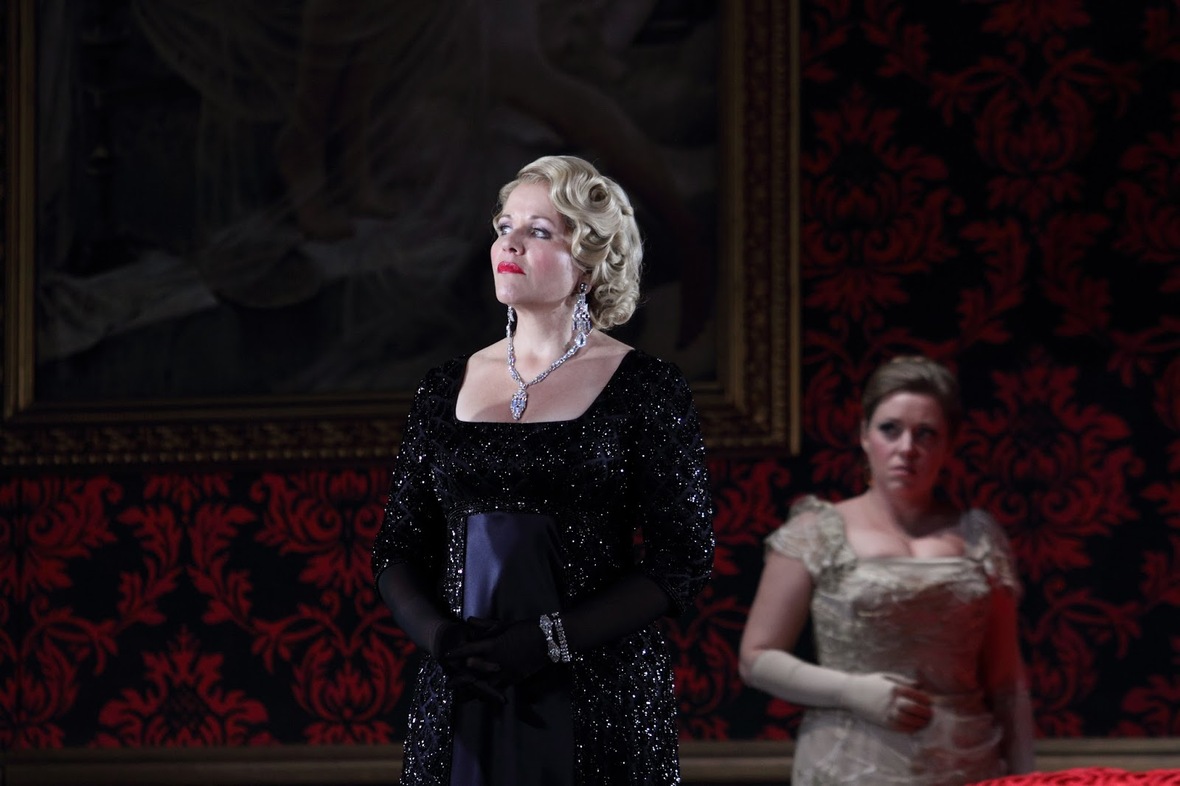
| Renée Fleming, Sophie Bevan in Act 3 of Der Rosenkavalier © ROH. Photograph by Catherine Ashmore |
Welcome to December on Planet Hugill, a month when we managed to catch two very different casts in Covent Garden's Der Rosenkavalier, heard a variety of Christmas music and theatre, and I was lucky enough to interview the film composer Rachel Portman.
Planet Hugill has been named as one of Feedspot Blog Reader's Top 25 Opera Blogs & Websites on the Web.
Opera Heroines
▪ Rising to the challenge: W11 Opera's new opera The Price about the Suffragette movement by Russell Hepplewhite.▪ A touch of greatness: Renée Fleming returned to the Marschallin at Covent Garden in Robert Carsen's new production of Der Rosenkavalier.
▪ Second view: Rachel Willis-Sørensen & Anna Stéphany in Der Rosenkavalier, a return to Robert Carsen's new production to hear two very different singers as the Marschallin and Octavian.
Performing Solo
▪ Epic Theatre? Heloise Werner in Scenes from the End, challenging one-woman music theatre piece addressing universal issues.▪ Solo viola: Rosalind Ventris in Blake, Bach, and Roxburgh.
Wigmore Hall
▪ Gravely moving: Philippe Jaroussky in Bach and Telemann with Le Concert de la Loge.▪ Telling stories: Sir John Tomlinson on vivid form in Schubert's Swansong in a new English translation.
▪ Vibrant music making: Arcangelo in early cantatas by Bach with an undeservedly neglected one from Telemann.
Various Venues
A feast of cello playing: Alban Gerhardt & the Aurora Orchestra at Kings Place
Labels:
concert review,
Kings Place
![]() |
| Alban Gerhardt, Nicholas Collon & Aurora Orchestra in rehearsal at Kings Place - photo Nick Rutter |
Reviewed by Robert Hugill on Jan 7 2017
Star rating: 4.5
An amazing evening of vibrant cello playing to launch Kings Place's cello season
![]() |
| Alban Gerhardt, Nicholas Collon & Aurora Orchestra at Kings Place photo Nick Rutter |
The concert with the Aurora Orchestra, entitled Reflections, explored how different composers had refracted the past into the present. Gerhardt opened with 'Canto primo' from Britten's Cello Suite No. 1, a work inspired directly by Bach's cello suites. Gerhardt plunged straight in, playing with singing tone and bringing out the Bachian elements. The music carried on into the Vivaldi concerto, which was performed without a conductor. The Aurora Orchestra used a reduced line-up, just thirteen strings and the fact that continuo was provided by theorbo and cello rather than harpsichord, meant that where the solo is accompanied there was very much a sense of dialogue between Gerhardt and the orchestra's principal cello (Sebastian van Kuijk).
The concerto is one of 27 which Vivaldi wrote, mainly in the 1720s, for the young women of the Ospedale dalla Pieta; clearly he had some gifted cellists in the orchestra. The Aurora Orchestra brought a lightness of touch and nice bounce to the music, without sounding confined or constrained; this was baroque music on modern instruments at its best. Gerhardt too combined litheness and bouncing rhythms with vibrancy in the solo part, and the whole created a really engaging performance. Gerhardt managed to invest the music with the right degree of intensity without bending the style over much. The Largo central movement had the solo accompanied just by continuo, with Gerhardt providing a soulful, sung line. The Allegro finale was vibrant and full of vigour, yet not unstylish, with orchestra and soloist matching each other in the vibrancy of the performance. Throughout the performance there was a strong sense of identification with the work from all the performers, a lovely degree of engagement and enjoyment, and as Gerhardt is a very physical performer this showed in his body language too.
Saturday, 7 January 2017
Remembering Ronald Stevenson
Labels:
feature article
![]() |
| Ronald Stevenson - photo courtesy of the Ronald Stevenson Society |
I first met Ronald Stevenson in around 1977, he was a close friend of one of my friends in Edinburgh so it was inevitable that I was taken to one of Ronald's recitals. I don't remember that much about the specifics, the various Ronald Stevenson recitals which I attended during the five years I was in Scotland have rather blurred. What I do remember is the slightly nerve-wracking socialising afterwards, myself, my friend, Ronald and the friends with whom he was staying in Edinburgh.
Such occasions would become something of a commonplace over the years and were as much an education for me as the music. Simple but effective food (from that first I remember the cheese and the strong black coffee), and good conversation. Ronald was not only erudite but talked with wit and charm. He could be informative and entertaining, and his musical heroes were never far away, Busoni and Grainger.
This extended to his recitals, where Ronald talked even if it was intended as a 'straight' recital. He had a gift for elucidating, informing and entertaining. I remember one lecture recital where to illustrate a point he played the opening from Chopin's Revolutionary Etude which made you wish he was playing the whole thing.
The one lecture recital I remember in more detail was one on Bach transcriptions. The art of transcription was something close to Ronald's heart, something profoundly at odds with the musical times. And Ronald's Bach transcriptions recital included some remarkable byways, such as RVW's Bach transcription from Harriet Cohen's Bach Book. This recital finished with one of Ronald's warhorses, the Bach/Busoni Chaconne. He played from music, needing a page turner, and the friend who did so commented after that it was tricky as Ronald re-composed some passages and at one point he was required to take off Ronald's glasses and wipe them.
Regrettably I never heard Ronald play his great Passacaglia on DSCH. In fact, there were few opportunities to hear Ronald's music, certainly no large-scale pieces. This was the period after he had completed the violin concerto for Yehudi Menuhin, too late and too taxing in length for Menuhin to play so there was much discussion about a possible premiere (I don't believe it was premiered until the 1990s). But his music rarely if ever seemed to crop up in concerts unless Ronald himself was involved. That Ronald was somewhat out of step with the musical times was indicated by his love not only of transcription but of writing in romantic genres,
Friday, 6 January 2017
Your New Year's resolution?
Labels:
news
We all make New Year's resolutions and never get round to them. Item, 'start going to Alexander Technique classes', but we never do, until it is too late and something needs correcting. So if you have ever thought about the Alexander Technique, then the City Lit, Keeley Street, Covent Garden, is the place for you. The City Lit is running a twelve-week course, Alexander technique: performance breath and voice, from 9 January to 3 April 2017.
The Alexander Technique is a popular technique relating to posture and breathing, aiming to help you move more freely. It is not strictly a performance technique, but is very popular with performers and many find it helpful with regard to stress and breathing.
The Technique encourages the release of habitual tension to allow greater freedom in movement, breath and speech, and the course will address the breathing and vocal needs of the actor, singer, musician and all performers. The course is aimed at actors, musicians and performers of all kinds and levels, and is suitable for complete beginners. Full information from the City Lit website.
The Alexander Technique is a popular technique relating to posture and breathing, aiming to help you move more freely. It is not strictly a performance technique, but is very popular with performers and many find it helpful with regard to stress and breathing.
The Technique encourages the release of habitual tension to allow greater freedom in movement, breath and speech, and the course will address the breathing and vocal needs of the actor, singer, musician and all performers. The course is aimed at actors, musicians and performers of all kinds and levels, and is suitable for complete beginners. Full information from the City Lit website.
New music from South Africa: I Musicanti at St John's Smith Square
Labels:
preview
![]() |
| Matthijs van Dijk |
Further ahead the group premieres a new work by Werner Bosch on 5 March, and a new duo Sonatina for Viola and Double Bass by David Earl on 28 May.
Matthijs Van Dijk won the Priaulx Rainer Prize for composition in 2003 whilst he was still studying at the University of Cape Town. He has been active in the film industry since 2005 and formed the South African Film Orchestra in 2014 to promote and record soundtracks in South Africa.
Pleasure from end to end: music for Epiphany from Clare College
Labels:
cd review
Lassus, John Sheppard, Byrd, Palestrina, Jean Mouton, Peter Cornelius, Poulenc, Howells, Warlock, John Jacob Niles, Lennox Berkeley, Arnold Bax, Judith Bingham, Judith Weir; Choir of Clare College, Cambridge, Graham Ross; Harmonia Mundi
Reviewed by Robert Hugill on Nov 27 2016
Star rating: 4.0
Imaginative programme of music for Epiphany centred on Bax's choral masterpiece
I included this disc in my round-up of Christmas discs, but as it is perfectly apposite for the season as today is Epiphany so I thought I would write in greater detail. Mater ora filium is the latest disc from Graham Ross and the Choir of Clare College, Cambridge on Harmonia Mundi where they explore music for a particular liturgical season. Here Ross casts his net widely with music for Epiphany by Lassus, John Sheppard, Byrd, Palestrina, Jean Mouton, Peter Cornelius, Poulenc, Howells, Warlock, John Jacob Niles, Lennox Berkeley, Arnold Bax, Judith Bingham and Judith Weir. The composers fall into three main groups, those from the 1400s and 1500s, those born in late 19th and early 20th century, and the two contemporary Judiths. The culmination of the disc is the title track, Bax's mammoth Mater ora filium, Ross also punctuates the programme with three hymns which form nice pause points.
Reviewed by Robert Hugill on Nov 27 2016
Star rating: 4.0
Imaginative programme of music for Epiphany centred on Bax's choral masterpiece
I included this disc in my round-up of Christmas discs, but as it is perfectly apposite for the season as today is Epiphany so I thought I would write in greater detail. Mater ora filium is the latest disc from Graham Ross and the Choir of Clare College, Cambridge on Harmonia Mundi where they explore music for a particular liturgical season. Here Ross casts his net widely with music for Epiphany by Lassus, John Sheppard, Byrd, Palestrina, Jean Mouton, Peter Cornelius, Poulenc, Howells, Warlock, John Jacob Niles, Lennox Berkeley, Arnold Bax, Judith Bingham and Judith Weir. The composers fall into three main groups, those from the 1400s and 1500s, those born in late 19th and early 20th century, and the two contemporary Judiths. The culmination of the disc is the title track, Bax's mammoth Mater ora filium, Ross also punctuates the programme with three hymns which form nice pause points.
The recording gives a strong sense of the generous acoustic, and this is filled with the choir's bright, smooth timbre and flexible tone. These are young voices, 28 in total giving an appealingly confident and stylish performance.
Thursday, 5 January 2017
London launch of the 2017 Van Cliburn Competition
![]() |
| Jayson Gillham performing at the London launch of the 2017 Van Cliburn competition |
The Van Cliburn Competition was founded in 1962 and takes place every four years in Fort Worth, Texas. It is named for the Texan pianist Van Cliburn who won the inaugural Tchaikovsky Piano Competition in Moscow in 1958.
For the 2017 competition there were over 290 applicants from 46 countries. These have been reduced to 125 and each of these are being listened to by the screening jury (Dmitri Alexeev, Michel Beroff, Janina Fialkowska, James Parker, Pamela Mia Paul) to select 30 pianist to go to Fort Worth for the main competition.
The competition is celebrating new partnerships, Universal will be recording the winners whilst Keynote Artists will be taking care of the winners, as part of the competitions mandate to support winning artists. This year's competition will be broadcast on Medici TV, in the hope of expanding the competition's base in Europe and Asia. In addition, the last two competition rounds will be shown live in 300 cinemas in the USA.
Wednesday, 4 January 2017
Poetic Inspirations: Heath Quartet and my pre-concert talk at Conway Hall
![]() |
| The Heath Quartet |
The Heath Quartet (Oliver Heath, Sara Wolstenholme, Gary Pomeroy, Chris Murray) was formed in 2002 at the Royal Northern College of Music and in May 2013 they became the first ensemble in 15 years to win the Royal Philharmonic Society’s Young Artists Award, and in 2012 won Ensemble Prize at the Festspiele Mecklenburg-Vorpommern. The quartet's recent recordings include Michael Tippett's complete quartets on Wigmore Hall Live (see my review).
At the Conway Hall they will be performing Beethoven's Quartet in D Op.18 No.3, Bartók's Quartet No.1 in A minor Sz.40, and Dvořák's Quartet in G Op.106.
Full information from the Conway Hall website, the concert starts at 6.30pm and my lecture is at 5.30pm.
The unfamiliar & the familiar in a new guise: RVW Discoveries
Labels:
cd review
RVW Three Nocturnes, Stricken Peninsula, A Road All Paved with Stars, A Road all Paved with Stars; Jennifer Johnston, Roderick Williams, BBC Symphony Orchestra, Martyn Brabbins; Albion Records
Reviewed by Robert Hugill on Dec 24 2016
Star rating: 4.0
The latest in the RVW Society's exploration of the composer's repertoire
This disc from Albion Records (the recording arm of the RVW Society) brings out one or two real RVW rarities and gives us more familiar music in unfamiliar guise. Hitherto unknown are the Walt Whitman settings Three Nocturnes for baritone and orchestra (two of them orchestrated by Anthony Payne), also hardly known is the score to the film Stricken Peninsula, here presented as Stricken Peninsula: An Italian Rhapsody for Orchestra reconstructed from the film by Philip Lane. A Road All Paved with Stars - A Symphonic Rhapsody is arranged from The Poisoned Kiss by Adrian Williams. The best known works are RVW's Four Last Songs, here performed in orchestrations by Anthony Payne. The performers baritone Roderick Williams, mezzo-soprano Jennifer Johnson, the BBC Symphony Orchestra, conductor Martyn Brabbins.
Reviewed by Robert Hugill on Dec 24 2016
Star rating: 4.0
The latest in the RVW Society's exploration of the composer's repertoire
This disc from Albion Records (the recording arm of the RVW Society) brings out one or two real RVW rarities and gives us more familiar music in unfamiliar guise. Hitherto unknown are the Walt Whitman settings Three Nocturnes for baritone and orchestra (two of them orchestrated by Anthony Payne), also hardly known is the score to the film Stricken Peninsula, here presented as Stricken Peninsula: An Italian Rhapsody for Orchestra reconstructed from the film by Philip Lane. A Road All Paved with Stars - A Symphonic Rhapsody is arranged from The Poisoned Kiss by Adrian Williams. The best known works are RVW's Four Last Songs, here performed in orchestrations by Anthony Payne. The performers baritone Roderick Williams, mezzo-soprano Jennifer Johnson, the BBC Symphony Orchestra, conductor Martyn Brabbins.
RVW's Three Nocturnes date from 1908, and span the period when RVW went to study with Ravel. The second Nocturne (which seems to have been written first, before he went to Ravel) survived in full orchestration whilst the other two (which date from after the Ravel lessons) survived in short score which has been filled out by Anthony Payne. The first opens with hints of the Pastoral Symphony and is full of the lyric beauty of RVW at his prime, with the high baritone part sung beautifully by Roderick Williams. The second is darker and more atmospheric, with richly rewarding vocals woven into the texture of the score, the third seems to return to the world of the first. None of the Nocturnes is uncomplex, but the second seems to be the most structured whereas the other two rely on lyrical directness.
Planet Hugill has been named as one of Feedspot Blog Reader's Top 25 Opera Blogs & Websites on the Web.
Many thanks and please keep reading!
Tuesday, 3 January 2017
Georgian history, politics and landscape in premiere of new Norwegian violin concerto
Labels:
preview
![]() |
| Henning Sommerro © Aleksandre Khatiskatsi |
Georgia plays a large role in the concerto, as it is partly inspired by the Norwegian author and artist Dagny Juel, who was murdered in Tbilisi, Georgia in 1903; Juel is known for her association with artists Edvard Munch, August Strindberg, Richard Dehmel and Stanisław Przybyszewski, but was a creator in her own right. Sommerro, who is writing an opera based on Dagny Juel, was encouraged by Aleksandre Khtiskatsi to travel to modern day Georgia and thus the concerto is influenced not just by Juel's history in Georgia, but the problems of modern day politics there with social unrest and the rise of the new right. During the performances of the concerto in Oslo, Aleksandre Katiskatsi's photographs (you can see his work at his Alexander Light website) from the trip will be projected, incorporating the landscape of Georgia into the new work.
Full details from the Oslo Philharmonic website.
Moving beauty: Iestyn Davies & Arcangelo in Bach cantatas
Bach Widerstehe doch der Sünde, Ich habe genug, Vergnüte Ruh, beliebte Seelenlust ; Iestyn Davies, Arcangelo, Jonathan Cohen; Hyperion
Reviewed by Robert Hugill on Jan 1 2017
Star rating: 4.5
Poised elegance from Iestyn Davies in three of Bach's solo alto cantatas
On this new disc from Hyperion, counter-tenor Iestyn Davies joins Jonathan Cohen and Arcangelo for performances of three of Bach's best-loved alto cantatas, Vergnüte Ruh, beliebte Seelenlust BWV170, Widerstehe doch der Sünde BWV54, and the alto version of Ich habe genug BWV82, and the ensemble performs the sinfonias from the cantatas Falsche welt, dir trau ich nicht! BWV52 and Ich liebe den Höchsten von ganzem Gemüte BwV174.
Reviewed by Robert Hugill on Jan 1 2017
Star rating: 4.5
Poised elegance from Iestyn Davies in three of Bach's solo alto cantatas
On this new disc from Hyperion, counter-tenor Iestyn Davies joins Jonathan Cohen and Arcangelo for performances of three of Bach's best-loved alto cantatas, Vergnüte Ruh, beliebte Seelenlust BWV170, Widerstehe doch der Sünde BWV54, and the alto version of Ich habe genug BWV82, and the ensemble performs the sinfonias from the cantatas Falsche welt, dir trau ich nicht! BWV52 and Ich liebe den Höchsten von ganzem Gemüte BwV174.
The disc provides a fine opportunity to hear Iestyn Davies on peak form, joining with Cohen and Arcangelo to make engagingly vibrant chamber music with the voice very much part of the ensemble. Though historically informed performances, it must be remembered that Bach's altos were boys rather then men, and that whilst we benefit from Davies' superbly mature technique, the sound he makes is very different to that which Bach heard, though the challenging nature of some of the writing in the cantatas implies Bach had one or two good boy altos for whom to write.
Monday, 2 January 2017
Review of the year - 2016 in CD reviews
Labels:
cd review,
feature article
In 2016 we saw CDs ranging from Guillaume de Machaut to James MacMillan, music for reconstructed Celtic horns to celebrations of Colin Matthews 70th birthday. St John's College Cambridge launched its own imprint with a disc of music by Jonathan Harvey, and Ethel Smyth's opera The Boatswain's Mate finally made it to CD. Here is my selection of some of the most memorable of the CDs from 2016.
My disc of the year must be Allan Clayton, Ian Page and Classical Opera's tribute to the great Handelian tenor John Beard, but Handel also showed up in trio sonatas from the Brooke Street Band, and in Mendelssohn's re-working of Israel in Egypt.
But top of the list must come Gareth Wilson and the choir of King's College, London's tribute to the late David Trendall
My disc of the year must be Allan Clayton, Ian Page and Classical Opera's tribute to the great Handelian tenor John Beard, but Handel also showed up in trio sonatas from the Brooke Street Band, and in Mendelssohn's re-working of Israel in Egypt.
But top of the list must come Gareth Wilson and the choir of King's College, London's tribute to the late David Trendall
- A remarkable tribute - In memoriam:William Byrd, Gareth Wilson, Silvina Milstein, Francis Pott, Jean L'Heritier, Robert Busiakiewicz, Rob Keeley, Antony Pitts, Matthew Martin, Giovanni Pierluigi da Palestrina, Jacobus Clemens non Papa, Francis Grier; The Choir of King's College Choir London, Gareth Wilson; Delphian. A remarkable tribute to a remarkable man
Disc of the year
- Where'er you walk - Arias for Handel's favourite tenor: Handel, Boyce, Arne; Allan Clayton, Mary Bevan, Orchestra of Classical Opera, Ian Page; Signum Classics. A survey of the music written for John Beard, the great tenor for whom Handel wrote Jephtha and Samson
CD reviews
- A voice from Heaven: The Kings Consort in 20th century British choral music: Howells, Harris, MacMillan, Tavener, Stanford, Leighton, Parry, Berkeley, Murrill, Jones; Choir of the King's Consort, Robert King; Vivat. An attractive and intriguing programme, very finely sung
- Mozartian fragment: Zaide from Classical Opera: Mozart Zaide; Sophie Bevan, Allan Clayton, Jacques Imbrailo, Darren Jeffery, Stuart Jackson, Classical Opera, Ian Page; Signum. A fine performance shows what sophisticated music there is in Mozart's first, unfinished singspiel
- Ethel Smyth The Boatswain's Mate receives a welcome first recording: Ethel Smyth The Boatswain's Mate; Nadine Benjamin, Edward Lee, Jeremy Huw Williams, Lontano Ensemble, Odaline de la Martinez; Retrospect Opera. First recording for Ethel Smyth's charming fourth opera
- Since it was the day of preparation: James MacMillan Since it was the day of preparation; Brindley Sherratt, Synergy Vocals, Hebrides Ensemble (director William Conway); Delphian. MacMillan's examination of the events after Christ's crucifixion, in a dramatic, innovative and profoundly moving new work
- Machaut's Messe de Nostre Dame rethought by Graindelavoix: Guillaume de Machaut Messe de Nostre Dame and mass propers; Graindelavoix, Bjorn Schmelzer; Glossa. A refreshing and invigorating view of Machaut's masterpiece, in the tradition of Marcel Peres and Ensemble Organum
- Deo - music by Jonathan Harvey from St John's College, Cambridge: Jonathan Harvey I Love the Lord, Magnificat & Nunc Dimittis, Come Holy Ghost, Praise ye the Lord, Missa Brevis, The Royal Banners Forward Go, The Annunciation, Toccata for Organ and Tape and Laus Deo; Choir of St John's College, Cambridge, Andrew Nethsingha, Edward Picton-Turberbill; Signum Classics. A new imprint from St John's College, Cambridge, launched in fine style by a terrific disc devoted to the sacred music of Jonathan Harvey
- A journey down the Rhine with 24 women's voices, four horns and harp: Rheinmädchen Wagner, Brahms, Schumann, Schubert; Ensemble Pygmalion, Raphael Pichon; Harmonia Mundi. Magical sounds conjured from this journey down the Rhine with 24 women's voices, four horns and harp
- Passionate intensity - Schnittke's Penitential Psalms: Alfred Schnittke Penitential Psalms; RIAS Kammerchor, Hans-Christoph Rademann; Harmonia Mundi. Passionate intensity and technical prowess in these dark psalms.
- Elena Langer - Landscape with Three People: Elena Langer Landscape with three people, Snow, The Storm Cloud, Two Cat Songs, Ariadne, Stay O Sweet; Anna Dennis, William Towers, Nicholas Daniel; Harmonia Mundi. Vocal music by the Russian-born British composer, full of fascinating textures and evocative writing
- Israel in Ägypten - Mendelssohn's take on Handel: Handel edited Mendelssohn Israel in Ägypten (Israel in Egypt); Lydia Teuscher, Julia Doyle, Hilary Summers, Benjamin Hulett, Roderick Williams, The King's Consort, Robert King; Vivat. Fascinating and illuminating reconstruction of the version of Handel's oratorio edited for performance by Mendelssohn
- Winning performances - Brook Street Band in Handel trio sonatas: Handel trio sonatas; The Brook Street Band; AVIE. Joyful accounts of trio sonatas not published in Handel's lifetime
- Scattered Ashes - Josquin's Miserere and the Savonarolan Legacy: Josquin, Palestrina, Lassus, Claude Le Jeune, Jean L'Heritier, Nicolas Gombert, Clemens non Papa, Byrd; Magnificat, Philip Cave; LINN. Engrossing disc examining the legacy both of Girolamo Savonarola and Josquin's setting of Savonarola's text.
- Michael Csányi-Wills - songs with orchestra: Michael Csányi-Wills Songs with Orchestra; Ilona Domnich, Nicky Spence, Jacques Imbrailo, Londamis Ensemble, Mark Eager; Toccata Classics. Mining his own family history, Songs of remarkable lyric power and intensity
- Vibrant Mendelssohn from Pablo Heras-Casado & the Freiburg Baroque Orchestra: Mendelssohn Scottish and Italian Symphonies; Freiburg Baroque Orchestra, Pablo Heras-Casado; Harmonia Mundi. Removing the varnish from Mendelssohn's music to reveal the brilliant young man underneath
- A powerful torso - Donizetti's Le Duc d'Albe: Donizetti Le duc d'Albe; Michael Spyres, Angela Meade, Laurent Naouri, Gianluca Buratto, Halle, Mark Elder; Opera Rara. Donizetti's unfinished French opera revealed as a powerful torso.
- Complete Tippett quartets recorded live by the Heath Quartet: Tippett String Quartets; The Heath Quartet; Wigmore Hall Live. Dazzling rhythms, complex textures and surprising lyricism in these live performances of Tippett's complete quartets
- Russian impressionism: Mussorgsky - Songs and Romances: Mussorgsky Songs and Romances; Katherine Broderick, Sergey Rybin; Stone Records. Two major cycles and a group of songs in a programme which links Mussorgsky's style to the later French impressionist composers
Saturday, 31 December 2016
Review of the year - 2016 in opera and concert reviews
Labels:
feature article
![]() |
| Disciples in Streetwise Opera and The Sixteen's The Passion Photo by Graeme Cooper |
![]() |
| Renée Fleming, Sophie Bevan - Act 3, Der Rosenkavalier © ROH. Photograph by Catherine Ashmore |
People
- A touch of greatness: Renée Fleming returns to the Marschallin at Covent Garden - Der Rosenkavalier at the Royal Opera House
- Religious fervour: Sonya Yoncheva singers her first Norma in La Fura dels Baus dramatic interpretation at Covent Garden - Norma at the Royal Opera House
- Telling stories: Sir John Tomlinson in Schubert's Swansong (Schwanengesang sung in English) at the Wigmore Hall
![]() |
| Paul Nilon, Simeon John-Wake - Handel Tamerlano - Buxton Festival photo Robert Workman |
- Thrilling yet disturbing theatre: first UK staging of Karl Amadeus Hartmann's Simplicius Simplicissimus by Independent Opera at Sadler's Wells
- The minutes simply sped by: an almost complete performance of Rossini's mammoth Semiramide by Opera Rara at the BBC Proms
- Visual and aural feast: Handel's Tamerlano at the Buxton Festival
- Grandeur and intimacy: Verdi's Don Carlo at Grange Park Opera
- Vivid and intense: Mozart's Don Giovanni from Classical Opera with Jacques Imbrailo in the title role
- Brought thrillingly to life: Enescu's Oedipe at Covent Garden
- Simply remarkable: The Passion from Streetwise Opera and The Sixteen
- Teeming with life and joy: Rimsky-Korsakov's May Night from Royal Academy Opera
- Rare Donizetti brought convincingly to life on stage in Hackney: Pia de'Tolomei from English Touring Opera
- Stuart MacRae & Louise Walsh's The Devil Inside from Music Theatre Wales
Concerts
![]() |
| Kimiko Ishizaka Photo credit: Intuitive Fotografie - Philippe Ramakers |
- A radical re-invention: Joyce DiDonato's War and Peace at the Barbican
- A day at the Oxford Lieder Festival: Bach revived, lunch with Schubert, tea with Mendelssohn and Gade and an evening with Juliane Banse
- Pure magic: sung poetry from Christian Gerhaher in Schumann at the Wigmore Hall
- A feast of pianism: Two-piano gala at the London Piano Festival at Kings Place
- Youth has it: Verdi's Requiem at the BBC Proms
- Master storytelling: Robin Tritschler and Graham Johnson in Schubert at the Wigmore Hall
- Last but not least: Rachel Podger and EUBO at the London Festival of Baroque Music
- Listening for the first time: Handel's Messiah with the Dunedin Consort at St John's Smith Square
- Rhinegold Live: Charles Owen and Katya Apekisheva in Stravinsky's Rite of Spring
- Blaze of Youth indeed: Chad Hoopes, Kristjan Järvi and the National Youth Orchestra at the Royal Festival Hall
- Perfectly right for this performer at this time: Kimiko Ishizaka performs The Art of Fugue with her own completion in Cologne
- Schubert refractions: Maxim Rysanov and Ashley Wass at the Wigmore Hall
Friday, 30 December 2016
Orchestral adventures: New South American Discoveries
Labels:
cd review
Jorge Villavicencio Grossmann, Victor Agudelo, Sebastian Vergara, Diego Luzuriaga, Diego Vega, Sebastian Errazuriz, Agustin Fernandez,Antonio Gervasoni; Norwegian Radio Orchestra, Miguel Harth-Bedoya; Harmonia Mundi
Reviewed by Robert Hugill on Dec 21 2016
Star rating: 4.0
Fascinating survey of contemporary South American music
This enterprising disc, from Miguel Harth-Bedoya and the Norwegian Radio Orchestra on Harmonia Mundi, is a survey of 21st century pieces by South American composers. Entitled New South American Discoveries it features music by Jorge Villavicencio Grossmann (Peru), Victor Agudelo (Colombia), Sebastian Vergara (Chile), Diego Luzuriaga (Ecuador), Diego Vega (Colombia), Sebastian Errazuriz (Chile), Agustin Fernandez (Bolivia) and Antonio Gervasoni (Peru).
Reviewed by Robert Hugill on Dec 21 2016
Star rating: 4.0
Fascinating survey of contemporary South American music
This enterprising disc, from Miguel Harth-Bedoya and the Norwegian Radio Orchestra on Harmonia Mundi, is a survey of 21st century pieces by South American composers. Entitled New South American Discoveries it features music by Jorge Villavicencio Grossmann (Peru), Victor Agudelo (Colombia), Sebastian Vergara (Chile), Diego Luzuriaga (Ecuador), Diego Vega (Colombia), Sebastian Errazuriz (Chile), Agustin Fernandez (Bolivia) and Antonio Gervasoni (Peru).
The disc provides a valuable overview of what is evidently a lively South American contemporary music scene. It is perhaps unwise to generalise from the selection on the disc, as the music probably represents Miguel Harth-Bedoya's taste as much as anything, but certainly the disc makes you interested to hear more. What is particularly illuminating is that though a number of the composers studied in the USA or UK, all started off in South American institutions, showing that contemporary composition has good native roots.
The title of Jorge Villavicencio's Wayra (2011) means Wind in the ancient Inca language. Starting with vivid excitement even when the music quietens there is a sense of something about to occur. Victor Agudelo's El Sombreron (2009) is based on a Colombian story. It opens with eerie atmosphere and the sound of horse's hooves (I have to confess on first listening I assumed it was the ticking of a clock) and develops a sense of narrative with strong filmic qualities, to create a striking narrative tone poem.
Thursday, 29 December 2016
Wintry Darkness from the Tallis Scholars
Labels:
by Ruth Hansford,
concert review,
SJSS
Josquin des Prez, Cipriano de Rore, Tomas Luiz de Victoria, Hernando Franco and John Tavener; The Tallis Scholars, Peter Phillips; St John's Smith Square
Reviewed by Ruth Hansford on Dec 21 2016
Star rating: 3.5
Darkness & mystery in this programme of Renaissance music
If you had walked into St John’s Smith Square (21 December 2016) without knowing what The Tallis Scholars did or what the music was, you would not immediately guess that this was a Christmas concert. There was plenty of darkness and mystery in this programme of Renaissance music that looked back to a time when Christmas was a time to celebrate – or reflect on – the unknown. Directed by Peter Phillips, they performed music by Josquin des Prez, Cipriano de Rore, Tomas Luiz de Victoria, Hernando Franco and John Tavener.
Reviewed by Ruth Hansford on Dec 21 2016
Star rating: 3.5
Darkness & mystery in this programme of Renaissance music
If you had walked into St John’s Smith Square (21 December 2016) without knowing what The Tallis Scholars did or what the music was, you would not immediately guess that this was a Christmas concert. There was plenty of darkness and mystery in this programme of Renaissance music that looked back to a time when Christmas was a time to celebrate – or reflect on – the unknown. Directed by Peter Phillips, they performed music by Josquin des Prez, Cipriano de Rore, Tomas Luiz de Victoria, Hernando Franco and John Tavener.
We started with Josquin’s short Christmas motet, Praeter rerum seriem (‘Beyond the order of this world’, the Virgin Mother bore God in human form). Something unfathomable yet perfect. The piece starts low and emerges slowly from the depths, with the cantus firmus or plainchant moving slowly ‘like tectonic plates’, said James Potter in his programme note. Josquin sowed the musical seeds for later composers by his understanding and exploitation of the music printing business – indeed he seems to have had rock-star status in his day, spawning imitations from copyists who would pass their work off as Josquin’s.
This austere motet certainly set the mood for the evening, and it provided the inspiration for de Rore’s full-length mass that followed. This was a still, meditative piece, written in praise of his employer Hercules of Ferrara and in homage to Josquin, and hence earning him a salary as well as a reputation as a clever composer.
Wednesday, 28 December 2016
Ring of Achievement?
Labels:
feature article
![]() |
| Amalie Materna, the first Bayreuth Brünnhilde, with Cocotte, the horse donated by King Ludwig to play her horse Grane |
Not only is Wagner's work based on a re-invention of the theatrical myth-making of Weber, Marschner and their contemporaries, but the work's length and festal nature have links to contemporary opera performance. In the 19th century nights in the theatre could be long, short operas would be supplemented by ballets. As a young man in Paris, Wagner experienced the theatrical grandiosity of French grand opera, where operas by Halevy and Meyerbeer can reach a length which we now think of as Wagnerian.
Wagner's musical background, though, was not in the state-subsidised opera house in Paris, but in the German Hofoper, the court opera where opera was staged as part of court festivities and the sense of a festival event (rather than run of the mill season) was great. This was, of course, changing and part of the story of 19th century opera is the replacement of royal and aristocratic patronage with other forms of more public support.
The sheer size of The Ring means that it remains something of a festal event. And in the modern opera world, the extremely long operas are rare. Few companies would consider mounting Halevy's La Juive uncut, and Verdi's Don Carlos is usually performed in the more compact later versions. Wagner is one of the few composers where the sheer amplitude of his vision is routinely preserved uncut.
Sunday, 25 December 2016
Saturday, 24 December 2016
The Ghost of Rosenkavaliers past
Labels:
feature article
![]() |
| Richard Strauss's Der Rosenkavalier at Theatr Magdeburg, director Olivia Fuchs. Photo by Nilz Böhme. |
![]() |
| Valerie Masterson as Sophie and Sandra Browne as Octavian in Der Rosenkavalier at ENO in 1975 Photograph © Sarah Quill, 1975 |
The shadow of Elisabeth Schwarzkopf hangs heavily over the role of the Marschallin in Der Rosenkavalier for people of my generation. Even though she had stopped singing the role before I started going to opera (I saw her in recital), she was the Marschallin par excellence. I have, however, been lucky enough to see some very fine Marschallin's indeed. At English National Opera there was Ava June and Valerie Masterson both in the pre-Jonathan Miller production, Yvonne Kenny, Janice Watson and Anne Evans in the Jonathan Miller production, Joan Rogers and Amanda Roocroft in the David McVicar production. Ava June was in fact my first Marschallin (at ENO in the late 1970s with Josephine Barstow as Octavian), but another early one was Catherine Wilson at Scottish Opera in 1979 in Anthony Besch's production. Whilst at Covent Garden, Marschallins have included Gwyneth Jones in the last revival of the Visconti production (which debuted in 1966), Kiri Te Kanawa, Anna Tomowa Sintow, Felicity Lott, Lucia Popp and Renee Fleming in the John Schlesinger production.
Friday, 23 December 2016
Unjustly neglected: Francesco Durante's Requiem
Labels:
cd review,
The Sixteen
Francesco Durante Requiem, Organ concert; Alexandra Kidgell, Katy Hill, William Purefoy, Mark Dobell, Ben Davies, Clive Driskill-Smith, Christ Church Cathedral Choir, Oxford, Oxford Baroque, Stephen Darlington; Coro
Reviewed by Robert Hugill on Dec 15 2016
Star rating: 4.0
Popular in its day but now unjustly neglected, a striking Requiem mass
If you have heard of Francesco Durante at all it is probably as a teacher (his pupils included Pergolesi, Traetta, Piccini and Paisiello) but this new disc on the Coro label from Christ Church Cathedral Choir and Oxford Baroque, conductor Stephen Darlington, shows us another side to Durante. Stephen Darlington conducts choir, orchestra and soloists Alexandra Kidgell, Katy Hill, WilliamPurefoy, Mark Dobell and Ben Davies in Durante's Requiem Mass in C minor, and organist Clive Driskill-Smith is the soloist in Durante's Organ Concerto in B flat major.
Reviewed by Robert Hugill on Dec 15 2016
Star rating: 4.0
Popular in its day but now unjustly neglected, a striking Requiem mass
If you have heard of Francesco Durante at all it is probably as a teacher (his pupils included Pergolesi, Traetta, Piccini and Paisiello) but this new disc on the Coro label from Christ Church Cathedral Choir and Oxford Baroque, conductor Stephen Darlington, shows us another side to Durante. Stephen Darlington conducts choir, orchestra and soloists Alexandra Kidgell, Katy Hill, WilliamPurefoy, Mark Dobell and Ben Davies in Durante's Requiem Mass in C minor, and organist Clive Driskill-Smith is the soloist in Durante's Organ Concerto in B flat major.
The recording is premiere of Darlington's new modern performing edition of Durante's Requiem, making easily available for the first time a work which was remarkably popular in its day. Though Durante was based in Naples, the Requiem seems to have spread widely over the Hapsburg Empire, but was in fact never published. Naples was renowned for its opera, and Durante's major pupils were all known for their operatic work, so the fact the Durante concentrated on writing sacred music seems to have hindered his historical reputation.
The Requiem is not the first orchestral requiem by a long chalk, but it very much takes a symphonic approach to the music. Listening to it I was reminded of the Requiem by Michael Haydn, an important precursor of Mozart's Requiem. Not that much is known about the work, but it was probably premiered in Rome in 1746; one probable suggestion begin a requiem mass for Philip V of Spain at S. Giacomo degli Spagnoli.
Durante wrote the Requiem for an interesting combination of performers. The main choir is five-part (SSATB), from which group the soloists were taken. There is also a ripieno group (ATB) which is often used simply to reinforce the tutti, but Durante also makes use of the ripieno group to create a rich eight-part texture.
On this recording both choirs are sung by members of the Christ Church Cathedral Choir. The recording does not specify details, but with a choir of 14 trebles, 5 altos, 5 tenors, and 4 basses, the numeric options are relatively limited. The soloists are not drawn from the choir but use singers associated with The Sixteen.
Rachel Willis-Sørensen & Anna Stéphany in Der Rosenkavalier
Labels:
Covent Garden,
opera review,
second view
![]() |
| Anna Stéphany, Rachel Willis-Sørensen - Der Rosenkavalier @ ROH. photo Catherine Ashmore |
Reviewed by Robert Hugill on Dec 22 2016
Star rating: 4.5
A return to Robert Carsen's new production to hear two very different singers as the Marschallin and Octavian
We returned to Robert Carsen's new production of Strauss's Der Rosenkavalier on 22 December 2016 at the Royal Opera House to see the alternative cast (see my review of the production's first night). This time Rachel Willis-Sørensen was the Marschallin and Anna Stéphany was Octavian, with the rest of the cast remaining the same; Matthew Rose as Ochs, Sophie Bevan as Sophie, and Jochen Schmeckenbecher as Faninal with Wolfgang Ablinger-Sperrhacke, Helene Schneiderman and Giorgio Berrugi. Sets were by Paul Steinberg, costumes by Brigitte Reiffenstuel, lighting by Robert Carsen and Peter van Praet, choreography by Philippe Giraudeau, with Andris Nelsons in the pit conducting the Orchestra of the Royal Opera House.
Soprano Rachel Willis-Sørensen won first prize at the 2014 Operalia competition, was a winner of the 2010 Metropolitan Opera National Council Auditions and spent three yeas as a member of the ensemble at the Dresden Semperoper. She is moving into jugend-dramatisch territory, singing Eva in Die Meistersinger at Covent Garden, Beethoven's Leonore and Freia. I am unclear whether this was her first Marschallin but it certainly isn't a role which she has sung extensively, yet! We last heard mezzo-soprano Anna Stéphany singing the title role in Handel's Serse with the Early Opera Company (see my review), and she first sang Octavian in 2011 at the Bolshoi and returned to the role more recently at the Royal Swedish Opera.
Thursday, 22 December 2016
Cavalli and Rameau at Woodhouse in 2017
Labels:
preview
| Woodhouse Copse |
Earlier in 2016 we saw a terrific performance of Lully's Armide staged at Woodhouse, you can read my review on this blog.
Full information from the Woodhouse Opera website.
Subscribe to:
Posts (Atom)
Popular Posts this month
-
Maurice Greene (1696 - 1755) is one of that generation of English composers who grew up in Handel's shadow. Handel, a composer who se...
-
Back in the late 1990s one of the origins for ideas for new musical works was the moment during mass when I tuned the homily out and my mind...
-
Walton: Cello Concerto - Jonathan Aasgaard, John Wilson, Sinfonia of London - BBC Proms at Royal Albert Hall (Photo: BBC / Chris Christodo...
-
Joan Rodgers CBE (Photo Groves Artists) Rachmaninov, Arensky, Prokofiev, Viardot, Scriabin, Shostakovich; Joan Rodgers, Michael Mofid...
-
Hugo Wolf Goethe Lieder, part 1 ; Louise Alder, Fflur Wyn, Katarina Karneus, Rowan Hellier, Adrian Thompson, Roderick Williams, Neal Davie...
-
These discs from the choir of New College, Oxford, under Edward Higginbottom, represent an admirable survey of Britten's unaccompanied...
-
John Wilson & Sinfonia of London at Cheltenham Town Hall, Cheltenham Music Festival (Photo: Still Moving Media for Cheltenham Festivals)...
-
Verdi: Un ballo in maschera; Elin Pritchard, Matteo Desole, Dario Solari, Rosalind Plowright, dir: Rodula Gaitanou, City of London Sinfoni...
-
Leonora d'Este Musica quincum voce ; Musica Secreta, Celestial Sirens, Deborah Roberts, Laurie Stras; Obsidian Reviewed by Ro...
-
Johann Strauss: Die Fledermaus - Alison Langer, Harry Wilson - Opera Holland Park (Photo: Craig Fuller) Johann Strauss: Die Fledermaus ; T...