Saturday, 14 January 2017

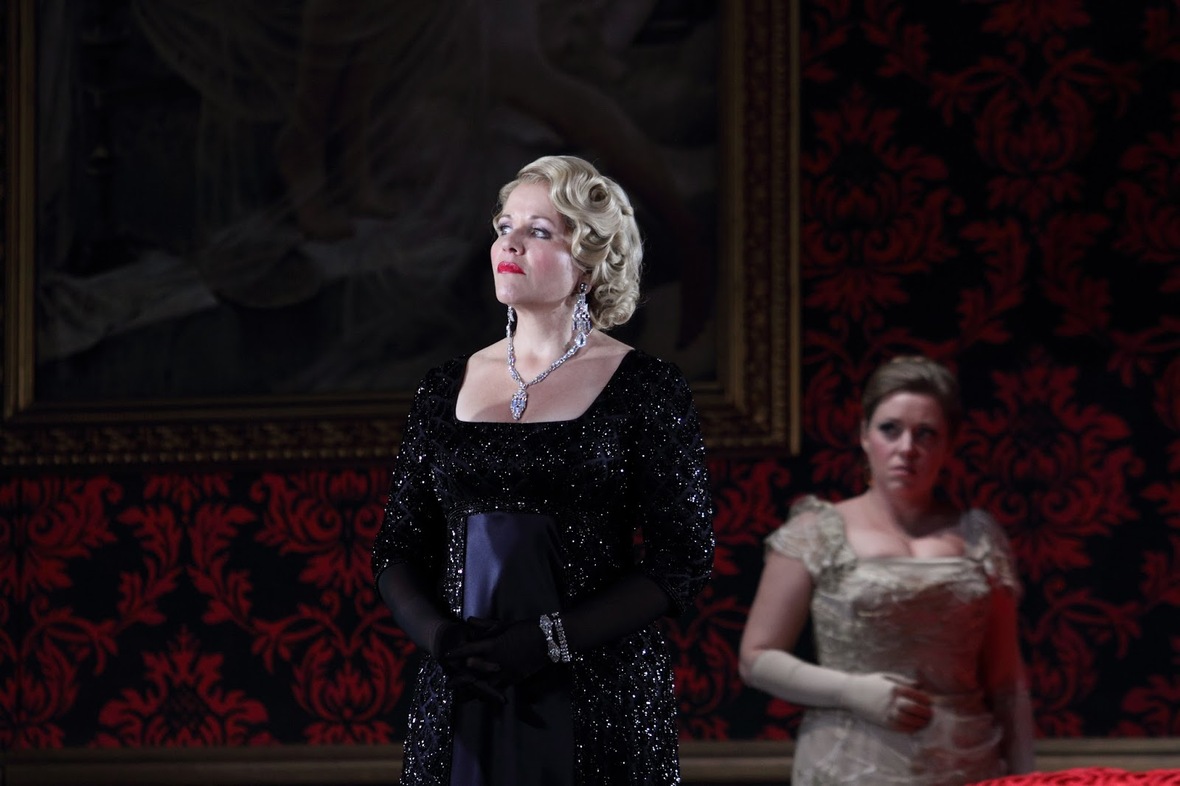
Concentrated intensity: George Benjamin and Martin Crimp's Written on Skin revived at Covent Garden

Barbara Hannigan - Written on Skin, The Royal Opera © ROH/Stephen Cummiskey, 2012
Barbara Hannigan - Written on Skin,
The Royal Opera © ROH/Stephen Cummiskey, 2012
George Benjamin Written on Skin; Barbara Hannigan, Iestyn Davies, Christopher Purves, Victoria Simmonds, Mark Padmore, dir: Katie Mitchell, cond: George Benjamin; Royal Opera House
Reviewed by Robert Hugill on Jan 13 2017
Star rating: 5.0

Slightly re-cast revival sheds new light on Benjamin's powerful opera

Having received its UK premiere in 2013, George Benjamin and Martin Crimp's opera Written on Skin returned to Covent Garden on 13 January 2017 in Katie Mitchell's production. Benjamin again conducted and Christopher Purves, Barbara Hannigan and Victoria Simmonds returned to their roles, with Iestyn Davies and Mark Padmore new to the opera at Covent Garden. Time has passed, and changes in casting inevitably shed different light on a work so the revival formed a welcome chance to re-assess the opera and the production. (See my review of the 2013 performance).

Katie Mitchell's production, with dazzling designs by Vicki Mortimer, remains one which I can understand but cannot love. The archly analytical nature of the production, with the need to rationalise everything and provide a coherent back-story, means that we receive rather too much information. I was less worried this time about the scenes in the modern part of the set (the Angels and the Angel Archivists preparing the props for the reenactment of the story). But by giving us multiple points of view, Mitchell is able to ensure that every detail of George Benjamin's stunning score is illustrated. The orchestral interludes which Benjamin provides, covering moments like Agnes' (Barbara Hannigan) seduction of the Boy (Iestyn Davies), and the Protector's (Christopher Purves) murder of the Boy, are illustrated in great detail when in fact much of the drama and emotional argument is in the orchestra.

Jorge Navarro-Colorado wins Audition Oracle Singers Preparation Scholarship

Jorge Navarro-Colorado - Photo: Jamie Capewell
Jorge Navarro-Colorado
Photo: Jamie Capewell 
The Spanish tenor Jorge Navarro-Colorado has been popping up in the blog ever since we saw him as Flute in Britten's A Midsummer Nights Dream and in Ned Rorem's Our Town with the Guildhall School in 2012. He has performed chorus and small roles/covers for several companies including Glyndebourne, Garsington & Wexford, and in 2017 he makes his role debut at a major international festival, and has been awarded the first Audition Oracle Singers Preparation Scholarship. The award of will pay for lessons and coaching to enable Jorge to prepare thoroughly for his role.

An anonymous sponsor has enabled a second award of £300 to help another singer from the shortlist of six. This will be awarded to British soprano Nazan Fikret to support her in the preparation of two role debuts, Euridice in Orfeo ed Euridice for Longborough Opera and Arasse in Hasse's Siroe for the Nederlandse Reisopera.

Audition Oracle is a website, founded by the singer Melanie Lodge, which has become a leading source for professional opera singers and auditions, enabling employers to find singers and singers to find auditions & opportunities, further information on Audition Oracle at their website.

Friday, 13 January 2017

Digital, Diversity and Brexit! Tough topics at ABO Conference

ABO Conference 2017
The Association of British Orchestras (ABO) holds its 2017 conference in Bournemouth on 25 to 27 January 2017. Rather intriguingly the conference theme is Disruption and there will be sessions on diversity, digital and Brexit. The conference is hosted by the Bournemouth Symphony Orchestra, (BSO), the only UK orchestra to have received Arts Council Change Makers funding for their project with conductor James Rose. James uses a specially developed head-baton, and he will develop a new ensemble for the BSO comprising disabled and non-disabled musicians, the first of its kind. 

Disruption comes in various guises, some welcome and some unwelcome. Many people agree that the classical concert format is a bit stale, and conference delegates will explore key questions such as 'How can new technology revolutionise the orchestral experience?' and 'Are there completely new business models to explore?'. Other key topics include what potential disruptors there are which will influence the diversity of orchestras and audiences, and of course in the era of Brexit, is politics the ultimate disruptor?

Delegates will also attend a concert conducted by Kirill Karabits, Chief Conductor of the BSO, featuring Prokofiev's Violin Concerto No. 2 (with Valeriy Sokolov) and Shostkovtich Symphony No. 8; the concert will be broadcast live on BBC Radio 3.

Full details from the ABO website.

On the road: Edward Gardner and the Bergen Philharmonic in UK and Netherlands

Edward Gardner and the Bergen Philharmonic on Tour
Edward Gardner has been chief conductor of the Bergen Philharmonic Orchestra since 2015, and now he is bringing the orchestra to the UK to give British audiences a chance to hear their extraordinary chemistry in action. They begin their tour of the UK and the Netherlands on Sunday 15 January 2017 at Saffron Hall, with Grieg's Peer Gynt Suite No. 1, Elgar's Cello Concerto with cellist Leonard Elschenbroich, and Bartok's Concerto for Orchestra.  The UK takes in City Hall, Birmingham, the Anvil Basingstoke, City Hall Sheffield, and Cadogan Hall with the same programme, with Leonard Elschenbroich and Truls Mørk sharing the soloist honours in the Elgar, and Basingstoke will get to hear Baibe Skride in Sibelius' Violin Concerto. The tour concludes in Amsterdam with a programme which combines Elgar's Cello Concerto (with Truls Mørk) and excerpts from Grieg's Peer Gynt.

Edward Gardner became chief conductor of the Bergen Philharmonic Orchestra in October 2015, when the orchestra celebrated its 250th anniversary. He recently renewed his contract with the orchestra until 2021. Gardner's recording with the orchestra of Schoenberg's Gurrelieder has recently been gaining plaudits.

Further information from the Bergen Philharmonic website.

An evening of contrasts: German lieder & English song at Kensington and Chelsea Music Society

The Arab Hall in Leighton House
Robert Schumann, Clara Schumann, Johannes Brahms, RVW, Britten, Walton, Roger Quilter; Mary Bevan, Johnny Herford, William Vann; Kensington and Chelsea Music Society at Leighton House
Reviewed by Robert Hugill on Jan 11 2017
Star rating: 4.0

Mix of German and English songs & duets in this engaging, intimate recital

Kensington and Chelsea Music Society runs a regular concert series in Leighton House, Kensington and on Wednesday 11 January 2017 we went along to hear soprano Mary Bevan, baritone Johnny Herford and pianist William Vann (who is co-chair of the society) in a programme of English and German songs and duets, with music by Robert Schumann, Clara Schumann and Johannes Brahms, alongside RVW's Songs of Travel, plus songs by Britten, Walton, RVW and Roger Quilter.

Leighton House is the former home of the artist, Frederic Leighton, and recitals take place in what was his studio, surrounded by his pictures and by his casts of Greek and Roman antiquities. The concert also presents a chance to wander round the house, with its collection of Leighton's pictures but the biggest attraction is perhaps the exotic splendour of the Arab Hall, where we could have a glass of wine at the interval.

Each half of the concert paired German lieder with English song. We started with Mary Bevan singing a group of songs by Robert Schumann, Widmung, Mondnacht and Requiem. Bevan sang with a lovely warm centred tone and a fine shapely line, and created a real sense of engaging intimacy. Widmung was lyrical and flowing, whilst Mondnacht was quiet and inward with long spun lines. In Requiem, the latest song of the three, Bevan sang with controlled intensity & beauty of line, but rising to intense passion at the climax. Throughout William Vann formed an equal partner, bringing the beauty of Schumann's piano writing to the fore.

Thursday, 12 January 2017

Semele in Wales

Mid-Wales Opera - Semele
Mid-Wales Opera, the Royal Welsh College of Music and Drama (RWCMD), and the Academy of Ancient Music are joining forces for a production of Handel's Semele which will tour Wales from 8 February 2016. The cast and orchestra will combine student singers and musicians with professional singers from Mid-Wales Opera and players from the Academy of Ancient Music, including leader Pavlo Beznosiuk. This co-production builds on Mid-Wales Opera and RWCMD's collaboration in 2014 on Handel's Acis and Galatea.

Semele will be directed by Martin Constantine and conducted by Nicholas Cleobury. The production opens at the Royal Welsh College of Music and Drama in Cardiff on 8 February and runs there until 11 February before touring to Newton, Llanelli, Colwyn Bay and Brecon.

See the Mid-Wales Opera website for full tour details.

Wednesday, 11 January 2017

Eight new productions: Opera North's 2017/18 season announcement

Opera North - Mati Turi as Siegfried in Gotterdammerung Photo credit: Clive Barda
In an era of stagnant or dwindling government funding, Opera North has become adept at making a little go a long way, creating striking seasons, bringing imagination to bear on the problems of producing Wagner's Ring Cycle, and balancing things by popular and theatrically vivid musical theatre. The launch of the company's 2017/18 season showed that they have not lost their touch. The season will include a remarkable eight new productions, as the Autumn offering is a package of six one-act operas, being presented in a flexible format, with Mascagni's Cavalleria Rusticana, Leoncavallo's Pagliacci, Ravel's L'enfant et les sortileges, Janacek's Osud, Gilbert and Sullivan's Trial by Jury and Bernstein's Trouble in Tahiti. Winter will see a new production of Verdi's Un ballo in maschera alongside revivals of Mozart's Don Giovanni and Puccini's Madama Butterfly whilst the Summer has a new production, a concert staging, of Richard Strauss's Salome plus an as yet to be announced musical theatre work. The company's 2016 production of Britten's Billy Budd will be going to Snape Maltings to close the 2017 Aldeburgh Festival.

But opera is only part of what the company does, at the launch Aleksandar Markovic (the company's new musical director) had warm words for the orchestra and talked of ideas for long term plans for concert seasons, whilst general director Richard Mantle talked of the expansion of the company's education work.

The present funding climate is challenging, Opera North's grant is frozen for four years and as 65% of the company's funding comes from central government, any change in grant has a significant effect. But there are positive points, the company has doubled its private sector funding, and has been confident enough to restore the chorus to full strength at 36. The company puts on a diverse range of work in its second venue in Leeds, the Howard Assembly Rooms where 90 performances were mounted in 2016.

In 2004 the company mounted its Eight little greats season, of eight one-act operas, and the Autumn 2017 season sees a return to this format. This time the operas have been chosen to be accessible, yet with a wide variety of works. In Leeds the operas will be performed in flexible fashion, with people able to book for one or two in an evening. This has been done out of a desire to relax the rigid nature of opera going, and allow people to be more flexible and sociable, and to choose repertoire which will encourage newcomers to experiment.

Uneven partnership: Maria Katzarava & Stefano La Colla at Rosenblatt Recitals

Maria Katzarava
Maria Katzarava
Verdi, Puccini, Massenet, Gounod, Giordano; Maria Katzarava, Stefano La Colla, Simon Lepper; Rosenblatt Recitals at the Wigmore Hall
Reviewed by Robert Hugill on Jan 10 2017
Star rating: 3.5

Some fine soprano solos redeem and evening of unequal duet partnership

The first Rosenblatt Recital of 2017 on 10 January at the Wigmore Hall saw the Mexican soprano Maria Katzarava and the Italian tenor Stefano La Colla, accompanied by pianist Simon Lepper performing a programme of arias and duets by Verdi, Puccini, Massenet, Gounod and Giordano including music from Aroldo, Manon Lescaut, Le Cid, Romeo e Juliette, Andrea Chenier, Tosca, La Boheme and Madama Butterfly.  Neither singer seems to have worked much in the UK so it was a welcome opportunity to hear them their core repertoire. Maria Katzarava won the first prize and zarzuela prize at Placido Domingo's Operalia 2008 and plans include Maguerite (Faust) in Lausanne, Mimi (La boheme) in Bologna, and Madama Butterfly in Palermo. Stefano La Colla's plans include Radames (Aida) in Naples and Verona, Des Grieux (Manon Lescaut) in Amsterdam, Rodrigue (Le Cid) in St Gallen, Ismaele (Nabucco) in Milan and Calaf (Turandot).

Stefano La Colla
Stefano La Colla
The evening started with an element of confusion. The programme led the audience to believe that we were were to hear Aroldo and Mina's duet Sotto il sol di Siria ardente from Verdi's Aroldo, his 1837 re-write of Stiffelio. But Stefano La Colla sang us a solo, which turned out to be the tenor cavatina extracted from the duet with the soprano part omitted, which seemed a shame given that there was a soprano included in the evening. But this was indicative of the general tenor of the evening, when the partnership of Stefano La Colla and Maria Katzarava seemed, from our side of the footlights, to be somewhat one-sided with the tenor as the dominant partner. At least it was noticeable that Maria Katzarava gave her best, and most subtle performances in her solos.

Stefano La Colla has an attractive, spinto voice and a vocal style which seems to be modelled on Mario del Monaco with a firmness of line, yet a rather unsubtle robust attitude to phrasing. He has the virtue of reliability, with a nice evenness of emission though he seemed to have only two volume settings, mezza-voce and loud. The mezza-voce moments were lovely, and we could have done with hearing more, but virtually everything at the top of his voice was sung full. This was rather too loud for the Wigmore Hall, and in the duets it forced Maria Katzarava to match him. La Colla also had a habit which, heard once was acceptable but when repeated came to annoy. For climactic top notes he tended to push his voice somewhat and kept going sharp.

Tuesday, 10 January 2017

Prizewinning Spanish pianist makes his UK debut

Juan Perez Floristan
The young Spanish pianist Juan Perez Floristan took the first prize and the audience prize in the 2015 Paloma O'Shea Santander International Piano Competition in Spain, and UK audiences will get a chance to hear him when he makes his UK debut at the Wigmore Hall on Thursday 12 January 2016. His eclectic programme mixes the popular forms of Ginastera's Danzas argentinas and Gershwin's Three Preludes  with Bartok's Sonata Sz80, Liszt's Sonata and four Debussy Preludes.

Perez Floristan trained at the Escuela Superior de Música Reina Sofía with Galina Eguiazarova, and now studies at Hanns Eisler School of Music in Berlin with Eldar Nebolsin. The Paloma O'Shea Santander International Piano Competition (formerly known as Concurso de Piano de Santander) takes place in Santander, Spain and was founded in 1972 by Paloma O'Shea, a Spanish pianist and patron of the arts (her husband was Emilio Botín, Executive Chairman of Grupo Santander ) Paloma O'Shea's surname comes from Irishman William O'Shea who came to Spain in the 18th century.

Full information from the Wigmore Hall website.

Looking ahead: the London Handel Festival 2017

Handel - Ariodante - London Handel Festival 2016 - photo Chris Christodoulou
The London Handel Festival will be upon us again in March and April 2017, when we can look forward to an interesting selection of music by Handel and his contemporaries. It is heartening that this year the festival seems to be continuing to extend the venues it uses, rather than rely on the historic, but limited, St George's Church, Hanover Square, and this year there are concerts at the Wigmore Hall, Cadogan Hall, Royal Academy of Music, the Foundling Hospital as well as St Lawrence's Church, Little Stanmore. This year's festival opera is the rather undeservedly neglected Faramondo whilst for the oratorio the festival turns its attention to the also rather neglected Joseph and his Brethren

The festival opens with a come-and-sing event at the Grosvenor Chapel on 18 March 2017 when you can come and sing some of Handel's Coronation Anthems.

The Handel Singing Competition is celebrating its 15th anniversary this year. So in addition to the competition itself, there is a gala concert with four past finalists of the competition Ruby Hughes, Iestyn Davies, Rupert Charlesworth and Josep-Ramon Olive, plus Lawrence Cummings conducting the London Handel Orchestra at Cadogan Hall. The competition proper takes place at the Grosvenor Chapel and St George's Church, Hanover Square and the panel of adjudicators for the final will be chaired by Iestyn Davies. There is also an extra event, at the Foundling Hospital, Canzoni Italiane which will showcase the winners of the 2016 festival.

There are two operas this year. Opera Settecento return, conducted by Leo Duarte with a young cast performing Handel's pasticcio Ormisda. Premiered in 1730 it contains a fine selection of arias by Orlandini, Hasse, Vinci, Giacommelli, Sarri and Leo. And the festival production at the Britten Theatre is Handel's Faramondo, It is a late work, premiered in 1738 and there were only ever 8 performances in Handel's lifetime. The libretto is problematic in the extreme, but there is much good music. A lot of the best is written for the title role which was Handel's first part for Caffarelli, reckoned one of the finest (and most temperamental) singers of the age, though he never went down well in London. Lawrence Cummings will conduct, and William Relton directs, with singers from the Royal College of Music.

A fine array of concerts celebrate Handel and Telemann's friendship (with soprano Rowan Pierce and the London Handel Players), the Chandos Anthems at the church of St Lawrence, Little Stanmore, Handel's duets (with Louise Alder and Emilie Renard, with David Bates conducting La Nuovo Musica).

This year's oratorio is Joseph and his Brethren, which will be conducted by Lawrence Cummings with Christopher Ainslie, Elizabeth Watts, Anna Starushkevych, Edward Grint, and William Wallace (winner of the 2016 Handel Singing Competition). Not Handel's best oratorio, but there are still some fine scenes and I have happy memories the wonderful prison scene with Ian Partridge at a previous Handel Festival.

Playing with personality: Juliette Bausor in Mozart & Nielson Flute Concertos

Nielsen + Mozart - Juliette Bausor
Mozart Flute Concerto No. 1, Nielsen Flute Concerto; Juliette Bausor, Royal Northern Sinfonia, Jaime Martin; Signum Classics
Reviewed by Robert Hugill on Jan 5 2017
Star rating: 4.0

Fine pairing of Mozart and Nielsen concertos in characterful performances

Mozart's concertante works for flute and orchestra are some of the only major such works in the classical repertoire, so flautists wishing to pair Mozart with another composer have to look further afield. For her disc on Signum Classics, Juliette Bausor, principal flute of the London Philharmonic Orchestra, has rather imaginatively paired Mozart's Flute Concerto No. 1 in G major, K313, with Carl Nielsen's Flute Concerto, FS 119 written nearly 150 years later and thus giving us two very different views of the flute as concertante instrument. Bausor is accompanied by the Royal Northern Sinfonia, a group of which she was principal flute for over 10 years, conducted by Jaime Martin (who is also flautist)

Mozart famously complained to his father about hating the flute, though there is little sign of this in his Flute Concerto No. 1 in G major, K313 written in 1778 though the work perhaps lacks the emotional depth of works like the Clarinet Concerto, (and for the second flute concerto (delivered to the same patron as the first) Mozart hastily re-cycled an oboe concerto).

The opening Allegro maestoso introduces us to the modern yet stylish chamber orchestra-scale Mozart from Martin and the Royal Northern Sinfonia. It is full of crisp details, and Martin keeps the tempo moving. The chamber-orchestra balance means that we hear some lovely details from the orchestral wind players, without them being overpowered by the strings.

Monday, 9 January 2017

BBC Proms Inspire

BBC Proms Inspire
The 2017 BBC Proms Inspire Competition opened today (9 January 2017) with a closing date for entries of 25 May 2017. The competition, now in its 19th year, offers a platform young composers aged 12-18 year olds from across the UK to develop their skills, share their ideas and get their music heard. 

The winners of the competition have their composition performed by professional musicians at the BBC Proms. Young composers will also have the opportunity to take part in projects aimed to encourage their skills including a project around International Women's Day, and Inspire session of Sir James MacMillan. Entrants from last year's competition will be invited to take part in a project to create a new piece of music for the BBC Symphony Orchestra’s Total Immersion: Philip Glass at 80 on Saturday 28 January at the Barbican Centre.

Every night this week, BBC Radio 3’s programme In Tune will mark the launch of Inspire with recordings of pieces from previous competition winners including Jack Robinson, James Chan and Shoshanah Sievers, as well as interviews from judge Kerry Andrew and 2016 winner Sam Rudd-Jones. Past competition winners and highly commended composers are also invited to join the team of Inspire Ambassadors, who act as a sounding board and champion the work of the Inspire scheme across the UK. Announced today, the 2017 Inspire Ambassadors are: Sarah Gait, Electra Perivolaris, Grace Mason, Sofia Swenson-Wright, Tammas Slater, Thomas Brown, Alex Jones, Ellis Howarth, Max Bilbe, William Kidner and Sarah Jenkins.

Full details from the BBC Proms Inspire website.

Poulenc's La voix humaine at Temple Song

La voix humaine
Poulenc himself produced the piano version of his opera, La voix humaine, and though he preferred the original full orchestra version, I have always thought that a performance with just voice and piano matches the concentrated (almost disturbing) intensity of the work. There is a chance to find out on Monday 23 January 2017 when mezzo-soprano Christine Rice and pianist Julius Drake perform La voix humaine at Middle Temple Hall for the Temple Music Foundation's first concert of 2017.

In a full and wide-ranging programme, Christine Rice and Julius Drake will start with Haydn's cantata Arianna a Naxos about another woman abandoned by her lover, followed by Ravel's Chants Populaires and Kaddish, with La voix humaine to finish.

La voix humaine was written in 1958 using a text based on a play by Jean Cocteau. Poulenc wrote the work for his muse Denise Duval (the first Blanche in Dialogues des Carmélites). Duval helped with the adaptation of Cocteau's text and Poulenc's writing for her was so aligned to her voice that her regarded her as co-creator.

Full details from the Temple Music website.

Intense & visceral: first recording of Erik Chisholm's Simoon

Erik Chisholm Simoon; Jane Irwin, Damian Thantrey, Philip Sheffield, Charlie Drummond, Music Co-OPERAtive Scotland, Ian Ryan; Delphian
Reviewed by Robert Hugill on Jan 5 2017
Star rating: 4.0

A first recording for a dramatically intense opera from Scotland's forgotten composer

The music of the Scottish composer Erik Chisholm still has not received the coverage which it deserves, particularly when it comes to recordings of his major works. So this new disc from Delphian is more than welcome. Here we have the first recording of Chisholm's 1953 opera Simoon based on a text by August Strindberg (translated into English by the Swedish-American journalist Edwin Björkman) performed by Music Co-OPERAtive Scotland, conductor Ian Ryan with Jane Irwin as Biskra, Philip Sheffield as Yusuf, Damian Thantrey as Guimard and Charlie Drummond as a voice.

Erik Chisholm's achievements were remarkable. Born into relatively humble circumstances he was only able to study music at Edinburgh University under Sir Donald Tovey thanks to a special exemption owing to the fact that Chisholm had no School Leaving Certificate. As musical director of Glasgow Grand Opera Society he conducted the the British premieres of Mozart's Idomeneo and Berlioz's Les Troyens and Béatrice et Bénédict in the 1930s as well as bringing contemporary composers like Bartók, Hindemith, Szymanowski, Bax, Walton, and Medtner to Scotland and helping found a ballet company and composing. Yet he failed to achieve a musical post of significance in Scotland and in 1946 he emigrated to South Africa to take up the post of Chair of Music at Cape Town University, where he remained until he died. It was in South Africa that Chisholm finally had the resources to write opera, 11 in all.

Simoon, written in 1953, is a one-act opera which Chisholm intended as part of a three-act trilogy, Murder in Three Keys. Simoon was premiered in New York in 1954 as part of the Murder in Three Keys Trilogy, which enjoyed a six-week season. The performances were just with piano accompaniment, and Chisholm never heard the opera. The recording, made live, is based on staged performances which took place in Glasgow in June 2015.

It is a short, intense piece.

Sunday, 8 January 2017

December on Planet Hugill: two Marschallins, Alice and Mrs Pankhurst

Renée Fleming, Sophie Bevan in Act 3 of Der Rosenkavalier © ROH. Photograph by Catherine Ashmore

Welcome to December on Planet Hugill, a month when we managed to catch two very different casts in Covent Garden's Der Rosenkavalier, heard a variety of Christmas music and theatre, and I was lucky enough to interview the film composer Rachel Portman.
Planet Hugill has been named as one of Feedspot Blog Reader's Top 25 Opera Blogs & Websites on the Web.

Opera Heroines

Rising to the challenge: W11 Opera's new opera The Price about the Suffragette movement by Russell Hepplewhite.
A touch of greatness: Renée Fleming returned to the Marschallin at Covent Garden in Robert Carsen's new production of Der Rosenkavalier.
Second view: Rachel Willis-Sørensen & Anna Stéphany in Der Rosenkavalier, a return to Robert Carsen's new production to hear two very different singers as the Marschallin and Octavian.


Performing Solo

Epic Theatre? Heloise Werner in Scenes from the End, challenging one-woman music theatre piece addressing universal issues.
Solo viola: Rosalind Ventris in Blake, Bach, and Roxburgh.


Wigmore Hall

Gravely moving: Philippe Jaroussky in Bach and Telemann with Le Concert de la Loge.
Telling stories: Sir John Tomlinson on vivid form in Schubert's Swansong in a new English translation.
Vibrant music making: Arcangelo in early cantatas by Bach with an undeservedly neglected one from Telemann.


Various Venues

A feast of cello playing: Alban Gerhardt & the Aurora Orchestra at Kings Place

Alban Gerhardt, Nicholas Collon & Aurora Orchestra at Kings Place - photo Nick Rutter
Alban Gerhardt, Nicholas Collon & Aurora Orchestra in rehearsal at Kings Place - photo Nick Rutter
Britten, Vivaldi, Ravel, Tchaikovsky, Stravinsky, Kodaly; Alban Gerhardt, the Aurora Orchestra, Nicholas Collon; Kings Place
Reviewed by Robert Hugill on Jan 7 2017
Star rating: 4.5

An amazing evening of vibrant cello playing to launch Kings Place's cello season

Alban Gerhardt, Nicholas Collon & Aurora Orchestra at Kings Place - photo Nick Rutter
Alban Gerhardt, Nicholas Collon & Aurora Orchestra at Kings Place
photo Nick Rutter
During 2017, Kings Place is presenting Cello Unwrapped, a year long season exploring all aspects of music for the cello. The season launched on Saturday 7 January 2017 with a pair of concerts featuring cellist Alban Gerhardt. For the first he was joined by Nicholas Collon and the Aurora Orchestra for a programme which included a movement from Britten's Cello Suite No. 1, Vivaldi's Cello Concerto in B minor, RV 424, Ravel's Le tombeau de Couperin, Tchaikovsky's Variations on a Rocco Theme, Op.33 and Stravinsky's Pulcinella Suite. Then at a late-night concert Gerhardt played Kodaly's Sonata for solo cello, Op. 8. Quite a meaty programme, and one which Gerhardt played from memory throughout, and we were treated to an encore at each concert.

The concert with the Aurora Orchestra, entitled Reflections, explored how different composers had refracted the past into the present. Gerhardt opened with 'Canto primo' from Britten's Cello Suite No. 1, a work inspired directly by Bach's cello suites. Gerhardt plunged straight in, playing with singing tone and bringing out the Bachian elements. The music carried on into the Vivaldi concerto, which was performed without a conductor. The Aurora Orchestra used a reduced line-up, just thirteen strings and the fact that continuo was provided by theorbo and cello rather than harpsichord, meant that where the solo is accompanied there was very much a sense of dialogue between Gerhardt and the orchestra's principal cello (Sebastian van Kuijk).

The concerto is one of 27 which Vivaldi wrote, mainly in the 1720s, for the young women of the Ospedale dalla Pieta; clearly he had some gifted cellists in the orchestra. The Aurora Orchestra brought a lightness of touch and nice bounce to the music, without sounding confined or constrained; this was baroque music on modern instruments at its best. Gerhardt too combined litheness and bouncing rhythms with vibrancy in the solo part, and the whole created a really engaging performance. Gerhardt managed to invest the music with the right degree of intensity without bending the style over much. The Largo central movement had the solo accompanied just by continuo, with Gerhardt providing a soulful, sung line. The Allegro finale was vibrant and full of vigour, yet not unstylish, with orchestra and soloist matching each other in the vibrancy of the performance. Throughout the performance there was a strong sense of identification with the work from all the performers, a lovely degree of engagement and enjoyment, and as Gerhardt is a very physical performer this showed in his body language too.

Saturday, 7 January 2017

Remembering Ronald Stevenson

Ronald Stevenson - photo courtesy of the Ronald Stevenson Society
The British composer, pianist and writer Ronald Stevenson (1928-2015) is known for one or two peaks of his output, such as the Passacaglia in DSCH, one of the longest unbroken single-movements composed for piano. Yet he was a prolific composer and his music is still not as well known as it deserves. I was lucky enough, as a young man in my first job following university, to meet and get to known Ronald somewhat and come to realise how much his own personality imbued his whole work. There was the sense of him not so much swimming against the contemporary musical tide as, from his base in West Linton, standing determinedly independent of it and creating a sense of the composer/pianist of the past in the mould of Liszt or Paderewski.


The Trasnscendental Tradition - Ronald Stevenson in Concert
I first met Ronald Stevenson in around 1977, he was a close friend of one of my friends in Edinburgh so it was inevitable that I was taken to one of Ronald's recitals. I don't remember that much about the specifics, the various Ronald Stevenson recitals which I attended during the five years I was in Scotland have rather blurred. What I do remember is the slightly nerve-wracking socialising afterwards, myself, my friend, Ronald and the friends with whom he was staying in Edinburgh.

Such occasions would become something of a commonplace over the years and were as much an education for me as the music. Simple but effective food  (from that first I remember the cheese and the strong black coffee), and good conversation. Ronald was not only erudite but talked with wit and charm. He could be informative and entertaining, and his musical heroes were never far away, Busoni and Grainger.

This extended to his recitals, where Ronald talked even if it was intended as a 'straight' recital. He had a gift for elucidating, informing and entertaining. I remember one lecture recital where to illustrate a point he played the opening from Chopin's Revolutionary Etude which made you wish he was playing the whole thing.

The one lecture recital I remember in more detail was one on Bach transcriptions. The art of transcription was something close to Ronald's heart, something profoundly at odds with the musical times. And Ronald's Bach transcriptions recital included some remarkable byways, such as RVW's Bach transcription from Harriet Cohen's Bach Book. This recital finished with one of Ronald's warhorses, the Bach/Busoni Chaconne. He played from music, needing a page turner, and the friend who did so commented after that it was tricky as Ronald re-composed some passages and at one point he was required to take off Ronald's glasses and wipe them.

Regrettably I never heard Ronald play his great Passacaglia on DSCH. In fact, there were few opportunities to hear Ronald's music, certainly no large-scale pieces. This was the period after he had completed the violin concerto for Yehudi Menuhin, too late and too taxing in length for Menuhin to play so there was much discussion about a possible premiere (I don't believe it was premiered until the 1990s). But his music rarely if ever seemed to crop up in concerts unless Ronald himself was involved. That Ronald was somewhat out of step with the musical times was indicated by his love not only of transcription but of writing in romantic genres,

Friday, 6 January 2017

Your New Year's resolution?

Alexander Technique
We all make New Year's resolutions and never get round to them. Item, 'start going to Alexander Technique classes', but we never do, until it is too late and something needs correcting. So if you have ever thought about the Alexander Technique, then the City Lit, Keeley Street, Covent Garden, is the place for you. The City Lit is running a twelve-week course, Alexander technique: performance breath and voice, from 9 January to 3 April 2017.

The Alexander Technique is a popular technique relating to posture and breathing, aiming to help you move more freely. It is not strictly a performance technique, but is very popular with performers and many find it helpful with regard to stress and breathing.  

The Technique encourages the release of habitual tension to allow greater freedom in movement, breath and speech, and the course will address the breathing and vocal needs of the actor, singer, musician and all performers. The course is aimed at actors, musicians and performers of all kinds and levels, and is suitable for complete beginners. Full information from the City Lit website.

New music from South Africa: I Musicanti at St John's Smith Square

Matthijs van Dijk
Matthijs van Dijk
New music from South Africa forms the centrepiece of a trio of concerts being given at St John's Smith Square starting on Sunday 8 January 2017 by the chamber ensemble I Musicanti and their South Afican-born, London-based artistic director Leon Bosch. On 8 January the ensemble will give the premiere of the quintet But All I Wanna Do Is Dance by South African composer Matthijs Van Dijk, alongside Schubert's Trout Quintet and Mozart's Piano Quintet in E flat, performed by Peter Donohoe, Tamás András, Robert Smissen, Richard Harwood, and Leon Bosch.

Further ahead the group premieres a new work by Werner Bosch on 5 March, and a new duo Sonatina for Viola and Double Bass by David Earl on 28 May.

Matthijs Van Dijk won the Priaulx Rainer Prize for composition in 2003 whilst he was still studying at the University of Cape Town. He has been active in the film industry since 2005 and formed the South African Film Orchestra in 2014 to promote and record soundtracks in South Africa.

Pleasure from end to end: music for Epiphany from Clare College

Mater ora filium - Clare College, Cambridge - Harmonia Mundi
Lassus, John Sheppard, Byrd, Palestrina, Jean Mouton, Peter Cornelius, Poulenc, Howells, Warlock, John Jacob Niles, Lennox Berkeley, Arnold Bax, Judith Bingham, Judith Weir; Choir of Clare College, Cambridge, Graham Ross; Harmonia Mundi
Reviewed by Robert Hugill on Nov 27 2016
Star rating: 4.0

Imaginative programme of music for Epiphany centred on Bax's choral masterpiece

I included this disc in my round-up of Christmas discs, but as it is perfectly apposite for the season as today is Epiphany so I thought I would write in greater detail. Mater ora filium is the latest disc from Graham Ross and the Choir of Clare College, Cambridge on Harmonia Mundi where they explore music for a particular liturgical season. Here Ross casts his net widely with music for Epiphany by Lassus, John Sheppard, Byrd, Palestrina, Jean Mouton, Peter Cornelius, Poulenc, Howells, Warlock, John Jacob Niles, Lennox Berkeley, Arnold Bax, Judith Bingham and Judith Weir. The composers fall into three main groups, those from the 1400s and 1500s, those born in late 19th and early 20th century, and the two contemporary Judiths. The culmination of the disc is the title track, Bax's mammoth Mater ora filium, Ross also punctuates the programme with three hymns which form nice pause points.

The recording gives a strong sense of the generous acoustic, and this is filled with the choir's bright, smooth timbre and flexible tone. These are young voices, 28 in total giving an appealingly confident and stylish performance.

Thursday, 5 January 2017

London launch of the 2017 Van Cliburn Competition

Jayson Gillham performing at the London launch of the 2017 Van Cliburn competition
Jayson Gillham performing at the London launch of the
2017 Van Cliburn competition
The Van Cliburn Competition is in town. The  international piano competition is being held in Fort Worth in May and June 2017, and currently the screening jury is listening to pianists to select those that go forward to the competition in Fort Worth. Last night (4 January 2017) there was a launch event at the Century Club in Soho, where Jacques Marquis (the competition CEO) introduced the competition and then we heard a short recital from London-based Australian pianist Jayson Gillham (an alumnus of the 2013 festival) who performed two movements from Rachmaninoff's arrangement of Bach's Violin Partita in E major, and the final movement of Chopin's B major Sonata.

The Van Cliburn Competition was founded in 1962 and takes place every four years in Fort Worth, Texas. It is named for the Texan pianist Van Cliburn who won the inaugural Tchaikovsky Piano Competition in Moscow in 1958.

For the 2017 competition there were over 290 applicants from 46 countries. These have been reduced to 125 and each of these are being listened to by the screening jury (Dmitri Alexeev, Michel Beroff, Janina Fialkowska, James Parker, Pamela Mia Paul) to select 30 pianist to go to Fort Worth for the main competition.

The competition is celebrating new partnerships, Universal will be recording the winners whilst Keynote Artists will be taking care of the winners, as part of the competitions mandate to support winning artists. This year's competition will be broadcast on Medici TV, in the hope of expanding the competition's base in Europe and Asia. In addition, the last two competition rounds will be shown live in 300 cinemas in the USA.

Wednesday, 4 January 2017

Poetic Inspirations: Heath Quartet and my pre-concert talk at Conway Hall

The Heath Quartet
The Heath Quartet
On Sunday 8 January 2017, the Heath Quartet will be performing a programme of quartets by Beethoven, Bartok and Dvorak at Conway Hall, Red Lion Square, and I will be giving the pre-concert talk. Under the title Poetic Inspirations, I will be looking at the way the composers were inspired by earlier composers and by emotional events in their own lives.

The Heath Quartet (Oliver Heath, Sara Wolstenholme, Gary Pomeroy, Chris Murray) was formed in 2002 at the Royal Northern College of Music and in May 2013 they became the first ensemble in 15 years to win the Royal Philharmonic Society’s Young Artists Award, and in 2012 won Ensemble Prize at the Festspiele Mecklenburg-Vorpommern. The quartet's recent recordings include Michael Tippett's complete quartets on Wigmore Hall Live (see my review).

At the Conway Hall they will be performing Beethoven's Quartet in D Op.18 No.3, Bartók's Quartet No.1 in A minor Sz.40, and Dvořák's Quartet in G Op.106.


Full information from the Conway Hall website, the concert starts at 6.30pm and my lecture is at 5.30pm.

The unfamiliar & the familiar in a new guise: RVW Discoveries

Vaughan Williams Discoveries - Albion Records
RVW Three Nocturnes, Stricken Peninsula, A Road All Paved with Stars, A Road all Paved with Stars; Jennifer Johnston, Roderick Williams, BBC Symphony Orchestra, Martyn Brabbins; Albion Records
Reviewed by Robert Hugill on Dec 24 2016
Star rating: 4.0

The latest in the RVW Society's exploration of the composer's repertoire

This disc from Albion Records (the recording arm of the RVW Society) brings out one or two real RVW rarities and gives us more familiar music in unfamiliar guise. Hitherto unknown are the Walt Whitman settings Three Nocturnes for baritone and orchestra (two of them orchestrated by Anthony Payne), also hardly known is the score to the film Stricken Peninsula, here presented as Stricken Peninsula: An Italian Rhapsody for Orchestra reconstructed from the film by Philip Lane. A Road All Paved with Stars - A Symphonic Rhapsody is arranged from The Poisoned Kiss by Adrian Williams. The best known works are RVW's Four Last Songs, here performed in orchestrations by Anthony Payne. The performers baritone Roderick Williams, mezzo-soprano Jennifer Johnson, the BBC Symphony Orchestra, conductor Martyn Brabbins.

RVW's Three Nocturnes date from 1908, and span the period when RVW went to study with Ravel. The second Nocturne (which seems to have been written first, before he went to Ravel) survived in full orchestration whilst the other two (which date from after the Ravel lessons) survived in short score which has been filled out by Anthony Payne. The first opens with hints of the Pastoral Symphony and is full of the lyric beauty of RVW at his prime, with the high baritone part sung beautifully by Roderick Williams. The second is darker and more atmospheric, with richly rewarding vocals woven into the texture of the score, the third seems to return to the world of the first. None of the Nocturnes is uncomplex, but the second seems to be the most structured whereas the other two rely on lyrical directness.
Planet Hugill has been named as one of Feedspot Blog Reader's Top 25 Opera Blogs & Websites on the Web

Many thanks and please keep reading!

Tuesday, 3 January 2017

Georgian history, politics and landscape in premiere of new Norwegian violin concerto

Henning Sommerro © Aleksandre Khatiskatsi
For the next four days (3-6 January 2017) there is chance to hear the premiere performances of a new violin concerto Borders by Norwegian composer Henning Sommerro. Borders combines a traditional violin concerto with influences from politics and history, along with a multimedia performance. The work will be performed by Georgian violinist Aleksandre Khatiskatsi with Oslo Philharmonic Orchestra (Olso Filharmonien), conductor Vasily Petrenko, at Oslo Konserthus.

Georgia plays a large role in the concerto, as it is partly inspired by the Norwegian author and artist Dagny Juel, who was murdered in Tbilisi, Georgia in 1903; Juel is known for her association with artists Edvard Munch, August Strindberg, Richard Dehmel and Stanisław Przybyszewski, but was a creator in her own right. Sommerro, who is writing an opera based on Dagny Juel, was encouraged by Aleksandre Khtiskatsi to travel to modern day Georgia and thus the concerto is influenced not just by Juel's history in Georgia, but the problems of modern day politics there with social unrest and the rise of the new right. During the performances of the concerto in Oslo, Aleksandre Katiskatsi's photographs (you can see his work at his Alexander Light website) from the trip will be projected, incorporating the landscape of Georgia into the new work.

Full details from the Oslo Philharmonic website.

Moving beauty: Iestyn Davies & Arcangelo in Bach cantatas

Iestyn Davies - Arcangelo, Jonathan Cohen - Hyperion
Bach Widerstehe doch der Sünde, Ich habe genug, Vergnüte Ruh, beliebte Seelenlust ; Iestyn Davies, Arcangelo, Jonathan Cohen; Hyperion
Reviewed by Robert Hugill on Jan 1 2017
Star rating: 4.5

Poised elegance from Iestyn Davies in three of Bach's solo alto cantatas

On this new disc from Hyperion, counter-tenor Iestyn Davies joins Jonathan Cohen and Arcangelo for performances of three of Bach's best-loved alto cantatas, Vergnüte Ruh, beliebte Seelenlust BWV170, Widerstehe doch der Sünde BWV54, and the alto version of Ich habe genug BWV82, and the ensemble performs the sinfonias from the cantatas Falsche welt, dir trau ich nicht! BWV52 and Ich liebe den Höchsten von ganzem Gemüte BwV174.

The disc provides a fine opportunity to hear Iestyn Davies on peak form, joining with Cohen and Arcangelo to make engagingly vibrant chamber music with the voice very much part of the ensemble. Though historically informed performances, it must be remembered that Bach's altos were boys rather then men, and that whilst we benefit from Davies' superbly mature technique, the sound he makes is very different to that which Bach heard, though the challenging nature of some of the writing in the cantatas implies Bach had one or two good boy altos for whom to write.

Monday, 2 January 2017

Review of the year - 2016 in CD reviews

In memorian - Delphian
In 2016 we saw CDs ranging from Guillaume de Machaut to James MacMillan, music for reconstructed Celtic horns to celebrations of Colin Matthews 70th birthday. St John's College Cambridge launched its own imprint with a disc of music by Jonathan Harvey, and Ethel Smyth's opera The Boatswain's Mate finally made it to CD. Here is my selection of some of the most memorable of the CDs from 2016.

My disc of the year must be Allan Clayton, Ian Page and Classical Opera's tribute to the great Handelian tenor John Beard, but Handel also showed up in trio sonatas from the Brooke Street Band, and in Mendelssohn's re-working of Israel in Egypt.

But top of the list must come Gareth Wilson and the choir of King's College, London's tribute to the late David Trendall
  • A remarkable tribute - In memoriam:William Byrd, Gareth Wilson, Silvina Milstein, Francis Pott, Jean L'Heritier, Robert Busiakiewicz, Rob Keeley, Antony Pitts, Matthew Martin, Giovanni Pierluigi da Palestrina, Jacobus Clemens non Papa, Francis Grier; The Choir of King's College Choir London, Gareth Wilson; Delphian. A remarkable tribute to a remarkable man
Where'er you walk - Allan Clayton, Classical Opera, Ian Page  - Signum

Disc of the year


CD reviews

  • A voice from Heaven: The Kings Consort in 20th century British choral music: Howells, Harris, MacMillan, Tavener, Stanford, Leighton, Parry, Berkeley, Murrill, Jones; Choir of the King's Consort, Robert King; Vivat. An attractive and intriguing programme, very finely sung
  • Mozartian fragment: Zaide from Classical Opera: Mozart Zaide; Sophie Bevan, Allan Clayton, Jacques Imbrailo, Darren Jeffery, Stuart Jackson, Classical Opera, Ian Page; Signum. A fine performance shows what sophisticated music there is in Mozart's first, unfinished singspiel 
  • Ethel Smyth The Boatswain's Mate receives a welcome first recording: Ethel Smyth The Boatswain's Mate; Nadine Benjamin, Edward Lee, Jeremy Huw Williams, Lontano Ensemble, Odaline de la Martinez; Retrospect Opera. First recording for Ethel Smyth's charming fourth opera
  • Since it was the day of preparation:  James MacMillan Since it was the day of preparation; Brindley Sherratt, Synergy Vocals, Hebrides Ensemble (director William Conway); Delphian. MacMillan's examination of the events after Christ's crucifixion, in a dramatic, innovative and profoundly moving new work
  • Machaut's Messe de Nostre Dame rethought by Graindelavoix: Guillaume de Machaut Messe de Nostre Dame and mass propers; Graindelavoix, Bjorn Schmelzer; Glossa. A refreshing and invigorating view of Machaut's masterpiece, in the tradition of Marcel Peres and Ensemble Organum 
  • Deo - music by Jonathan Harvey from St John's College, Cambridge: Jonathan Harvey I Love the Lord, Magnificat & Nunc Dimittis, Come Holy Ghost, Praise ye the Lord, Missa Brevis, The Royal Banners Forward Go, The Annunciation, Toccata for Organ and Tape and Laus Deo; Choir of St John's College, Cambridge, Andrew Nethsingha, Edward Picton-Turberbill; Signum Classics. A new imprint from St John's College, Cambridge, launched in fine style by a terrific disc devoted to the sacred music of Jonathan Harvey
  • A journey down the Rhine with 24 women's voices, four horns and harp:   Rheinmädchen Wagner, Brahms, Schumann, Schubert; Ensemble Pygmalion, Raphael Pichon; Harmonia Mundi. Magical sounds conjured from this journey down the Rhine with 24 women's voices, four horns and harp
  • Passionate intensity - Schnittke's Penitential Psalms: Alfred Schnittke Penitential Psalms; RIAS Kammerchor, Hans-Christoph Rademann; Harmonia Mundi. Passionate intensity and technical prowess in these dark psalms.
  • Elena Langer - Landscape with Three People: Elena Langer Landscape with three people, Snow, The Storm Cloud, Two Cat Songs, Ariadne, Stay O Sweet; Anna Dennis, William Towers, Nicholas Daniel; Harmonia Mundi. Vocal music by the Russian-born British composer, full of fascinating textures and evocative writing
  • Israel in Ägypten - Mendelssohn's take on Handel: Handel edited Mendelssohn Israel in Ägypten (Israel in Egypt); Lydia Teuscher, Julia Doyle, Hilary Summers, Benjamin Hulett, Roderick Williams, The King's Consort, Robert King; Vivat. Fascinating and illuminating reconstruction of the version of Handel's oratorio edited for performance by Mendelssohn
  • Winning performances - Brook Street Band in Handel trio sonatas: Handel trio sonatas; The Brook Street Band; AVIE. Joyful accounts of trio sonatas not published in Handel's lifetime
  • Scattered Ashes - Josquin's Miserere and the Savonarolan Legacy: Josquin, Palestrina, Lassus, Claude Le Jeune, Jean L'Heritier, Nicolas Gombert, Clemens non Papa, Byrd; Magnificat, Philip Cave; LINN. Engrossing disc examining the legacy both of Girolamo Savonarola and Josquin's setting of Savonarola's text.
  • Michael Csányi-Wills - songs with orchestra: Michael Csányi-Wills Songs with Orchestra; Ilona Domnich, Nicky Spence, Jacques Imbrailo, Londamis Ensemble, Mark Eager; Toccata Classics. Mining his own family history, Songs of remarkable lyric power and intensity
  • Vibrant Mendelssohn from Pablo Heras-Casado & the Freiburg Baroque Orchestra: Mendelssohn Scottish and Italian Symphonies; Freiburg Baroque Orchestra, Pablo Heras-Casado; Harmonia Mundi. Removing the varnish from Mendelssohn's music to reveal the brilliant young man underneath
  • A powerful torso - Donizetti's Le Duc d'Albe:  Donizetti Le duc d'Albe; Michael Spyres, Angela Meade, Laurent Naouri, Gianluca Buratto, Halle, Mark Elder; Opera Rara. Donizetti's unfinished French opera revealed as a powerful torso.
  • Complete Tippett quartets recorded live by the Heath Quartet: Tippett String Quartets; The Heath Quartet; Wigmore Hall Live. Dazzling rhythms, complex textures and surprising lyricism in these live performances of Tippett's complete quartets
  • Russian impressionism: Mussorgsky - Songs and Romances: Mussorgsky Songs and Romances; Katherine Broderick, Sergey Rybin; Stone Records. Two major cycles and a group of songs in a programme which links Mussorgsky's style to the later French impressionist composers
     

Popular Posts this month