Wednesday, 20 March 2019

Thrilling dynamism: Taverner's Missa Gloria tibi trinitas from Owen Rees, Contrapunctus & the Choir of The Queen's College, Oxford on Signum

Taverner: Missa Gloria tibi trinitas - Signum
John Taverner Missa Gloria tibi trinitas; Contrapunctus, the Choir of The Queen's College, Oxford; Signum Classics  
Reviewed by Robert Hugill on 17 March 2019 
Star rating: 5.0 (★★★★★)
Performances which restore the contrasts of scale in Taverner's great mass

For this thrilling new recording of John Taverner's Missa Gloria tibi trinitas, on Signum Classics, Owen Rees conducts the combined forces of Contrapunctus and the Choir of The Queen's College, Oxford. The programme also includes Taverner's Gaude plurimum, Le roy Kyrie, Ave Maria, Audivi vocem and Dum transisset Sabbatum.

We don't know much about the circumstances of Missa Gloria tibi trinitas' composition, it could convincingly date from Taverner's period in the collegiate church in Tattershall, Lincolnshire, or from his time at Cardinal Wolsey's Cardinal College in Oxford. The mass survives in the Forrest-Heyther part-books in the Bodleian Library which may have come from Cardinal College or the Chapel Royal.

Owen Rees suggests that for a major performance of the mass on Trinity Sunday in Cardinal Wolsey's chapel or in one of the palace chapels the full forces of the choir would have numbered some 30 to 40 singers. Far larger numbers than the majority of performances on disc.

Tuesday, 19 March 2019

BBC Scottish Symphony Orchestra's new season: newcomers, rarities and excitement

Thomas Dausgaard - BBC SSO (Photo BBC)
Under its chief conductor Thomas Dausgaard, the BBC Scotttish Symphony Orchestra's 2019/20 season is a mix of interesting new pieces and highlights of rarely performed ones. Thomas Dausgaard will conduct the premiere of a new concerto for electric violin and orchestra by Mexican composer Enrico Chapela, with soloist Pekka Kuusisto.  Dausgaard will also be conducting premieres by Emma-Ruth Richards, in the Scottish Inspirations series, and by Danish composer Bent Sørensen, as well as the UK premiere of Chaya Czernowin’s 'large-scale miniature for orchestra' Once I blinked nothing was the same (which premiered in Bamberg in 2015), plus works by Lisa Robertson, Maxwell Davies, Villa-Lobos and Toshio Hosokawa.

Principal guest conductor Ilan Volkov will be performing music by the Romanian composer Myriam Marbé (1931-1997) and will be pairing Luigi Nono’s Per Bastiana Tai-Yang Cheng with Brahms’s A German Requiem. Nono's piece was written in 1967 to celebrate the birth of his daughter and it uses a Chinese folk song with three instrumental groups playing in quarter tones and plus electronics (originally magnetic tape). Volkov is also conducting an evening dedicated to the music of Heinz Holliger.

Valentina Peleggi will be making her BBC SSO debut with Second Fanfare for the Uncommon Woman by Joan Tower, plus a new work from Roxanna Panufnik. Alondra de la Parra will be conducting music by the contemporary Mexican composer Arturo Márquez alongside Schubert, Mozart and Richard Strauss.

For those of a more traditional frame of mind, Martyn Brabbins presents Britten’s Serenade for tenor, horn and strings performed by Stuart Jackson and BBC SSO principal horn Alberto Menéndez Escribano, Antony Hermus conducts an orchestral adaptation of Wagner’s The Ring, and a Beethoven symphony cycle closes the season in May 2020 to mark Beethoven's 250th anniversary.

Full details from the BBC SSO website.

A chance for two top-class amateur choirs to shine: the Eaton Square Concerts' Spring season

St Peter's Church, Eaton Square
London has hundreds (perhaps thousands) of amateur choirs ranging from local community ensembles to those whose performances and repertoire aspire to international class. The latest season of Eaton Square Concert s(which starts on Thursday 21 March 2019 at St Peter's Church, Eaton Square) is giving us a chance to appreciate two of London's top-class amateur choirs.

The concert season opens with Stephen Layton and the Holst Singers in a programme entitle Reformation and Revolution contrasting English music from the turbulent 16th century with contemporary Baltic repertoire with its links to the 'Singing Revolution' (21/3/2019). Then Andrew Griffiths and Londinium will be presenting a programme of masses by Richard Rodney Bennett, Rheinberger, Albright and RVW (4/4/2019).

Each year, Easton Square Concerts awards the St Peter's Prize to a quartet at the Royal Academy of Music, this year it is the Kirkman Quartet whose programme includes music by Mozart, Mendelssohn, Bridge and Stravinsky (11/4/2019).  Michael Collins and the London Mozart Players will be celebrating the ensemble's 70th birthday with Mozart and Weber (2/5/2019) whilst violinist Fenella Humphreys and pianist Nicola Eimer will be playing a selection of sonatinas (25/4/2019).

Full details from the Eaton Square Concerts website.

Rarities by Lalo & Milhaud in Hee-Young Lim's imaginative disc of French cello concertos on Sony

French Cello Concerto - Hee-Young Lim - Sony
Saint-Saens, Lalo, Milhaud, Offenbach, Massent; Hee-Young Lim, London Symphony Orchestra, Scott Yoo; Sony Classical Reviewed by Robert Hugill on 13 March 2019 Star rating: 3.5 (★★★½)
An imaginative debut recital including rarities by Lalo and Milhaud, but perhaps a slightly over-serious mood from this young cellist

This disc of French cello concertos on Sony Classical from the young Korean-born cellist Hee-Young Lim with the London Symphony Orchestra conducted by Scott Yoo starts with the well-known Concerto for Cello and Orchestra No. 1 in A minor by Saint-Saens but then Lim's choice of companion pieces become far more interesting with Lalo's rarely performed Concerto for Cello and Orchestra in D minor and Milhaud's Cello Concerto No. 1, Op. 136, along with Offenbach's Les larmes de Jacqueline as a little extra.

Hee-Young Lim plunges straight in with the Saint-Saens,her playing full of impetuosity combined with a fine strength of line and a rich, dark vibrant tone. She and the orchestra bring a nice robustness to the concertos more lyrical sections. The middle movement is finely elegant while retaining the vibrancy,  complemented by some delicate orchestral playing and the finale returns to the opening movement's impetuosity.

Monday, 18 March 2019

The Gardeners is coming and Robert is in focus at Conway Hall


The Gardeners - Robert Hugill & Joanna Wyld - Conway Hall
The Gardeners - 18 June 2019


Plans are well under way for the premiere of The Gardeners, my new chamber opera with a libretto by Joanna Wyld. The first performance is a concert at Conway Hall on Tuesday 18 June 2019, conducted by William Vann. Our exciting young cast is Peter Brathwaite (baritone), Magid El-Bushra (counter-tenor), Flora McIntosh (mezzo-soprano), Georgia Mae Bishop (mezzo-soprano) and Julian Debreuil (baritone).
Set in a Commonwealth War Graves Commission Cemetery in a war-torn country amongst the family which maintains the gardens, the opera examines themes of tolerance, remembrance and brotherhood using the garden as a metaphor for the possibility of growth and renewal.
The graves belong to the Dead, who once invaded the land in which they lie. Tensions rise between three generations of the same family who look after war graves in a politically divided region.
Read more about the cast, synopsis, tickets and more from:

Robert Hugill in Focus - 5 May 2019

There is a chance to hear songs from my Cd Quickening live at Conway Hall on Sunday 5 May 2019 as part of their long-running Sunday Concert Series. I will be giving a pre-concert talk at 5.30pm, and then at 6.30pm Anna Huntley (mezzo-soprano), Rosalind Ventris (viola), James Newby (baritone) and William Vann (piano) will be performing the song cycles Quickening and Winter Journey, plus Three pieces from The Book of Common Prayer, along with music by George Butterworth, Frank Bridge and York Bowen.
After the concert there will be a Q&A with myself and the artists.
Full details from

Ancient instruments and new music: BCMG's Murmurs

Wu Wei and the sheng
Wu Wei and the sheng (Photo Elsa Thorp)
Birmingham Contemporary Music Group's (BCMG) forthcoming concert at the CBSO Centre in Birmingham on Thursday 21 March 2019 gives us the chance to further explore the music of Berlin-based British composer Rebecca Saunders (winner of the recent Ernst von Siemens Music Prize), and to extend our experience of the Sheng, the ancient Chinese instrument, via new concertos for the instrument by Donghoon Shin and by Jia Guoping.

BCMG, conductor James Leroy, will be performing Saunders' 2009 work murmurs, which gives the concert its title, along with CRIMSON - Molly's Song 1 which is based on Molly Bloom's final monologue from James Joyce's Ulysses. Rebecca Saunders will be at the concert and before hand there will be a chance to hear her in conversation with composer Donghoon Shin.

Donghoon Shin, BCMG Apprentice Composer in Residence 2017-18 and 2016 Royal Philharmonic Society Composition Prize winner, was commissioned by BCMG to write a concerto for the ancient Chinese instrument, the Sheng, and the concerto, will be premiered by the Chinese sheng virtuoso Wu Wei, who will also be playing Chinese composer Jia Guopong's 2002 work for sheng, cello and percussion, The Wind Sounds in the Sky.

Full details from the BCMG website.

Not heard since its 1956 premiere: Eugene Bozza's Le chant de la mine, with its hints of Florent Schmitt and Honegger, makes a fascinating revival

Eugene Bozza: Le chant de la mine - IndeSens
Eugene Bozza Le chant de la mine; Orchestre Valentiana, Nicolas Bucher; IndeSens Reviewed by Robert Hugill on 13 March 2019 Star rating: 3.0 (★★★)
With hints of Honegger and Florent Schmitt, Bozza's oratorio from the 1950s receives a rare revival

Eugene Bozza is not a particularly well known composer outside of his native France, though his output was large with significant amounts of wind chamber music alongside five symphonies, operas, ballets and more.

Born in Nice to an Italian violinist father and a French mother, he trained at the Accademia di Santa Cecilia in Rome, and at the Paris Conservatoire with Henri Busser (in fact his third period of study at the conservatoire having previously studied violin and then conducting). He won the Prix de Rome in 1934. From 1950 he was director of the Ecole Nationale de Musique in Valenciennes and it is during this period that, in 1956, he wrote Le chant de la mine; technically an oratorio, the work uses a spoken narration with text by the Belgian poet Jose Bruyr and the two regarded themselves as co-creators of the piece.


Eugene Bozza's Le chant de la mine was premiered in 1956 and not heard since, until the performance in Valenciennes in 2018 which forms the basis for this recording on the IndeSens label from the Orchestre Valentiana, conductor Nicolas Bucher, with soloists Zoe Gosset, Sarah Laulan, Sebastien Obrecht and Daniel Ottevaere, and narrator Didier Kerckaert.


Lunchbreak Opera announces its ambitious plans for the 2019/20 season

Lunchbreak Opera from Lunchbreak Opera on Vimeo.

Lunchbreak Opera is a relatively new company whose mission is to persuade those who work in the area around St Botolph without Bishopgate (where the company is based) a lunch-hour nourishing their artistic imagination with one of its accessible and digestible opera performances. The company is run by artistic director Thomas Holland and musical director Matthew O'Keeffe (who also runs the Brixton Chamber Orchestra, see my interview with Matthew).

On Friday 15 March 2019, the company had a launch for its ambitious 2019/20 season, building on the success of its previous productions, Puccini's Suor Angelica (in 2017) and Salieri's Prima la musica (2018).

On Friday were heard singers Eva Gheorghiu (soprano), Joanna Harries (mezzo-soprano), Joseba Ceberio (tenor) and Jack Holton (baritone) in a programme of opera arias and duets which, with lively narration from Thomas Holland and Matthew O'Keeffe and introductions from the singers themselves, provided an informative yet amusing introduction to the world of opera. We heard arias by Mozart, Bizet, Leoncavallo, Puccini and Donizetti, ending with a trio of numbers from more recent operas, Douglas Moore's The Ballad of Baby Doe, Samuel Barber's A Hand of Bridge, and Jonathan Dove's Flight.

The company plans to perform Puccini's Gianni Schicchi  from 16 to 20 September at St Botolph without Bishopsgate, in a new translation by Thomas Holland (setting the piece in Sicilian Mafia territory) with a new orchestration by Matthew O'Keeffe for a Sicilian band - accordion, trumpet, clarinet and strings, and as a taster, Eva Gheorghiu sang O mio babbino Caro. Then in 2020 the company plans Lennox Berkeley's A dinner engagement which was written for Britten's English Opera Group and premiered at the Aldeburgh Festival in 1954

Performances are free to attend, with a retiring collection, and at under an hour long they are designed to fit into the working day with lunchtime and rush hour performances. The company performs in English with accompaniment from a chamber ensemble.

There is a treasure trove of one act operas, many woefully neglected, and I look forward to the company's explorations.

Full details from the Lunchbreak Opera website.

Sunday, 17 March 2019

One last show: Bury Court Opera's final performance ever presented Britten's The Turn of the Screw in a production vividly conceived to highlight the venue's distinctive qualities

Britten: The Turn of the Screw - Andrew Dickinson, Hugh Hetherington - Bury Court Opera (Photo Robert Workman)
Britten The Turn of the Screw; Alison Rose, Andrew Dickinson, Daisy Brown, Emily Gray, Jennifer Clark, Harry Hetherington, dir: Ella Marchment, Chroma Ensemble, cond: Paul Wingfield; Bury Court Opera  
Reviewed by Robert Hugill on 5 February 2019 
Star rating: 4.5 (★★★★½)
A vividly theatrical and cohesively conceived account of Britten's chamber opera, with compelling performances from the young cast

Last night (16 March 2019) was the last ever performance of Bury Court Opera, the final performance of a new production of Britten's The Turn of the Screw, the company's second production of a season which started with the premiere of Noah Mosley's Aurora [see my review].

Britten: The Turn of the Screw - Hugh Hetherington, Alison Rose - Bury Court Opera (Photo Robert Workman)
Hugh Hetherington, Alison Rose
Bury Court Opera (Photo Robert Workman)
Britten's The Turn of the Screw was directed by Ella Marchment and designed by Holly Pigott, with Alison Rose as the Governess, Andrew Dickinson as Peter Quint and the Prologue, Daisy Brown as Miss Jessel, Emily Gray as Mrs Grose, Jennifer Clark as Flora and Harry Hetherington as Miles. Paul Wingfield conducted the Chroma Ensemble.

Britten's opera might be quite a compact piece, using just six singers and 13 instrumentalists, but its scenic demands are quite complex as Myfanwy Piper's scenario moves in an almost filmic way between locations in and around Bly, and this movement is important to the plot. The opera is hardly one which responds to being played in a single location, and Holly Pigott's imaginative setting for Ella Marchment's production gave us everything the opera needed despite the limited facilities of the Bury Court Opera stage (for the rest of the year the venue is a barn used for weddings).

The big advantage was the dark, claustrophobic nature of the essential space, and by using the stepped stage, and various traps we had a series of evocative settings, emphasised by Ben Pickersgill's dramatic lighting, all darkness and light, full of hidden corners and wonderfully theatrical. Central to Marchment's concept for the production was the area in the upper rear stage, separated from the rest by a translucent black curtain which formed the ghosts' domain, a parallel Bly. Marchment and Pigott set the opera in the correct period, and in the programme book Marchment argued cohesively that the complex psychology of the drama only really works in the Victorian setting with its restriction and propriety.

Saturday, 16 March 2019

Almost music theatre: Dominick Argento and Schumann song cycles about Virginia Woolf and Mary, Queen of Scots, expanded with dramatic texts from Sarah Connolly at Wigmore Hall

Virginia Woolf and Ethel Smyth
Zemlinsky, Schumann, Argento; Sarah Connolly, Julius Drake, Emily Berrington; Wigmore Hall Reviewed by Robert Hugill on 15 March 2019 Star rating: 4.0 (★★★★)
An interweaving of song and text as Schumann's Mary Stuart and Dominick Argento's Virginia Woolf are set in context and expanded into something close to music theatre

Mezzo-soprano Sarah Connolly's residency at the Wigmore Hall is proving to be interesting in the way she is exploring various collaborations. Last year she performed Judith Bingham with the choir Tenebrae [see my review], French song with baritone James Newby plus instrumentalists, and in April she is being joined by tenor Robin Tritschler and mezzo-soprano Anna Huntley.

Last night, 15 March 2019, Sarah Connolly and pianist Julius Drake were joined by actor Emily Berrington at Wigmore Hall for a programme of song cycles by Alexander Zemlinsky, Robert Schumann and Dominick Argento, but with a difference. For Robert Schumann's Gedichte der Königin Maria Stuart Op. 135 , Schumann's songs were interspersed with texts from Schiller's play Mary Stuart (taken from Robert Icke's recent translation), whilst Dominick Argento's song cycle From the diary of Virginia Woolf was interspersed with readings from Woolf's diaries. The concert was dedicated to the memory of Dominick Argento who died in February this year.

Sarah Connolly (Photo Christopher Pledger)
Zemlinsky's Sechs Gesänge Op. 13 set poems by the Belgian symbolist poet and playwright Maurice Maeterlinck in German translations by Friedrich von Oppein-Bronikowski. As such they provide a fascinating link between Pierrot Lunaire, settings of German translations of Belgian symbolist poet Albert Giraud by Zemlinsky's pupil Arnold Schoenberg, and Debussy's Pelleas et Melisande setting Maeterlinck. Maeterlinck's poems as selected by Zemlinsky are all rather oblique, yet each features women being tested and badly treated, with endings often being left up in the air. One big feature of the songs in the original version for voice and piano is that few have piano introductions, they plunge straight in (Zemlinsky would add introductions when he orchestrated the pieces).

The music combines folk-ish elements with more turbulent passages with highly taxing piano parts. In her programme note Laura Tunbridge linked the folk-ish elements to Mahler, especially his Wunderhornlieder, but I also heard Kurt Weill both his later German style and his more complex manner during his studies in Berlin with Busoni. An intriguing link. Textures were often sparse, moving to more contorted harmonies for the more intense sections, all delivered with brilliant directness and intensity by Sarah Connolly with partnered by some superb piano playing from Julius Drake whose gusts of complex, expressionist piano acted as a commentary on the strange, hypnotic world of the songs. I am still not sure what they meant, but Connolly's sense of identification and great storytelling held us spell-bound.

Emotional soundscapes: the music of young Australian composer Brendon John Warner on his debut album 'La fonte'

Brendon John Warner - la fonte
The young Sydney-based composer Brendon John Warner was a name entirely new to me until I was sent his recent album La fonte. 

Warner was a guitarist with the Australian band We Lost The Sea for eight years, before leaving the band to pursue his own compositional career, where synthesisers and lo-fi electronics are a big feature.

Friday, 15 March 2019

Melting, Shifting, Liquid World


Hollie Harding & Trinity Laban - Melting, Shifting, Liquid World from Trinity Laban on Vimeo.

Tomorrow (Saturday 16 March 2019) there is a chance to experience the premiere of composer Hollie Harding's immersive piece Melting, Shifting, Liquid World on the iconic Great Map at the National Maritime Museum in Greenwich. Holly is a PhD student at Trinity Laban Conservatoire of Music and Dance, and her piece is an immersive one, with both the audience and the players moving within the space. There is a spatialised string ensemble, an electric viola and an electro-acoustic track which is delivered to the audience over bone-conducting headphones (these transmit the sound via the bone in your skull leaving the ears open to hear other sounds, so you have a combination of electronic track and live acoustic). The performances are free and take place at 5.30pm, 7.30pm and 9.30pm but you have to book tickets.

Hollie is interested in climate change issues, and the piece brings these into play too as she recreates ocean monitoring indicators in sound, as well as incorporating sounds of the natural world into the electronic track. The performers will be the Trinity Laban String Ensemble with Nic Pendlebury playing the electric viola.

Full details from the National Maritime Museum website.

A strong cast in a highly engaging revival of Mozart's The Magic Flute from Simon McBurney, ENO & Complicité

ENO The Magic Flute 2019, Julia Bauer and Rupert Charlesworth, © Donald Cooper
Mozart The Magic Flute; Lucy Crowe, Rupert Charlesworth, Thomas Oliemans, Brindley Sherratt, Julia Bauer, dir: Simon McBurney, cond: Ben Gernon; English National Opera at the London Coliseum Reviewed by Robert Hugill on 14 March 2019 Star rating: 4.5 (★★★★½)
A strong cast brings an engaging sense of theatricality and vitality to this revival of Simon Burney and Complicité's production

ENO The Magic Flute 2019, Thomas Oliemans and Lucy Crowe, © Donald Cooper
Thomas Oliemans and Lucy Crowe, © Donald Cooper
Mozart's The Magic Flute returned to the London Coliseum on Thursday 14 March 2019 in Simon McBurney's production which is a collaboration between English National Opera (ENO) and Complicité. ENO has assembled a strong cast, with Lucy Crowe as Pamina, Rupert Charlesworth as Tamino, Thomas Oliemans as Papageno, Brindley Sherratt as Sarastro, Julia Bauer as the Queen of the Night, Jonathan Lemalu as the Speaker, Daniel Norman as Monastatos, Susanna Hurrell, Samantha Price and Katie Stevenson as the Three Ladies, and Rowan Pierce as Papagena, with David Webb and David Ireland as Armed Men and Priests. The revival director was Josie Daxter, who was associate director/movement in the original production, and she was movement director for the recent premiere of Gavin Higgins' The Monstrous Child [see my review]. The conductor was Ben Gernon, Principal Guest Conductor of the BBC Philharmonic [see my article] and winner of the Salzburg Festival Young Conductor's Award. The performance was dedicated to the memory of Stephen Jeffreys who had produced the English translation used.

Returning to McBurney's production after something of a gap [we last saw the production in 2013, see my review] I was struck by how well the production is holding up. It is a performance full of stage business, and there remains a crispness and vitality to the action. That Ben Thompson does live drawing to create some of the video effects and that Ruth Sullivan as Foley artist creates sound events live means that there is a vital sense of performance (and danger). But many of the effects, such as the paper birds manipulated by Complicité's actors, could easily become stale and they have not.

ENO The Magic Flute 2019, Brindley Sherratt, © Donald Cooper
It remains an overly busy production, and there were moments in Act Two (which lasts 90 minutes) when I felt McBurney and his designers (Michael Levine, sets, Nicky Gillibrand, costumes, Jean Kalman, lighting, Finn Ross, video, Gareth Fry, sound) were a bit too carried away by their own ideas and the production needed to move on faster. McBurney successfully creates his own world, there is no sense of Enlightenment, nor Masonic symbolism, nor satire of late 18th century Austrian politics and it works because the cast believe in it and work hard to create a sense of the opera happening here and now in this space.

Thursday, 14 March 2019

The past filtered through the present: Jessica Cottis conducts Britten, Ravel & Stravinsky

Jessica Cottis
Conductor Jessica Cottis, whom I interviewed recently, makes her debut with the English Chamber Orchestra at Cadogan Hall on Saturday 16 March 2019, in a programme which includes Britten's Serenade for tenor, horn and strings, with tenor Ben Johnson, a former BBC New Generation Artist, and horn player Ben Goldscheider, a BBC Young Musician Finalist [see my interview with Ben Goldscheider].

Britten's serenade brilliantly combines his very 20th century music with older poetry, and Cottis has chosen to complement it with three works which give us 20th century composers reworking and looking back to the music of the past, Ravel's Le tombeau de Couperin,  written in memory of friends lost in World War One yet revitalising dances from the age of Couperin, Britten's Purcell arrangements Six songs from Orpheus Brittanicus which subtly re-work Britten's beloved Purcell and Stravinsky's Pulcinella Suite which is the composer's witty take on a series of Baroque pieces which were once thought to be by Pergolesi. Interestingly, the music in the programmes dates from a remarkably narrow window (less than 30 years) in the 20th century with Ravel 's work dating from 1914/1917, Stravinsky's from 1920/1922 and Britten's serenade from 1943.

Full details from the ECO website.

Magnificent original: Tchaikovsky's Swan Lake restored in a superb performance from Vladimir Jurowski on Pentatone

Tchaikvosky: Swan Lake - Vladimir Jurowski - Pentatone
Tchaikovsky Swan Lake (1877 version); State Academic Symphony Orchestra of Russia "Evgeny Svetlanov", Vladimir Jurowski; Pentatone Reviewed by Robert Hugill on 26 February 2019 Star rating: 5.0 (★★★★★)
Tchaikovsky's original symphonic version of the iconic ballet restored to the repetoire.

On this new disc from Pentatone, Vladimir Jurowski and the State Academic Symphony Orchestra of Russia "Evgeny Svetlanov" give us the Swan Lake ballet that Tchaikovsky actually wrote in 1877, rather than the one arranged and re-adjusted after the composer's death for Petipa's famous version of the ballet in 1895.

In the 1980s, I attended a performance of Swan Lake at the Royal Ballet. For the first three acts, it was a relatively traditional Petipa-based production but in the last act things changed as the music reverted to Tchaikovsky's original and the choreography was by Frederick Ashton. I am not sure if this version has been revived since, but certainly we get few chances to experience Tchaikovsky's original thoughts in the ballet.

Whilst Swan Lake might be one of the most iconic, and most revived, ballets in the Western Classical canon, it is strange that whatever the choreography, whether it is a reconstruction of Petipa and Ivanov's 1895 original, 'after Petipa' or anything up to Matthew Bourne's superb re-working, the music always stays pretty much the same (give or take a few cuts). And all based on a version created after the composer's death and which he never sanctioned.

The history is quite simple, in 1895 Marius Petipa and Lev Ivanov created a new version of Swan Lake using music Tchaikovsky had written in 1877 for another ballet company for a production which was not very successful.

Wednesday, 13 March 2019

Music by Grażyna Bacewicz from the Northern Chamber Orchestra

Grażyna Bacewicz
Grażyna Bacewicz
Music by one of Poland's foremost 20th century composers will be part of the Northern Chamber Orchestra's latest programme. The Concerto for Strings by Grażyna Bacewicz features as part  of the orchestras concert at the Stoller Hall, Manchester (15/3/2019) and the Heritage Centre, Macclesfiel (16/3/2019), in a programme which also includes Schumann's Piano Concerto with soloist Martin Roscoe, Gounod's Petite symphony and Mozart's Haffner Symphony.

Grażyna Bacewicz studied both violin and composition, first in her native Poland and then in Paris with Nadia Boulanger and Carl Flesch. After returning to Poland she combined a career performing and composing, eventually becoming professor of music at the State Conservatoire of Music in Łódź. Her Concerto for Strings was written in 1949 and has become one of Bacewicz's most performed works.

Full details from the orchestra's website.

Intimate conversations: the young Jubilee Quartet in three quartets spanning 20 years of Haydn's maturity

Haydn String Quartet - Jubilee Quartet
Haydn quartets; Jubilee Quartet; Rubicon Reviewed by Robert Hugill on 22 February 2019 Star rating: 4.5 (★★★★½)
Three quartets spanning nearly 20 years of Haydn's composing career, in vibrantly engaging performances from this young quartet

For its debut album on Rubicon, the Jubilee Quartet (Tereza Privratska, Julia Loucks, Lorena Cantó Woltèche, Toby White) perform three Haydn string quartets stretching across nearly 20 years of Haydn's composing life, the String Quartet in C major Op.20 no.2 (1772), the String Quartet in C major Op.54 no.2 (1788) and the String Quartet in G major Op.64 no. 4 (1790).

Listening to the music on this album, you cannot not be amazed at the sheer musical and technical imagination that Haydn brought to the string quartet. It was his influence which changed the genre from entertainment in the salon to a complex and challenging genre in which four players had an intimate conversation. It is this idea of dialogue and conversation which is central to the works. Whilst later composers might develop the genre further, Haydn rarely feels the need to rely for long on a violin-led texture with accompanying roles for the other instruments.

Haydn was 40 when he wrote his Opus 20 quartets, well established with a good job with Prince Esterhazy, yet life was not comfortable with the move to the prince's new palace on the site of a swamp and far from Vienna.

Tuesday, 12 March 2019

Brilliant revival of Peter Konwitschny's remarkably focused production of Halévy's 'La Juive' in Antwerp

Halévy:La Juive - Roy Cornelius Smith, Corinne Winters - Opera Vlaanderen (Photo Annemie Augustijns)
Fromental Halévy: La Juive; Corinne Winters, Ray Cornelius Smith, Riccardo Zanellato, Enea Scala, Nicole Chevalier, dir Peter Konwitschny, cond Antonino Fogliani; Opera Vlaanderen at Opera Antwerp  
Reviewed by Robert Hugill on 10 March 2019 
Star rating: 5.0 (★★★★★)
Revival of a riveting contemporary production which creates a remarkably focused, intent drama

Halévy:La Juive - Corinne Winters - Opera Vlaanderen (Photo Annemie Augustijns)
Halévy:La Juive - Corinne Winters
Opera Vlaanderen (Photo Annemie Augustijns)
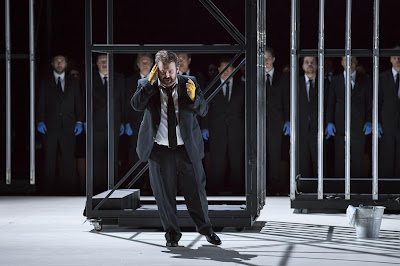
Peter Konwitschny's production of Fromental Halévy's La Juive debuted at Opera Vlaanderen in 2015, subsequently winning awards and travelling to other opera companies. It has now returned to Opera Vlaanderen (revival director Marcos Darbyshire) and we caught the performance on Sunday 10 March 2019 at Opera Antwerp. Corinne Winters played Rachel, with Roy Cornelius Smith as Eléazar, Riccardo Zanellato as Cardinal de Brogni, Enea Scala as Léopold, Nicole Chevalier as Princess Eudoxie and Leon Kosavic as Ruggiero. Antonino Fogliani conducted.

For all its emphasis on grand theatrical effects and visual drama, there was a remarkable vein of politics in French Grand Opera of the 1830s and 1840s. Both Meyebeer's Les Huguenots (1836) and Le Prophète (1849) examine political discord through the mirror of religion, whilst Halévy's La Juive (1835) places Christian intolerance of the Jews firmly at its centre. There is some discussion amongst commentators about quite how contemporary audiences saw the opera, and whether the role of Eléazar is too much a caricature. But Eléazar and his daughter Rachel (the Jewess of the title) are at the centre of the drama, and were played by two of the biggest stars of the Paris opera, Adolphe Nourrit and Cornelie Falcon.
Halévy:La Juive - Roy Cornelius Smith - Opera Vlaanderen (Photo Annemie Augustijns)
Halévy:La Juive - Roy Cornelius Smith
Opera Vlaanderen (Photo Annemie Augustijns)
Konwitschny's brilliant production has managed to create a remarkably focused, intent drama out of Halévy's sprawling epic. There were cuts, but we had around three hours of music, and this was recognisably Fromental Halévy's La Juive. Konwitschny did not shy away from the lighter, oom-pah, vein in the music (French Grand Opera's besetting sin) and instead found space for it in his dramaturgy. So, at the end of Act One when the crowd celebrates with an unfeasibly jolly chorus, Konwitschny makes us complicit, bringing the chorus into the auditorium and forcing us through sheer embarassment (few audience members failed to wave the flags they were given) to side with the Christians as they mocked the Jews.

This sort of meta-theatre was central to Konwitschny's concept. After Léopold (Enea Scala) made the revelation of his Christianity he pleaded with Rachel (Corinne Winters) in a typically operatic-theatrical fashion, but Konwitschny brought Winters into the auditorium and she registered emotions in a far more naturalistic way, mocking Léopold's over the top emoting. And similarly in the opera's hit number, 'Rachel, quand au Seigneur', Roy Cornelius Smith's Eléazar came out into the audience, a father pleading for his daughter, leaving the stage to the over the top drama of the Christian chorus. Konwitschny made us both takes sides and step out of the drama.


Monday, 11 March 2019

Not yet down and dirty: English Touring Opera rising to the challenge of Verdi's Macbeth

Verdi: Macbeth - English Touring Opera (Photo Richard Hubert Smith)
Verdi Macbeth; Grant Doyle, Madeleine Pierard, Amar Muchhala, Andrew Slater, dir: James Dacre, cond: Jerry Cornelius; English Touring Opera at the Hackney Empire
Reviewed by Anthony Evans on 9 March 2019
Star rating: 3.5 (★★★½)

A claustrophobic and atmospheric production with performances, as yet, a little to repressed

Verdi: Macbeth - Grant Doyle, Madeleine Pierard - English Touring Opera (Photo Richard Hubert Smith)
Verdi: Macbeth - Grant Doyle, Madeleine Pierard
English Touring Opera (Photo Richard Hubert Smith)
Verdi’s psychologically intense portrait of a descent into the womb of hell is a story worthy of Terence Fisher. Devilishly malign, its ferociously expansive music, intoxicating rhythms and ghostly silences make it a real crowd puller.

Goodness knows how a touring company can marshal the forces for Verdi but on Saturday 9 March 2019 English Touring Opera took on the challenge in front of a packed house at the Hackney Empire, with some success. Grant Doyle was the eponymous anti-hero and Madeleine Pierard the dastardly Lady M. Amar Muchhala, Andrew Slater and David Lynn sang Macduff, Banquo and Malcolm. Ed Hawkins was a marvelously orotund Doctor and Tanya Hurst the nurse. It was conducted by Gerry Cornelius.

Notwithstanding the excellent chorus and Amar Muchhala’s nice turn as the old soak Macduff, in truth, this is a three-character opera; Mr and Mrs M and the witches. Here in James Dacre's production the witches very clearly rule the drama, appearing unnervingly like the denizens of a supernatural Nonnatus House directing proceedings with quiet authority and clearing up other people’s mess. I unexpectedly liked the idea neatly sidestepping any misgivings about the alleged style of the witches’ music.

If Macbeth is all about the drama, then it was set up perfectly in the claustrophobic and atmospherically lit environs of a concrete bunker bristling with weaponry.

Sunday, 10 March 2019

Pared-down production lets the music speak for itself: Mozart's Idomeneo from ETO

Mozart: Idomeneo - English Touring Opera (Photo Richard Hubert Smith)
Mozart Idomeneo; Christopher Turner, Catherine Carby, Galina Averina, Paula Sides, dir: James Conway, cond: Jonathan Kenny; English Touring Opera at the Hackney Empire Reviewed by Ruth Hansford on 8 March 2019 Star rating: 4.5 (★★★★½)
Mozart's first mature opera in a highly effective pared down production from ETO

Mozart: Idomeneo - Christopher Turner - English Touring Opera (Photo Richard Hubert Smith)
Christopher Turner - English Touring Opera (Photo Richard Hubert Smith)
I am a huge fan of Mozart’s opera seria, written when he was 24/25 and considered his first operatic masterpiece. But London’s two recent productions have buried his sublime music under a distracting directorial Konzept. Who will ever forget the rubber shark at the ROH in 2014, or the dozens of extras parading across the stage in silent stilettos at ENO a few years earlier?

English Touring Opera's new production of Mozart's Idomeneo opened at Hackney Empire on 8 March 2019. James Conway directed, with Christopher Turner as Idomeneo, Catherine Carby as Idamante, Galina Averina as Ilia, Paula Sides as Elettra and John Colyn Gyeantey as Arbace. Jonathan Kenny conducted.

James Conway’s straightforward, pared-down production allows Mozart’s wonderful score to speak for itself. The set is a simple diagonal wall with a doorway with some sort of civilisation hinted at upstage right, and going downstage and left is a shoreline with sliding partitions that reveal storms and war-ravaged chorus. And that was all we had to look at during the overture, so we could focus on the music. What a novelty! And what a relief!

Saturday, 9 March 2019

From Renaissance to Contemporary: the Gesualdo Six at Cadogan Hall

The Gesualdo Six (Photo Ash Mills)
Tallis, Byrd, Joby Talbot, Veljo Tormis, Gesualdo, Alison Willis, Gyorgy Ligeti, Luca Marenzio, Palestrina, Sarah Rimkus, Gerda Blok-Wilson, Owain Park, Jacob Beranek, Joanna Marsh and Rheinberger; The Gesualdo Six; Cadogan Hall Reviewed by Robert Hugill on 7 March 2019 Star rating: 4.0 (★★★★)
Celebrating its fifth birthday, the young all-male ensemble in a highly crafted, eclectic programme

The Gesualdo Six vocal ensemble as just celebrated its fifth birthday and the six men, Guy James, Alexander Chance, Joseph Wicks, Josh Cooter, Michael Craddock, and Sam Mitchell, and director Owain Park, brought their programme Passion and Polyphony to the Cadogan Hall as part of the Choral at Cadogan series on 7 March 2019.

It was a programme of contrasts, ancient and modern, sacred and secular, with and eclectic mix of Tallis, Byrd, Joby Talbot, Veljo Tormis, Gesualdo, Alison Willis, Gyorgy Ligeti, Luca Marenzio, Palestrina, Sarah Rimkus, Gerda Blok-Wilson, Owain Park, Jacob Beranek, Joanna Marsh and Rheinberger, including the first performances of the winning entries in the ensemble's recent composition competition.

Friday, 8 March 2019

A sincerity running through it: I chat to John Nelson about Berlioz' Requiem

John Nelson (Photo Gregory Massat)
Friday 8 March, 2019 is the 150th anniversary of the death of Berlioz, and commemorations include a performance of Berlioz' Grande messe des morts (Requiem) at St Paul's Cathedral in London with John Nelson conducting the Philharmonia Orchestra, the London Philharmonic Choir, the Philharmonia Chorus and soloist Michael Spyres. I was lucky enough to be able to catch up with John Nelson in a break from rehearsals to chat about Berlioz' Requiem and John's other plans for performances of Berlioz this year.


John Nelson (Photo Marco Borggreve)
When discussing the work, John points out that Berlioz himself highly regarded it, saying towards the end of his life that if one of his works survived it would be that one, and John feels that it is a work which needs to be considered not just for the obvious grandeur but for its essence, the musical interpretation of the text.

With the enormous number of musicians involved in the large space of St Paul's Cathedral with the four bands in the rotunda, John agrees that the performance will indeed be impressive. The grandeur of the work matches that of St Paul's but acoustically the cathedral is not ideal though those sitting under the rotunda will get a good experience. But John is also after the textual meaning of the Requiem, whilst Berlioz was not religious, John feels that he wrote sincerely. He points out that Berlioz was from a Roman Catholic family and the memory of that is surely very present in the work. John finds a sincerity running through the entire piece.

The performance is being live streamed and will be recorded for DVD and for CD, by Warner Classics as part of John's on-going cycle of live Berlioz recordings the most recent of which was Les Troyens [see my review]. The idea for the performance arose after the performances of Les Troyens in Strasburg; to commemorate the 150th anniversary of Berlioz' death on the day in St Paul's, a venue which had been used for Sir Colin Davis' performance of the Requiem with the London Symphony Orchestra in 2012. A complex operation, yet it turned out to be possible; though only used as a concert hall infrequently, the cathedral was sympathetic to the performance and it proved possible to have Warner Classics record it and Medici TV live stream it. And the tenor Michael Spyres was free.

The acoustics at St Paul's Cathedral make recording a challenge and John feels lucky that the production team includes the sound engineer who worked on Colin Davis' live recording of Berlioz Requiem from St Paul's [on the LSO Live label], as well as the French engineer who has worked on all of John's other live Berlioz recordings.

Thursday, 7 March 2019

Children's Hour: Gareth Brynmor John and William Vann at Pizza Express Live

Gareth Brynmor John
Gareth Brynmor John
The basement music room of the Pizza Express at the Pheasantry on the Kings Road in Chelsea is usually host to cabaret artists as part of Pizza Express Live, but a new monthly Art Song Series has started there under the artistic directorship of pianist William Vann. We went along last night (6 March 2019) for The Children's Hour, an intriguing programme from baritone Gareth Brynmor John and William Vann which explored children and children's stories from an adult point of view, including Richard Rodney Bennett's song cycle Songs before Sleep. John and Vann have recently recorded the programme for disc and The Children's Hour will be issued on Champs Hill Records later this year.

The room is very much geared up to intimate cabaret, and our table was far closer to the performers than would be usual in a more conventional concert hall, and of course there was also the possibility to eat and drink though most people did so before the music started. But even so, there was something delightfully casual about sitting at a table, with a glass of wine listening to a serious programme of art songs in such a relaxed atmosphere.

The two performers introduced the programme, and this added to both the casual feeling and the sense of close intimacy between performers and audience. Both are family men with young children, and the idea for the programme arose from personal experience, expanding Charles Ives' Longfellow setting The Children's Hour into ideas arising from the time spent with children just before bedtime, usually reading stories and such. William Vann at one point commented that whilst the second section of the first half, Days out and Adventures, included plenty of pirates, they had been unable to find any songs about dinosaurs, his son's current obsession!

Well deserved: Hastings International Piano Competition winners

Fumiya Koido & the Royal Philharmonic Orchestra at the Hastings International Piano Competition
Fumiya Koido & the Royal Philharmonic Orchestra at the Hastings International Piano Competition (Photo John Cole)
The Hastings International Piano Competition reached its climax last weekend with a final spread over two days (1 & 2 March 2019) where the six finalists each played a concerto with the Royal Philharmonic Orchestra. For this year's competition there were originally 176 entrants from 26 countries, aged between 18 and 30, of whom 50 were invited to play at Hastings, where the focus of the competition is on concerto playing so that the first and second rounds are require the entrants to play concertos.

First prize winner this year was Fumiya Koido from Japan who gave a stunning performance of Ravel’s Piano Concerto in G major and received a cash prize of £15,000 plus future concerto performance engagements with the Royal Philharmonic Orchestra and additional performance opportunities in both the UK and the USA.

Second Prize Winner was Maxim Kinasov from Russia, who gave an impressive performance of Tchaikovsky’s Piano Concerto No.1 in B flat minor Op.23 and received a cash prize of £7,000. Kinasov also received the special ‘Orchestra Prize’ voted for by players of the Royal Philharmonic Orchestra and in addition will receive future performance engagements.

Additional prize winners were Third Prize: Eric Guo - Canada, Fourth Prize: Yuanfan Yang - UK, Fifth Prize: Sylvia Jiang - New Zealand, Sixth Prize: Alexander Yau - Australia. The Special Prize of £1,000 Awarded to a British Contestant reaching the Final went to Yuanfan Yang.

Popular Posts this month