


Korngold: The Dead City (Die tote Stadt); Rolf Romei, Allison Oakes, Sarah Connolly, Audun Iversen, director: Annilese Miskimmon, conductor: Kyrill Karabits; English National Opera at London Coliseum
Reviewed 31 March 2023
Korngold's phantasmagorical opera for the first time at ENO in a highly theatrical production with strong performances
Korngold's Die tote Stadt has not appeared much in London, this production was English National Opera's first presentation of it, here called by its English translation, The Dead City. The UK premiere was, amazingly, in 1996 (a concert performance with Russell Keable conducting the Kensington Symphony Orchestra) whilst the Royal Opera's production in 2009 was the UK stage premiere.
At ENO, Annilese Miskimmon directed Korngold's Die tote Stadt, with set designs by Miriam Buether and costumes by Nicky Gillibrand. Rolf Romei was Paul, Allison Oakes was Marietta/voice of Marie, Sarah Connolly was Brigitta and Audun Iversen was Franz.
A work of music-theatre by a Viennese composer based on a German translation of a major work by a Belgian Symbolist. Fascinatingly this rather tortuous description can be applied both to Arnold Schoenberg's Pierrot Lunaire and Erich Korngold's Die tote Stadt. Schoenberg's Pierrot Lunaire was based on the poetic cycle Pierrot Lunaire by Belgian Symbolist poet Albert Giraud. Schoenberg set a total of 21 poems in German translations by Otto Erich Hartleben, whose translations were also set by Joseph Marx. The fascination for the work of the Symbolists can be understood in the wider context of Austrian expressionism, in music moving from the tonal experiments of Strauss to Schoenberg to Webern and Berg. And an artistic context this links to the Vienna Secession movement (1890s to 1914)
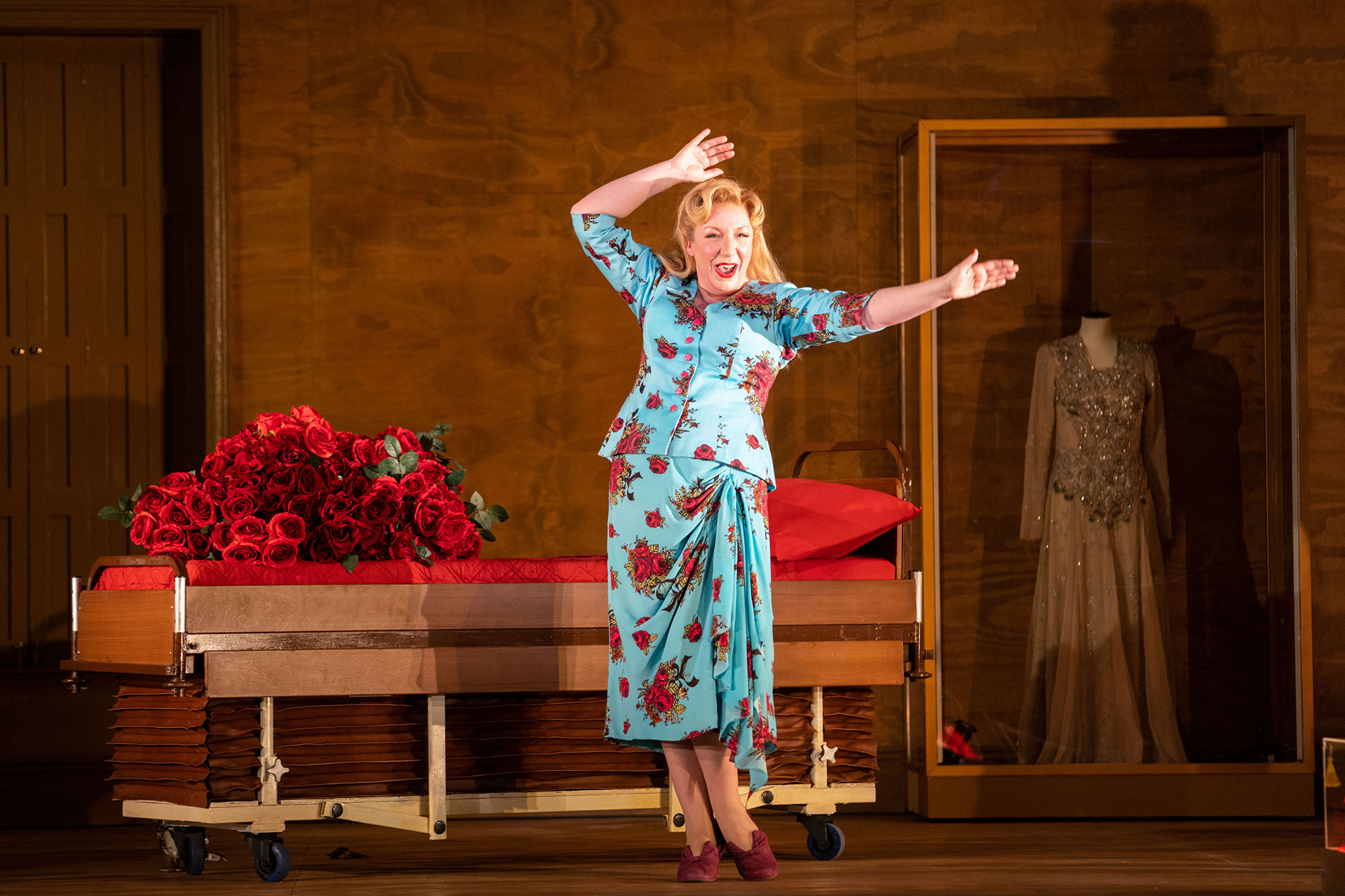 |
| Korngold: The Dead City - Allison Oakes - English National Opera (Photo Helen Murray) |
Korngold's Die tote Stadt has similar origins; it was based on Bruges-la-morte, a short novel by the Belgian author Georges Rodenbach, published in 1892 and regarded as the archetypal Symbolist novel. Korngold and his father's libretto for the opera was based on a German translation by a friend of Korngold's father of Rodenbach's own play based on the book.
The difference between the two, however, is that of date. Pierrot Lunaire premiered in 1912, at the height of the Vienna Secession, whilst Die tote Stadt came after the horrors of the First World War. Neither work actually premiered in Vienna, one in Berlin, the other in Hamburg.
In a way, you feel that in Die tote Stadt, Korngold's first full-length opera (he was 23 at the time of its premiere) was harking back to the earlier era. So that musically, the work seems to relate to Richard Strauss' two early hits Salome (1905) and Elektra (1909), with the size of the orchestra, the lushness of the orchestration, the romantic language and the huge demands made on the lead singers/




%205%20%C2%A9%20Robin%20Clewley.jpg "Jonathan Dove - Mansfield Park - RNCM Opera (Photo Robin Clewley)")
%208%20%C2%A9%20Robin%20Clewley.jpg "Jonathan Dove: Mansfield Park - Olivia Tringham - RNCM Opera (Photo Robin Clewley)")


.jpeg "Philip Venables & Ted Huffman (Photo: Dominic Mercier)")


%20weds%20Mad%20Margaret%20(Charli%20Baptie),%20photo%20by%20Mark%20Senior%20.jpg "Gilbert & Sullivan: Ruddigore - Peter Benedict, Charli Baptie - Oracle Productions at Wilton's Music Hall (Photo by Mark Senior)")
%20and%20Madeline%20Robison%20(Rose%20Maybud)%20Ruddigore,%20Mark%20Senior%20PR.jpg "Gilbert & Sullivan: Ruddigore - Joe Winter, Madeline Robinson - Oracle Productions at Wilton's Music Hall (Photo by Mark Senior)")

.jpg)


.jpg)


