
In 1972 I was a lowly viola on the back desk of the Grimsby, Cleethorpes and District Youth Orchestra. The orchestra was the most senior of 3 and was looked after by 3 conductors, the most distinctive and charismatic being Geoffrey Babb. He had a knack of being able to bring off unusual and challenging works such as Malcolm Williamson's The Stone Wall and Rubbra's 3rd Symphony.
For the RVW centenary he decided that we would play excerpts from Job. We did the 1st movement and from number 6 to the end. We started rehearsing with number 6, the dance of Job's comforters. For a start it was the first time I'd played in an orchestra which included a bass clarinet and a saxophone (the orchestra also add a wind band from which to draw these players).
The sounds of the opening of the movement with the saxophone solo made a profound impression on me. At that time, classical music was (for me) Schubert, Mendelssohn and Bach (though I had studied Bartok as part of my O level music). RVW's world was new and entrancing, it blew me away and started a love affair with the composer that has gone on ever since.
We took the work on tour when we visited Bremerhaven, in Germany, that summer. I remember that we had to perform the RVW without the harp part (played on the piano) because the piano in the theatre was tuned to higher continental pitch. Later in the tour we played the RVW at a school, though I seem to remember the pupils being restive and puzzled by RVW's music.
In later life I never heard Adrian Boult conduct Job live, but did finally hear it in concert at the Royal Festival Hall with Vernon Handley. But the most memorable performance was when Birmingham Royal Balled brought their staging of Dame Ninette de Valois's ballet to the Royal Opera House. I know that some people find the ballet undramatic, but for me the combination of RVW's music and de Valois's movement created something beautifully meditative and moving. I'd love so see it again.
I remember reading that Nureyev had tried to persuade the Royal Ballet to revive Job so that he could dance Satan (the only really dancing role in the ballet, memorably taken by Anton Dolin and Robert Helpman). In the end they revived her ballet of The Rakes Progress and Nureyev never danced Satan. Our loss.
The Royal Ballet lost the original sets to Job in a fire. They had been designed by RVW's cousin, Gwen Raverat. After the war the designs were re-done by John Piper (I think), but RVW always preferred Raverat's versions. It would be interesting perhaps if the Royal Opera House could revive Job with Raverat's desiggs recreated. Small hope of this, I fear

Friday, 29 August 2008

Thursday, 28 August 2008
Prom 54
Labels:
concert review
Tuesday night's Prom was the Ralph Vaughan Williams centenary Prom. The works included ranged from the Tallis Fantasia from 1907 to the 9th Symphony which was premiered in 1958, the year RVW died. In between Andrew Davis and the BBC Symphony Orchestra presented 2 works from the inter-war period, the Serenade to Music in the original version for 16 soloists and Job, a masque for dancing.
We were sitting in the choir, behind the orchestra, so the balance was not ideal. In the Tallis Fantasia we were in fact closer to the small string orchestra than the larger body of strings. So RVW's effects were disturbed but the result was still magical.
Similarly with Job, we were slightly too close to the brass, so that the trumpet was often dominant. This was not ideal, but there was much to enjoy in the performance. There were some notable solo moments: leader Simon Bryant gave a lovely sinuous line to Elihu's dance and the saxophone solo in the dance of Job's comforters was suitably oily. Though I would have like slightly less vibrato. But the work is such that many different artists go a chance to shine and the BBC Symphony Orchestra responded beautifully.
Job is divided into 9 movements, and each movement splits into named sections. The link between then is the continuous flow of the narrative. Andrew Davis's Job was a sequence of beautiful and moving moments, some stunningly lovely, varying from the spiky dissonance of Satan's dance to the quiet contemplation of the close.
But these moments never quite added up to a dramatic whole. Perhaps because I see Job as a dramatic ballet, rather than a concert work, I want a performance to coalesce into a coherent whole. But there was much to enjoy in the performance and with this caveat it was profoundly satisfying.
After the interval, 16 young singers assembled to perform the Serenade to Music. Here, perhaps, our placing in the auditorium gave us an advantage as the singers were stood behind the orchestra. It will be interesting to hear the TV broadcast of the concert (without Job) on Saturday to discover how different the recorded balance is.
It is always fascinating to hear a group of modern singers in the Serenade as it was written for 16 very specific singers. Each singer gets 1 short solo (except for Soprano 1:Isobel Baillie who gets a 2nd solo at the end). And RVW wrote for their particular voice type. More than this, English singers of the period tended to have more focussed, rather lower vibrato voices. This means that, particularly for the singers with bigger voices, such as Eva Turner and Walter Widdop, they not only projected but did so with a sense of line and noticeable lack of wobble.
Sarah Tynan successfully evoked the ghost of Isobel Baillie with her gloriously floated phrases. Not all singers were quite as successful. Tim Mirfin could not quite generate the necessary resonance for Noorman Allin's low phrase. And both Rachel Nicholls (Eva Turner) and Peter Wedd (Walter Widdop) seemed to have large voices which were slightly slower to respond, less laser sharp, than their predecessors, something which is desirable in their solos. But again it comes down to the change in vocal types in the last 70 years. Overall this was a magical performance.
RVW's 9th Symphony was rather coolly received when premièred. But more recently we have come to see that RVW had developed a fascinating late style and now the 9th is regarded as one of his strongest symphonies. It is an uneasy, brooding work which has the spirit of Hardy's Tess of the d'Urbervilles hovering in the background. Andrew Davis brought out the sinister and ambiguous nature of the piece, something which is never resolved even in the closing pages.
RVW uses a large orchestra but the sound world is notable for the way he incorporates a flugel horn and 3 saxophones. These are not solo instruments but incorporated into the orchestral texture. There was much discussion in the interval about the nature of a flugel horn. It proved to be a large trumpet/cornet like instrument played by one of the trumpet players. As in Job, the saxophones had slightly more vibrato than I would have liked.
The concert was well received by a packed Albert Hall, perhaps reflecting the way this anniversary year has helped to focus attention on how powerful a symphonist RVW was.
Wednesday, 27 August 2008
Arts Council?
Labels:
feature article
I have just received the Arts Council's news letter, a glossy publication which comes out every few months. In it, the Arts Council highlights the ventures of which they are most proud - at least that's what I presume they are doing. Text size is large, pictures are to the fore; the result is attractive and promotional, with articles sometimes lacking in depth.
Most worrying about this latest issue is the remarkable absence of Western Classical Music. Granted the cover picture is for a production at the Royal Opera House, but that was of Damon Albarn's Monkey: Journey to the West and is hardly typical of the work general promoted at Covent Garden. The only other classical references are to the performers involved in the 2012 Olympics spot at the closing ceremony.
The remainder of the document covers everything from World Music to location specific art and theatrical performance. There are 2 articles relating to music, one covering a group of World Music Festivals and the other relating to a superb project for access to music for disabled people.
The range of projects funded by the Arts Council is impressive, I just wish that they were a little bit prouder of the work that they do in sponsoring classical music in this country. Unfortunately access seems to be the key-word at the moment, but only access of a certain type.
The Royal Opera House is re-instating its Paul Hamlyn performances, where those unused to visiting the opera are able to buy tickets at discount prices. But this is being done in tandem with the Helen Hamlyn Trust and the Sun Newspaper. Surely this is an area that the Arts Council should be investing in.
Instead of really looking at the difficult subject of bringing Classical Music to people and helping them understand it, the Arts Council seems to be content to re-define what it means by Art and create events which will be popular enough to be appreciated by the masses. Or am I being cynical.
What I do know, from personal experience, is that it is getting harder and harder for small scale groups to get money to present classical music and create new music.
Tuesday, 26 August 2008
Recent CD Review
Labels:
cd review
My review of Bernhard Lang's opera I hate Mozart is here, on Music Web International.
A lively and rather off-the-wall little gem ...
A lively and rather off-the-wall little gem ...
Sunday, 24 August 2008
Recent CD Review
Labels:
cd review
My review of Jonathan Dove's Siren Song is here.
Fast paced and illuminating - keeps us entertained and wanting more ...
Fast paced and illuminating - keeps us entertained and wanting more ...
Friday, 15 August 2008
Recent CD Review
Labels:
cd review
My review of the classic Malcolm Sargent recording of Yeomen of the Guard is here, on Music and Vision.
Superb diction and high musical values ...
Superb diction and high musical values ...
Wednesday, 13 August 2008
Prom 35
Labels:
concert review
Vassily Sinaisky and the BBC Philharmonic Orchestra gave a fascinating programme which mixed the familiar and unfamiliar. They started with Elgar's In the South and finished with Rimsky Korsakov's Scheherezade, but in the middle Ashley Wass was the soloist in Ralph Vaughan Williams's Piano Concerto.
It is always interesting hearing foreign artists interpreting standard English repertoire. Here Sinaisky's account of the Elgar linked it to such continental models as the tone poems of Richard Strauss. The large body of BBC Philharmonic strings played magnificently but there were times when they seemed to overwhelm the woodwind players, but this might have been simply the vagaries of the Albert Hall acoustic.
For me, the highlight of the evening was the RVW Piano Concerto. Young pianist Ashley Wass has an association with Bax's piano music which provided links, via Harriet Cohen to the RVW (see previous post).
RVW's piece is famously taxing for the pianist. The player is required to produce whole fistfuls of notes and in the first 2 movements, rarely gets a moment to play alone or to really show off. The programme note describes the work as being influenced by the baroque concerto grosso, but there is nothing neo-baroque about the soundworld of the piece. From the outset, RVW goes for a big bold sound with a percussive piano part that links to Bartok.
Wass had the power and poetry to bring off the piano part brilliantly. He dominated the big orchestra passages remarkably, yet was still able to bring off the quieter, more introspective passages. This was particularly true of the bridge passages which link the movements. Here, and in the lovely slow movement, Wass was able to demonstrate his sure feel for the poetry of the piece.
Not every pianist can bring off playing loudly without seeming to hector. Wass managed the task perfectly, bringing a feeling of controlled poetry to even the loudest of the repetitive Bartokian passages. I do hope that this won't be the last time we get to hear Wass playing this much neglected work.
As we were planning to go to the late night Prom, I'm afraid that we cheated and missed the 2nd half of the concert so that we could go and get the car.
A Bach Book for Harriet Cohen
Labels:
diary
Last night's main Prom featured Ashley Wass playing the RVW piano concerto. I first met Ashley Wass when I interviewed him as part of the publicity for his first volume of Bax piano works on Naxos. During the interview conversation veered towards Harriet Cohen who was Bax's mistress and for whom he wrote a number of his piano works. RVW also wrote his piano concerto for her. Though she evidently found both the Bax and the RVW works tricky because both wrote large chords which were awkward with Cohen's small hands.
RVW and Bax were also 2 of the composers who contributed to A Bach Book for Harriet Cohen, this was a volume of Bach transcriptions by RVW, Bax, Bantock, Ireland, Bliss, Berners, Bridge, Howells, Goossens, Lambert, Walton and Whittaker. To a certain extent the selection of composers was dictated by the response of the composers; Elgar said he would do something and then failed to deliver, Holst said he couldn't find anything he wanted to arrange and didn't fancy writing for the piano. I first came across the book in the late 1970's when the Scottish composer/pianist Ronald Stevenson included a couple of the pieces in his lecture recital on Bach transcriptions. The recital also included Grainger transcriptions and finished with the Bach/Busoni Chaconne. I remember the RVW transcription as being a curious amalgam of typical RVW harmonies with Bach.
You can find 4 of the pieces on Angela Hewitt's Hyperion disc of Bach transcriptions. There she says that not all are of equal quality, but it would be fascinating to hear them all together, if only once.
Tuesday, 12 August 2008
Recent CD Reviews
Labels:
cd review
My review of a disc of Nicholas Jackson's choral music is here.
Attractive, richly textured, accessible yet with piquant harmonies ...
And my review of Domenico Scarlatti's Sacred Music is here. Both reviews on MusicWeb International.
Attractive and highly recommendable to anyone wanting to find out what Domenico Scarlatti did before he wrote harpsichord sonatas ...
Monday, 11 August 2008
Prom 32
Labels:
concert review
An afternoon Prom, in which Messiaen's Messe de Pentecote was alternated with Manchicourt's Missa Veni Sancte Spiritus. James O'Donnell played the Messiaen, getting some amazing sounds out of the Albert Hall organ. I am not well up enough on organs to be able to begin to explain/describe how he did it. One of the movements ended on an amazing chord in which Messiaen combined what seemed to be the highest note on the organ with the lowest, the latter making itself more as a throbbing than anything else.
In complete contrast Manchicourt's mass, which was sung by the BBC Singers conducted by Andrew Carwood, was the epitome of fluent restraint. Not that Manchicourt eschewed richness, as he wrote the mass for a 6 part choir and gave us some lovely textures. He ended his life as the director of Philip II of Spain's Flemish chapel in Madrid, so Manchicourt had a body of extremely fine singers at his disposal. The BBC Singers did him justice and created a fluent performance which managed to fill the space of the Albert Hall.
Alternating the organ pieces with the mass was a superb idea. Neither the organ piece, nor the mass was designed to be heard in a single lump and this gave us the opportunity to hear both works in distributed format. More please!
Sunday, 10 August 2008
What if? part (2)
Labels:
feature article
If we fast forward nearly 200 years from the death of Purcell then we come to the death of Thomas Linley junior in 1778. He was just 22 and an exact contemporary of Mozart's.
 He came from a gifted family, his father was a harpsichordist, composer and singing teacher in Bath and Thomas junior's sisters were fine singers and actresses (Gainsborough famously painted them and the family portraits are now in the Dulwich Picture Gallery).
Thomas junior studied in Italy, with Nardini, where he met Mozart. On his return to London his father was appointed musical director of the Drury Lane Theatre. Thomas junior wrote some remarkable, fine large scale works, including the Lyric Ode on the Fairies, Aerial Beings and Witches of Shakespeare, a piano concerto and The Song of Moses. This latter was his last work and is a very accomplished oratorio which mixed large scale Handelian choruses with solos in the more current galant style.
This latter style was heavily influence by Johann Christian Bach, the English Bach. J.C. Bach was one of the composers who had continued to fill in the gap in English musical life and had been influential in his own concert series in London.
Thomas junior's writing is confident and striking for a 20 year old, though perhaps not quite as advanced as Mozart's writing at the same age. If you listen to The Song of Moses then it sounds a little out of date when compared to Haydn or Mozart. But where Linley gains is that he mixes styles, so that his Handelian choruses provide far more choral interest than Haydn or Mozart choruses from the same period. Haydn never really did crack this, even the choruses in his late oratorios are a bit unvarying. But Mozart, a Handel admirer who re-orchestrated a number of Handel's works, eventually came to his more developed late style in the Requiem.
All this provides fascinating grist to the mill as to what might have happened if poor Tom Linley had not died in a boating accident in 1778. The answer, regrettably, is probably he would have succumbed to the consumption which killed his sisters in the decade or so following his death. But we can still be curious about what might have been.
Saturday, 9 August 2008
What if?
Labels:
feature article
Purcell died in 1695 at the age of 36 (or thereabouts), at the peak of his career. It is tempting to speculate what would have happened if he had lived to old age and composed music for another 20 to 30 years (perhaps until the 1720's). Becoming the grand old man of English music.
The span between Purcell's death and the advent of Handel saw English composers trying to come to grips with the news forms proliferating in Europe, especially Italian opera. There were attempts to create English operas, but none performed were by composers of sufficient genius to create a work which would stand up to the Italian form. Nowadays, commentators reckon that good works were created, but unfortunately the first few English operas were the relatively weaker ones and the better never got performed as promoters rather gave up on the form. So with Henry Purcell very much alive and in pole position, surely the course of English music and English opera would be different.
Well, let's not get too carried away. We must remember that Purcell seems to have had no love for Italian style opera. He composed a single example of the form, the brilliantly perfect Dido and Aeneas, and then went back to composing semi-operas. Granted that was what the public seemed to want and economics dictated. But if Purcell had been strongly drawn to full blown opera surely Dido might have provoked other siblings.
Another point is that during Handel's reign and for long after, the English remained very attached to semi-opera, opera with spoken English dialogue and ballad opera. The form was still going strong when Planche wrote his libretto for Weber; on receiving the text Weber was horrified at the amount of spoken dialogue.
Purcell would have been in his 50's when Handel was invited over. A Purcell who continued to write English semi-operas or concentrated on sacred music would have been little use to a syndicate who wished to have a real Italian trained maestro to write Italian operas for Italian opera stars. Handel could well have still been invited over, but his stay might not have been so long. He does not seem to have been able to bear competition, even the lowly Maurice Greene was seen as a competitor. So it is unlikely that Handel would have stayed in England and, especially, developed oratorio if Purcell was around.
Don't forget that besides Handel a number of other composers were invited over, including Bononcini and Porpora, with varying degrees of success. Handel's departure would have meant simply that the opera syndicate invited another composer over.
It is also worthwhile bearing in mind that not every elderly composer continues writing music. Handel, Bach (to a certain extent), Haydn, Faure, Verdi, RVW and Richard Strauss did. Sibelius and Rossini didn't. Sterndale Bennett started out as an extremely promising young composer but ended up mired in musical administration. So even if Purcell had survived, he might not have written much.
We are, of course, still left with a variety of imponderables. But the what if's are completely fascinating.
Friday, 8 August 2008
Prom 28
Labels:
concert review
Last night was the Kenneth Montgomery and the Ulster Orchestra's Prom. We went mainly to see hear Finghin Collins playing Stanford's 2nd Piano Concerto, but the Prom proved to have a great deal in it to enjoy.
They opened with Howard Fergusson's Overture for an Occasion, the occasion being the Coronation. The work was commissioned for the Ulster Orchestra's predecessor. Fergusson was famously circumspect with his music, there are only 20 opus numbers. This piece was rhythmically lithe and finely scored, beautifully played and certainly worth hearing again. Though the programme booklet talked of comparisons with Walton, there seemed to be much that was distinctive about Fergusson's voice.
Stanford's 2nd Piano Concerto is often compared to Rachmaninov's 2nd Piano Concerto, which had in fact inspired the composer to write his. But though you can find many parallels I have always found that the Stanford sounds very much like Stanford rather than ersatz Rachmaninov. The work has Stanford's familiar sweep to the music and the melodies have his rather Irish cast. Collins played the piano part beautifully poetically. He provided the requisite heft at the really big moments but as with Rachmaninov's 1st Piano Concerto at the Proms the other week, there were moments when the orchestra overshadowed the piano, when you simply wanted more heft from the pianist.
After the interval we were treated to a lively performance of Smetana's Vltava, in fact it was a very swift flowing Vltava that the orchestra gave us. The opening flute solos rippled at quite a considerable speed, and much credit to flautists and other instrumentalists for creating such a fast but deft flow. The Smetana was followed by Dvorak's 8th Symphony, the work which Dvorak conducted prior to his honorary degree in Cambridge (at the invitation of Stanford). This was a bravura performance of a charming work. The orchestra's performance was lithe and lively, rhythms well sprung. Part of the charm of their account was that they did not try and play it like Brahms, as many orchestras do. This had none of the smoothed out feeling that more recent performances of the symphony have had, instead Montgomery and the orchestra brought a sprung liveliness and crisp rhythmical undertow to it; add a great deal of charm for good measure.
As an encore we heard another Fergusson piece, one of his Diversons for orchestra. Another charmer to complete a fine concert.
This was one of the BBC's family proms so that we were surrounded by children, on the whole pretty attentive. I did feel that the 30 minute, long-breathed romantic concerto from Stanford was pushing it a bit for a children's audience but I suppose you'd have to ask the children.
Recent CD Reviews
Labels:
cd review
My review of a disc of music by Frantisek Xaver Brixi is here.
No masterpieces but a fascinating glimpse into the mid-18th century Czech world ...
And my review of the Tallis Scholars disc of Josquin's canon masses is here.
Admirers of Josquin will be getting near perfection of execution ...
Both reviews are on MusicWeb International.
No masterpieces but a fascinating glimpse into the mid-18th century Czech world ...
And my review of the Tallis Scholars disc of Josquin's canon masses is here.
Admirers of Josquin will be getting near perfection of execution ...
Both reviews are on MusicWeb International.
Thursday, 7 August 2008
Review of Tosca
Labels:
opera review
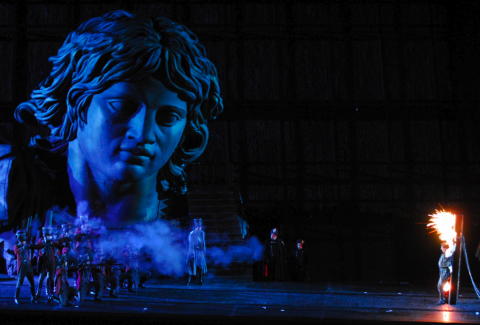 Cavaradossi's execution at the Castel Sant'Angelo from Act III of Puccini's 'Tosca' at the Verona Arena. Photo © 2008 Maurizio Brenzoni.
My review of Tosca from the Verona Arena is here, on Music and Vision.
Wednesday, 6 August 2008
Verona Arena
Labels:
feature article
The first opera to be performed in Verona Arena was Aida in 1913, staged to commemorate the centenary of Verdi's birth. Since then there have been 517 performances of Aida. The opera has been performed every year but one since 1980, it has been performed in over 40 seasons since 1946 but prior to that there were performances of Aida in just 1913, 1920, 1927 and 1936. In fact, since the 2nd World War the Arena seems to have become something of an Aida industry.
The count of performances since 1913 for the top 10 operas is quite revealing, with Aida leading by far:-
Aida = 517
Carmen = 177
Nabucco = 157
Turandot = 108
La Traviata = 90
Rigoletto = 85
Tosca = 82
Cavelleria Rusticana = 76
Il Trovatore = 74
La Boheme = 72
Apart from Aida leading by a long way, the list reveals other things. It includes most (but not all) of the really popular 19th/early 20th century operas, and the selection is not just restricted to operas which would seem suitable for large scale performance. Some of the opera selection inevitably reflects the venue's Italian location, I'm not sure that a comparable English venture would have so many performances of Nabucco. And the absence of Otello from the top 10 possibly reflects the difficulty of casting the title role in such a large venue.
Whereas before the 2nd War the repertoire was quite varied, it now seems to be approaching ossification. This year's operas were Aida, Rigoletto, Nabucco, Tosca and Carmen. Next year's operas are Aida, Il Barbiere di Siviglia, Turandot, Tosca and Carmen.
The last time the Arena stage an opera for the first time was in 1999 when they performed Lehar's La Vedova Allegra (The Merry Widow). Prior to that it was I Lombardi in 1984 and Attila in 1985. An opera like Attila would seem to be ideal for the Arena. Similarly Don Carlo (1969, 1992), Boris Goudonov (1930, 1952, 1976) and Samson et Dalila (1921, 1974) would seem to be ideal for Arena performance. In fact I am quite puzzled at why Samson et Dalila has been performed so little, it would seem to be ideally constructed for Verona Arena; but again this probably represents different attitudes and preferences.
Perhaps, also, economics has something to do with it, with the Arena being dependent on attracting punters; and many punters are those for whom opera going is not a regular activity. The Arena is simply too big to rely on opera fanatics.
But it hasn't always been so. In its first 40 years the arena performed a selection of lesser known operas by Catalani, Ponchielli, Zandonai, Boito, Spontini and Meyerbeer. In fact Callas's famous debut was in La Gioconda in 1947.
But in addition to the less well known Italian repertoire, the Arena also staged Wagner: Parsifal (1924), I Maestri Cantori (1931), La Walkiria (1950), Tannhauser (1936) and Lohengrin (1922, 1933, 1949, 1963).
An opera like Lohengrin would have seemed ideal. But then other thoughts occur. If Tosca lasts from 9pm to midnight, how long would a performance of a Wagner opera take?
It would be nice to see the Arena becoming a little more adventurous occasionally, if only because the performing space would seem to lend itself to a wider variety of opera than is performed at present
Tuesday, 5 August 2008
Farewell Ian Partridge
Labels:
preview
Veteran tenor Ian Partridge will be giving his final performance at the Oxford Lieder Festival in October 2008. Partridge started his singing career as a chorister at New College Oxford some 60 years ago. Partridge will be performing a selection of his favourite songs.
Back from Verona
Labels:
diary
This last weekend we were in Verona where we attended the final performance this year of Hugo De Ana's production of Tosca at the opera (to be reviewed in due course) and sang with London Concord Singers in 3 performances. My motet Deus in Adjutorium received its Italian premiere at a concert at the Church of St. Nicolo and St. Severo in Bardolino on Saturday 1st August and went on to receive a 2nd performance at Mass on Sunday 2nd August at St. Giorgio in Briada in Verona.
Our concert in Bardolino featured Alberto Ginastera's Lamentations and in the audience was a man who had sung in the work's première in 1946! On Sunday evening we sang at San Tomaso en Cantuarense in Verona, on whose organ Mozart had improvised.
On our way back from Verona we managed to call in at Bergamo where we saw the house where Donizetti died. We also saw the tombs of Donizetti and Simone Mayr (his teacher) in the Basilica in Bergamo
Wednesday, 30 July 2008
Prom 16
Labels:
concert review
I did my degree in Manchester in the 1970's a few years after Barbirolli's death when his place at the helm of the Halle Orchestra had been taken by James Loughran. Whilst Loughran did a sterling job, it has taken until now for the orchestra to really recapture the form that had under Barbirolli. Since Sir Mark Elder took over in 2000 the orchestra has been in brilliant shape. Their Prom last night showed them to be delivering a remarkable consistency of tone throughout the whole orchestra. I'm not quite sure what exactly the 'new' Halle sound is like, but it is certainly impressive, musical and beautifully textured.
For their Proms visit Elder and the orchestra chose to perform the RVW Symphony (no. 8) which they had premièred under Barbirolli in 1958. But Elder started with a poised and finely textured account of Butterworth's rhapsody A Shropshire Lad. From the very first notes this was spine tingling stuff, only marred by the rather inept delivery of a selection of the poems before and after the rhapsody. It was a nice idea to include the poems but having them declaimed in poor demotic by a pair of young actors, whose main experience would seem to be in TV soaps, was not a good idea.
The RVW performance was similarly beautifully controlled, where necessary, so that the string Cavatina was finely shaped and very consistent whereas the wind and brass only scherzo displayed a fine appreciation of RVW's humour. In the outer movements the percussion section gave vent to RVW's lively percussion parts, making the tuned percussion elements more noticeable and more extravagant than I remember from Hickox and the Philharmonia's recent performance. Which is certainly a good thing, late RVW contains quite a few fascinating experiments with textures and timbres.
After the interval we had a performance of the 1st violin concerto by RVW's teacher, Bruch. Janine Jansen was the poised soloist, spinning out Bruch's long lines. This was a fine performance, but which have many of the RVW outings been coupled with serious 19th century Romantic beasts. The last concert we went to included Rachmaninov's 1st Piano concerto and next week RVW's Piano Concerto is coupled with Rimsky Korsakov's Scheherezade. I've no objections to these works, but couldn't we have had some RVW symphonic pieces coupled with something a little riskier and spikier.
The concert concluded with a lively and witty performance of Strauss's Til Eulenspiegel with Elder showing what a fine Strauss conductor he is.
Self referential
The blogosphere is endlessly self-referential, with links to other sites linking ultimately back to the one you first thought of. There's a link to my posting about Prom 10 on the MyChordSpace blog, an interesting music blog worth exploring.
Subscribe to:
Posts (Atom)
Popular Posts this month
-
 Du Yun & Royce Vavrek: Angel's Bone - English National Opera at London Coliseum [Photo: Tristram Kenton] Du Yun & Royce Vavrek...
-
 Halévy: La Dame de Pique - Gothic Opera at Battersea Arts Centre [Photo: Craig Fuller] Fromental Halévy: La Dame de Pique ; Grace O’Malley,...
-
 Bellini: La sonnambula (Act Two finale) - HGO [Photo: Julian Guidera] Bellini: La sonnambula ; Eyra Norman, Hailey West, Mathilda Goike, To...
-
 Charpentier: David and Jonathan - Harun Ellis Tekin, Tom Lilburn - New Sussex Opera [Photo: Colin Chapman] Charpentier: David and Jonathan...
-
 Ambroise Thomas: Hamlet - Malachy Frame, Ruari Bowen, Jacques Imbrailo, Jonathan Cole-Swinard, Jay Broadhurst, Grace Durham, Richard Wiegol...
-
 Purcell: Dido & Aeneas - Michael Lafferty, Samantha Price - English Touring Opera [Photo: Richard Hubert Smith] Elena Langer: Ariadne ...
-
 BBC Young Musician final, 20206 - Sofia Demetriades [Photo: BBC / Betsan Evans] It was heartening to hear three such talented young people i...
-
 Wexford Festival Opera has announced its 2027 programme. Artistic director Rosetta Cucchi's theme for next year is a tribute to the extr...
-
 Gluck: Iphigénie en Tauride - Nick Pritchard, Jacques Imbrailo, Christine Rice - English National Opera, 2026 [Photo: Helen Murray] Gluck: ...
-
 Charles-Aimable Battaille as André Roskow in Fromental Halévy's La Dame de Pique at the Opéra Comique in 1850 Gothic Opera’s production...