Monday, 24 May 2021

ARMSymphony AI Violin Competition

ARMSymphony AI Violin Competition

 The issue of Artificial Intelligence (AI) and classical music is an intriguing one, we don't seem to be there yet, quite. But technological developments in the area are significant. Now a new competition is going to showcase just such innovations.

The ARMSymphony AI Violin Competition will feature competitors playing Khachaturian's Violin Concerto with an orchestral accompaniment recorded by the Armenian State Symphony Orchestra 'conducted' by a remarkable new app, Cadenza Live which has been developed by Metamusic Inc. The Armenian State Symphony Orchestra has a track record of technological innovations, it took the 2020 Khachaturian competition online, using technology that was specially created to synchronize recordings submitted by contestants with the playing of the orchestra.

The new app allows musicians to play with an attentive AI accompanist, making music together in real time (rather than synchronizing the solo and accompaniment after the fact). So competition is aimed at musicians from around the world, many of whom may not have ready access to a sensitive accompanist, to show what they can do, technically and musically, with the backing of a skilled and responsive (albeit virtual) professional orchestra. 

There is more detail at the Metamusic website, and the competition is open to all violinists with a deadline of 15 September 2021.

Sunday, 23 May 2021

Sheer joy: Carolyn Sampson and Joseph Middleton's Elysium at Wigmore Hall

Joseph Middleton and Carolyn Sampson at a previous Wigmore Hall concert (Photo Robert Piwko)

Elysium
- Schubert; Carolyn Sampson, Joseph Middleton; Wigmore Hall

Reviewed by Robert Hugill on 21 May 2021 Star rating: 5.0 (★★★★★)
A return of live audiences, Carolyn Sampson and Joseph Middleton celebrate with a programme of Schubert

Our first live concert this year, the first song recital at Wigmore Hall since it started welcoming audiences again, so no pressure then. Rather appropriately, soprano Carolyn Sampson and pianist Joseph Middleton looked to Schubert for their inspiration. Elysium was a programme of songs inspired by the mythical idea of a blessed and happy eternal future, which led us from Jakob Nikolaus Craigher de Jachelutta's young nun to Friedrich Schiller's description of Elysium itself, via Goethe's Ganymede and Rückert's Du bist der Ruh.

The programme played without an interval and with just two breaks for the artists, so that with no applause between the items this really flowed with the transitions between the songs as important as the songs themselves as Sampson's intent, rapt The young nun moved straight into the rather eerie Sister's Greeting where the tension grew intense, then Goethe's Ganymede provided a joyful release. Now, I confess that I have always found this latter song and poem a bit strange; if you can get over the fact that it barely relates to the myth of Zeus abducting the young boy, then this was wonderful with its combination of urgency and purity.

Throughout the recital, Sampson sang with a silvery purity, producing some lovely line alongside fine words, and Middleton complemented her with some strongly characterised piano playing. Sampson was able to give us many different incarnations of joy and wonder, along with a sense of essential goodness and almost simplicity, yet the result when combined with Middleton's piano created a complex mix.

Saturday, 22 May 2021

English Touring Opera invites you to win a walk-on role in one of their productions

Puccini: La Boheme - English Touring Opera

Like most arts organisations, English Touring Opera is fundraising in order to be able to look forward to its forthcoming live seasons. Part of this is a Silent Auction taking place at the moment (closing at 9pm on 27 May), here the items being auctioned include not only things like holidays, good wine, art and signed books, but there are opera themed items too.

Those of a generous heart might be inclined perhaps to bid for a in-person performance from four world-class ETO singers, or what about a walk-on role in one of ETO's productions? You can bid for a chance to appear in ETO's Spring production of Puccini's La Boheme as an extra in London, Snape Maltings, Sheffield, York, Cambridge, Cheltenham, Durham, Canterbury, Exeter, Norwich, Buxton and Poole. Now how cool is that?

Full details from the Silent Auction website.


Fiendish, but fantastic: after a long relationship with the composer, percussionist Colin Currie has recorded both of HK Gruber's percussion concertos

Colin Currie
Colin Currie

The percussionist Colin Currie has a new disc out, his own label, Colin Currie Records. Having previously issued Steve Reich's Drumming, a duet disc with trumpeter Håkan Hardenberger, Scene of the Crime, and Colin Currie & Steve Reich Live at Fondation Louis Vuitton on the label, the new disc has percussion concertos by the Austrian composer, conductor and chansonnier HK Gruber. Featuring two live recordings with the BBC Philharmonic and conductors Juanjo Mena and John Storgårds, the disc sees Colin performing Gruber's Rough Music from 1982-83 and into the open..., which Colin premiered at the BBC Proms in 2015. I recently met up with Colin, via Zoom, to chat about H.K. Gruber, Colin's connection to Steve Reich's music, what makes a good percussion concerto and more.

HK Gruber: Percussion Concertos - Colin Currie
One of the reasons that Colin wanted to issue the disc was that he feels the Gruber concertos have a unique place in percussion concertos yet are rather lesser known than other contemporary concertos. into the open..., of course, has only had a few performances since the premiere but for Colin, Rough Music has been a smash hit. He has performed it a lot and feels close to the piece, and in fact, recorded it in his own version. Colin had performed both works in recent times with the BBC Philharmonic (which has a long association with Gruber) and both concerts were memorable and it is the recordings from these that they have been able to use for the new disc.

into the open..., which Colin premiered, has an ambitious use of percussion and the piece needed an intense amount of editing, finessing the virtuosic solo part (Gruber evidently calls this the 'Colin Currie Edition'). But Colin feels that we now have a practical version of the piece which could be played by others though so far Colin is the only percussionist to have played the work. He describes it as 'fiendish, but fantastic' and it includes proverbial fistfuls of notes. It requires a huge percussion set-up including timpani and tomtoms, yet reveals many different sides to the solo part. Performance of the work also needs stamina, there are only a few seconds rest in the piece, and in these, the soloist still has things to do with the set-up.

When I ask about the style of Gruber's music, Colin comments that it is difficult to describe. He sees the music as very European, and Gruber (who trained in Vienna at what is now called the Universität für Musik und darstellende Kunst Wien) comes through the Austro-German tradition from Berg and Richard Strauss. Yet the music of Kurt Weill is also close to Gruber's heart, so the result is expressionist, melodic and hard to pin down! Very much the maverick indeed, and there is an anarchy in Gruber's music that pushes boundaries, and Colin's article about Gruber in the disc's booklet notes is entitled, 'HK Gruber, The Artful Anarchist'.

Colin has performed both of Gruber's concertos with Gruber conducting and indeed their collaboration goes back to 2001 when Colin first worked with Gruber in Leipzig.

Friday, 21 May 2021

Unashamedly delicious: Nostalgic Russia, music for violin and piano from Hideko Udagawa and Petr Limonov

Nostalgic Russia - Tchaikovsky, Eduard Nápravník, Rachmaninov, Stravinsky, Rimsky-Korsakov, Arensky, Scriabin, Shostakovich, Kabalevsky; Hideko Udagawa, Petr Limonov; Northern Flowers

Nostalgic Russia
- Tchaikovsky, Eduard Nápravník, Rachmaninov, Stravinsky, Rimsky-Korsakov, Arensky, Scriabin, Shostakovich, Kabalevsky; Hideko Udagawa, Petr Limonov; Northern Flowers

Reviewed by Robert Hugill on 21 May 2021 Star rating: 4.0 (★★★★)
The London-based Japanese violinist returns to Russia with a wonderful cache of richly melodic repertoire from the late 19th and early 20th centuries

There is something unashamedly delicious about the music on this new album, Nostalgic Russia from violinist Hideko Udagawa and pianist Petr Limonov on Northern Flowers. It brings together short pieces by Russian composers from the late 19th and early 20th century, works which enjoy their melody in an unashamed way but which are sophisticated too. So we have music by Tchaikovsky, Eduard Nápravník, Rachmaninov, Stravinsky, Rimsky-Korsakov, Arensky, Scriabin, Shostakovich and Kabalevsky, some written originally for violin and piano, others in arrangements by Mikhailovsky, Kreisler, Mogilevsky, Heifetz, and Tsyganov.

We begin with Tchaikovsky, arrangements of two short piano pieces; Romance is an early work, from 1868, whilst Valse Sentimentale is a late one, from 1882. Both display both Tchaikovsky's talent for melody, and his ability to express emotion in what could be a salon piece, creating bitter-sweet, soulful music. And that is very true of most of the works on this disc, they are relatively compact and would make a lovely addition to a recital programme. The music's revelling in its melodic charm veers towards to salon, but the harmonic and structural sophistication means that there is great emotional depth too.

Young composers in Sweden, Manchester and Denmark: O/Modernt, Manchester International Festival and BBC Philharmonic

Paul Saggers
Paul Saggers

The Swedish O/Modernt festival, artistic director Hugo Ticciati, has announced the winner of the 2021 iteration of its annual Composition Award. This year's competition was staged in collaboration with the Manchester International Festival, the Manchester Camerata, specialist music school Lilla Akademien and DUEN – The Danish Youth Ensemble. The winning work will be premiered at the Manchester International Festival on 16 July 2021, at a site-specific concert The Patience of Trees when Hugo Ticciati conducts the Manchester Camerata in a programme which will also include the premiere of a new piece by Dobrinka Tabakova. There will then be performances of the winning work in Sweden and Denmark during the 2021/22 season. 

First prize went to British composer Paul Saggers and his composition Vulpes Vulpes for string orchestra and percussion. The title is the binomial name of the red fox, and the work depicts the challenges the animal faces in rural and urban environments. Saggers started playing the cornet at the age of 12, and at the age of 25 he decided to pursue a career in the Royal Marines Band Service and is currently based in the Plymouth Band, and in 2019 completed an MMus in Composition through the Royal Marines in partnership with Plymouth University where he was tutored by Simon Dobson.

A Special Distinction from O/Modernt has been awarded to Todo Era Vuelo En Nuestra Tierra by Argentinian composer Julieta Szewach.  

Full details of the competition from the O/Modernt website, and details of the premiere from Manchester International Festival's website.

Tom Could (Photo: Timothy Lutton)
The British composer Tom Coult has been appointed as the BBC Philharmonic’s Composer in Association, starting in Autumn 2021 with the premiere of his first commission Pleasure Garden. In his new role, Coult will compose three new scores for the BBC Philharmonic. His appointment builds on an existing creative relationship with the orchestra, including Sonnet Machine in 2016 which was commissioned by the BBC Philharmonic and premiered at Bridgewater Hall in Manchester, and Rainbow-Shooting Cloud Contraption which was first broadcast in March on BBC Radio 3.

Coult's St John’s Dance was premiered by Edward Gardner and the BBC Symphony Orchestra to open the First Night of the 2017 BBC Proms, and his chamber opera Violet, to a text by Alice Birch, will premiere at the 2022 Aldeburgh Festival. Coult studied at the University of Manchester with Camden Reeves and Philip Grange and at King’s College London with George Benjamin. Between 2017 and 2019 he was Visiting Fellow Commoner in the Creative Arts at Trinity College Cambridge, and has taught on the Britten Sinfonia Academy composition course and with Aldeburgh Young Musicians.

Coult commented, "I love writing for orchestra – I think of writing music as playing with toys, and the orchestra is the biggest box of toys there is. In the last year I’ve wondered whether that extravagant box of toys will ever be open to anyone again, so it’s an almost unimaginable luxury to be thinking about orchestral music for the next few years. I honestly can’t wait to work more with the extraordinary musicians of the BBC Philharmonic – I’m enormously lucky."

Full details from the BBC Philharmonic's website, and Coult recently created a programme of Baroque arrangements for the orchestra which is available on BBC Sounds.

A love-letter to a much missed audience

Andrew Staples has made a film Wagner's Siegfried Idyll with the Swedish Radio Symphony Orchestra and conductor Daniel Harding. Filmed at the orchestras home, Berwaldhallen in Stockholm, Staples has  imagined the piece as a love letter with a twist - this time not from a composer to his wife but instead from the players of the orchestra to their much-missed absent audience.

This is the third film projected created by Berwaldhallen with Staples, Harding and the orchestra, in June 2020 they filmed Mozart's Don Giovanni [available on-demand], and at Easter this year Bach's St John Passion [see my A Life On-Line column]

The film is available on the Berwaldhallen website.

Thursday, 20 May 2021

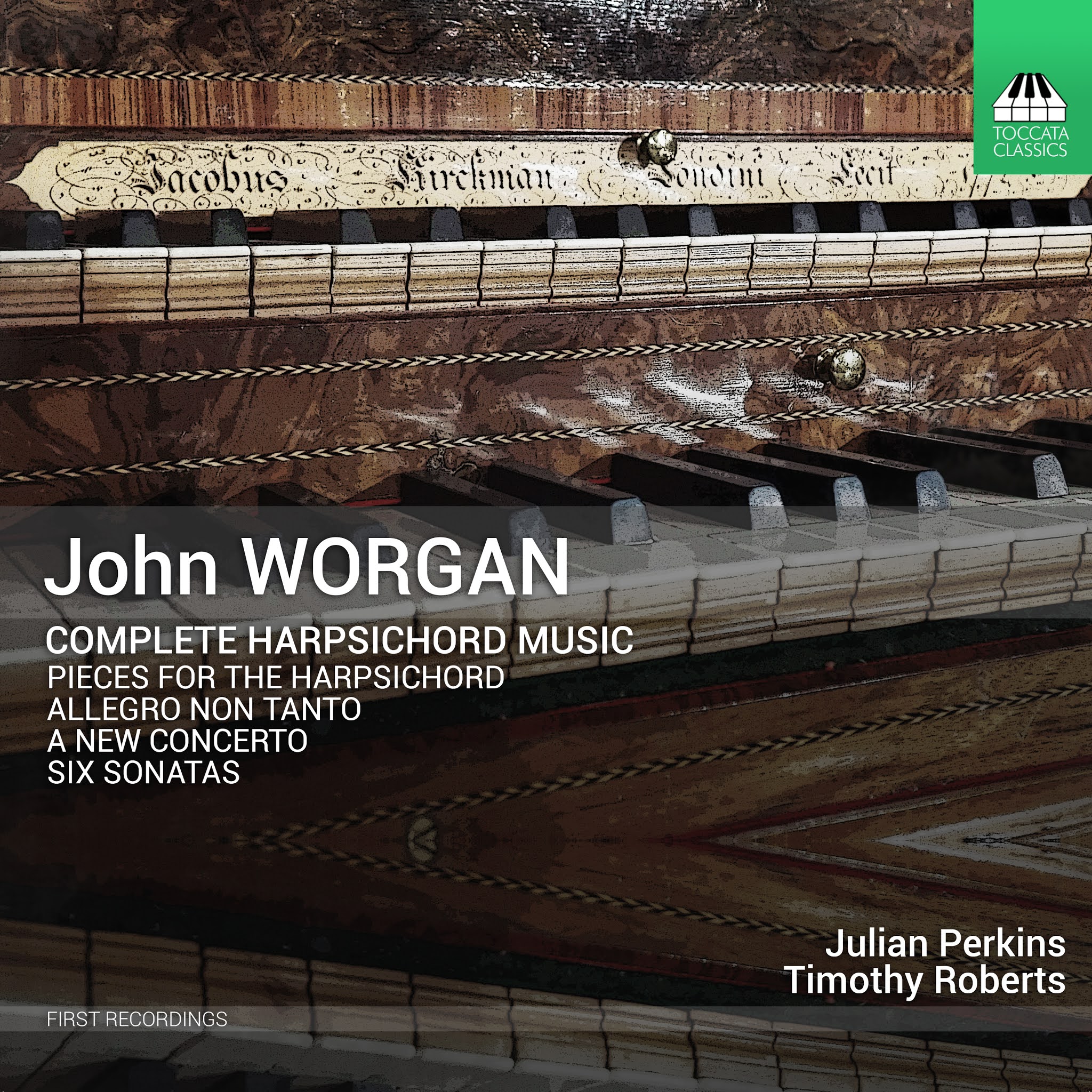
A disc of harpsichord pieces by an unknown late-18th century English composer might not appeal, but you've never heard anything like John Worgan's harpsichord music

John Worgan Complete Harpsichord Music; Julian Perkins, Timothy Roberts; Toccata Classics

John Worgan Complete Harpsichord Music; Julian Perkins, Timothy Roberts; Toccata Classics

Reviewed by Robert Hugill on 19 May 2021 Star rating: 5.0 (★★★★★)
Famous in his lifetime, the 18th century composer John Worgan seems to have dropped off the radar but this disc should tickle the palate with its exploration of Worgan's idiosyncratic Scarlatti-on-acid style

Until I received a copy of this disc, I have to confess that the name of the 18th century composer John Worgan was virtually unknown to me (he crops up briefly on London Early Opera's first Handel at Vauxhall disc). Having recorded Worgan's complete organ music for Toccata Classics, Timothy Roberts has returned to record John Worgan's complete harpsichord music, sharing the harpsichord honours with Julian Perkins
 
The disc contains Worgan's Allegro non tanto, Six Sonatas for Harpsichord, Pieces for the Harpsichord composed purposely for forming the Hands of Young Pupils to that Instrument and A New Concerto for the Harpsichord in G major.

So who was John Worgan?

Born in London, Worgan studied with his elder brother James, then with Thomas Roseingrave, and finally with Francesco Geminiani. He held a number of church appointments in the City of London alongside being organist for Vauxhall Gardens. In church he was famous for his improvisations, whilst at Vauxhall he produced organ concertos and songs, and would publish fourteen volumes of his Vauxhall songs (and he was only in post from 1751 to 1753!) One of his sons, George Worgan, was the surgeon on Captain Cook’s First Fleet and in January 1788 George Worgan arrived in Port Jackson, New South Wales, on board the flagship Sirius, along with his square pianoforte by Frederick Beck – the first piano in Australia.

From Thomas Roseingrave, Worgan got a liking for the music of Domenico Scarlatti and it is very much Scarlatti that comes to mind when you listen to these pieces. Thomas Roseingrave had befriended Scarlatti in Venice in 1709, and in 1739 published his own edition of 42 Scarlatti sonatas, including some of the Essercizi, as well as other sonatas of which he must have had manuscript copies. In 1752, Worgan able to obtain a licence directly from Scarlatti in Madrid to publish another volume of his music, and there was a further one after Scarlatti's death.

Worgan's fellow organist Joah Bates records that in his improvisations, "his imagination was of the original and captivating kind, that his audience often looked on each other with significant astonishment, and remained open-mouthed and breathless for several seconds after the organ had ceased", and it seems to be the element of wildness in Scarlatti that appealed to Worgan.

Beethoven complete cello sonatas from Ailbhe McDonagh and John O'Conor

Irish cellist Ailbhe McDonagh and pianist John O'Conor celebrated Beethoven’s 250th anniversary year with a double album of his complete sonatas for cello and piano recorded at St. Peter’s Church, Drogheda, Ireland. The set has been released is on the Steinway & Sons music label.

Beethoven's five cello sonatas are remarkable because they span his whole career. The two sonatas of Op. 5 come from his early Viennese years, though they were written for a visit to the Prussian court in Berln and still give prominence to the piano. The great A Major Sonata (Op. 69) is the single representative of his incredible middle period, and shows Beethoven re-inventing the form and giving both instruments equal prominence, whilst the two Op. 102 sonatas epitomize his late works. 

Ailbhe McDonagh and John O'Conor have made a short documentary about the project, which is one of those which might not have happened if last year's events hadn't cleared their diaries. O'Conor is known for his performances of Beethoven, but had not recorded the Cello Sonatas before, whilst he has a long connection with Ailbhe McDonagh having taught her piano.

You can hear a movement of the third sonata on YouTube, and listen to the album here:  Spotify | Apple Music | YouTube

Young composers and old music at the National Centre for Early Music in York

York Early Music Festival: Encounters

The National Centre for Early Music (NCEM) in York has been having a busy time of it. NCEM hosted the final of its 14th Young Composer Award earlier this week, presented in partnership with BBC Radio 3. And NCEM has also announced the details of this year's York Early Music Festival which runs from 12 to 16 July 2021.

For this year's Young Composer Award, NCEM and BBC Radio 3 invited aspiring young composers to create a new work for recorder quartet Palisander based on dance-forms, choosing whatever dance-form they liked across all eras and cultures, from the bransle and the galliard to the Charleston and the tango. The Award was judged at NCEM on Thursday 13 May when the shortlist of entries was performed by Palisander and earlier in the day the shortlisted pieces were rehearsed by Palisander in a workshop with the young composers, led by composer Christopher Fox. 
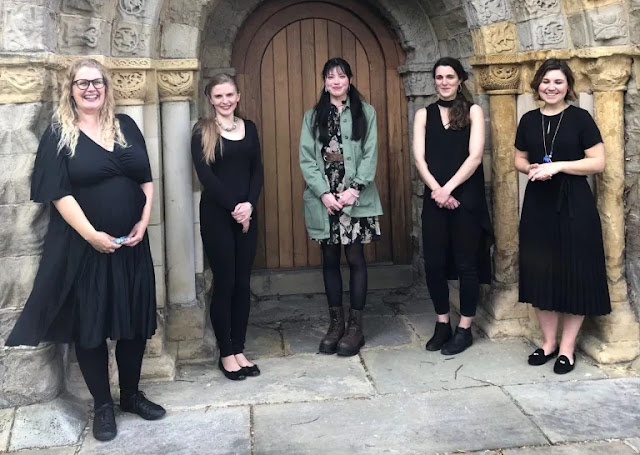
Young Composers Award winner Delyth Field (centre) with Palisander at the National Centre for Early Music, York

This year‘s Young Composer Award winner in the 19 to 25 years category is Delyth Field with Kagura Suite for Recorders inspired by Kagura, the oldest form of dance in Japan. The winner in the 18 years and under category is Jacob Fitzgerald with murmuration inspired by the natural dance performed by starlings. Both works will be premiered by Palisander on 20 September 2021 at St John’s Smith Square, London as part of the London Festival of Baroque Music and be recorded for broadcast on BBC Radio 3's Early Music Show. You can catch the film of the awards on NCEM's website.

Looking ahead to July, the theme of this year's York Early Music Festival is one of encounters, most vitally between audience and artists, which seems particularly pertinent at a time when the festival can welcome audiences back to an array of York’s historic venues. A particular emphasis is on the music of Josquin des Prez, celebrating his 500th anniversary.

Soprano Hannah Ely and the Monteverdi String Orchestra kick things off with The Madrigal Re-imagined (and the ensemble's leader Oliver Webber is giving a talk, Un non so che di frizzante: the madrigal as a cauldron of creativity) and then there is violinist Rachel Podger, EEEmerging artists La Vaghezza (specialising in music from 17th and 18th centuries), harpsichordist Steven Devine and Robin Bigwood in The Bach Circle, The Society of Strange and Ancient Instruments' wierd and wonderful The Trumpet Marine Project, and bass Matthew Brook & harpsichordist Peter Seymour in cantatas for bass voice.

There is Josquin from Stile Antico, lutenist Jacob Heringman [see my review of his disc of Josquin transcriptions], and Ensemble Clement Janequin. And the festival closes with Spanish Baroque ensemble L’Apothéose, back to York as part of the Young Artists Showcase. [I very much enjoyed their 2020 Handel disc, see my review] L’Apothéose last appeared in the York in 2019 when they won the York Early Music International Young Artists Competition and The Friends of York Early Music Festival prize. This year they will be recording a CD with Linn Records which was part of their prize.

For those unable to travel to York, the festival will also be available online from 15 to 18 July and will include concerts recorded during the festival alongside commissioned highlights with guests including Gesualdo Six and the Rose Consort of Viols. 

Further information from the NCEM website.

Wednesday, 19 May 2021

Making goodness interesting: a new recording of Handel's Rodelinda from the English Concert with Lucy Crowe, Iestyn Davies and Joshua Ellicott

Handel Rodelinda; Lucy Crowe, Iestyn Davies, Joshua Ellicott, Jess Dandy, Brandon Cedel, Tim Mead, The English Concert, Harry Bicket; LINN

Handel Rodelinda; Lucy Crowe, Iestyn Davies, Joshua Ellicott, Jess Dandy, Brandon Cedel, Tim Mead, The English Concert, Harry Bicket; LINN

Reviewed by Robert Hugill on 18 May 2021 Star rating: 4.5 (
★★★½)
The English Concert's new recording belies any lockdown restrictions to give us a full account of the opera, finely sung and vividly characterised

Handel's 1725 opera Rodelinda is not only one of his acknowledged masterpieces but also an opera where Handel's approach to the opera seria form created an opera that resonates with contemporary audiences in a way that many others do not. The opera was based on pre-existing sources and, as with his other operas written for London audiences, Handel and his librettist, Nicola Haym, heavily trimmed the source material; Londoners were not keen on vast quantities of explanatory recitative (which usually meant following the translation in the printed libretto) and some of Handel's later operas get positively telegraphic. With Rodelinda, Handel and Haym seem to have made this compression serve the plot, as well as tieing the arias more directly to the action. Unusually for an opera seria, Rodelinda almost unfolds as a linear narrative in a way which modern audiences identify with, and some distance away from the rather knotty plotting of some opera serias which rather resemble a complex historical novel than the more direct narrative arc of many later operas.


As a result, Rodelinda has done rather well in performance and on disc. For some years, Harry Bicket and The English Concert have been doing an annual Handel opera tour in collaboration with the Carnegie Hall with casts which mix operatic luminaries from both sides of the Atlantic [see my 2019 interview with Harry Bicket]. 2020 was to be no different, but inevitably the planned tour was cancelled. However, the orchestra decided to go ahead and recorded Rodelinda in September 2020 at St John's Smith Square with socially distanced performers. Inevitably, giving restrictions on travel, the cast is somewhat less international than previous recordings but is a very strong one. Handel's Rodelinda is on LINN Records; Lucy Crowe is Rodelinda with Iestyn Davies as Bertarido, plus Joshua Ellicott as Grimoaldo,  Brandon Cedel as Garibaldo, Jess Dandy as Eduige and Tim Mead as Unolfo, with Harry Bicket directing The English Concert from the harpsichord.

As a recording project we get a remarkably complete view of Rodelinda, even Unolfo gets all three of his arias. The result has a luxury of length (three acts of 68 minutes, 66 minutes and 65minutes) which, whilst not approaching Giulio Cesare, is certainly more suitable to home listening than the modern opera house. Handel and Haym's changes mean that the title role is most definitely the prominent one, but a point worth making is that after Rodelinda, Bertarido and Grimoaldo have the same number of arias (though Bertarido also has a duet with his wife and an accompanied recitative). Grimoaldo is an unusually prominent tenor role, written for Francesco Borosini who had created the role of Bajazet in Handel's Tamerlano the previous year.  It is a similarly complex role and makes the opera unusually intriguing to modern audiences.

Birthday celebrations indeed: Cecilia McDowall at the BBC, the London Festival of Contemporary Church Music, Presteigne and more

Cecilia McDowall
Cecilia McDowall
Amazingly, Cecilia McDowall is celebrating her 70th birthday this year and not surprisingly her music has been popping up in concerts and services, including recent performances of her anthems in services at St Mary's Episcopal Cathedral, Edinburgh and at Merton College, Oxford. The BBC Singers, conductor Owain Park, performed her anthem The Lord is Good on Afternoon Concert on BBC Radio 3 on 11 May 2021 (and you can still catch it on-line).

But on Saturday 22 May 2021, as part of the London Festival of Contemporary Church Music there is a chance to hear a whole evening of McDowall's fascinating and varied music. At St Pancras Parish Church, Christopher Batchelor conducts the festival’s own professional vocal ensemble, The LFCCM Festival Singers (which expands the Choir of St Pancras Parish Church with additional singers from London’s world-class choral institutions). The programme is all-McDowall, ranging from sacred works such as Three Latin Motets to Standing as I do before God, her reflection on the death of Edith Cavell, to Everyday Wonders: The Girl from Aleppo, a cantata which tells the remarkable story story of Nujeen Mustafa, a Kurdish teenager with cerebral palsy forced by war to flee her home and embark on an arduous journey to Europe with her sister. 

Full details from the London Festival of Contemporary Music website, and Cecilia McDowall is giving a pre-concert talk before the concert.

London Oriana Choir, conductor Dominic Ellis-Peckham, has announced that Cecilia McDowall has become the choir’s first patron. In September, the choir will begin the fifth and final year of its five15 initiative in support of women composers and, in 2023, will be celebrating its 50th birthday.

Looking further ahead, Cecilia McDowall is the composer in residence at this year's Presteigne Festival, 26-31 August 2021.

Welcoming live audiences back at Conway Hall

Conway Hall
Conway Hall
The 2020/21 season at Conway Hall Sunday Concerts is coming to a close with something of a bang as, for the first time this year, the hall is able to welcome audience members to the hall for the final concert. 

On Sunday 30 May 2021, the Oculi Ensemble is performing a fascinating programme of quartets and quintets. Webern's early Langsamer Satz is being performed alongside quintets by Mozart and Brahms with both composers favouring a line-up which included two violas (rather than a quintet with two cellos such as that by Schubert).

This will be a welcome opportunity to hear music live in Conway Hall, though it is being live-streamed as well. Full details from the Conway Hall website.

Tuesday, 18 May 2021

Remembering Denys Darlow at this year's Tilford Bach Festival

Denys Darlow
Denys Darlow

This week we have already marked the centenary of the horn player Dennis Brain, and now comes another remarkable centenarian.

For concert goers of a certain age, the name Denys Darlow (1921-2015) is inextricably linked with the music of Bach and of Handel, and with the two festivals that he founded, the Tilford Bach Festival (founded 1952) and the London Handel Festival (founded in 1978). He was an inspirational figure in the early music revival in the 1960s and 1970s, as well as being Professor of Organ, Theory, Aural and History at the Royal College of Music for 30 years. He commissioned numerous composers, composed a number of works himself and championed the lesser known works of Bach and Handel long before it became fashionable to do so.

This year is his centenary and the Tilford Bach Festival, which takes place on 12 and 13 June 2021, will include a special tribute to Darlow. Students from the Royal College of Music, directed from the harpsichord by Tolga Un, will be joined by soprano Joanne Lunn at 12 noon on Saturday, 12 June for a performance of Darlow's final composition, High Hills, which he wrote for Joanne Lunn and the London Handel Players in 2005.

On the Saturday evening, Adrian Butterfield (current artistic director of the festival) directs a Bach programme from the violin, featuring the London Handel Players in two Brandenburg Concerto related cantatas and the Kyrie and Gloria of the B minor Mass, with singers from the Royal College of Music (supported by the Josephine Baker Trust). Cantata BWV 52 Falsche Welt, dir trau ich nicht features the opening sinfonia which comes from Brandenburg Concerto No. 1, and Cantata BWV 174 Ich liebe den Höchsten von ganzem Gemüte takes a movement from Brandenburg Concerto No. 3 as its opening sinfonia, but with added instrumental parts. Then on Sunday afternoon there is a performance of all six Brandenburg Concertos performed by the London Handel Players directed by Adrian Butterfield. Not coincidentally, this year is the 300th anniversary of the creation of the Brandenburg Concertos.

The festival programme (with details about reserving tickets) is available as an online flipbook.

Pianist George Fu introduces his EP which launches Listenpony Sessions

George Fu at Listenpony #16

On Friday 28 May 2021, Listenpony is releasing the first of a planned series of EPs, Listenpony Sessions, which will allow artists to create programmes based around their past live Listenpony concerts. For the first EP, Chinese-American pianist George Fu recorded in St Giles Cripplegate in November 2020 a programme which combines Listenpony commissions by Daniel Fardon, William Marsey and Josephine Stephenson with music by Messiaen and Rachmaninov, and is based on a programme Fu first performed for Listenpony in May 2018.

George Fu explained the programme a little more, "This program is more or less a version of the program I played for Listenpony On Tour in 2018 (Birmingham, Manchester and London). On this tour, I played short pieces by Messiaen and Rachmaninov, which had both been written around the same time (early 20th century) and yet reflect very different sensibilities. Rachmaninov was one of the final great composer-pianists in the Romantic tradition. His Études-Tableaux are not only great to listen to, they also give me such pleasure to play, as they are so pianistic and reflect the sensibility of a seasoned musician who understands the instrument so well. On the other hand, Messiaen’s Préludes seem to create a mystical universe with new colors, textures and shapes. These pieces by Messiaen and Rachmaninov were a foil for the Listenpony pieces by William Marsey, Josephine Stephenson and Daniel Fardon, which all treat the piano in such different and interesting ways. The variety of music being written nowadays proves that now, more than ever, is a very exciting time to be a musician.

When Listenpony approached me about recording this EP, we were in the midst of a national lockdown, and I had not played to a full live audience for months. I felt inundated by countless online streams and recordings, but what I missed most was live music. There already exists countless recordings of perfectly engineered piano recitals; what is the point of recording an EP now, at this present time, when we were all isolated? In reaction to this, we wanted to capture the spirit of a live Listenpony concert. We set up this EP to record an experience that closely duplicates what you might have heard on that day we recorded in St Giles Cripplegate. When I listened back to some of the tracks, I was surprised at how different this recording sounded from others; it took me a little bit of time to get used to it. But once I did, I felt that I had found something in it that I missed from this entire year of lockdown. I hope listeners feel the same
."

Further information from the Listenpony website

Legacy: A Tribute to Dennis Brain from horn player Ben Goldscheider

Legacy: A Tribute to Dennis Brain - Watkins, Arnold, Poulenc, Britten, Panufnik, Maxwell Davies; Ben Goldscheider, Huw Watkins, James Gilchrist; Three Worlds Records

Legacy: A Tribute to Dennis Brain
- Watkins, Arnold, Poulenc, Britten, Panufnik, Maxwell Davies; Ben Goldscheider, Huw Watkins, James Gilchrist; Three Worlds Records

Reviewed by Robert Hugill on 17 May 2021 Star rating: 4.0 (★★★★)
A remarkable centenary tribute to the great horn player by one of the younger generation's finest horn players, spanning music written for Brain, music written in his memory and new music created for this programme

How does a young contemporary horn player pay tribute to the memory of the great horn player Dennis Brain whose centenary is this year. Brain was notable not just for his playing but for the way he brought the instrument into the spotlight and helped develop the repertoire. This fascinating new disc, Legacy, from horn player Ben Goldscheider on Three Worlds Records takes a highly intelligent approach to commemorating Brain. Goldscheider is joined by pianist Huw Watkins and tenor James Gilchrist for a programme which includes two works by composers associated with Brain, Benjamin Britten and Malcolm Arnold, two works written in his memory by Francis Poulenc and Peter Maxwell Davies, and two new works written specially for the disc by Huw Watkins and Roxanna Panufnik.

We begin with Huw Watkins' Lament. This beging with long lyrical horn lines over piano support, very much bitter sweet but developing in intensity and finally the harmony becomes ultimately disturbing. Watkins explains in his booklet note that he wanted to use the Poulenc Elegie's combination of lyrical beauty and anger, and indeed the result is a terrific piece, terrifically played.

Huw Watkins, James Gilchrist, Ben Goldscheider during recording sessions at Henry Wood Hall

In complete contrast, Goldscheider follows Watkins with the Fantasy for Horn by Malcolm Arnold, who wrote his Horn Concerto No. 2 for Brain in 1957. Arnold's Fantasy for Horn was written in 1966 for the Birmingham International Wind Competition (commissioned by the City of Birmingham Symphony Orchestra). Written for unaccompanied horn, the work is a striking exploration of what is possible on the instrument, beginning with a lively opening fanfare which is hunting horn-like yet bears the imprint of Arnold's music too. There are meditative moments, and virtuosic ones too, with Arnold compressing a lot into under five minutes, ending with some pretty vivid fast moments which are joyously pure Arnold.

Monday, 17 May 2021

Polska Scotland: Celebrating a rich cultural history

Polska Scotland: Celebrating a rich cultural history
Scotland's links to Poland date back to trade routes in the 15th century and by the end of the 17th century 30,000 Scots had migrated to Poland, whilst musical links include the fact that Chopin visited in 1848. More recently, the influx of Polish soldiers during the Second World War led to many choosing to settle and the number of Polish residents in Scotland today numbers around 90,000, making it the largest migrant population in Scotland.

All these links are celebrated in the Adam Mickiewicz Institute and the Royal Scottish National Orchestra's continuing digital series Polska Scotland. Concerts broadcast in May and June in the series include Marta Gardolińska conducting Lutosławski’s Mala suita, the RSNO Chamber Ensemble, Adrian Wilson and Lena Zeliszewska in Szymanowski, Lutosławski and Bacewicz, pianist Benjamin Grosvenor  in Chopin’s Piano Concerto No. 1 plus music by Kilar and Lutosławski, and Szymanowski’s second Violin Concerto with Nicola Benedetti, conducted by Elim Chan. Already available are Nicola Benedetti’s performance of Szymanowski’s Violin Concerto No. 1 alongside Weinberg’s Rhapsody on Moldavian Themes and Andrzej Panufnik’s Sinfonia Sacra, conducted by Thomas Søndergård.

The Polish series also reflects the RSNO’s long association with Polish music and musicians, dating from Emil Młynarski (Polish Principal Conductor of the then Scottish Orchestra from 1910 to 1916 and early champion of Szymanowski’s music) to composers who conducted their own works – Andrzej Panufnik in 1956, Krzysztof Penderecki on three occasions in the 1970s, and Witold Lutosławski in 1979 and 1981.

Full details from the RSNO website.

Summer at Snape

Snape Maltings
Snape Maltings

Britten Pears Arts is not presenting an Aldeburgh Festival this year, but they have announced an action-packed 
Summer at Snape season running until early September with the concerts in June having a strongly festival feel with an emphasis on new work and on the music of Britten. Things kick off on the weekend of 21 to 23 May, when performers include the BBC Symphony Orchestra and conductor Ryan Wigglesworth in music by Mozart, Julian Anderson and Ryan Wigglesworth (and the performances are given in memory of pianist and conductor Steuart Bedford, who died in February this year and was an Artistic Director of the Aldeburgh Festival from 1974 - 1998), and mezzo-soprano Sarah Connolly and pianist Joseph Middleton in music by Brahms, Mahler, Bridge and Tippett.


The centenary of horn player Dennis Brain will be marked by performances of two works written for Brain, Britten's Serenade for tenor, horn and strings and Canticle III: Still falls the rain, along with Britten's In Memoriam Dennis Brain. Horn player Ben Goldscheider will be performing music by Tansy Davies and Peter Maxwell Davies


There will be premieres of a series of new versions of Britten's music, Colin Matthews' string orchestra versions of the Double Concerto (a student piece written when Britten was just 18) and Charm of Lullabies, Robin Holloway's orchestration of the song cycle Winter Words (with tenor Nick Spence, London Philharmonic Orchestra, conductor Edward Gardner), Joseph Phibbs' new chamber version of Our Hunting Fathers (with soprano Elizabeth Watts and the Hebrides Ensemble).


There will be a chance to hear Britten's folk-song arrangements alongside the folk originals when folk-singer Maz O'Connor joins pianist Roger Vignoles and Britten Pears Young Artists soprano Milly Forrest and tenor Laurence Kilsby.


During June, there are several projects which should have premiered at last year's festival along with new works for 2021, including the first public performance of Colin Matthews' Seascapes (with soprano Clare Booth and the Nash Ensemble, who premiered the work at the Wigmore Hall earlier this month),  and music by Tansy Davies, John Tavener, John Woolrich and Stephen Hough. There are two new music-theatre pieces, soprano Juliet Fraser in Samuel Beckett and Morton Feldman, and soprano Nadine Benjamin's new piece which follows one woman’s journey from fragmentation to wholeness. Tenor Allan Clayton (who was due to be artist in residence at the 2020 festival) joins pianist James Baillieu and the Aurora Orchestra for performances of music by Mark-Anthony Turnage, Priaulx Rainier and Britten, plus the complete Britten canticles.


Full details from the Snape Maltings website.

Side-stepping with deft elegance the issue of what instrument the music was written for, Andrew Wilder reinvents Bach's Lute Suites on classical guitar

Bach Complete lute music; Andrew Wilder

Bach Complete lute music; Andrew Wilder

Reviewed by Robert Hugill on 14 May 2021 Star rating: 4.0 (★★★★)
A young American classical guitarist in stylish and engaging transcriptions of the music Bach wrote for lute or lute-harpsichord

On this new digital release from classical guitarist Andrew Wilder we get the complete set of works which are regarded as being written by Johann Sebastian Bach for the lute, the Suite in G minor BWV 995, the Suite in E minor BWV 996, the Suite in C minor BWV 997, the Prelude, Fugue and Allegro BWV 998, the Prelude in C minor BWV 999, the Fugue in G minor BWV 1000 and the Suite in E Major BWV 1006a.

Now Bach did own a lute (there was a valuable one listed amongst his musical instruments after his death), and used the instrument as colouring in several works but whether he wrote any solo music for lute is debatable. It is worth quoting lutenist Nigel North on the matter, "Instead of labouring over perpetuating the idea that the so-called lute pieces of Bach are proper lute pieces I prefer to take the works for unaccompanied Violin or Cello and make them into new works for lute, keeping (as much as possible) to the original text, musical intention, phrasing and articulation, yet transforming them in a way particular to the lute so that they are satisfying to play and to hear."

Andrew Wilder


Also in Bach's possession at the time of his death were two gut-strung lute-harpsichords, and it is almost certainly for these that the music was written, especially as identification with the lute itself is something which seems to have come after his death.

The Suite in G minor BWV 995, is a transcription of the fifth Cello Suite, BWV 1011 and is marked Suite pour la Luth par J.S. Bach. The trouble with this is that it extendes down to a note which was not available on lutes commonly used in Leipzig. Also, from the layout of the work it is clear that Bach was working at the keyboard. The music exists in a lute tablature which dates from 1760 and which makes significant adaption of the original which must, however have seemed rather old-fashioned compared the the lute music of the period.  

Sunday, 16 May 2021

A Life On-Line: Recovering The White Rose, rediscovering Grainger, rethinking Bach, reimagining Elgar

Jorge Jimenez - Rethinking Bach (Capture from stream)

This week we have been busy rediscovering, rethinking and reimagining whether it be The White Rose's non-violent resistance to the Nazi's, the sheer strangeness and imagination of Percy Grainger's music, a journey towards Bach's Goldberg Variations via a new transcription for violin or David Matthews' reworking Elgar's string quartet.

The White Rose, the non-violent resistance group in Nazi Germany, has been in the news recently partly because 9 May 2021 was the centenary of the birth of Sophie Scholl, one of the founders of the group. There have been a number of artistic responses to the group and its message, from new music [David Chesky's The White Rose Trilogy] to new opera [Udo Zimmerman's Weisse Rose at Hamburg State Opera]. 

The choir Sansara and conductor Tom Herring joined forces with The White Rose Project, a research and engagement initiative at the University of Oxford, to create Voices of the German Resistance, a programme which interleaved music by Bach, Byrd, Rudolf Mauersberger, Max Reger, Philip Moore and Piers Kennedy with readings from the resistance group's writings in new English translations by students at the University of Oxford. 

The programme was recorded last year (for the 77th anniversary of the first White Rose trials) and finally broadcast last Sunday on Harrison Parrott's Virtual Circle platform. The first part featured Bach chorales and William Byrd's Ne irascaris Domine and Civitas sancti tui (which form two parts of a single large-scale work from his 1589 Cantiones Sacrae lamenting the desolation of the Holy City, Jerusalem) alongside readings from the White Rose's pamphlets, texts which have an extraordinary prescience when seen in the context of developments in contemporary politics.

Popular Posts this month