Thursday, 16 March 2023

A wonderful sense of poetry: Timothy Ridout in Lionel Tertis' viola transcription of Elgar's Cello Concerto

Elgar: Cello Concerto, transcribed for viola by Lionel Tertis, Bloch: Suite for Viola and Orchestra; Timothy Ridout, BBC Symphony Orchestra, Martyn Brabbins; Harmonia Mundi

Elgar: Cello Concerto, transcribed for viola by Lionel Tertis, Bloch: Suite for Viola and Orchestra; Timothy Ridout, BBC Symphony Orchestra, Martyn Brabbins; Harmonia Mundi
Reviewed 10 March 2023

A gorgeously poetic account of Tertis' viola transcription of Elgar's Cello Concerto that completely captivates on its own terms, accompanied by Bloch's fascinatingly exotic contemporaneous suite

Lionel Tertis seemed to be rather proud of his transcription for viola of Elgar's Cello Concerto, at least he devotes some pages in his autobiography to an anecdote about playing it through to Elgar for the first time (with piano accompaniment). And interestingly, on the recent Building a Library feature on BBC Radio 3's Record Review devoted to Walton's Viola Concerto (written in 1929), the reviewer suggested that one of Tertis' reasons for turning down the Walton was that at the time, Tertis was much involved in promoting his viola version of the Cello Concerto.

On this disc from Harmonia Mundi, viola player Timothy Ridout plays Tertis' transcription of Elgar's Cello Concerto alongside an almost exactly contemporaneous work, Ernest Bloch's Suite for Viola and Orchestra. Ridout is accompanied by the BBC Symphony Orchestra, conducted by Martyn Brabbins.

Wednesday, 15 March 2023

Celebrating Wren and his church: Tercentenary festival at St Stephen's Walbrook

St Stephen Walbrook
St Stephen Walbrook

Architect and polymath,  Sir Christopher Wren died 300 years ago this year. In addition to the various celebrations of Wren's achievements, architectural and otherwise, the Orchestra of the Age of Enlightenment (OAE) is joining forces with St Stephen Walbrook to present a festival of music commemorating Wren, who designed the church following the Great Fire of London in 1666. The three concerts aim to provide a snapshot of musical life at the time of Wren's death. 

A recital of music by Purcell interspersed with atmospheric readings from the period will evoke the time when Wren rebuilt the city following the Great Fire whilst Purcell composed the music for its reviving theatre scene and newly opulent church and royal court. Vivaldi’s cycle of four violin concertos, The Four Seasons, is believed to have been completed in 1723, the year of Sir Christopher Wren’s death, and will be played by Debretzeni, one of the OAE’s leaders. Then the OAE presents one of their signature Baroquebusters concerts. From fellow Londoner Handel to Bach, Albinoni and Pachelbel, this engaging and interactive concert of much-loved Baroque favourites will offer a snapshot of musical life at the end of Wren’s life, exploring why these works are all so popular today. There will be an opportunity for the audience to meet the players and learn about their historical instruments.

2023 marks not only the 300th anniversary of Wren's death, but the 350th anniversary of St Stephen's Walbrook, and the 70th anniversary of the founding of the Samaritans at the church, so there are lots more anniversary events planned. Full details from St Stephen Wallbrook's website.


Classical music and more: Bath Festival 2023

Bath Festival in 2022 - Steve Reich's Drumming with Colin Currie Quartet at Bath Abbey

The Bath Festival is running from 12 to 21 May this year, and features a diverse mix of music, literature and other events. The Bath Festival Orchestra, conductor Peter Manning, is in residence over the opening weekend, presenting a concert in Bath Abbey, featuring music by the 18th-century Viennese composer Marianna Martinez, Bruckner, Hans Andre Stamm and Mozart plus Mozart's Requiem with local choir Bath Camerata and an appealing line-up of soloists Nadine Benjamin, Kitty Whately, Thomas Walker and William Thomas. There is also an open rehearsal earlier in the day.

Another local ensemble, the Bath Philharmonia will be joined by violinist Esther Yoo and the 120 young people of Bath Festival's Schools Voices for a concert that includes music by John Adams, Prokofiev, Stravinsky, and Jonathan Dove plus the premiere of the Bath Festival Schools' Voices commission.

A sequence of morning recitals features the festival's rising stars with concerts by Iyad Sughayer (piano), Jaren Ziegler (viola), Tim Beattie (guitar), Irene Duval (violin) and Maciej Kulakowski (cello), Ryan Corbett (accordion) and Dida Condria (piano). 

Other visitors to the festival include BBC New Generation Artist Tom Borrow (piano),  vocal ensemble Siglo de Oro, celebrating the work William Byrd, who died in 1623, Connaught Brass, first prize winners in the inaugural Philip Jones International Brass Ensemble Competition, and Quatuor Agate in Boccherini, Bartok and Schubert's Death and the Maiden Quartet.

And there is plenty more from talks, walks and other events, one that caught my eye was Polari Salon, a celebration of LGBTQ+ words and voices - whether written, spoken or sung, with Paul Burston, poet Joelle Taylor and Miss Hope Springs.

Full details from the festival website.

This is my body: Figure's imaginative rethinking of Buxtehude's intense sung devotion, Membra Jesu Nostri

Buxtehude: Membra Jesu Nostri - Figure at the Swiss Church
Dietrich Buxtehude: Membra Jesu Nostri; Figure, Frederic Waxman; The Swiss Church, Covent Garden

Buxtehude's intense seven-cantata sequence reinvented as an imaginatively engaging communal experience


Dietrich Buxtehude's Membra Jesu Nostri is a seven-cantata sequence, described by the composer as a sung devotion, written in 1680 and dedicated to the Swedish organist and composer Gustaf Düben (Buxtehude was himself Swedish) whose collection, now in Uppsala University Library, is an important source for Buxtehude's music. Most of Buxtehude's oratorios do not survive, so Membra Jesu Nostri is an important example of his larger-scale writing. The stanzas of its main text are drawn from the medieval hymn Salve mundi salutare, and each cantata addresses a part of Jesus’ crucified body: feet, knees, hands, side, breast, heart and face.

It is a strikingly intimate and intense work, one where we have to address its original purpose and how we might perform it nowadays. On Tuesday 14 March 2023, the ensemble Figure, artistic directors Frederick Waxman and Philip Barrett, presented Buxtehude's Membra Jesu Nostri in what might be called a dramatised staging at the Swiss Church in Covent Garden. The five singers were Claire Ward, Katie Macdonald, Tom Lilburn, Michael Bell and Hugo Herman-Wilson accompanied by an instrumental ensemble of Dominika Feher and Emilia Benjamin (violin & treble viol), Emily Ashton (cello & tenor viol), Chris Terepin (bass viol), Kate Brooke (double bass & violone) and Jonatan Bougt (theorbo) directed from the organ by Frederick Waxman. Philip Barrett was the movement directed with lighting by Chris Burr, and animations by Joshua Tabti.

Buxtehude: Membra Jesu Nostri - Figure at the Swiss Church

Tuesday, 14 March 2023

Welcome to Cheltenham Music Festival 2023: Music by 40 contemporary composers and the 10th anniversary of the Composers Academy

The Old Courthouse in Cheltenham (Photo: Mark Watkins, from Gloucestershire Live)
The Old Courthouse in Cheltenham, venue for two late-night electronic sets at Cheltenham Music Festival
(Photo: Mark Watkins, from Gloucestershire Live)

This year's Cheltenham Music Festival will feature the world premieres of works by James B Wilson, Soosan Lolavar and Aileen Sweeney plus performances of newly commissioned works by James MacMillan, and Laurence Osborn.

At the opening concert, the City of Birmingham Symphony Orchestra premieres a work by James B Wilson which is a response to Vaughan Williams’s ideas and philosophies in works such as The Lark Ascending. James B Wilson was himself a former participant of Cheltenham’s long-running Composer Academy programme. The concert also features Richard Rodney Bennett's Partita, a work that Bennett described as 'lively and I hope accessible'. It was commissioned by BT in co-operation with the Association of British Orchestras, to be performed by seventeen different orchestras between October 1995 and July 1996!

The Carice Singers, director George Parris, return to the festival to give the world premiere of a work by Soosan Lolavar, as part of a programme inspired by light and luminosity. Laurence Osborn’s TOMB! is a co-commission with the Norfolk and Norwich Festival and Kings Place, London, and will be performed by the 12 Ensemble and GBSR Duo in a genre-crossing programme that brings together classical and non-classical music in an exploration of unsettling film soundtracks. James MacMillan’s We Are Collective is a co-commission alongside the Haddo Arts, Sound Festival and Spitalfields Music and will be performed at Cheltenham Music Festival by the Maxwell Quartet in a programme also featuring the quartet’s own arrangements of Scottish folk music.

Byrdwatching is a promenade experience commemorating the 400th anniversary of William Byrd’s death. Musicians from the Royal Birmingham Conservatoire take audiences on a tour of Cheltenham’s historic drawing rooms in a series of intimate performances exploring works from Byrd and his contemporaries and beyond – including a newly commissioned work from Composer Academy graduate Aileen Sweeney.

In addition to new commissions and premieres, previous commissions and other contemporary works also feature in the programme. Laura van der Heijden and Jâms Coleman perform Michael Zev Gordon’s Roseland, which premiered at the festival in 2008, and there are works by Thomas Adès, Jonathan Harvey, Cecilia McDowall, Caroline Shaw, Anna Meredith and many more. In all, the programme features work by 40 living composers.

The popular Mixtape concert returns with an evening of relaxed, rule-free classical music at DEYA Taproom, whilst there two innovative late-night electronic sets at The Old Courthouse, an historic venue in the heart of Cheltenham. Laura Cannell combines recorder with electronics to embody the beauty of birdsong in a performance from her latest album, Antiphony of the Trees, and Rakhi Singh’s set features music by Alex Groves, Emily Hall, Edmund Finnis, Nicola Matteis and more.

At the start of the festival, musicians from the City of Birmingham Symphony Orchestra present an interactive musical experience exploring Oliver Jeffers’s The Way Back Home for children aged 4-7, whilst musical storytellers MishMash Ensemble offer 7-11 year-olds and their families a guided exploration of woodwind instruments with five leading players.

The Gloucestershire Youth Chamber Orchestra perform in the Festival’s annual Concert for Schools, aimed at Key Stage 1 and 2 pupils. The concert features engaging storytelling alongside live orchestral music to create an interactive journey through classical music. The following day, the orchestra returns to perform the Relaxed Concert for Schools, an interactive event designed for young people with special educational needs and their caregivers.

2023 marks the 10th year of Cheltenham Music Festival’s Composer Academy, which supports early-career composers who are looking for professional advice and mentorship. Part of the festival’s Spotlight Talent Development programme, young composers aged 18+ will work with director and mentor Daniel Kidane to workshop, perform and record their works with The Carice Singers, culminating in two Composium showcases.

Full details from the festival website.

The Horizons of Doubt: celebrating the BBC Singers celebrating Stephen McNeff

BBC Singers (Photo: BBC)

It seems horribly apt that the title of Stephen McNeff's new choral piece for the BBC Singers, to be premiered on 24 March 2023, is The Horizons of Doubt! At a time when the BBC Singers future has been effectively cancelled by thoughtless administrators, the ensemble itself continues its sterling work. The concert at Maida Vale Studios on 24 March will feature an all-contemporary programme conducted by Grace Rossiter. The programme is celebrating McNeff's work, performing The Horizons of Doubt (which has a text by Aoife Mannix, the librettist of McNeff's opera, Beyond the Garden), A Half Darkness (written in 2016 for Chamber Choir Ireland), The Starlight Night, The Song of Amergin and Mandy and Milly and Molly and Me, plus music by Kerry Andrew, Siobhán Cleary, Tarik O’Regan, Rhona Clarke, Alan Bullard, Dobrinka Tabakova, and Emily Hazrati.

According to the BBC website, the event is fully booked but fear not, it will feature on BBC Radio 3 at some point, catch them while you can. After all, how many choirs can give two concerts of contemporary music within a week (they perform Knut Nystedt, Sven-David Sandström, Krzysztof Penderecki, Roxanna Panufnik at St Giles Cripplegate on 17/3/2023).

And if you haven't already, please sign the petition at change.org

Imaginative programming, unusual location, exceptional music-making: Nonclassical's The Greenhouse Effect at the Barbican Conservatory

The Greenhouse Effect - Nonclassical at the Barbican Conservatory (Photo: Mark Allan / Barbican)

The Greenhouse Effect
: Gabriel Prokofiev: Tracing Contours, Lines & Planes; Marcus Vergette: Tintinnabulation; Quinta Meltemia; Dasos & Chloris; Andy Akiho: Pillar: No 4; Claudia Molitor: Polymer Hauntings; Steve Reich: Music for pieces of wood; Carola Bauckholt: Doppelbelichtung; David Lang: So Called Laws of Nature ; Nonclassical at the Barbican Conservatory
Reviewed by Florence Anna Maunders; 12 March 2023

Gripping & immersive soundscapes & percussive grooves in a typically unconventional setting

Since their founding in 2004 by composer and producer Gabriel Prokofiev, London-based Nonclassical has established a reputation for presenting unusual and exciting musical events, and this was no exception. Fantastically well-attended, both the afternoon and evening shows were sold out, a clear indicator not only of the strength of Nonclassical's loyal followers, but also the currently growing appetite for unconventional approaches to contemporary and experimental music.

Nonclassical's event on 12 March 2023 took place in the Barbican Conservatory and featured music by Gabriel Prokofiev, Marcus Vergette, Quinta Meltemia, Andy Akiho, Claudia Molitor, Steve Reich, Carola Bauckholt, and David Lang, performed by percussion ensemble Abstruckt, the London Triangle Orchestra and friends.

In the incredible setting of the Barbican Conservatory – a massive indoor jungle, with layers of brutalist concrete walkways intersecting a spectacular explosion of creepers, vines, palms, banana plants and tropical foliage of all kinds – the various musicians and their instruments were laid out in different locations, as if scattered throughout the rainforest in different clearings. During the performances, it was quite possible to stroll through the pathways and bridges, but the majority of the audience chose to stand or sit nearby the performers, so as to give the music their full attention. To direct these listeners along the paths to each performance, the performers of the London Triangle Orchestra acted as guides, forming an almost-ritualistic procession of people through the jungle from site to site. Made from reclaimed steel ReBar rods, twisted into triangular form, their instruments produced a wide range of timbres, from shimmering bell-like tones, to metallic scraping and grating, composer & organiser Gabriel Prokofiev among the performers of his own piece, Tracing Contours, Lines & Planes for ReBar Triangle. This piece was directly inspired by the architecture and materials of the Barbican Centre itself – something which vividly came across when it was performed in that space.

The Greenhouse Effect - Nonclassical at the Barbican Conservatory (Photo: Mark Allan / Barbican)

Monday, 13 March 2023

Imagination and belief in a hostile climate: new seasons from Welsh National Opera and Opera North

Golijov: Ainadamar - Scottish Opera
Golijov's Ainadamar at Scottish Opera, a production coming to Welsh National Opera
(Photo James Glossop)

New seasons from Welsh National Opera and Opera North. Both WNO and Opera North have released details of forthcoming 2023/24 seasons, and both companies seem determined to make the most of opportunities despite funding cuts and a generally hostile climate for the arts. New productions at WNO will be Osvaldo Golijov’s Ainadamar, the company's first-ever production of Britten's Death in Venice, Mozart's Cosi fan tutte, and Puccini's Il Trittico. Opera North presents new productions of Verdi's Falstaff, Puccini's La Rondine, a new masque based on Purcell's music, and Rachmaninoff's Aleko, with the company's Autumn season being fully sustainable. 

WNO's Autumn season features Golijov's Ainadamar, in a production shared with Scottish Opera who gave the work's UK premiere last year. Ainadamar is directed by choreographer Deborah Colker and conducted by Matthew Kofi Waldren, with Argentinian soprano Jaquelina Livieri, Julieth Lozano, and Alfredo Tejada. There is a revival of David McVicar's production of Verdi's La Traviata conducted by Alexander Joel with Olga Pudova, David Junghoon Kim and Mark S Doss. The operas will tour to Cardiff, Llandudno, Bristol, Plymouth, Birmingham, Milton Keynes and Southampton.

Opera North's Autumn is devoted to its Green Season, its first fully sustainable season which will use shared scenic elements, designed by Leslie Travers, to create three interlinked yet distinctive designs, enabling Opera North to reduce its use of materials and its carbon footprint. All sets, props and costumes in the season are sourced from previous productions or purchased second-hand. A new production of Verdi's Falstaff is directed by Jo Davies, conducted by Garry Walker with Henry Waddington in the title role. Sir David Pountney has created the Masque of Might using Purcell's music reimagining the 17th-century form of the masque with modern technology to create a biting yet humorous contemporary satire, billed as an ‘eco-entertainment’. The conductor is Harry Bickett with Andri Björn Róbertsson, James Laing and Anna Dennis. Puccini's La Rondine is directed by James Hurley, conducted by Kerem Hasan, with Galina Averina, Claire Lees, Sébastien Guèze and Elgan Llŷr Thomas. The operas will tour to Leeds, Newcastle, Nottingham, and Salford.

WNO's Spring season features two new productions. Music director Tomáš Hanus conducts Mozart's Cosi fan tutte, directed by Max Hoehn, with Sophie Bevan, Kayleigh Decker, Egor Zhuravskii and James Atkinson. Olivia Fuchs directs Britten's Death in Venice, conducted by Leo Hussain, with Mark LeBrocq, making his role debut as Aschenbach, Roderick Williams and Alexander Chance. The Spring operas tour to Cardiff, Llandudno, Southampton, Oxford, Bristol and Plymouth.
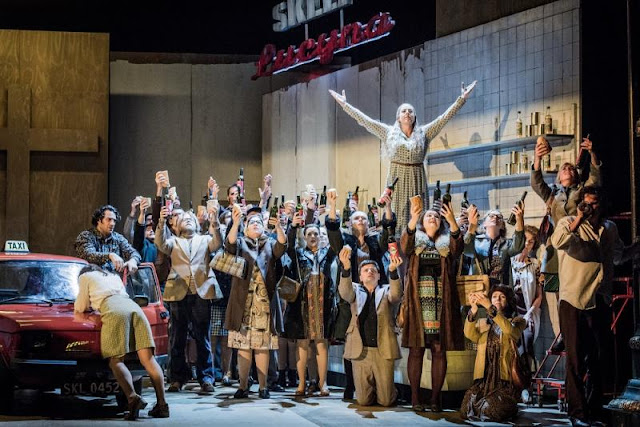
Mascagni's Cavalleria Rusticana at Opera North in 2017
the production is revived in 2024 (Photo Robert Workman)

Opera North's Spring Season features a revival of Giles Havergal's production of Britten's Albert Herring, conducted by Garry Walker with Josephine Barstow as Lady Billows, plus Katie Bray, William Dazeley, Amy Freston, Richard Mosley-Evans, Claire Pascoe, Dominic Sedgwick, and Heather Shipp. Tim Albery's production of Mozart's Cosi fan Tutte is revived with Alexandra Lowe, Heather Lowe, Anthony Gregory and Henry Neill as the lovers, conducted by Clemens Schuldt and Chloe Rooke, each making their Opera North debuts. A double bill features a new production of Rachminoff's rarely-performed Aleko, directed by Karolina Sofulak with a revival of her production of Mascagni’s Cavalleria rusticana, conducted by Antony Hermus. Many of the cast take roles in both works with Robert Hayward, Giselle Allen, Andrés Presno, Elin Pritchard and Anne-Marie Owens. The operas will tour to Leeds, Nottingham, Salford and Hull. 

WNO's Summer seaon features David McVicar's new production of Puccini's Il Trittico which debuts in Scotland this month. The conductor is Carlo Rizzi and the cast includes Justina Gringytė, Vuvu Mpofu, and Alexia Voulgaridou. The production will not tour and is only being performed in Cardiff.

Throughout the year, the WNO Orchestra will be giving a programme of concerts including St David's Hall, and two concert tours, whilst the Orchestra of Opera North will be appearing at the Kirklees Concert Season


More than just a rarity: Tchaikovsky's first surviving opera, Oprichnik, gets a vibrant performance from Chelsea Opera Group

Tchaikovsky, aged 33. Photographed by Alfred Lorenz in Saint Petersburg, January 1874 (Photo Tchaikovsky Research Project)
Tchaikovsky, aged 33 in January 1874 
Photographed by Alfred Lorenz in Saint Petersburg
(Photo Tchaikovsky Research Project)
Tchaikovsky: Oprichnik; Seljan Nasibli, Brian Smith Walters, Yvonne Howard, Stephen Richardson, Nicholas Lester, conductor: James Ham; Chelsea Opera Group at Cadogan Hall
Saturday 12 March 2023

Tchaikovsky's first surviving opera in what was surprisingly its English premiere, proves full of colour and drama, with some strong individual performances

Tchaikovsky was fascinated by opera; he started writing around 20 of which nine survive as complete works. We know so very few of them well. His first opera to survive was Oprichnik which debuted in 1874, so comes at the time he was working on his first two symphonies. It was performed in concert by Scottish Opera at the Edinburgh Festival in 1992, which was the work's UK premiere. On Saturday night (11 March 2023) the ever-enterprising Chelsea Opera Group gave Tchaikovsky's Oprichnik its English premiere at Cadogan Hall. James Ham conducted with Seljan Nasibli as Natalya, Brian Smith Walters as Andrey, Yvonne Howard as Andrey's mother, Stephen Richardson as Natalya's father, Elinor Rolfe Johnson as Natalya's maid and Nicholas Lester as Prince Vyazminsky.

The title translates as The Guardsman and refers to Tsar Ivan IV's hated political police. The opera takes place during Ivan's reign under the weight of oppression from the Oprichniks. The libretto is by Tchaikovsky himself, based on an existing historical drama by Ivan Lazhechnikov. This had been written in 1843, but the play was not performed, due to censorship, until 1867 and then repeated during the 1869/1870 season. And by 1870, Tchaikovsky was talking about writing an opera based on the play, though for the first scene, with Natalya and her ladies in the garden, the entire libretto was lifted from Tchaikovsky's earlier, discarded opera, The Voyevoda and there are around seven numbers in Oprichnik which include reworked music from The Voyevoda (see the Tchaikovsky Research Project for details).

Sunday, 12 March 2023

Late-Romantic atmosphere & emotional turmoil: Ethel Smyth's Der Wald gets a rare outing

Ethel Smyth: Der Wald
Ethel Smyth: Der Wald; Becca Marriott, Jacob Bettinelli, Louis Hurst, Lizzie Ryder, Martins Smaukstelis, Francesca Lauri, Panaretos Kyriatzidis; The Opera Makers at Holy Sepulchre Church
Friday 10 March 2023

A rare outing indeed for Smyth's second opera, 70 minutes of late-Romantic atmosphere and emotional turmoil, well caught in this small-scale performance

When the guns began to roar and the armies march at the beginning of World War I, it marked a significant divide in Ethel Smyth's career. German-trained, she had remained something of a German composer, performances of her work across Europe being far more common than in England. In 1914, she had major European performances of her operas planned, the two being Der Wald and Strandrecht (the German version of The Wreckers). Never again would she write large-scale romantic drama and her final three operas are smaller scale and firmly English.

Smyth's second opera, Der Wald had a distinguished history, it was premiered at the Königliches Opernhaus in Berlin in 1902, going on to have performances in London, New York and Strasbourg. It was the first opera by a woman to be presented at the Metropolitan Opera in New York (and remained so until 2016, when Kaija Saariaho's opera L'Amour de loin was first performed there). Since then, nothing.

Ethel Smyth's Der Wald received what was perhaps its first London performance since its UK premiere on Friday 10 March 2023 in an enterprising concert performance from The Opera Makers at Holy Sepulchre Church. Panaretos Kyriatzidis conducted, with Becca Marriott as Iolanthe, Jacob Bettinelli as Rudolf, Louis Hurst as the Pedlar, Lizzie Ryder as Röschen, Martins Smaukstelis as Heinrich and Masimba Ushe as Peter, accompanied by Francesca Lauri at the piano, and there was a large, voluntary chorus made up largely of music students.

Saturday, 11 March 2023

Snakebite! composer Stephen Montague at 80

Stephen Montague
Stephen Montague

If you ask composer Stephen Montague about the style of his music, his response is likely to echo the maverick American composer Henry Cowell (1897-1965) who wanted to live in the whole world of music, not just one corner. Stephen is 80 this year and remains just as much a free musical spirit as before. I recently met up with him to chat about his forthcoming birthday concert at St John's Smith Square, where Southbank Sinfonia will be joined by an array of conductors and other performers to celebrate Stephen with a programme of his music ranging from the 1990s to recent works.

When it comes to music, Stephen admits that he is interested in too many things, which is unfashionable at the moment; composers such as Philip Glass and Steve Reich have made names for themselves by cultivating a particular corner of the musical landscape. But Stephen likes writing everything, something that he feels he takes unconsciously on board, so his style can be experimental or tonal and use functional harmony, esoteric or full Hollywood-style film score. This has been unfashionable during Stephen's lifetime and has applied to the visual arts too.

But every piece has Stephen's hallmark on it in some way, he feels that he tends toward recognisable harmonies and any dirty dissonances often resolve. He now does exactly what he wants to do and can take the consequences, and like Mozart, he knows for whom he is writing and the sort of music needed. Stephen recently wrote a large-scale ballet for Birmingham Royal Ballet; being a ballet dance piece, he clearly understood that this was not the time for experimentalism and that dancers have to be able to count so it wasn't time for irregularity.

Friday, 10 March 2023

Daylight Music is back with two Piano Days

Daylight Music
Daylight Music

East London's favourite and most dynamic music series, Daylight Music is back on Saturday 11 March with the first of two days devoted entirely to the piano. Saturday's Piano Day at St John's Leytonstone features Jenny Moore, songwriter and lead mystic of the choral-punk ensemble Jenny Moore’s Mystic Business, duo Tori Freestone on tenor saxophone and Alcyona Mick on piano, and performer and composer Maya-Leigh Rosenwasser, whose performance will include a curated journey through composers who connect with themes of playfulness, queerness, intimacy, gender as well as engaging with perceptions of societal and artistic notions of success and failure.  

The second Piano Day, on 1/4/2023 (and repeated in Faversham on 2/4/23) features musician Matthew Bourne, who presents Iconoclast, which is Glen Leach on piano, Matthew Bourne on synthesizer and Emil Karlsen on drums and percussion, a solo set from Ruth Goller, and Nika Ticciati's Cataclysm Ensemble, a spiritual jazz-punk band.

Other events to come include the return of the London Accordion Orchestra with Guildhall Saxophone Ensemble.

Full details from the Daylight Music website.

Britten Sinfonia's Play On appeal

Britten Sinfonia at Saffron Hall, Saffron Walden (Photo: Tom Lovatt)

Britten Sinfonia has launched a £1 million appeal to help secure its future in the wake of the cut to its Arts Council Funding. The orchestra was an Arts Council Portfolio Organisation from April 2020 to April 2023 but has been removed from the list for the following period. It has secured transition funding until October 2023, but then has a significant short-fall in budget.

The orchestra has always used a mixed funding model with 50% of its income coming from ticket sales and engagements, with the remainder (approximately 25% each) from Arts Council funding and the orchestra's independent fundraising efforts.  The orchestra’s annual turnover is typically in the region of £1.5 million.

Whilst the orchestra has a strong presence in London, it is an associate ensemble at the Barbican, it also has an important presence in East Anglia and Essex. It is resident at Saffron Hall and gives regular seasons in Cambridge and in Norwich, as well as performing at the Aldeburgh Festival and the Norwich and Norfolk Festival.

Outside the concert hall, Britten Sinfonia musicians work on creative and therapeutic projects with pre-school children, teenagers, young carers, people living with dementia, life-time prisoners and older people at risk of isolation. The orchestra also has two talent development schemes for composers: Opus 1 and Magnum Opus.

Those lending support to the Play On appeal include a range of musical figures close to Britten Sinfonia, including composers Steve Reich, Master of the King’s Music, Judith Weir, Sir James MacMillan, Thomas Adès and Nico Muhly,  singers Dame Sarah Connolly and Roderick Williams, trumpeter Alison Balsom, harpsichordist Mahan Esfahani and pianist Benjamin Grosvenor. 

Read our recent coverage of Britten Sinfonia events, including The Golden Road to Samarkand and Holst's Savitri.


Sending everyone away with a smile: Academy of Ancient Music in Purcell and Locke

Matthew Locke
Matthew Locke
Locke, Humfrey, Banister, Reggio: The Tempest, Purcell: Hail! Bright Cecilia; Academy of Ancient Music, Laurence Cummings; Milton Court Concert Hall
Reviewed 9 March 2023

An imaginative programme paired one of Purcell's large-scale masterworks with a theatrical sequence from a joint-effort Shakespeare adaptation, all lifted by engaging, rhythmically alert and colourful performances

Last night (9 March 2023) at Milton Court Concert Hall, Laurence Cummings and the Academy of Ancient Music (AAM) gave us a feast of last 17th-century English music. The focus of the programme was Purcell's largest and grandest ode, Hail! Bright Cecilia, which was imaginatively paired with a sequence of the surviving music from the 1674 production of Shakespeare's The Tempest with music by Matthew Locke, Pelham Humfrey, John Banister and Pietro Reggio. The soloists, eight in all, were all members of the choir.

In France and Italy, in their various ways, the court ceremonial musical entertainments (masque, ballet du court and such) developed into large-scale, fully sung opera. The English, perhaps with an innate love-hate relationship with Continental influences, did something different. There were fully sung theatrical pieces during the mid-17th century, such as The Siege of Rhodes (1656) but these seem to have been as much about getting around Puritan laws against spoken drama as an innate desire for full-sung opera. With the Restoration, the preferred musical entertainment was the spectacular, an evening combining spoken word, instrumental music, song, and dance with spectacular stagings, variously called dramatick opera or semi-opera. But there was a certain flexibility, so plays with a bit of incidental music might shade into full dramatick opera spectaculars. One of these was Thomas Shadwell's 1674 production of The Tempest.

This used a version of the text based on one rewritten by John Dryden in 1667, there was singing and dancing, and plenty of extra characters (an extra daughter for Prospero, love interest for her, a girl-friend for Ariel and a sister for Caliban). It was a great success. The music, as was common at this period, was the product of a number of hands and, as was also common, the theatrical scores do not survive. But in 1675, Matthew Locke published his contribution, a suite of dances and act tunes, whilst some songs by the other composers do survive. The AAM gave us a substantial sequence that interspersed Locke's dances with songs by John Banister (one-time master of the King's violin band), Pelham Humfrey (master of the Children of the Chapel Royal and French-trained), and two Italian emigres, Giovanni Draghi and Pietro Reggio.

Thursday, 9 March 2023

Requiem: Journeys of the Soul - For LEEDS 2023, Opera North, Phoenix Dance Theatre & Jazzart Dance Theatre in a staged Mozart Requiem

Phoenix Dance Theatre dancers in rehearsal for Requiem © Point of View Photography
Phoenix Dance Theatre dancers in rehearsal for Requiem (Photo: Point of View Photography)

As part of LEEDS 2023 Year of Culture, two Leeds-based companies Opera North and Phoenix Dance Theatre are joining forces with South African partners Jazzart Dance Theatre and Cape Town Opera to present a staged re-imagining of Mozart’s Requiem at the Grand Theatre, Leeds from 26 May to 4 June 2023. The collaboration follows on from Opera North and Phoenix Dance Theatre's collaborations on The Rite of Spring (2019) and West Side Story Symphonic Dances (2021).  

The performance will combine Mozart's music with that of South African composer Neo Muyanga. Muyuanga's new work for choir and orchestra, After Tears: After a Requiem was conceived as a response to Mozart’s Requiem. Both will be choreographed by Dane Hurst, guest choreographer and former artistic director of Phoenix Dance Theatre, for dancers from Phoenix and from Jazzart Dance Theatre. Garry Walker will conduct the chorus and orchestra of Opera North, with four guest soloists.

The production, conceived during the COVID-19 pandemic, takes Mozart’s music as an act of remembrance, honouring those we have lost – and examining what life means for those left behind in a reflective and hopeful expression of the beauty, brutality and brevity of life.

Full details from the Opera North website.

Shifting harmonies & tonal instability: Kitty Whately & Joseph Middleton are sympathetic & communicative in their programme of late-Romantic lieder on Befreit: A Soul Surrendered

Befreit: A Soul Surrendered  - songs by Johanna Müller-Hermann, Richard Strauss, Margarete Schweikert, Gustav Mahler; Kitty Whately, Joseph Middleton; Chandos
Befreit: A Soul Surrendered  - songs by Johanna Müller-Hermann, Richard Strauss, Margarete Schweikert, Gustav Mahler; Kitty Whately, Joseph Middleton; Chandos

Early 20th-century Vienna is the focus for this disc of lieder focused around the intense subject of love and loss illuminated by gloriously sympathetic and communicative performances

The new disc from mezzo-soprano Kitty Whately and pianist Joseph Middleton on Chandos is entitled Befreit: A Soul SurrenderedThe title track is Richard Strauss' Befreit, a strange but lovely song to a poem about someone dying. Around this, they have crafted a haunting programme of lieder by composers mainly from Vienna including Richard Strauss and ending with Gustav Mahler's Kindertotenlieder but also including two lesser-known names, Johanna Müller-Hermann and Margarete Schweikert, both of whom seem to have disappeared from view because of their sex rather than from any inherent quality of their music.

The music on the disc all circles around the late-Romantic, there are advanced harmonies yet moments of looking back. No-one approaches Schoenberg, quite, yet there is a sense of the instability of the harmonic world.

Wednesday, 8 March 2023

National Centre for Early Music celebrates International Women’s Day, now & throughout the year!

Ensemble Moliere
Ensemble Moliere

The National Centre for Early Music (NCEM) is celebrating International Women’s Day in style this year with a new composition Rossignolet by NCEM Composer Award winner Sarah Cattley, commissioned by BBC Radio 3 and presented by the all-female instrumentalists Ensemble Moliere (Radio 3 New Generation Baroque Ensemble) at a lunchtime concert to be broadcast at 1.30pm on Wednesday 8 March.  At the concert the ensemble will be joined by soprano Ruby Hughes for a programme that also includes music by three 18th century French composers, Mademoiselle Laurent, Mademoiselle Duval and Elisabeth Jacquet de la Guerre.

The concert will be available to listen to on catch up on BBC Sounds

Looking ahead, women composers are highlighted within this summer’s York Early Music Festival with a new work by Lithuanian composer and NCEM alumna Juta Pranulyte, commissioned jointly by NCEM, The Marian Consort and the Rose Consort; three miniature operas by the late 17th century French composer Élisabeth-Claude Jacquet de La Guerre telling the heartrending stories of three Biblical women and sung by three exception singers: Carolyn Sampson, Anna Dennis – winner of the RPS Vocal Award 2023 -  and Alys Mererid Roberts; and BBC New Generation Artist Helen Charlston presenting her award-winning Battle Cry! 

Sign the petition: BBC announces the disbanding of the BBC Singers

The BBC Singers
The BBC Singers

Please sign the petition to urge the BBC to stop this ridiculous and short-sighted decision. Full details at change.org.

The BBC has announced that as part of its New strategy for Classical Music it will be disbanding the BBC Singers - the only full-time professional choir in the UK. The BBC Singers’ roots can be traced back to 1924. Based at the BBC’s Maida Vale Studios, the choir also gives free concerts at a number of venues across London and makes regular appearances at major festivals across the UK and beyond, with the vast majority of its performances broadcast on BBC Radio 3.

The number of people affected by the planned closure of the UK’s only full-time professional choir is significant. Firstly there are the 20 professional singers and additional administrative staff whose jobs and livelihoods will be taken away. The BBC Singers have a proud history of commissioning new works from contemporary composers - from the BBC Christmas Carol Competition to other commissions from established and promising composers. This important work would be lost. 

The choir does an incredible amount of outreach work in schools and other educational institutions, providing singing days and masterclasses to young singers and conductors from all backgrounds. 

Please sign the petition to urge the BBC to stop this ridiculous and short-sighted decision. Full details at change.org.

Once you hear it, I guarantee you'll be seduced: Arne Nordheim's The Tempest, Suite from the Ballet in a new recording from Bergen

Arne Nordheim; The Tempest, Suite from the Ballet; Bergen Philharmonic Orchestra, Edward Gardner, Beate Mordal, Jeremy Carpenter; LAWO Classics
Arne Nordheim; The Tempest, Suite from the Ballet; Bergen Philharmonic Orchestra, Edward Gardner, Beate Mordal, Jeremy Carpenter; LAWO Classics
Reviewed 7 March 2023

Nordheim's 1979 Shakespeare-based ballet in a single-disc distillation is full of magical timbres and a mysterious, seductive sound world

Whilst  Shakespeare's The Tempest has constantly fascinated composers, few if any have managed to turn it into a coherent dramatic musical work. The drama itself is simply too elusive and changeable. I saw the Ballet Rambert's production of Glen Tetley's ballet, The Tempest in Edinburgh in 1979 or 1980. A full evening, two-act ballet that had no corps de ballet and was based on a distinctly modernist score, it was totally fascinating. 

Tetley was commissioned for a new ballet by the Schwetzinger Festival and the resulting work was premiered at the Rokoko Theater, Schweztingen by Ballet Rambert in 1979. The score was commissioned from Norwegian composer, Arne Nordheim. In 2021, Edward Gardner and the Bergen Philharmonic Orchestra presented music from Nordheim's The Tempest in concert at the Bergen International Festival combining the music with, not dance, but with a visual retelling of the story.

On this new disc from Norwegian label, Lawo Classics, Edward Gardner and the Bergen Philharmonic Orchestra present Nordheim's The Tempest: Suite from the Ballet with soprano Beate Mordal and baritone Jeremy Carpenter.

There are eight movements to the suite, 'Calm Sea', 'Storm with Lightning and Thunder', 'Awakening', 'Magic Circle', 'Lacrymae', 'A Mazed Trod', 'Four Legs and Two Voices' and 'Caliban's Warning', some 50 minutes from a two-hour score. Nordheim writes for orchestra with double woodwind (including piccolo, cor anglais, bass clarinet and contrabassoon), horn, timpani, strings, percussion (three players), harp and celesta, plus of course the two wordless soloists and the electronics.

Tuesday, 7 March 2023

Light Flowing: cellist Clare O'Connell's new project for an innovative disc of contemporary music for solo cello

Clare O'Connell
Clare O'Connell

I chatted to cellist Clare O'Connell back in 2021 [see my interview] about her solo disc, The Isolated Cellist, and about her innovative Berkhamsted concert series, Behind the Mirror. Now Clare has now started a Kickstarter campaign to raise money for an innovative disc of music for solo cello and solo cello and electronics on the NMC label. This will be the first disc of music for solo cello that NMC has recorded, and it will feature new pieces by Emily Hall, Emilie Levienaise Farrouch and Natalie Klouda.

Clare describes the new album as 'something very close to my heart and deeply relevant given the challenges of the past few years', and she wants it to be as uplifting and as experimental as possible. She comments, 'I am passionate about creating and sharing beautiful and moving musical experiences with people, both live and recorded, and I'm committed to raising up and collaborating with new artistic voices.'

The disc will not only feature music by Emily Hall, Emilie Levienaise Farrouch and Natalie Klouda, but will include contemporary works by Edmund Finnis, Alex Mills and Nick Martin.

The money raised will not only support creating the disc, but will enable Clare to commission the three new pieces from Hall, Farrouch and Klouda, and Natalie Klouda's piece will receive its premiere on International Women's Day 2024 (8/3/2024) at Wigmore Hall.

Clare's campaign starts today, do please register your support at Kickstarter.

Popular Posts this month