Thursday, 23 March 2017

Guto Puw's Welsh-language opera premieres at the Vale of Glamorgan Festival

Guto Puw and Gwyneth Glyn
The highlight of this year's Vale of Glamorgan Festival (19-26 May 2017) must be Music Theatre Wales' premiere of Guto Puw's Welsh language opera Y Tŵr (The Tower), but there are plenty of other good things on. The only UK festival devoted to the work of living composers, there are lots of other new pieces on offer with the Marsyas Trio showcasing music by six women composers, Onyx Brass performing another Guto Puw piece, this time for fairground organ and brass quintet, and the Apollon Musagete Quartet celebrating John Adams' 70th birthday. The festival finale features the BBC National Orchestra of Wales, conductor Tecwyn Evans, in the premiere of Graham Fitkin's concerto for multiple amplified recorders, written for BBC Young Musician Finalist Sophie Westbrooke, and Huw Watkins' Cello Concerto performed by his brother Paul Watkins.

Y Tŵr, Guto Puw's first opera, is commissioned and performed by Music Theatre Wales in conjunction with Theatr Genedlaethol Cymru, the Welsh-language national theatre company. The libretto, by Welsh poet Gwyneth Glyn, adapts a classic play by Gwenlyn Parry which explores the journey of two people through life. Gwenlyn Parry (1932-1991) was one of the most important 20th century Welsh-language playwrights. He joined BBC Wales in 1966 where he helped establish the scripts department and worked on popular Welsh programmes such as Pobol y Cwm. He played a key role in popularising drama in theatre and television in the 1970s and 1980s, and his plays, including Y Tŵr had a huge impact.

Michael McCarthy directs the opera and Richard Baker conducts with a cast featuring Caryl Hughes and Gwion Thomas. There are two performances at the festival, 19 & 20 May 2017 at the Sherman Theatre, Cardiff (details from the festival website) and then Music Theatre Wales take the piece on tour - Aberystwyth (May 23), Bangor (May 25), Mold (June 5), Swansea (June 15) and the Buxton Festival (July 17). Full details from the Music Theatre Wales website.


Wednesday, 22 March 2017

Gallicantus: Queen Mary's Big Belly

Queen Mary's Big Belly
Philip von Wilder, William Mundy, Christopher Tye, Thomas Tallis, John Sheppard; Galicantus; Signum Classics
Reviewed by Robert Hugill on Mar 14 2017
Star rating: 4.0

Queen Mary's phantom pregnancy forms the thread on which to hang superb music in this imaginative recital

The reign of Queen Mary I provides a rich seam for musicians. There is the contrast between the new simplicity of music under her predecessor, King Edward VI and the late-Tudor flowering of English polyphony under the restored Roman Catholic Church in Queen Mary's reign. Her marriage to King Philip of Spain brought forth music such as Thomas Tallis's Missa puer natus est along with the fascinating interaction between the choirs of the English Chapel Royal and the Spanish Capilla Flamenca, and of course Mary's phantom pregnancies.

This last topic might seem a curious theme for a recital disc but on Queen Mary's Big Belly on Signum Classics, Gabriel Crouch and Gallicantus use the topic to create a fascinating musical narrative. Perhaps simply a frame on which to hang music, the programme traces a musical year in the life of Queen Mary. But what music it is! We get choral music by Philip von Wilder, William Mundy, Christopher Tye, Thomas Tallis, and John Sheppard, along with a selection of songs with lute, with Elizabeth Kenny.

Mary married in July 1554, and the programme begins in expectation with a Pater Noster by Philip van Wilder which was probably written as a devotional piece for the privy chamber, along with a sequence which hovers on the edge of the sacred with William Mundy's three-part canon Exurge Christe (a specially written text), Christopher Tye's eccavimus con patribus and Te spectatnt Reginalde, poli by Orlande de Lassus. This latter was written for the Queen's cousin Cardinal Reginald Pole, who became Archishop of Canterbury. Lassus is a slightly unexpected figure in the story, but he seems to have popped up in England in 1554 in the entourage of the Neapolitan singer-diplomat Giulio Cesare Brancaccio.

Snappy Operas to get children learning and performing opera

Mahogany Opera Group - Snappy Operas
Mahogany Opera Group is creating ten new ten-minute operas with some of the UK most exciting writers and composers. These short pieces will be designed for, performed by and created by children aged 7 to 11. And the first operas are first performed during March and April, in Cornwall, West Cumbria, Norfolk, Suffolk and North Tyneside.

Artists who have created the first five Snappy Operas include composers Emily Hall, Errollyn Wallen, Jamie Man, Ed Hughes and Luke Carver Goss, and writers Ian McMillan, Toby Litt, Stephen Plaice and Peter Cant.

Mahogany Opera is teaming up with ten regional partners, including music education hubs and arts venues, to bring each of the Snappy Operas to life with 1,500 children across the UK. In the first year, this includes: The Apex, Cornwall Music Education Hub, Norfolk Music Hub, North Tyneside Music Education Hub, Rosehill Theatre and Suffolk County Music Service. The process is overseen by Mahogany Artistic Director Frederic Wake-Walker and music director Stephen Deazley, and the first group of operas have been written and workshopped, they are now being learnt, rehearsed and produced in each school. In addition to learning the music and libretti, the children taking part in the project receive a design pack to create their own costume for the final performance.

One of the first Snappy Operas, The Itch-Witch, created by composer Emily Hall and writer Toby Litt has won a place in the New Music Biennial 2017 and is part of Hull UK City of Culture celebrations (on 1 July 2017) and will be performed at London’s Southbank Centre on 8 July 2017.

Snappy Operas is generously supported by the Michael Tippett Musical Foundation and PRS for Music Foundation (Talent Development Partnership).

Full details from the Mahogany Opera website.

New commissions, new collaborations & more: Garsington Opera's season grows

Garsington Opera inside the auditorium (Photo Clive Barda)
Garsington Opera is growing, this year there are four operas not three, the Philharmonia Orchestra is joining in with a five-year agreement to provide the orchestra for one of the four, and such was the enthusiasm for the season that one extra performance has been added. Outside the main season this year, there will also be a new opera, a people's opera written for the local community, Roxanna Panufnik's Silver Birch, and next year the main season will include a brand new commissioned opera from David Sawer. I met up with Nicky Creed, Garsington Opera's CEO to find out more.


The Opera Garden at Garsington Opera at Wormsley (Photo credit Clive Barda)
The Opera Garden at Garsington Opera at Wormsley (Photo Clive Barda)
Last year the Garsington Opera season sold 98% of capacity, and with their expansion this year they do seem to be bucking the trend. Nicky tells me that booking this season is already at 87% which is where they want to be because they still want tickets to be available when public booking opens on 28 March 2017. But this sort of calculation is tricky as the demand is volatile; tickets for Handel's Semele 'shot out of the door' which is why the company added an extra performance, because there was a danger that their members might not be able to be able to buy tickets.

Pelleas et Melisande is proving to be slower, though the opera  is notorious at the box office but Nicky points out that there are indeed a great many people who love the opera. And one of the things that Garsington has come to appreciate about its members is that they are knowledgeable people who enjoy a good night out at an opera they don't see all the time. But Nicky admits that it is a challenge to get the right balance, with suitable mixture of the popular and the lesser known. And the company has to sell 96%, if they don't they have a problem, so it is quite a balancing act. For Nicky that is the excitement of it, and why she is still there after 17 years.

Membership has doubled in size in the last five years, so this means that there are 1200 new members that they need to get to know, with all the changes to the members preferences which this implies.

Garsington Opera moved to its present location, at Wormsley, in 2011 transferring from a setting on a terrace in the gardens at Garsington Manor to a custom built pavilion. This has entailed changes, but the company has tried to transplant the best of the old Garsington to the new. Certainly it is true that it is far easier to strive for excellence in the new theatre. The old one, picturesque though it was, provided limitations; everything, including the sets, had to come through a 1.5m wide stone arch. So something like Cinderella's caravan had to be sawn in half and hitched back together again. But Nicky points out that at La Fenice in Venice all the scenery has to come in barges, so limitations can be overcome.

Tuesday, 21 March 2017

Ten days to go

There is still time to support our crowdfunding for the new CD of my songs, Quickening: Songs to texts by English and Welsh poets

So far we have raised over £1600 so many thanks to everyone who has supported the project so far.

http://www.crowdfunder.co.uk/quickening

A problem no more: William Relton's production of Handel's Faramondo at the London Handel Festival

Kieran Rayner, Harriet Eyley - Handel: Faramondo - London Handel Festival (Photo Chris Christodoulou)
Handel Faramondo; Ida Räntzlöv, Harriet Eyley, Beth Moxon, Josephine Goddard, dir: William Relton, cond: Laurence Cummings; London Handel Festival at the Britten Theatre, Royal College of Music
Reviewed by Robert Hugill on Mar 20 13 2017
Star rating: 4.5

A vivid re-invention of one of Handel's problem operas, in a brilliantly theatrical 1960s setting

Beth Moxon, Ida Ränzlöv - Handel: Faramondo - London Handel Festival (Photo Chris Christodoulou)
Beth Moxon, Ida Ränzlöv - Handel: Faramondo
London Handel Festival (Photo Chris Christodoulou)
Handel's 1737 opera Faramondo was never going to be that high on anyone's list, even the great Winton Dean described the plot as a 'whirlpool of inconsequence'. But the role of festival like the London Handel Festival is to explore all the composer's music, and this year's festival opened on 20 March 2017 at the Royal College of Music's Britten Theatre with William Relton's production of Faramondo, giving us a valuable chance to reassess the opera by experiencing it on stage.

William Relton directed, with designs by Cordelia Chisholm and lighting by Kevin Treacy, and Laurence Cummings conducted the London Handel Orchestra, leader Oliver Webber, with Ida Räntzlöv as Faramondo, Harriet Eyley as Clotilde, Kieran Rayner as Gustavo, Beth Moxon as Rosimonda, Josephine Goddard as Adolfo, Timothy Morgan as Gernando, Harry Thatcher as Teobaldo, and Lauren Morris as Childerico.

Part of the problem with Faramondo is that the original libretto by Apostolo Zeno from 1699 reached Handel in mangled form and he trimmed it further, removing over 700 lines of recitative, Like Il trovatore the opera starts in the middle of the plot, and relies heavily on events in the past. William Relton's brilliantly theatrical production re-invented the piece as 1960s gang warfare with Ida Räntzlöv's Faramondo the leader of leather clad rockers, Kieran Rayner's Gustavo as a night-club owning mod and Timothy Morgan's Gernando as the leader of a gang of skin-heads. Relton brought out the vividness of the action, and kept the pace moving bringing to mind the opera's similarities to soap opera.

The key to appreciating such opera seria is not to worry about narrative logic but to savour that different emotional binds that the characters are put into. By 19th and early 20th century operatic logic, the libretto is hopelessly obscure and the characters lack detailed motives for their actions. But Handel's audience would have worried less about this, and would have relished the chance to see a scene between a father threatening to kill his son, a woman torn between hatred and love for her brother's killer, a tender duet between to lover's destined for execution. That none of the scenes followed logically on from the other, would have worried them less.

Relton and his cast gave the opera the virtue of taking it seriously, and by setting it in the world of young gangs, the characters' impulsive actions jarred far less. Cordelia Chisholm's designs kept up the pace, she used a drop curtain frequently to mask the scene changes so we moved seamlessly between Gustavo's seedy club to a world of dark alleys. Relton and Chisholm ensured that we knew exactly who these characters were (something which the libretto's terseness makes difficult).

Handel's Theodora in Manchester

Handel - Theodora
Whilst the London Handel Festival gets into full swing this week, Manchester has its own Handel performances to look forward to as the Royal Northern College of Music is staging Handel's late oratorio Theodora. John Ramster directs, with designs by Bridget Kimak and Roger Hamilton conducts the RNCM Opera Orchestra and RNCM Chorus. The production opens on 24 March and runs until 1 April 2017, it is double cast and you can find the casts on the RNCM website (PDF). 

To coincide with the final performance, on Saturday 1 April 2017, there is a study day at the college offered jointly by the Handel Institute and the RNCM with the opportunity to hear Professor Donald Burrows, Dr Ruth Smith, Professor Colin Timms, Dr Amanda Babington, Dr David Vickers and Dr Cheryll Duncan talking about the opera, followed by a matinee performance. Full details from the RNCM website.

16 choirs from 11 countries - the third London International A Cappella Choral Competition

London International A Cappelle Choir Competition
The third London International A Cappella Choral Competition at St John's Smith Square runs from 26 June to 1 July 2017, with a total of 16 competing choirs from 11 countries (Chile, Colombia, Denmark, Hungary, the Netherlands, Norway, Poland, Philippines, India, Indonesia, and the UK). There are six choirs from the UK with 10 from other countries.

It is the only choral competition in the UK with a purely a cappella focus, and this year the competition celebrates the music of Arvo Pärt. The participating choirs compete in the initial rounds (26-29 June) for a place in the finale on 1 July 2017, but also choirs have the opportunity to perform at a lunchtime concert in a central London venue, and to participate in a specialist workshop with Ghislaine Morgan. Morgan is one of the judges alongside Peter Phillips (chairman), Graham Ross, Tõnu Kaljuste, and Carolyn Sampson.

In addition to the main competition, there will be a screening of Dorian Supin’s third documentary film on Arvo Pärt even if I lose everything, and an exhibition of photographs of Arvo Pärt by Kaupo Kikkas, which are being exhibited in the UK for the first time. On Friday 30 June, Peter Phillips and the Tallis Scholars will give a recital performing Heinrich Isaac's Missa de Apostolis and Virgo prudentissima (written for a big international peace conference in 1507) alongside music by Arvo Pärt and Allegri (guess what?).

Full information from the competition website.

Monday, 20 March 2017

Looking Ahead: Oxford Phillharmonic's Oxford Piano Festival

The Oxford Piano Festival is a regular summer event presented by the Oxford Philharmonic Orchestra, artistic director Marios Papadopoulos. This year it runs from 30 July to 7 August, with a line-up of performers including Richard Goode, Zhang Zuo, Zaleem Ashkar, John Lill, Yefim Bronfman, Menahem Pressler and Andras Schiff.

The festival's patron, Alfred Brendel, will be giving a lecture on Beethoven's last sonatas and his late style, and there will be performances of Beethoven from Zhang Zuo, Saleem Ashkar, John Lill and Richard Good. Andras Schiff, who is the festival's president, will perform Book I of Bach's The Well-Tempered Clavier. The festival closes with a performance of Brahms' Piano Concerto No. 2, with Yefim Bronfman and the Oxford Philharmonic Orchestra, conductor Marios Papadopoulos.

As well as recitals there are talks, including one on performance anxiety from Charlotte Thomson, and there will be a Q&A with Dame Fanny Waterman the founder of the Leeds Piano Competition. There is a series of masterclasses for young pianists, who also attend lectures and recitals and can showcase their talents in the Participants' Recital.

Full details from the Oxford Philharmonic's website.

Thrilling moments from a youthful cast in Saint-Saens' Samson et Dalila

Samson et Dalila at the Paris Opéra, 1892:
Camille Saint-Saens Samson et Dalila; Claudia Huckle, Aaron Cawley, Michel de Souza, Michael Scott Rogers; Chelsea Opera Group at Cadogan Hall
Reviewed by Robert Hugill on Mar 19 2017
Star rating: 4.0

Some notable performances in an ultimately thrilling account of Saint-Saens best-known

Camille Saint-Saens' opera Samson et Dalila retains a toe-hold on the repertoire (the only one of the composer's operas twelve to do so) thanks in part to its highly memorable tunes. But the Royal Opera's production has not been seen in London since 2004, and the opera's only recent UK outing seems to have been Grange Park Opera's 2015 production (see my review). So Chelsea Opera Group's performance at the Cadogan Hall on Sunday 19 March 2017 was extremely welcome. Matthew Scott Rogers, who joined the Royal Opera House's Jette Parer young Artists Programme at the start of the 2016/2017 season, conducted the Chelsea Opera Group orchestra and chorus, with Aaron Cawley as Samson, Claudia Huckle as Dalila, Nicholas Folwell as Abimelech, Michel de Souza as the High Priest of Dagon, and Jihoon Kim as the old Hebrew.

The two title roles of the opera are large scale and taxing, requiring dramatic voices; the classic recording with Jon Vickers and Rita Gorr gives some idea of the size and type of voices required, The first Samson (the opera was premiered under Liszt's patronage at Weimar in 1877) sang dramatic tenor roles in Wagner and Meyerbeer as well as Arnold in Guillaume Tell and Manrico in Il Trovatore, and the first Dalila sang Azucena in Il trovatore and Fricka in Wagner's Ring Cycle.

Chelsea Opera Group was lucky to find two young singers, Aaron Cawley and Claudia Huckle, with the right style and type of voice for the roles. Both are young and I doubt that either will be singing the role on stage any time soon, but both Cawley and Huckle were admirable in the way they coped with the dramatic rigours required of them.

Aaron Cawley is only 30 and sings at the Hessiche Staatsoper in Wiesbaden were his repertoire (Pinkerton (Madama Butterfly) and Rodolfo (La Boheme) with plans for Lensky (Eugene Onegin), Erik (The Flying Dutchman) and Riccardo (Un ballo in maschera)), gives no hint of the size and vibrancy of his voice. Cawley's is thrilling voice seems to have bigger roles beckoning. It is rather a high-tension voice and as yet his very upper register still seems to require a high degree of careful management. It is also very loud.

Surrender to the madness: Patricia Petibon and Susan Manoff at Wigmore Hall

Patricia Petibon & Susan Manoff
Barber, Britten, Bacri, de Falla, Rodrigo, Obradors, Villa-Lobos, Bridge Poulenc, Collet, Semos & Stanton, Mignone, Granados, Turina, Guastavino, Lara, Churchill, Glanzberg; Patricia Petibon, Susan Manoff; Wigmore Hall
Reviewed by Robert Hugill on Mar 18 2017
Star rating: 4.0

Not an ordinary recital, a vein of theatricality and manic humour ran alongside serious intent in this Spanish-themed evening from French soprano Patricia Petibon

To call the evening at the Wigmore Hall with soprano Patricia Petibon and pianist Susan Manoff, on Saturday 18 March 2017, a simple song recital would be something of a misnomer, this was a richly theatrical event with each item receiving a carefully choreographed presentation which at times verged on pure cabaret and seemed to break the bounds of the possible in the sober halls of Wigmore Street.

Petibon and Manoff's programme gives some idea, it was highly eclectic with Poulenc's Sanglots sitting cheek by jowl with a Seguidilla by Henri Collet, Murray Semos and Frank Stanton's song Busy Line and the pure Carmen Miranda of Francisco Mignon's Dona Janaina. Spain and the evocation of Spain was a theme running through the evening, as was the idea of different aspects of love, but this did not preclude Petibon starting with Samuel Barber's Sure on this shining night and Benjamin Britten's arrangement of Greensleeves and ending with Norbert Glanzberg's Padam Padam, made famous by Piaf, and an version of Frank Churchill's Someday my prince will come (from Disney's Snow White) which went beyond arrangement into a complete comic scena which you could either find truly bizarre or simply surrender to the glorious madness.

Both the Barber and the Britten arrangement were sung in creditable English, the Barber was performed quite straight and very evocatively though this highlighted another Petibon particularity, her tendency to croon quieter numbers. The result was affecting but very distinct and particular. For no particular reason, she put on a small crown for Greensleeves.

Sunday, 19 March 2017

Richly vibrant & strongly characterful: songs by Buxton Orr from Nicky Spence & Iain Burnside

Buxton Orr - Songs
Buxton Orr songs; Nicky Spence, Iain Burnside, Jordan Black, Nikita Naumov, members of the Edinburgh Quartet
Reviewed by Robert Hugill on Mar 8 2017
Star rating: 4.5

Characterful performances of a clutch of new discoveries, in Buxton Orr's distinctive voice

You may not know the name Buxton Orr, but his music might be familiar as he wrote a number of film scores including that for the 1959 film Suddenly Last Summer with Elizabeth Taylor. On this new disc from Delphian we are treated to a selection of the Glasgow-born composer's songs from the period 1962 to 1986. Tenor Nicky Spence is joined by pianist Iain Burnside, clarinettist Jordan Black, double-bass player Nikita Naumov and members of the Edinburgh Quartet (Tristan Gurney, Gordon Bragg, Mark Bailey), to perform The Painter's Mistress, Canzona, The Ballad of Mr & Mrs Discobbolos, Ten Types of Hospital Visitor and Songs of Childhood. The language of the poems which Orr set varying from the classic English of James Elroy Flecker, through the comic with of Edward Lear and Charles Causley, to a variety of Scots texts from the more traditional to William Dunbar, William Soutar and King James I of Scotland.

The Painter's Mistress was written in 1974 using a poem by James Elroy Flecker describing the thoughts of the painter's mistress as she poses for the artists. It starts rather dramatically in media res with her thoughts 'And still you paint, and still I stand / White and erect, the classic pose', creating something rather intriguing to which Orr adds rather darker hints in the piano. The form is almost a lyrical recitative with Nicky Spence fully alive to the words.

Orr's Canzona is a song cycle for voice, clarinet and string trio (violin, viola and cello). It is his longest song cycle, and the combination of the relatively unusual scoring and fact that the poems are all in Scots hints at why the piece is not better known. 'Lament for Graham' sets text by 15th century minstrel Blind Harry lamenting John de Graham, one of William Wallace's companions, combined with William Dunbar's poem Of Life. Orr combines rather perky neo-classical drama of clarinet and strings with more lyrical, serious recitative in the voice, the two elements interacting until the dramatic climax. As with a number of the Scots language songs on the disc, Spence's performance is highly communicative (he is a Scot himself) but many will need to follow with the printed words.

Saturday, 18 March 2017

Viola Dolorosa: contemporary music for viola and piano

Peter Seabourne - Viola Dolorosa
Peter Seabourne Pieta, Britten Elegy, Lachrymae; Georg Hamman, Akari Komiya; Sheva
Reviewed by Robert Hugill on Mar 14 2017
Star rating: 4.0

Passionate and intense, contemporary British music for viola

Though prolific as a composer, Peter Seabourne is not a well-known name, though his work has had some significant success. This disc on Sheva Contemporary, Viola Dolorosa, from viola player Georg Hamann and pianist Akari Komiya pairs Britten's Elegy and Lachrymae with Seabourne's Pieta.

Born in 1960, Seabourne studied at Cambridge with Robin Holloway and at York University and had some national success with his music, but he became dissatisfied with his work and with the new music world. He eventually abandoned composition for some 12 years, only returning to it by chance in 2001. Since 2004 he has had some significant success and won a number of international prizes. The Italian label Sheva has issued a number of discs of Seabourne's piano music and this CD complements that with music for viola and piano. More of Seabourne's music can be heard online via his YouTube channel.

Seabourne's Pieta for viola and piano was written for Georg Hamann, who is the violist in the Aron Quartet. It is a large-scale piece lasting over 35 minutes, inspired partly by the Pieta statues of Michelangelo. Each of the five movements takes a different character, yearning, questioning, resignation, anger and reminiscence.

Virtuoso: I chat to recorder player Jill Kemp about her disc of new music

Jill Kemp (Photo Kate Mount)
Recorder player Jill Kemp's new disc Aztec Dances is programme of contemporary music recorded with pianist Aleksander Szram. The disc features music for recorder and piano by Edward Gregson, Gregory Rose, David Bedford, George King and Daryl Runswick all of which except the Gregson was written for her. I met up with Jill to find out more about the disc and to talk about working with contemporary composers, mixing the recorder with the piano, and her support for the music academy at Keiskamma in South Africa.


Jill Kemp (Photo Matt Jamie)
Jill has always enjoyed playing new pieces. When she and Aleksander Szram recorded their disc of 20th century recorder pieces English Recorder Works, they noticed how many of them had been commissioned by Carl Dolmetsch so they decided to do something for contemporary recorder repertoire and hence their new disc has four pieces which were written specifically for Jill and Aleksander. 

There is a lot of good contemporary recorder music for recorder solo and recorder ensemble, but not so much for recorder and piano. Part of this, Jill thinks, is because the two instruments are so very different, which means there are difficulties (in fact many of the pieces commissioned by Carl Dolmetsch were for recorder and harpsichord). But when playing contemporary repertoire, Jill plays a modern recorded which is louder than the older instruments and has an extended range. She and Aleksander Szram have formed a duo since 2007, and she describes Aleksander as a very sensitive player which helps in this repertoire.

'An amazing gift'


The pieces written for Jill came about in a variety of ways. She was playing David Bedford's Recorder Concerto and he commented that he had to write something for Jill. She didn't commission him, but suddenly he wrote her a piece which she describes as 'an amazing gift'. She premiered it just two weeks after he died and it was one of the last piece that he wrote. Aleksander had worked with both Gregory Rose and Darryl Runswick, in fact they knew each other through Trinity Laban. Whilst David Bedford had obviously written for recorder before, the pieces written by Gregory Rose and by Darryl Runswick were the first works for solo recorder each composer had written.

One of the beauties of working with living composers

Friday, 17 March 2017

Beyond the music: a further look at the poetry of Ivor Gurney

Ivor Gurney
Ivor Gurney
For this article I continue looking at the poet and composer, Ivor Gurney, four of whose poems are part of my song cycle Four Songs to Texts by Ivor Gurney which, performed by Johnny Herford and William Vann, is on our new disc Quickening: Songs to texts by English and Welsh poets for which we are currently crowd funding

You can read the first part of the article on this blog, in this second part I look at the four poems which I have set, Song, Requiem, To his love and Song and Pain.

After being gassed in 1917, Ivor Gurney was sent to the Edinburgh War Hospital where he met and fell in love with the nurse Annie Drummond and though there is a suggestion that they became engaged, the relationship failed for reasons which are not known for certain. Ivor Gurney wrote Song, 'My heart makes songs on lonely roads /to comfort me while you are away' for Annie at the height of his relationship with her.

In July 1917, Gurney had had his first book of poems accepted for publication, this was Severn and Somme. Requiem comes from this collection, and here we are firmly in the realm of Somme:

Pour out your light, O stars, and do not hold
Your loveliest shining from earth's outworn shell -
Pure and cold your radiance, pure and cold
My dead friend's face as well.

With To his love we continue in the realm of the Somme with Gurney re-creating the shock of the death of a comrade, interleaving references to the war with remembrances of happier times in Gloucestershire:

He's gone and all our plans
     are useless indeed.
We'll walk no more on Cotswold
     where the sheep feed
     quietly and take no heed.

The final song in the group Song and Pain returns to poems from Severn and Somme, with the final verse achieving a measure of transcendence:

Some day, I trust, God's purpose of pain for me
shall be complete,
And then to enter in the house of joy...
Prepare, my feet.

Quickening: Songs to Texts by English and Welsh Poets comes out on the Navona Records label in the Autumn and features my settings of poems by Ivor Gurney, AE Housman, Christina Rossetti and Rowan Williams. Please do support our crowd-funding.

Slow burn: Sondra Radvanovsky's London recital debut pays dividends in the end

Anthony Manoli & Sondra Radvanovsky at Rosenblatt Recitals at Cadogan Hall (photo Jonathan Rose)
Giacomelli, Bellini, Richard Strauss, Liszt, Barber, Giordano; Sondra Radvanovsky, Anthony Manoli; Rosenblatt Recitals at Cadogan Hall
Reviewed by Robert Hugill on Mar 16 2017
Star rating: 4.0

An interesting and varied programme which only came fully alive in the final items
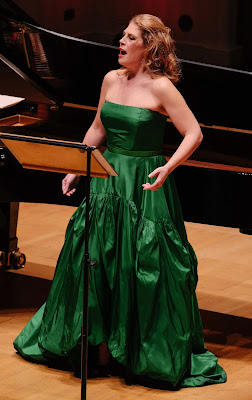
Sondra Radvanovsky at Rosenblatt Recitals at Cadogan Hall (photo Jonathan Rose)
Sondra Radvanovsky (photo Jonathan Rose)
Amazingly, soprano Sondra Radvanovsky was making her London recital debut when she performed a recital at Cadogan Hall on Thursday 16 March 2017 with pianist Anthony Manoli as part of Rosenblatt Recitals season. Radvanovsky and Manoli's programme included 'Sposa son disprezzata' from Geminiano Giacomelli's La merope, three ariette by Vincenzo Bellini, a group of Richard Strauss songs, Allerseelen Op.10 no.8, Befreit Op.39 no. 4, Morgen Op.27 no.4, Heimliche Aufforderung Op.27 no.3, three of Franz Liszt's French songs, a selection of songs from Samuel Barber's Hermit Songs and 'La mamma morta' from Umberto Giordano's Andrea Chenier.

There was something slightly old school about Sondra Radvanovsky's recital in the way she started with arie antiche. The programme was an interesting one which eschewed opera arias entirely until the last item, but it was only in the Giordano and the encores (three opera arias and a song from a musical) that Radvanovsky's voice seemed to come fully alive and fill the Cadogan Hall with vibrant life. Though their voices are very different, in many ways Radvanovsky's recital reminded me of the ones I heard Montserrat Caballe give at Covent Garden, with the careful trajectory from opening arie antiche to final encores when hair is finally let down.

Alessandro Parisotti's arrangement of Geminiano Giacomelli's 'Sposa son disprezzata' was written in 1890, in an age long before period performance practice. The aria is from Giacomelli's opera La merope, but is best known for being included in Vivaldi's pasticcio La Bajazet. Radvanovsky sang it using a beautifully modulated middle voice only rising to full voice at climaxes, her expressive phrasing taking classic 19th century view of the music.

Sony Radvanovsky has quite a large voice, her signature roles include the title role in Bellini's Norma and Leonora in Verdi's Il trovatora, roles which require a certain combination of volume and flexibility. Radvanovsky has this in spades, she regularly fined her voice right down and showed an impressive degree of control. This is combined with a rather particular, vibrant quality which means one's impression of the voice is of the highly distinctive and expressive phrasing rather than a pure sense of line.


Looking ahead: Incontri in Terra di Siena

Incontri in Terra di Siena
Pianist Alessio Bax is the new artistic director of the festival Incontri in Terra di Siena. Based at the Villa La Foce and the nearby medieval castle, Castelluccio, the Val d'Orcia, Tuscany, the chamber music festival runs from 29 July to 5 August 2017. The programme will feature Sarah Connolly in recital with Julius Drake, the Escher String Quartet and jazz pianist Dan Tepfer in Tepfer's Solar Spiral, violinist Joshua Bell in recital with Alessio Bax, as well as appearances from pianist Lucille Chung, viola player Lise Berthaud (a former BBC Young Musician), violinist and composer Henning Kraggerud, and cellist Paul Watkins.

The festival was founded 29 years ago by Antonio Lysy in memory of his grandparents, Antonio and Iris Origo. Iris Origo was the Anglo-American author of War in the Val d'Orcia, a book describing the events during the Second World War in Tuscany, and The Merchant of Prato which paints a detailed picture of Italian domestic life in the Renaissance based the astonishing cache of letters surviving from an Tuscan merchant dynasty.

Full information from the festival website.


Bampton Classical Opera Young Singers’ Competition 2017

Anna Starushkevych, winner of the first Bampton Classical Opera Young Singers' Competition in 2013
Applications opened earlier this month for the 2017 edition of the Bampton Classical Opera Young Singers’ Competition. Launched in 2013 to celebrate Bampton Classical Opera's 20th anniversary, the biennial competition aims at identifying emerging young singers working in the UK. Previous winners were mezzo-soprano Anna Starushkevych (2013) and soprano Galina Averina (2015). 

Applications close on 11 August 2017, and the first (closed) round takes place on 28 & 29 October 2017,  when the applicants prepare three items from which the jury will choose two. For the public finale at the Holywell Music Room, Oxford, on Sunday 19 November at 6pm, applicants perform a 20 minute programme of contrasting items including opera and song, and at least one work in English. Judges for the competition will be tenor Bonaventura Bottone and mezzo-soprano Jean Rigby.

Competitors can apply by downloading an application form and information document from the company’s website or on request by emailing ysc@bamptonopera.org. This competition is open UK residents aged between 21 and 32 on 19 November, 2017. The first prize is £1,500, the second prize £500 and the accompanists prize £500

Bampton Classical Opera's Summer season opens on 21 July 2017, with the first performances in modern times of Salieri's The School of Jealousy.

Thursday, 16 March 2017

Nancy Cunard invites: ENO's Partenope with Sarah Tynan

ENO - Handel: Partenope - Patricia Bardon, Matthew Durkan, Stephanie Windsor-Lewis, Sarah Tynan (Photo Donald Cooper)
ENO - Handel: Partenope - Patricia Bardon, Matthew Durkan, Stephanie Windsor-Lewis, Sarah Tyana
 (Photo Donald Cooper)
Handel Partenope; Sarah Tynan, Stephanie Windsor-Lewis, Patricia Bardon, James Laing, Rupert Charlesworth, dir: Christopher Alden, cond: Christian Curnyn; English National Opera
Reviewed by Robert Hugill on Mar 15 2017
Star rating: 4.5

A musically sparkling revival of ENO's stylish 1920s production with Sarah Tynan stunning in the title role

ENO - Handel: Partenope - Rupert Charlesworth, Sarah Tynan (Photo Donald Cooper)
Rupert Charlesworth, Sarah Tynan (Photo Donald Cooper)
Nancy Cunard is having a house-party, amongst the guests are Lytton Strachey and Man Ray (who has a dark-room set up on the premises), as well as two men both of whom are vying for Nancy's attention. This seems to be the premise of Christopher Alden's production of Handel's Partenope which was revived by English National Opera at the London Coliseum on Wednesday 15 March 2017. The production was designed by Andrew Lieberman (sets) and Jon Morrell (costumes) with lighting by Adam Silverman. Sarah Tynan was Partenope, with Rupert Charlesworth as Emilio, Patricia Bardon as Arsace, James Laing as Armindo, Stephanie Windsor-Lewis as Rosmira and Matthew Durkan as Oronte. The opera was sung in Amanda Holden's English translation and Christian Curnyn conducted.

ENO - Handel: Partenope - James Laing (Photo Donald Cooper)
The production, new in 2008, has scrubbed up well with a sequence of strikingly theatrical spaces and 1920s period costumes. It was nice to see the men's suits, for once, looking perfectly in period, and the wig department clearly had fun too. Under conductor Christian Curnyn the whole musical performance was stylish and technically superb, making the evening a stunning musical evening with strong performances from all the leads.

I remain less convinced by the production. Though Alden's idea of using Paris in the 1920s makes an imaginative setting, he does not seem  to have made the best of it. The 'battle' at the opening of Act Two, with its obsession with the flat's one lavatory,, was inadequate and by Act Three's duel  Alden seemed to be throwing everything at the production.

Though Partenope is a comedy, it is very much a comedy of character, satirising the expected opera seria stereotypes. But Alden, with the aid of Amanda Holden's witty translation, has added layers of verbal and physical comedy which verged on the distracting.

Sacred showcase: Stile Antico in Giaches de Wert

Giaches de Wert - Stile Antico
Giaches de Wert motets; Stile Antico; Harmonia Mundi
Reviewed by Robert Hugill on Mar 02 2017
Star rating: 4.0

Better known for his madrigals, this disc showcases Giaches de Wert's fine sacred music

If the name of Giaches de Wert is known at all it is for his madrigals, but this disc from Stile Antico on Harmonia Mundi presents another side to the composer, his motets. The vocal ensemble perform a selection of thirteen motets taken from the second and third volumes (both dating from 1581) of Giaches de Wert's three published volumes of motets,

The motets are relatively unusual in that the texts are mainly from the New Testament, which can be explained by the distinctive nature of the church for which they were written, the Duke of Mantua's chapel of Santa Barbara.

Though Giaches de Wert (1535 - 1596) was born in the Low Countries, his youth and maturity were all spent in Italy where he developed a relationship with the court at Ferrara and was influenced by Cipriano de Rore (1515/16 - 1565). From 1565 Giaches de Wert was maestro di cappella in the Duke of Mantua's recently completed chapel of Santa Barbara and he was to remain there for the rest of his life. So Giaches de Wert overlapped with Monteverdi (1567-1643) who started to work for the Duke of Mantua as a vocalist and viol player during de Wert's latter years. And de Wert is regarded as an influence on Monteverdi's madrigals and writing in the seconda prattica.

Unsurprisingly, Giaches de Wert's motets are all in the prima prattica style which has a lineage from Palestrina (1525-1594). The motets were all written for the Duke's chapel, and the Duke had a special dispensation from the pope to use his own liturgy at the chapel of Santa Barbara, which mean that polyphonic settings were used for parts of the service which would be spoken or intoned elsewhere. This was completely at odds with the general trend towards standardisation as a result of the reforms arising from the Tridentine Council (1545-1565).

Popular Posts this month