Wednesday, 17 June 2020

Far from the home I love: pianist Margaret Fingerhut's mammoth recital tour raises £88,000 for refugees, £1000 for each of the piano's keys

Margaret Fingerhut
In 2019, pianist Margaret Fingerhut started Far from the Home I Love, a fundraising recital tour aimed at raising money for refugees by performing concerts all over the UK. With her livestream concert on 5 June 2020, Margaret has now reached her target and raised £88,000 which represents £1000 for each of the piano's 88 keys.

For the livestream recital, Margaret joined forces with singer/songwriter Sam Slatcher, the Syrian viola player Raghad Haddad who now lives in Birmingham, violinist Peter Fisher and the Kurdish composer and oud player Arian Hu, now resident in Beijing, who had composed Memories of my land for Margaret to play during her concert tour.

The money raised has gone to City of Sanctuary UK, and the network of over 120 local groups around the country who are working across their communities to build a culture of welcome for refugees and asylum seekers. "The pandemic has hit many people hard," Margaret said, "but none more so than people seeking asylum, many of whom have not been able to access the internet or even buy adequate food for their young families, let alone toiletries. It’s a heart-breaking situation".

Visit Margaret Fingerhut's Far from the Home I Love page, download Margaret playing Arian Hu's Memories of my Land.

Contemporary re-invention: the String Orchestra of Brooklyn's debut disc features two works which re-invent fragments of classics

afterimage Christopher Cerrone, Jacob Cooper; String Orchestra of Brooklyn, Eli Spindel; Furious Artisans
afterimage
Christopher Cerrone, Jacob Cooper; String Orchestra of Brooklyn, Eli Spindel; Furious Artisans

Reviewed by Robert Hugill on 16 June 2020 Star rating: 3.5 (★★★½)
Fragments of 18th century classics give rise to contemporary re-inventions in this debut disc from the Brooklyn-based ensemble

On this disc from Furious Artisans, afterimage, the String Orchestra of Brooklyn, founder and artistic director Eli Spindel, perform two contemporary works which echo fragments of older ones. The orchestra is joined by the Argus Quartet for Christopher Cerrone's High Windows, and joined by soprano Melissa Hughes and mezzo-soprano Kate Maroney for Jacob Cooper's Stabat Mater Dolorosa.

The String Orchestra of Brooklyn (SOB) was founded in 2007 by conductor Eli Spindel. The orchestra is a volunteer ensemble which embraces an inclusive approach to music-making, the SOB seeks to democratize both the production and reception of concert music.  The present disc is its recording debut, though the disc was made in 2016.

Christopher Cerrone is a New York City-based composer who studied at the Manhattan School of Music and at Yale. His piece for string orchestra and string quartet, High Windows was written for the String Orchestra of Brooklyn in 2013 (when he and the orchestra's founder, Eli Spindel were neighbours).

Tuesday, 16 June 2020

Critics' Circle Music Awards 2019: Maxim Emelyanychev, Donghoon Shin, Louise Alder, Pavel Kolesnikov, Bernard Haitink, Billy Budd at Royal Opera


Best Opera Production: Britten's Billy Budd at the Royal Opera in 2019 - Jacques Imbrailo, Alasdair Elliot(Photo ROH/Catherine Ashmore)
Best Opera Production: Britten's Billy Budd at the Royal Opera in 2019
Jacques Imbrailo, Alasdair Elliot(Photo ROH/Catherine Ashmore)
Lovely to see plenty of young talent recognised in the 2019 Critics' Circle Music Awards.

Young Talent (conductor) goes to Maxim Emelyanychev (chief conductor of Il Pomo d'Oro and principal conductor of the Scottish Chamber Orchestra).
Young Talent (composer) goes to the London-based South Korean composer Donghoon Shin.
Young Talent (voice) goes to soprano Louise Alder (last seen as Susanna in ENO's The Marriage of Figaro, see my review, and who also wowed us with Morgana's 'Tornami a vagheggiar' from Handel's Alcina at the Royal Opera House on Saturday).
Young Talent (Piano) goes to pianist Pavel Kolesnikov (who gave a lovely duet recital with Samson Tsoy at BBC Radio 3's lunchtime concert at Wigmore Hall Live, and who we caught in Rachmaninov with the Britten-Shostakovich Festival Orchestra last year, see my review).
Young Talent (Instrument) goes to viola player Timothy Ridout (whom we caught in concert with Allan Clayton in Britten at the Wigmore Hall earlier this year, see my review)

The Lifetime Achievement award goes to Bernard Haitink, CH KBE whom I saw conducting many memorable productions at Covent Garden (most notably Britten's Peter Grimes with Jon Vickers and Heather Harper), and I had the honour of singing in the choir when he conducted his first performance of Elgar's The Dream of Gerontius (with Richard Lewis in the title role). He celebrated his 90th birthday with the Vienna Philharmonic at the BBC Proms in 2019 [see Colin Clarke's review]

The Best Opera Production goes to the Royal Opera House's recent performances of Britten's Billy Budd directed by Deborah Warner, conducted by Ivor Bolton and with Jacques Imbrailo in the title role [see my review].

The awards are presented by the Music Section of the Critics’ Circle, which is made up of the country’s most respected critics. Membership of the Circle is by invitation.

Full details from the Critics' Circle website.

Turn your ears off: I sample Thomas Elwin's on-line singing lesson for English Touring Opera

English Touring Opera: Adults Singing Lessons - Thomas Elwin
Many people have been intending to use lockdown to do all those things that we have always intended to do but never have. Judging by activity on Twitter, Instagram and Facebook, many have succeeded (has anyone managed to read Marcel Proust's Remembrance of Things Past yet?), but many of us have failed dismally.

But, there to support and encourage us in one area are the artists of English Touring Opera (ETO). They should have been touring performances of Handel's Giulio Cesare, Mozart's Cosi fan tutte and Bach's St John Passion (on cancellation of the tour, ETO made a commitment to pay all 67 artists for all 52 performances). Instead, the singers have been creating a series of films of singing lessons for adults, and for children, which ETO has been releasing weekly on its YouTube channel.

With the adult singing lessons we have reached week nine, and so far there have been lessons from Stephan Loges, Jenny Stafford, Frederick Long, Edward Hawkins, Thomas Elwin, Susanna Hurrell, Themba Mvula, and Paula Sides. I decided to sample what was on offer and dropped in on Thomas Elwin's lesson, Turn your ears off.

Most amateur singers that I know have had singing lessons at some point in their careers, but whilst some do so regularly others, like myself, always mean to do more and never quite have the time. So lockdown is an ideal time for this. Admittedly, video is not quite the ideal medium as it lacks the interactiveness of real interaction, with the teacher listening to you and telling you what you are doing wrong. But there again, with only your own ears as critic, the results are perhaps less cutting.

But, in fact, the upshot of Elwin's lesson was that we should not trust our ears, and the nub of the lesson was a fascinating sequence about feeling the effect of the voice with the body, rather than listening to what you are singing. All singers are taught not to listen to themselves, but it is very tempting and Elwin's lesson was very salutary.

Of course, he didn't start there. All singing lessons start with a warm-up, and the fascinating thing is how different teachers vary it in different ways, so Elwin's warm-up was familiar yet different. And as anyone knows, singing is something of an imprecise science. If you are learning to play the violin the teacher can tell you where to put your fingers, how to hold the bow; but in singing, the instrument is to a large extent invisible and all a teacher can do is use analogy. And each singer, each teacher is a little different, using different analogies. Which, again, adds to the interest.

Then at the end there was the homework, each lesson begins with the teacher recapping the homework set previously, and then at the end giving you more, so that you have things to practice during the week. I suspect that following this activity might work better if there were more than one of you, a couple singing together for instance.

I have to admit, there is something slightly unnerving at having a singing lesson with the teacher staring at you intently from your computer screen for 20 minutes. And of course, there are 20 minutes of listening to yourself trying to emulate the wonderful sounds emanating from the computer's speakers.  And then there is that sense of unsatisfied curiosity, what is the music on the piano, what is it that you can see just round the corner in the window, what is that picture just glimpsed off camera; the endless fascinating of eavesdropping in someone else's house.

ETO's Adult Singing Lessons are available via the company's website, and via its YouTube channel, and there Kids' Singing Lessons too, so all the family can join in.

A picture of a musical collaboration: 'In Seven Days' from Thomas Adès and Kirill Gerstein

Thomas Adès Concert paraphrase on "Powder her face",Berceuse from "The Exterminating Angel", Mazurkas, In Seven Days; Kirill Gerstein, Thomas Adès, Tanglewood Music Center Orchestra; MYRIOS

Reviewed by Robert Hugill on 13 June 2020 Star rating: 5.0 (★★★★★)
A testament to a musical relationship, Thomas Adès joins pianist Kirill Gerstein as composer, pianist and conductor

Following on from their recent collaboration on Thomas Adès's Concerto for Piano and Orchestra [on Adès conducts Adès on Deutsche Grammophon, see my review], Thomas Adès and Kirill Gerstein return with a further joint project. In seven days on Myrios Classics features four of Thomas Adès pieces performed by pianist Kirill Gerstein, with Adès demonstrating his versatility by joining with Gerstein as pianist to perform the Concert paraphrase on "Powder her face" for two pianos, and conducting Gerstein and the Tanglewood Music Center Orchestra in "In seven days" for piano and orchestra. As solo pianist Gerstein plays another paraphrase, this time from Adès' most recent opera, the Berceuse from "The Exterminating Angel" for piano, plus Mazurkas for Piano.

Since 2012, Kirill Gerstein has been a frequent collaborator of Thomas Adès, and was the direct inspirer for some of the music on this disc. As a pianist, Gerstein regularly plays music by pianist composers such as Chopin, Lizst and Busoni [see my review of Gerstein's recording of Busoni's Piano Concerto], but his relationship with Thomas Adès means that he can interrogate the composer about detail in the music in a way that is not possible with the earlier composers. Gerstein says of the experience, "It really feels like working with one of those composers one grows up with – except this is here and now, and it’s such a vibrant experience". But it has not been all plain sailing, and in the CD booklet, Gerstein talks about first learning Seven Days in 2012, "I remember staring at the first page and not understanding what to do with these so-called irrational meters – divisions of the bar in Adès’s score based on note values other than more conventional quarter- and eighth-notes – and then closing the part after 30 minutes, and going for a coffee. But when I figured out what may be meant, and how to read it, I saw that the notation is all about shaping a different perception of time in music, the way that Tom’s scores create a very precisely shaped written-out rubato. He controls time in a logical but asymmetrical way, not constrained by the bar-lines."

Monday, 15 June 2020

Welsh National Opera launches weekly podcast series

WNO Podcasts
Welsh National Opera (WNO) has launched a pair of weekly podcasts, intended to give an insight into a touring opera company working on an international scale, and highlighting the relevance of opera today and its power to change lives. There is one podcast in English, The O Word, and another in Welsh, Cipolwg; the English one being presented by journalist and opera enthusiast Gareth Jones, the Welsh one by comedian, journalist and life-long opera fan Lorna Prichard. The first pair of episodes was launched on 11 June, with more to come weekly.

The O Word will be featuring amongst its interviewees, Aidan Lang (general director of WNO), James Clutton (director, Opera Holland Park), composer Will Todd (talking about his new opera Migrations, which is a WNO commission), librettist Emma Jenkins (who co-wrote the libretto to Iain Bell's In Parenthesis, premiered by WNO in 2016), and WNO producer Jennifer Hill will be talking about Cradle Choir, a project which brings together primary school children and people living with dementia for a shared choral experience

The Welsh language podcasts will feature conductor Carlo Rizzi talking about Verdi, soprano Elin Pritchard, baritone John Ieuan Jones, and producer Branwen Jones talks about her involvement with some of WNO’s youth and community projects.

The podcast will be available to download from a number of podcast directories, including Spotify, Apple Podcasts and Google Podcasts, as well as from the WNO website:

Live music returns to Glasgow City Halls

Performing with Ian Page at the Classical Opera and the Mozartists Gala Concert, Goldsmiths' Hall. Photo credit Roger Way
Michael Mofidian at the Classical Opera and the Mozartists Gala Concert
Goldsmiths' Hall (Photo Roger Way)
Next month, BBC Radio 3 is planning to broadcast the first live classical concerts in Scotland. From 14 to 17 July 2020, there will be a series of four Lunchtime Concerts broadcast live from Glasgow's City Hall. The recitals will involve solo and duo performers based in Central Scotland; every concert will be broadcast live on BBC Radio 3 and streamed on BBC Sounds and the City Hall's website.

The series opens with bass-baritone Michael Mofidian (a Jette Parker Young Artist at Covent Garden for from 2018 to 2020) and pianist Julia Lynch in a programme called Music when no-one else is near, with Schubert, Tchaikovsky, Ravel's Don Quichotte à Dulcinée and RVW's Songs of Travel. This is followed by pianist Steven Osborne in an all Schubert programme, then tenor Thomas Walker accompanied at the harpsichord by John Butt (director of the Dunedin Consort) in operatic arias and keyboard works by Handel and his contemporaries. The series finishes with percussionist Colin Currie in a programme of music by Per Nøgård, Bryce Dessner, Kalevi Aho, Kevin Volans, Karlheinz Stockhausen, Toshio Hosokawa, and Iannis Xenakis.

Full details from BBC Radio 3

Richard Wagner's heir, innovative festival director, opera composer, homosexual; the complex tale of Siegfried Wagner,

Siegfried Wagner
Siegfried Wagner

Siegfried Wagner was Richard Wagner's only son and heir. He never managed to escape the influence of his dominating mother; a successful opera composer himself, his operas were never performed at the Bayreuth Festival. As director of the Festival, he introduced important innovations, yet his use of the casting couch was notorious and his homosexuality was an open secret.

Siegfried Wagner was born in 1869 at Tribschen on Lake Lucerne in Switzerland, where Richard Wagner's patron King Ludwig II had installed him after the scandal in Munich surrounding Richard's affair with Cosima von Bülow (wife of the conductor Hans von Bülow, who had been conducting the premiere of Richard Wagner's Tristan und Isolde in Munich). Siegfried, the third of Richard and Cosima's children was born before they were able to marry in 1870. And in 1871, Richard Wagner moved to Bayreuth to pursue his dream of creating a festival to give the premiere of the Ring Cycle.

Siegfried and Richard Wagner
Siegfried Wagner
Life cannot have been easy for the young Siegfried, his father was 53 when he was born and Siegfried had to live in the shadow of his father's reputation and obsession with Bayreuth, and his mother's adoration of his father. That Siegfried might have a strange and unsatisfactory relationship with his parents is suggested by Cosima's diaries:

'At lunch a dismal occurrence; Fidi [Siegfried Wagner, then aged 9] behaves badly toward his father; the dreadful thought that he might prove unworthy of him takes possession of me, and this thought, instead of being turned against myself in resigned acknowledgement of original sin, turns inside me against my child, and I hit him, so violently that it causes bruises. No words, not even my sobs, can express the horror I feel about myself – oh, fortunate people who lived in times when one could atone! In this instance, as always, R. heavenly toward me.'
                            Cosima Wagner: Diaries. 22 July 1878

Siegfried was musical and some compositions of his have survived dating from when he was around 13. After he completed his secondary education in 1889, he studied with Wagner's pupil Engelbert Humperdinck in Frankfurt (during 1880 and 1881, Humperdinck assisted Wagner with the preparations for the premiere of Parsifal at Bayreuth in 1882, and he also acted as music tutor to young Siegfried). But Siegfried was more strongly drawn to a career as an architect and studied architecture in Berlin and Karlsruhe.

In 1892 he undertook a trip to Asia with a friend, the English composer Clement Harris (1871-1897), who had studied with Clara Schumann and whom Siegfried had met (and fallen in love with perhaps) in Frankfurt in 1889. Harris was something of a protege of Oscar Wilde; Harris would perform Wagner transcriptions for Wilde. The trip to Asia was Harris' idea, and it would last six months. Recent writers have suggested that Harris may well have been the love of Siegfried's life; he would die in the Greco-Turkish War.

Sunday, 14 June 2020

A Life On-line: Thais from the Metropolitan Opera, Sorochinsy Fair and Eugene Onegin from the Komische Oper, and Covent Garden re-opens

Tchaikovksy: Eugene Onegin - Asmik Grigorian, Günter Papendell - Komische Oper, Berlin (Photo: Holger Jacobs)
Tchaikovksy: Eugene Onegin - Asmik Grigorian, Günter Papendell - Komische Oper, Berlin
(Photo: Holger Jacobs)

Our listening to opera on-line in the last few months has been very much characterised by seeing productions of operas that we were unlikely to see live, and with a particular emphasis on rarities, operas which are hardly ever staged in the UK.

I was lucky enough to see two of the UK stagings of Massenet's  Thais (at the Royal Northern College of Music in the 1970s, and at Grange Park Opera in 2006), so it was fascinating to catch up with the Metropolitan Opera's luxurious staging directed by John Cox in 2008 with Renée Fleming in the title role and Thomas Hampson as Athanaël, conducted by Jesús López-Cobos. Visually the production seemed to combine an Edwardian period setting with elements of something more exotic. Thais' luxurious costumes were by Christian Lacroix, but no other designer was credited. It struggled somewhat in the desert scenes, and the Cenobites long robes, hairy wigs and beards seemed straight out of central casting. Perhaps more seriously, each scene change was marked by a significant pause which affected the musical flow. Thankfully, the musical side of things was entrancing; López-Cobos conducted a fluent performance with Fleming luxuriating in the title role, and Hampson being suitably trenchant whilst finding a suaveness of line as well. Michael Schade made Nicias a strong presence, and Alain Vernhes gave Palémon suitable gravity.

To Berlin next, for another rarity, Mussorgsky's unfinished comedy Sorochintsy Fair, in Barrie Kosky's 2017 production from the Komische Oper, Berlin (available via OperaVision), conducted by Henrik Nánási. Kosky used the 1932 completion of the opera by Pavel Lamm and Vissarion Shebalin, but also added some extra choruses and an aria for the tenor 'hero' Gritsko. There is almost no plot, simply a series of vignettes of peasant life strung together around the attempts of Gritsko, a peasant lad (Alexander Lewis) and Parasya (Mirka Wagner), but though Parasya's father, the peasant Cherevik (Jens Larsen), supports them, her step-mother Khivrya (Agnes Zwierko) does not. Throw in Khivrya's affair with the local priest, and a legend about the devil returning each year to the fair to look for his missing red coat and you have the entire plot.

But Kosky made the piece erupt with engaging energy, using the large chorus to maximum effect and keeping a stripped down stage. There were plenty of dramatic tropes familiar from other Russian operas, but the result had an energy and poignancy which came over on the small screen, and must have been superb in the theatre.

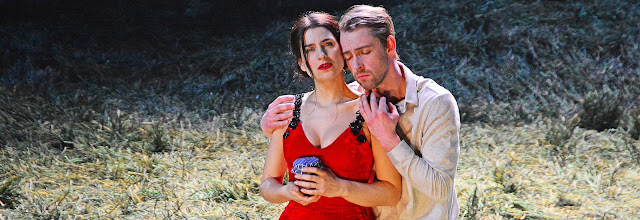
On Thursday were returned to Russia by way of the Komische Oper, Berlin, for Kosky's production of Tchaikovsky's Eugene Onegin. This profoundly beautiful production featured striking designs by Rebecca Ringst and Klaus Bruns, which set virtually the entire action (bar the ball scene in Act III) in a luxuriant meadow. The 2016 performance was conducted by Henrik Nánási, with Asmik Grigorian as Tatiana, Karolina Gumos as Olga, Christiane Oertel as Larina, Margarita Nekrasova as Filippyevna, Aleš Briscein as Lensky and Günter Papendell as Onegin.

The protagonists were all believably young, so that Grigorian's remarkably Tatiana did go on a journey, from gauche interior girl to poised, and perhaps a little heartless. Much of Grigorian's intensity came over on the small screen, so much so that one regretted not seeing her in the role live. Papendell was almost as remarkable, creating a character which was believable if not likeable, sexy and charismatic but complex and going on a journey of his own. The supporting cast were equally fine and this was very much an ensemble piece. My only regret was that Kosky effectively dropped the ball scene, there was no dancing, Act III started with the polonaise played with the curtain down; Kosky clearly had decided that there was enough vividness in Tchaikovsky's music, and he concentrated on the intimate scenes. It felt something of a loss, but perhaps came over differently in the theatre.

Both the Russian operas were available via OperaVision, which is a fantastic project which enables you to visit opera houses all over Europe and beyond. Garsington Opera's 2018 performance of David Sawer's The Skating Rink is now available on OperaVision until the end of this year, do catch it [see my review of the original production].

On Saturday, there was a very great occasion, the re-opening of Covent Garden, albeit without an audience [available via their streaming website]. We had a mixture of song, opera and dance, all accompanied by Antonio Pappano on piano (without anyone to turn pages). For the song and opera, the camera was turned to face the empty auditorium, a rather poignant image. We started with English song, soprano Louise Alder sang Britten's On this Island, and then Toby Spence sang Butterworth's Six songs from A Shropshire Lad. Both pieces, perhaps, explore common themes but Auden set by Britten is far spikier than Housman set by Butterworth, but 'The lads in their hundreds' remains my candidate for my favourite English song. Next came a new piece by choreographer Wayne McGregor danced by Francesca Hayward and Cesar Corrales (who are partners in life as well as art), set to Richard Strauss' Morgen sung by Louise Alder with an uncredited violinist. Alder is wonderful in this repertoire, and McGregor's response to the music was fascinating, not at all what I expected; far more restless and intense, a long way from the dreamy melancholy applied to this music. No mention, of course, that Henry Mackay's original poem was written from one man to another, though we doubt Strauss knew this [see my article]

There was more English song, Gerald Finley sang Mark-Anthony Turnage's Three Songs which were written for Finley in 2000 and set cat poems by Stevie Smith, Thomas Hardy and Walt Whitman, and showed us another, delightful side to Turnage. Finley followed with another animal, Britten's The Crocodile! Then gave us Gerald Finzi's profoundly beautiful, yet melancholy Shakespeare setting, Fear No More the Heat o’ the Sun.

Louise Alder then returned, and really turned up the heat with Morgana's Tornami a vagheggiar from Handel's Alcina, killer coloratura sung in a way which made you understand that Winton Dean could refer to Morgana as one of Handel's 'sex kitten' roles! We finished in more sober territory, 'Au fond du temple saint' from Bizet's Les Pêcheurs de perles sung by Spence and Finley.

Next week we return to Covent Garden for Sarah Connolly and David Butt Philip in Mahler's Das Lied von der Erde and dance by Frederick Ashton to music by Gluck.

Massenet: Thais - Renée Fleming - Metropolitan Opera (Photo: Metropolitan Opera)

Elsewhere online there was plenty to catch up with.

Saturday, 13 June 2020

A coffee with ....


One of my on-line contacts, Michael Thallium, has been doing an interview series, A coffee with .... on Facebook Live, and I joined him for a chat on Thursday, me in London and him in Spain. It was a novelty for me to be the one being interviewed, and live too. We chatted about my musical background, choral traditions, my own compositions and much else besides. Michael has now edited the interview and posted it on YouTube [see above], and you can read more on Michael's website.

An organist in lockdown: I chat to Edmund Aldhouse, director of music at Ely Cathedral, about his work, the English romantic organ, & how to keep choristers motivated without regular services

Edmund Aldhouse recording Chris Warner's Wonders of the Cosmos at the organ of Ely Cathedral
I first came across Edmund Aldhouse playing the organ of Ely Cathedral on Chris Warner's Wonders of the Cosmos [see my interview with Chris]. At the time Edmund was the assistant organist at Ely Cathedral and has since become director of music there, in succession to Paul Trepte. I recently caught up with Edmund, via Zoom, to chat about his work at Ely, the history of the organ there and, of course, how the music department and the choristers are coping with lockdown.

The building at Ely Cathedral dates back to 1083, though there has been a church on the site since AD 672. Originally an abbey church, it became a cathedral in 1109. The list of the cathedral's organists/directors of music can be traced back right to 1541, when the cathedral was re-founded after the dissolution of the monasteries by King Kenry VIII.

Edmund Aldhouse (Photo Ely Cathedral)
Edmund Aldhouse
(Photo Ely Cathedral)
As director of music, Edmund is responsible for the music at any and all of the services at the cathedral, and this includes having overall responsibility for the cathedral's choirs, of which it has a number. There are the boys trebles and the adults (the lay clerks) who historically sang the cathedral's services, and in 2006 they added a girls choir so that services are sung by a mixture of these three groups. In addition, there is the voluntary adult choir, the Ely Octagon Singers, and the children's choir, the Ely Imps. Edmund has direct responsibility for the boy trebles and the lay clerks, with Sarah Macdonald the directing the girl choristers, and Ely Octagon Singers being directed by Glen Dempsey (the cathedral's assistant director of music).

When I ask Edmund how much organ playing he does, he ruefully comments 'not enough'. He feels that he ought to play more, but this is one of the dangers of becoming a director of music, when administration and other musical activities take over from organ playing. He sometimes swaps services with the assistant director of music, and also Edmund does play recitals. As well as studying at Oxford, Edmund studied in France with Frédéric Blanc and François-Henri Houbart, and made quite a name for himself with his performances of organ music by Olivier Messiaen (1908-1992) and Marcel Dupré (1886-1961) in the UK.

The other problem is the difficulty of actually scheduling time to play the organ at the cathedral. The cathedral is both a working church and a major visitor attraction, so during the daytime the organ can only be played inaudibly which is fine for learning notes but not for developing a piece. Evening events also play an important role in the cathedral's life, especially as many of these help to balance the cathedral's books. Hence, it is a logistical challenge to even get to play the organ!

Friday, 12 June 2020

London Mozart Players return to performing live for the first time in three months

London Mozart Players (Photo Kevin Day)
For the first time since 13 March 2020, the players of London Mozart Players (LMP) will be performing together on Monday 15 June 2020. The concert, possibly the first concert by a UK chamber orchestra since lockdown, will be performed under strict social distancing rules with no audience and will be streamed live, and free to view, on Classic FM's Facebook Page. It is the first of three LMP Live! concerts to be given over the Summer months, which take advantage of the unusual conditions in which the concerts take place to give the performances in unusual locations.

All three concerts take place at 7pm, and will be directed by LMP co-leaders Simon Blendis and Ruth Rogers. On Monday 15 June, LMP will be performing from Westfield London, in Shepherd's Bush, on the first day of trading, and the programme will include music by Mozart, Elgar and Tchaikovsky. On Saturday 4 July, LMP will be at St Giles Cripplegate, celebrating the re-opening of churches to congregations, playing Grieg's Holberg Suite, Copeland's Hoedown, with RVW's The Lark Ascending giving us a chance to hear violinist Tamsin Little live before she retires later this year. Then on 22 July at Mansfield College, the last official day of home-schooling, the orchestra will be joined by violinist Jennifer Pike for Vivaldi's The Four Seasons.

All the concerts are available via Classic FM's Facebook page; full details from LMP's website.

Hee-Young Lim: the young Korean cellist in Prokofiev & Rachmaninov cello sonatas on Sony Classical

Rachmaninov & Prokofiev Cello Sonatas; Hee-Young Lee, Nathalia Milstein; SONY CLASSICAL
Rachmaninov & Prokofiev Cello Sonatas; Hee-Young Lim, Nathalia Milstein; SONY CLASSICAL

Reviewed by Robert Hugill on 12 June 2020 Star rating: 3.5 (★★★½)
Elegant line, and expressive classicism to the fore in these two Russian cello sonatas

On this new disc from Sony Classical, the young Korean cellist Hee-Young Lim plays a pair of Russian cello sonatas, by Rachmaninov and by Prokofiev, accompanied by pianist Nathalia Milstein. The two sonatas form an interesting pairing, two thirds of a trilogy of Russian sonatas by three great 20th century Russian composers. The third, of course, being Shostakovich, and fascinatingly all three composers only wrote one cello sonata.

Through the sonatas we can detect a fascinating web of influence by major Russian cellists. The threads go back to the 19th century when Hector Berlioz visited Russia and conducted Beethoven's Symphony No. Five, in the audience was a nine-year old Anatoly Brandukov, who would study with the great German cellist Wilhelm Fitzenhagen. It was Fitzenhagen who premiered Tchaikovsky's Variations on a Rococco Theme (in his own arrangement of the work) as well as playing in the first performances of Tchaikovsky's quartets and piano trio. Brandukov's first solo concert was sponsored by composer and pianist Nikolay Rubinstein, a close friend of Tchaikovsky and younger brother of Anton Rubinstein, who founded the St Petersburg Conservatory; Brandukov would go on to play Anton Rubinstein's two cello sonatas. Tchaikovsky admired Brandukov's playing and in 1887 sent Brandukov a copy of his Pezzo Capriccioso for cello and orchestra, Brandukov played it but in his own arrangement!

Brandukov helped the 19-year-old Sergei Rachmaninov give his first independent concert, by playing some new works, and Brandukov would be the best man at Rachmaninov’s wedding.

In 1897 Rachmaninov's Symphony No. 1 was premiered in St Petersburg with Alexander Glazunov conducting; the performance was terrible and the result plunged the composer into depression, completely unable to compose. It was only with the help of neurologist (and amateur cellist) Nikolai Dahl, that Rachmaninov recovered. The first fruits of his creative re-birth in 1901 were the Second Suite for Two Pianos, the Second Symphony and the Cello Sonata. This latter was written for Brandukov, who premiered it with the composer; Rachmaninov was a distinguished and gifted pianist and perhaps this is one of the reasons that in the Cello Sonata he treats the two instruments as complete equals with the piano never playing a mere accompanying role.

One of Brandukov's pupils was cellist Viktor Kubatsky, who was a good friend of composer Dmitri Shostakovich and Shostkovich's Cello Sonata was written in for Kubatsky and the composer to perform on recital tours alongside the sonatas by Rachmaninov, and by Grieg. One of Shostakovich's pupils at Moscow Conservatory was a young cellist, Mstislav Rostropovich who came from a musical family with a renowned cellist father (Leopold Vitoldovich Rostropovich was a pupil of Pablo Casals). Rostropovich would go on to premiere both of Shostakovich's cello concertos.

At the revolution, Rachmaninov would leave Russia never to return; an act which had a significant effect on his compositional style and his musical output. Prokofiev (nearly 20 years Rachmaninov's junior) would leave in 1917 but returned in 1936. Both Prokofiev and Shostakovich (15 years Prokofiev's junior) would struggle with the regime's repressive attitudes to advanced musical styles.

Thursday, 11 June 2020

Conway Hall appeal

I have done a little video for Conway Hall's #DoorsOpen appeal, donations via http://crowdfunder.co.uk/conwayhall


CMF Presents: Wednesday recitals, live-streamed from the St Pancras clocktower

Lotte Betts-Dean,  Bartosz Glowacki, Andrey Lebedev (Photo City Music Foundation)
Lotte Betts-Dean,  Bartosz Glowacki, Andrey Lebedev (Photo City Music Foundation)
In ordinary circumstances, the City Music Foundation (CMF) would be giving a regular series of lunchtime recitals as a way of presenting its current crop of Young Artists to the public. With lockdown, these ceased, but CMF has come up with an imaginative new scheme. From Wednesday 17 June 2020, there will be a regular live-streamed recital on YouTube, presented from the Tower Room, just below the  clock in St Pancras Clock Tower. For many of the young artists, this will be the first time they have had paid work since March.

During the crisis, CMF has worked hard to support the artists, with a new Hardship Fund, as well as weekly workshops, building websites, securing future performances and recordings, and more. But being able to curate these live performances is a crucially important step for the  musicians and the music industry.

The recital on Wednesday 17 June will be given by Lotte Betts-Dean (mezzo), Andrey Lebedev (guitar), Bartosz Glowacki (accordion), with recitals running weekly until 15 July, and then from 20 July there will be a series of recitals as part of CMF's annual residency at the Wallace Collection.

Full details from the CMF website.

Going it alone: pianist Warren Mailley-Smith presents live-streamed Chopin

Warren Mailley-Smith
The restrictions of social distancing, and the uncertainty facing live theatre and concert performance mean that performers are looking at alternative models for presenting music. Oxford Lieder Festival recently announced that is 2020 season in October will be entirely live-streamed [see my article], Grange Park Opera has been presenting its Found Festival in an empty theatre [see my article], and the Wigmore Hall and tBBC Radio 3 have been collaborating on the lunchtime series at Wigmore Hall.


Tonight the pianist Warren Mailley-Smith will be presenting his own live, lockdown concert at the 1901 Arts Club (11 June 2020, 7.30pm). Not only is Mailley Smith performing without an audience and live-streaming the event, but every aspect of the performance, technical set up, marketing and programming is achieved by the performer alone.

Mailley-Smith will be performing an all-Chopin programme including Ballade no.1 in G minor, Op. 23 (1835), Mazurka No. 19 in B minor, Op. 30 No. 2, Introduction and Rondo in E-flat major, Op.16 (1832), Nocturne No. 9 in B major, Op. 32 No. 1, Waltz No. 10 in B minor, Op. 69 No. 2, Waltz No. 3 in A minor, Op. 34 No. 2, Souvenir de Paganini, Waltz in A minor (1843), Ballade No. 2 in F major, Op. 38 (1839), Polonaise No. 6 in A-Flat major, Op. 53 -"Heroic"

Mailley-Smith is giving a similar weekly series of monetised solo concerts on multiple platforms and multiple venues, including Sunday evenings at Finchcocks in Kent. Over 200,000 people have watched his concerts since lockdown, and he has been able to support himself financially through online streaming during a period when monetised classical performance has otherwise ‘shut down’.

The concert will be live-streamed on Mailley-Smith's Facebook page, and on his website. He is inviting voluntary donations via TicketSource.

Cultured, well-made songs: The Complete Roger Quilter Songbook from Mark Stone and Stephen Barlow

The Roger Quilter Songbook, volume 3; Mark Stone, Stephen Barlow; Stone Records

Reviewed by Robert Hugill on 9 June 2020 Star rating: 4.0 (★★★★)
The third volume of Stone Record's exploration of the gentle, well-made songs of Roger Quilter, focusing mainly on his arrangements of folk-song and traditional songs

The English composer Roger Quilter is best known for just a handful of songs. An admirable project from Stone Records has seen baritone Mark Stone and pianist Stephen Barlow record all of Quilter's songs, with the aim of encouraging us to explore further. The third volume of their Quilter Songbook focuses on Quilter's folk-song arrangements, The Arnold Book of Old Songs, plus Four Songs of Mirza Schaffy, and songs from Quilter's light opera Love at the Inn.

Born in 1877, Roger Quilter was a younger son of the stockbroker and politician, Sir William Cuthbert Quilter, Bart. Quilter's father disapproved of his son's chosen career as a musician, and it was only when his father died in 1911 that Roger Quilter inherited enough money to be able to live an independent lifestyle. Quilter had trained at the Conservatory in Frankfurt where he was a fellow student of Percy Grainger, Cyril Scott, Balfour Gardiner, and Norman O'Neill, who became known as the Frankfurt Group (or the Frankfurt Gang). It has been said of them that they were united by their friendship and non-conformity rather than particular musical ideals, though all were in different ways resistant to English musical nationalism and the English school of RVW and Holst, admiring composers with a more continental influence such as Fredrick Delius. Another link between them is that all would, at times, write works tinged with light music, tuneful and approachable.

I know Roger Quilters name, because he floats across the biographies of Percy Grainger, but without any sense of knowing the man deeply, and there is a danger of us doing the same with the songs which are beautifully made, approachable and lyrically attractive. Yet there is always Quilter's particular voice, and the man himself was clearly more complex.

Wednesday, 10 June 2020

BSO Resound and composer Shirley Thompson celebrate 60 years of the Independent Living Movement

Shirley Thompson (Photo Joy Gregory)
To celebrate its 60th anniversary, Allianz Musical Insurance (the UK's oldest insurer of musical instruments) has commissioned a new work to celebrate this anniversary, and also the 60th anniversary of the founding of the Independent Living Movement [a movement of people with disabilities working for equal opportunities, self-determination, and self-respect].

The work will be written by composer Shirley Thompson [see my 2019 interview with Shirley] and will be premiered later this year by BSO Resound, the world's first professional, disabled-led orchestra, conducted by James Rose, which is a core part of the Bournemouth Symphony Orchestra.

Shirley Thompson was interviewed by The Voice last month to chat about the project, and you can catch up with that interview on YouTube. Shirley commented, "I am very excited about the commission to highlight the great and historic work of the Independent Living Movement. It is an honour to be chosen by BSO Resound to commemorate how far society has come in terms of attitudes to disabled people. I am looking forward to exploring the instrumental sonorities offered by the wonderful performers of BSO Resound."

Musicians for Musicians: a fundraising campaign and an album with an eclectic line-up, in support of Help Musicians UK

Musicians for Musicians
The shutdown of live events has hit freelance musicians hard, and Help Musicians UK has been doing a lot to support those in need. Musicians for Musicians is a fund-raising campaign started by violinist Amelia Conway-Jones, with the aim of supporting Help Musicians UK. There is a fund-raising campaign via JustGiving, but the idea is that there will also be an album, with half the proceeds going to the artists and half to Help Musicians UK.

The performers on the album are an eclectic mix, with folk, rock, world music, singer songwriters, electronic, reggae, jazz and hip-hop. The album will be released physically on 3 July 2020, and will be available via BandCamp.

There are three classical artists contributing, all three violinists! Rachel Podger will be recording something, Fenella Humphreys will be contributing a work by Alison Berry called Caged Bird, and Madeleine Mitchell [see my 2017 interview with Madeleine] will be premiering a new piece by Richard Blackford [see my review of the recent London premiere of Richard Blackford's Pieta], which was written especially for the project; it is a 3-minute solo violin piece called Worlds Apart

The full list of contributors to the album is as follows:

Folk: Jenn Butterworth, Vicki Swann & Jonny Dyer, Urban Folk Quartet
Rock: Axes, Alpha Male Tea Party, Field Music
Classical: Rachel Podger, Madeleine Mitchell, Fenella Humphreys
World Music: Iyatra Quartet
Singer/Songwriters: Chloe Foy, Matthew Robins, Lemon & Paice, Zoe Konez
Electronic: Dommix
Reggae: The Skints
Jazz: Mike Chillingworth
Indie-Pop:Sun Silva

See the campaign's YouTube video; Full details from the Musicians for Musicians JustGiving page

From the pen of the septuagenarian swan: Francisco Valls' Missa Regalis from the Choir of Keble College and the Academy of Ancient Music

Francisco Valls Missa Regalis; Choir of Keble College, Academy of Ancient Music, Matthew Martin; AAM

Reviewed by Robert Hugill on 8 June 2020 Star rating: 4.0 (★★★★)
A late work by the 18th century Spanish composer Francisco Valls reveals a work rich in subtlety with an unusual use of polyphony for the period

Francisco Valls (c1671 to 1747) was an important Spanish composer of the Baroque period, known for his compositions and for his publications on musical theory. His best known work, the Missa Scala Aretina caused controversy because of its use of unprepared dissonance; something that would not have surprised listeners to the music of Henry Purcell but which raised eyebrows to Valls' Iberian contemporaries.

Valls was probably born in Valencia and was an important figure in Catalan music at a critical time, during the War of the Spanish Succession (1705-14), and he spent much of his working life as chapel-master of Barcelona Cathedral. Valls retired in 1726 (though he was in exile from 1719 to 1725, owing to his support for the losing Hapsburg candidate, Carlos II (Archduke Charles), in the War of the Spanish Succession). But he was alive for two decades following his retirement, and many years after his last dated compositions he wrote his Missa Regalis for King Joao V of Portugal in 1740 (the King who brought Domenico Scarlatti from Rome to become a chamber musician to his daughter Maria Barbara).

It is not entirely certain how Valls seems to have come out of retirement to write for the Portuguese king, one possibility is King Joao's support for the Hapsburg candidate to the Spanish throne, and that Joao married Archduke Charles' sister Maria Anna of Austria.

On this new disc on the Academy of Ancient Music's own label, Matthew Martin directs the choir of Keble College and members of the Academy of Ancient Music in Francisco Valls' Missa Regalis; this is primarily vocal music with the instruments simply providing support, here just Joseph Crouch (bass violin), Inga Klaucke (dulcian) and Edward Higginbottom (organ). Interspersed in the movements of the masses is organ music by Francisco Correa de Arauxo and Juan Bautista Jose Cabanilles, performed by Matthew Martin.

Popular Posts this month
