Friday, 17 June 2022

Strong meat: Grange Park Opera stages Ponchielli's rarity, La Gioconda in a performance that full embraces the work's drama

Ponchielli: La gioconda - Grange Park Opera 2022 (Photo Marc Brenner)
Ponchielli: La gioconda - Act One - Grange Park Opera 2022 (Photo Marc Brenner)

Ponchielli: La gioconda; Amanda Echalaz, Joseph Calleja, Elisabetta Fiorillo, David Stout, Marco Spotti, director: Stephen Medcalf, the Gascoigne Orchestra, conductor: Stephen Barlow; Grange Park Opera
Reviewed 16 June 2022, (★★★★)

A rare chance to hear Ponchielli's best-known opera in a large-scale and dramatic staging featuring a strong array of voices 

There were plenty of opera composers in Italy in the 19th century, but few wrote operas that have managed to stay in the repertoire and it is Verdi who dominated then and certainly dominates now. Between Donizetti's Caterina Cornaro (premiered in Naples in 1844) and Mascagni's Cavalleria Rusticana (premiered in Rome in 1890), few new operas by composers other than Verdi have managed to remain in the repertoire. One of these is Ponchielli's La gioconda (premiered 1876, revised 1880), though its hold on the repertoire is fragile. Opera North staged it (with Rosalind Plowright in the title role in 1993, and revived with Clare Rutter in 2000), the Royal Opera gave it in concert in 2004, and Opera Holland Park staged it in 2008. Our most recent encounter with the opera was in Brussels in 2019 [see my review]. Grange Park Opera planned to stage the work in 2020, and now finally this has come to pass.

We caught Grange Park Opera's performance of Ponchielli's La gioconda on Thursday 16 June 2022. Directed by Stephen Medcalf, it featured Amanda Echalaz as Gioconda, Joseph Calleja as Enzo Grimaldi, Elisabetta Fiorillo as La Cieca, David Stout as Barnaba, Marco Spotti as Alvise Badoero and Ruxandra Donose as Laura. Stephen Barlow conducted the Gascoigne Orchestra. Designs were by Francis O'Connor, movement by Sarah Fahie and lighting by Tim Mitchell.

Ponchielli: La gioconda - Amanda Echalaz - Grange Park Opera 2022 (Photo Marc Brenner)

It is tricky to understand La gioconda without comprehending the vogue for French Grand Opera that spread in Italy from the 1860s.

Thursday, 16 June 2022

Violinist Charlie Lovell-Jones wins the 2022 John Fussell Award for Young Musicians

Charlie Lovell-Jones
Founded in 1992, the John Fussell Award for Young Musicians is a yearly Award to support young musicians with links to Wales. This year's final took place on Tuesday 14 June 2022 at the Taliesin Arts Centre, Swansea University when Charlie Lovell-Jones (violin),  Nye Hughes-Watts (piano), Dafydd Jones (tenor) and Hannah Lowri Roberts (viola) each performed a short recital for the judges, organist Huw Tregelles Williams, soprano Rebecca Evans and conductor Julian Smith,

The finalists competed for a first prize of £2,500 to enable them to continue their studies in music.  To be eligible for the competition all competitors must have either been born or raised in Wales, have Welsh heritage or studied in Wales. 

This year's winner was violinist Charlie Lovell-Jones, who attended Ysgol Gyfun Gymraeg Glantaf, in Cardiff, before going to Oxford.  He is currently in the final year of his MA (Performance) degree at the Royal Academy of Music before going to Yale School of Music in Connecticut, USA, to study for his MMA. There is a further chance to hear Charlie in action when he and pianist Daniel King-Smith give a recital at the High Barnet Chamber Music Festival on 17 July 2022, performing music by Schubert, William Grant Still, Bach, Szymanowski, Florence Price and Saint-Saens. Further information from the festival website.

The John Fussell Award is funded by a Trust set up in memory of John Fussell who was a well-known figure in the South Wales music scene from 1970 until his death in 1990.  He had a strong belief that we should help our young musicians to further their studies to achieve their dreams, and so, following his death, a Trust Fund was set up in 1991 to fund this yearly Award. Among the many past winners who have gone on to build successful careers in their field are pianist Llŷr Williams, harpist Catrin Finch and tenor Rhys Meirion.


Rising to the challenge: the Young Artists of the National Opera Studio in Sondheim: Before & After

Sondheim: Before & After

Sondheim: Before & After
: Sondheim, Ravel, Britten, Berg, Heggie, Mazzoli, Muhly, Tesori; Alexandra Chernenko, Ffion Edwards, Inna Husieva, Laura Lolita Peresivana, Sian Griffiths, Joanna Harries, Shakira Tsindos, Logan Lopez Gonzalez, Philip Clieve, Monwabisi Lindi, Josef Ahn, Kamohelo Tsotetsi, Chloe Kim, Nadia Kisseleva, Alexsander Ribeiro de Lara, Elli Welsh, director: Keith Warner, conductor: Andrew Griffiths; National Opera Studio at Hoxton Hall
Reviewed 14 June 2022

The Young Artists of the National Opera Studio rise to the challenge of singing Sondheim's brand of music-theatre, alongside composers he admired and composers he influenced

Some of Stephen Sondheim's songs are a big stretch for music theatre voices and his works are increasingly staged by opera companies. But equally, Sondheim's style of text-based music theatre can be a different sort of challenge for opera singers; most companies, like Opera North's recent production of A Little Night Music [see my review], use a mix of classically trained and music theatre. For the National Opera Studio's latest challenge for its current cohort of singers, it set them to presenting a programme based around Stephen Sondheim's songs.

The result was Sondheim: Before & After, where Keith Warner directed the Young Artists of the National Opera Studio, with conductor Andrew Griffiths, at Hoxton Hall in a programme that mixed Sondheim's songs with music by Ravel, Britten, Berg, Jake Heggie, Missie Mazzoli, Nico Muhly, and Jeanine Tesori. The idea behind the programme was to mix Sondheim with excerpts from composers that he admired, and composers that he has influenced.

We heard a nice range of Sondheim's work, with solos and ensembles from Sunday in the Park with George, Sweeney Todd, Assassins, Follies, Company, and A Little Night Music. And what the young opera singers achieved in the Sondheim was impressive, with performances that ranged from the creditable to the stunning.

Wednesday, 15 June 2022

Songs for a Summer night: the Scottish Ensemble's new concert series uses venues that make the most of the long days around the Summer Solstice

Scottish Ensemble
Scottish Ensemble
The Scottish Ensemble has announced its Concerts for a Summer Night, a series of concerts around the Summer Solstice, 20 to 23 June 2022, when days are longest. 

The events have all been designed to use venues which make the most of the natural light, from atriums at Edinburgh's National Museum of Scotland, Aberdeen Art Gallery and Barras Art and Design in Glasgow, to a byre in Perthshire.     

Directed by Jonathan Morton, a 12-piece ensemble will play an eclectic programme including music by Purcell, Mozart, Schubert, Dvorak, William Grant Still and Victor Herbert. Dobrinka Tabakova's Spinning a Yarn (which features violin and hurdy-gurdy) will be paired with her arrangement of Schubert's song Gretchen am Spinnrade,  and there is music by Hans AbrahamsenThomas Adès and Jessie Montgomery.

Full details from the Scottish Ensemble website.


Poul Ruders' Harpsichord Concerto

Poul Ruders Harpsichord Concerto; Mahan Esfahani, Aarhus Symphony Orchestra, Leif Sgestram; OUR Recordings
Poul Ruders Harpsichord Concerto; Mahan Esfahani, Aarhus Symphony Orchestra, Leif Sgestam; OUR Recordings

Harpsichordist Mahan Esfahani premieres a work written for him, a concerto that utilises the instrument with remarkable vividness & vibrancy

The world premiere recording of Poul RudersHarpsichord Concerto has been issued as an EP by OUR Recordings with soloist Mahan Esfahani (harpsichord), Aarhus Symphony Orchestra, conductor Leif Segestam.

The concerto, premiered in 2020, was written as the result of a commission from the Aarhus Symphony Orchestra specifically for a work for harpsichord and orchestra, and is here recorded live in Aarhus.

Contemporary music for harpsichord and orchestra is not a new thing, since the instruments revitalising in the 20th century there have been composers willing to experiment from Manuel de Falla and Francis Poulenc to Joseph Horovitz and beyond. Ruders' takes quite a traditional approach, this is a three movement work, fast - slow - fast, lasting some 20 minutes.

Tuesday, 14 June 2022

Young Artists performance of Tchaikovsky's Eugene Onegin at Opera Holland Park

Tchaikovsky: Eugene Onegin - Lucy Anderson, Rory Musgrave - Opera Holland Park Young Artists Performance (Photo Alastair Muir)
Tchaikovsky: Eugene Onegin - Lucy Anderson, Rory Musgrave
Opera Holland Park Young Artists Performance (Photo Alastair Muir)

Tchaikovsky: Eugene Onegin; Lucy Anderson, Rory Musgrave, Jack Roberts, Anna Elizabeth Cooper, Emily Hodkinson, Jane Mondari, Henry Grant Kerswell, director: Julia Burbach/Emma Black, City of London Sinfonia,  conductor: Hannah von Wiehler; Young Artists Performance at Opera Holland Park
Reviewed 13 June 2022

Originally planned for 2020, this year's cohort of Young Artists show their mettle in a wonderfully finished and profoundly moving account of Tchaikovsky's lyric scenes

For Opera Holland Park's Young Artists Performance this year, Julia Burbach's production of Tchaikovsky's Eugene Onegin [see my review] returned on 13 June 2022 with Emma Black directing the Young Artists with Lucy Anderson as Tatyana, Rory Musgrave as Onegin, Jack Roberts as Lensky, Anna Elizabeth Cooper as Olga, Emily Hodkinson as Madame Larina, Jane Monari as Filippyevna, Henry Grant Kerswell as Prince Gremin and Phillip Costovski as Triquet. Hannah von Wiehler conducted the City of London Sinfonia.

The basic outlines of Burbach's production were unchanged, and seeing it again it became clearer that the first half (the four scenes ending with Madame Larina's party) are very much seen through Tatyana's eyes, the silent appearances of both Onegin and her friends testify to the young woman's interior life. For the second half we experience things through Onegin's eyes as he obsessively re-lives the duel and fantasises over reconciliation with Tatyana.

Reasons to Sing!

Steel City Choristers: Reasons to Sing!

Steel City Choristers and social inclusion charity Parson Cross Initiative (PXI) have developed Reasons to Sing! to help people find wellbeing through music and connection. The Reasons to Sing! short course consists of videos and discussion notes, free to download from the Steel City Choristers website, and can be used by schools, churches, care homes and others. It is intended to help people reflect on the role that songs play in their lives.

Steel City Choristers was founded following the unexpected closure of Sheffield Cathedral Choir in July 2020. Members of the former cathedral choir were committed to continuing to sing together and to keeping choral music alive in the city. So Steel City Choristers was established as a choir that sings to the standard associated with our country’s cathedrals, but which does so out and about around the city. The choir brings children and adults together to sing to the highest musical standards, welcoming boys and girls aged 7-18 regardless of their background or prior musical experience.

Steel City Choristers have connected six songs chosen by people from PXI with six pieces from the traditional English choral repertoire through the themes of comfort, gratitude, loss, love, unity and structure. A series of workshops enabled a number of people from Parson Cross to learn to sing their six songs, and to then join with Steel City Choristers to perform them at a community concert in May 2022, at which the choir also performed their six pieces [see more on YouTube]. Six themed videos of the songs and stories have been recorded. Course discussion notes accompany the videos. The discussion notes and videos are all freely available to download on the Steel City Choristers’ website.

Full information from the Steel City Choristers website.

Unquiet: a series aimed at audiences who are equally engaged in the contemporary classical music scene as they are with UK pirate radio and electronic music culture

Manchester Camerata: Unquiet

Manchester Camerata is presenting a new concert series, Unquiet, with artistic direction from Robert Ames, bringing contemporary classical and electronic music together. Manchester Camerata is collaborating with performing arts agency Newform Music for the series which is aimed at audiences who are equally engaged in the contemporary classical music scene as they are with UK pirate radio and electronic music culture.

The series will kick off with a four dates in the Autumn in Leeds, Norwich, Birmingham and Bristol. Members of the Camerata will be joined by Norwegian-Mexican composer Carmen Villain who has been commissioned to write a new for the tour, and the programme also includes music by Hildur Guðnadóttir, Bryce Dessner, Mica Levi and a new work by Afrodeutsche. 

Afrodeutsche is a Manchester-based composer, producer and DJ whose piece He Sings Over Me, commissioned by Manchester Camerata and Newform Music, was premiered in Coventry last month as part of New Music Biennial 2022.

Full details from the Manchester Camerata website.

Monday, 13 June 2022

Noye's Fludde at Holy Trinity Church, Sloane Street

Noye's Fludde at Holy Trinity Church, Sloane Street
Britten's Noye's Fludde was premiered at the 1958 Aldeburgh Festival. Based on the story of Noah's Ark from the 15th century Chester Mystery Plays, the piece was designed to be performed by largely amateur ensemble mainly of children and was intended for churches and large halls, rather than the theatre. 

Centenaries and special occasions apart however, it doesn't pop up very often and so it is delightful that William Vann will be conducting Noye's Fludde at Holy Trinity Church, Sloane Street on Friday 17th June 2022.

Vann will be conducting the London Mozart Players with the combined choirs of Christ Church and Holy Trinity Schools, Trinity Boys School and Old Palace School, plus Pimlico Recorder Group and Alex Ashworth as Noye and Kate Symonds-Joy as Mrs Noye. 

As well as regular instruments in the orchestra, the child percussionists, led by a professional timpanist, play various exotic and invented percussion instruments, including sandpaper mugs hung from a length of string, inspired by Imogen Holst's wartime experience with improvised percussion with the Women's Institute! 

Full details from the London Mozart Players' website.


On a highly concentrated scale: Verdi's Macbeth at The Grange Festival

Verdi: Macbeth - Gezim Myshketa - The Grange Festival (Photo Simon Annand)

Verdi: Macbeth (1865); Judith Howarth, Gezim Myshketa, Jonathan Lemalu, Samuel Sakker, director: Maxine Braham, conductor: Francesco Cilluffo, Bournemouth Symphony Orchestra; The Grange Festival
Reviewed 11 June 2022 (★★★★½)

Stunning singing and vivid performances bring out the sense of character in the revised version Verdi's first Shakespearean opera

Verdi: Macbeth - Judith Howarth - The Grange Festival (Photo Bodnar Photography)
Verdi's Macbeth premiered at the Teatro all Pergola in Florence in 1847. It had a respectable life in Italian houses before Verdi revised it for Paris in 1865 (where it was performed by the Théâtre Lyrique at what is now the Théâtre de la Ville in Paris), but then the work rather languished till the 20th century. This has left the opera with a somewhat complicated history, modern performances tend to focus on the 1865 revision, but miss out the ballet music that Verdi wrote for Paris and many companies follow Glyndebourne's lead in re-instating Macbeth's death aria from the 1845 version (though this was not done here). 

We caught the second performance (11 June 2022) of Verdi's Macbeth at The Grange Festival in a production directed and choreographed by Maxine Braham and conducted by Francesco Cilluffo with Gezim Myshketa as Macbeth, Judith Howarth as Lady Macbeth, Jonathan Lemalu as Banquo and Samuel Sakker as Macduff.  Designs were by Madeleine Boyd, with lighting by Matt Haskins.

There was a drop curtain, opened and closed by the witches, revealing a fixed set, a sort of distressed library with an upper walkway. The witches were in black, somewhere between punk and steam-punk, and from this library they produced the artefacts used to tempt Macbeth, the crown, the dagger. Throughout the opera, the witches were highly active, controlling the action, provoking, threatening and manipulating the characters.

Baroque mind games: Handel's Tamerlano at The Grange Festival

Handel:Tamerlano - The Grange Festival (Photo Simon Anand)
Handel:Tamerlano - The Grange Festival (Photo Simon Annand)

Handel: Tamerlano; Raffaele Pe, Paul Nilon, Sophie Bevan, Patrick Terry, Angharad Lyddon, director: Daniel Slater, conductor: Robert Howarth, Bournemouth Symphony Orchestra; The Grange Festival
Reviewed 10 June 2022 (★★★
)

Strong performances and an intelligently modern-dress staging make Handel's darkest operatic drama a gripping evening

Tamerlano is regarded as one of Handel's greatest operas yet productions of it in the UK have been few and far between in recent years, but that has all changed. Cambridge Handel Opera, the Grange Festival and English Touring Opera are all addressing the work, whilst Irish National Opera looked at Vivaldi's take on the same story. Opera seria is such that each production can be somewhat different, taking a different route to addressing the fundamental issues at stake in the opera. 

Whilst Tamerlano does contain two of the greatest dramatic scenes that Handel wrote in his Italian operas, the opera's complex plot essentially boils down to a series of mind games. The work uses that classic opera seria plot where characters are confined in a single space over a short period of time and then we see what happens. Which leaves a lot of scope.

At The Grange Festival, we caught the first night (10 June 2022) of Daniel Slater's new production of Handel's Tamerlano, Robert Howarth conducted the Bournemouth Symphony Orchestra, with Raffaele Pe as Tamerlano, Paul Nilon as Bajazet, Sophie Bevan as Asteria, Patrick Terry as Andronico, Angharad Lyddon as Irene and Stuart Orme as Leone. Designs were by Robert Innes Hopkins with lighting by Johanna Town.

Handel:Tamerlano - Sophie Bevan, Paul Nilon, Raffaele Pe The Grange Festival (Photo Simon Anand)
Handel:Tamerlano - Sophie Bevan, Paul Nilon, Raffaele Pe The Grange Festival (Photo Simon Annand)

Saturday, 11 June 2022

Violinist Midori Komachi has not only recorded Vaughan Williams' Violin Sonata but is planning performances of the composer's music in Japan

Simon Callaghan & Midori Komachi recording their Vaughan Williams album

On 1 July, the London-based Japanese violinist Midori Komachi is releasing a disc of Vaughan Williams' Complete works for Violin and Piano, with Simon Callaghan on the MusiKaleido label including The Lark Ascending and the rarely performed Violin Sonata in A minor. Not only is Midori performing the music from the disc in the UK but she has a parallel project in Japan, performing Vaughan Williams' music alongside films and talks as well as the release of a new Japanese translation of Simon Heffer's biography of the composer. This builds on Midori's 2017 Delius Project, which included the publication of her Japanese translation of Eric Fenby’s Delius as I Knew Him. I caught up with Midori by Zoom from Japan, where she was doing research for her PhD, to chat about Vaughan Williams, his music for violin and how playing his music in Japan.

Midori Komachi
Midori Komachi
The centre-piece of the new disc is Vaughan Williams' Violin Sonata. Rarely performed, this work is late Vaughan Williams (from 1954), written for the violinist Frederick Grinke when the composer was 82. The first time that Midori played it was when she was learning it for the recording, and she subsequently learned more about the composer and the work. 

I was interested to know how well the sonata was written for the violin. Midori comments that Vaughan Williams learned the violin when younger and certainly The Lark Ascending (written in 1914 and premiered in 1920) is well written for the instrument, and though you might expect the same style for the sonata, it is completely different. Midori feels that you can sense Vaughan Williams' development as a composer in the way he expresses himself in the violin. The writing in the sonata is still melodic, with reminiscences of folksong but for Midori it is more expressive, coming from deep down.

The Violin Sonata was written between Symphonies Nos 7 and 8, and Midori sees Vaughan Williams' mind as being in symphonic sonorities. She did some research on the work, looking at the manuscript and Vaughan Williams' archive. In the first draft there are lots of notes on the page, and seemingly too many ideas. He presented the first draft to the dedicatee, Frederick Grinke, and they made notes on the music. Grinke said it was difficult and suggested reducing the number of notes as well as alternative versions for some passages. Vaughan Williams took in these ideas, and many of the more technical passages incorporate Grinke's suggestions making it a real work of collaboration. Midori feels that he wrote the original work for an ideal sound world rather than for practicality.

Thursday, 9 June 2022

City Music Foundation celebrates 10 years with gala concert

CMF Artists

The City Music Foundation (CMF) is celebrating its 10th anniversary with a gala concert at Wigmore Hall on 5 July 2022. Performers at the concert include CMF Alumni, violinist Emily Sun, mezzo-soprano Helen Charlston, pianist Samson Tsoy (performing with his duo partner Pavel Kolesnikov), and violinist Michael Foyle, performing with the Trio Balthasar which includes Iain Burnside (CMF Patron) and Tim McHugh. Other distinguished performers will include bass-baritone Christopher Purves, trumpeter David Blackadder and violinist Jennifer Pike (CMF Patron).

Music include Stravinsky's The Rite of Spring (in the version for piano four-hands), Mendelssohn's Piano Trio No. 2, Bach's Double Violin Concerto and arias from Handel's Ode for the Birthday of Queen Anne.

The City Music Foundation was co-founded by the late Sir Roger Gifford (1955-2021), who was the 685th Lord Mayor of London and was installed as Master of the Musician's Company in 2016. The CMF selects exceptional professional musicians at the start of their careers, when managing ‘the business of music’ can be a challenge, and supports them with a comprehensive career development programme. 

Full details from the CMF website.

Wednesday, 8 June 2022

Noh Reimagined 2022: Spirits of Flowers Festival

Noh Reimagined at Kings Place in 2018 (Photo mu:arts)

Noh Reimagined
is a biennial festival at Kings Place that brings together Japanese Noh theatre with contemporary arts to create something intriguingly new. Hilary covered the 2018 festival for us [see Hilary's article] but the 2020 festival was cancelled. Now, Noh Reimagined is back with Noh Reimagined 2022: Spirits of Flowers Festival at Kings Place on 24 and 25 June 2022.

This year's festival explores how the natural world is celebrated and interpreted in one of Japan’s oldest theatrical traditions, alongside what it means to our lives today. Top-class Noh performers including celebrated Noh shite (the masked protagonist in a Noh) actor Sano Noboru and wildly inventive nohkan (lit. noh-pipe) flautist Isso Yukihiro will be performing, and there will be premieres of new Noh-inspired work by some of the UK’s top creative artists, including the remarkable contemporary artist Cerith Wyn Evans, acclaimed contemporary dance duo Thick & Tight, and a new interpretation of the Noh Sumida River combining music and gesture with sign language.

There are two days of performances and workshops, culminating in the final event when the Noh performers will come together with Thick & Tight and recorder player Piers Adams to perform Hengenka (meaning transformations), an exquisite Noh music drama, written by nohkan flautist Isso Yukihiro, which combines elements of traditional Noh repertories, baroque music and ancient divine dancing to create a dreamy music drama perfect for a high summer evening.

Full details from the Kings Place website.

Remembering two trailblazing women of the classical guitar

Paraguayan classical guitarist Berta Rojas has released a new album, Legado which celebrates two trailblazing women classical guitarists, Ida Presti and Maria Luisa Anido. The disc features music by Presti and Anido alongside tombeaux by John Duarte, Gilbert Biberian and Sergio Assad. The video features Rojas playing John Duarte's Idylle pour Ida

Born outside of Paris, Ida Presti (1924-1967) was a child prodigy, giving her first full concert at the age of 10. "When I listened to her, I was aware that heaven had bestowed to her the gift of musical communication", Segovia commented. Pushed by her father, success came early but his death in 1938 and the advent of World War II, limited widespread travel and exposure. In 1952, she married fellow guitarist Alexandre Lagoya and the pair became one of the most celebrated duos in classical guitar, perhaps overshadowing her solo accomplishments. 

Argentinian-born Maria Luisa Anido (1907-1996) drew inspiration for much of her music from the folk tunes and idioms of South America. "Maria Luisa Anido was for me a revelation. The impression it produced to me I’ll never be able to erase from my mind.…it is something that surpasses all that is imaginable", renowned guitar virtuoso Miguel Llobet said. Like Presti, her talents were recognized early, and her early career guided by her guitarist father. But it was only after the death of her parents that Anido was able to travel more extensively and perform in prominent venues worldwide. 

Rojas disc, Legado is available online [Link Tree]

A romantic woodland walk with Igor Levit and Simon Bode at Wigmore Hall

Igor Levit, Simon Bode (Photo Felix Broede)
Robert Schumann: Waldszenen & song, Bartok: Out of Doors, songs by Eisler, Schumann, Schubert, Wolf; Simon Bode, Igor Levit; Wigmore Hall
Reviewed 7 June 2022 (★★★★)

Interleaving short character pieces and songs, Simon Bode and Igor Levit explored Schumann's woodland wanderings, followed by an astonishing sequence which moved between Bartok's rarely performed suite and a series of complementing songs in performances that really fizzed

Pianist Igor Levit and tenor Simon Bode's concert at Wigmore Hall on Tuesday 7 June 2022 took as its premise the interleaving of short piano pieces by Schumann and Bartok with similarly themed song. Both piano suites, Schumann's Waldszenen and Bartok's Out of Doors, are underperformed in the concert hall and here Levit and Bode asked us to look again. In the first half of the concert the movements from Schumann's Waldszenen were interleaved with songs by Schumann echoing the themes of the piano solos. In the second half, Bartok's piano solos were paired with songs by Eisler, Schumann, Schubert and Wolf.

We began with Schumann. The song selection concentrated on songs from 1840, from Opus 51 and Opus 77, and 1850, from Opus 89 and Opus 96, and with Waldszenen, Opus 82 dating from 1848-49 we thus had a recital that veered towards late-Schumann. There was just one early song, Der Weinende (1827).

I have to admit that few of the songs were familiar to me and that I had never heard a complete performance of Waldszenen, In the piano pieces, Schumann seems almost to be reaching back to his earlier piano writing though Gavin Plumley's programme note also suggests that Schumann might have been influenced by Mendelssohn's songs without words as that composer's death was quite recent when Schumann started writing Waldszenen in 1848.

Tuesday, 7 June 2022

i bērzs, i smilgas... (and a birch and grasses...) - Latvian song across the generations from Emils Melngailis & Kristaps Pētersons

i bērzs, i smilgas... (and a birch and grasses...) - songs by Emils Melngailis, Kristaps Pētersons; Ieva Parša, Andrejs Osokins; SKANI
i bērzs, i smilgas... (and a birch and grasses...) - songs by Emils Melngailis, Kristaps Pētersons; Ieva Parša, Andrejs Osokins; SKANI
Reviewed 7 June 2022, (★★★½)

Best known as a folklorist and writer of choral music, Latvian composer Emils Melngailis was an early supporter of Mussorgsky, and this new disc pairs his intriguing songs with those of a younger generation Latvian composer

Emils Melngailis was a Latvian composer and folklorist, perhaps best known for his choral music and his involvement with the Latvian Song and Dance Festival. A new disc from Latvian label Skani, i bērzs, i smilgas... (and a birch and grasses...) brings out another side to the composer as mezzo-soprano Ieva Parša and pianist Andrejs Osokins perform a selection of songs by Emils Melngailis alongside music by contemporary composer Kristaps Pētersons.

Emils Melngailis is an intriguing figure. Born in Latvia (then part of the Russian Empire), he studied at the St Petersburg Conservatory. But as a student Melngailis came into conflict with his teacher Rimsky Korsakov as Melngailis condemned the way Rimsky Korsakov was adjusting (correcting) Mussorgsky's harmonic language in his ground-breaking edition of Mussorgsky's Boris Godunov. As a result Melngailis had to leave the conservatory and complete his studies privately. At the time, Mussorgsky's original orchestration was considered lost, and Melngailis would premiere his own orchestration in Riga in 1924, attempting to return the work to something like what the composer intended.

So, whilst folk-music and folk-idioms play a strong role in Melngailis' songs, there are also other elements. Some songs seem to shade into a style which is not that remote from folk-influenced English song of the early 20th century (and of course Melngailis belonged to the same generation as composers such as RVW). But whilst, the folk melodies weave their way around, it is often the words that we notice. Some are traditional but many are not, and clearly for Melngailis the words and the Latvian language are important.

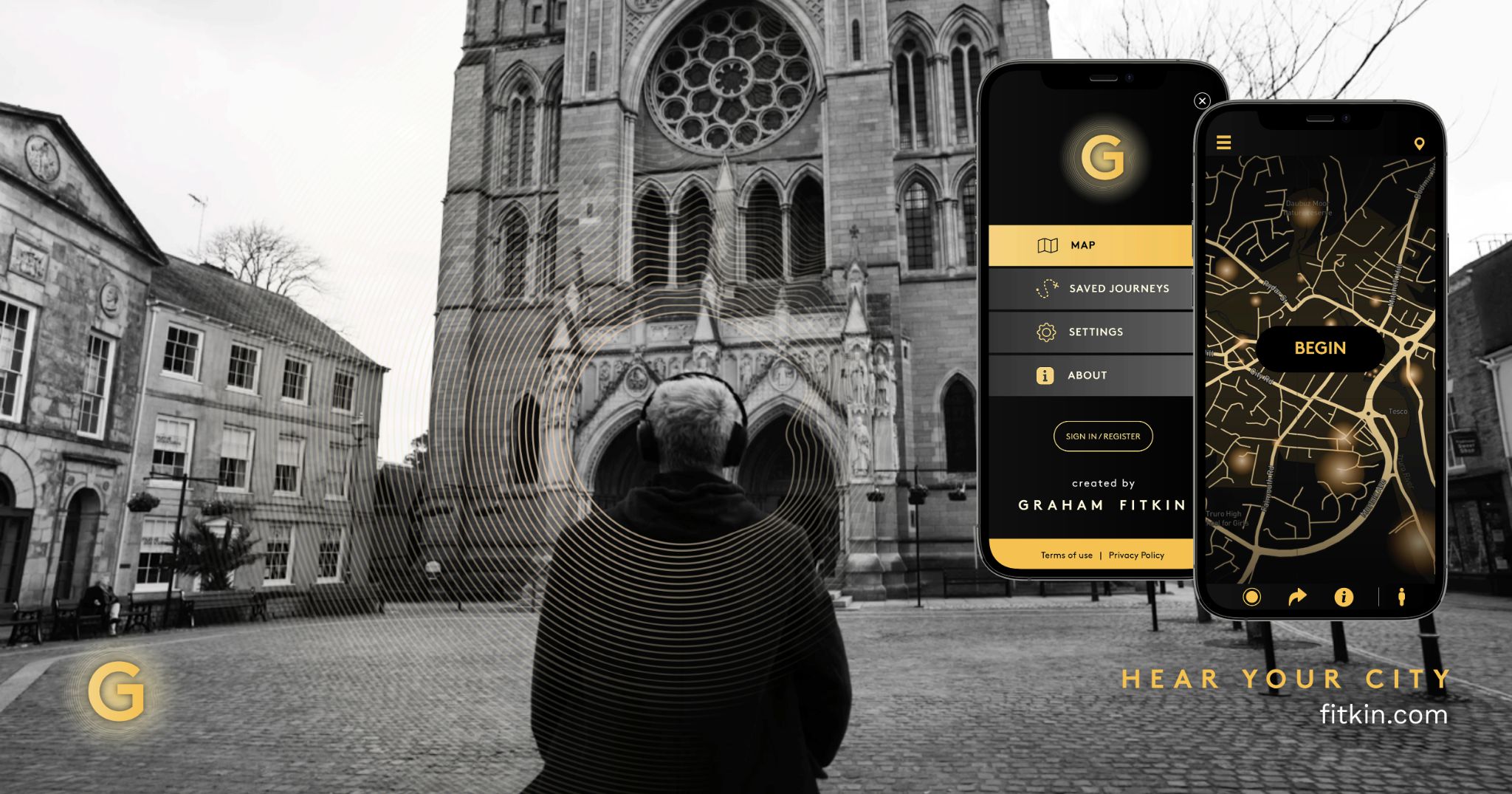
Hear your city afresh: a new app, Geography, encourages you to explore Truro through Graham Fitkin's music

Geography app

There are plenty of apps for your phone which encourage you to explore places in different ways, but an innovative new app, Geography, allows the user to experience the city centre of Truro as an immersive musical journey of their own making with music specially created by Cornwall-based composer Graham Fitkin (you can hear him talking about the project on his website), and the app produced in association with Hall for Cornwall

You can either walk around the city whilst connected to the app, and the soundtrack will change accordingly, or you can save and share the music, experiencing Truro remotely through the music and each person's soundtrack will be different, bringing city exploration to life in a very different way. Fitkin has composed different tracks for different ‘pathways’  - be that roads, footpaths or pavements - through the cityscape,  so the decisions taken by each listener as they make their journey, make these musical sections combine into a linked composition.

Further information from Graham Fitkin's website.

Guildhall School of Music's Chamber Music Festival

Guildhall School of Music and Drama - Chamber Music Festival

The Guildhall School of Music and Drama's Chamber Music Festival is taking place from 8 to 10 July 2022 across a variety of venues at the Guildhall School as well as the Charterhouse Chapel. There will be performances from some of the Guildhall School's most accomplished chamber groups, student-professor collaborations featuring major performers from the chamber music faculty as well as distinguished guests.

The festival's opening performance is intriguing, the Coalitio Quartet joins forces with Levon Chilingirian for a lecture-recital, What is Functional Analysis?, looking at the musical analysis system propounded by Hans Keller. The opening concert features students and professors in music by Malcolm Arnold, Shostakovich, Coleridge Taylor and Dvorak. At Charterhouse Chapel on the Saturday, a variety of student ensembles bring together music by Britten, including his divertimenti and String Quartet No. 2, and Purcell. The evening concert features guest ensembles and chamber music fellows, the Mithras Trio, the Consone Quartet and the Fibonacci Quartet in music by Tchaikovsky, Mendelssohn and Boccherini. Sunday includes masterclasses, music by Martinu, Debussy, Silvestrov, Kapustin, Tailleferre, Beethoven and Prokofiev, and a closing concert that features music by Mozart, Brahms, Roussel and Bridge.

Full details from the Guildhall School website.

Monday, 6 June 2022

Paul Melia: Before Moons

On the release of Paul Melia's 2013 album Hold Onto The Colours the Irish Independent wrote "trying to categorise Paul Melia is a fool’s errand". Now Melia has a new album coming, Moons Over Sleep, and he has released a lyric video, Before Moons in advance, [on Spotify or YouTube]

Popular Posts this month