
Purcell died in 1695 at the age of 36 (or thereabouts), at the peak of his career. It is tempting to speculate what would have happened if he had lived to old age and composed music for another 20 to 30 years (perhaps until the 1720's). Becoming the grand old man of English music.
The span between Purcell's death and the advent of Handel saw English composers trying to come to grips with the news forms proliferating in Europe, especially Italian opera. There were attempts to create English operas, but none performed were by composers of sufficient genius to create a work which would stand up to the Italian form. Nowadays, commentators reckon that good works were created, but unfortunately the first few English operas were the relatively weaker ones and the better never got performed as promoters rather gave up on the form. So with Henry Purcell very much alive and in pole position, surely the course of English music and English opera would be different.
Well, let's not get too carried away. We must remember that Purcell seems to have had no love for Italian style opera. He composed a single example of the form, the brilliantly perfect Dido and Aeneas, and then went back to composing semi-operas. Granted that was what the public seemed to want and economics dictated. But if Purcell had been strongly drawn to full blown opera surely Dido might have provoked other siblings.
Another point is that during Handel's reign and for long after, the English remained very attached to semi-opera, opera with spoken English dialogue and ballad opera. The form was still going strong when Planche wrote his libretto for Weber; on receiving the text Weber was horrified at the amount of spoken dialogue.
Purcell would have been in his 50's when Handel was invited over. A Purcell who continued to write English semi-operas or concentrated on sacred music would have been little use to a syndicate who wished to have a real Italian trained maestro to write Italian operas for Italian opera stars. Handel could well have still been invited over, but his stay might not have been so long. He does not seem to have been able to bear competition, even the lowly Maurice Greene was seen as a competitor. So it is unlikely that Handel would have stayed in England and, especially, developed oratorio if Purcell was around.
Don't forget that besides Handel a number of other composers were invited over, including Bononcini and Porpora, with varying degrees of success. Handel's departure would have meant simply that the opera syndicate invited another composer over.
It is also worthwhile bearing in mind that not every elderly composer continues writing music. Handel, Bach (to a certain extent), Haydn, Faure, Verdi, RVW and Richard Strauss did. Sibelius and Rossini didn't. Sterndale Bennett started out as an extremely promising young composer but ended up mired in musical administration. So even if Purcell had survived, he might not have written much.
We are, of course, still left with a variety of imponderables. But the what if's are completely fascinating.

Saturday, 9 August 2008

Friday, 8 August 2008
Prom 28
Labels:
concert review
Last night was the Kenneth Montgomery and the Ulster Orchestra's Prom. We went mainly to see hear Finghin Collins playing Stanford's 2nd Piano Concerto, but the Prom proved to have a great deal in it to enjoy.
They opened with Howard Fergusson's Overture for an Occasion, the occasion being the Coronation. The work was commissioned for the Ulster Orchestra's predecessor. Fergusson was famously circumspect with his music, there are only 20 opus numbers. This piece was rhythmically lithe and finely scored, beautifully played and certainly worth hearing again. Though the programme booklet talked of comparisons with Walton, there seemed to be much that was distinctive about Fergusson's voice.
Stanford's 2nd Piano Concerto is often compared to Rachmaninov's 2nd Piano Concerto, which had in fact inspired the composer to write his. But though you can find many parallels I have always found that the Stanford sounds very much like Stanford rather than ersatz Rachmaninov. The work has Stanford's familiar sweep to the music and the melodies have his rather Irish cast. Collins played the piano part beautifully poetically. He provided the requisite heft at the really big moments but as with Rachmaninov's 1st Piano Concerto at the Proms the other week, there were moments when the orchestra overshadowed the piano, when you simply wanted more heft from the pianist.
After the interval we were treated to a lively performance of Smetana's Vltava, in fact it was a very swift flowing Vltava that the orchestra gave us. The opening flute solos rippled at quite a considerable speed, and much credit to flautists and other instrumentalists for creating such a fast but deft flow. The Smetana was followed by Dvorak's 8th Symphony, the work which Dvorak conducted prior to his honorary degree in Cambridge (at the invitation of Stanford). This was a bravura performance of a charming work. The orchestra's performance was lithe and lively, rhythms well sprung. Part of the charm of their account was that they did not try and play it like Brahms, as many orchestras do. This had none of the smoothed out feeling that more recent performances of the symphony have had, instead Montgomery and the orchestra brought a sprung liveliness and crisp rhythmical undertow to it; add a great deal of charm for good measure.
As an encore we heard another Fergusson piece, one of his Diversons for orchestra. Another charmer to complete a fine concert.
This was one of the BBC's family proms so that we were surrounded by children, on the whole pretty attentive. I did feel that the 30 minute, long-breathed romantic concerto from Stanford was pushing it a bit for a children's audience but I suppose you'd have to ask the children.
They opened with Howard Fergusson's Overture for an Occasion, the occasion being the Coronation. The work was commissioned for the Ulster Orchestra's predecessor. Fergusson was famously circumspect with his music, there are only 20 opus numbers. This piece was rhythmically lithe and finely scored, beautifully played and certainly worth hearing again. Though the programme booklet talked of comparisons with Walton, there seemed to be much that was distinctive about Fergusson's voice.
Stanford's 2nd Piano Concerto is often compared to Rachmaninov's 2nd Piano Concerto, which had in fact inspired the composer to write his. But though you can find many parallels I have always found that the Stanford sounds very much like Stanford rather than ersatz Rachmaninov. The work has Stanford's familiar sweep to the music and the melodies have his rather Irish cast. Collins played the piano part beautifully poetically. He provided the requisite heft at the really big moments but as with Rachmaninov's 1st Piano Concerto at the Proms the other week, there were moments when the orchestra overshadowed the piano, when you simply wanted more heft from the pianist.
After the interval we were treated to a lively performance of Smetana's Vltava, in fact it was a very swift flowing Vltava that the orchestra gave us. The opening flute solos rippled at quite a considerable speed, and much credit to flautists and other instrumentalists for creating such a fast but deft flow. The Smetana was followed by Dvorak's 8th Symphony, the work which Dvorak conducted prior to his honorary degree in Cambridge (at the invitation of Stanford). This was a bravura performance of a charming work. The orchestra's performance was lithe and lively, rhythms well sprung. Part of the charm of their account was that they did not try and play it like Brahms, as many orchestras do. This had none of the smoothed out feeling that more recent performances of the symphony have had, instead Montgomery and the orchestra brought a sprung liveliness and crisp rhythmical undertow to it; add a great deal of charm for good measure.
As an encore we heard another Fergusson piece, one of his Diversons for orchestra. Another charmer to complete a fine concert.
This was one of the BBC's family proms so that we were surrounded by children, on the whole pretty attentive. I did feel that the 30 minute, long-breathed romantic concerto from Stanford was pushing it a bit for a children's audience but I suppose you'd have to ask the children.
Recent CD Reviews
Labels:
cd review
My review of a disc of music by Frantisek Xaver Brixi is here.
No masterpieces but a fascinating glimpse into the mid-18th century Czech world ...
And my review of the Tallis Scholars disc of Josquin's canon masses is here.
Admirers of Josquin will be getting near perfection of execution ...
Both reviews are on MusicWeb International.
No masterpieces but a fascinating glimpse into the mid-18th century Czech world ...
And my review of the Tallis Scholars disc of Josquin's canon masses is here.
Admirers of Josquin will be getting near perfection of execution ...
Both reviews are on MusicWeb International.
Thursday, 7 August 2008
Review of Tosca
Labels:
opera review
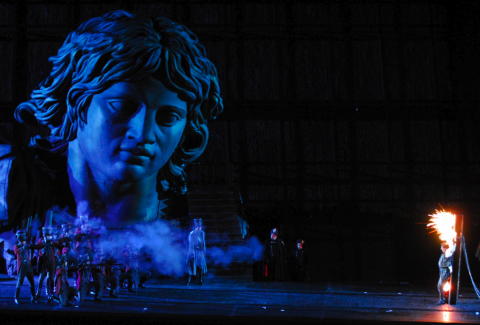 Cavaradossi's execution at the Castel Sant'Angelo from Act III of Puccini's 'Tosca' at the Verona Arena. Photo © 2008 Maurizio Brenzoni.
My review of Tosca from the Verona Arena is here, on Music and Vision.
Wednesday, 6 August 2008
Verona Arena
Labels:
feature article
The first opera to be performed in Verona Arena was Aida in 1913, staged to commemorate the centenary of Verdi's birth. Since then there have been 517 performances of Aida. The opera has been performed every year but one since 1980, it has been performed in over 40 seasons since 1946 but prior to that there were performances of Aida in just 1913, 1920, 1927 and 1936. In fact, since the 2nd World War the Arena seems to have become something of an Aida industry.
The count of performances since 1913 for the top 10 operas is quite revealing, with Aida leading by far:-
Aida = 517
Carmen = 177
Nabucco = 157
Turandot = 108
La Traviata = 90
Rigoletto = 85
Tosca = 82
Cavelleria Rusticana = 76
Il Trovatore = 74
La Boheme = 72
Apart from Aida leading by a long way, the list reveals other things. It includes most (but not all) of the really popular 19th/early 20th century operas, and the selection is not just restricted to operas which would seem suitable for large scale performance. Some of the opera selection inevitably reflects the venue's Italian location, I'm not sure that a comparable English venture would have so many performances of Nabucco. And the absence of Otello from the top 10 possibly reflects the difficulty of casting the title role in such a large venue.
Whereas before the 2nd War the repertoire was quite varied, it now seems to be approaching ossification. This year's operas were Aida, Rigoletto, Nabucco, Tosca and Carmen. Next year's operas are Aida, Il Barbiere di Siviglia, Turandot, Tosca and Carmen.
The last time the Arena stage an opera for the first time was in 1999 when they performed Lehar's La Vedova Allegra (The Merry Widow). Prior to that it was I Lombardi in 1984 and Attila in 1985. An opera like Attila would seem to be ideal for the Arena. Similarly Don Carlo (1969, 1992), Boris Goudonov (1930, 1952, 1976) and Samson et Dalila (1921, 1974) would seem to be ideal for Arena performance. In fact I am quite puzzled at why Samson et Dalila has been performed so little, it would seem to be ideally constructed for Verona Arena; but again this probably represents different attitudes and preferences.
Perhaps, also, economics has something to do with it, with the Arena being dependent on attracting punters; and many punters are those for whom opera going is not a regular activity. The Arena is simply too big to rely on opera fanatics.
But it hasn't always been so. In its first 40 years the arena performed a selection of lesser known operas by Catalani, Ponchielli, Zandonai, Boito, Spontini and Meyerbeer. In fact Callas's famous debut was in La Gioconda in 1947.
But in addition to the less well known Italian repertoire, the Arena also staged Wagner: Parsifal (1924), I Maestri Cantori (1931), La Walkiria (1950), Tannhauser (1936) and Lohengrin (1922, 1933, 1949, 1963).
An opera like Lohengrin would have seemed ideal. But then other thoughts occur. If Tosca lasts from 9pm to midnight, how long would a performance of a Wagner opera take?
It would be nice to see the Arena becoming a little more adventurous occasionally, if only because the performing space would seem to lend itself to a wider variety of opera than is performed at present
The count of performances since 1913 for the top 10 operas is quite revealing, with Aida leading by far:-
Aida = 517
Carmen = 177
Nabucco = 157
Turandot = 108
La Traviata = 90
Rigoletto = 85
Tosca = 82
Cavelleria Rusticana = 76
Il Trovatore = 74
La Boheme = 72
Apart from Aida leading by a long way, the list reveals other things. It includes most (but not all) of the really popular 19th/early 20th century operas, and the selection is not just restricted to operas which would seem suitable for large scale performance. Some of the opera selection inevitably reflects the venue's Italian location, I'm not sure that a comparable English venture would have so many performances of Nabucco. And the absence of Otello from the top 10 possibly reflects the difficulty of casting the title role in such a large venue.
Whereas before the 2nd War the repertoire was quite varied, it now seems to be approaching ossification. This year's operas were Aida, Rigoletto, Nabucco, Tosca and Carmen. Next year's operas are Aida, Il Barbiere di Siviglia, Turandot, Tosca and Carmen.
The last time the Arena stage an opera for the first time was in 1999 when they performed Lehar's La Vedova Allegra (The Merry Widow). Prior to that it was I Lombardi in 1984 and Attila in 1985. An opera like Attila would seem to be ideal for the Arena. Similarly Don Carlo (1969, 1992), Boris Goudonov (1930, 1952, 1976) and Samson et Dalila (1921, 1974) would seem to be ideal for Arena performance. In fact I am quite puzzled at why Samson et Dalila has been performed so little, it would seem to be ideally constructed for Verona Arena; but again this probably represents different attitudes and preferences.
Perhaps, also, economics has something to do with it, with the Arena being dependent on attracting punters; and many punters are those for whom opera going is not a regular activity. The Arena is simply too big to rely on opera fanatics.
But it hasn't always been so. In its first 40 years the arena performed a selection of lesser known operas by Catalani, Ponchielli, Zandonai, Boito, Spontini and Meyerbeer. In fact Callas's famous debut was in La Gioconda in 1947.
But in addition to the less well known Italian repertoire, the Arena also staged Wagner: Parsifal (1924), I Maestri Cantori (1931), La Walkiria (1950), Tannhauser (1936) and Lohengrin (1922, 1933, 1949, 1963).
An opera like Lohengrin would have seemed ideal. But then other thoughts occur. If Tosca lasts from 9pm to midnight, how long would a performance of a Wagner opera take?
It would be nice to see the Arena becoming a little more adventurous occasionally, if only because the performing space would seem to lend itself to a wider variety of opera than is performed at present
Tuesday, 5 August 2008
Farewell Ian Partridge
Labels:
preview
Veteran tenor Ian Partridge will be giving his final performance at the Oxford Lieder Festival in October 2008. Partridge started his singing career as a chorister at New College Oxford some 60 years ago. Partridge will be performing a selection of his favourite songs.
Back from Verona
Labels:
diary
This last weekend we were in Verona where we attended the final performance this year of Hugo De Ana's production of Tosca at the opera (to be reviewed in due course) and sang with London Concord Singers in 3 performances. My motet Deus in Adjutorium received its Italian premiere at a concert at the Church of St. Nicolo and St. Severo in Bardolino on Saturday 1st August and went on to receive a 2nd performance at Mass on Sunday 2nd August at St. Giorgio in Briada in Verona.
Our concert in Bardolino featured Alberto Ginastera's Lamentations and in the audience was a man who had sung in the work's première in 1946! On Sunday evening we sang at San Tomaso en Cantuarense in Verona, on whose organ Mozart had improvised.
On our way back from Verona we managed to call in at Bergamo where we saw the house where Donizetti died. We also saw the tombs of Donizetti and Simone Mayr (his teacher) in the Basilica in Bergamo
Our concert in Bardolino featured Alberto Ginastera's Lamentations and in the audience was a man who had sung in the work's première in 1946! On Sunday evening we sang at San Tomaso en Cantuarense in Verona, on whose organ Mozart had improvised.
On our way back from Verona we managed to call in at Bergamo where we saw the house where Donizetti died. We also saw the tombs of Donizetti and Simone Mayr (his teacher) in the Basilica in Bergamo
Wednesday, 30 July 2008
Prom 16
Labels:
concert review
I did my degree in Manchester in the 1970's a few years after Barbirolli's death when his place at the helm of the Halle Orchestra had been taken by James Loughran. Whilst Loughran did a sterling job, it has taken until now for the orchestra to really recapture the form that had under Barbirolli. Since Sir Mark Elder took over in 2000 the orchestra has been in brilliant shape. Their Prom last night showed them to be delivering a remarkable consistency of tone throughout the whole orchestra. I'm not quite sure what exactly the 'new' Halle sound is like, but it is certainly impressive, musical and beautifully textured.
For their Proms visit Elder and the orchestra chose to perform the RVW Symphony (no. 8) which they had premièred under Barbirolli in 1958. But Elder started with a poised and finely textured account of Butterworth's rhapsody A Shropshire Lad. From the very first notes this was spine tingling stuff, only marred by the rather inept delivery of a selection of the poems before and after the rhapsody. It was a nice idea to include the poems but having them declaimed in poor demotic by a pair of young actors, whose main experience would seem to be in TV soaps, was not a good idea.
The RVW performance was similarly beautifully controlled, where necessary, so that the string Cavatina was finely shaped and very consistent whereas the wind and brass only scherzo displayed a fine appreciation of RVW's humour. In the outer movements the percussion section gave vent to RVW's lively percussion parts, making the tuned percussion elements more noticeable and more extravagant than I remember from Hickox and the Philharmonia's recent performance. Which is certainly a good thing, late RVW contains quite a few fascinating experiments with textures and timbres.
After the interval we had a performance of the 1st violin concerto by RVW's teacher, Bruch. Janine Jansen was the poised soloist, spinning out Bruch's long lines. This was a fine performance, but which have many of the RVW outings been coupled with serious 19th century Romantic beasts. The last concert we went to included Rachmaninov's 1st Piano concerto and next week RVW's Piano Concerto is coupled with Rimsky Korsakov's Scheherezade. I've no objections to these works, but couldn't we have had some RVW symphonic pieces coupled with something a little riskier and spikier.
The concert concluded with a lively and witty performance of Strauss's Til Eulenspiegel with Elder showing what a fine Strauss conductor he is.
For their Proms visit Elder and the orchestra chose to perform the RVW Symphony (no. 8) which they had premièred under Barbirolli in 1958. But Elder started with a poised and finely textured account of Butterworth's rhapsody A Shropshire Lad. From the very first notes this was spine tingling stuff, only marred by the rather inept delivery of a selection of the poems before and after the rhapsody. It was a nice idea to include the poems but having them declaimed in poor demotic by a pair of young actors, whose main experience would seem to be in TV soaps, was not a good idea.
The RVW performance was similarly beautifully controlled, where necessary, so that the string Cavatina was finely shaped and very consistent whereas the wind and brass only scherzo displayed a fine appreciation of RVW's humour. In the outer movements the percussion section gave vent to RVW's lively percussion parts, making the tuned percussion elements more noticeable and more extravagant than I remember from Hickox and the Philharmonia's recent performance. Which is certainly a good thing, late RVW contains quite a few fascinating experiments with textures and timbres.
After the interval we had a performance of the 1st violin concerto by RVW's teacher, Bruch. Janine Jansen was the poised soloist, spinning out Bruch's long lines. This was a fine performance, but which have many of the RVW outings been coupled with serious 19th century Romantic beasts. The last concert we went to included Rachmaninov's 1st Piano concerto and next week RVW's Piano Concerto is coupled with Rimsky Korsakov's Scheherezade. I've no objections to these works, but couldn't we have had some RVW symphonic pieces coupled with something a little riskier and spikier.
The concert concluded with a lively and witty performance of Strauss's Til Eulenspiegel with Elder showing what a fine Strauss conductor he is.
Self referential
The blogosphere is endlessly self-referential, with links to other sites linking ultimately back to the one you first thought of. There's a link to my posting about Prom 10 on the MyChordSpace blog, an interesting music blog worth exploring.
Monday, 28 July 2008
Half-way there
Labels:
music news
I am currently working on the motet Benedicat sit Sancta Trinitas, setting the words from the Introit for Trinity Sunday, when complete this will be the 35th motet which I have written in my sequence Tempus per Annum. When complete the sequence of motets contain some 70 motets setting the texts (in Latin and in English) of the introits for the Sundays and major Feasts of the church's year. Currently Volume 1 is complete (covering Advent and Christmastide). Volume 2 is nearing completion (just 3 to go) and covers Lent, Eastertide, Ascension and Pentecost. The final volume (with some 34 motets) will cover the 32 Sundays of Ordinary time plus a couple of major feasts.
Recent CD Review
Labels:
cd review
My review of a disc of Carissimi motets performed by a remarkable high counter-tenor is here, on MusicWeb International.
Crowe gives strikingly committed performances ...
Crowe gives strikingly committed performances ...
Saturday, 26 July 2008
Friday, 25 July 2008
Prom 10
Labels:
concert review
To the Royal Albert Hall last night for Prom 10, performed by the BBC Philharmonic Orchestra, Yevgeny Sudbin (piano) and Yan Pascal Tortelier (conductor). The programme consisted of Bax's In memoriam, Rachmaninov's 1st Piano Concerto and Vaughan Williams's 4th Symphony.
The Bax has long been known in short score but it was assumed that Bax had never orchestrated it. It was written in memory of an Irish Patriot who died in the Easter Uprising. Not surprisingly there was no performance during Bax's lifetime. In 1998 a full score came to light in a publisher's basement! The piece has been recorded but never performed in public. It proved to be a highly atmospheric piece, to my ears very reminiscent of Hamilton Harty's Irish themed tone poems.
Sudbin gave a highly poetic account of the solo part in the Rachmaninov, proving himself well able to stay on top of the cascades of notes. The results were dazzling, though there were moments when Tortelier allowed the robust orchestration to dominate the piano. I would have liked a bit more robust rawness in Sudbin's playing, but his account erred on the positive side.
In the 2nd half we had RVW's corruscating symphony in a performance which took no prisoners. From the opening dissonant motto theme, it was obvious that Tortelier's account of the score was one which emphasised the European links of RVW's music and played down the pastoral English element which is still present even in this symphony. In the 2nd movement Tortelier conjured an eerie world which was extremely reminiscent of the bi-tonal scores of RVW's friend Holst. For the finale the orchestra finished the performance is towering form. Their and Tortelier's account seemed to play up the dissonant, hard edged side of the score which played up its links with European music. A terrific performance and a fabulous slant on a familiar work.
The Bax has long been known in short score but it was assumed that Bax had never orchestrated it. It was written in memory of an Irish Patriot who died in the Easter Uprising. Not surprisingly there was no performance during Bax's lifetime. In 1998 a full score came to light in a publisher's basement! The piece has been recorded but never performed in public. It proved to be a highly atmospheric piece, to my ears very reminiscent of Hamilton Harty's Irish themed tone poems.
Sudbin gave a highly poetic account of the solo part in the Rachmaninov, proving himself well able to stay on top of the cascades of notes. The results were dazzling, though there were moments when Tortelier allowed the robust orchestration to dominate the piano. I would have liked a bit more robust rawness in Sudbin's playing, but his account erred on the positive side.
In the 2nd half we had RVW's corruscating symphony in a performance which took no prisoners. From the opening dissonant motto theme, it was obvious that Tortelier's account of the score was one which emphasised the European links of RVW's music and played down the pastoral English element which is still present even in this symphony. In the 2nd movement Tortelier conjured an eerie world which was extremely reminiscent of the bi-tonal scores of RVW's friend Holst. For the finale the orchestra finished the performance is towering form. Their and Tortelier's account seemed to play up the dissonant, hard edged side of the score which played up its links with European music. A terrific performance and a fabulous slant on a familiar work.
Tuesday, 22 July 2008
This time next year
Labels:
feature article,
opera
We have just booked some opera tickets for the Santa Fe Festival (Christine Brewer in Alceste and Natalie Dessay's first La Traviata plus Tom Ford’s opera designing debut). For 2009! This seems to be part of a growing trend, the stretching out of booking periods so that for popular events you can find yourself booking for a ridiculously long period in advance.
In the case of Santa Fe, this is understandable; it encourages this year’s festival goers to sign up for next year’s tickets whilst they are at this year’s festival. But organisations such as the Royal Opera House and English National Opera seem to be putting longer lead times on their advanced booking. And ENO seems to have reduced its number of booking periods, so that you find yourself booking for longer stretches of time.
Some of the other UK opera companies seem to have adopted the yearly booking strategy; we have just booked tickets for Scottish Opera for May 2009 (Massenet’s Manon with Anne Sophie Duprels and Paul Charles Clarke). This yearly booking cycle is one used by the Barbican’s Great Performer’s Season, so that in early Spring each year we find ourselves booking for the following season, which might run until June/July the following year.
Why book so early, you ask yourself?
Partly it’s because you can. If you don’t book early then you stand a chance on missing out on the better seats. As an example, we normally sit in the cheaper front seats in the stalls at the Barbican. We like the closeness. But if we don’t book soon after booking opens, then we either miss these seats or end up sitting further away or at the side.
This ends up becoming a self fulfilling cycle, companies open booking earlier so people book earlier; certainly a case of supply generating demand. The only benefit would seem to be in the companies’ bank accounts where they get their income earlier.
By contrast, a number of the continental opera companies still operate the old system whereby booking opens a fixed period before the first performance of the opera. This system though, I suspect, may gradually give way under pressure from the internet.
People want on-line internet booking so that they can choose their own seats; we certainly prefer this and are prepared to wait for it in some cases. But when companies move to this method of booking, you can find that their whole model of booking changes. The other area where the UK, well at least London, differs from many Continental houses is that on mainland Europe subscriptions are still a vital point.
The end result of all this is that I have already bought my 2009 diary and have a clear idea about my main holidays in 2009 (Scotland in May and Santa Fe in August). It also means that increasingly we have a very expensive cache of tickets sitting in our in-box. But the main casualty is that spontaneity can go out of the window.<
In the case of Santa Fe, this is understandable; it encourages this year’s festival goers to sign up for next year’s tickets whilst they are at this year’s festival. But organisations such as the Royal Opera House and English National Opera seem to be putting longer lead times on their advanced booking. And ENO seems to have reduced its number of booking periods, so that you find yourself booking for longer stretches of time.
Some of the other UK opera companies seem to have adopted the yearly booking strategy; we have just booked tickets for Scottish Opera for May 2009 (Massenet’s Manon with Anne Sophie Duprels and Paul Charles Clarke). This yearly booking cycle is one used by the Barbican’s Great Performer’s Season, so that in early Spring each year we find ourselves booking for the following season, which might run until June/July the following year.
Why book so early, you ask yourself?
Partly it’s because you can. If you don’t book early then you stand a chance on missing out on the better seats. As an example, we normally sit in the cheaper front seats in the stalls at the Barbican. We like the closeness. But if we don’t book soon after booking opens, then we either miss these seats or end up sitting further away or at the side.
This ends up becoming a self fulfilling cycle, companies open booking earlier so people book earlier; certainly a case of supply generating demand. The only benefit would seem to be in the companies’ bank accounts where they get their income earlier.
By contrast, a number of the continental opera companies still operate the old system whereby booking opens a fixed period before the first performance of the opera. This system though, I suspect, may gradually give way under pressure from the internet.
People want on-line internet booking so that they can choose their own seats; we certainly prefer this and are prepared to wait for it in some cases. But when companies move to this method of booking, you can find that their whole model of booking changes. The other area where the UK, well at least London, differs from many Continental houses is that on mainland Europe subscriptions are still a vital point.
The end result of all this is that I have already bought my 2009 diary and have a clear idea about my main holidays in 2009 (Scotland in May and Santa Fe in August). It also means that increasingly we have a very expensive cache of tickets sitting in our in-box. But the main casualty is that spontaneity can go out of the window.<
Monday, 21 July 2008
Sex matters
Labels:
opera
Glyndebourne's new Hansel and Gretel has debuted, with Wolfgang Ablinger-Sperrhacke as the Witch, sung at tenor pitch. Now I have no problems with the witch being sung by a man, a counter-tenor friend of mine has performed it at soprano pitch albeit with just piano accompaniment; he created a rather scary, slightly androgynous figure, miles away from the pantomime dame. But I have severe problems with the issue of transposing it down an octave. The effect on the vocal line is to render something rather scary as an out and out caricature. You can observe similar effects when castrato roles are translated down in baroque opera, the results become cruder, more highly coloured owing to the way the lower voices cope with the faster notes.
But somehow it seems to be acceptable in some operas, notably lighter ones, to move roles about. If you think I'm being a bit prissy about this, then it helps to consider what people's reactions would be if instead of Humperdinck we considered Richard Strauss. What would the critical reaction be if we were to be presented with Octavian sung by a tenor or the Composer (in Arabella). Critics would be up in arms of course because the transposition would ruin the balance between voices (think of the presentation of the Rose scene or the final trio with Octavian an octave lower). That such considerations do no fly from critical pens when the Witch is done by a tenor is perhaps an indication that, despite some superbly thoughtful productions in this country (David Pountney, Richard Jones), we don't quite take Humperdinck's opera as seriously as Richard Strauss's.
Surely the issue is that if an opera is worth doing, then its worth doing properly according to the composer's intentions.
The same arguments apply to the other Strauss's Die Fledermaus, where Orlofsky can be sung by a tenor. This makes the role into something rather different, more roue than excitable youngster. It also makes nonsense of the vocal line for Orlofsky's couplets where many commentators argue that the distinctive vocal leap is meant to represent Orlofsky's voice breaking as he is a teenager.
But of course certain types of lighter opera and operetta have always been prone to directors knowing better and presenting them with substantial re-writes. Granted Humperdinck's opera is not really a light opera, but it is based on a fairy tale and involves children; though he uses Wagnerian techniques, Humperdinck does so in an open an accessible way.
Strangely, its not always light opera that comes in for these alterations, lesser known ones can as well. Witness Massenet's Cendrillon where the only studio recording is still one which uses a tenor for the Prince rather than a mezzo-soprano/Falcon soprano as Massenet specifies. Whereas the change in sex of the Witch is to add extra comedy to the work, the Massenet and Johan Strauss changes are done for different reasons notably the rather modern obsession with having young men sung by men on the operatic stage, particularly when they are in love.
The ultimate change in this style can be found at the very opposite end of the operatic canon, in Monteverdi where Nerone is not infrequently sung by a tenor.
So what should we do about this? Complain! I know that it goes against the grain. But if you've paid a small fortune for tickets you are, I think, entitled to a degree of come back.
But somehow it seems to be acceptable in some operas, notably lighter ones, to move roles about. If you think I'm being a bit prissy about this, then it helps to consider what people's reactions would be if instead of Humperdinck we considered Richard Strauss. What would the critical reaction be if we were to be presented with Octavian sung by a tenor or the Composer (in Arabella). Critics would be up in arms of course because the transposition would ruin the balance between voices (think of the presentation of the Rose scene or the final trio with Octavian an octave lower). That such considerations do no fly from critical pens when the Witch is done by a tenor is perhaps an indication that, despite some superbly thoughtful productions in this country (David Pountney, Richard Jones), we don't quite take Humperdinck's opera as seriously as Richard Strauss's.
Surely the issue is that if an opera is worth doing, then its worth doing properly according to the composer's intentions.
The same arguments apply to the other Strauss's Die Fledermaus, where Orlofsky can be sung by a tenor. This makes the role into something rather different, more roue than excitable youngster. It also makes nonsense of the vocal line for Orlofsky's couplets where many commentators argue that the distinctive vocal leap is meant to represent Orlofsky's voice breaking as he is a teenager.
But of course certain types of lighter opera and operetta have always been prone to directors knowing better and presenting them with substantial re-writes. Granted Humperdinck's opera is not really a light opera, but it is based on a fairy tale and involves children; though he uses Wagnerian techniques, Humperdinck does so in an open an accessible way.
Strangely, its not always light opera that comes in for these alterations, lesser known ones can as well. Witness Massenet's Cendrillon where the only studio recording is still one which uses a tenor for the Prince rather than a mezzo-soprano/Falcon soprano as Massenet specifies. Whereas the change in sex of the Witch is to add extra comedy to the work, the Massenet and Johan Strauss changes are done for different reasons notably the rather modern obsession with having young men sung by men on the operatic stage, particularly when they are in love.
The ultimate change in this style can be found at the very opposite end of the operatic canon, in Monteverdi where Nerone is not infrequently sung by a tenor.
So what should we do about this? Complain! I know that it goes against the grain. But if you've paid a small fortune for tickets you are, I think, entitled to a degree of come back.
Thursday, 17 July 2008
Recent CD Reviews
Labels:
cd review
My review of Donizetti's Requiem performed by Czech forces is here.
A largely creditable performance played confidently and with not a little style ....
And my review of Jake Heggie's For a Look or a Touch is here.
Both reviews on MusicWeb International.
Fine performances, much of interest but not the composers’ best work...
A largely creditable performance played confidently and with not a little style ....
And my review of Jake Heggie's For a Look or a Touch is here.
Both reviews on MusicWeb International.
Fine performances, much of interest but not the composers’ best work...
Wednesday, 16 July 2008
The Proms
Labels:
diary,
feature article
So we are about to embark on that peculiar phase in London life when the Proms begin. Concert and opera going life in London never closes, it merely metamorphoses and the Proms is perhaps the strangest metamorphosis of all. A festival which lasts some 2 months with a concert (at least) per night, rather then relaxing in the summer Londoners would seem to prefer to be exhausted. This was particularly true in past seasons, before the recent rebuilding of the Albert Hall, when the Hall could get overly hot during concerts.
Even now, frankly, the Albert Hall is hardly the ideal place to hear music; the best places are in the promenade area. It is the promenaders who give the festival its special buzz. Forget the Last Night, for the remaining evenings they provide a keenly interested, generally intelligent audience and all for a ridiculous amount of money per night (ridiculously small that is). Of course, to manage a day job and going each night to a Prom (or 2) means you need the constitution of a horse.
The festival is made viable by the sheer size of the Albert Hall, if a concert sells out the BBC can sell a remarkable number of tickets. Add to this their use of the BBC orchestras and their leveraging of the broadcasts from the Proms and you begin to understand how the economics might work.
It is also remarkable what Proms are popular. I remember a late night Prom last year when the Tallis Scholars gave the performance of Strigio’s mass which in places is in 60 parts. The hall seemed full and just about every singer I knew was in the audience.
This is another thing about the Proms, people make an effort to go to see them in a way that they might not during the ordinary Winter and Spring concert seasons. Generally the programmes are diverse enough and the Festival long enough so that there is usually something of interest to everyone. I must confess that this year, Roger Wright’s emphasis understandable emphasis on RVW has attracted me. But I prefer his ominium-gatherum approach which means that the Prom season is varied and diverse, rather than his predecessors’ emphasis on themes. Themed seasons work well if you enjoy the them, but if you don’t then you find large chunks of the season lacking.
In the 1980’s I sang at quite a few Proms as a member of the London Philharmonic Choir who augmented the BBC Symphony Chorus on a number of occasions when big choirs were needed. One memorable such occasion was Mark Elder conducting Verdi’s Requiem with a huge chorus in an attempt to emulate the work’s UK première when there had been a chorus of 1200 in the Albert Hall. For that performance we also had an Italian coach to ensure our Latin pronunciation was correct.
On another occasion, also under Mark Elder, we performed Berlioz’s Damnation of Faust. This was one of the few times when I have heard the final apotheosis done with the correct number of harps, the effect was magical. Similarly, we did another Prom which included Berlioz’s Symphonie Funebre et Triomphale, which was originally written for military band and includes an incredible number of clarinets. We reckoned virtually every professional clarinettist in London was there. And the effect? Well it sounded like a huge fairground organ.
But the single occasion which stands out was doing Mahler’s 8th Symphony under Zubin Mehta, sitting at the back of the choir seemingly miles from Mehta and looking over a huge choir and orchestra. I had a promming season ticket that year so my mother was able to take my place, braving arthritis to stand throughout the symphony and loving it. This was one of those occasions, though, when you suspected that the Radio audience got rather a better deal than some of the listeners in the Albert Hall. The soloists were stationed behind the orchestra, just in front of the organ and I rather gather that balance left something to be desired in some parts of the hall, though it sounded good on the Radio.
Nowadays, if we go to the Proms we tend to sit downstairs. But concert going can still be something of a trial, with intervals spent circumnavigating the outer corridor in search of refreshments and toilets (the Albert Hall must be the only concert hall I’ve been to where there are queues for the Gents!).
Still I appreciate the re-Victorianising which has happened in recent years and look forward immensely to this year’s Prom’s season.
Even now, frankly, the Albert Hall is hardly the ideal place to hear music; the best places are in the promenade area. It is the promenaders who give the festival its special buzz. Forget the Last Night, for the remaining evenings they provide a keenly interested, generally intelligent audience and all for a ridiculous amount of money per night (ridiculously small that is). Of course, to manage a day job and going each night to a Prom (or 2) means you need the constitution of a horse.
The festival is made viable by the sheer size of the Albert Hall, if a concert sells out the BBC can sell a remarkable number of tickets. Add to this their use of the BBC orchestras and their leveraging of the broadcasts from the Proms and you begin to understand how the economics might work.
It is also remarkable what Proms are popular. I remember a late night Prom last year when the Tallis Scholars gave the performance of Strigio’s mass which in places is in 60 parts. The hall seemed full and just about every singer I knew was in the audience.
This is another thing about the Proms, people make an effort to go to see them in a way that they might not during the ordinary Winter and Spring concert seasons. Generally the programmes are diverse enough and the Festival long enough so that there is usually something of interest to everyone. I must confess that this year, Roger Wright’s emphasis understandable emphasis on RVW has attracted me. But I prefer his ominium-gatherum approach which means that the Prom season is varied and diverse, rather than his predecessors’ emphasis on themes. Themed seasons work well if you enjoy the them, but if you don’t then you find large chunks of the season lacking.
In the 1980’s I sang at quite a few Proms as a member of the London Philharmonic Choir who augmented the BBC Symphony Chorus on a number of occasions when big choirs were needed. One memorable such occasion was Mark Elder conducting Verdi’s Requiem with a huge chorus in an attempt to emulate the work’s UK première when there had been a chorus of 1200 in the Albert Hall. For that performance we also had an Italian coach to ensure our Latin pronunciation was correct.
On another occasion, also under Mark Elder, we performed Berlioz’s Damnation of Faust. This was one of the few times when I have heard the final apotheosis done with the correct number of harps, the effect was magical. Similarly, we did another Prom which included Berlioz’s Symphonie Funebre et Triomphale, which was originally written for military band and includes an incredible number of clarinets. We reckoned virtually every professional clarinettist in London was there. And the effect? Well it sounded like a huge fairground organ.
But the single occasion which stands out was doing Mahler’s 8th Symphony under Zubin Mehta, sitting at the back of the choir seemingly miles from Mehta and looking over a huge choir and orchestra. I had a promming season ticket that year so my mother was able to take my place, braving arthritis to stand throughout the symphony and loving it. This was one of those occasions, though, when you suspected that the Radio audience got rather a better deal than some of the listeners in the Albert Hall. The soloists were stationed behind the orchestra, just in front of the organ and I rather gather that balance left something to be desired in some parts of the hall, though it sounded good on the Radio.
Nowadays, if we go to the Proms we tend to sit downstairs. But concert going can still be something of a trial, with intervals spent circumnavigating the outer corridor in search of refreshments and toilets (the Albert Hall must be the only concert hall I’ve been to where there are queues for the Gents!).
Still I appreciate the re-Victorianising which has happened in recent years and look forward immensely to this year’s Prom’s season.
Monday, 14 July 2008
Was it 25 years ago
Labels:
diary
On Saturday we went to the Pink Singers 25th Anniversary concert. The choir was founded in April 1983 and I ran it from July 1983 until 1988, during which time it grew from a simple idea to a self-governing choir and a member of the NFMS. We celebrated our 5th anniversary with a concert which mixed Eisler's cantata Die Mutter with other more popular music from 1936 (the year the cantata was premièred).
At Saturday's concert the 60 strong choir (far bigger than in my day) was conducted by their musical director, Mladen Stankovic. Surprisingly the group has 2 members who date back to my time in the 1980's. Their celebratory programme was suitably eclectic, mixing Bruckner, Karl Jenkins with popular numbers by Richard Rodgers, Elton John, Annie Lennox, Bernstein and concluding with an uplifting Mo-town medley.
Here's to the next 25 years!
At Saturday's concert the 60 strong choir (far bigger than in my day) was conducted by their musical director, Mladen Stankovic. Surprisingly the group has 2 members who date back to my time in the 1980's. Their celebratory programme was suitably eclectic, mixing Bruckner, Karl Jenkins with popular numbers by Richard Rodgers, Elton John, Annie Lennox, Bernstein and concluding with an uplifting Mo-town medley.
Here's to the next 25 years!
Review of The Rake's Progress
Labels:
opera review
To the Royal Opera House on Saturday for a performance of Stravinsky's The Rake's Progress in Robert Lepage's new production (well, new to Covent Garden, it has already appeared at La Monnaie and in San Francisco). Like Robert Carsen's much travelled production of Bernstein's Candide, Lepage's Rake moves the action to mid 20th Century America and makes it an odyssey through American culture. In Lepage's case the main focus is on American films, so that the opening scenes of the opera are inspired by the open plains of Giant and the Rake's progress becomes a procession through significant American films. The scene in Mother Goose's brothel becomes a film with Nick Shadow as director, which surely loses some of the scenes significance as surely Shadow is meant to be inciting Tom Rakewell to sexual misdemeanours; having him film Rakewell simulating sex is hardly the same thing. Auden and Kalman's libretto is carefully structured so that Nick Shadow takes Tom through a series of increasingly serious misdemeanours, carefully structured; Lepage's resetting seemed to rub the edge off Auden and Kalman's point.
The problem with the opening scene is that Giant, with its background of oil-wells and oil money, is surely not the image of Eden which the countryside in Auden/Kalman's libretto is meant to represent. Throughout the libretto we have the sense that the move to the city is a move towards corruption and that Tom's life in the countryside is a lost Eden. We lack this sense in the Lapage production where the opening scene is not really idyllic and the subsequent ones lack a real sense of place.
Each scene is truly spectacular, as Lepage and his team make extensive use of projection onto a rear screen. There were some problematic apercus, such as Tom's location caravan being inflatable and blowing up before our eyes (why?). Nick's suggestion that Tom marry Baba seems to be more related to the film they are working on than any feeling of Nick further corrupting Tom.
The first half ends part of way through Act 2, with the scene with Tom, Baba and the crowd, represented as the first night of Tom and Baba's film. As Anne has arrived by car (a real one), D. was convinced that the interval was so placed so that they could get the car off. M., though, felt that it was more related to the pool which appears in Act 2, scene 3 (which opened part 2). The pool remains for the opening of Act 3 (the auction scene), mainly you suspect because they couldn't work out how to get rid of it!
As you can see from these comments, the scenery and the set were almost protagonists in their own right. Charles Castelnovo and Sally Matthews could hardly compete. They sang well, but you lacked any sense of character development. Frankly, Lepage just did not make us care who these people were.
The primary fault was probably in the character of Nick Shadow, he just did not seem to be corrupting Tom; Shadow was more like a more disreputable room mate. And John Relyea's performance was simply not sinister. Setting the card scene in a gambling hall seemed to remove another sinister element from the plot.
Conductor Thomas Ades obviously loves the score, but he seems to love it a little too much. His performance fatally lacked pace and punch, particularly in the last act. Too often in the final scenes Ades seemed to dwell lovingly on the details, when what we wanted was something spikier and pacier.
The problem with the opening scene is that Giant, with its background of oil-wells and oil money, is surely not the image of Eden which the countryside in Auden/Kalman's libretto is meant to represent. Throughout the libretto we have the sense that the move to the city is a move towards corruption and that Tom's life in the countryside is a lost Eden. We lack this sense in the Lapage production where the opening scene is not really idyllic and the subsequent ones lack a real sense of place.
Each scene is truly spectacular, as Lepage and his team make extensive use of projection onto a rear screen. There were some problematic apercus, such as Tom's location caravan being inflatable and blowing up before our eyes (why?). Nick's suggestion that Tom marry Baba seems to be more related to the film they are working on than any feeling of Nick further corrupting Tom.
The first half ends part of way through Act 2, with the scene with Tom, Baba and the crowd, represented as the first night of Tom and Baba's film. As Anne has arrived by car (a real one), D. was convinced that the interval was so placed so that they could get the car off. M., though, felt that it was more related to the pool which appears in Act 2, scene 3 (which opened part 2). The pool remains for the opening of Act 3 (the auction scene), mainly you suspect because they couldn't work out how to get rid of it!
As you can see from these comments, the scenery and the set were almost protagonists in their own right. Charles Castelnovo and Sally Matthews could hardly compete. They sang well, but you lacked any sense of character development. Frankly, Lepage just did not make us care who these people were.
The primary fault was probably in the character of Nick Shadow, he just did not seem to be corrupting Tom; Shadow was more like a more disreputable room mate. And John Relyea's performance was simply not sinister. Setting the card scene in a gambling hall seemed to remove another sinister element from the plot.
Conductor Thomas Ades obviously loves the score, but he seems to love it a little too much. His performance fatally lacked pace and punch, particularly in the last act. Too often in the final scenes Ades seemed to dwell lovingly on the details, when what we wanted was something spikier and pacier.
Recent CD Review
Labels:
cd review
My review of Gluck's Alceste on Covent Garden's own label, with Janet Baker in the title role, is here.
Essential; no home should be without one ...
Essential; no home should be without one ...
Sunday, 13 July 2008
Review of London Concord Singers concert
Labels:
concert review,
performance
Thursday's concert from the London Concord Singers was reviewed for the Seen and Heard web site. My motet, Deus in Adjutorium came in for the following comments from review Bob Briggs:-
'Robert Hugill’s Deus in adjutorium , one in a projected series of 70 motets - 35 of which have been completed so far - of settings of all the Introit texts for all the Sundays and major church festivals, used both the declamatory and the polyphonic. A solo tenor, well sung by Margaret Jackson-Roberts, one of two female tenors in the group, acting as a kind of narrator, leading the choir into a prayer to “Let my enemies be confounded…” with music that seems to be of the utmost simplicity, but is in fact well thought out and carefully designed to illuminate the words. How wonderful to hear a contemporary work where the composer actually cares about the text he is setting and writes music that is so grateful to sing. Hugill is himself a singer, and a member of this choir, so he knows how to write for the group's voices and this showed in every bar. This was my first hearing of Hugill’s music and it made me want to hear more.'
Full review here.
'Robert Hugill’s Deus in adjutorium , one in a projected series of 70 motets - 35 of which have been completed so far - of settings of all the Introit texts for all the Sundays and major church festivals, used both the declamatory and the polyphonic. A solo tenor, well sung by Margaret Jackson-Roberts, one of two female tenors in the group, acting as a kind of narrator, leading the choir into a prayer to “Let my enemies be confounded…” with music that seems to be of the utmost simplicity, but is in fact well thought out and carefully designed to illuminate the words. How wonderful to hear a contemporary work where the composer actually cares about the text he is setting and writes music that is so grateful to sing. Hugill is himself a singer, and a member of this choir, so he knows how to write for the group's voices and this showed in every bar. This was my first hearing of Hugill’s music and it made me want to hear more.'
Full review here.
Friday, 11 July 2008
Recent CD Review
Labels:
cd review
My review of James Gilchrist and David Hill's latest Finzi disc on Naxos is here, on Music Web.
Beautifully expressive and fluid … entirely admirable ...
Beautifully expressive and fluid … entirely admirable ...
Wednesday, 9 July 2008
Deus in adjutorium
Labels:
performance
My motet Deus in adjutorium will be performed tomorrow (Thursday 10th July) by London Concord Singers, conductor Malcolm Cottle, at their concert at St. Michael's Church, Chester Square, SW1W 1HH. The programme also includes music by Eric Whitacre, Charles Ives, Hubert Parry, Brahms, Alberto Ginastera, Sheppard and Parsons (further details here).
The motet will be also performed at the choir's concert on Saturday 2nd August at 9.00pm in the church at Bardolino, Italy (on Lake Garda near Verona). The choir will sing the motet as the Introit at Mass at St. Thomas's Church, Verona and Sunday 3rd August (when the text of the motet will be the text for the Introit of the day).
The motet will be also performed at the choir's concert on Saturday 2nd August at 9.00pm in the church at Bardolino, Italy (on Lake Garda near Verona). The choir will sing the motet as the Introit at Mass at St. Thomas's Church, Verona and Sunday 3rd August (when the text of the motet will be the text for the Introit of the day).
Tuesday, 8 July 2008
Agree to differ
Labels:
cd review
My recent review Handel's Hercules on Naxos wasn't the only review of the set on the Music Web site. Mark Sealy also reviewed the set here, and his view of the set couldn't be more different! Music Web often posts multiple reviews of CD's and its amazing how two people can have markedly differing views of the same performance.
Monday, 7 July 2008
Review of The Marriage of Figaro.
Labels:
opera review
It is some considerable time since I have seen a production of Le Nozze di Figaro. It was the conducting of Sir Charles Mackerras, more than anything else, which attracted me to the current run of performances at Covent Garden. Add to this the generally positive reviews for David McVicar's production and a cast which included 3 native Italian speakers, which is always a blessing in Mozart's Italian operas.
Tanya McCallin's designs are realistic, setting the opera firmly in the early 19th century. The production shows the advantage of originating productions at the Royal Opera House, the set takes advantage of the theatre's facilities and the huge, realistic walls of Count Almaviva's palace move around to re-configure themselves for each scene.
The show starts as soon as the overture begins, as we see a large hall with scurrying servants busy preparing for the day. McVicar uses a group of actors to play servants who are ubiquitous; the production is realistic in the way the Count and Countess are rarely alone, surrounded as they are by a flurry of servants.
In the orchestra things are equally dramatic. Unlike some other elder statesman conductors, Mackerras does not seem to have relaxed into slower tempos and lusher textures. In the orchestra, the brass and french horns had replaced their usual instruments with narrow bore, valve-less instruments - something which Mackerras has done with other modern instruments orchestras. Woodwind and string tone was correspondingly lithe and Mackerras's speeds were pleasantly brisk without feeling rushed.
Figaro (Ildebrando D'Arcengelo) and Susanna's (Aleksandra Kurzak) room is a rather distressed back-room in the palace and McCallin's inventive set also displays the adjacent corridor, which enables the servants to eavesdrop and gossip, and Marcellina (Ann Murray) and Bartolo (Robert Lloyd) to have their meeting in the corridor outside the room. McVicar's direction is constantly thoughtful, displaying his usual deftness with logistics so that the complex comings and goings work in a natural and logical manner.
The scene change from Act 1 to Act 2 took place seamlessly with no break in the music, which was a big bonus. The Countess's (Barbara Frittoli) room is in direct contrast to that of the previous scene, which indicates the relative difference between servant and master - something which is important in this opera and which some productions rather blur. Throughout the opera McVicar makes you constantly aware of this difference; no matter how friendly Figaro and Susanna may be with the Count and Countess they are most definitely still servants.
Act 3 opens on a large room leading to an outdoor terrace. The Count (Peter Mattei) is very much a modern man and is experimenting with the latest scientific equipment. The presence of the terrace gives scope for all sorts of eavesdropping.
But when Act 3 gives way to Act 4, all this realism starts to evaporate. The rear backdrop becomes the outside of the house, with trees in front. But the cast, in slow motion, re-arrange the furniture so that it is all topsy turvy and in this strange surreal world the garden scene takes place. Once you are used to it, this works after a fashion, but I am not really sure what McVicar is trying to tell us. Perhaps that the confusions are of the mind and not real, or perhaps he simply ran out of money.
As for the performances which articulated this staging, they probably can hardly be bettered. Peter Mattei's Count was distinguished, finely sung, mixing charm with anger and a fine sense of line. The only thing he lacked was the ability to be angry and sexy at the same time, showing the appeal beneath the hard exterior - something that Dieskau could do just with his voice. Barbara Frittoli's Countess was young and charming. For her two big arias, Dove Sono and Porgi D'Amor Frittoli displayed rather more vibrato than I would have liked, but she combined this with a good sense of line so that you never lost sight of the shape of Mozart's music. Both Frittoli and Mattei had the great virtue that they sounded aristocratic whilst retaining their humanity.
As their servants, D'Arcangelo and Kurzak made an equally fine, sparky pair. Neither was as manic as in some performances, both were thoughtful with elements of sparkiness. Perhaps Kurzak lacked a little of the mercurial fire which some singers have brought to the part, but her Susanna was well crafted and had the necessary fire and strength when needed. The two singers played off each other so that they created a realistic relationship.
I have rarely seen a more convincing Cherubino than that of Anna Bonitatibus. She sang beautifully, but many mezzos have done that; she also looked and behaved like the teenage boy that Cherubino is. For large stretches of time you lost sight of the fact that Bonitatibus was a woman, too often in this role you are permanently conscious of the singer's sex. Bonitatibus is small of stature so she made a lively, sparky, impulsive Cherubino, one completely dominated by his topsy-turvy hormones.
The remaining characters were equally well drawn and performed. Ann Murray made Marcellina less the caricatured harridan and was casting of such quality that you regretted the omission of her aria. Equally Robert Lloyd was luxury casting as Bartolo. Robin Leggate made a fine, effect Don Basilio and his aria was regretted also. And Donald Maxwell had a great time as the drunken Antonio. Jette Parker Young Artist Kishani Jayasinghe made a sweet Barbarina, giving a lovely account of her aria.
Mackerras opted to have the continuo performed by harpsichord and cello, with the latter often playing the larger role. The recitative bowled along at a good rate, always comprehensible and flexible, it never felt rushed but seemed a realistic conversational pace. Similarly his fast-ish speeds in the arias made sense in the context of the whole production and this far into the run the singers seem to have become comfortable with Mackerras's speeds.
The production has choreographer Leah Hausman credited, presumably for the complex movement patterns of the servants, and it was Hausman who acted as revival director.
Tanya McCallin's designs are realistic, setting the opera firmly in the early 19th century. The production shows the advantage of originating productions at the Royal Opera House, the set takes advantage of the theatre's facilities and the huge, realistic walls of Count Almaviva's palace move around to re-configure themselves for each scene.
The show starts as soon as the overture begins, as we see a large hall with scurrying servants busy preparing for the day. McVicar uses a group of actors to play servants who are ubiquitous; the production is realistic in the way the Count and Countess are rarely alone, surrounded as they are by a flurry of servants.
In the orchestra things are equally dramatic. Unlike some other elder statesman conductors, Mackerras does not seem to have relaxed into slower tempos and lusher textures. In the orchestra, the brass and french horns had replaced their usual instruments with narrow bore, valve-less instruments - something which Mackerras has done with other modern instruments orchestras. Woodwind and string tone was correspondingly lithe and Mackerras's speeds were pleasantly brisk without feeling rushed.
Figaro (Ildebrando D'Arcengelo) and Susanna's (Aleksandra Kurzak) room is a rather distressed back-room in the palace and McCallin's inventive set also displays the adjacent corridor, which enables the servants to eavesdrop and gossip, and Marcellina (Ann Murray) and Bartolo (Robert Lloyd) to have their meeting in the corridor outside the room. McVicar's direction is constantly thoughtful, displaying his usual deftness with logistics so that the complex comings and goings work in a natural and logical manner.
The scene change from Act 1 to Act 2 took place seamlessly with no break in the music, which was a big bonus. The Countess's (Barbara Frittoli) room is in direct contrast to that of the previous scene, which indicates the relative difference between servant and master - something which is important in this opera and which some productions rather blur. Throughout the opera McVicar makes you constantly aware of this difference; no matter how friendly Figaro and Susanna may be with the Count and Countess they are most definitely still servants.
Act 3 opens on a large room leading to an outdoor terrace. The Count (Peter Mattei) is very much a modern man and is experimenting with the latest scientific equipment. The presence of the terrace gives scope for all sorts of eavesdropping.
But when Act 3 gives way to Act 4, all this realism starts to evaporate. The rear backdrop becomes the outside of the house, with trees in front. But the cast, in slow motion, re-arrange the furniture so that it is all topsy turvy and in this strange surreal world the garden scene takes place. Once you are used to it, this works after a fashion, but I am not really sure what McVicar is trying to tell us. Perhaps that the confusions are of the mind and not real, or perhaps he simply ran out of money.
As for the performances which articulated this staging, they probably can hardly be bettered. Peter Mattei's Count was distinguished, finely sung, mixing charm with anger and a fine sense of line. The only thing he lacked was the ability to be angry and sexy at the same time, showing the appeal beneath the hard exterior - something that Dieskau could do just with his voice. Barbara Frittoli's Countess was young and charming. For her two big arias, Dove Sono and Porgi D'Amor Frittoli displayed rather more vibrato than I would have liked, but she combined this with a good sense of line so that you never lost sight of the shape of Mozart's music. Both Frittoli and Mattei had the great virtue that they sounded aristocratic whilst retaining their humanity.
As their servants, D'Arcangelo and Kurzak made an equally fine, sparky pair. Neither was as manic as in some performances, both were thoughtful with elements of sparkiness. Perhaps Kurzak lacked a little of the mercurial fire which some singers have brought to the part, but her Susanna was well crafted and had the necessary fire and strength when needed. The two singers played off each other so that they created a realistic relationship.
I have rarely seen a more convincing Cherubino than that of Anna Bonitatibus. She sang beautifully, but many mezzos have done that; she also looked and behaved like the teenage boy that Cherubino is. For large stretches of time you lost sight of the fact that Bonitatibus was a woman, too often in this role you are permanently conscious of the singer's sex. Bonitatibus is small of stature so she made a lively, sparky, impulsive Cherubino, one completely dominated by his topsy-turvy hormones.
The remaining characters were equally well drawn and performed. Ann Murray made Marcellina less the caricatured harridan and was casting of such quality that you regretted the omission of her aria. Equally Robert Lloyd was luxury casting as Bartolo. Robin Leggate made a fine, effect Don Basilio and his aria was regretted also. And Donald Maxwell had a great time as the drunken Antonio. Jette Parker Young Artist Kishani Jayasinghe made a sweet Barbarina, giving a lovely account of her aria.
Mackerras opted to have the continuo performed by harpsichord and cello, with the latter often playing the larger role. The recitative bowled along at a good rate, always comprehensible and flexible, it never felt rushed but seemed a realistic conversational pace. Similarly his fast-ish speeds in the arias made sense in the context of the whole production and this far into the run the singers seem to have become comfortable with Mackerras's speeds.
The production has choreographer Leah Hausman credited, presumably for the complex movement patterns of the servants, and it was Hausman who acted as revival director.
Recent CD Review
Labels:
cd review
My review of Handel's Hercules on Naxos is here.
Better to save up and try and get one of the others ...
Better to save up and try and get one of the others ...
Sunday, 6 July 2008
Review of Don Carlo
Labels:
opera
My review of Don Carlo at the Royal Opera House is here on Music and Vision.
Friday, 4 July 2008
Don Carlo(s)
Labels:
opera
To Covent Garden last night for the final performance of their new production of Verdi's Don Carlos in the 5-Act Modena Version done in Italian translation. A review follows, but here I'll let off steam a little again about the Opera House's obfuscation about language.
In their magazine, About the House some months ago there was an article about the forthcoming production of Don Carlos with interviews with Hyntner and Pappano. They said that they had chosen to perform the Italian version because it was more dramatic. What they actually meant was that they preferred to perform the Modena version because it was more dramatic. There is in fact no Italian version of Don Carlos, simply a translation of the French version. Whenever he made revisions to the opera Verdi worked in French. When he made the compact 4-act version for Milan he went to some trouble to get revisions (in French) to the French libretto and worked similarly when adding the original Act 1 (in compressed format) to this version for Modena. Also when working on the version for Milan he ensured that the Italian translation was updated.
In the programme notes, Christopher Wintle states that Verdi worked on the French version for Milan in 1884, but does not make it clear that the 1886 Modena version is an Italian translation of the French version.
In fact, in an interview in last month's opera Feruccio Furlanetto (who sings King Philip in the production), comments that whilst most singers prefer singing the opera in Italian, the academics and some critics prefer it in French.
Here is the nub, of course. Covent Garden are doing the 1886 version because it is the most dramatic version, Verdi's last thoughts. They are doing it in Italian not because this is correct, but because it is easier to cast; dramatic Verdi operas are difficult to cast at the best of times and to ensure a good, balanced cast you probably have to compromise on language. Another point is the parlous state of singing in French at the moment; last night's performance included 2 Italians, an American, 2 Englishmen, a Mexican and a Russian - what are the chances of getting good French out of such a polyglot cast whereas their Italian seemed most credible.
Opera managements seem to want to divide Don Carlo(s) into the 1867 French version and the 1884/6 Italian versions. This might be convenient, but its not true.
Evidently the 2009/10 revival will include Jonas Kauffman as Don Carlo, what chances of this being in French?
In their magazine, About the House some months ago there was an article about the forthcoming production of Don Carlos with interviews with Hyntner and Pappano. They said that they had chosen to perform the Italian version because it was more dramatic. What they actually meant was that they preferred to perform the Modena version because it was more dramatic. There is in fact no Italian version of Don Carlos, simply a translation of the French version. Whenever he made revisions to the opera Verdi worked in French. When he made the compact 4-act version for Milan he went to some trouble to get revisions (in French) to the French libretto and worked similarly when adding the original Act 1 (in compressed format) to this version for Modena. Also when working on the version for Milan he ensured that the Italian translation was updated.
In the programme notes, Christopher Wintle states that Verdi worked on the French version for Milan in 1884, but does not make it clear that the 1886 Modena version is an Italian translation of the French version.
In fact, in an interview in last month's opera Feruccio Furlanetto (who sings King Philip in the production), comments that whilst most singers prefer singing the opera in Italian, the academics and some critics prefer it in French.
Here is the nub, of course. Covent Garden are doing the 1886 version because it is the most dramatic version, Verdi's last thoughts. They are doing it in Italian not because this is correct, but because it is easier to cast; dramatic Verdi operas are difficult to cast at the best of times and to ensure a good, balanced cast you probably have to compromise on language. Another point is the parlous state of singing in French at the moment; last night's performance included 2 Italians, an American, 2 Englishmen, a Mexican and a Russian - what are the chances of getting good French out of such a polyglot cast whereas their Italian seemed most credible.
Opera managements seem to want to divide Don Carlo(s) into the 1867 French version and the 1884/6 Italian versions. This might be convenient, but its not true.
Evidently the 2009/10 revival will include Jonas Kauffman as Don Carlo, what chances of this being in French?
Wednesday, 2 July 2008
From this month's Opera
Labels:
opera magazine
Gleanings from this month's Opera Magazine.
An interesting interview with conductor Kazushi Oni. Oni seems an interesting throwback, he coaches singers from the piano and in 2005 he saved the French premiere of Henze's Die Bassariden after industrial action by re-scoring it (in 3 days and nights) for 3 pianos, 7 percussionists and other instruments. Henze was impressed.
A clutch of distinguished obituaries. Edmund Barham, the tenor whom many of us remember as being a stalwart of ENO, aged only 58. Leyla Gencer the Turkish bel-canto soprano. And John Noble, the first Pilgrim in RVW's opera and Wat Tyler in Alan Bush's opera of the same name. (Now when is someone going to revive that opera we ask ourselves?)
In his review of Siegfried from the new Ring at the Staatsoper in Vienna, Christopher Norton-Welsh comments that despite some good personenregie director Sven-Eric Bechtholf has come in for some criticism because he has not subtext. How refreshing!
Still with the Ring, Strasbourg has reached Die Walküe, in David McVicar's new production. Rodney Milnes seems impressed and it tempts me to go over there for next season's Siegfried. McVicar's production involves extras playing Rams (specified in Wagner's libretto, they pull Fricka's chariot!) and horses. The horses are folk in sculpted metal costumes, but this means that the actual libretto for the Ride of the Valkyrie could be followed. Grane also accompanies his mistress to the Todesverkundigung, as specified by Wagner, and accompanies her to sleep at the end. Which of course raises the important point that McVicar will include Grane during the closing scenes of the final opera. It sounds a fascinating and lovely so can't we see it in the UK please.
Another non-schocking Ring. This time Rhinegold in Hamburg directed by Claus Guth, conducted by Simone Young.
Unusual operas. Wolf Ferrari's Il Segreto di Susanna seems to have been a hit on Montreal and over in Prague they have been exploring Leoncavallo's La Boheme. Hartmann's Simplicius Simplicissimus in Hanover, now when are we going to hear the opera in the UK. In Rome, performances of Saul, no not Handel's oratorio but an opera by Flavio Testi setting Gide's drama of the same name - the reviewer describes the opera as involving and stimulating. So how about doing it in tandem with the Handel version.
Still in Rome, Zefferelli has just committed a new Tosca, consolation for the retirement of his productions in New York perhaps. Luigi Bellingardi described the spectacle grand and luxurious, just on the brink of kitsch.
Over in Ireland, Ariadne auf Naxos with the composer as a woman, having a Lesbian affair with Zerbinetta, sniffing coke etc. Hmmm.
At the gala for the opening of the new opera house in Oslo, Solveig Kringelborn sang a song from Waldemar Thrane's Mountain Adventure (of 1824, a Jenny Lind favourite) accompanied by a Norwegian species of Alpenhorn. Then there was a performance of Va pensiero sung by a choir of amateurs, 1 each from Norway's 430 muncipalities; what a wonderful idea.
A couple of whatever happened to her sort of appearances at Carnegie Hall; Kathleen Battle returned for a recital and Aprille Millo sang at a gala. Millo in particular is one of those names who seems to have dropped from the circuit.
A fit of campery (or more) seems to have come over Acis and Galatea at Wilton's Music Hall with Damon, Corydon and Cleon as sailors attempting to deduce Acis during Stay, shepherd stay. In his review of a DVD of Ariodante George Loomis comments that whilst no-one observes the entrance and exit rules for opera seria it would be interesting to see a director try.
That Icon of early 19th century opera, Pauline Viardot (younger sister to Malibran) survived rather longer than Malibran; Viardot died in Paris in 1904. She had a strong relationship with Turgenev and he spent much time living either with or nextdoor to Viardot and her husband. She wrote operettas with Turgenev as librettist. Michael Steen's new biography sounds interesting reading.
We hear that...; Christine Brewer is doing Gluck's Alceste at Santa Fe next year - sounds a good reason for going. Paul Groves also stars. Susan Bullock gets to sing Brunnhilde at Covent Garden in the 2012-13 Ring cycles (sounds worth waiting for). Catherine Malfitano is having a go at another new Tosca at ENO in 2010 (Keith Warner's production can't be that old can it?). Angela Gheorghiu will do Luisa Miller at Covent Garden in 2009-10 (perhaps???). Hope they get a new production, the previous new one was less than acute. Still at the Garden, Francesca Zamballo is doing Tchaikovsky's Cherevichki with Sergei Leiferkus, and John Tomlinson will be the Grand Inquisitor in the 2009 revival of Don Carlo.
An interesting interview with conductor Kazushi Oni. Oni seems an interesting throwback, he coaches singers from the piano and in 2005 he saved the French premiere of Henze's Die Bassariden after industrial action by re-scoring it (in 3 days and nights) for 3 pianos, 7 percussionists and other instruments. Henze was impressed.
A clutch of distinguished obituaries. Edmund Barham, the tenor whom many of us remember as being a stalwart of ENO, aged only 58. Leyla Gencer the Turkish bel-canto soprano. And John Noble, the first Pilgrim in RVW's opera and Wat Tyler in Alan Bush's opera of the same name. (Now when is someone going to revive that opera we ask ourselves?)
In his review of Siegfried from the new Ring at the Staatsoper in Vienna, Christopher Norton-Welsh comments that despite some good personenregie director Sven-Eric Bechtholf has come in for some criticism because he has not subtext. How refreshing!
Still with the Ring, Strasbourg has reached Die Walküe, in David McVicar's new production. Rodney Milnes seems impressed and it tempts me to go over there for next season's Siegfried. McVicar's production involves extras playing Rams (specified in Wagner's libretto, they pull Fricka's chariot!) and horses. The horses are folk in sculpted metal costumes, but this means that the actual libretto for the Ride of the Valkyrie could be followed. Grane also accompanies his mistress to the Todesverkundigung, as specified by Wagner, and accompanies her to sleep at the end. Which of course raises the important point that McVicar will include Grane during the closing scenes of the final opera. It sounds a fascinating and lovely so can't we see it in the UK please.
Another non-schocking Ring. This time Rhinegold in Hamburg directed by Claus Guth, conducted by Simone Young.
Unusual operas. Wolf Ferrari's Il Segreto di Susanna seems to have been a hit on Montreal and over in Prague they have been exploring Leoncavallo's La Boheme. Hartmann's Simplicius Simplicissimus in Hanover, now when are we going to hear the opera in the UK. In Rome, performances of Saul, no not Handel's oratorio but an opera by Flavio Testi setting Gide's drama of the same name - the reviewer describes the opera as involving and stimulating. So how about doing it in tandem with the Handel version.
Still in Rome, Zefferelli has just committed a new Tosca, consolation for the retirement of his productions in New York perhaps. Luigi Bellingardi described the spectacle grand and luxurious, just on the brink of kitsch.
Over in Ireland, Ariadne auf Naxos with the composer as a woman, having a Lesbian affair with Zerbinetta, sniffing coke etc. Hmmm.
At the gala for the opening of the new opera house in Oslo, Solveig Kringelborn sang a song from Waldemar Thrane's Mountain Adventure (of 1824, a Jenny Lind favourite) accompanied by a Norwegian species of Alpenhorn. Then there was a performance of Va pensiero sung by a choir of amateurs, 1 each from Norway's 430 muncipalities; what a wonderful idea.
A couple of whatever happened to her sort of appearances at Carnegie Hall; Kathleen Battle returned for a recital and Aprille Millo sang at a gala. Millo in particular is one of those names who seems to have dropped from the circuit.
A fit of campery (or more) seems to have come over Acis and Galatea at Wilton's Music Hall with Damon, Corydon and Cleon as sailors attempting to deduce Acis during Stay, shepherd stay. In his review of a DVD of Ariodante George Loomis comments that whilst no-one observes the entrance and exit rules for opera seria it would be interesting to see a director try.
That Icon of early 19th century opera, Pauline Viardot (younger sister to Malibran) survived rather longer than Malibran; Viardot died in Paris in 1904. She had a strong relationship with Turgenev and he spent much time living either with or nextdoor to Viardot and her husband. She wrote operettas with Turgenev as librettist. Michael Steen's new biography sounds interesting reading.
We hear that...; Christine Brewer is doing Gluck's Alceste at Santa Fe next year - sounds a good reason for going. Paul Groves also stars. Susan Bullock gets to sing Brunnhilde at Covent Garden in the 2012-13 Ring cycles (sounds worth waiting for). Catherine Malfitano is having a go at another new Tosca at ENO in 2010 (Keith Warner's production can't be that old can it?). Angela Gheorghiu will do Luisa Miller at Covent Garden in 2009-10 (perhaps???). Hope they get a new production, the previous new one was less than acute. Still at the Garden, Francesca Zamballo is doing Tchaikovsky's Cherevichki with Sergei Leiferkus, and John Tomlinson will be the Grand Inquisitor in the 2009 revival of Don Carlo.
Saturday, 28 June 2008
Country House Opera
Labels:
feature article,
opera
In this month's Opera magazine, the editor addresses the issue of country house opera, particularly in relation to the planned move of Garsington Opera from its current home. In his editorial he says, 'Its Elgar Howarth-David Fielding Strauss cycle apart, Garsington has generally resembled English Touring Opera with better champagne facilities'.
Though critics generally regard country house opera with disdain, it is unusual for them to be so very direct in print. In fact critical reaction to Garsington Opera over the years has tended to disguise both the limitations of the company and the venue. In some reviews you felt reviewers were charmed by the champagne, the lovely house and garden, and liked the pleasant journey out of London and so were prepared to be a little forgiving if standards slipped a little or if the weather was not kind.
By contrast Grange Park Opera has come in for quite a bit of critical flak, some reviewers giving the impression that they resented schlepping out to Hampshire and felt out of place amidst the well-to-do locals enjoying their champagne on the portico of the ruined mansion. In fact in one of their Festival supplements Opera Magazine referred to Grange Park Opera as the UK's most unnecessary opera festival! Grange Park Opera is something of an offshoot of Garsington in that Wasfi Kani, who co-founded Grange Park, was previous the assistant to Leonard Ingrams who founded Garsington Opera.
Garsington Opera was founded in 1989 and Grange Park Opera in 1997. It is only in recent years that Grange Park Opera has had the money to ensure that standards of performance are raised to a consistent standard, particularly by having a named orchestra in the pit rather than a pick-up band. It would be interesting to go over the early reviews for Garsington to see whether or not they had the same start-up problems. What the 2 companies have in common is a reliance on funding from local sponsors, no dependence on public subsidy and an artistic policy which mixes the well known with the more outre, both in terms of repertoire and production style. Leonard Ingrams at Garsington seems to have played neatly to critical prejudices by specialising in Strauss leavened with some unusual Rossini; generally critics liked his choice of unusual repertoire. At Garsington Wasfi Kani was more varied, she has consistently championed rare Slavic operas, giving us Tchaikovsky's The Enchantress, Prokofiev's The Gambler, along with French rarities like Massenet's Thais, Chabrier's Le Roi Malgre Lui and Messager's Fortunio. These have sparked rather less critical appreciation, in some reviews you could feel the critical hackles rise as the review has trekked out to Hampshire to see a rather undercooked production of Le Roi Malgre Lui, an opera which requires everything going for it for it to work properly.
What both these opera companies have in common is that they sell tickets and people come back for more. The Editor of Opera implies, in his article, that the audiences for these opera companies lack critical faculties and kid themselves that they are getting a Glyndebourne experience. But, as he points out, Glyndebourne is no-longer country house opera, it is an opera house in the countryside. Pre-rebuild you could just about convince yourself that you were seeing opera in a country house setting, but this has gone with the increase in size of the new house. I don't think that people attending Garsington, Grange Park or any of the other country house opera companies are lacking in critical faculties. They are out to combine pleasures, lovely surroundings, good food, good company (many people use these occasions for entertaining) and good music, all on your own doorstep. This latter point is important, many of the audience at Grange Park, for instance, have not schlepped down to Hampshire, they live there and Grange Park is local to them.
Though critics generally regard country house opera with disdain, it is unusual for them to be so very direct in print. In fact critical reaction to Garsington Opera over the years has tended to disguise both the limitations of the company and the venue. In some reviews you felt reviewers were charmed by the champagne, the lovely house and garden, and liked the pleasant journey out of London and so were prepared to be a little forgiving if standards slipped a little or if the weather was not kind.
By contrast Grange Park Opera has come in for quite a bit of critical flak, some reviewers giving the impression that they resented schlepping out to Hampshire and felt out of place amidst the well-to-do locals enjoying their champagne on the portico of the ruined mansion. In fact in one of their Festival supplements Opera Magazine referred to Grange Park Opera as the UK's most unnecessary opera festival! Grange Park Opera is something of an offshoot of Garsington in that Wasfi Kani, who co-founded Grange Park, was previous the assistant to Leonard Ingrams who founded Garsington Opera.
Garsington Opera was founded in 1989 and Grange Park Opera in 1997. It is only in recent years that Grange Park Opera has had the money to ensure that standards of performance are raised to a consistent standard, particularly by having a named orchestra in the pit rather than a pick-up band. It would be interesting to go over the early reviews for Garsington to see whether or not they had the same start-up problems. What the 2 companies have in common is a reliance on funding from local sponsors, no dependence on public subsidy and an artistic policy which mixes the well known with the more outre, both in terms of repertoire and production style. Leonard Ingrams at Garsington seems to have played neatly to critical prejudices by specialising in Strauss leavened with some unusual Rossini; generally critics liked his choice of unusual repertoire. At Garsington Wasfi Kani was more varied, she has consistently championed rare Slavic operas, giving us Tchaikovsky's The Enchantress, Prokofiev's The Gambler, along with French rarities like Massenet's Thais, Chabrier's Le Roi Malgre Lui and Messager's Fortunio. These have sparked rather less critical appreciation, in some reviews you could feel the critical hackles rise as the review has trekked out to Hampshire to see a rather undercooked production of Le Roi Malgre Lui, an opera which requires everything going for it for it to work properly.
What both these opera companies have in common is that they sell tickets and people come back for more. The Editor of Opera implies, in his article, that the audiences for these opera companies lack critical faculties and kid themselves that they are getting a Glyndebourne experience. But, as he points out, Glyndebourne is no-longer country house opera, it is an opera house in the countryside. Pre-rebuild you could just about convince yourself that you were seeing opera in a country house setting, but this has gone with the increase in size of the new house. I don't think that people attending Garsington, Grange Park or any of the other country house opera companies are lacking in critical faculties. They are out to combine pleasures, lovely surroundings, good food, good company (many people use these occasions for entertaining) and good music, all on your own doorstep. This latter point is important, many of the audience at Grange Park, for instance, have not schlepped down to Hampshire, they live there and Grange Park is local to them.
Thursday, 26 June 2008
Review of La Fanciulla del West
Labels:
opera
My review of La Fanciulla del West at Grange Park, is here on Music and Vision.
Wednesday, 25 June 2008
Review of Rusalka
Labels:
opera
My review of Grange Park Opera's Rusalka is here, on Music and Vision.
Monday, 23 June 2008
The Pilgrim's Progress
Labels:
opera review
I first made the acquaintance of RVW's opera The Pilgrim's Progress in the 1970's as a student, eagerly devouring Meredith Davies's wonderfully cast boxed set; even today I can hear Ian Partridge's lovely tones as the Interpreter.
I was lucky enough to see the opera when it was staged by the Royal Northern College of Music and also went to see Richard Hickox's semi-staged performance at the Barbican, mounted after proposed performances at the Royal Opera House fell through. Both these performances had much to recommended them and the staging at the Royal Northern College of Music was particularly moving.
But both performances seemed to suffer when it came to some of the voice types used. RVW wrote his opera for a generation of English singers who still combined singing Handel with singing larger scale works, for whom focus and line were the watchwords rather than vibrato and spread of tone. This meant that in the more recent revivals of this opera, there was sometimes a noticeable lack of blend between the voices. With this new production Hickox has used not just young voices, but lyric singers who are often happy alternating between 19th century music and baroque period performance. The result was a performance which combined commitment with the beauty of tone and blend which RVW requires.
Having just conducted the opera in Australia, Hickox is back in London conducting The Pilgrim's Progress as the centrepiece of the Philharmonia Orchestra's year long celebration of the composer. The opera was performed at Sadlers Wells Theatre in a staging by David Edwards. It was billed as a semi-staging; true the chorus remained seated and sang from scores, but the large cast of costumed soloists all sang off the book and were given a substantial acting area in front of the orchestra.
Not unnaturally the Philharmonia Orchestra took centre stage, with the pit covered, and the singers made their entrances and exits through the orchestra.
Matthew Rose's Evangelist and Robert Hayward's Herald both wore dark suits, like some sort of functionary, but the Shining Ones (Susan Gilmour Bailey, Sarah Tynana and Pamela Helen Stephenson), the Interpreter (James Gilchrist), the Heavenly Beings (Sarah Tynan and Pamela Helen Stephenson) and the Celestial Messenger (Andrew Kennedy), all wore white Indian style garb.
Edwards also provided the cast with a repertoire of hierartic gestures which enabled them to convey the unworldly nature of the Pilgrim's journey in a consistent and satisfying manner.
As can be seen from this list, the roster of names involved in the production was an impressive one. Not mentionned so far, Timothy Robinson (Timorous, Usher), Richard Cozon (Pliable, Mr By-Ends), Gidon Saks (Apollyon, Lord Hategood) and Neal Davies as Bunyan. All the cast were impressive, singing without scores and without prompt, throwing themselves into Edwards's concept so as to give us an involving and believable theatrical experience.
In the Vanity Fair scene, which was done in modern dress, all involved conspired to give us a convincing account of what can be a problematic scene and RVW was depicting not the corruption of real evil but the corruption of everyday lax folk. Andrew Kennedy was particularly impressive as the good-time playboy Lord Lechery.
But it is in the title role that this opera can stand or fall. The Pilgrim is on stage for most of the evening, Roderick Williams sang Pilgrims music in firm, mellifluous tones and conveyed Pilgrim's dilemma and spiritual journey with a convincing intensity. There were moments during the lovely prison scene when he seemed to be tiring, but he recovered to give us a radiant and brilliant end.
The other hero of the evening was the orchestra, RVW includes a great many orchestra interludes so the orchestra was often at the fore. Individual players contributed some fine solos and the whole group played as if they too were on Pilgrim's journey.
Hickox, of course, loves this music but also has the measure of it so that it works well in the concert hall and theatre.
There was a libretto and house lights were high enough for this to be followed. But frankly, I didn't need to; the cast's diction was so uniformly excellent so that you could follow the words at all times.
This was an inspiring and entrancing evening, convincing one again that RVW's morality is a stageable and stageworthy work. The only down side was that there were only 2 performances, would that it could have been caught on DVD.
I was lucky enough to see the opera when it was staged by the Royal Northern College of Music and also went to see Richard Hickox's semi-staged performance at the Barbican, mounted after proposed performances at the Royal Opera House fell through. Both these performances had much to recommended them and the staging at the Royal Northern College of Music was particularly moving.
But both performances seemed to suffer when it came to some of the voice types used. RVW wrote his opera for a generation of English singers who still combined singing Handel with singing larger scale works, for whom focus and line were the watchwords rather than vibrato and spread of tone. This meant that in the more recent revivals of this opera, there was sometimes a noticeable lack of blend between the voices. With this new production Hickox has used not just young voices, but lyric singers who are often happy alternating between 19th century music and baroque period performance. The result was a performance which combined commitment with the beauty of tone and blend which RVW requires.
Having just conducted the opera in Australia, Hickox is back in London conducting The Pilgrim's Progress as the centrepiece of the Philharmonia Orchestra's year long celebration of the composer. The opera was performed at Sadlers Wells Theatre in a staging by David Edwards. It was billed as a semi-staging; true the chorus remained seated and sang from scores, but the large cast of costumed soloists all sang off the book and were given a substantial acting area in front of the orchestra.
Not unnaturally the Philharmonia Orchestra took centre stage, with the pit covered, and the singers made their entrances and exits through the orchestra.
Matthew Rose's Evangelist and Robert Hayward's Herald both wore dark suits, like some sort of functionary, but the Shining Ones (Susan Gilmour Bailey, Sarah Tynana and Pamela Helen Stephenson), the Interpreter (James Gilchrist), the Heavenly Beings (Sarah Tynan and Pamela Helen Stephenson) and the Celestial Messenger (Andrew Kennedy), all wore white Indian style garb.
Edwards also provided the cast with a repertoire of hierartic gestures which enabled them to convey the unworldly nature of the Pilgrim's journey in a consistent and satisfying manner.
As can be seen from this list, the roster of names involved in the production was an impressive one. Not mentionned so far, Timothy Robinson (Timorous, Usher), Richard Cozon (Pliable, Mr By-Ends), Gidon Saks (Apollyon, Lord Hategood) and Neal Davies as Bunyan. All the cast were impressive, singing without scores and without prompt, throwing themselves into Edwards's concept so as to give us an involving and believable theatrical experience.
In the Vanity Fair scene, which was done in modern dress, all involved conspired to give us a convincing account of what can be a problematic scene and RVW was depicting not the corruption of real evil but the corruption of everyday lax folk. Andrew Kennedy was particularly impressive as the good-time playboy Lord Lechery.
But it is in the title role that this opera can stand or fall. The Pilgrim is on stage for most of the evening, Roderick Williams sang Pilgrims music in firm, mellifluous tones and conveyed Pilgrim's dilemma and spiritual journey with a convincing intensity. There were moments during the lovely prison scene when he seemed to be tiring, but he recovered to give us a radiant and brilliant end.
The other hero of the evening was the orchestra, RVW includes a great many orchestra interludes so the orchestra was often at the fore. Individual players contributed some fine solos and the whole group played as if they too were on Pilgrim's journey.
Hickox, of course, loves this music but also has the measure of it so that it works well in the concert hall and theatre.
There was a libretto and house lights were high enough for this to be followed. But frankly, I didn't need to; the cast's diction was so uniformly excellent so that you could follow the words at all times.
This was an inspiring and entrancing evening, convincing one again that RVW's morality is a stageable and stageworthy work. The only down side was that there were only 2 performances, would that it could have been caught on DVD.
Friday, 20 June 2008
Labels:
diary
Tonight we are off to the Philharmonia Orchestra's performance of RVW's The Pilgrim's Progress at Sadlers Wells Theatre. Everyone seems to be celebrating RVW this year in a relatively small, Riders to the Sea is cropping up quite a lot. So it is heartening to see that not only are Hickox and the Philharmonia doing all the symphonies but they are doing these semi-staged performances of RVW's longest opera, one that I have long enjoyed. I am luck enough to have seen the staging at the Royal Northern College of Music, but also Hickox did semi staged performances at the Barbican as well.
Then tomorrow we are off to Grange Park Opera for our 2nd visit, this time taking in La Fanciulla del West and Russalka.
Reviews of these will, of course, appear in due course
Then tomorrow we are off to Grange Park Opera for our 2nd visit, this time taking in La Fanciulla del West and Russalka.
Reviews of these will, of course, appear in due course
Muerte, Danza y Ensalada
Labels:
concert review
To the Chelsea Festival for I Fagiolini's programme 'Muerte, Danza y Ensalada - Death, Dance and Salad', which performed Spanish music from the 15th century, culminating in a pair of Ensaladas, the Salads of the title.
Just 4 singers, a harpist and a guy doubling on lute and vihuela but the results were magical. Each half ended in one of the long Ensaladas. La viuda and El Fuego. This latter was dramatised and included an exorcism, with 2 brave members of the audience.
I Fagiolini are a wonderfully communicative group and even though doing the concert in the sober surroundings of St. Luke's Church n Chelsea, managed to conjure the right atmosphere.
Robert Hollingworth provided enlightening and witty introductions to each group of songs. The group's diction was such that it was easy to follow the Spanish/English texts provided for the audience. Towards the end of the evening the house lights were brought up, at Hollingworth's suggestion, to allow the audience to be able to read their texts.
The only blot was that the concert was nearly 20 minutes late starting. Perhaps it was because the audience seemed unable to arrive; at the advertised starting time the church was nearly empty and people were still arriving at 7.50pm. But it might also be because the Festival ran out of copies of the texts of the songs, rather an oversight; so they had to send someone to copy more.
Just 4 singers, a harpist and a guy doubling on lute and vihuela but the results were magical. Each half ended in one of the long Ensaladas. La viuda and El Fuego. This latter was dramatised and included an exorcism, with 2 brave members of the audience.
I Fagiolini are a wonderfully communicative group and even though doing the concert in the sober surroundings of St. Luke's Church n Chelsea, managed to conjure the right atmosphere.
Robert Hollingworth provided enlightening and witty introductions to each group of songs. The group's diction was such that it was easy to follow the Spanish/English texts provided for the audience. Towards the end of the evening the house lights were brought up, at Hollingworth's suggestion, to allow the audience to be able to read their texts.
The only blot was that the concert was nearly 20 minutes late starting. Perhaps it was because the audience seemed unable to arrive; at the advertised starting time the church was nearly empty and people were still arriving at 7.50pm. But it might also be because the Festival ran out of copies of the texts of the songs, rather an oversight; so they had to send someone to copy more.
Tuesday, 17 June 2008
Comments
Labels:
diary
A comment on one of my previous posts responds to my comments about singers like Danielle De Niese and David Daniels. My references to technique were mostly about the way that they sing fast notes, passage-work. My preference is for fast, light even passagework in Baroque opera. De Niese and Daniels both seem to use uneven stresses on notes, De Niese's passage work is heavier and more emphatic than I feel is necessary in Handel. Daniels seems to shape his semiquavers in groups which seem to be entirely 19th century in manner. To a certain extent they are responding to the likings of people like my anonymous commenter.
I must confess that I also find too much vibrato rather uncomfortable when used in passagework, it gets in the way of the runs. Also my correspondent refers to singers singing legato and letting their voices vibrate naturally. Unfortunately for me, there is a fine dividing line between a natural vibrato and a wobble which obscures the fundamental pitch of the note, thus obviating any feeling for legato.
I must confess that I also find too much vibrato rather uncomfortable when used in passagework, it gets in the way of the runs. Also my correspondent refers to singers singing legato and letting their voices vibrate naturally. Unfortunately for me, there is a fine dividing line between a natural vibrato and a wobble which obscures the fundamental pitch of the note, thus obviating any feeling for legato.
Monday, 16 June 2008
Review of Andreas Scholl recital
Labels:
concert review
My review of Andreas Scholl's recital with the OAE is here, on Music and Vision.
Sunday, 15 June 2008
Original and best?
Labels:
opera
We were lucky enough to visit Grange Park Opera for 2 years running before they rebuilt the theatre. Whilst the new theatre is a wonderful achievement and a perfect space for staging small to medium scale opera, I am still glad we experienced the smaller, more difficult (no wings, no backstage), more intimate theatre.
Similarly with Garsington. I imagine that the existing out-door theatre has a multiplicity of disadvantages, so that when they move they will hopefully transfer to an improved location. So experiencing the existing theatre in Ottoline Morrell's garden in starting to come high on the list of things TO DO. Next year they are staging Fidelio, La Cenerentola and Mirandolina (Martinu). The Martinu will be the opera's UK premiere.
Similarly with Garsington. I imagine that the existing out-door theatre has a multiplicity of disadvantages, so that when they move they will hopefully transfer to an improved location. So experiencing the existing theatre in Ottoline Morrell's garden in starting to come high on the list of things TO DO. Next year they are staging Fidelio, La Cenerentola and Mirandolina (Martinu). The Martinu will be the opera's UK premiere.
Saturday, 14 June 2008
Vivaldi
Labels:
opera
Vivaldi's operas seem to be in the air at the moment. Garsington have premièred his comedy, L'Incoronazione de Dario, to rather mixed reviews. Fiona Maddocks in the Evening Standard (always a critic whose opinion I respect), made an interesting comment about the work. She enjoyed the music but seemed in two minds about the opera, though she added that we still did not quite understand how to stage these operas. That we are in the position with Vivaldi which we were in with Handel 30 years ago. So expect more experimental Vivaldi productions and more articles about whether his operas are theatrically viable.
That they are is confirmed by a sparkling new DVD of Ercole s'ul Termodonte from the Spoleto Festival, directed by John Pascoe and conducted by Alan Curtis (with his Complesso Barocco in the pit). It is an intelligent and imaginative re-thinking of a traditional staging of a baroque comedy which takes the work serious and does not resort to broad comedy or slapstick. The fact that Zachary Stains, in the title role, spends virtually the entire opera naked is entirely a bonus!
That they are is confirmed by a sparkling new DVD of Ercole s'ul Termodonte from the Spoleto Festival, directed by John Pascoe and conducted by Alan Curtis (with his Complesso Barocco in the pit). It is an intelligent and imaginative re-thinking of a traditional staging of a baroque comedy which takes the work serious and does not resort to broad comedy or slapstick. The fact that Zachary Stains, in the title role, spends virtually the entire opera naked is entirely a bonus!
Friday, 13 June 2008
Labels:
diary
What is it about this time of year? Our diaries for the next few weeks are full of exciting events: we've just seen Andreas Scholl (review to follow), the Chelsea Festival is happening (we're off to see I Fagiolini next week), on the horizon are RVW's The Pilgrim's Progress at Sadlers Wells, La Fanciulla del West and Rusalka at Grange Park Opera and Don Carlo at the Royal Opera House.
But despite this, there are numerous events that we wont be going to through lack of time. Its still uncertain whether we will manage to catch the exciting new production of Weill's Street Scene at the Young Vic. For yet another year we won't be going to Garsington, despite their brave revival of Vivaldi's L'Incoronazione di Dario - note to self, we must find time to go before they move.
We won't be getting to the Buxton Festival, again. This year we are missing the triple bill which includes RVW's Riders to the Sea and Handel's Samson. We will, however, be going to the Verona Arena for the first time. My choir, London Concord Singers, are doing a couple of concerts in the Verona and Lake Garda area so this means that we can see Tosca at the Arena as well.
And for the first time in a long time we are going to a slew of Proms, its the first time in a few years that I've felt inspired by the programming. The presence of so much RVW is a draw, not only the symphonies but the Piano Concerto (always high on my list and a work I've never yet heard live). Plus some other interesting bits and pieces such as a Stanford Piano Concerto. Unfortunately we'll miss Ethel Smyth's concerto for horn and violin, but thanks to the BBC's listen again facility we will manage to catch it.
So all in all, a plethora of lovely events - only why are they all compressed into a couple of months!
But despite this, there are numerous events that we wont be going to through lack of time. Its still uncertain whether we will manage to catch the exciting new production of Weill's Street Scene at the Young Vic. For yet another year we won't be going to Garsington, despite their brave revival of Vivaldi's L'Incoronazione di Dario - note to self, we must find time to go before they move.
We won't be getting to the Buxton Festival, again. This year we are missing the triple bill which includes RVW's Riders to the Sea and Handel's Samson. We will, however, be going to the Verona Arena for the first time. My choir, London Concord Singers, are doing a couple of concerts in the Verona and Lake Garda area so this means that we can see Tosca at the Arena as well.
And for the first time in a long time we are going to a slew of Proms, its the first time in a few years that I've felt inspired by the programming. The presence of so much RVW is a draw, not only the symphonies but the Piano Concerto (always high on my list and a work I've never yet heard live). Plus some other interesting bits and pieces such as a Stanford Piano Concerto. Unfortunately we'll miss Ethel Smyth's concerto for horn and violin, but thanks to the BBC's listen again facility we will manage to catch it.
So all in all, a plethora of lovely events - only why are they all compressed into a couple of months!
Wednesday, 11 June 2008
From this Month's opera
Labels:
opera magazine
Gleanings from this month's Opera magazine.
In an interview with Stephen Langridge and his father Philip, Stephen makes the interesting comment that when young and going to concerts sung by his father he was exposed to either 'really wacky modernism or Schütz, Scheidt and Schein.'. Later, when SL was doing work experience at Opera Factory he was living in a squat and used to phone singers to tell them when their call was for the next day from a payphone with the help of a bag of 10p pieces given him by the stage manager.
In another interview, Ferrucio Furlanetto comments that in 1977 when he got his first big break, as Don Giovanni, it was almost unheard of for a 27 year old to be cast in this opera. Whereas nowadays it is getting increasingly difficult to hear older singers in these roles. That said, he comments that he is no longer doing Figaro on stage, having seen a 55 year old colleague on stage looking like a 55 year old Figaro.
Evidently Furlanetto with be singing in Verdi's Don Carlo when the new Hyntner production is revived in 2010. He also sang in the French version in the previous Luc Bondy production, though as native Italian speaker he prefers singing the work in the Italian translation rather than the original French. The article goes on to comment that scholars (and some listeners!) prefer the French whereas singers prefer the Italian translation.
One of the few roles that Furlanetto has yet to do which he'd like to is Baron Ochs, now that's an interesting idea.
Still on the subject of age, 85 year old Franco Zefirelli is evidently miffed that the Met. plan to replace some of his productions. Having seen his over-cooked, over decorated La Traviata I'm surprised they've lasted so long.
The controversy surrounding the completion of Turandot continues. One letters correspondent comments that there is still a need for an authentically Puccinian solution which refers to the Puccini sketches which Alfano did not use. Oh well, we can but hope. I have only just recently heard the full Alfano completion live, thanks to Midsummer Opera, and this confirms me in my belief that full Alfano is preferable to the truncated Toscanini/Alfano currently in use.
There is now also a new conclusion by Han Weiya, but Julian Budden does not sound as if he was too impressed when he heard it in Beijing. And Shang Hai opera are going to be the first Chinese company to tour an original language Western opera to the west (to Dalhalla and Savolinna). At the performance in Shang Hai the company omitted the organ, which gave an interesting slant on Verdi's orchestration in the storm scene.
La Forza del Destino in Vienna, with Preziosilla as a Las Vegas cow girl! Still in Vienna, the first performance of Marin Marais's Alcione since 1771 - amazing what treasures are still remaining to be found. Gluck's Orfeo made it to Stockholm in 1773, only 11 years after its first performance. The opera has just returned, in Berlioz's 1859 version (with a cadenza by Saint-Saens written for Pauline Viardot) with Orfeo portrayed as an elderly, paunchy figure (production by the choreographer Mats Eck).
And in Berlin, an American Aida which had the 2nd Act danced by cheer leaders and the triumphal scene as an apple-pie eating competition.
And in Antwerp, a new opera by Luc Van Hove based on Fellini's La Strada, why try to improve on something like Fellini's film.
CNN opera has found its way to Chile, where a new piece by Sebastian Errazuriz bases itself on a 2005 tragedy where 45 soldiers died in a mountain storm.
Mixed reviews of the new production of Herold's Zampa from the restored Opera Comique in Paris. I have happy memories of playing the overture in the school orchestra and would have great curiosity to see the complete opera.
More curiosities. Leoncavallo's Edipo Re performed with Cav. in Thessaloniki - its not a hidden masterpiece evidently. And Gounod's La Nonne Sanglante performed in Osnabrück - evidently an opera worth investigating, based on an episode from Lewis's Gothic novel, The Monk.
And in Chicago a revival of Il Barbiere included the rarely performed final aria for Almaviva, something I'd love to hear live.
In New York, Martin Bernheimer seems less than enamoured of Satyagraha, his comments echoing my thoughts on the opera.
Christopher Morley in his review of L'Incoronazione di Poppea from Birmingham Conservatoire admits something which no-one seems to want to say; that the opera has stretches of tedium within the score.
In We hear that.. I see that Jonas Kaufmann is doing his first Lohengrin next year. And that Colin Lee will be singing Argirio in Tancredi at the Theater an der Wien.
In an interview with Stephen Langridge and his father Philip, Stephen makes the interesting comment that when young and going to concerts sung by his father he was exposed to either 'really wacky modernism or Schütz, Scheidt and Schein.'. Later, when SL was doing work experience at Opera Factory he was living in a squat and used to phone singers to tell them when their call was for the next day from a payphone with the help of a bag of 10p pieces given him by the stage manager.
In another interview, Ferrucio Furlanetto comments that in 1977 when he got his first big break, as Don Giovanni, it was almost unheard of for a 27 year old to be cast in this opera. Whereas nowadays it is getting increasingly difficult to hear older singers in these roles. That said, he comments that he is no longer doing Figaro on stage, having seen a 55 year old colleague on stage looking like a 55 year old Figaro.
Evidently Furlanetto with be singing in Verdi's Don Carlo when the new Hyntner production is revived in 2010. He also sang in the French version in the previous Luc Bondy production, though as native Italian speaker he prefers singing the work in the Italian translation rather than the original French. The article goes on to comment that scholars (and some listeners!) prefer the French whereas singers prefer the Italian translation.
One of the few roles that Furlanetto has yet to do which he'd like to is Baron Ochs, now that's an interesting idea.
Still on the subject of age, 85 year old Franco Zefirelli is evidently miffed that the Met. plan to replace some of his productions. Having seen his over-cooked, over decorated La Traviata I'm surprised they've lasted so long.
The controversy surrounding the completion of Turandot continues. One letters correspondent comments that there is still a need for an authentically Puccinian solution which refers to the Puccini sketches which Alfano did not use. Oh well, we can but hope. I have only just recently heard the full Alfano completion live, thanks to Midsummer Opera, and this confirms me in my belief that full Alfano is preferable to the truncated Toscanini/Alfano currently in use.
There is now also a new conclusion by Han Weiya, but Julian Budden does not sound as if he was too impressed when he heard it in Beijing. And Shang Hai opera are going to be the first Chinese company to tour an original language Western opera to the west (to Dalhalla and Savolinna). At the performance in Shang Hai the company omitted the organ, which gave an interesting slant on Verdi's orchestration in the storm scene.
La Forza del Destino in Vienna, with Preziosilla as a Las Vegas cow girl! Still in Vienna, the first performance of Marin Marais's Alcione since 1771 - amazing what treasures are still remaining to be found. Gluck's Orfeo made it to Stockholm in 1773, only 11 years after its first performance. The opera has just returned, in Berlioz's 1859 version (with a cadenza by Saint-Saens written for Pauline Viardot) with Orfeo portrayed as an elderly, paunchy figure (production by the choreographer Mats Eck).
And in Berlin, an American Aida which had the 2nd Act danced by cheer leaders and the triumphal scene as an apple-pie eating competition.
And in Antwerp, a new opera by Luc Van Hove based on Fellini's La Strada, why try to improve on something like Fellini's film.
CNN opera has found its way to Chile, where a new piece by Sebastian Errazuriz bases itself on a 2005 tragedy where 45 soldiers died in a mountain storm.
Mixed reviews of the new production of Herold's Zampa from the restored Opera Comique in Paris. I have happy memories of playing the overture in the school orchestra and would have great curiosity to see the complete opera.
More curiosities. Leoncavallo's Edipo Re performed with Cav. in Thessaloniki - its not a hidden masterpiece evidently. And Gounod's La Nonne Sanglante performed in Osnabrück - evidently an opera worth investigating, based on an episode from Lewis's Gothic novel, The Monk.
And in Chicago a revival of Il Barbiere included the rarely performed final aria for Almaviva, something I'd love to hear live.
In New York, Martin Bernheimer seems less than enamoured of Satyagraha, his comments echoing my thoughts on the opera.
Christopher Morley in his review of L'Incoronazione di Poppea from Birmingham Conservatoire admits something which no-one seems to want to say; that the opera has stretches of tedium within the score.
In We hear that.. I see that Jonas Kaufmann is doing his first Lohengrin next year. And that Colin Lee will be singing Argirio in Tancredi at the Theater an der Wien.
Tuesday, 10 June 2008
Review of Der Rosenkavalier
Labels:
opera review
My review of Der Rosenkavalier in David McVicar's new production at the London Coliseum is here, on Music and Vision.
Monday, 9 June 2008
Review of Bluebeard
Labels:
opera review
My review of Grange Park Opera's new production of Offenbach's Bluebeard is here, on Music and Vision
Friday, 6 June 2008
Grange Park Opera 2009
We were at Grange Park last night for the first night of Bluebeard in Stephen Langridge's Bond themed production, a review will appear shortly. We'll also be returning later this month for Rusalka and La Fanciulla del West.
Next season's plans for the Festival sound exciting. Clare Rutter is singing Norma; the other two staged operas will be The Cunning Little Vixen and Cavalli's Eliagabalo, with male soprano Michael Maniaci in the title role. Plus a concert performance of The Flying Dutchman with the Welsh National Opera orchestra.
Next season's plans for the Festival sound exciting. Clare Rutter is singing Norma; the other two staged operas will be The Cunning Little Vixen and Cavalli's Eliagabalo, with male soprano Michael Maniaci in the title role. Plus a concert performance of The Flying Dutchman with the Welsh National Opera orchestra.
Tuesday, 3 June 2008
Opera North 2008/09 season
Having premiered Jonathan Dove's Pinnochio this season, Opera North are continuing their roll and presenting a further premiere next season. This new seasons completes their Shakespeare season and continues to extend the company's repertoire. In the see-saw world that is UK opera, Opera North seem to be on a winning streak as compared to Scottish Opera's brave work clawing their way back to success. November 2008 will also see the completion of work on the Grand Theatre, Leeds, with the restoration of the front of house features and the re-instatement of the Assembly Rooms as a small scale venue. This is definitely an exciting time for Opera North.
David Sawyer, whose first opera From Morning to Midnight was presented by ENO in 2001, is writing an operetta to a text by Armando Iannuci. It is a comedy set in a cosmetic surgery and is described as a darkly-comic satire. The new work, Skin Deep will be directed by Richard Jones and stars Geoffrey Dolton and Janis Kelly.
Sawyer's first work was promising, but seemed to have spent a little too long in the ENO workshops with a dramaturg. Hopefully this new piece will have a streak of unpredictability thanks to Iannuci's comic genius.
In October 2008 they are concluding their Shakespeare season with a new production, by Orpha Phelan, of Bellini's Capuleti e Montecchi with Sarah Connolly and Sara Tynan. Definitely a production to look out for, it tours to Leeds, Newcastle, Nottingham and Salford in the Autumn.
The other two new productions are a pairing of Gershwin's Of Thee I Sing with Let em Eat Cake. Of Thee I Sing is premiered in the Autumn to co-incide with the American Presidential elections (the subject of the operetta), then both pieces will be performed together in the Spring. Both productions will be directed by Caroline Gawn and will start William Dazely as Wintergreen, a part he sang in Opera North's semi-staged production in 1998. The pairing tours to Sadlers Wells Theatre in February.
The final new production of the season is The Abduction from the Seraglio, sung in English in a production designed and directed by Tim Hopkins.
Also in the new season, a revival of David Pountney's production of Shostakovich's Paradise Moscow, revival of Christopher Alden's production of Tosca with Takesha Meshe Kizart in the title role and Tim Albery's production of Don Carlos making its first appearance since 1998. The Don Carlos is being recorded for the Chandos/Peter Moores Foundation Opera in English series. Julian Gavin sings the title role, Janice Watson and Susannah Glanville share Elisabeth, Alistair Miles repeats his Philip II and Richard Farnes conducts. This is definitely a performance to catch and tours to Leeds, Salford, Nottingham and Newcastle in June 2009. I caught the production in the 1990's and have always been very taken with Albery's claustrophobic take on the piece, with Hildegard Bechtler's strikingly stylish designs.
The company is also giving concert performances of Elektra with Susan Bullock in the title role with Richard Farnes conducting. Rebecca de Pont Davies takes the role of Klytemnestra.
Including these concert performances, the orchestra of Opera North will be giving an impressive 24 concerts during the season in a variety of venues around the company's core areas.
David Sawyer, whose first opera From Morning to Midnight was presented by ENO in 2001, is writing an operetta to a text by Armando Iannuci. It is a comedy set in a cosmetic surgery and is described as a darkly-comic satire. The new work, Skin Deep will be directed by Richard Jones and stars Geoffrey Dolton and Janis Kelly.
Sawyer's first work was promising, but seemed to have spent a little too long in the ENO workshops with a dramaturg. Hopefully this new piece will have a streak of unpredictability thanks to Iannuci's comic genius.
In October 2008 they are concluding their Shakespeare season with a new production, by Orpha Phelan, of Bellini's Capuleti e Montecchi with Sarah Connolly and Sara Tynan. Definitely a production to look out for, it tours to Leeds, Newcastle, Nottingham and Salford in the Autumn.
The other two new productions are a pairing of Gershwin's Of Thee I Sing with Let em Eat Cake. Of Thee I Sing is premiered in the Autumn to co-incide with the American Presidential elections (the subject of the operetta), then both pieces will be performed together in the Spring. Both productions will be directed by Caroline Gawn and will start William Dazely as Wintergreen, a part he sang in Opera North's semi-staged production in 1998. The pairing tours to Sadlers Wells Theatre in February.
The final new production of the season is The Abduction from the Seraglio, sung in English in a production designed and directed by Tim Hopkins.
Also in the new season, a revival of David Pountney's production of Shostakovich's Paradise Moscow, revival of Christopher Alden's production of Tosca with Takesha Meshe Kizart in the title role and Tim Albery's production of Don Carlos making its first appearance since 1998. The Don Carlos is being recorded for the Chandos/Peter Moores Foundation Opera in English series. Julian Gavin sings the title role, Janice Watson and Susannah Glanville share Elisabeth, Alistair Miles repeats his Philip II and Richard Farnes conducts. This is definitely a performance to catch and tours to Leeds, Salford, Nottingham and Newcastle in June 2009. I caught the production in the 1990's and have always been very taken with Albery's claustrophobic take on the piece, with Hildegard Bechtler's strikingly stylish designs.
The company is also giving concert performances of Elektra with Susan Bullock in the title role with Richard Farnes conducting. Rebecca de Pont Davies takes the role of Klytemnestra.
Including these concert performances, the orchestra of Opera North will be giving an impressive 24 concerts during the season in a variety of venues around the company's core areas.
RVW Royal Festival Hall
Labels:
concert review
Saturday 31st May saw the second concert of the Philharmonia's Ralph Vaughan Williams festival at the South Bank, an event which lasts from now until November and encompasses all the symphonies, staged performances of The Pilgrim's Progress at Sadler's Wells and a number of smaller scale events and talks. In addition to the complete programme being presented in London, large portions of it are being given in various other locations around the country. All of the concerts are being conducted by Richard Hickox.
The Festival opened with the Sea Symphony and the Sinfonia Antarctica, Saturday's concert presented the 2nd and 8th Symphonies, plus The Lark Ascending with Andrew Marwood as the solo violin.
I have always found RVW 8 and 9 rather puzzling and one of the benefits of this series was that I will get to hear both of them live, something that I have never been able to do before. The Philharmonia performance of RVW 8, with all its tuned percussion and Bartokian type division of the middle 2 movements into one for the wind and one for strings, was coherent and convincing, it certainly didn't feel like a work rarely played. Hickox relished the score's unusual colours and brought out its strain of mysticism.
Marwood's performance of The Lark Ascending was ravishing.
After the interval came the 2nd Symphony, the London Symphony, in the original version. Hickox brought out the multifarious continental influences in the score, so that this was well and truly a symphony to sit beside continental models such as Mahler.
The original version, which is some 20 minutes longer than RVW's preferred revised version, has some stunningly lovely passages though it does ramble a little. At around an hour the symphony is long, but Hickox and the Philharmonia never made you feel they lingered unnecessarily and Hickox had a good feel for the overall structure. His performance always seemed to be going somewhere. There were one or two moments when the symphony took me by surprise as a familiar passage led to enchanting but unfamiliar details.
The Royal Festival Hall wasn't full but there was a very large and very enthusiastic audience including rather more young people than I would have expected. The next instalment in the festival is The Pilgrims Progress in June.
The Festival opened with the Sea Symphony and the Sinfonia Antarctica, Saturday's concert presented the 2nd and 8th Symphonies, plus The Lark Ascending with Andrew Marwood as the solo violin.
I have always found RVW 8 and 9 rather puzzling and one of the benefits of this series was that I will get to hear both of them live, something that I have never been able to do before. The Philharmonia performance of RVW 8, with all its tuned percussion and Bartokian type division of the middle 2 movements into one for the wind and one for strings, was coherent and convincing, it certainly didn't feel like a work rarely played. Hickox relished the score's unusual colours and brought out its strain of mysticism.
Marwood's performance of The Lark Ascending was ravishing.
After the interval came the 2nd Symphony, the London Symphony, in the original version. Hickox brought out the multifarious continental influences in the score, so that this was well and truly a symphony to sit beside continental models such as Mahler.
The original version, which is some 20 minutes longer than RVW's preferred revised version, has some stunningly lovely passages though it does ramble a little. At around an hour the symphony is long, but Hickox and the Philharmonia never made you feel they lingered unnecessarily and Hickox had a good feel for the overall structure. His performance always seemed to be going somewhere. There were one or two moments when the symphony took me by surprise as a familiar passage led to enchanting but unfamiliar details.
The Royal Festival Hall wasn't full but there was a very large and very enthusiastic audience including rather more young people than I would have expected. The next instalment in the festival is The Pilgrims Progress in June.
Review of Cendrillon
Labels:
opera review
My review of Chelsea Opera Group's performance of Massenet's Cendrillon is here, on Music and Vision.
Monday, 2 June 2008
So it isn't just me
Labels:
diary
On Saturday morning, Berta Joncus discussed recent Handel recordings on the CD Review programme on BBC Radio 3. Here selection of recordings included Handel's Alcina from the Bavarian State Opera under Ivor Bolton and Danielle de Niese's recent recital record with William Christie and Les Arts Florissants. Joncus played de Niese's account of Tornami a vagheggiar and compared it with the same aria from the Bavarian State Opera recording. She complained that de Niese's version was slower and heaver than the Bavarian account, suggesting that de Niese sang this music with an essentially 19th century type technique, adding that on stage de Niese's personality was dazzling so that you forgave her these musical issues, but that on disc the problems were more noticeable.
It was interesting to hear somebody articulate what I had felt about de Niese's singing. As soon as Joncus made her comments I realised that it made a great deal of sense to me. There are number of singers on the circuit, David Daniels is another, who often seem to attach the baroque repertoire in the same way that they would sing Rossini. It seems that for much of the time this goes uncommented.
It was interesting to hear somebody articulate what I had felt about de Niese's singing. As soon as Joncus made her comments I realised that it made a great deal of sense to me. There are number of singers on the circuit, David Daniels is another, who often seem to attach the baroque repertoire in the same way that they would sing Rossini. It seems that for much of the time this goes uncommented.
Scottish Opera new season
Scottish Opera's 2008/09 season does not contain anything quite as exciting as their evening of short contemporary operas, but it is still a creditable and interesting season. There are 5 operas, 2 are relatively small scale - Cimarosa's The Secret Marriage and Smetana's Two Widows. The Cimarosa opera has a strong cast which includes Rebecca Bottone as Caroline; the opera will be sung in English which makes a great deal of sense in this character driven comedy. Smetana's comedy will star Kate Valentine and Jane Irwin as the two widows and will be conducted by Scottish Opera's new musical director, Francesco Corti; it is being designed by Tobias Hoheisel and directed by Hoheisel in tandem with Imogen Kogge so should be striking and stylish.
David McVicar is doing a new production of La Traviata, he is very much becoming a house flavour both here and at the London Coliseum, but it is good to see that he is continuing to support the Scottish company, even though they can hardly be paying him the sort of top level fees that he could surely command elsewhere. McVicar and his designer Tanya McCallin promise an authentic take on the opera, with a 19th century setting. Carmen Giannattasio and Federico Lepre sing the lovers.
McVicar re-appears in Cosi van tutte as his Opera National du Rhin production is revived in Scotland for the first time. Marie McLaughlin gives us her sparkling Despina and Peter Rose is Don Alfonso, Caitlin Hulcup sings Dorabella.
The other big new production is Massenet's Manon. This is being directed by choreographer Renaud Doucet and conducted by Francesco Corti (Corti is in charge of 2 of the 5 operas in the season). Doucet is a choreographer and we are promised a very full version with choreographed ballet scenes. Anne Sophie Duprels sings Manon and Paul Charles Clarke sings Des Grieux so this should certainly be a production worth catching. Scottish Opera are performing it in Glasgow, Inverness, Aberdeen and Edinburgh.
David McVicar is doing a new production of La Traviata, he is very much becoming a house flavour both here and at the London Coliseum, but it is good to see that he is continuing to support the Scottish company, even though they can hardly be paying him the sort of top level fees that he could surely command elsewhere. McVicar and his designer Tanya McCallin promise an authentic take on the opera, with a 19th century setting. Carmen Giannattasio and Federico Lepre sing the lovers.
McVicar re-appears in Cosi van tutte as his Opera National du Rhin production is revived in Scotland for the first time. Marie McLaughlin gives us her sparkling Despina and Peter Rose is Don Alfonso, Caitlin Hulcup sings Dorabella.
The other big new production is Massenet's Manon. This is being directed by choreographer Renaud Doucet and conducted by Francesco Corti (Corti is in charge of 2 of the 5 operas in the season). Doucet is a choreographer and we are promised a very full version with choreographed ballet scenes. Anne Sophie Duprels sings Manon and Paul Charles Clarke sings Des Grieux so this should certainly be a production worth catching. Scottish Opera are performing it in Glasgow, Inverness, Aberdeen and Edinburgh.
Sunday, 1 June 2008
South Bank Centre new season
Is it only me, or do other people find the London SouthBank Centre's publicity system rather annoying. First of all, their leaflets are now published on horrible, thick paper (I know, I'm being petty). Secondly, we no longer seem to get the Monthly digests giving ALL the concerts which are one, now its just a monthly newsletter. Instead there is a hugely thick book, detailing all the Classical Music for 2008/09. Like the Barbican, they seem to have gone for multiple series and each series opens booking in advance so that we are considering booking for concerts next year.
That said, there are some tempting morsels hidden amongst the rather standard classical orchestral repertoire (no I don't plan to do any Mozart, Brahms, Beethoven or Rachmaninov).
The Sixteen are bringing their programme of music dedicated to the Virgin Mary (from Palestrina to Elgar by way of Grieg, Liszt and Cornysh), but I can't help thinking that hearing them do it in a Cathedral would be more fun. Then next year the Sixteen reappear with a program which mixes music by Purcell and James MacMillan, including his O Bone Jesu, which was written for the Sixteen (as a companion to Robert Carver's motet).
There seems to be something of a Tchaikovsky event. The Moscow Conservatory Chamber choir are bringing Liturgy of St. John Chrysostom. The London Philharmonic are doing Iolanta and the Orchestra of the Age of Enlightenment are giving his orchestral pieces an authentic look, performing both the first and last versions of Romeo and Juliet.
RVW comes in for quite a lot of platform time. The Philharmonia under Richard Hickox doing two concerts covering symphonies 3,4,5 and 9. The Bach Choir under David Hill are doing Sancta Civitas, definitely a concert to note as this lovely work is rarely done (it needs too many choirs), they are being joined by Westminster Cathedral Choristers and Winchester College Quiristers. The concert also includes Howells' Sir Patric Spens and Howells's Te Deum.
The Bach Choir crop up again next Easter with the annual St. Matthew Passion, Evangelist being James Gilchrist. I must confess to being old enough to remember these performances with Robert Tear and Dame Janet Baker, under Sir David Willcocks.
The Orchestra of the Age of Enlightenment are also doing a Matthew Passion with Mark Padmore as the Evangelist. They have spent quite some time doing the John Passion together, so expect some interesting insights. Listing simply gives 8 singers, no choir so I am unclear whether this is going to be a solo ensemble performance or one with a larger ripieno group of singers.
Other unusual choral repertoire includes the LPO doing Dvorak's Requiem with Neeme Jarvi and the Orchestra of the Age of Enlightenment doing Haydn's The Return of Tobias with Sir Roger Norrington.
Orchestra of the Age of Enlightenment under Robin Ticciati are doing an early Romantic programme, with Schumann's enticing Konzertstuck for 4 horns (one of my favourite pieces), Mendelssohn's 3rd Symphony and a rare, rare, rare outing for Sterndale Bennett's overture The Naiads.
Opera Rara are sponsoring 2 concerts with the LPO, Donizetti's Parisina with Patrizia Ciofi and Jose Bros and Rossini's Ermione with Carmen Giannatasio, Patricia Bardon and Colin Lee. I look forward to both recordings!
Zurich Opera are bringing Handel's Agrippina with a good cast including Vesselina Kassarova, Marijana Mijanovic and Malin Hartelius; I only wish they were giving us a more unusual opera, or one of the more serious, bigger boned mid-period London ones, there seems to have been quite a glut of Handel's slightly comic operas.
Philippe Jaroussky is doing a song recital of music by Faure, Massenet, Debussy, Saint-Saens and Chausson - quite an interesting mix for a counter-tenor.
Finally, in June next year Mark Padmore is doing Winterreise directed by Katie Mitchell in a programme which will include Samuel Beckett's poetry. Padmore will be singing the Schubert in a new translation by Michael Symmons Roberts.
That said, there are some tempting morsels hidden amongst the rather standard classical orchestral repertoire (no I don't plan to do any Mozart, Brahms, Beethoven or Rachmaninov).
The Sixteen are bringing their programme of music dedicated to the Virgin Mary (from Palestrina to Elgar by way of Grieg, Liszt and Cornysh), but I can't help thinking that hearing them do it in a Cathedral would be more fun. Then next year the Sixteen reappear with a program which mixes music by Purcell and James MacMillan, including his O Bone Jesu, which was written for the Sixteen (as a companion to Robert Carver's motet).
There seems to be something of a Tchaikovsky event. The Moscow Conservatory Chamber choir are bringing Liturgy of St. John Chrysostom. The London Philharmonic are doing Iolanta and the Orchestra of the Age of Enlightenment are giving his orchestral pieces an authentic look, performing both the first and last versions of Romeo and Juliet.
RVW comes in for quite a lot of platform time. The Philharmonia under Richard Hickox doing two concerts covering symphonies 3,4,5 and 9. The Bach Choir under David Hill are doing Sancta Civitas, definitely a concert to note as this lovely work is rarely done (it needs too many choirs), they are being joined by Westminster Cathedral Choristers and Winchester College Quiristers. The concert also includes Howells' Sir Patric Spens and Howells's Te Deum.
The Bach Choir crop up again next Easter with the annual St. Matthew Passion, Evangelist being James Gilchrist. I must confess to being old enough to remember these performances with Robert Tear and Dame Janet Baker, under Sir David Willcocks.
The Orchestra of the Age of Enlightenment are also doing a Matthew Passion with Mark Padmore as the Evangelist. They have spent quite some time doing the John Passion together, so expect some interesting insights. Listing simply gives 8 singers, no choir so I am unclear whether this is going to be a solo ensemble performance or one with a larger ripieno group of singers.
Other unusual choral repertoire includes the LPO doing Dvorak's Requiem with Neeme Jarvi and the Orchestra of the Age of Enlightenment doing Haydn's The Return of Tobias with Sir Roger Norrington.
Orchestra of the Age of Enlightenment under Robin Ticciati are doing an early Romantic programme, with Schumann's enticing Konzertstuck for 4 horns (one of my favourite pieces), Mendelssohn's 3rd Symphony and a rare, rare, rare outing for Sterndale Bennett's overture The Naiads.
Opera Rara are sponsoring 2 concerts with the LPO, Donizetti's Parisina with Patrizia Ciofi and Jose Bros and Rossini's Ermione with Carmen Giannatasio, Patricia Bardon and Colin Lee. I look forward to both recordings!
Zurich Opera are bringing Handel's Agrippina with a good cast including Vesselina Kassarova, Marijana Mijanovic and Malin Hartelius; I only wish they were giving us a more unusual opera, or one of the more serious, bigger boned mid-period London ones, there seems to have been quite a glut of Handel's slightly comic operas.
Philippe Jaroussky is doing a song recital of music by Faure, Massenet, Debussy, Saint-Saens and Chausson - quite an interesting mix for a counter-tenor.
Finally, in June next year Mark Padmore is doing Winterreise directed by Katie Mitchell in a programme which will include Samuel Beckett's poetry. Padmore will be singing the Schubert in a new translation by Michael Symmons Roberts.
Saturday, 31 May 2008
Wigmore Hall new season (2)
Labels:
preview
Continuing our brief survey of the Wigmore Hall's new season.
They open the new year with a complete delight, tenor Jonas Kauffmann in a programme of Schubert, Britten (Seven Sonnets of Michelangelo and Strauss. Then the Classical Opera Company, under Stephen Page, are giving us a survey of Handel's London Operas - a single concert seems far too short for so many riches!
Still in early mode, Anna Caterina Antonacci with the English Consort are doing a programme which includes Monteverdi's Combattimento di Tancredi e Clorinda. And in February, the Gabrieli Consort give us Acis and Galatea. Further ahead in April, Carolyn Sampson and the Kings's Consort are mixing Handel cantatas and trio sonatas, unfortunately the selection of cantatas restricts itself to the well known ones.
Andrew Carwood and the Cardinall's music are mixing RVW's Mass in G minor with music by Taverner, Tallis and Gregorian Chant.
In a concert entitled Nash Inventions, the Nash Ensemble perform music by James Macmillan, Huw Watkins, Michael Berkley, George Benjamin and Mark-Anthony Turnage, some pieces are world premieres. Definitely a concert to note in the diary.
Towards Easter, the Chilingirian Quartet are pairing up with the Hilliard Ensemble to do Haydn's Seven Last Words and Les Talens Lyriques are doing Charpentier's Lecons de tenebres
Inevitably so far ahead, a number of programmes are not yet fixed but names include Solveig Kringelborn with Malcolm Martineau, Toby Spence, both Christopher Maltman and Mark Padmore in Brahms with Graham Johnson, Felicity Lott, Bernada Fink (in Schubert), Alice Coote,
They open the new year with a complete delight, tenor Jonas Kauffmann in a programme of Schubert, Britten (Seven Sonnets of Michelangelo and Strauss. Then the Classical Opera Company, under Stephen Page, are giving us a survey of Handel's London Operas - a single concert seems far too short for so many riches!
Still in early mode, Anna Caterina Antonacci with the English Consort are doing a programme which includes Monteverdi's Combattimento di Tancredi e Clorinda. And in February, the Gabrieli Consort give us Acis and Galatea. Further ahead in April, Carolyn Sampson and the Kings's Consort are mixing Handel cantatas and trio sonatas, unfortunately the selection of cantatas restricts itself to the well known ones.
Andrew Carwood and the Cardinall's music are mixing RVW's Mass in G minor with music by Taverner, Tallis and Gregorian Chant.
In a concert entitled Nash Inventions, the Nash Ensemble perform music by James Macmillan, Huw Watkins, Michael Berkley, George Benjamin and Mark-Anthony Turnage, some pieces are world premieres. Definitely a concert to note in the diary.
Towards Easter, the Chilingirian Quartet are pairing up with the Hilliard Ensemble to do Haydn's Seven Last Words and Les Talens Lyriques are doing Charpentier's Lecons de tenebres
Inevitably so far ahead, a number of programmes are not yet fixed but names include Solveig Kringelborn with Malcolm Martineau, Toby Spence, both Christopher Maltman and Mark Padmore in Brahms with Graham Johnson, Felicity Lott, Bernada Fink (in Schubert), Alice Coote,
Recent CD Reviews
Labels:
cd review
My review of Mayr's opera L'Amor conjugal is here.
Not a masterpiece but strong and interesting ...
And my review of a disc of choral music by Christian Heinrich Rinck is here. Both reviews are on MusicWeb International.
Fascinating, confident, stylish performances of Lutheran music from the early 19th century ...
Not a masterpiece but strong and interesting ...
And my review of a disc of choral music by Christian Heinrich Rinck is here. Both reviews are on MusicWeb International.
Fascinating, confident, stylish performances of Lutheran music from the early 19th century ...
Friday, 30 May 2008
Recent CD Review
Labels:
cd review
My review of Handel's Ode for St. Cecila's Day, from the Handel FestSpiel Halle in 1982 is here, on MusicWeb International.
An attractive enough performance but you’ll be missing out on the extra special touch that other singers bring to this music ...
An attractive enough performance but you’ll be missing out on the extra special touch that other singers bring to this music ...
Thursday, 29 May 2008
City of London Festival
The City of London Festival kicks off on 20th June. This year's festival has a number of themes running through it.
First off, of course, is RVW. His Mass in G minor is given by the choir of St. Pauls, under Andrew Carwood, at the Festival's opening service. Ronan Collett includes his Songs of Travel in a recital which also includes Holst's Vedic Hymns and a group of lieder setting words by Goethe.
Goethe is another thread running through the Festival. There are a pair of concerts entitled Goethe and the Lied, Goethe's poetry crops up in songs features in a number of recitals, and Richard Stokes gives a lecture. Extending this theme, Samuel West and David Owen Norris give a Byron themed programme which mixes Byron's poems, music by Liszt, Mendelssohns (both), Schumann and Judith Bingham with a new melodrama featuring Byron's words and Aidan Andrew Dun's music and Alberto Venzago's photography.
Another thread is West-East, a thread which links neatly into Holst's Vedic Hymns. His choral versions of these crop up in a BBC Singers concert which includes Messiaen's amazing Cinq Rechants and music by Param Vir and Jonathan Harvey. Param Vir (again a West-East feeling here) is one of the composers featured in a recital by Patricia Rozario, Rohan de Saram and Julius Drake entitled a West-Eastern Divan, which mixes exotica by Schubert and Mendelssohn with Param Vir, John Tavener and Heinz Holliger. It is here that multiple threads link as one of the pieces features Goethe's östlichen Divan.
The Swiss influence continues with a new melodrama by Edward Rushton based on the writings of Sir Arnold Lunn, the reciter is Eleanor Bron.
Emily Beynon and Cedric Tiberghien perform George Benjamin's FLight amid a programme of Ravel, Messiaen and Couperin. Messiaen and Carl Rütti appear in an organ recital by Greg Morris; Maxwell Davies, Alexander Goehr and Pavel Haas feature in a recital by the Pavel Haas Quartet and percussionist Colin Currie. John Tavener and Peter Maxwell Davies crop up in a programme from St. Paul's Cathedral Choir which also includes Britten's Rejoice in the Lamb, Bernstein's Chichester Psalms and a new piece to words by Andrew Motion celebrating the 300th anniversary of St. Pauls.
And for those of you that yearn for something bigger, Valery Gergiev is doing Mahler's 8th Symphony with the LSO, with both the London Symphony Chorus and the Choral Arts Society of Washington. Apart from Ailish Tynan, the soloists have a distinctly Slav cast to them which should give an interesting slant to the performance. This takes place, of course, at St. Paul's Cathedral.
First off, of course, is RVW. His Mass in G minor is given by the choir of St. Pauls, under Andrew Carwood, at the Festival's opening service. Ronan Collett includes his Songs of Travel in a recital which also includes Holst's Vedic Hymns and a group of lieder setting words by Goethe.
Goethe is another thread running through the Festival. There are a pair of concerts entitled Goethe and the Lied, Goethe's poetry crops up in songs features in a number of recitals, and Richard Stokes gives a lecture. Extending this theme, Samuel West and David Owen Norris give a Byron themed programme which mixes Byron's poems, music by Liszt, Mendelssohns (both), Schumann and Judith Bingham with a new melodrama featuring Byron's words and Aidan Andrew Dun's music and Alberto Venzago's photography.
Another thread is West-East, a thread which links neatly into Holst's Vedic Hymns. His choral versions of these crop up in a BBC Singers concert which includes Messiaen's amazing Cinq Rechants and music by Param Vir and Jonathan Harvey. Param Vir (again a West-East feeling here) is one of the composers featured in a recital by Patricia Rozario, Rohan de Saram and Julius Drake entitled a West-Eastern Divan, which mixes exotica by Schubert and Mendelssohn with Param Vir, John Tavener and Heinz Holliger. It is here that multiple threads link as one of the pieces features Goethe's östlichen Divan.
The Swiss influence continues with a new melodrama by Edward Rushton based on the writings of Sir Arnold Lunn, the reciter is Eleanor Bron.
Emily Beynon and Cedric Tiberghien perform George Benjamin's FLight amid a programme of Ravel, Messiaen and Couperin. Messiaen and Carl Rütti appear in an organ recital by Greg Morris; Maxwell Davies, Alexander Goehr and Pavel Haas feature in a recital by the Pavel Haas Quartet and percussionist Colin Currie. John Tavener and Peter Maxwell Davies crop up in a programme from St. Paul's Cathedral Choir which also includes Britten's Rejoice in the Lamb, Bernstein's Chichester Psalms and a new piece to words by Andrew Motion celebrating the 300th anniversary of St. Pauls.
And for those of you that yearn for something bigger, Valery Gergiev is doing Mahler's 8th Symphony with the LSO, with both the London Symphony Chorus and the Choral Arts Society of Washington. Apart from Ailish Tynan, the soloists have a distinctly Slav cast to them which should give an interesting slant to the performance. This takes place, of course, at St. Paul's Cathedral.
Subscribe to:
Posts (Atom)
Popular Posts this month
-
 Maurice Greene (1696 - 1755) is one of that generation of English composers who grew up in Handel's shadow. Handel, a composer who se...
 -
.jpg) Walton: Cello Concerto - Jonathan Aasgaard, John Wilson, Sinfonia of London - BBC Proms at Royal Albert Hall (Photo: BBC / Chris Christodo...
Walton: Cello Concerto - Jonathan Aasgaard, John Wilson, Sinfonia of London - BBC Proms at Royal Albert Hall (Photo: BBC / Chris Christodo... -
 Joan Rodgers CBE (Photo Groves Artists) Rachmaninov, Arensky, Prokofiev, Viardot, Scriabin, Shostakovich; Joan Rodgers, Michael Mofid...
 -
 These discs from the choir of New College, Oxford, under Edward Higginbottom, represent an admirable survey of Britten's unaccompanied...
 -
 Johann Strauss: Die Fledermaus - Alison Langer, Harry Wilson - Opera Holland Park (Photo: Craig Fuller) Johann Strauss: Die Fledermaus ; T...
 -
 Verdi: Un ballo in maschera; Elin Pritchard, Matteo Desole, Dario Solari, Rosalind Plowright, dir: Rodula Gaitanou, City of London Sinfoni...
 -
 Bizet: Carmen - Asmik Grigorian - Salzburg Festival (Photo: Virginia Rota) Bizet: Carmen ; Asmik Grigorian, Jonathan Tetelman, Kristina M...
 -
 Back in the late 1990s one of the origins for ideas for new musical works was the moment during mass when I tuned the homily out and my mind...
 -
 John Wilson & Sinfonia of London at Cheltenham Town Hall, Cheltenham Music Festival (Photo: Still Moving Media for Cheltenham Festivals)...
 -
 Story of Griselda in the Spalliera panels from Siena, c1490 Vivaldi's operas are slowly making a come back. His opera Griselda was ...