
What we seem to have lost, somewhere in the last 70 or so years is the ability of an opera composer to fail, learn and come back for more. Operatic commissions are usually high profile things and and false step in such a spot light is liable to be rather over magnified. I must admit that, when it comes to contemporary opera, I have frequently found myself out of step with many critics. I can think of quite a few dreadful evenings which, when it came to the printed reviews, garnered praise. But as an opera composer myself, it is difficult to be overly critical without implying that you think you could do better.
So when I read the criticism of Dominique Le Gendre's new piece Burial at Thebes premiered at the Globe, I have no idea what really happened on stage there. It would be easy to simply dismiss the new opera as a disaster because of the critical reaction. But critics are not always right. An equally important reaction is that of the audience, but that is rather difficult to gauge. So what do you do? Well generally, I suspect, rely on the judgement of your peers and fellow musicians, which is a comforting way of going on. But not necessarily the best way forward. Opera, after all, is about the art of communication and if the work fails to communicate to the audience then you are stumped.
It is a worrying tendency of modern operas to concentrate on what the composer and librettist mean and want, rather than what the audience want. To give the audience everything they might want is, of course, to risk talking down to them and producing music which challenges no-one. But say simply 'this is what I want, take it or leave it' is foolish as the audience may simply leave it.
What it needs, as I have said before, is some sort of commercial space for composers to try things out without too much pressure. Note the word commercial, I am not sure that workshops and such can ever quite prove the right testing ground. There is too much judgement by your peers and not enough testing in the crucible of audience reaction.
In the 19th and early 20th centuries composers had too cope with pleasing audience and critics. But they were allowed to fail and come back again. Few contemporary composers have the opportunity, or the stomach, to face highly public criticism and simply come back again. I really hope that Dominque Le Gendre does. After all, to get a 2nd opera on at all is a brilliant achievement, and she deserves the opportunity to try again. Don't forget that Richard Strauss's first 2 operas were hardly a success and he was, by then, an experienced composer of concert music.
But there does seem to be slightly odd attitude in the operatic establishment regarding the type of composer needed for a contemporary commission. Sometimes I have heard works by composers who write 'dramatic music', but who do not seem to have the slightest idea about writing for the voice. And composers like Jonathan Dove, who have an extremely interesting body of work behind them, are relatively ignored by mainstream establishment. Having written Flight for Glyndebourne, you would have expected him to get the opportunity write another, bigger work for a main house. Instead he has operated on the fringes, honing his talent and producing fascinating, audience friendly work. Perhaps Dove has risked pleasing the audience a little too much, but his works always challenge on some level or other.
I don't really have a conclusion to this. Its just a musing on an on-going problem

Tuesday, 14 October 2008

Sunday, 12 October 2008
Recent CD review
Labels:
cd review
My review of the Maria Callas sings bel canto disc from alto is here, on MusicWeb International.
Interesting but not essential ...
Interesting but not essential ...
Saturday, 11 October 2008
Recent activity
Labels:
concert review
Last night we went to see the last night of La Calisto at Covent Garden and a review will appear in due course.
On Thursday night we saw the Tallis Scholars, conductor Peter Phillips, at Cadogan Hall in a programme of music for Double Choir. The choir numbered just 10 singers (4 sopranos, 1 contralto, 1 counter-tenor, 2 tenors and 2 basses) and they covered a wide range of music in a number of different multi-choir combinations. Inevitably they included Allegri's Miserere, but unfortunately used the traditional version (with high C and incorrect modulation in the solo parts). This version is an effective piece, though not real Allegri. It helps if it has a generous acoustic; whereas here the group performed in a rather dry hall and seemed to thing they were doing real 17th century music. Still the audience loved it.
I was far more taken with the remainder of the programme. Two stunning pieces from Peter Philips (no relation), Ecce vicit leo and Ave Maria opened the evening. For all the pieces, except the Allegri, the choristers sang in a single arc across the stage. This was effective enough, but did not make anything of the spatial separations which these pieces seem to need.
On disc, the choir are notable for the perfection of tone and beauty of blend, sometimes to the detriment of other musical characteristics. Heard live, in a slightly dry acoustic, they presented a far more characterful ensemble. Blended yes, but with individual voices each having their own distinct character. And of course displaying their usual superb musicianship.
The 1st half continued with Andrea Gabrieli's Benedictus dominus and Lassus's double choir mass, Missa Bel'amfitrit'altera. Here the lack of words and movement information in the programme was something of a handicap, I am not sure I liked the audience applauding after the Gloria and the Credo, brilliant though they were.
The revelation of the 2nd half was the Lamentations by Daniel Phinot (1510 - 1556). Phinot was a name new to me and his lamentations were a superb find. One of the stand-out moments was the section sung just by the 4 lower male voices (2 tenors, 2 basses). In completion we had Palestrina's Magnificat and Nunc Dimittis for Double Choir.
This was a brilliant programme and a fine start to Cadogan Hall's first Choral series. To come are programmes from I Fagiolini, The Armonico Consort and another programme from The Tallis Scholars, this latter includes Mundy's Vox Patris Coelestis, so is a must.
The evening had me cycling home vowing to try and acquire some of this music so that we can perform it ourselves, which surely shows what a success the concert was.
On Thursday night we saw the Tallis Scholars, conductor Peter Phillips, at Cadogan Hall in a programme of music for Double Choir. The choir numbered just 10 singers (4 sopranos, 1 contralto, 1 counter-tenor, 2 tenors and 2 basses) and they covered a wide range of music in a number of different multi-choir combinations. Inevitably they included Allegri's Miserere, but unfortunately used the traditional version (with high C and incorrect modulation in the solo parts). This version is an effective piece, though not real Allegri. It helps if it has a generous acoustic; whereas here the group performed in a rather dry hall and seemed to thing they were doing real 17th century music. Still the audience loved it.
I was far more taken with the remainder of the programme. Two stunning pieces from Peter Philips (no relation), Ecce vicit leo and Ave Maria opened the evening. For all the pieces, except the Allegri, the choristers sang in a single arc across the stage. This was effective enough, but did not make anything of the spatial separations which these pieces seem to need.
On disc, the choir are notable for the perfection of tone and beauty of blend, sometimes to the detriment of other musical characteristics. Heard live, in a slightly dry acoustic, they presented a far more characterful ensemble. Blended yes, but with individual voices each having their own distinct character. And of course displaying their usual superb musicianship.
The 1st half continued with Andrea Gabrieli's Benedictus dominus and Lassus's double choir mass, Missa Bel'amfitrit'altera. Here the lack of words and movement information in the programme was something of a handicap, I am not sure I liked the audience applauding after the Gloria and the Credo, brilliant though they were.
The revelation of the 2nd half was the Lamentations by Daniel Phinot (1510 - 1556). Phinot was a name new to me and his lamentations were a superb find. One of the stand-out moments was the section sung just by the 4 lower male voices (2 tenors, 2 basses). In completion we had Palestrina's Magnificat and Nunc Dimittis for Double Choir.
This was a brilliant programme and a fine start to Cadogan Hall's first Choral series. To come are programmes from I Fagiolini, The Armonico Consort and another programme from The Tallis Scholars, this latter includes Mundy's Vox Patris Coelestis, so is a must.
The evening had me cycling home vowing to try and acquire some of this music so that we can perform it ourselves, which surely shows what a success the concert was.
Friday, 10 October 2008
The Young Ones
Labels:
diary
BBC Radio 3 has announced its new clutch of Young Artists. The list has grown from 6 to 8 and, for the first time, includes a period performance practice artist, harpsichordist Mahan Esfahani. The others are violinists Jennifer Pike (a former BBC Young Musician of the Year) and Tai Murray; cellist Andreas Brantelid, winner of the 2006 Eurovision Young Musician Competition; jazz trumpeter Tom Arthurs; principal trumpeter of the Leipzig Gewandhaus Orchestra, Giuliano Sommerhalder; mezzo-soprano Daniela Lehner (winner of the Marilyn Horne Competition in 2004) and Finnish string quartet Meta4.
Of course, this list raises another clutch of interesting issues. Should the UK tax-payer be funding a scheme (admirable though it is) which includes so many non-UK nationals? Just who is the scheme aimed at and is the principal trumpeter of the Leipzig Gewandhaus Orchestra really in need of help and encouragement with his career?
Of course everyone has such young artists schemes nowadays. In the case of the Royal Opera House and the ENO, in the old days they didn't need young artists schemes because the kept roster of young singer on the books. Singers whose careers were nurtured and cared for; I believe Yvonne Kenny was such an artist in her early days.
Now at the Royal Opera House they have the Jette Parker Young Artist Programme, which supports a group of singers, conductors, directors and repetiteurs. This young people (of a variety of nationalities) crop up in small to medium roles in a variety of ROH productions over the year. But next week is Meet the Young Artists Week at the Royal Opera House.
The week contains a number of free events, but the centre piece (for which you'll have to pay) is a double bill of Walton's Facade and The Bear. Young artist Thomas Guthrie is staging The Bear and acting as the male reciter in Facade. In The Bear, all three singers are Young Artists as is Guthrie, the director, and Stephen Moore, the conductor. In the cast is South African bass Vuyani Mlinde who made an extremely big impression when he sang in Grange Park Opera's Thais last year.
Other events include a series of recitals. There are 4 recitals during the week at various times, listed here. There's also an interesting multi-part event on Saturday which seems to be trying to involve the audience in planning the evening's recital - just the sort of thing which will either be exciting or embarrassing, but probably worth the effort of getting a free ticket.
Of course, this list raises another clutch of interesting issues. Should the UK tax-payer be funding a scheme (admirable though it is) which includes so many non-UK nationals? Just who is the scheme aimed at and is the principal trumpeter of the Leipzig Gewandhaus Orchestra really in need of help and encouragement with his career?
Of course everyone has such young artists schemes nowadays. In the case of the Royal Opera House and the ENO, in the old days they didn't need young artists schemes because the kept roster of young singer on the books. Singers whose careers were nurtured and cared for; I believe Yvonne Kenny was such an artist in her early days.
Now at the Royal Opera House they have the Jette Parker Young Artist Programme, which supports a group of singers, conductors, directors and repetiteurs. This young people (of a variety of nationalities) crop up in small to medium roles in a variety of ROH productions over the year. But next week is Meet the Young Artists Week at the Royal Opera House.
The week contains a number of free events, but the centre piece (for which you'll have to pay) is a double bill of Walton's Facade and The Bear. Young artist Thomas Guthrie is staging The Bear and acting as the male reciter in Facade. In The Bear, all three singers are Young Artists as is Guthrie, the director, and Stephen Moore, the conductor. In the cast is South African bass Vuyani Mlinde who made an extremely big impression when he sang in Grange Park Opera's Thais last year.
Other events include a series of recitals. There are 4 recitals during the week at various times, listed here. There's also an interesting multi-part event on Saturday which seems to be trying to involve the audience in planning the evening's recital - just the sort of thing which will either be exciting or embarrassing, but probably worth the effort of getting a free ticket.
Thursday, 9 October 2008
Recent CD Review
Labels:
cd review
My review of the King's Consort's recording of Handel's Parnasso in Festa is here, on Music and Vision.
'... some truly superb Handel singing (and playing) ...'
'... some truly superb Handel singing (and playing) ...'
Wednesday, 8 October 2008
Recent CD Review
Labels:
cd review
My review of Nimbus's 2 CD set of opera arias sung by Nicolai Gedda is here, on MusicWeb International.
A vivid glimpse of one of the 20th century’s most versatile tenors ...
A vivid glimpse of one of the 20th century’s most versatile tenors ...
Monday, 6 October 2008
In this month's Opera
Labels:
opera magazine
Gleanings from this month's Opera magazine.
It shouldn't matter, of course, but I couldn't noticing the mention of John Mark Ainsley's civil partnership in his interview. Many gay singers still seem to live in a glass closet, with all mention of partners omitted from interviews. It would be nice to see more of Ainsley in London, he is a sing whom I have always admired. And, for the record, I find his way with Handel as seductive, if not more so, than anything Mark Padmore or Ian Bostridge can conjure up.
There was also an interesting article by Brian Kellow on the decline of writing about voices in musical criticism. The problem, of course, is that it requires time and space to adequately write about differences in voices. You need to keep a register in your head of the different singers and their performances. It is far easier, and quicker, to simply comment on what is happening on stage. I have been to a number of performances where, when reading the reviews, I couldn't believe how some critics seemed to ignore the apparent vocal difficulties or deficiencies of particular singers.
And Robin Holloway describes his sojourn on the green hill of Bayreuth, having never been there before. Neither have I, and its starting to look as if this is one thing that we'll never do. Perhaps I should have made more effort to get tickets when the Chereau ticket was young!
A couple of venerable names in the obits: Nicola Rescigno and Grace Hoffmann. Both blasts from the past whom I was surprised to encounter again.
In Chile, they've just had their first staging of Bartok's Bluebeard's Castle amazingly enough, given in a double bill with Suor Angelica. Now there's a new combination, passing strange as well.
And in Bologna, they've done Samson et Dalila for the first time since 1951, and prior to that they'd only done it in 1899. The opera is so ubiquitous here that you forget this isn't true everywhere. And Seattle Opera have just done done I Puritani for the first time in their 45 years of existence. And they had Lawrence Brownlee as an Arturo complete with the high F!
And in Sussex, New Sussex Opera are doing RVW's opera/operetta The Poisoned Kiss in early November. Alas, I'm going to miss it.
In Madrid, they've done a series on Orpheus including a concert performance of the Paris version of Gluck's opera. The event gets just a throw away line at the end of the review, rather frustrating as the haut-contre part was sung by Juan Diego Florez. Now that's something I would like to hear.
In Lyon, Jose Montalvo and Dominique Hervieu who were responsible for the version of Rameau's La Paladins which I disliked, have been let loose on Porgy and Bess.
And in Erfurt, Leoncavallo's La reginetta delle rose received an outing. One of his Italian language, Viennese style, operettas (written as money spinners I believe), it would be interesting to encounter one.
In Stuttgart they've just done Halevy's La Juive in a relatively complete edition which meant that it lasted nearly 6 hours. They obviously had more time to go to the opera in the old days.
An interesting comment on the new Don Giovanni in Chicago. John von Rhein comments on how the director ignored the class distinction which drives the action. How true, this is something that often annoys me in new productions.
Roger Parker's review of Monkey at Covent Garden is interesting for the intelligent way he attacks the problem of what is an opera, and what do we expect to hear in an opera house. Parker, again, gives a thoughtful review of Eotvos's Love and Other Demons at Glyndebourne and gives the lie to the suggestions that Eotvos had mellowed his style.
Age seems to crop up in various places. Rodney Milnes, in his review of the Rudolph Kempe Ring from Covent Garden, admits that he was there for the original Ring Cycles in 1957. And then, I learn that Soile Ioskoski is 51, and I still think of her as a young singer!
It shouldn't matter, of course, but I couldn't noticing the mention of John Mark Ainsley's civil partnership in his interview. Many gay singers still seem to live in a glass closet, with all mention of partners omitted from interviews. It would be nice to see more of Ainsley in London, he is a sing whom I have always admired. And, for the record, I find his way with Handel as seductive, if not more so, than anything Mark Padmore or Ian Bostridge can conjure up.
There was also an interesting article by Brian Kellow on the decline of writing about voices in musical criticism. The problem, of course, is that it requires time and space to adequately write about differences in voices. You need to keep a register in your head of the different singers and their performances. It is far easier, and quicker, to simply comment on what is happening on stage. I have been to a number of performances where, when reading the reviews, I couldn't believe how some critics seemed to ignore the apparent vocal difficulties or deficiencies of particular singers.
And Robin Holloway describes his sojourn on the green hill of Bayreuth, having never been there before. Neither have I, and its starting to look as if this is one thing that we'll never do. Perhaps I should have made more effort to get tickets when the Chereau ticket was young!
A couple of venerable names in the obits: Nicola Rescigno and Grace Hoffmann. Both blasts from the past whom I was surprised to encounter again.
In Chile, they've just had their first staging of Bartok's Bluebeard's Castle amazingly enough, given in a double bill with Suor Angelica. Now there's a new combination, passing strange as well.
And in Bologna, they've done Samson et Dalila for the first time since 1951, and prior to that they'd only done it in 1899. The opera is so ubiquitous here that you forget this isn't true everywhere. And Seattle Opera have just done done I Puritani for the first time in their 45 years of existence. And they had Lawrence Brownlee as an Arturo complete with the high F!
And in Sussex, New Sussex Opera are doing RVW's opera/operetta The Poisoned Kiss in early November. Alas, I'm going to miss it.
In Madrid, they've done a series on Orpheus including a concert performance of the Paris version of Gluck's opera. The event gets just a throw away line at the end of the review, rather frustrating as the haut-contre part was sung by Juan Diego Florez. Now that's something I would like to hear.
In Lyon, Jose Montalvo and Dominique Hervieu who were responsible for the version of Rameau's La Paladins which I disliked, have been let loose on Porgy and Bess.
And in Erfurt, Leoncavallo's La reginetta delle rose received an outing. One of his Italian language, Viennese style, operettas (written as money spinners I believe), it would be interesting to encounter one.
In Stuttgart they've just done Halevy's La Juive in a relatively complete edition which meant that it lasted nearly 6 hours. They obviously had more time to go to the opera in the old days.
An interesting comment on the new Don Giovanni in Chicago. John von Rhein comments on how the director ignored the class distinction which drives the action. How true, this is something that often annoys me in new productions.
Roger Parker's review of Monkey at Covent Garden is interesting for the intelligent way he attacks the problem of what is an opera, and what do we expect to hear in an opera house. Parker, again, gives a thoughtful review of Eotvos's Love and Other Demons at Glyndebourne and gives the lie to the suggestions that Eotvos had mellowed his style.
Age seems to crop up in various places. Rodney Milnes, in his review of the Rudolph Kempe Ring from Covent Garden, admits that he was there for the original Ring Cycles in 1957. And then, I learn that Soile Ioskoski is 51, and I still think of her as a young singer!
Sunday, 5 October 2008
Tempus Per Annum volume 2
Labels:
diary

Further info on the new volume, this time an image of the contents page. You can get a full listing along with the texts here.
Tempus per Annum volume 2
Labels:
diary

Volume 2 of Tempus per Annum will be out on 15th October and the first copies have come from the press. The volume contains 22 motets covering the period from Lent to Trinity Sunday. I'm very pleased with it.
Saturday, 4 October 2008
Recent CD and DVD Reviews
Labels:
cd review
My review of Jennifer Larmore's Royal Mezzo recital (Queens from Britten, Barber, Berlioz) is here.
Will not disappoint even if they don’t quite inspire ...
And my review of a re-issue of a disc of Bach and Handel transcriptions for two trumpets is here.
Superb trumpet playing but unsatisfactory accompaniment ...
And my review of the DVD of Tony Britten's adaptation of Verdi's Falstaff, set in a modern-day Windsor golf club, is here. All three are on MusicWeb International.
Much is lost and not a lot is gained ...
Will not disappoint even if they don’t quite inspire ...
And my review of a re-issue of a disc of Bach and Handel transcriptions for two trumpets is here.
Superb trumpet playing but unsatisfactory accompaniment ...
And my review of the DVD of Tony Britten's adaptation of Verdi's Falstaff, set in a modern-day Windsor golf club, is here. All three are on MusicWeb International.
Much is lost and not a lot is gained ...
Thursday, 2 October 2008
Cav and Pag
Labels:
opera review
My review of the new ENO Cav and Pag double bill is here, on Music and Vision.
Wednesday, 1 October 2008
Review of "The Rest is Noise"
Labels:
diary
My review of Alex Ross's book The Rest is Noise has appeared in the current issue of the Salisbury Review magazine. So I'm afraid that if you want to read the review, you'll have to buy the magazine.
English Touring Opera
Labels:
opera
English Touring Opera start their Autumn tour next week with performances of Carmen and Rusalka at the Hackney Empire, before visiting 9 other venues.
Rusalka will be given using Iain Farrington's chamber orchestra version which he created for the 2005 Iford Festival. Rusalka seems to be having something of a Fringe revival because it was done at Grange Park this summer. For the ETO production, director James Conway is setting it in Haiti with Jezibaba as a Voodoo Priestess. As locale's go, it is certainly an interesting solution to the problem of realism v. fairy tale in the opera. Jezibaba will be Fiona Kimm with Donna Bateman as Rusalka.
For Carmen ETO have turned to Peter Brook's derangement of the opera, which concentrates on just the 4 principals. I've never seen this live, so I am looking forward to it with interest (and a health degree of scepticism, I must admit).
Rusalka will be given using Iain Farrington's chamber orchestra version which he created for the 2005 Iford Festival. Rusalka seems to be having something of a Fringe revival because it was done at Grange Park this summer. For the ETO production, director James Conway is setting it in Haiti with Jezibaba as a Voodoo Priestess. As locale's go, it is certainly an interesting solution to the problem of realism v. fairy tale in the opera. Jezibaba will be Fiona Kimm with Donna Bateman as Rusalka.
For Carmen ETO have turned to Peter Brook's derangement of the opera, which concentrates on just the 4 principals. I've never seen this live, so I am looking forward to it with interest (and a health degree of scepticism, I must admit).
Monday, 29 September 2008
Continuo questions
Labels:
diary
When you listen to many recordings of Rossini's Il Barbieri di Siviglia you probably never really think too much about the instruments which make up the continuo group. Until relatively recently it was completely standard to use a harpsichord in this function, even with modern instruments.
I have always been curious about how this anachronism came about. After all Mozart often directed his operas from the piano and Rossini would have done likewise. In the later part of the 19th century, when operas requiring continuo rather died out, some steyed in the repertoire. Il Barbieri di Siviglia was one, which raises the interesting question: when Dame Nellie Melba sang the role of Rosina in the opera, what instrument was used for continuo. Presumably a modern piano.
I have so far been unable to dig up and concrete information on this matter. The only vaguely relevant point that I can come up with was that Vaughan Williams always performed the St. Matthew Passion at the Leith Hill festival with a piano accompaniment, he disliked the 'modern' fad for using a harpsichord. And it was during his lifetime that the harpsichord sprang back into consciousness. Wanda Landowska played it incessantly, Poulenc and De Falla wrote music for her. Though it is worth bearing in mind that her harpsichord was a far bigger, brasher instrument than the modern authentic ones.
So presumably it was this instrument that someone had the idea of bringing into the opera house to make continuo more 'authentic'.
I had hoped that this post would be a fund of concrete information about the use of continuo in the late 19th and early 20th century, but it seems that the information is slightly better hidden than I had anticipated. I will report back when I have dug around some more.
I have always been curious about how this anachronism came about. After all Mozart often directed his operas from the piano and Rossini would have done likewise. In the later part of the 19th century, when operas requiring continuo rather died out, some steyed in the repertoire. Il Barbieri di Siviglia was one, which raises the interesting question: when Dame Nellie Melba sang the role of Rosina in the opera, what instrument was used for continuo. Presumably a modern piano.
I have so far been unable to dig up and concrete information on this matter. The only vaguely relevant point that I can come up with was that Vaughan Williams always performed the St. Matthew Passion at the Leith Hill festival with a piano accompaniment, he disliked the 'modern' fad for using a harpsichord. And it was during his lifetime that the harpsichord sprang back into consciousness. Wanda Landowska played it incessantly, Poulenc and De Falla wrote music for her. Though it is worth bearing in mind that her harpsichord was a far bigger, brasher instrument than the modern authentic ones.
So presumably it was this instrument that someone had the idea of bringing into the opera house to make continuo more 'authentic'.
I had hoped that this post would be a fund of concrete information about the use of continuo in the late 19th and early 20th century, but it seems that the information is slightly better hidden than I had anticipated. I will report back when I have dug around some more.
Sunday, 28 September 2008
Recent CD Reviews
Labels:
cd review
My review of Regis's Renata Tebaldi recital disc is here on MusicWeb International.
Ideal for anyone unfamiliar with Tebaldi in all her youthful prime ...
Ideal for anyone unfamiliar with Tebaldi in all her youthful prime ...
Saturday, 27 September 2008
Review of Handel's Israel in Egypt
Labels:
concert review
As performed today, Handel's Israel in Egypt is pretty much a tour-de-force for the chorus. In its original version it was even more so, stretching to some 40 choruses. Handel seems to have written it piecemeal. He started with the last movement, the song of Moses, then at some point decided to start with piece with a similar balancing movement by re-cycling the Funeral Ode for Queen Caroline. In between he wrote a description of the plagues of Egypt and the escape of the Israelites. Despite the glories of the choral writing, the work did not go down well with Handel's audience. Even when he created a new version which intermixed lots of solos, the punters still stayed away.
This means that the version of the oratorio which has come down to us is curious. The first movement, the re-worked funeral ode, has failed to stick and as published it now starts with a tenor recitative. There would be some benefit in attempting to re-construct Handel's original 3 act version, but this would give us a very substantial work, one that would be very taxing chorally. Instead, for their performance at Cadogan Hall on Wednesday, the London Chorus under Ronald Corp chose to start the concert with Handel's organ concerto The Cuckoo and the Nightingale. This was a curious choice as the organ concerto entirely fails to set the sombre tone needed for the oratorio. Added to this, the solo organ part was played on a small portative organ which seemed entirely too underpowered for its solo role, especially when accompanied by modern instruments.
The question of balance had worried me with regard to the choral movements, being as the London Chorus numbered some 80 singers and the orchestra were only 23. But as it turned out Ronald Corp managed to keep balance admirably between the two groups. My main cause for complaint in this area was that the chamber organ was too small as a continuo instrument with such a large chorus and the choral movements sounded entirely continuo free.
Ronald Corp favoured quite steady speeds, perhaps to help his chorus. The singers responded admirably to Handel's challenging vocal writing. They displayed all the virtues (and faults) of the traditional amateur choral society. On the plus side they showed vigorous attack, a lively narrative sense, superb commitment, good diction and attentiveness to their conductor. On the negative side, the tricky passage-work was sometimes smudgy, some difficult entries were faulty, the soprano led sound tended to get hard under stress and the choir seemed rather taxed by the difficult double chorus movements.
That Handel would have intended his soloists to sing with the choir is probably indicated by his vocal dispositions. The work requires 6 soloists (2 sopranos, 1 alto, 1 tenor, 2 basses) and few of the singers get more than a single movement in the spot light. Here the London Chorus chose a group of talented young singers who brought great lustre to the proceedings.
Tenor Ben Johnson was a committed narrator and sang his solo aria deftly and dramatically. Alto Magid El-Bushra had rather a subdued stage presence but he has a lovely warm counter-tenor voice which he used musically. Sopranos Mary Bevan and Sophie Bevan delivered their duet ravishingly, I thought it was the best item in the performance until I heard Ben Davies and Sam Evans sing the bass duet, The Lord is a man of war. Rarely have I heard such beautifully shaped and balanced bass singing, certainly no bluster here.
The choir were well supported by the New London Orchestra, though they rarely got moments to shine, Handel keeps them pretty much in a supporting role.
This was by no means a perfect performance but overall the impression was one of supreme committment, vivid story telling and great energy.
This means that the version of the oratorio which has come down to us is curious. The first movement, the re-worked funeral ode, has failed to stick and as published it now starts with a tenor recitative. There would be some benefit in attempting to re-construct Handel's original 3 act version, but this would give us a very substantial work, one that would be very taxing chorally. Instead, for their performance at Cadogan Hall on Wednesday, the London Chorus under Ronald Corp chose to start the concert with Handel's organ concerto The Cuckoo and the Nightingale. This was a curious choice as the organ concerto entirely fails to set the sombre tone needed for the oratorio. Added to this, the solo organ part was played on a small portative organ which seemed entirely too underpowered for its solo role, especially when accompanied by modern instruments.
The question of balance had worried me with regard to the choral movements, being as the London Chorus numbered some 80 singers and the orchestra were only 23. But as it turned out Ronald Corp managed to keep balance admirably between the two groups. My main cause for complaint in this area was that the chamber organ was too small as a continuo instrument with such a large chorus and the choral movements sounded entirely continuo free.
Ronald Corp favoured quite steady speeds, perhaps to help his chorus. The singers responded admirably to Handel's challenging vocal writing. They displayed all the virtues (and faults) of the traditional amateur choral society. On the plus side they showed vigorous attack, a lively narrative sense, superb commitment, good diction and attentiveness to their conductor. On the negative side, the tricky passage-work was sometimes smudgy, some difficult entries were faulty, the soprano led sound tended to get hard under stress and the choir seemed rather taxed by the difficult double chorus movements.
That Handel would have intended his soloists to sing with the choir is probably indicated by his vocal dispositions. The work requires 6 soloists (2 sopranos, 1 alto, 1 tenor, 2 basses) and few of the singers get more than a single movement in the spot light. Here the London Chorus chose a group of talented young singers who brought great lustre to the proceedings.
Tenor Ben Johnson was a committed narrator and sang his solo aria deftly and dramatically. Alto Magid El-Bushra had rather a subdued stage presence but he has a lovely warm counter-tenor voice which he used musically. Sopranos Mary Bevan and Sophie Bevan delivered their duet ravishingly, I thought it was the best item in the performance until I heard Ben Davies and Sam Evans sing the bass duet, The Lord is a man of war. Rarely have I heard such beautifully shaped and balanced bass singing, certainly no bluster here.
The choir were well supported by the New London Orchestra, though they rarely got moments to shine, Handel keeps them pretty much in a supporting role.
This was by no means a perfect performance but overall the impression was one of supreme committment, vivid story telling and great energy.
Friday, 26 September 2008
Kings Place
Labels:
diary
To Kings Place last night for the opening party (concerts start in earnest next week with a 5 day festival). It is a truly amazing place. The entrance leads into a large atrium, the ground floor is devoted to box off and restaurants (overlooking the canal) and the upper floors are offices. The arts centre is housed in 2 lower floors, so that the 2 recital halls are underground. A long escalator leads you right down to the concert hall level. Hall 1 is an attractive, wood lined space with the walls designed to give a feeling of openness, you don't feel that you are 2 stories under ground.
During the opening party, there were Royal Academy of Music students playing all over so that in the main hall we heard music for 2 pianos. On this showing, it has fine acoustics and I look forward to hearing a full concert there. Though I am still curious about what it will be like for vocal music. The smaller hall is more of a studio and there was a jazz group playing there.
The only worry about the centre is whether they will be able to attract a new audience to make the journey up York Way. Whilst not being that far from the tube, York Way has in the past had rather a bad reputation. Now that regeneration has started, things are on the up; but the immediate area around the arts centre is still a little odd. Still, the programme for the next 3 months is attractive and the festival next week should go a long way towards attracting people.
During the opening party, there were Royal Academy of Music students playing all over so that in the main hall we heard music for 2 pianos. On this showing, it has fine acoustics and I look forward to hearing a full concert there. Though I am still curious about what it will be like for vocal music. The smaller hall is more of a studio and there was a jazz group playing there.
The only worry about the centre is whether they will be able to attract a new audience to make the journey up York Way. Whilst not being that far from the tube, York Way has in the past had rather a bad reputation. Now that regeneration has started, things are on the up; but the immediate area around the arts centre is still a little odd. Still, the programme for the next 3 months is attractive and the festival next week should go a long way towards attracting people.
Thursday, 25 September 2008
Recent CD Reviews
My review of Berlioz's La Damnation de Faust with Janet Baker and Nicolai Gedda is here.
Made doubly tempting by Baker's wonderful Cléopatre ...
My review of Handel's Semele from Naxos is here.
Not an ideal recording ...
My review of the Holst Singers recent disc of music by Veljo Tormis is here. All reviews are on MusicWeb International.
An excellent introduction to Tormis’s art ...
Made doubly tempting by Baker's wonderful Cléopatre ...
My review of Handel's Semele from Naxos is here.
Not an ideal recording ...
My review of the Holst Singers recent disc of music by Veljo Tormis is here. All reviews are on MusicWeb International.
An excellent introduction to Tormis’s art ...
Wednesday, 24 September 2008
This month's Opera
Labels:
opera magazine
Rather later than usual, here are some gleaning from this month's Opera magazine.
The interview is with Lucio Gallo who, remarkably, started out as a professional pop singer; he sang on cruise ships and even sang Sinatra songs. Quite a training for a distinguished baritone. He then went on to train as a carabiniere and did his first operatic role whilst still doing his carabiniere training.
It is interesting to see that Gallo sings a reasonable amount of Wagner, something which is still relatively rare with Italian singers; Wagner performances in Italy are often cast from non-Italians. Over in Austria, John Treleaven has made his belated role debut as Parsifal. And Ben Heppner has sung his first Siegfried in Aix en Provence. Both are roles I'd like to see the singers in, but as usual I'm not holding my breath for London performances.
In Paris, Anna Netrebko sang Juliet in I Capuletti e I Montecchi before going off to have her (and Erwin Schrott's) baby. I trust that she was not showing too much, as the thought of a pregnant Juliet lends an entirely new premise to the opera. (I saw Rossini's Italiana in Algeri at Buxton with a very pregnant Jean Rigby, which did make sense in terms of the plot). Hugh Canning's review of the Netrebko/Joyce di Donato pairing likened it to the stellar performances by Gruberova and Baltsa at Covent Garden in 1981.
In Strasbourg, Nicholas Snowman has been doing something I've always wanted to do, if I ran an opera house. He's themed the last 2 seasons around the Trojans so that earlier this year you could compare and contrast Elektra with Iphigenie en Aulide.
Stewart Wallace is best known to me for his Harvey Milk opera. His new piece is The Bonesetter's Daughter based on Amy Tan's book. Remarkably the principals consist of mezzos and baritones, no sopranos and no tenors. I'll be interested to find out what the piece sounds like, but it's premièring in San Francisco and the new generation American operas are not making their way across the Atlantic very often.
Frederica von Stade will close her career in 2010, which will mark her 40th anniversary in the business - it hardly seems possible. And in another impossible date, it seems that Dame Joan Sutherland is 81. It seems like yesterday that I saw her in concert in Manchester when I was a student (in the late 1970's), when she seemed to be dressed in a lime green dressing gown.
Further distinguished older singers appeared in Henze's The Bassarids in Munich, where Reiner Goldberg and Hanna Schwarz defied the years to evidently give strong performances.
Then in Houston, 70 year old Gwynne Howell made his role debut (!) as Benoit in La Boheme.
Interesting fact, Puccini's Il Trittico had not been given in its entirety at La Scala since 1983. The new production there in March sounded unconvincing, alas. Lorin Maazel's 1984 finally fetched up at La Scala, but does not seem to have been any better received there than it was in London.
In Turin, they've been digging even further back; their first performance of Donizetti's Lucrezia Borgia since 1919. They've also just done Salome (the link in my mind between the two being, of course, Caballe who was strong in both operas). Robert Carsen set the action in a Las Vegas night club. Hmmm.
Michael Berkeley's new opera For You, having been cancelled for its Welsh premiere will now be given by Music Theatre Wales in the Linbury Studio in Covent Garden in May. Next year looks like a good time for new UK opera as David Sawyer's new piece will receive its London premiere at Sadlers Wells. Both pieces use well known writers, Berkeley working with Ian McEwan and Sawyer with comic writer Armando Ianucci. Not surprisingly Sawyer and Ianucci's new piece is that rare thing, a comedy!
St. Louis have done Walton's Troilus and Cressia and like Opera North they have given the role to a soprano. But, also like Opera North, they more or less adhere to the cuts Walton made when staging the opera for Janet Baker. I'd love, just the once, to hear the original longer version of the opera. This sounds an ideal scheme for an opera festival or even a concert performance.
Patrick O'Connor's review of ENO's recent Candide makes a similar plea for Lillian Helman's orginal libretto for Candide. O'Connor implies that it might be just as stageable as the more recent cut and paste jobs. Lets try it!
Finally, some juicy morsels from the We Hear That... column.
William Christie and Jonathan Kent are doing a new Fairy Queen at Glyndebourne next year. One wonders what, if anything, they are using for the book?
Divine Joyce (DiDonato) is doing Cendrillon at Covent Garden in 2011
Jonas Kauffman will be singing with Angela Georghiu in Adriana Lecouvreur at Covent Garden in 2009/10. I first heard the opera at the San Carlo in Naples with Marid Chiara and look forward to the London outing with bated breath.
Stephen Medcalf is reported to be directing Capriccio with Susan Gritton at Grange Park next year. I think they've got the year wrong as next year's GPO programme has no Capriccio in it. Perhaps we have that to look forward to in 2010.
ENO are doing L'Amour du Loin in July with Joan Rodgers.
And Covent Garden are getting rid of their dodgy Tristan und Isolde to replace it with one by Christoph Loy. No, I'm not holding my breath either, but if it has the right Isolde.... The production, new next season, will include Matti Salminen as King Marke appearing at Covent Garden for the first time in 30 years.
The interview is with Lucio Gallo who, remarkably, started out as a professional pop singer; he sang on cruise ships and even sang Sinatra songs. Quite a training for a distinguished baritone. He then went on to train as a carabiniere and did his first operatic role whilst still doing his carabiniere training.
It is interesting to see that Gallo sings a reasonable amount of Wagner, something which is still relatively rare with Italian singers; Wagner performances in Italy are often cast from non-Italians. Over in Austria, John Treleaven has made his belated role debut as Parsifal. And Ben Heppner has sung his first Siegfried in Aix en Provence. Both are roles I'd like to see the singers in, but as usual I'm not holding my breath for London performances.
In Paris, Anna Netrebko sang Juliet in I Capuletti e I Montecchi before going off to have her (and Erwin Schrott's) baby. I trust that she was not showing too much, as the thought of a pregnant Juliet lends an entirely new premise to the opera. (I saw Rossini's Italiana in Algeri at Buxton with a very pregnant Jean Rigby, which did make sense in terms of the plot). Hugh Canning's review of the Netrebko/Joyce di Donato pairing likened it to the stellar performances by Gruberova and Baltsa at Covent Garden in 1981.
In Strasbourg, Nicholas Snowman has been doing something I've always wanted to do, if I ran an opera house. He's themed the last 2 seasons around the Trojans so that earlier this year you could compare and contrast Elektra with Iphigenie en Aulide.
Stewart Wallace is best known to me for his Harvey Milk opera. His new piece is The Bonesetter's Daughter based on Amy Tan's book. Remarkably the principals consist of mezzos and baritones, no sopranos and no tenors. I'll be interested to find out what the piece sounds like, but it's premièring in San Francisco and the new generation American operas are not making their way across the Atlantic very often.
Frederica von Stade will close her career in 2010, which will mark her 40th anniversary in the business - it hardly seems possible. And in another impossible date, it seems that Dame Joan Sutherland is 81. It seems like yesterday that I saw her in concert in Manchester when I was a student (in the late 1970's), when she seemed to be dressed in a lime green dressing gown.
Further distinguished older singers appeared in Henze's The Bassarids in Munich, where Reiner Goldberg and Hanna Schwarz defied the years to evidently give strong performances.
Then in Houston, 70 year old Gwynne Howell made his role debut (!) as Benoit in La Boheme.
Interesting fact, Puccini's Il Trittico had not been given in its entirety at La Scala since 1983. The new production there in March sounded unconvincing, alas. Lorin Maazel's 1984 finally fetched up at La Scala, but does not seem to have been any better received there than it was in London.
In Turin, they've been digging even further back; their first performance of Donizetti's Lucrezia Borgia since 1919. They've also just done Salome (the link in my mind between the two being, of course, Caballe who was strong in both operas). Robert Carsen set the action in a Las Vegas night club. Hmmm.
Michael Berkeley's new opera For You, having been cancelled for its Welsh premiere will now be given by Music Theatre Wales in the Linbury Studio in Covent Garden in May. Next year looks like a good time for new UK opera as David Sawyer's new piece will receive its London premiere at Sadlers Wells. Both pieces use well known writers, Berkeley working with Ian McEwan and Sawyer with comic writer Armando Ianucci. Not surprisingly Sawyer and Ianucci's new piece is that rare thing, a comedy!
St. Louis have done Walton's Troilus and Cressia and like Opera North they have given the role to a soprano. But, also like Opera North, they more or less adhere to the cuts Walton made when staging the opera for Janet Baker. I'd love, just the once, to hear the original longer version of the opera. This sounds an ideal scheme for an opera festival or even a concert performance.
Patrick O'Connor's review of ENO's recent Candide makes a similar plea for Lillian Helman's orginal libretto for Candide. O'Connor implies that it might be just as stageable as the more recent cut and paste jobs. Lets try it!
Finally, some juicy morsels from the We Hear That... column.
William Christie and Jonathan Kent are doing a new Fairy Queen at Glyndebourne next year. One wonders what, if anything, they are using for the book?
Divine Joyce (DiDonato) is doing Cendrillon at Covent Garden in 2011
Jonas Kauffman will be singing with Angela Georghiu in Adriana Lecouvreur at Covent Garden in 2009/10. I first heard the opera at the San Carlo in Naples with Marid Chiara and look forward to the London outing with bated breath.
Stephen Medcalf is reported to be directing Capriccio with Susan Gritton at Grange Park next year. I think they've got the year wrong as next year's GPO programme has no Capriccio in it. Perhaps we have that to look forward to in 2010.
ENO are doing L'Amour du Loin in July with Joan Rodgers.
And Covent Garden are getting rid of their dodgy Tristan und Isolde to replace it with one by Christoph Loy. No, I'm not holding my breath either, but if it has the right Isolde.... The production, new next season, will include Matti Salminen as King Marke appearing at Covent Garden for the first time in 30 years.
Tuesday, 23 September 2008
New venue
Labels:
diary
Next week sees the opening of another new concert venue in London. Kings Place is a new building on York Way, next to the Regent's Canal. The building houses a pair of concert halls as well as an Art Gallery. This is London's first purpose built concert hall since the Barbican opened. And before you start quibbling Cadogan Hall in Sloane Square, admirable though it is, isn't purpose built, it started out life as a Christian Scientist Church.
Kings Place houses not only the concert hall and art gallery but is home to the London Sinfonietta and the Orchestra of the Age of Enlightenment.
You might consider whether London needs another concert hall, but Kings Place seems to be firmly geared towards the chamber music side of things. The larger hall seats some 400 people (for comparison the Wigmore Hall seats 537 people). The introduction of the Barbican and the Cadogan Halls has shown that London seems to be able to support multiple halls. If King's Place's lively opening programme is anything to go by, they should have an interesting time of it.
There is an opening Festival from 1st to 5th October with the various venues in the centre resounding to multiple concerts each day. Their programme for the next 3 months has been published. It is arranged around themes for Sunday, Monday and Tuesday evenings. Mondays are devoted to Spoken Word, Tuesdays to experimental music curated by a variety of musicians such as Graham Fitkin and the spnm. Sundays are their regular chamber music evenings where the London Chamber Music Society's long running concert series comes to rest (having been at Conway Hall since 1929).
Another strand is a series of festivals such as Beethoven Unwrapped, which features the Orion String Quartet, Jean Bernard Pommier (playing all the Sonatas in chronological order) and films of major performances. There is also the London Guitar Festival with a bewildering 20 events. The Aldeburgh Festival are bringing a small selection from this year's festival including a concert performance of The Rape of Lucretia and a concert of music for violin and piano by Stravinsky given by Anthony Marwood and Thomas Ades.
Then in November their is a festival celebrating Norwegian Jazz. Further on in December, Ian Page's Classical Opera Company take residence for a week, giving us a series of Mozart based events including his fifth opera, Ascanio in Alba. Rather more interesting than this (sorry, I've never found Ascanio very interesting), is a programme exploring Mozart's childhood links to London. We also get Haydn in London with another mini-festival exploring the chamber music Haydn wrote for London. The festival is directed by Peter Cropper, formerly in the Lindsay Quartet. Here he plays piano trios with Moray Welsh and Martin Roscoe, as well as the Chilingirian Quartet giving us the late quartets.
This first programme finishes with a Roald Dahl festival, involving a variety of childhood themed works.
One noticeable absentee from this season is choral and vocal music. I know you can probably find vocal events in the brochure but the emphasis does seem to be on chamber music, perhaps in deference to the way that the Wigmore Hall rather defines itself by its song recitals. One area they might like to explore is the possibility of redefining the song recital, rather than ignoring it or simply cloning them.
To a certain extend this first quarter's concerts feel like someone putting as much together as possible and seeing what sticks. The themed days of the week are a good idea if they can attract a regular following. As there is an art gallery on site, it will be interesting to see if some synergy can be created here.
I must admit that the programme has a little too much main stream classical chamber music for my taste, but then I'm rather heretical when it comes to Mozart and Beethoven piano sonatas. Still there is much of interest and I have managed to circle a few events which look outstanding.
Kings Place houses not only the concert hall and art gallery but is home to the London Sinfonietta and the Orchestra of the Age of Enlightenment.
You might consider whether London needs another concert hall, but Kings Place seems to be firmly geared towards the chamber music side of things. The larger hall seats some 400 people (for comparison the Wigmore Hall seats 537 people). The introduction of the Barbican and the Cadogan Halls has shown that London seems to be able to support multiple halls. If King's Place's lively opening programme is anything to go by, they should have an interesting time of it.
There is an opening Festival from 1st to 5th October with the various venues in the centre resounding to multiple concerts each day. Their programme for the next 3 months has been published. It is arranged around themes for Sunday, Monday and Tuesday evenings. Mondays are devoted to Spoken Word, Tuesdays to experimental music curated by a variety of musicians such as Graham Fitkin and the spnm. Sundays are their regular chamber music evenings where the London Chamber Music Society's long running concert series comes to rest (having been at Conway Hall since 1929).
Another strand is a series of festivals such as Beethoven Unwrapped, which features the Orion String Quartet, Jean Bernard Pommier (playing all the Sonatas in chronological order) and films of major performances. There is also the London Guitar Festival with a bewildering 20 events. The Aldeburgh Festival are bringing a small selection from this year's festival including a concert performance of The Rape of Lucretia and a concert of music for violin and piano by Stravinsky given by Anthony Marwood and Thomas Ades.
Then in November their is a festival celebrating Norwegian Jazz. Further on in December, Ian Page's Classical Opera Company take residence for a week, giving us a series of Mozart based events including his fifth opera, Ascanio in Alba. Rather more interesting than this (sorry, I've never found Ascanio very interesting), is a programme exploring Mozart's childhood links to London. We also get Haydn in London with another mini-festival exploring the chamber music Haydn wrote for London. The festival is directed by Peter Cropper, formerly in the Lindsay Quartet. Here he plays piano trios with Moray Welsh and Martin Roscoe, as well as the Chilingirian Quartet giving us the late quartets.
This first programme finishes with a Roald Dahl festival, involving a variety of childhood themed works.
One noticeable absentee from this season is choral and vocal music. I know you can probably find vocal events in the brochure but the emphasis does seem to be on chamber music, perhaps in deference to the way that the Wigmore Hall rather defines itself by its song recitals. One area they might like to explore is the possibility of redefining the song recital, rather than ignoring it or simply cloning them.
To a certain extend this first quarter's concerts feel like someone putting as much together as possible and seeing what sticks. The themed days of the week are a good idea if they can attract a regular following. As there is an art gallery on site, it will be interesting to see if some synergy can be created here.
I must admit that the programme has a little too much main stream classical chamber music for my taste, but then I'm rather heretical when it comes to Mozart and Beethoven piano sonatas. Still there is much of interest and I have managed to circle a few events which look outstanding.
Sunday, 21 September 2008
Labels:
diary
Away for the weekend, we managed to catch Evensong in St. Edmundsbury Cathedral on Saturday. It must be confessed that our reasons for visiting were mainly architectural as the cathedral have recently finished their architectural improvements following on from the creation of the new tower. The service sung by the Prebendal Singers who gave us Philip Moore's Responses and his Second Service along with an anthem by Paul Trepte. It was my first acquaintance with Moore's useful, practical but imaginative settings. The choir had a rather distinctive line-up with counter-tenors apparently outnumbering women and featuring on both the soprano and alto lines. The result was attractive and distinctive but not necessarily what the composer had in mind. The resulting performances were convincing but the ensemble seemed not quite to have taken all of the quirks of Moore's writing on board.
Saturday, 20 September 2008
Further expansion
Labels:
music news
The four Advent Motets from Tempus per Annum and the motet Nunc Dimittis are now available from Choirworks.com. Nunc Dimittis is here and the Advent Motets are here.
You can view PDF's of the music before you buy and also buy a licence to re-print copies for the choir. Do check the site out.javascript:void(0)
You can view PDF's of the music before you buy and also buy a licence to re-print copies for the choir. Do check the site out.javascript:void(0)
Friday, 19 September 2008
Tuesday, 16 September 2008
Hurrah! The Proms have ended.
Labels:
diary
I know it seems an awful thing to say, but by the time we come to the end of 2 months worth of of Proms, I am starting to feel rather glad its over. Not that the festival did not include some wonderful gems. But the Festival covers every night from mid-July to mid-September, and every concert is broadcast on Radio 3. So this means that we miss out on Live broadcasts from events such as the Bayreuth Festival and the Edinburgh Festival. I know that these sort of broadcasts are saved up and given out later in the year, but it would be nice once in a while to hear a broadcast from Bayreuth during the summmer.
But I have another, even more venal reason for disliking the festival. Radio 3 uses it as an excuse to take CD Review off the air and replace it by Summer CD Review. I love CD Review and have been listening to it, in all its vicissitudes, since it was called Record Review. It is one of the few essential regular parts of my weekly listening, and I miss it dreadfully during the summer. Saturday mornings are just not the same without Building a Library, even when its a work I don't like or a review with whom I disagree!
But I have another, even more venal reason for disliking the festival. Radio 3 uses it as an excuse to take CD Review off the air and replace it by Summer CD Review. I love CD Review and have been listening to it, in all its vicissitudes, since it was called Record Review. It is one of the few essential regular parts of my weekly listening, and I miss it dreadfully during the summer. Saturday mornings are just not the same without Building a Library, even when its a work I don't like or a review with whom I disagree!
Monday, 15 September 2008
Emmanuel Despax
Labels:
concert review
On Friday we went to the Wigmore Hall for Emmanuel Despax's recital. Despax won the Jacques Samuel competition in 2005 and made is debut at the Wigmore Hall as a result. For his latest recital he provided a substantial and taxing recital, giving a profoundly satisfying performance. Opening with Ravel's Gaspard de la Nuit, Despax demonstrated his technical mastery. But beyond that he displayed great emotional commitment to the music. Despax is still young (he's only 25) but his performances have great maturity and go far beyond mere showing off. As on previous visits to the Wigmore Hall, I rather found the tone quality of the piano a little glassy at the top end, despite Despax's fine technique. The Ravel was followed by Debussy's Children's Corner, almost a piece of light relaxation following the harrowing depths of the Ravel.
There was a single work in the 2nd half, Schumann's Etudes Symphoniques. Despax played these as a continuous whole, rather than a series of separate movements, and his speeds varied greatly thus contributing to the feeling of development. Again this is a taxing work, one that was designed to be so, and Despax was its equal, using his formidable technique at the service of the music.
Following some well deserved applause, Despax gave us two encores. The first, a short movement from Schumann's Kinderscenen. The second, a dazzlingly bravura account of Liszt's Mazeppa. Despite his playing such a long programme, this last piece seemed imbued with energy and virtuosic fire. A brilliant way to conclude a fine recital.
There was a single work in the 2nd half, Schumann's Etudes Symphoniques. Despax played these as a continuous whole, rather than a series of separate movements, and his speeds varied greatly thus contributing to the feeling of development. Again this is a taxing work, one that was designed to be so, and Despax was its equal, using his formidable technique at the service of the music.
Following some well deserved applause, Despax gave us two encores. The first, a short movement from Schumann's Kinderscenen. The second, a dazzlingly bravura account of Liszt's Mazeppa. Despite his playing such a long programme, this last piece seemed imbued with energy and virtuosic fire. A brilliant way to conclude a fine recital.
Sunday, 14 September 2008
Review of "Flight"
Labels:
opera review
My review of British Youth Opera's production of Jonathan Dove's Flight is here on Music and Vision.
Friday, 12 September 2008
Vernon Handley (1930 - 2008)
Labels:
diary
Tuesday, 9 September 2008
Expanding Availability
Labels:
music news
Some of my motets, notably ones from my Tempus per Annum sequence will be appearing on the ChoirWorks.com web site. You can see the catalogue listing here and buy a PDF, with a licence to print, if you wish.
Monday, 8 September 2008
Review of British Youth Opera's La Rondine
Labels:
opera review
My review of La Rondine is here, on Music and Vision.
Friday, 5 September 2008
Recent CD Reviews
Labels:
cd review
My review of the disc of Requiem masses by Campra and Michael Haydn is here.
New light shed on Haydn’s Requiem ...
And my review of Surprised by Beauty a disc of contemporary choral music from Boston Secession is here.
Strong performances …. if the mix of works appeals look no further ...
My review of the re-issue of Berstein's Serenade and William Schuman's Violin Concerto is here.
Poised and lyrical, capable and musical, without quite setting me afire ...
All reviews are on MusicWeb International.
New light shed on Haydn’s Requiem ...
And my review of Surprised by Beauty a disc of contemporary choral music from Boston Secession is here.
Strong performances …. if the mix of works appeals look no further ...
My review of the re-issue of Berstein's Serenade and William Schuman's Violin Concerto is here.
Poised and lyrical, capable and musical, without quite setting me afire ...
All reviews are on MusicWeb International.
Thursday, 4 September 2008
Beyond Authenticity (3)
Labels:
feature article
The final area of authenticity I'd like to consider is the issue of castrato voices. This is an area where we can never hope to recapture anything like the original aural experience. Castrati manage to combine the power of a male voice with the tessitura of a male one and perhaps elements of the purity of a boy's voice.
Though they were often great virtuosi, not all of them had huge ranges. Senesino was a relatively low contralto with a fairly narrow range. His technical forte was not fast passage work but vocal control (the messa di voce). Whereas the singer who created Ariodante specialised in fast, instrumental-like passage work, so Handel wrote this role rather differently than those written for Senesino.
Last year the BBC broadcast a programme about the castrato voice in which scientists attempted to create an electronically synthesized version of the voice. The result was fascinating and the more that we learn about castrato voices, the more we can educate both the public and operatic managements in the type of voices suitable for castrato parts.
Handel did not always have 2 castratos available to him so that one of his male roles would be sung be a female contralto who specialised in travesty roles. Unfortunately nowadays what can happen is that the castrato part is sung by a woman and the travesty part a counter tenor, owing to the differences in tessitura. But new generations of counter-tenors are proving that they are well able to cope with the higher castrato parts. For me, the variety of voice types in Handel is important, so that when casting we still need to provide a variety of different voices, male and female. If we can have the primo uomo sung by a counter-tenor then we should if possible preserve Handel's vocal dispositions and assign the second'uomo to a woman if that is what he desired (Of course, with Handel, he often broke his own rules when mounting later performances of the operas, but we must differentiate between Handel the composer and Handel the impresario).
We're never going to know what Senesino actually sounded like, but working towards a greater understanding of his vocal technique and sound is a great help towards greater authenticity in baroque opera
Though they were often great virtuosi, not all of them had huge ranges. Senesino was a relatively low contralto with a fairly narrow range. His technical forte was not fast passage work but vocal control (the messa di voce). Whereas the singer who created Ariodante specialised in fast, instrumental-like passage work, so Handel wrote this role rather differently than those written for Senesino.
Last year the BBC broadcast a programme about the castrato voice in which scientists attempted to create an electronically synthesized version of the voice. The result was fascinating and the more that we learn about castrato voices, the more we can educate both the public and operatic managements in the type of voices suitable for castrato parts.
Handel did not always have 2 castratos available to him so that one of his male roles would be sung be a female contralto who specialised in travesty roles. Unfortunately nowadays what can happen is that the castrato part is sung by a woman and the travesty part a counter tenor, owing to the differences in tessitura. But new generations of counter-tenors are proving that they are well able to cope with the higher castrato parts. For me, the variety of voice types in Handel is important, so that when casting we still need to provide a variety of different voices, male and female. If we can have the primo uomo sung by a counter-tenor then we should if possible preserve Handel's vocal dispositions and assign the second'uomo to a woman if that is what he desired (Of course, with Handel, he often broke his own rules when mounting later performances of the operas, but we must differentiate between Handel the composer and Handel the impresario).
We're never going to know what Senesino actually sounded like, but working towards a greater understanding of his vocal technique and sound is a great help towards greater authenticity in baroque opera
Wednesday, 3 September 2008
Proms Chamber Music
Labels:
concert review
On Monday we went to Cadogan Hall to hear the penultimate Proms Chamber Music concert. The Nash Ensemble with tenor Mark Padmore gave Samuel Taylor-Coleridge's Clarinet Quintet and Ralph Vaughan William's On Wenlock Edge in the version for tenor, piano and string quartet.
Taylor-Coleridge was only 20, and still studying with Stanford, when he wrote the Clarinet Quintet. It is a beautifully melodic and precocious work. Supremely confident in its handling of the medium and material with the later movements not a little indebted to Dvorak. Rather than being an undiscovered masterpiece the work displays charm and promise. The Nash ensemble gave a fine performance but at the end we came away feeling that the piece was melodic but somehow insubstantial.
RVW's song cycle was shorter than the Taylor-Coleridge but far more substantial Mark Padmore gave a finely honed account, paying close attention to the meaning of the text with his usual superb diction. Some of the most haunting moments were the quieter ones; Padmore's voice seemed slightly uncomfortable when under high pressure at the top. A small price to pay for his intense communicability.
I applaud the BBC for giving the Taylor-Coleridge and an outing but at nearly 40 minutes duration it seemed a little too long for the concert. I would love to have heard some more from Padmore, preferably in works as substantial as the RVW
Taylor-Coleridge was only 20, and still studying with Stanford, when he wrote the Clarinet Quintet. It is a beautifully melodic and precocious work. Supremely confident in its handling of the medium and material with the later movements not a little indebted to Dvorak. Rather than being an undiscovered masterpiece the work displays charm and promise. The Nash ensemble gave a fine performance but at the end we came away feeling that the piece was melodic but somehow insubstantial.
RVW's song cycle was shorter than the Taylor-Coleridge but far more substantial Mark Padmore gave a finely honed account, paying close attention to the meaning of the text with his usual superb diction. Some of the most haunting moments were the quieter ones; Padmore's voice seemed slightly uncomfortable when under high pressure at the top. A small price to pay for his intense communicability.
I applaud the BBC for giving the Taylor-Coleridge and an outing but at nearly 40 minutes duration it seemed a little too long for the concert. I would love to have heard some more from Padmore, preferably in works as substantial as the RVW
Recent CD Review
Labels:
cd review
My review of Rossini's Il Turco in Italia, from the 2007 Pesaro Festival, is here on MusicWeb International.
Live … a capable but not inspirational cast ...
Live … a capable but not inspirational cast ...
Sunday, 31 August 2008
Authenticity - the next step
Labels:
feature article
The period performance revolution is now very mature. Some of the earliest early music groups have been going for some considerable time (Academy of Ancient Music:35 years, Concentus Musicus Wien:50 years). In fact the ideas that arose from these experiments have now percolated out to the standard orchestras. Conductors like Nikolaus Harnoncourt, Roger Norrington and Charles Mackerras regularly work with non-period orchestra and create remarkable syntheses. In fact Mackerras, for one, seems to prefer working in period practice with a modern instrument orchestra, though he often makes modifications like using narrow bore trombones.
It is not only mainstream orchestras who have taken on board period practice. The younger generation of singers routinely move between modern and period performance. Opera houses now regularly use period performance specialists to conduct baroque operas, often with a period band and expect young singers to fit in. The young conductor Emanuelle Haim regularly works with young mainstream opera singers within her period group Les Concerts d'Astree.
This is certainly all very creditable and impressive. But what it has disguised is the fact that in all period performance, we are using old instruments and techniques with modern voices. There are a few groups like the Consort of Musicke where both the singers and instrumentalists perform using identical period style. Perhaps in the area of small to medium size groups this is more common. But I doubt that few of us have heard an Italian baroque opera where all the singers performed using identical period style to the instrumentalists, i.e. we hear real period voices.
You might argue that we do not know what period voices sound like, but 40 years ago the same was true of instrumentalists. It was only by experiment and exploration that the early period practice performers developed.
To take a concrete example. In Handel's day, one of the most admired 'tricks' was the Messa di Voce, the taking of the voice gradually and smoothly from quiet to loud and back again. This was something that castrato Senesino specialised in and expected to be able to do in his arias. Few singers nowadays seem to study this, certainly I have heard very few Handel operas where the singers have the sort of control and technique to do this, other vocal techniques have become more important. This is not to say that modern performances are bad, just different, using different vocal techniques.
This leads to a one-size fits all sort of technique, where a singer will use similar ways of singing elaborate passage-work in Handel and Rossini. I have a problem with some popular singers because, to my ears, their singing of runs in Handel sounds too much like the way they'd sing Rossini. I know from discussions that this does not bother other people, in fact they find my ideal Handel performance somewhat unsatisfactory. This is a matter of educating our ears, a process that early music groups had to go through all those years ago. Unfortunately not that many groups seem to be doing this with baroque opera and large scale vocal performance.
Consider Handel oratorios, we know little about the minutiae of their first performances. But it is generally agreed (I think) that he used a choir of men and boys but had adult soloists. A number of commentators say that the soloists sang in the choruses but I am not aware that anyone has tried this. Does it work, I wonder? What does this possibility say about the relative differences or similarities of the vocal techniques of the female soloists and the boys?
One area where these sort of experiments have been taking place is with Bach performance practice. The first baroque period practice performances tended to use a one-size fits all group of performers so that Bach's passions were performed by similar groups to Handel's oratorios. We are only now beginning to accept that Bach's performances might have used 1 singer to a part. But even so, we are hearing Bach performance practice sung by modern voices and modern vocal techniques.
These concerns covers not just Baroque performance. It even affects Wagner and this example is illuminating because recordings can help point the change in vocal techniques over the 20th century. We are now only just experiencing occasional Wagner operas with period orchestra. But regarding singers the gap between modern and 19th century vocal performance is huge. There are big issues of vibrato, spread and focus, besides the changes in the way vocal technique is taught. You only have to listen to pre-war recordings to realise that singers had far more focussed voices, less width more penetration. This means a lot when it comes to how the voice carries over Wagner's large orchestra and also, how fast the speeds could be. The role of Brünnhilde in Die Walküre is written with trills; most modern Wagner sopranos simply don't have voices built for trills, in fact one or 2 have so much vibrato as to render a trill obsolete.
As a final example of the changes to voice types I mention 2 extreme performances. At the urging of tenor Jean de Reske (who sang both Italian opera and Wagner) soprano Nellie Melba tried singing Brünnhilde in Die Walküre at the Met. Similarly Isobel Bailey was persuaded to sing in a live broadcast of Act 2 of Tristan. Neither performance was successful, but the fact that they were attempted tells us a lot about what it was though such voices could do and what sort of voices might have been singing in Wagner.
In fact, I heard Bailey singing when she was in her 80's. Her voice was still remarkable, pure, accurate, focussed. The closest modern singer is Emma Kirkby. And whilst there are one or two 19th century operatic roles that I could imagine Dame Emma doing, Isolde is not one of them.
So that I do not end on a low note, I'd like to highlight one area where the singers have worked closely with the instrumentalists, notably French baroque music. Here William Christie and Les Arts Florissants have rediscovered the vocal techniques and the voices types necessary to correctly articulate French Baroque works. The work Christie and his group have put in has
enabled us to re-discover and entire world. I have a disc from the 1950's where Nicolai Gedda and Victoria de los Angeles sing excerpts from French Baroque opera. The result is fascinating, but entirely fails to illustrate the greatness of the music in the way that Christie and his group do. This shows how research into performance practice, vocal types and vocal techniques can illuminate our knowledge of the music itself.
It is not only mainstream orchestras who have taken on board period practice. The younger generation of singers routinely move between modern and period performance. Opera houses now regularly use period performance specialists to conduct baroque operas, often with a period band and expect young singers to fit in. The young conductor Emanuelle Haim regularly works with young mainstream opera singers within her period group Les Concerts d'Astree.
This is certainly all very creditable and impressive. But what it has disguised is the fact that in all period performance, we are using old instruments and techniques with modern voices. There are a few groups like the Consort of Musicke where both the singers and instrumentalists perform using identical period style. Perhaps in the area of small to medium size groups this is more common. But I doubt that few of us have heard an Italian baroque opera where all the singers performed using identical period style to the instrumentalists, i.e. we hear real period voices.
You might argue that we do not know what period voices sound like, but 40 years ago the same was true of instrumentalists. It was only by experiment and exploration that the early period practice performers developed.
To take a concrete example. In Handel's day, one of the most admired 'tricks' was the Messa di Voce, the taking of the voice gradually and smoothly from quiet to loud and back again. This was something that castrato Senesino specialised in and expected to be able to do in his arias. Few singers nowadays seem to study this, certainly I have heard very few Handel operas where the singers have the sort of control and technique to do this, other vocal techniques have become more important. This is not to say that modern performances are bad, just different, using different vocal techniques.
This leads to a one-size fits all sort of technique, where a singer will use similar ways of singing elaborate passage-work in Handel and Rossini. I have a problem with some popular singers because, to my ears, their singing of runs in Handel sounds too much like the way they'd sing Rossini. I know from discussions that this does not bother other people, in fact they find my ideal Handel performance somewhat unsatisfactory. This is a matter of educating our ears, a process that early music groups had to go through all those years ago. Unfortunately not that many groups seem to be doing this with baroque opera and large scale vocal performance.
Consider Handel oratorios, we know little about the minutiae of their first performances. But it is generally agreed (I think) that he used a choir of men and boys but had adult soloists. A number of commentators say that the soloists sang in the choruses but I am not aware that anyone has tried this. Does it work, I wonder? What does this possibility say about the relative differences or similarities of the vocal techniques of the female soloists and the boys?
One area where these sort of experiments have been taking place is with Bach performance practice. The first baroque period practice performances tended to use a one-size fits all group of performers so that Bach's passions were performed by similar groups to Handel's oratorios. We are only now beginning to accept that Bach's performances might have used 1 singer to a part. But even so, we are hearing Bach performance practice sung by modern voices and modern vocal techniques.
These concerns covers not just Baroque performance. It even affects Wagner and this example is illuminating because recordings can help point the change in vocal techniques over the 20th century. We are now only just experiencing occasional Wagner operas with period orchestra. But regarding singers the gap between modern and 19th century vocal performance is huge. There are big issues of vibrato, spread and focus, besides the changes in the way vocal technique is taught. You only have to listen to pre-war recordings to realise that singers had far more focussed voices, less width more penetration. This means a lot when it comes to how the voice carries over Wagner's large orchestra and also, how fast the speeds could be. The role of Brünnhilde in Die Walküre is written with trills; most modern Wagner sopranos simply don't have voices built for trills, in fact one or 2 have so much vibrato as to render a trill obsolete.
As a final example of the changes to voice types I mention 2 extreme performances. At the urging of tenor Jean de Reske (who sang both Italian opera and Wagner) soprano Nellie Melba tried singing Brünnhilde in Die Walküre at the Met. Similarly Isobel Bailey was persuaded to sing in a live broadcast of Act 2 of Tristan. Neither performance was successful, but the fact that they were attempted tells us a lot about what it was though such voices could do and what sort of voices might have been singing in Wagner.
In fact, I heard Bailey singing when she was in her 80's. Her voice was still remarkable, pure, accurate, focussed. The closest modern singer is Emma Kirkby. And whilst there are one or two 19th century operatic roles that I could imagine Dame Emma doing, Isolde is not one of them.
So that I do not end on a low note, I'd like to highlight one area where the singers have worked closely with the instrumentalists, notably French baroque music. Here William Christie and Les Arts Florissants have rediscovered the vocal techniques and the voices types necessary to correctly articulate French Baroque works. The work Christie and his group have put in has
enabled us to re-discover and entire world. I have a disc from the 1950's where Nicolai Gedda and Victoria de los Angeles sing excerpts from French Baroque opera. The result is fascinating, but entirely fails to illustrate the greatness of the music in the way that Christie and his group do. This shows how research into performance practice, vocal types and vocal techniques can illuminate our knowledge of the music itself.
Saturday, 30 August 2008
Recent CD Review
Labels:
cd review
My review of Sir Malcolm Sargent's recording of The Mikado is here.
Strongly operatic cast letting their hair down a little, superb diction, high musical values ...
Strongly operatic cast letting their hair down a little, superb diction, high musical values ...
Beyond Authenticity (2)
Labels:
feature article
Continuing my theme of developing authenticity in performance there are two further areas about which I've been thinking.
The first is dance!
When Adolph Adam's Giselle was premièred in Paris in 1841, Paris was the centre of the ballet world. Dancers were tall and willowy, dresses were long, below the knee.
The traditional look of a modern Giselle stagings reflects this, with the ballerinas wearing long tulle dresses rather than tutus. In fact the modern ballerina silhouette is probably moderately close to their Parisian counterparts.
Later in the 19th century the centre of ballet performance passed from Paris to Milan. There the dancers where shorter, chunkier, so dresses were shortened. The tutu was developed so that it flattered a short ballerina with chunky legs.
It was the Italian ballet school which fed the 19th century Russian one. Until Matilde Kchessinskaya (the Tsar's mistress) performed the famous 32 fouette turns in Swan Lake, the Prima Ballerina of the Russian Imperial court was Italian.
This means that Petipa's patterns, such as the "putting out the washing" arm movements which he uses a lot, would be more vigorous, more robust in original form with shorter, chunkier ballerinas. Whereas today's willowy ones produce something more langorous.
This size issue continue into the 20th century. When Diaghilev's company put on La Chatte (music by Sauget, choreography by Massine and designs by Pavel Tchelichev) it was the first time a whole corps de ballet had been put into body stockings. Richard Buckle in his biography of Diaghilev points out that the dancers would have had chunkier, less svelte bodies than their modern counter parts.
So next time you see Swan Lake or Sleeping Beauty just think what it would have looked like on the original dancers!
I'll consider the issue of castrato voices in the final part of my article.
The first is dance!
When Adolph Adam's Giselle was premièred in Paris in 1841, Paris was the centre of the ballet world. Dancers were tall and willowy, dresses were long, below the knee.
 |
| Carlotta Grisi as Giselle in 1841 |
The traditional look of a modern Giselle stagings reflects this, with the ballerinas wearing long tulle dresses rather than tutus. In fact the modern ballerina silhouette is probably moderately close to their Parisian counterparts.
Later in the 19th century the centre of ballet performance passed from Paris to Milan. There the dancers where shorter, chunkier, so dresses were shortened. The tutu was developed so that it flattered a short ballerina with chunky legs.
It was the Italian ballet school which fed the 19th century Russian one. Until Matilde Kchessinskaya (the Tsar's mistress) performed the famous 32 fouette turns in Swan Lake, the Prima Ballerina of the Russian Imperial court was Italian.
This means that Petipa's patterns, such as the "putting out the washing" arm movements which he uses a lot, would be more vigorous, more robust in original form with shorter, chunkier ballerinas. Whereas today's willowy ones produce something more langorous.
This size issue continue into the 20th century. When Diaghilev's company put on La Chatte (music by Sauget, choreography by Massine and designs by Pavel Tchelichev) it was the first time a whole corps de ballet had been put into body stockings. Richard Buckle in his biography of Diaghilev points out that the dancers would have had chunkier, less svelte bodies than their modern counter parts.
So next time you see Swan Lake or Sleeping Beauty just think what it would have looked like on the original dancers!
I'll consider the issue of castrato voices in the final part of my article.
Friday, 29 August 2008
Job and me
Labels:
feature article
In 1972 I was a lowly viola on the back desk of the Grimsby, Cleethorpes and District Youth Orchestra. The orchestra was the most senior of 3 and was looked after by 3 conductors, the most distinctive and charismatic being Geoffrey Babb. He had a knack of being able to bring off unusual and challenging works such as Malcolm Williamson's The Stone Wall and Rubbra's 3rd Symphony.
For the RVW centenary he decided that we would play excerpts from Job. We did the 1st movement and from number 6 to the end. We started rehearsing with number 6, the dance of Job's comforters. For a start it was the first time I'd played in an orchestra which included a bass clarinet and a saxophone (the orchestra also add a wind band from which to draw these players).
The sounds of the opening of the movement with the saxophone solo made a profound impression on me. At that time, classical music was (for me) Schubert, Mendelssohn and Bach (though I had studied Bartok as part of my O level music). RVW's world was new and entrancing, it blew me away and started a love affair with the composer that has gone on ever since.
We took the work on tour when we visited Bremerhaven, in Germany, that summer. I remember that we had to perform the RVW without the harp part (played on the piano) because the piano in the theatre was tuned to higher continental pitch. Later in the tour we played the RVW at a school, though I seem to remember the pupils being restive and puzzled by RVW's music.
In later life I never heard Adrian Boult conduct Job live, but did finally hear it in concert at the Royal Festival Hall with Vernon Handley. But the most memorable performance was when Birmingham Royal Balled brought their staging of Dame Ninette de Valois's ballet to the Royal Opera House. I know that some people find the ballet undramatic, but for me the combination of RVW's music and de Valois's movement created something beautifully meditative and moving. I'd love so see it again.
I remember reading that Nureyev had tried to persuade the Royal Ballet to revive Job so that he could dance Satan (the only really dancing role in the ballet, memorably taken by Anton Dolin and Robert Helpman). In the end they revived her ballet of The Rakes Progress and Nureyev never danced Satan. Our loss.
The Royal Ballet lost the original sets to Job in a fire. They had been designed by RVW's cousin, Gwen Raverat. After the war the designs were re-done by John Piper (I think), but RVW always preferred Raverat's versions. It would be interesting perhaps if the Royal Opera House could revive Job with Raverat's desiggs recreated. Small hope of this, I fear
For the RVW centenary he decided that we would play excerpts from Job. We did the 1st movement and from number 6 to the end. We started rehearsing with number 6, the dance of Job's comforters. For a start it was the first time I'd played in an orchestra which included a bass clarinet and a saxophone (the orchestra also add a wind band from which to draw these players).
The sounds of the opening of the movement with the saxophone solo made a profound impression on me. At that time, classical music was (for me) Schubert, Mendelssohn and Bach (though I had studied Bartok as part of my O level music). RVW's world was new and entrancing, it blew me away and started a love affair with the composer that has gone on ever since.
We took the work on tour when we visited Bremerhaven, in Germany, that summer. I remember that we had to perform the RVW without the harp part (played on the piano) because the piano in the theatre was tuned to higher continental pitch. Later in the tour we played the RVW at a school, though I seem to remember the pupils being restive and puzzled by RVW's music.
In later life I never heard Adrian Boult conduct Job live, but did finally hear it in concert at the Royal Festival Hall with Vernon Handley. But the most memorable performance was when Birmingham Royal Balled brought their staging of Dame Ninette de Valois's ballet to the Royal Opera House. I know that some people find the ballet undramatic, but for me the combination of RVW's music and de Valois's movement created something beautifully meditative and moving. I'd love so see it again.
I remember reading that Nureyev had tried to persuade the Royal Ballet to revive Job so that he could dance Satan (the only really dancing role in the ballet, memorably taken by Anton Dolin and Robert Helpman). In the end they revived her ballet of The Rakes Progress and Nureyev never danced Satan. Our loss.
The Royal Ballet lost the original sets to Job in a fire. They had been designed by RVW's cousin, Gwen Raverat. After the war the designs were re-done by John Piper (I think), but RVW always preferred Raverat's versions. It would be interesting perhaps if the Royal Opera House could revive Job with Raverat's desiggs recreated. Small hope of this, I fear
Thursday, 28 August 2008
Prom 54
Labels:
concert review
Tuesday night's Prom was the Ralph Vaughan Williams centenary Prom. The works included ranged from the Tallis Fantasia from 1907 to the 9th Symphony which was premiered in 1958, the year RVW died. In between Andrew Davis and the BBC Symphony Orchestra presented 2 works from the inter-war period, the Serenade to Music in the original version for 16 soloists and Job, a masque for dancing.
We were sitting in the choir, behind the orchestra, so the balance was not ideal. In the Tallis Fantasia we were in fact closer to the small string orchestra than the larger body of strings. So RVW's effects were disturbed but the result was still magical.
Similarly with Job, we were slightly too close to the brass, so that the trumpet was often dominant. This was not ideal, but there was much to enjoy in the performance. There were some notable solo moments: leader Simon Bryant gave a lovely sinuous line to Elihu's dance and the saxophone solo in the dance of Job's comforters was suitably oily. Though I would have like slightly less vibrato. But the work is such that many different artists go a chance to shine and the BBC Symphony Orchestra responded beautifully.
Job is divided into 9 movements, and each movement splits into named sections. The link between then is the continuous flow of the narrative. Andrew Davis's Job was a sequence of beautiful and moving moments, some stunningly lovely, varying from the spiky dissonance of Satan's dance to the quiet contemplation of the close.
But these moments never quite added up to a dramatic whole. Perhaps because I see Job as a dramatic ballet, rather than a concert work, I want a performance to coalesce into a coherent whole. But there was much to enjoy in the performance and with this caveat it was profoundly satisfying.
After the interval, 16 young singers assembled to perform the Serenade to Music. Here, perhaps, our placing in the auditorium gave us an advantage as the singers were stood behind the orchestra. It will be interesting to hear the TV broadcast of the concert (without Job) on Saturday to discover how different the recorded balance is.
It is always fascinating to hear a group of modern singers in the Serenade as it was written for 16 very specific singers. Each singer gets 1 short solo (except for Soprano 1:Isobel Baillie who gets a 2nd solo at the end). And RVW wrote for their particular voice type. More than this, English singers of the period tended to have more focussed, rather lower vibrato voices. This means that, particularly for the singers with bigger voices, such as Eva Turner and Walter Widdop, they not only projected but did so with a sense of line and noticeable lack of wobble.
Sarah Tynan successfully evoked the ghost of Isobel Baillie with her gloriously floated phrases. Not all singers were quite as successful. Tim Mirfin could not quite generate the necessary resonance for Noorman Allin's low phrase. And both Rachel Nicholls (Eva Turner) and Peter Wedd (Walter Widdop) seemed to have large voices which were slightly slower to respond, less laser sharp, than their predecessors, something which is desirable in their solos. But again it comes down to the change in vocal types in the last 70 years. Overall this was a magical performance.
RVW's 9th Symphony was rather coolly received when premièred. But more recently we have come to see that RVW had developed a fascinating late style and now the 9th is regarded as one of his strongest symphonies. It is an uneasy, brooding work which has the spirit of Hardy's Tess of the d'Urbervilles hovering in the background. Andrew Davis brought out the sinister and ambiguous nature of the piece, something which is never resolved even in the closing pages.
RVW uses a large orchestra but the sound world is notable for the way he incorporates a flugel horn and 3 saxophones. These are not solo instruments but incorporated into the orchestral texture. There was much discussion in the interval about the nature of a flugel horn. It proved to be a large trumpet/cornet like instrument played by one of the trumpet players. As in Job, the saxophones had slightly more vibrato than I would have liked.
The concert was well received by a packed Albert Hall, perhaps reflecting the way this anniversary year has helped to focus attention on how powerful a symphonist RVW was.
We were sitting in the choir, behind the orchestra, so the balance was not ideal. In the Tallis Fantasia we were in fact closer to the small string orchestra than the larger body of strings. So RVW's effects were disturbed but the result was still magical.
Similarly with Job, we were slightly too close to the brass, so that the trumpet was often dominant. This was not ideal, but there was much to enjoy in the performance. There were some notable solo moments: leader Simon Bryant gave a lovely sinuous line to Elihu's dance and the saxophone solo in the dance of Job's comforters was suitably oily. Though I would have like slightly less vibrato. But the work is such that many different artists go a chance to shine and the BBC Symphony Orchestra responded beautifully.
Job is divided into 9 movements, and each movement splits into named sections. The link between then is the continuous flow of the narrative. Andrew Davis's Job was a sequence of beautiful and moving moments, some stunningly lovely, varying from the spiky dissonance of Satan's dance to the quiet contemplation of the close.
But these moments never quite added up to a dramatic whole. Perhaps because I see Job as a dramatic ballet, rather than a concert work, I want a performance to coalesce into a coherent whole. But there was much to enjoy in the performance and with this caveat it was profoundly satisfying.
After the interval, 16 young singers assembled to perform the Serenade to Music. Here, perhaps, our placing in the auditorium gave us an advantage as the singers were stood behind the orchestra. It will be interesting to hear the TV broadcast of the concert (without Job) on Saturday to discover how different the recorded balance is.
It is always fascinating to hear a group of modern singers in the Serenade as it was written for 16 very specific singers. Each singer gets 1 short solo (except for Soprano 1:Isobel Baillie who gets a 2nd solo at the end). And RVW wrote for their particular voice type. More than this, English singers of the period tended to have more focussed, rather lower vibrato voices. This means that, particularly for the singers with bigger voices, such as Eva Turner and Walter Widdop, they not only projected but did so with a sense of line and noticeable lack of wobble.
Sarah Tynan successfully evoked the ghost of Isobel Baillie with her gloriously floated phrases. Not all singers were quite as successful. Tim Mirfin could not quite generate the necessary resonance for Noorman Allin's low phrase. And both Rachel Nicholls (Eva Turner) and Peter Wedd (Walter Widdop) seemed to have large voices which were slightly slower to respond, less laser sharp, than their predecessors, something which is desirable in their solos. But again it comes down to the change in vocal types in the last 70 years. Overall this was a magical performance.
RVW's 9th Symphony was rather coolly received when premièred. But more recently we have come to see that RVW had developed a fascinating late style and now the 9th is regarded as one of his strongest symphonies. It is an uneasy, brooding work which has the spirit of Hardy's Tess of the d'Urbervilles hovering in the background. Andrew Davis brought out the sinister and ambiguous nature of the piece, something which is never resolved even in the closing pages.
RVW uses a large orchestra but the sound world is notable for the way he incorporates a flugel horn and 3 saxophones. These are not solo instruments but incorporated into the orchestral texture. There was much discussion in the interval about the nature of a flugel horn. It proved to be a large trumpet/cornet like instrument played by one of the trumpet players. As in Job, the saxophones had slightly more vibrato than I would have liked.
The concert was well received by a packed Albert Hall, perhaps reflecting the way this anniversary year has helped to focus attention on how powerful a symphonist RVW was.
Wednesday, 27 August 2008
Arts Council?
Labels:
feature article
I have just received the Arts Council's news letter, a glossy publication which comes out every few months. In it, the Arts Council highlights the ventures of which they are most proud - at least that's what I presume they are doing. Text size is large, pictures are to the fore; the result is attractive and promotional, with articles sometimes lacking in depth.
Most worrying about this latest issue is the remarkable absence of Western Classical Music. Granted the cover picture is for a production at the Royal Opera House, but that was of Damon Albarn's Monkey: Journey to the West and is hardly typical of the work general promoted at Covent Garden. The only other classical references are to the performers involved in the 2012 Olympics spot at the closing ceremony.
The remainder of the document covers everything from World Music to location specific art and theatrical performance. There are 2 articles relating to music, one covering a group of World Music Festivals and the other relating to a superb project for access to music for disabled people.
The range of projects funded by the Arts Council is impressive, I just wish that they were a little bit prouder of the work that they do in sponsoring classical music in this country. Unfortunately access seems to be the key-word at the moment, but only access of a certain type.
The Royal Opera House is re-instating its Paul Hamlyn performances, where those unused to visiting the opera are able to buy tickets at discount prices. But this is being done in tandem with the Helen Hamlyn Trust and the Sun Newspaper. Surely this is an area that the Arts Council should be investing in.
Instead of really looking at the difficult subject of bringing Classical Music to people and helping them understand it, the Arts Council seems to be content to re-define what it means by Art and create events which will be popular enough to be appreciated by the masses. Or am I being cynical.
What I do know, from personal experience, is that it is getting harder and harder for small scale groups to get money to present classical music and create new music.
Most worrying about this latest issue is the remarkable absence of Western Classical Music. Granted the cover picture is for a production at the Royal Opera House, but that was of Damon Albarn's Monkey: Journey to the West and is hardly typical of the work general promoted at Covent Garden. The only other classical references are to the performers involved in the 2012 Olympics spot at the closing ceremony.
The remainder of the document covers everything from World Music to location specific art and theatrical performance. There are 2 articles relating to music, one covering a group of World Music Festivals and the other relating to a superb project for access to music for disabled people.
The range of projects funded by the Arts Council is impressive, I just wish that they were a little bit prouder of the work that they do in sponsoring classical music in this country. Unfortunately access seems to be the key-word at the moment, but only access of a certain type.
The Royal Opera House is re-instating its Paul Hamlyn performances, where those unused to visiting the opera are able to buy tickets at discount prices. But this is being done in tandem with the Helen Hamlyn Trust and the Sun Newspaper. Surely this is an area that the Arts Council should be investing in.
Instead of really looking at the difficult subject of bringing Classical Music to people and helping them understand it, the Arts Council seems to be content to re-define what it means by Art and create events which will be popular enough to be appreciated by the masses. Or am I being cynical.
What I do know, from personal experience, is that it is getting harder and harder for small scale groups to get money to present classical music and create new music.
Tuesday, 26 August 2008
Recent CD Review
Labels:
cd review
My review of Bernhard Lang's opera I hate Mozart is here, on Music Web International.
A lively and rather off-the-wall little gem ...
A lively and rather off-the-wall little gem ...
Sunday, 24 August 2008
Recent CD Review
Labels:
cd review
My review of Jonathan Dove's Siren Song is here.
Fast paced and illuminating - keeps us entertained and wanting more ...
Fast paced and illuminating - keeps us entertained and wanting more ...
Friday, 15 August 2008
Recent CD Review
Labels:
cd review
My review of the classic Malcolm Sargent recording of Yeomen of the Guard is here, on Music and Vision.
Superb diction and high musical values ...
Superb diction and high musical values ...
Wednesday, 13 August 2008
Prom 35
Labels:
concert review
Vassily Sinaisky and the BBC Philharmonic Orchestra gave a fascinating programme which mixed the familiar and unfamiliar. They started with Elgar's In the South and finished with Rimsky Korsakov's Scheherezade, but in the middle Ashley Wass was the soloist in Ralph Vaughan Williams's Piano Concerto.
It is always interesting hearing foreign artists interpreting standard English repertoire. Here Sinaisky's account of the Elgar linked it to such continental models as the tone poems of Richard Strauss. The large body of BBC Philharmonic strings played magnificently but there were times when they seemed to overwhelm the woodwind players, but this might have been simply the vagaries of the Albert Hall acoustic.
For me, the highlight of the evening was the RVW Piano Concerto. Young pianist Ashley Wass has an association with Bax's piano music which provided links, via Harriet Cohen to the RVW (see previous post).
RVW's piece is famously taxing for the pianist. The player is required to produce whole fistfuls of notes and in the first 2 movements, rarely gets a moment to play alone or to really show off. The programme note describes the work as being influenced by the baroque concerto grosso, but there is nothing neo-baroque about the soundworld of the piece. From the outset, RVW goes for a big bold sound with a percussive piano part that links to Bartok.
Wass had the power and poetry to bring off the piano part brilliantly. He dominated the big orchestra passages remarkably, yet was still able to bring off the quieter, more introspective passages. This was particularly true of the bridge passages which link the movements. Here, and in the lovely slow movement, Wass was able to demonstrate his sure feel for the poetry of the piece.
Not every pianist can bring off playing loudly without seeming to hector. Wass managed the task perfectly, bringing a feeling of controlled poetry to even the loudest of the repetitive Bartokian passages. I do hope that this won't be the last time we get to hear Wass playing this much neglected work.
As we were planning to go to the late night Prom, I'm afraid that we cheated and missed the 2nd half of the concert so that we could go and get the car.
It is always interesting hearing foreign artists interpreting standard English repertoire. Here Sinaisky's account of the Elgar linked it to such continental models as the tone poems of Richard Strauss. The large body of BBC Philharmonic strings played magnificently but there were times when they seemed to overwhelm the woodwind players, but this might have been simply the vagaries of the Albert Hall acoustic.
For me, the highlight of the evening was the RVW Piano Concerto. Young pianist Ashley Wass has an association with Bax's piano music which provided links, via Harriet Cohen to the RVW (see previous post).
RVW's piece is famously taxing for the pianist. The player is required to produce whole fistfuls of notes and in the first 2 movements, rarely gets a moment to play alone or to really show off. The programme note describes the work as being influenced by the baroque concerto grosso, but there is nothing neo-baroque about the soundworld of the piece. From the outset, RVW goes for a big bold sound with a percussive piano part that links to Bartok.
Wass had the power and poetry to bring off the piano part brilliantly. He dominated the big orchestra passages remarkably, yet was still able to bring off the quieter, more introspective passages. This was particularly true of the bridge passages which link the movements. Here, and in the lovely slow movement, Wass was able to demonstrate his sure feel for the poetry of the piece.
Not every pianist can bring off playing loudly without seeming to hector. Wass managed the task perfectly, bringing a feeling of controlled poetry to even the loudest of the repetitive Bartokian passages. I do hope that this won't be the last time we get to hear Wass playing this much neglected work.
As we were planning to go to the late night Prom, I'm afraid that we cheated and missed the 2nd half of the concert so that we could go and get the car.
A Bach Book for Harriet Cohen
Labels:
diary
Last night's main Prom featured Ashley Wass playing the RVW piano concerto. I first met Ashley Wass when I interviewed him as part of the publicity for his first volume of Bax piano works on Naxos. During the interview conversation veered towards Harriet Cohen who was Bax's mistress and for whom he wrote a number of his piano works. RVW also wrote his piano concerto for her. Though she evidently found both the Bax and the RVW works tricky because both wrote large chords which were awkward with Cohen's small hands.
RVW and Bax were also 2 of the composers who contributed to A Bach Book for Harriet Cohen, this was a volume of Bach transcriptions by RVW, Bax, Bantock, Ireland, Bliss, Berners, Bridge, Howells, Goossens, Lambert, Walton and Whittaker. To a certain extent the selection of composers was dictated by the response of the composers; Elgar said he would do something and then failed to deliver, Holst said he couldn't find anything he wanted to arrange and didn't fancy writing for the piano. I first came across the book in the late 1970's when the Scottish composer/pianist Ronald Stevenson included a couple of the pieces in his lecture recital on Bach transcriptions. The recital also included Grainger transcriptions and finished with the Bach/Busoni Chaconne. I remember the RVW transcription as being a curious amalgam of typical RVW harmonies with Bach.
You can find 4 of the pieces on Angela Hewitt's Hyperion disc of Bach transcriptions. There she says that not all are of equal quality, but it would be fascinating to hear them all together, if only once.
RVW and Bax were also 2 of the composers who contributed to A Bach Book for Harriet Cohen, this was a volume of Bach transcriptions by RVW, Bax, Bantock, Ireland, Bliss, Berners, Bridge, Howells, Goossens, Lambert, Walton and Whittaker. To a certain extent the selection of composers was dictated by the response of the composers; Elgar said he would do something and then failed to deliver, Holst said he couldn't find anything he wanted to arrange and didn't fancy writing for the piano. I first came across the book in the late 1970's when the Scottish composer/pianist Ronald Stevenson included a couple of the pieces in his lecture recital on Bach transcriptions. The recital also included Grainger transcriptions and finished with the Bach/Busoni Chaconne. I remember the RVW transcription as being a curious amalgam of typical RVW harmonies with Bach.
You can find 4 of the pieces on Angela Hewitt's Hyperion disc of Bach transcriptions. There she says that not all are of equal quality, but it would be fascinating to hear them all together, if only once.
Tuesday, 12 August 2008
Recent CD Reviews
Labels:
cd review
My review of a disc of Nicholas Jackson's choral music is here.
Attractive, richly textured, accessible yet with piquant harmonies ...
And my review of Domenico Scarlatti's Sacred Music is here. Both reviews on MusicWeb International.
Attractive and highly recommendable to anyone wanting to find out what Domenico Scarlatti did before he wrote harpsichord sonatas ...
Attractive, richly textured, accessible yet with piquant harmonies ...
And my review of Domenico Scarlatti's Sacred Music is here. Both reviews on MusicWeb International.
Attractive and highly recommendable to anyone wanting to find out what Domenico Scarlatti did before he wrote harpsichord sonatas ...
Monday, 11 August 2008
Prom 32
Labels:
concert review
An afternoon Prom, in which Messiaen's Messe de Pentecote was alternated with Manchicourt's Missa Veni Sancte Spiritus. James O'Donnell played the Messiaen, getting some amazing sounds out of the Albert Hall organ. I am not well up enough on organs to be able to begin to explain/describe how he did it. One of the movements ended on an amazing chord in which Messiaen combined what seemed to be the highest note on the organ with the lowest, the latter making itself more as a throbbing than anything else.
In complete contrast Manchicourt's mass, which was sung by the BBC Singers conducted by Andrew Carwood, was the epitome of fluent restraint. Not that Manchicourt eschewed richness, as he wrote the mass for a 6 part choir and gave us some lovely textures. He ended his life as the director of Philip II of Spain's Flemish chapel in Madrid, so Manchicourt had a body of extremely fine singers at his disposal. The BBC Singers did him justice and created a fluent performance which managed to fill the space of the Albert Hall.
Alternating the organ pieces with the mass was a superb idea. Neither the organ piece, nor the mass was designed to be heard in a single lump and this gave us the opportunity to hear both works in distributed format. More please!
In complete contrast Manchicourt's mass, which was sung by the BBC Singers conducted by Andrew Carwood, was the epitome of fluent restraint. Not that Manchicourt eschewed richness, as he wrote the mass for a 6 part choir and gave us some lovely textures. He ended his life as the director of Philip II of Spain's Flemish chapel in Madrid, so Manchicourt had a body of extremely fine singers at his disposal. The BBC Singers did him justice and created a fluent performance which managed to fill the space of the Albert Hall.
Alternating the organ pieces with the mass was a superb idea. Neither the organ piece, nor the mass was designed to be heard in a single lump and this gave us the opportunity to hear both works in distributed format. More please!
Sunday, 10 August 2008
What if? part (2)
Labels:
feature article
If we fast forward nearly 200 years from the death of Purcell then we come to the death of Thomas Linley junior in 1778. He was just 22 and an exact contemporary of Mozart's.
 He came from a gifted family, his father was a harpsichordist, composer and singing teacher in Bath and Thomas junior's sisters were fine singers and actresses (Gainsborough famously painted them and the family portraits are now in the Dulwich Picture Gallery).
Thomas junior studied in Italy, with Nardini, where he met Mozart. On his return to London his father was appointed musical director of the Drury Lane Theatre. Thomas junior wrote some remarkable, fine large scale works, including the Lyric Ode on the Fairies, Aerial Beings and Witches of Shakespeare, a piano concerto and The Song of Moses. This latter was his last work and is a very accomplished oratorio which mixed large scale Handelian choruses with solos in the more current galant style.
This latter style was heavily influence by Johann Christian Bach, the English Bach. J.C. Bach was one of the composers who had continued to fill in the gap in English musical life and had been influential in his own concert series in London.
Thomas junior's writing is confident and striking for a 20 year old, though perhaps not quite as advanced as Mozart's writing at the same age. If you listen to The Song of Moses then it sounds a little out of date when compared to Haydn or Mozart. But where Linley gains is that he mixes styles, so that his Handelian choruses provide far more choral interest than Haydn or Mozart choruses from the same period. Haydn never really did crack this, even the choruses in his late oratorios are a bit unvarying. But Mozart, a Handel admirer who re-orchestrated a number of Handel's works, eventually came to his more developed late style in the Requiem.
All this provides fascinating grist to the mill as to what might have happened if poor Tom Linley had not died in a boating accident in 1778. The answer, regrettably, is probably he would have succumbed to the consumption which killed his sisters in the decade or so following his death. But we can still be curious about what might have been.
 He came from a gifted family, his father was a harpsichordist, composer and singing teacher in Bath and Thomas junior's sisters were fine singers and actresses (Gainsborough famously painted them and the family portraits are now in the Dulwich Picture Gallery).
Thomas junior studied in Italy, with Nardini, where he met Mozart. On his return to London his father was appointed musical director of the Drury Lane Theatre. Thomas junior wrote some remarkable, fine large scale works, including the Lyric Ode on the Fairies, Aerial Beings and Witches of Shakespeare, a piano concerto and The Song of Moses. This latter was his last work and is a very accomplished oratorio which mixed large scale Handelian choruses with solos in the more current galant style.
This latter style was heavily influence by Johann Christian Bach, the English Bach. J.C. Bach was one of the composers who had continued to fill in the gap in English musical life and had been influential in his own concert series in London.
Thomas junior's writing is confident and striking for a 20 year old, though perhaps not quite as advanced as Mozart's writing at the same age. If you listen to The Song of Moses then it sounds a little out of date when compared to Haydn or Mozart. But where Linley gains is that he mixes styles, so that his Handelian choruses provide far more choral interest than Haydn or Mozart choruses from the same period. Haydn never really did crack this, even the choruses in his late oratorios are a bit unvarying. But Mozart, a Handel admirer who re-orchestrated a number of Handel's works, eventually came to his more developed late style in the Requiem.
All this provides fascinating grist to the mill as to what might have happened if poor Tom Linley had not died in a boating accident in 1778. The answer, regrettably, is probably he would have succumbed to the consumption which killed his sisters in the decade or so following his death. But we can still be curious about what might have been.
Saturday, 9 August 2008
What if?
Labels:
feature article
Purcell died in 1695 at the age of 36 (or thereabouts), at the peak of his career. It is tempting to speculate what would have happened if he had lived to old age and composed music for another 20 to 30 years (perhaps until the 1720's). Becoming the grand old man of English music.
The span between Purcell's death and the advent of Handel saw English composers trying to come to grips with the news forms proliferating in Europe, especially Italian opera. There were attempts to create English operas, but none performed were by composers of sufficient genius to create a work which would stand up to the Italian form. Nowadays, commentators reckon that good works were created, but unfortunately the first few English operas were the relatively weaker ones and the better never got performed as promoters rather gave up on the form. So with Henry Purcell very much alive and in pole position, surely the course of English music and English opera would be different.
Well, let's not get too carried away. We must remember that Purcell seems to have had no love for Italian style opera. He composed a single example of the form, the brilliantly perfect Dido and Aeneas, and then went back to composing semi-operas. Granted that was what the public seemed to want and economics dictated. But if Purcell had been strongly drawn to full blown opera surely Dido might have provoked other siblings.
Another point is that during Handel's reign and for long after, the English remained very attached to semi-opera, opera with spoken English dialogue and ballad opera. The form was still going strong when Planche wrote his libretto for Weber; on receiving the text Weber was horrified at the amount of spoken dialogue.
Purcell would have been in his 50's when Handel was invited over. A Purcell who continued to write English semi-operas or concentrated on sacred music would have been little use to a syndicate who wished to have a real Italian trained maestro to write Italian operas for Italian opera stars. Handel could well have still been invited over, but his stay might not have been so long. He does not seem to have been able to bear competition, even the lowly Maurice Greene was seen as a competitor. So it is unlikely that Handel would have stayed in England and, especially, developed oratorio if Purcell was around.
Don't forget that besides Handel a number of other composers were invited over, including Bononcini and Porpora, with varying degrees of success. Handel's departure would have meant simply that the opera syndicate invited another composer over.
It is also worthwhile bearing in mind that not every elderly composer continues writing music. Handel, Bach (to a certain extent), Haydn, Faure, Verdi, RVW and Richard Strauss did. Sibelius and Rossini didn't. Sterndale Bennett started out as an extremely promising young composer but ended up mired in musical administration. So even if Purcell had survived, he might not have written much.
We are, of course, still left with a variety of imponderables. But the what if's are completely fascinating.
The span between Purcell's death and the advent of Handel saw English composers trying to come to grips with the news forms proliferating in Europe, especially Italian opera. There were attempts to create English operas, but none performed were by composers of sufficient genius to create a work which would stand up to the Italian form. Nowadays, commentators reckon that good works were created, but unfortunately the first few English operas were the relatively weaker ones and the better never got performed as promoters rather gave up on the form. So with Henry Purcell very much alive and in pole position, surely the course of English music and English opera would be different.
Well, let's not get too carried away. We must remember that Purcell seems to have had no love for Italian style opera. He composed a single example of the form, the brilliantly perfect Dido and Aeneas, and then went back to composing semi-operas. Granted that was what the public seemed to want and economics dictated. But if Purcell had been strongly drawn to full blown opera surely Dido might have provoked other siblings.
Another point is that during Handel's reign and for long after, the English remained very attached to semi-opera, opera with spoken English dialogue and ballad opera. The form was still going strong when Planche wrote his libretto for Weber; on receiving the text Weber was horrified at the amount of spoken dialogue.
Purcell would have been in his 50's when Handel was invited over. A Purcell who continued to write English semi-operas or concentrated on sacred music would have been little use to a syndicate who wished to have a real Italian trained maestro to write Italian operas for Italian opera stars. Handel could well have still been invited over, but his stay might not have been so long. He does not seem to have been able to bear competition, even the lowly Maurice Greene was seen as a competitor. So it is unlikely that Handel would have stayed in England and, especially, developed oratorio if Purcell was around.
Don't forget that besides Handel a number of other composers were invited over, including Bononcini and Porpora, with varying degrees of success. Handel's departure would have meant simply that the opera syndicate invited another composer over.
It is also worthwhile bearing in mind that not every elderly composer continues writing music. Handel, Bach (to a certain extent), Haydn, Faure, Verdi, RVW and Richard Strauss did. Sibelius and Rossini didn't. Sterndale Bennett started out as an extremely promising young composer but ended up mired in musical administration. So even if Purcell had survived, he might not have written much.
We are, of course, still left with a variety of imponderables. But the what if's are completely fascinating.
Friday, 8 August 2008
Prom 28
Labels:
concert review
Last night was the Kenneth Montgomery and the Ulster Orchestra's Prom. We went mainly to see hear Finghin Collins playing Stanford's 2nd Piano Concerto, but the Prom proved to have a great deal in it to enjoy.
They opened with Howard Fergusson's Overture for an Occasion, the occasion being the Coronation. The work was commissioned for the Ulster Orchestra's predecessor. Fergusson was famously circumspect with his music, there are only 20 opus numbers. This piece was rhythmically lithe and finely scored, beautifully played and certainly worth hearing again. Though the programme booklet talked of comparisons with Walton, there seemed to be much that was distinctive about Fergusson's voice.
Stanford's 2nd Piano Concerto is often compared to Rachmaninov's 2nd Piano Concerto, which had in fact inspired the composer to write his. But though you can find many parallels I have always found that the Stanford sounds very much like Stanford rather than ersatz Rachmaninov. The work has Stanford's familiar sweep to the music and the melodies have his rather Irish cast. Collins played the piano part beautifully poetically. He provided the requisite heft at the really big moments but as with Rachmaninov's 1st Piano Concerto at the Proms the other week, there were moments when the orchestra overshadowed the piano, when you simply wanted more heft from the pianist.
After the interval we were treated to a lively performance of Smetana's Vltava, in fact it was a very swift flowing Vltava that the orchestra gave us. The opening flute solos rippled at quite a considerable speed, and much credit to flautists and other instrumentalists for creating such a fast but deft flow. The Smetana was followed by Dvorak's 8th Symphony, the work which Dvorak conducted prior to his honorary degree in Cambridge (at the invitation of Stanford). This was a bravura performance of a charming work. The orchestra's performance was lithe and lively, rhythms well sprung. Part of the charm of their account was that they did not try and play it like Brahms, as many orchestras do. This had none of the smoothed out feeling that more recent performances of the symphony have had, instead Montgomery and the orchestra brought a sprung liveliness and crisp rhythmical undertow to it; add a great deal of charm for good measure.
As an encore we heard another Fergusson piece, one of his Diversons for orchestra. Another charmer to complete a fine concert.
This was one of the BBC's family proms so that we were surrounded by children, on the whole pretty attentive. I did feel that the 30 minute, long-breathed romantic concerto from Stanford was pushing it a bit for a children's audience but I suppose you'd have to ask the children.
They opened with Howard Fergusson's Overture for an Occasion, the occasion being the Coronation. The work was commissioned for the Ulster Orchestra's predecessor. Fergusson was famously circumspect with his music, there are only 20 opus numbers. This piece was rhythmically lithe and finely scored, beautifully played and certainly worth hearing again. Though the programme booklet talked of comparisons with Walton, there seemed to be much that was distinctive about Fergusson's voice.
Stanford's 2nd Piano Concerto is often compared to Rachmaninov's 2nd Piano Concerto, which had in fact inspired the composer to write his. But though you can find many parallels I have always found that the Stanford sounds very much like Stanford rather than ersatz Rachmaninov. The work has Stanford's familiar sweep to the music and the melodies have his rather Irish cast. Collins played the piano part beautifully poetically. He provided the requisite heft at the really big moments but as with Rachmaninov's 1st Piano Concerto at the Proms the other week, there were moments when the orchestra overshadowed the piano, when you simply wanted more heft from the pianist.
After the interval we were treated to a lively performance of Smetana's Vltava, in fact it was a very swift flowing Vltava that the orchestra gave us. The opening flute solos rippled at quite a considerable speed, and much credit to flautists and other instrumentalists for creating such a fast but deft flow. The Smetana was followed by Dvorak's 8th Symphony, the work which Dvorak conducted prior to his honorary degree in Cambridge (at the invitation of Stanford). This was a bravura performance of a charming work. The orchestra's performance was lithe and lively, rhythms well sprung. Part of the charm of their account was that they did not try and play it like Brahms, as many orchestras do. This had none of the smoothed out feeling that more recent performances of the symphony have had, instead Montgomery and the orchestra brought a sprung liveliness and crisp rhythmical undertow to it; add a great deal of charm for good measure.
As an encore we heard another Fergusson piece, one of his Diversons for orchestra. Another charmer to complete a fine concert.
This was one of the BBC's family proms so that we were surrounded by children, on the whole pretty attentive. I did feel that the 30 minute, long-breathed romantic concerto from Stanford was pushing it a bit for a children's audience but I suppose you'd have to ask the children.
Recent CD Reviews
Labels:
cd review
My review of a disc of music by Frantisek Xaver Brixi is here.
No masterpieces but a fascinating glimpse into the mid-18th century Czech world ...
And my review of the Tallis Scholars disc of Josquin's canon masses is here.
Admirers of Josquin will be getting near perfection of execution ...
Both reviews are on MusicWeb International.
No masterpieces but a fascinating glimpse into the mid-18th century Czech world ...
And my review of the Tallis Scholars disc of Josquin's canon masses is here.
Admirers of Josquin will be getting near perfection of execution ...
Both reviews are on MusicWeb International.
Thursday, 7 August 2008
Review of Tosca
Labels:
opera review
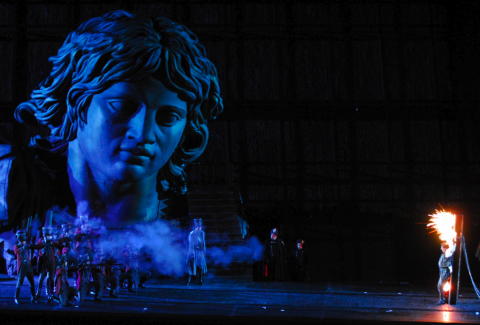 Cavaradossi's execution at the Castel Sant'Angelo from Act III of Puccini's 'Tosca' at the Verona Arena. Photo © 2008 Maurizio Brenzoni.
My review of Tosca from the Verona Arena is here, on Music and Vision.
Wednesday, 6 August 2008
Verona Arena
Labels:
feature article
The first opera to be performed in Verona Arena was Aida in 1913, staged to commemorate the centenary of Verdi's birth. Since then there have been 517 performances of Aida. The opera has been performed every year but one since 1980, it has been performed in over 40 seasons since 1946 but prior to that there were performances of Aida in just 1913, 1920, 1927 and 1936. In fact, since the 2nd World War the Arena seems to have become something of an Aida industry.
The count of performances since 1913 for the top 10 operas is quite revealing, with Aida leading by far:-
Aida = 517
Carmen = 177
Nabucco = 157
Turandot = 108
La Traviata = 90
Rigoletto = 85
Tosca = 82
Cavelleria Rusticana = 76
Il Trovatore = 74
La Boheme = 72
Apart from Aida leading by a long way, the list reveals other things. It includes most (but not all) of the really popular 19th/early 20th century operas, and the selection is not just restricted to operas which would seem suitable for large scale performance. Some of the opera selection inevitably reflects the venue's Italian location, I'm not sure that a comparable English venture would have so many performances of Nabucco. And the absence of Otello from the top 10 possibly reflects the difficulty of casting the title role in such a large venue.
Whereas before the 2nd War the repertoire was quite varied, it now seems to be approaching ossification. This year's operas were Aida, Rigoletto, Nabucco, Tosca and Carmen. Next year's operas are Aida, Il Barbiere di Siviglia, Turandot, Tosca and Carmen.
The last time the Arena stage an opera for the first time was in 1999 when they performed Lehar's La Vedova Allegra (The Merry Widow). Prior to that it was I Lombardi in 1984 and Attila in 1985. An opera like Attila would seem to be ideal for the Arena. Similarly Don Carlo (1969, 1992), Boris Goudonov (1930, 1952, 1976) and Samson et Dalila (1921, 1974) would seem to be ideal for Arena performance. In fact I am quite puzzled at why Samson et Dalila has been performed so little, it would seem to be ideally constructed for Verona Arena; but again this probably represents different attitudes and preferences.
Perhaps, also, economics has something to do with it, with the Arena being dependent on attracting punters; and many punters are those for whom opera going is not a regular activity. The Arena is simply too big to rely on opera fanatics.
But it hasn't always been so. In its first 40 years the arena performed a selection of lesser known operas by Catalani, Ponchielli, Zandonai, Boito, Spontini and Meyerbeer. In fact Callas's famous debut was in La Gioconda in 1947.
But in addition to the less well known Italian repertoire, the Arena also staged Wagner: Parsifal (1924), I Maestri Cantori (1931), La Walkiria (1950), Tannhauser (1936) and Lohengrin (1922, 1933, 1949, 1963).
An opera like Lohengrin would have seemed ideal. But then other thoughts occur. If Tosca lasts from 9pm to midnight, how long would a performance of a Wagner opera take?
It would be nice to see the Arena becoming a little more adventurous occasionally, if only because the performing space would seem to lend itself to a wider variety of opera than is performed at present
The count of performances since 1913 for the top 10 operas is quite revealing, with Aida leading by far:-
Aida = 517
Carmen = 177
Nabucco = 157
Turandot = 108
La Traviata = 90
Rigoletto = 85
Tosca = 82
Cavelleria Rusticana = 76
Il Trovatore = 74
La Boheme = 72
Apart from Aida leading by a long way, the list reveals other things. It includes most (but not all) of the really popular 19th/early 20th century operas, and the selection is not just restricted to operas which would seem suitable for large scale performance. Some of the opera selection inevitably reflects the venue's Italian location, I'm not sure that a comparable English venture would have so many performances of Nabucco. And the absence of Otello from the top 10 possibly reflects the difficulty of casting the title role in such a large venue.
Whereas before the 2nd War the repertoire was quite varied, it now seems to be approaching ossification. This year's operas were Aida, Rigoletto, Nabucco, Tosca and Carmen. Next year's operas are Aida, Il Barbiere di Siviglia, Turandot, Tosca and Carmen.
The last time the Arena stage an opera for the first time was in 1999 when they performed Lehar's La Vedova Allegra (The Merry Widow). Prior to that it was I Lombardi in 1984 and Attila in 1985. An opera like Attila would seem to be ideal for the Arena. Similarly Don Carlo (1969, 1992), Boris Goudonov (1930, 1952, 1976) and Samson et Dalila (1921, 1974) would seem to be ideal for Arena performance. In fact I am quite puzzled at why Samson et Dalila has been performed so little, it would seem to be ideally constructed for Verona Arena; but again this probably represents different attitudes and preferences.
Perhaps, also, economics has something to do with it, with the Arena being dependent on attracting punters; and many punters are those for whom opera going is not a regular activity. The Arena is simply too big to rely on opera fanatics.
But it hasn't always been so. In its first 40 years the arena performed a selection of lesser known operas by Catalani, Ponchielli, Zandonai, Boito, Spontini and Meyerbeer. In fact Callas's famous debut was in La Gioconda in 1947.
But in addition to the less well known Italian repertoire, the Arena also staged Wagner: Parsifal (1924), I Maestri Cantori (1931), La Walkiria (1950), Tannhauser (1936) and Lohengrin (1922, 1933, 1949, 1963).
An opera like Lohengrin would have seemed ideal. But then other thoughts occur. If Tosca lasts from 9pm to midnight, how long would a performance of a Wagner opera take?
It would be nice to see the Arena becoming a little more adventurous occasionally, if only because the performing space would seem to lend itself to a wider variety of opera than is performed at present
Tuesday, 5 August 2008
Farewell Ian Partridge
Labels:
preview
Veteran tenor Ian Partridge will be giving his final performance at the Oxford Lieder Festival in October 2008. Partridge started his singing career as a chorister at New College Oxford some 60 years ago. Partridge will be performing a selection of his favourite songs.
Back from Verona
Labels:
diary
This last weekend we were in Verona where we attended the final performance this year of Hugo De Ana's production of Tosca at the opera (to be reviewed in due course) and sang with London Concord Singers in 3 performances. My motet Deus in Adjutorium received its Italian premiere at a concert at the Church of St. Nicolo and St. Severo in Bardolino on Saturday 1st August and went on to receive a 2nd performance at Mass on Sunday 2nd August at St. Giorgio in Briada in Verona.
Our concert in Bardolino featured Alberto Ginastera's Lamentations and in the audience was a man who had sung in the work's première in 1946! On Sunday evening we sang at San Tomaso en Cantuarense in Verona, on whose organ Mozart had improvised.
On our way back from Verona we managed to call in at Bergamo where we saw the house where Donizetti died. We also saw the tombs of Donizetti and Simone Mayr (his teacher) in the Basilica in Bergamo
Our concert in Bardolino featured Alberto Ginastera's Lamentations and in the audience was a man who had sung in the work's première in 1946! On Sunday evening we sang at San Tomaso en Cantuarense in Verona, on whose organ Mozart had improvised.
On our way back from Verona we managed to call in at Bergamo where we saw the house where Donizetti died. We also saw the tombs of Donizetti and Simone Mayr (his teacher) in the Basilica in Bergamo
Wednesday, 30 July 2008
Prom 16
Labels:
concert review
I did my degree in Manchester in the 1970's a few years after Barbirolli's death when his place at the helm of the Halle Orchestra had been taken by James Loughran. Whilst Loughran did a sterling job, it has taken until now for the orchestra to really recapture the form that had under Barbirolli. Since Sir Mark Elder took over in 2000 the orchestra has been in brilliant shape. Their Prom last night showed them to be delivering a remarkable consistency of tone throughout the whole orchestra. I'm not quite sure what exactly the 'new' Halle sound is like, but it is certainly impressive, musical and beautifully textured.
For their Proms visit Elder and the orchestra chose to perform the RVW Symphony (no. 8) which they had premièred under Barbirolli in 1958. But Elder started with a poised and finely textured account of Butterworth's rhapsody A Shropshire Lad. From the very first notes this was spine tingling stuff, only marred by the rather inept delivery of a selection of the poems before and after the rhapsody. It was a nice idea to include the poems but having them declaimed in poor demotic by a pair of young actors, whose main experience would seem to be in TV soaps, was not a good idea.
The RVW performance was similarly beautifully controlled, where necessary, so that the string Cavatina was finely shaped and very consistent whereas the wind and brass only scherzo displayed a fine appreciation of RVW's humour. In the outer movements the percussion section gave vent to RVW's lively percussion parts, making the tuned percussion elements more noticeable and more extravagant than I remember from Hickox and the Philharmonia's recent performance. Which is certainly a good thing, late RVW contains quite a few fascinating experiments with textures and timbres.
After the interval we had a performance of the 1st violin concerto by RVW's teacher, Bruch. Janine Jansen was the poised soloist, spinning out Bruch's long lines. This was a fine performance, but which have many of the RVW outings been coupled with serious 19th century Romantic beasts. The last concert we went to included Rachmaninov's 1st Piano concerto and next week RVW's Piano Concerto is coupled with Rimsky Korsakov's Scheherezade. I've no objections to these works, but couldn't we have had some RVW symphonic pieces coupled with something a little riskier and spikier.
The concert concluded with a lively and witty performance of Strauss's Til Eulenspiegel with Elder showing what a fine Strauss conductor he is.
For their Proms visit Elder and the orchestra chose to perform the RVW Symphony (no. 8) which they had premièred under Barbirolli in 1958. But Elder started with a poised and finely textured account of Butterworth's rhapsody A Shropshire Lad. From the very first notes this was spine tingling stuff, only marred by the rather inept delivery of a selection of the poems before and after the rhapsody. It was a nice idea to include the poems but having them declaimed in poor demotic by a pair of young actors, whose main experience would seem to be in TV soaps, was not a good idea.
The RVW performance was similarly beautifully controlled, where necessary, so that the string Cavatina was finely shaped and very consistent whereas the wind and brass only scherzo displayed a fine appreciation of RVW's humour. In the outer movements the percussion section gave vent to RVW's lively percussion parts, making the tuned percussion elements more noticeable and more extravagant than I remember from Hickox and the Philharmonia's recent performance. Which is certainly a good thing, late RVW contains quite a few fascinating experiments with textures and timbres.
After the interval we had a performance of the 1st violin concerto by RVW's teacher, Bruch. Janine Jansen was the poised soloist, spinning out Bruch's long lines. This was a fine performance, but which have many of the RVW outings been coupled with serious 19th century Romantic beasts. The last concert we went to included Rachmaninov's 1st Piano concerto and next week RVW's Piano Concerto is coupled with Rimsky Korsakov's Scheherezade. I've no objections to these works, but couldn't we have had some RVW symphonic pieces coupled with something a little riskier and spikier.
The concert concluded with a lively and witty performance of Strauss's Til Eulenspiegel with Elder showing what a fine Strauss conductor he is.
Self referential
The blogosphere is endlessly self-referential, with links to other sites linking ultimately back to the one you first thought of. There's a link to my posting about Prom 10 on the MyChordSpace blog, an interesting music blog worth exploring.
Monday, 28 July 2008
Half-way there
Labels:
music news
I am currently working on the motet Benedicat sit Sancta Trinitas, setting the words from the Introit for Trinity Sunday, when complete this will be the 35th motet which I have written in my sequence Tempus per Annum. When complete the sequence of motets contain some 70 motets setting the texts (in Latin and in English) of the introits for the Sundays and major Feasts of the church's year. Currently Volume 1 is complete (covering Advent and Christmastide). Volume 2 is nearing completion (just 3 to go) and covers Lent, Eastertide, Ascension and Pentecost. The final volume (with some 34 motets) will cover the 32 Sundays of Ordinary time plus a couple of major feasts.
Recent CD Review
Labels:
cd review
My review of a disc of Carissimi motets performed by a remarkable high counter-tenor is here, on MusicWeb International.
Crowe gives strikingly committed performances ...
Crowe gives strikingly committed performances ...
Saturday, 26 July 2008
Friday, 25 July 2008
Prom 10
Labels:
concert review
To the Royal Albert Hall last night for Prom 10, performed by the BBC Philharmonic Orchestra, Yevgeny Sudbin (piano) and Yan Pascal Tortelier (conductor). The programme consisted of Bax's In memoriam, Rachmaninov's 1st Piano Concerto and Vaughan Williams's 4th Symphony.
The Bax has long been known in short score but it was assumed that Bax had never orchestrated it. It was written in memory of an Irish Patriot who died in the Easter Uprising. Not surprisingly there was no performance during Bax's lifetime. In 1998 a full score came to light in a publisher's basement! The piece has been recorded but never performed in public. It proved to be a highly atmospheric piece, to my ears very reminiscent of Hamilton Harty's Irish themed tone poems.
Sudbin gave a highly poetic account of the solo part in the Rachmaninov, proving himself well able to stay on top of the cascades of notes. The results were dazzling, though there were moments when Tortelier allowed the robust orchestration to dominate the piano. I would have liked a bit more robust rawness in Sudbin's playing, but his account erred on the positive side.
In the 2nd half we had RVW's corruscating symphony in a performance which took no prisoners. From the opening dissonant motto theme, it was obvious that Tortelier's account of the score was one which emphasised the European links of RVW's music and played down the pastoral English element which is still present even in this symphony. In the 2nd movement Tortelier conjured an eerie world which was extremely reminiscent of the bi-tonal scores of RVW's friend Holst. For the finale the orchestra finished the performance is towering form. Their and Tortelier's account seemed to play up the dissonant, hard edged side of the score which played up its links with European music. A terrific performance and a fabulous slant on a familiar work.
The Bax has long been known in short score but it was assumed that Bax had never orchestrated it. It was written in memory of an Irish Patriot who died in the Easter Uprising. Not surprisingly there was no performance during Bax's lifetime. In 1998 a full score came to light in a publisher's basement! The piece has been recorded but never performed in public. It proved to be a highly atmospheric piece, to my ears very reminiscent of Hamilton Harty's Irish themed tone poems.
Sudbin gave a highly poetic account of the solo part in the Rachmaninov, proving himself well able to stay on top of the cascades of notes. The results were dazzling, though there were moments when Tortelier allowed the robust orchestration to dominate the piano. I would have liked a bit more robust rawness in Sudbin's playing, but his account erred on the positive side.
In the 2nd half we had RVW's corruscating symphony in a performance which took no prisoners. From the opening dissonant motto theme, it was obvious that Tortelier's account of the score was one which emphasised the European links of RVW's music and played down the pastoral English element which is still present even in this symphony. In the 2nd movement Tortelier conjured an eerie world which was extremely reminiscent of the bi-tonal scores of RVW's friend Holst. For the finale the orchestra finished the performance is towering form. Their and Tortelier's account seemed to play up the dissonant, hard edged side of the score which played up its links with European music. A terrific performance and a fabulous slant on a familiar work.
Tuesday, 22 July 2008
This time next year
Labels:
feature article,
opera
We have just booked some opera tickets for the Santa Fe Festival (Christine Brewer in Alceste and Natalie Dessay's first La Traviata plus Tom Ford’s opera designing debut). For 2009! This seems to be part of a growing trend, the stretching out of booking periods so that for popular events you can find yourself booking for a ridiculously long period in advance.
In the case of Santa Fe, this is understandable; it encourages this year’s festival goers to sign up for next year’s tickets whilst they are at this year’s festival. But organisations such as the Royal Opera House and English National Opera seem to be putting longer lead times on their advanced booking. And ENO seems to have reduced its number of booking periods, so that you find yourself booking for longer stretches of time.
Some of the other UK opera companies seem to have adopted the yearly booking strategy; we have just booked tickets for Scottish Opera for May 2009 (Massenet’s Manon with Anne Sophie Duprels and Paul Charles Clarke). This yearly booking cycle is one used by the Barbican’s Great Performer’s Season, so that in early Spring each year we find ourselves booking for the following season, which might run until June/July the following year.
Why book so early, you ask yourself?
Partly it’s because you can. If you don’t book early then you stand a chance on missing out on the better seats. As an example, we normally sit in the cheaper front seats in the stalls at the Barbican. We like the closeness. But if we don’t book soon after booking opens, then we either miss these seats or end up sitting further away or at the side.
This ends up becoming a self fulfilling cycle, companies open booking earlier so people book earlier; certainly a case of supply generating demand. The only benefit would seem to be in the companies’ bank accounts where they get their income earlier.
By contrast, a number of the continental opera companies still operate the old system whereby booking opens a fixed period before the first performance of the opera. This system though, I suspect, may gradually give way under pressure from the internet.
People want on-line internet booking so that they can choose their own seats; we certainly prefer this and are prepared to wait for it in some cases. But when companies move to this method of booking, you can find that their whole model of booking changes. The other area where the UK, well at least London, differs from many Continental houses is that on mainland Europe subscriptions are still a vital point.
The end result of all this is that I have already bought my 2009 diary and have a clear idea about my main holidays in 2009 (Scotland in May and Santa Fe in August). It also means that increasingly we have a very expensive cache of tickets sitting in our in-box. But the main casualty is that spontaneity can go out of the window.<
In the case of Santa Fe, this is understandable; it encourages this year’s festival goers to sign up for next year’s tickets whilst they are at this year’s festival. But organisations such as the Royal Opera House and English National Opera seem to be putting longer lead times on their advanced booking. And ENO seems to have reduced its number of booking periods, so that you find yourself booking for longer stretches of time.
Some of the other UK opera companies seem to have adopted the yearly booking strategy; we have just booked tickets for Scottish Opera for May 2009 (Massenet’s Manon with Anne Sophie Duprels and Paul Charles Clarke). This yearly booking cycle is one used by the Barbican’s Great Performer’s Season, so that in early Spring each year we find ourselves booking for the following season, which might run until June/July the following year.
Why book so early, you ask yourself?
Partly it’s because you can. If you don’t book early then you stand a chance on missing out on the better seats. As an example, we normally sit in the cheaper front seats in the stalls at the Barbican. We like the closeness. But if we don’t book soon after booking opens, then we either miss these seats or end up sitting further away or at the side.
This ends up becoming a self fulfilling cycle, companies open booking earlier so people book earlier; certainly a case of supply generating demand. The only benefit would seem to be in the companies’ bank accounts where they get their income earlier.
By contrast, a number of the continental opera companies still operate the old system whereby booking opens a fixed period before the first performance of the opera. This system though, I suspect, may gradually give way under pressure from the internet.
People want on-line internet booking so that they can choose their own seats; we certainly prefer this and are prepared to wait for it in some cases. But when companies move to this method of booking, you can find that their whole model of booking changes. The other area where the UK, well at least London, differs from many Continental houses is that on mainland Europe subscriptions are still a vital point.
The end result of all this is that I have already bought my 2009 diary and have a clear idea about my main holidays in 2009 (Scotland in May and Santa Fe in August). It also means that increasingly we have a very expensive cache of tickets sitting in our in-box. But the main casualty is that spontaneity can go out of the window.<
Subscribe to:
Posts (Atom)
Popular Posts this month
-
.jpg) Britten: Violin Concerto - Simone Lamsma, Andrew Manze, Royal Liverpool Philharmonic - BBC Proms (Photo: BBC/ Chris Christodoulou) Vaughan...
Britten: Violin Concerto - Simone Lamsma, Andrew Manze, Royal Liverpool Philharmonic - BBC Proms (Photo: BBC/ Chris Christodoulou) Vaughan... -
 A drawing of Joyce (with eyepatch) by Djuna Barnes from 1922, the year in which Joyce began the 17-year task of writing Finnegans Wake Alast...
 -
 Edward Longstaff: The History of Mr. Polly: Part One - Robin Bailey - Tête à Tête: The Opera Festival at the Cockpit (Photo Claire Shovelto...
 -
.jpg) Bach: Mass in B Minor - Arcangelo - BBC Proms (Photo: BBC / Chris Christodoulou) Bach: Mass in B minor ; Jeanine De Bique, Eva Zaïcik, Hugh...
Bach: Mass in B Minor - Arcangelo - BBC Proms (Photo: BBC / Chris Christodoulou) Bach: Mass in B minor ; Jeanine De Bique, Eva Zaïcik, Hugh... -
 Fromental Halévy (1799-1862) was one of the mainstays of French opera in the 19th century. A pupil of Cherubini, his opera La Juive (1835) w...
 -
 Gerald Finzi: The Dance Continued, recording session - Nick Pritchard, Ian Tindale [Photo: Jan Capinski] Gerald Finzi is a composer whose m...
 -
 Patrick Lange Opera North 's forthcoming Autumn season has an interesting element of compare and contrast to it. Patrick Nolan's new...
 -
 National Children’s Choir of Great Britain's Blue Choir & Soundabout in workshop (Photo: Milly March) A collaboration between the Na...
 -
 The Red House, Aldeburgh (Photo: Britten Pears Arts) Highlights of this very special weekend (Friday-Sunday, 4th-6th December) honouring the...
 -
 Handel's Italians : Italian castrati in the London oratorios - music from Handel's Esther, Deborah, Athalia, Belshazzar, Messiah,...