Thursday, 12 May 2016

New audiences and alternative classical musics - the 2016 RPS Music Awards

Graham Vick presented with Honorary Membership of the Royal Philharmonic Society by John Gilhooly at the RPS Music Awards, 10 May photo credit - Simon Jay Price
Graham Vick (right) presented with Honorary Membership of the Royal Philharmonic Society by John Gilhooly (left)
at the RPS Music Awards, 10 May. photo credit - Simon Jay Price
The winners of the 2016 Royal Philharmonic Society (RPS) Music Awards were announced on Tuesday 10 May 2016, and a remarkable group of artists has been honoured. What was particularly striking was the vein of alternative approaches to classical music and to audiences, which threaded its way through the awards. 

Katy Whitley and Chris Stark of Multi-Story, winner of the RPS Music Award for Audiences and Engagement photographed at the RPS Music Awards in London Tuesday 10 May photo credit Simon Jay Price
Katy Whitley & Chris Stark of Multi-Story, winner of the
RPS Music Award for Audiences and Engagement
photo credit Simon Jay Price
Opera director Graham Vick was made an honorary member of the RPS. Vick is a director who has become known for his more community based approach to opera production with his Birmingham Opera Company, taking performances out of the theatre. In his address he said that 'Music effects change by touching humanity. Through music we can harness and share the richness of cultural background and identity, the breadth of life experience and alternative perspectives available in our expanding communities and enrich all our understanding'.

Also taking music out of its usual venue is Multi-Story who received the RPS Music Award for Audiences and Engagement for its concert season in the Bold Tendencies car park in Peckham. And Michael Church collected the RPS Music Award for Creative Communication for the book The Other Classical Musics (Boydell Press) which he edited, presenting a range of different classical musics from various traditions.

Young artists and learning were also at the forefront, with pianist Clare Hammond (whose 2015 schedule included world premiere performances and her film debut as the younger incarnation of Maggie Smith’s character, Miss Shepherd, in The Lady in the Van) taking the RPS Music Award for Young Artists with the jury commending her support for contemporary repertoire. The National Youth Orchestra of Great Britain took the Ensemble aware for its 'campaign to engage hundreds more teenagers with the orchestra', and Tri-borough Music Hub won the Learning and Participation Award for a retelling of the Persephone Myth, Seven Seeds, (music John Barber; libretto Hazel Gould) which involved 1200 young singers and performers from three London boroughs alongside several leading ensembles.

Going from strength to strength - Saffron Hall's 2016-17 season

Vladimir Jurowski & the London Philharmonic Orchestra at Saffron Hall - photo Roger King
Saffron Hall seems to be going from strength to strength. Attendance at the hall has tripled in just two seasons, and they have just announced a strong 2016-17 season. I went along to hear chief executive Angela Dixon’s presentation of the new season, which took place at an evening for the hall’s members (on 9 May 2016), a testament to the growth of local support. We were also treated to music from two of the young artists appearing in concert during the 2016-17 season, guitarist Sean Shibe and pianist Richard Uttley. Sean Shibe played two fantasies by John Dowland and movements from Walton’s Five bagatelles, whilst Richard Uttley gave us a Chopin nocturne and Mark Simpson’s Barkham Fantasy which was written specially for Uttley (see my review of Uttley's recording of the work). Both artists' performances showed off the hall's critically acclaimed acoustics, achieving a real intimacy of sound.

The 2016-17 season will be opened by Vladimir Jurowski and the London Philharmonic Orchestra, with violinist Nicola Benedetti. The LPO is one of a number of major groups who are returning to play at the hall, and the season also sees the return of the English Concert directed by Rachel Podger. Other major groups include Edward Gardner and the Bergen Philharmonic Orchestra whose programme includes Leonard Elschenbroich performing Elgar’s Cello Concerto, plus Yurki Temirkanov and the St Peterburg Philharmonic Orchestra who will be joined by Nikolai Lugansky in Rachmaninov’s Rhapsody on the theme of Paganini. Paul McCreesh and the Gabrieli Consort will make their Saffron Hall debut with Bach’s Easter Oratorio.

As the hall is based within Saffron Walden County High School, Education plays a large part in the hall’s programme, so that Nicola Benedetti doesn’t just perform but works with the local school children. Last season as a result of one of her sessions she inspired a group of children to work on with the hall sponsoring them for lessons. Whilst Gabrieli are at the hall there will be a project with Gabrieli Roar which hopes to get the entire school singing!

Wednesday, 11 May 2016

Strength, discipline & delicacy - Alexandra Dariescu, Fabien Gabel and RPO

Alexandra Dariescu
Borodin, Rachmaninov, Tchaikovsky; Alexandra Dariescu, Royal Philharmonic Orchestra, Fabien Gabel; Cadogan Hall
Reviewed by Robert Hugill on May 11 2016
Star rating: 4.0

Exciting all Russian programme vividly performed

A very full platform at the Cadogan Hall on 10 May 2016 saw the Royal Philharmonic Orchestra performing a programme of large-scale Russian music with Borodin’s overture to Prince Igor, Rachmaninov’s Rhapsody on a Theme of Paganini and Tchaikovsky’s Symphony No. 5. The orchestra was conducted by the young French conductor Fabien Gabel who is music director of the Quebec Symphony Orchestra, and they were joined in the Rachmaninov by the pianist Alexandra Dariescu.

Fabien Gabel -  photo Gaetan Bernard
Fabien Gabel -  photo Gaetan Bernard
Borodin’s overture to Prince Igor is perhaps a misnomer, what we hear is Glazounov’s reconstruction of the work based on his memories of Borodin playing it through on the piano and on Borodin’s sketches. Whatever its origins, it makes an exciting concert opener particularly in a performance like that of the Royal Philharmonic Orchestra as under Gabel’s vivid direction they combined vibrancy with crisp discipline. Fabien Gabel is a very expressive conductor, his gestures expansive and clearly the orchestra responded as he drew tightly disciplined yet exciting performances from them in all three works. This was not an evening which explored that dark depths of the Russian soul, instead Gabel drew out the feeling of classicism in the music, allied to a lovely sweep whenever composers gave the strings a powerful melody.

I last heard Alexandra Dariescu performing with the Royal Philharmonic Orchestra in 2014 when, on tour to Grimsby, they performed Tchaikovsky’s Piano Concerto No.1, so it was a great treat to hear them in another dramatic Russian showcase. The work was written after Rachmaninov left Russia after the Revolution, but it has Russia in its soul notwithstanding the Paganini links. Dariescu made a strong impression from the striking opening chords, and her initial variations had great firmness of touch with great clarity in the fast fingerwork as well as wit. There was a corresponding admirable sense of detail from Gabel and the orchestra. He made the build up to the slower middle variations seem one of constant anticipation. There were, however, a couple of moments when he could have done with reining the orchestra in more, as their lively contributions masked Dariescu’s passagework. The slower section had a lovely languorous quality to it, and Dariescu showed that she had sensitivity in her fingers as well a strength. The performance from both her and the orchestra was a study in contrasts, delicacy v strength, lyricism v forceful articulation, romantic gestures v sly wit. A darkly mysterious section led up to the big tune, which was finely poetic and flexible. Then it was back to the dazzling fingerwork and exciting articulation. A sense of build up let to the outrageous fistfuls of notes at the finish.

How to be HIP - from listening to Adelina Patti to an 18th century Scots dance band

Clare Salaman
Clare Salaman
Study Day: How to be HIP – Historically Informed Performance; Here and Now, Why and How; Richard Wistreich, Stevie Wishart, David McGuiness, Clare Salaman; Kings Place
Reviewed by Robert Hugill on May 7 2016
Absorbing day discussing how historically informed practice can intersect with modern perceptions.

As part of its Baroque Unwrapped season, Kings Place had a study day on 7 May 2016. Though the title might have been cumbersome, Study Day: How to be HIP – Historically Informed Performance; Here and Now, Why and How, the content was fascinating and full of insights into contemporary practice in period performance. 

Richard Wistreich
Richard Wistreich
Richard Wistreich, founder of Red Byrd and Director of Research at the Royal College of Music, talked about Reconstructing Historical Singing – Reality or Fantasy? - the challenge of 'historic singing' in a contemporary environment. In Improvising the Past Stevie Wishart, composer, improviser and instrumentalist, both talked and played as she showed us how she re-creates the music of the past. Whilst David McGuinness, director of Concerto Caledonia, asked the question Is Early Music Classical?, questioning whether the musical lives of the original performers might be better reflected elsewhere in our present-day culture. The day was presided over by Clare Salaman, multi-instrumentalist and director of The Society of Strange and Ancient Instruments, and all four took part in panel discussions and a final Q&A.

Richard Wistreich started by playing two recordings, the baritone Alberto del Campo singing an extract from Bellini's La Sonnambula recorded 118 years ago in 1898, and the rather better known recording of soprano Adelina Patti singing Voi que sapete recorded in 1905 (you can hear the recording on YouTube). He asked whether we can hear echoes of the singers' teachers in these (and the teachers teachers). The Patti recording in particular is known because Patti's performance seems bizarre to us today and has been dismissed as the aberration of a singer who was past it (she was 62 when it was recorded and had been retired for 10 years). But when Patti heard the recording she loved it, unlike many singers from the period hearing themselves for the first time, and most of what she does in the recording can be linked to historical texts. So can we see her lack of vibrato, use of glissandos, portamentos, rallentandos, mid-phrase accelerandos, appogiaturas and register changes as being an echo of 19th century style rather than an old woman's drift towards Florence Foster Jenkins?

Mozart in the Marches - somewhere for the weekend

Whittington Castle - photo David Preston
Whittington International Chamber Music Festival is dedicating itself to Mozart this year, with a week of his chamber music from 17 - 22 May 2016 in the Shropshire town. Under the artistic directorship of cellist James Barrelet, the festival is now in its fourth year with previous festivals having been devoted to Brahms, to Schumann, and to Mendelssohn. There are six concerts which concentrate, no on Mozart's string quartets, but on the plenitude of other chamber music he wrote so that there are string trios, piano trios, quartets & quintets, an oboe quartet, horn quintet, piano quintet, and six of the string quintets, plus arrangements for piano and string quartet of two of the piano concertos.

The performers are a group of young artists many of whom are playing throughout the festival, a format which enables audience members to really get to know players. The performers this year come from a wide variety of countries providing a fine international flavour and include artistic director & cellist James Barralet (UK), violinist Kristine Balanas (Latvia), bassoonist Joost Bosdijk (Holland), cellist Nathaniel Boyd (UK), violinist Bogdan Božović (Serbia), pianist Simon Callaghan (UK), violinist Tim Crawford (UK), pianist Caspar Frantz (Germany), violist Léa Hennino (France), violist Mark Holloway (USA), violinist Laura Lutzke (USA), clarinetist Chris Richards (UK), cellist Ditta Rohmann (Hungary), oboist Olivier Stankiewicz (France), violist Rosalind Ventris (UK) and horn player Katy Woolley (UK).

There is free admission to the concerts for 8 to 25 year olds. Full details from the festival website.

Tuesday, 10 May 2016

Beethoven, Dvorak and a constellation - Trio Celeste

Trio Celeste
Beethoven, Dvorak, Eugene Drucker, Mike Block, Eric Guinvan, Peter Erskine, Paul Dooley, Fred Hersch, Samuel Adler, Jim Scully, Christina Sinei, Pierre Jalbert; Trio Celeste; Navona Records
Reviewed by Robert Hugill on May 6 2016
Star rating: 3.5

Beethoven, Dvorak and a constellation of new commissions for piano trio

Trio Celeste is a young American piano trio (Iryna Krechkovsky, Ross Gasworth, Kevin Kwan Loucks), and on this eponymous disc from Navona Records they perform two classics of the piano trio repertoire, Beethoven's Piano trio in G major, Op.1 No.2 and Dvorak's Piano Trio No. 4, Op.90 'Dumky'. Rather than linking the two with a third classic work the trio instead include a set of variations commissioned from 10 contemporary composers. Based on the opening theme of the slow movement of Beethoven's trio, Constellations: Variations on a theme of Beethoven features short variations by Eugene Drucker, Mike Block, Eric Guinvan, Peter Erskine, Paul Dooley, Fred Hersch, Samuel Adler, Jim Scully, Christina Sinei and Pierre Jalbert.

Beethoven's opus 1 piano trios were his first major work, and Beethoven was still writing in the piano trio form inherited from Mozart, where the structure of the piece was only beginning to be liberated from the earlier accompanied sonata. The piano is often still dominant here, and there is a long was to go to having the three equal parts of Dvorak's trio, though Beethoven's final piano trio, the Archduke, would show the way.

The invention of 'genocide' and a shared passion for music - A Song of Good and Evil

A Song of Good and Evil at Berwald Hallen, Stockholm with Philippe Sands, Emma Pallant
A Song of Good and Evil at the Berwald Hallen, Stockholm
with Philippe Sands, Emma Pallant
When I talked to director Nina Brazier last year (see my interview) she was preparing for performances of A Song of Good and Evil in Nuremberg at the Palace of Justice on the 70th anniversary of the Nuremberg trials, a performance which had great resonance as the work deals with the conflict and connections between three men at the heart of the Nuremberg trials - Cambridge academic Hersch Lauterpacht (who came up with the phrase Crimes against Humanity), Polish prosecutor Raphael Lemkin (who invented the word Genocide), and Hitler’s lawyer Hans Frank. All three men had a shared passion for music.

Written by the international human rights lawyer Philippe Sands, A Song of Good and Evil mixes spoken narrative with live performance of music by Bach, Beethoven, Rachmaninoff, Misraki and Leonard Cohen to create a personal exploration of the origins of modern justice and the fate of individuals and groups.

The production has been touring extensively and returns to London for a short run at Kings Place on 16 to 18 May 2016. At Kings Place, Philippe Sands will be joined by renowned German actress Katja Riemann (making her London debut) as co-narrator, plus bass-baritone Laurent Naouri and jazz pianist Guillaume de Chassy. There is a short Q&A session with the performers hosted by Jon Snow following Wednesday’s performance .


Full information from the Kings Place website.

Monday, 9 May 2016

Guildhall Gold Medal Winner - Oliver Wass

Oliver Wass
Harpist Oliver Wass has won the 2016 Gold Medal from the Guildhall School of Music and Drama, the School’s most prestigious prize for outstanding soloists. The prize is awarded to singers and instrumentalists in alternate years and this year was the turn of the instrumentalists. Oliver Wass’ winning performance was Ginastera’s Concerto for Harp and was accompanied by the Guildhall Symphony Orchestra, conducted by Adrian Leaper. The other Gold Medal finalists were Antonina Suhanova and Scott MacIsaac.

Oliver Wass is in his first year of a Masters degree at the Guildhall School, for which he was awarded a full scholarship to study with Imogen Barford. He graduated from the University of York with a First Class Honours degree, achieving the highest mark ever awarded for a final recital, and winning the Blake Music Prize. Wass was recently announced as one of St John's Smith Square's young artists for 2016-2017

Stravinsky - thirty-eight works across nine concerts

The Great Sacrifice' (original working title for <span class='ital'>The Rite of Spring</span>), preliminary paintings by Nicolas Roerich (1910). © Heritage Image Partnership Ltd / Alamy Stock Photo
The Great Sacrifice (original working title for The Rite of Spring),
preliminary paintings by Nicolas Roerich (1910)
© Heritage Image Partnership Ltd / Alamy Stock Photo
The Philharmonia Orchestra and their Principal Conductor & Artistic Advisor Esa-Pekka Salonen are giving us the opportunity to hear 38 works by Stravinsky spread across nine concerts. Stravinsky Myths and Rituals will include semi-staged versions of Stravinsky's Mavra and Renard directed by Irina Brown, plus a version of Agon choreographed by Karole Armitage and Oedipus Rex directed by Peter Sellers, alongside concert performances of works such as The Rite of Spring and Les Noces and lesser known works like Perséphone, Orpheus and Apollon musagète

At St John's Smith Square there will be a more intimate performance of Stravinsky's sacred music performed by Philharmonia Voices, conductor David Edwards. Partner collaborations include three concerts from the Royal College of Music, and a rush-hour concert from the Southbank Sinfonia, plus all five of the Philharmonia Orchestra's concerts will be broadcast by BBC Radio 3.

Things start on 15 May with Esa-Pekka Salonnen conducting the Philharmonia Orchestra at the Royal Festival Hall and events continue until September.
Full details from the Philharmonia Orchestra's website.

namesErased - new music by Reiko Füting

Reiko Fueting - Names Erased
Reiko Füting namesErased; New Focus
Reviewed by Robert Hugill on Apr 13 2016
Star rating: 4.0

Strongly characterised and intensely wrought chamber and vocal music by this USA-based German-born composer.

The composer Reiko Füting was a name new to me. He was born in the DDR in 1970 and studied at Dresden Conservatory, Rice University, Manhattan School of Music, and Seoul National University. He currently teaches at Manhattan School of Music where he is chair of the theory department. This disc, namesErased, from New Focus Recordings presents us with a selection of Füting's recent vocal and instrumental music.

So we have Kaddish: The art of Losing played by cellist John Popham and pianist Yegor Shevtsov, tanz.tanz played by violinist Miranda Cuckson, leaving without/palimpsest played by Joshua Rubin (clarinet) and Yegor Shevtsov (piano), names, erased (prelude) played by John Popham (cello), ist-Mensch-geworden played by Luna Kang (flutes) & Jing Yang (piano), land-haus-berg played by Yegor Shevtsov (piano), light, asleep played by Olivia de Prato (violin) and David Broome (piano), finden - suchen played by Eric Lamb (alto flute), John Popham (cello), Yegor Shevtsov (piano), and ...und ich bin Dein Spiegel performed by Nani Füting (mezzo-soprano), the Mivos Quartet (Olivia de Prato, Joshua Modney, Victor Lowrie, Mariel Roberts), interspersed with movements from ... gesammeltest Schweigen sung by Nani Füting.

Most of the pieces on the disc seem to have extra-musical or musical connections, either building on pre-existing musical structures of referring to non-musical ones. This might be inferred perhaps from the epigrammatic nature of the title, but there is nothing pastiche-like about Reiko Füting's work, he speaks with a very definite and rather striking music accent.

Sunday, 8 May 2016

Intimate charm - Handel's Acis and Galatea at Kings Place

Auguste Ottin - Polyphemus Surprising Acis and Galatea 1852-63, Luxembourg Gardens
Auguste Ottin
Polyphemus Surprising Acis and Galatea
1852-63, Luxembourg Gardens
Handel Acis and Galatea (Cannon's version); Grace Davidson, Jeremy Budd, Stuart Young, The Sixteen, Harry Christophers
Reviewed by Robert Hugill on May 7 2016
Star rating: 4.5

Pastoral enjoyment as the Sixteen explore Handel's original version

Handel's serenata Acis and Galatea exists in a number of versions, and that most commonly given is based on Handel's expansion of the work for his performances in 1739 (though there is also a larger scale three act version in English and Italian which he created in 1732). But in many ways the original, written for the Duke of Chandos at Cannon's in 1718, is difficult to beat. The Sixteen, conducted by Harry Christophers, gave us the opportunity to hear Handel's 1718 version of Acis and Galatea at Kings Place on 7 May 2016 as part of Kings Place's Baroque Unwrapped season.

Harry Christophers conducted forces similar to those Handel would have used with just five singers as both soloists and chorus, the balance of voices (soprano, three tenors and bass) presumably reflecting what was available in the Duke of Chandos's household. At Kings Place, Grace Davidson was Galatea, Jeremy Budd was Acis, Mark Dobell was Damon, Simon Berridge was Corydon and Stuart Young was Polyphemus with an ensemble of nine instruments.

Harry Christophers' speed for the opening Sinfonia was infectiously fast, immediately involving us in the excitement but there were hints of the speed endangering ensemble. The opening chorus immediately conveyed the pastoral mood and the balance with three tenors in the middle worked well, though Grace Davidson on the top line could have afforded to give a little more. This is a work, like Handel's oratorios, where the words are important and the clarity of diction from the singers was exemplary.

Saturday, 7 May 2016

Cav & Pag in new home

On 13 May 2016, Hampstead Garden Opera (HGO) opens in its new home, Jacksons Lane Theatre, Highgate, N6 5AA. The enterprising company will be giving performances of Cav & Pag, Mascagni's Cavalleria Rusticana and Leoncavallo's Pagliacci. The operas will be sung in David Parry's English translations and directed by Bruno Ravella (his fifth production for the company). Music director Oliver John Ruthven conducts the HGO Orchestra in a reduced orchestration.

The operas are double cast with Michelle Prage and Nina Kanter sharing Santuzza, Jonathan Cook and Laurence Panter as Turiddu, Elisabeth Poirel and Kirsty Anderson as Nedda, Adam Music and Benjie del Rosario as Canio and Michael Craddock and Andrew Sparling as Tonio. There are 10 performances:
Evenings at 7.30 pm – May 13, 14, & 17-21
Matinées at 4.00pm: Sundays May 15 & 22
Matinée at 2.30pm: Saturday May 21

Full details from the Hampstead Garden Opera website.

Side-by-Side - Elgar's Symphony No. 1 from Trinity Laban Symphony Orchestra & members of WNO Orchestra

George Jackson
George Jackson
Elgar Symphony No. 1 Side-by Side; Trinity Laban Symphony Orchestra, members of Welsh National Opera Orchestra, George Jackson; Blackheath Halls, Trinity Laban Conservatoire of Music and Dance
Reviewed by Robert Hugill on May 6 2016
Students playing alongside professionals in an impressive performance assembled in a single, intense day

Playing large-scale mainstream repertoire, and receiving coaching from established professionals are two of the key components in any conservatoire training for orchestral musicians. But Trinity Laban Conservatoire of Music and Dance's Side-by-Side performances put the two together with an added twist; professional musicians play alongside the students and the whole is put together in just one day of intense rehearsal. Jonathan Tilbrook, Trinity Laban's Head of Orchestral Studies, refers to the 'focus and discipline required to prepare a performance in limited rehearsal time' as 'a crucial discipline for the aspiring professional orchestral musician'.

On Friday 6 May 2016 at Blackheath Halls, I heard the fruits of Trinity Laban's latest Side-by-Side project as the Trinity Laban Symphony Orchestra with members of the Welsh National Opera Orchestra performed Elgar's Symphony No. 1, conducted by George Jackson. Jackson is not on the staff of Trinity Laban, he is the Charles Mackerras Junior Conducting Fellow, and won the 2015 Aspen Conducting Prize.

In his spoken introduction to the concert Jonathan Tilbrook pointed out a number of other Mackerras links, Sir Charles was the president of Trinity Laban as well as being a former music director of Welsh National Opera, and he had recorded regularly in Blackheath Halls the last time being his 2006 recording of Humperdinck's Hansel and Gretel. And members of the Mackerras family were in the audience to hear the results of Jackson's impressive achievement marshalling his huge forces in this large scale romantic symphony.

Friday, 6 May 2016

In case you missed it: April on Planet Hugill - Bach at Kings Place, new music in Tallinn, Lucia of Lammermoor

Royal Opera House's new production of Donizetti's Lucia di Lammermoor, photo credit Stephen Cummiskey
Welcome to April on Planet Hugill, where events included our visit to Estonia for the Estonian Music Days.
Opera started with Katie Mitchell's new production of Donizetti's Lucia di Lammermoor at Covent Garden, whilst on a different scale entirely the Drayton Arms presented Euphonia's small scale yet intense account of Gluck's Iphigenie en Tauride. We also heard a concert performance of an exciting rediscovery, Niccolo Jommelli's Il Vologeso performed by Classical Opera, conductor Ian Page.

An evening of English song - Looking forward to the London English Song Festival's summer programme

London English Song Festival
Last year, pianist William Vann and the London English Song Festival gave us RVW's complete songs (see my review of the final concert), and this year they plan to commemorate the 100th anniversary of the Battle of the Somme with Songs of the Somme combining song, film and spoken text. To help launch the 2016 concerts and give us a little taster of what was to come, William Vann accompanied singers Katie Bray and Nicky Spence in a programme of English song from the 19th, 20th and 21st centuries at a private recital on 5 May 2016.

An evening of English song encompassed Walton's A song for the Lord Mayor's table, Madeleine Dring's Business Girls, Judith Weir's Sweet little red feet, Jonathan Dove's Song of the dry organge tree, RVW's When I am dead, my dearest and Parry's My heart is like a singing bird all sung by Katie Bray, and Thomas Dunhill's The cloth of heaven, Roger Quilter's O Mistress Mine, Gustav Holst's The heart worships, Ian Venables' Flying Crooked, Ivor Gurney's In Flanders, Haydn Wood's Roses of Picardy sung by Nicky Spence. The two singers came together at the end in RVW's Dirge for Fidele and as an encore gave us a delightful rendition of Lisa Lehmann's setting of Hillare Belloc's Rebecca - Who Slammed Doors for Fun and Perished Miserably

To give us a taster of their summer concert, the Ivor Gurney and the Haydn Wood were complemented with a reading from Siegfried Sassoon's diary, the entry for 1 July 1911 (the first day of the Battle of the Somme), and a poem by Ivor Gurney. The London English Song Festival will be giving their programme Songs of the Somme at Wilton's Music Hall on 11 to 13 July 2016. William Vann will be joined by mezzo-soprano Katie Bray, tenor Nicky Spence and baritone Nicholas Merryweather for a programme which will include songs by Ivor Gurney (several of whose songs were written on active service, George Butterworth and Frederick Kelly (both of whom were killed at the Somme) as well as popular songs by Haydn Wood, plus readings from Siegfried Sassoon's war diary and poetry by Ivor Gurney. These will be complemented by films from the Imperial War Museum including footage from the film of the Battle of the Somme. As well as the three performances, the London English Song Festival has an associated education programme in association with Wilton's including a performance of Songs of the Somme for local school children, when an interactive element will include a Q&A with the performers.

The Grafenegg Festival - somewhere for the weekend

The Wolkenturm - Grafenegg Festival
The Grafenegg Festival is 10 years old this summer. The festival, based at Grafenegg Castle in Lower Austria, is one of those events where circumstances seem to have just come together, the will to create the festival, the venue, the money and the artistic input. There were celebrations for the birthday at the Austrian Residence in London on 4 May 2016 hosted by the Austrian Ambassador to the Court of St James, Martin Eichinger, a reception attended by Rudolf Buchbinder, artistic director of the festival, and Marshall Marcus, CEO of the European Union Youth Orchestra (EUYO). We learned more about the festival as well as listening to music performed by members of a brass quintet from the EUYO (Matilda Lloyd - trumpet, Tom Griffiths - trumpet, Joel Ashford - horn, Andrew McCoy - trombone, Ross Knight – tuba).

Grafenegg Castle is the historic home of the Metternich family; the current owner is Tassilo Metternich-Sándor and his ancestor is the Prince Metternich who was the architect of the 1815 Vienna Congress. Set in lovely countryside by the Danube, an hour from Vienna, the setting provides local wine, gastronomy and history alongside the music, with a plethora of venues in the castle and grounds. The castle itself provides rehearsal spaces, as well as space for chamber music concerts in the castle courtyard, whilst the auditorium, the riding-school and the Wolkenturm are the three main performance spaces. The Wolkenturm is a spectacular outdoor stage, truly 21st century intervention in the landscape.

Grafenegg Castle
Grafenegg Castle

The delight of having both - A Midsummer Nights Dream

Lucy Thatcher and David North - A Midsummer Night's Dream - © 2016 Celia Bartlett Photography
Lucy Thatcher and David North - A Midsummer Night's Dream  - © 2016 Celia Bartlett Photography
Mendelssohn/Shakespeare A Midsummer Nights Dream; David North, Lucy Thatcher, Nigel Richards, Joe Sleight, Mark Hawkins, Ben Wiggins, Bebe Sanders, Frances McNamee, Rob Hughes, David Edwards, Michael Vivian, Outcry Ensemble, James Henshaw; Temple Music at Middle Temple Hal
Reviewed by Robert Hugill on May 3 2016
Star rating: 4.0

Mendelssohn's incidental music in a lively new production of Shakespeare's play in Middle Temple Hall

Joe Sleight, Sam Townsend and one of the fairies - © 2016 Celia Bartlett Photography
Joe Sleight, Sam Townsend and one of the fairies
 © 2016 Celia Bartlett Photography
Middle Temple Hall's connection to Shakespeare dates back to the playwright's lifetime when we know that As You Like It was performed there, so that the hall is the only surviving venue we have where Shakespeare's plays were performed in his lifetime. Temple Music now puts on a highly regarded concert series in the hall, so in celebration of the Shakespeare 400 anniversary, they presented a performance of Shakespeare's play A Midsummer Night's Dream with Mendelssohn's incidental music, we caught the second performance on 3 May 2016.

The production director was David Edwards, with Michael Vivian directing the play. James Henshaw conducted the Outcry Ensemble, designs were by Colin Mayes with lighting by Mike Lambert. David North was Theseus & Oberon, Lucy Thatcher was Hippolyta & Titania, Joe Sleight was Puck, Nigel Richards was Egeus & Snout, Mark Hawkins was Lysander, Ben Wiggins was Demetrius, Bebe Sanders was Hermia, Frances McNamee was Helena, Rob Hughes was Bottom, Bobby Hirston was Quince, Sam Townsend was Flute, Michael Luxton was Starveling and Scarlett Neville was Snug. Aidan Oliver was the chorus master of the women's chorus, with Jessica Cale and Lucy Goddard singing the solos.

Mendelssohn's music was written to accompany a performance of Shakespeare's play in Potsdam in 1843, utilising the overture which the young Mendelssohn had written in 1826 The music is best known from Mendelssohn's suite and the larger movements, Scherzo, Nocturne, Wedding March are all intended as intermezzos. Additionally there are the two settings of the fairy songs (Ye spotted snakes from Act Two and the final Through the house give glimmering light) plus much incidental music, either linking passages or melodramas, which hardly makes sense out of context. Interestingly, Mendelssohn confines these musical elements to the fairies and the mechanicals (the melodramas are there to enhance the magical moments from Puck and Oberon), the young lovers are played without any musical elements. In this Mendelssohn's technique was remarkably akin to that of Purcell in his semi-operas, where it was only the minor characters or the non-humans who sang.

At Middle Temple Hall, both play and music were cut, the play substantially so and the music slightly, to bring the playing time in at around two hours 20 minutes. But there was the essence of both to give the right idea, and the cutting of the play was probably true to the original Berlin performances as Henry Irving's famous London performances of Shakespeare were always heavily cut.

Thursday, 5 May 2016

Much to admire - ENO 2016-17 Season Launch

Daniel Kramer - photo Tristram Kenton
To say that English National Opera's press launch of its 2016-17 season was eagerly anticipated is very much an understatement. After all the turmoil of the last year, it was some achievement to present such a coherent, interestingly cast season rounded off with a promisingly inspiring speech from the incoming artistic director, Daniel Kramer (who took time out of rehearsals from Tristan and Isolde to appear. The season has been put together by ENO's senior artistic team, led by programming director Bob Holland, and it has all the hallmarks of age and experience. 

There are just four new productions (Richard Jones directing Mozart's Don Giovanni, William Kentridge directing the Berg/Cerha Lulu, Rory Kinnear directing the premiere of Ryan Wigglesworth's The Winter's Tale, and Ron Daniels' production of Daniel Schnyder's Charlie Parker's YARDBIRD), six revivals (Catherine Malfitano's production of Puccini's Tosca, Penny Woolcock's production of Bizet's The Pearl Fishers, Jonathan Miller's production of Verdi's Rigoletto, Mike Leigh's production of The Pirates of Penzance, Christopher Alden's production of Handel's Partenope, and Jonathan Miller's production of The Mikado) and a concert staging (of Elgar's The Dream of Gerontius) with three of these taking place outside the Coliseum as part of an itinerant Summer season whilst the Coliseum is let (for 15 weeks as opposed to the usual eight or nine).

Kramer seems to be coming into things with his eyes open, he will be very much around in the company for the next two years before the first season he programmes (2018-19). In his speech he talked about the transformative power of opera and his keenness to develop new artists, new British talent not just singers, but directors and technical crew. He spoke of his own journey into opera, growing up as a gay man in a Christian household in rural Ohio, and how it is difficult for a theatre director to really make the journey into opera. His own past ENO work, Punch and Judy at the Young Vic and Bluebeard's Castle has not been without controversy but the work has led to new collaborations and he feels he has changed from a theatre director who does some opera, to an opera director who does some theatre.

He clearly has an interest in how the company functions, and was at some pains to emphasise how his ideas build in what is needed following the trauma of recent years.

Temptings at Glyndebourne in 2017

Kate Lindsey (Composer) in Ariadne auf Naxos by Richard Strauss in Katharina Thoma's production at Glyndebourne in 2013. Photograph: Tristram Kenton
Kate Lindsey (Composer) in Ariadne auf Naxos by Richard Strauss in
Katharina Thoma's production at Glyndebourne in 2013.
Photograph: Tristram Kenton
Glyndebourne Opera has announced its 2017 rather earlier than usual, perhaps in order to tantalise us with the delights which are going to be on offer. These include a rare Cavalli opera, with Glyndebourne revisiting its championship of a composer first experience in Raymond Leppard's versions in the 1960s and 1970s, plus a new opera on Hamlet from Australian composer Brett Dean, and the chance to hear Alice Coote and Kate Lindsey in Mozart's La clemenza di Tito. The season also includes a couple of distinguished returnees.

The season opens with the new production of Cavalli's Hipermestra, directed by Graham Vick (returning for his first new staging at Glyndebourne in 17 years), and conducted by William Christie. The opera was premiered in 1656 but was not performed between 1680 and 2006 when it received its modern premiere at the Early Music Festival in Utrecht. The cast includes Emöke Baráth (Hipermestra), Raffaele Pe (Linceo), Renato Dolcini (Danao), Ana Quintans (Elisa), and Benjamin Hulett (Arbante). The plot is based on the Greek legend of Hypermnestra who was the only one of the Danaids (sons of Danaus) who did not kill her husband on their wedding night!

Another new production is the premiere of Brett Dean's Hamlet, directed by the Australian director Neil Armfield, who staged Dean’s first opera Bliss in 2010. Conductor Vladimir Jurowski returns to Glyndebourne for the first time since completing his tenure as music director, and a terrific cast includes Allan Clayton (Hamlet), Sarah Connolly (Gertrude), Barbara Hannigan (Ophelia), Rod Gilfry (Claudius), Kim Begley (Polonius), and John Tomlinson (Ghost of Old Hamlet). Part of me feels that it would have been rather interesting to have staged Ambroise Thomas' very different take on Hamlet in the same season.

The final new production is Mozart's La Clemenza di Tito, only the second time the opera has been staged at Glyndebourne. It will be directed by Claus Guth (director of Covent Garden's 2014 production of Strauss's Die Frau ohne Schatten, see my review), and conducted by Robin Ticciati with another strong cast including Alice Coote as Vitellia plus Steve Davislim (Tito), Kate Lindsey (Sesto), Joélle Harvey (Servilia)

Revivals include Tom Cairns production of Verdi's La Traviata conducted by Richard Farnes with Kristina Mkhitaryan (Violetta), Zach Borichevksy (Alfredo), Igor Golovatenko (Giorgio), Katharina Thoma's production of Strauss's Ariadne auf Naxos (see my review from 2013) conducted by Cornelius Meister with Thomas Allen (Music Master), Lise Davidsen (Ariadne), Angela Brower (Composer), Erin Morley (Zerbinetta), and AJ Glueckert (Bacchus), and Donizetti's Don Pasquale in Mariame Clement's production with Renato Girolami (Don Pasquale), Lisette Oropesa (Norina), Andrew Stenson (Ernesto), and Andrey Zhilikhovsky (Dr Malatesta).

The 2017 Glyndebourne On Tour season will include Brett Dean's Hamlet plus revivals of Mozart's Il barbiere di Sivigla and Mozart's Cosi fan tutte.

Glyndebourne’s Young Composer-in-Residence, Lewis Murphy, will premiere his first main-stage youth opera performed by members of Glyndebourne Youth Opera aged 9-19, whilst other education works includes a major singing project with SoundCity involving secondary schools from across Brighton and Hove and the Tour 2017 Performances for Schools will be offering schools subsidised tickets to see a full-length, fully staged opera.

St John's Smith Square Young Artists 2016/17

St John's Smith Square
St John's Smith Square has announced the members of its Young Artists programme for 2016/17, they are pianist Christina McMaster, the Ensemble Mirage (Matthew Scott clarinet, Julia Pusker violin, Ugne Tiskute viola, Tatiana Chernyshova cello, Alexandra Vaduva piano), the Ferio Saxophone Quartet (Huw Wiggin, Ellie McMurray, Jose Banyuls, Shevaughan Beere), the Minerva Piano Trio (Michal Cwizewcz, Richard Birchall, Annie Yim), harpist Oliver Wass and the Palisander recorder quartet (Hannah St Clair Fisher, Lydia Gosnell, Miriam Nerval, Caoimhe de Paor).

The scheme aims to develop the career of emerging artists and the artists are each given three performance dates in St John's Smith Square over the course of the concert season. They are invited to select their repertoire, market the concerts and produce programme notes. Each artist or ensemble will perform one Thursday Lunchtime Concert, one Sunday at St John’s afternoon chamber music concert, and one full length evening recital.

Amongst the projects planned by the artists, Christina McMaster will be commissioning new works by Ayanna Witter-Johnson and Richard Bullen and developing education projects, Oliver Wass (the first harpist to go on the scheme) will be performing his own arrangements of piano works which have never been heard on the harp before, Palisander has chosen to feature a concert for schools, the Minerva Piano Trio will be collaborating with a new generation of composers and initiating cross-cultural partnerships with the worlds of dance and art, the Ferio Saxophone Quartet plans to work with new composers, Ensemble Mirage will be combining core works with lesser known gems utlising the ensemble's flexible line-up

Wednesday, 4 May 2016

Soft stillness at the Hoddinott Hall

Madeleine Mitchell
Madeleine Mitchell
On 12 May 2016 (at 2pm) the BBC National Orchestra of Wales, conductor Edwin Outwater, will be giving a contemporary programme at the Hoddinott Hall, Cardiff, as part of the 2016 Vale of Glamorgan Festival. The concert includes the UK premiere of Sala by Latvian composer Peteris Vasks (who is 70 this year), and the world premiere of Ghyll by Mark David Boden; the orchestra will be joined by violinist Madeleine Mitchell for the Violin Concerto - Soft Stillness by Guto Puw.

Puw's violin concerto was premiered in 2014 by Madeleine Mitchell with the Orchestra of the Swan at the Bangor New Music Festival. The work is based on lines from Shakespeare's play The Merchant of Venice, lines which were also used by RVW for his Serenade to Music.

Full information from the Vale of Glamorgan Festival website. The festival runs from 10  to 20 May 2016 with concerts celebrating the 70th birthdays of Peteris Vasks and John Metcalf, and the 80th birthday of Steve Reich. For the final concert, on 20 May 2016 at the Hoddinott Hall, the BBC National Orchestra of Wales, conductor Edwin Outwater, perform John Metcalf's Cello Symphony with cellist Alice Neary, and give the world premiere of Peteris Vasks's Viola Concerto with viola player Maxim Rysanov.

From Garsington to Grimsby, with stops at Skegness, Ramsgate, Bridgewater, Marlow and Buckingham

Garsington Opera's 2015 production of Cosi fan Tutte
Following Garsington Opera for All's successful launch last year, they will again be screen Garsington Opera's performances in isolated coastal and rural communities The 2016 production of Tchaikovsky’s Eugene Onegin, featuring Roderick Williams and Natalya Romaniw will be screened in free in Skegness (2 July), Ramsgate (25 - 30 July), Bridgewater (20 August) and Grimsby (30 September). Garsington Opera's 2015 production of Mozart’s Così fan tutte (see my review) will be also be screened this year at the Buckingham Fringe Festival (11 June) and Marlow Town Festival (12 June). 

In each place, education and outreach work is integrated with the public screenings to provide opportunities for community involvement in creating, learning about, and performing opera. In 2015 the touring participation programme involved over 1000 young people taking part in creative residencies at both primary and secondary schools. For the students in each of the 25 schools, the experience of working alongside a team of professional artists to create and perform their own pieces in relation to the opera that was screened, was transformative. For many it was their first experience of live professional singing.

Full details from the Garsington Opera for All website.

Tuesday, 3 May 2016

Greensleeves - Folk Music of the British Isles

Greensleeves - Armonico Consort - Signum Classiics
Geoffrey Webber, Charles Villier Stanford, Toby Young, Gustav Holst, Thomas Morley, Christopher Monks, RVW, Patrick Hadley Folk Music of the British Isles; The Armonico Consort, Christopher Monks; Signum Classics
Reviewed by Robert Hugill on Apr 26 2016
Star rating: 4.0

Superb musical performances lift this disc of folk-song arrangements into something special

Having developed a number of larger scale projects, Christopher Monks and the Armonico Consort return to their roots with this disc on Signum Classics of folk-songs from the British Isles arranged by Geoffrey Webber, Toby Young, Christopher Monks, Gustav Holst, RVW and Patrick Hadley. In his booklet note Christopher Monks explains that in the early days of the Armonico Consort the group performed a large number of smaller scale programmes which usually included some folk songs.

Influential amongst these were arrangements by Geoffrey Webber of Gonville and Caius College, Cambridge. Monks had been a music scholar at the college and Webber's highly effective arrangements were a staple of the choir for lighter moments. On this disc they are joined by arrangements from the influential greats of the British folk-song movement, RVW and Holst, along with new arrangements commissioned from Armonico Consort member Toby Young, one of Monks' own and one by Patrick Hadley who wrote a number of folk-song arrangements for the Gonville and Caius Choir.

Prizewinners’ Recital - Bampton Classical Opera Young Singers’ Competition

Galina Averina
Galina Averina
The Russian soprano Galina Averina was the winner of the 2015 Bampton Classical Opera Young Singers' Competition, with Welsh soprano Celine Forrest being the runners up. Now we have a chance to hear the two in recital as they give a joint recital on 4 May 2016 at 22 Mansfield Street, London W1 as part of the recital series run by Elisabeth and Bob Boas. Accompanied by pianist Charlotte Forrest, the singers will each perform a group of songs and arias by Mozart, Puccini, Debussy, Nikolai, Donizetti, Rachmaninov, Delibes, Schubert, Purcell, and Frank Bridge, as well as singing the letter duet from Mozart's Le nozze di Figaro.

Galina Averina currently studies at the Royal College of Music where she is on the second year in the International Opera School. She took second place in the 2016 Handel Singing Competition. Celine Forrest studied at the Royal College of Music and is now a young artist at the National Opera Studio.


Bampton Classical Opera's Young Singers' Competition is a biennial competition which was first launched in 2013 to celebrate Bampton Classical Opera’s 20th birthday. The competition is aimed at identifying the finest emerging young opera singers currently working in the UK. 67 young singers aged between 21 and 30 entered the 2015 Young Singers’ Competition.
Full information and booking details from the Bampton Classical Opera website.

Hashtag #LoveOpera

To celebrate the huge range of opera and music theatre going on around the UK, people are encouraged to tweet using the hashtag #LoveOpera during the weekend 6-8 May 2016. The Opera and Music Theatre Forum is encouraging people to tweet what they are doing in pursuit of opera & music theatre, so tweets to show the range of work by talking about what is actually happening. They add on their web site that 'By all means add links to performances, though stating how good they are is not as interesting as telling us you'll be baking fairy cakes for the singers, etc.'! 

Tweets should relate to and name specific current/future performances or events but activities taking place during this weekend could include rehearsing, performing, planning, painting sets, travelling on tour, warming up for an evening performance, leading a workshop, attending a performance or watching a live stream.

The whole celebration has been designed to coincide with the European Opera Days, an annual event which celebrates opera as an art form throughout Europe.

Monday, 2 May 2016

Christian Wolff premiere at Kammer Klang

Christian Wolff at his prepared piano performance, 2007.
Kazakh-born violinist Aisha Orazbayeva and London & Berlin-based pianist Joseph Houston first came together in 2015 to perform a recital of music by Morton Feldman, Christian Wolff and John Cage in Europe, UK and the USA, now they have commissioned a new piece from Christian Wolff. They worked with Wolff at the Orpheus Institute Ghent, Belgium. At Kammer Klang at Cafe Oto on Tuesday 3 May 2016, the duo will give the premiere of Wolff's Wade in the Water, plus Wolff's 1964 classic For 1, 2, 3, 4 People.

French-born to German parents and now an American citizen, Christian Wolff (born 1934) studied with John Cage and became a close associate of Cage and his artistic circle, which included the fellow composers Earle Brown and Morton Feldman, the pianist David Tudor, and the dancer and choreographer Merce Cunningham.

A journey down the Rhine with 24 women's voices, four horns and harp

Rhinemaidens - Ensemble Pygmalion - Harmonia Mundi
Rheinmädchen Wagner, Brahms, Schumann, Schubert; Ensemble Pygmalion, Raphael Pichon; Harmonia Mundi
Reviewed by Robert Hugill on Apr 27 2016
Star rating: 4.0

Magical sounds conjured from this journey down the Rhine with 24 women's voices, four horns and harp

This charming new disc Rhinemaidens on Harmonia Mundi from Raphael Pichon and Ensemble Pygmalion takes us on a metaphorical journey down the Rhine. Essentially the disc is a solution to the problem, what to programme with Brahms' Vier gesänge Op. 17 for women's voices, two horns and harp and so we have arrangements from Wagner's Ring Cycle, and songs by Schumann, Brahms, and Schubert as well as something after Heinrich Isaac. The performers are the women;s choir from Ensemble Pygmalion, conducted by Raphael Pichon with horn players Anneke Scott, Joseph Walters, Olivier Picon and Chris Larkin and harpists Marie-Amelie Clement and Yann Dubost. The horn players use period, late 19th century instruments with Brahms' requested natural horns in the Vier gesänge Op. 17.

We start with Vincent Manac'h's Auf dem Grunde des Rheines for women's voices, harp, four horns and two double basses adapting the opening of Wagner's Das Rheingold with the women's voices singing the instrumental parts wordlessly to create a striking and rather magical effect.

Sunday, 1 May 2016

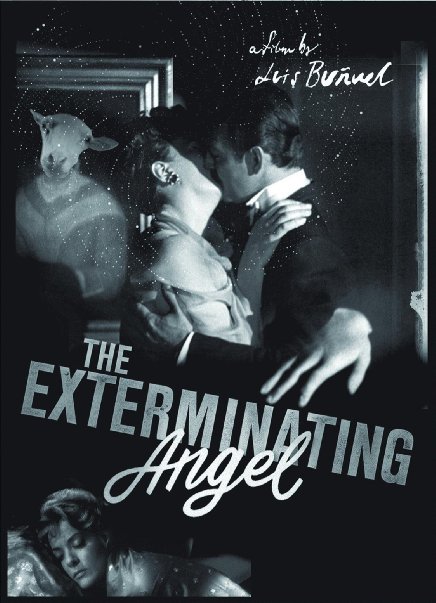
Looking forward to The Exterminating Angel

Luis Bunuel - The Exterminating Angel
Thomas Ades' new opera The Exterminating Angel, which comes to Covent Garden next year, premieres at the Salzburg Festival on 28 July 2016. The work is a co-commission and co-production between the Salzburg Festival, the Royal Opera House, Covent Garden, the Metropolitan Opera and Den Kongelige Opera, Copenhagen. In Salzburg the opera is being performed at the Haus für Mozart. Thomas Ades conducts the ORF Radio-Symphonie Orchester Wien and the director is Tom Cairns with designs by Hildegard Bechtler.

The opera is based on the Louis Bunuel film El angel exterminador and the libretto is by Tom Cairns in collaboration with Thomas Ades. Bunuel's film was written after Bunuel's abortive return to Spain in 1960 when the film he made there, Viridiana failed to satisfy Franco's regime. Back in Mexico, Bunuel made El angel exterminador, a film which appears to satirise the ruling elite of Spain, though Bunuel never explained the quasi-surreal plot in which a group of dinner-party guests are trapped in a a room with the dinner party descending into squalor and chaos. (You can see the original trailer for the film on YouTube and there is also a fascinating interview with Sylvia Pinal who starred in the film).

The film has quite a large cast, and this has been transferred to the opera where there are at least 21 named roles (Tom Cairns has managed to reduce the plays 21 principal characters down to a mere 15!). For me, one of the problems with Ades' The Tempest was that he had kept all of the play's characters and some of the roles seemed to have no time to make an impact in the opera. It will be interesting to see how the new opera copes with this problem, especially as the cast includes such luminaries as Anne Sofie von Otter, Sally Matthews, Christine Rice, Sophie Bevan, Amanda Echalaz, Charles Workman, Iestyn Davies, Ed Lyon, Thomas Allen and John Tomlinson!

PureGold 2016 - showcasing Goldsmiths

Pure Gold 2016
Goldsmiths, University of London, launches its festival, PureGold 2016, at the Clore Ballroom in the South Bank Centre on Monday 2 May 2016. From 4pm there will be a chance to preview the college's annual celebration of the eclectic, innovative and exciting music coming out of Goldsmiths. There will be two stages featuring featuring bands and singer-songwriters, choral and piano works, jazz, multi-keyboards and sitar, cutting edge digital manipulation and new instrument devices, plus up-and-coming artists currently featured on the NX Records mixtape.

PureGold events, showcasing the talents of the current crop of students, will be going on from May to July across London including The Albany, Deptford, as well as at Goldsmiths, follow @goldsmithsmusic #PureGold16 on twitter for updates or see their website.

Popular Posts this month