Thursday, 22 December 2016

Live buzz: James MacMillan's Symphony No. 4 and Violin Concerto

Macmillan Violin Concerto
James MacMillan Violin Concerto, Symphony No. 4; Vadim Repin, BBC Scottish Symphony Orchestra, Donald Runnicles; Onyx
Reviewed by Robert Hugill on Dec 18 2016
Star rating: 4.5

Two substantial symphonic works in terrific performances

This new disc on Onyx (in association with BBC Radio 3) from Donald Runnicles and the BBC Scottish Symphony Orchestra includes two substantial symphonic works by James MacMillan, the Violin Concerto (with violinist Vadim Repin, to whom the concerto is dedicated), and Symphony No. 4 (dedicated to Donald Runnicles).

The booklet information on the concerto is slightly frustrating, there is an admirable explanatory note from MacMillan, and details of the original commission, but no dates. So we must resort to Google to discover the work was premiered in 2010 by Vadim Repin, the London Symphony Orchestra and Valery Gergiev. [Whilst I am in grouchy mood, it would have been nice if someone had spotted that the CD booklet has added 9 years to James MacMillan's age].

The Violin Concerto is in three movements, 'Dance', 'Song' and 'Song and Dance'. 'Dance' opens with rhythmic elements in the orchestra and a high energy violin part. There are many moments of pause, but this feeling of energy continues through the movement. MacMillan achieves a sense of distance between soloist and orchestra, not so much physical as conceptual, indicated by the way the high violin part floats over the lower instrumental writing. Overall, there is a sense of dialogue, one leading the other on. I have to confess that it was only after reading James MacMillan's note that I realised that one of the episodes was a Scottish reel.

Wednesday, 21 December 2016

The Three Kings: The Sixteen at Christmas

The Three Kings
Three Kings, Handl, Fricker, Howells, Palestrina, Sheppard, Lassus, Warlock, Cornelius, Anerio; The Sixteen, Harry Christophers; Cadogan Hall
Reviewed by Robert Hugill on Dec 20 2016
Star rating: 4.0

An intriguing mix of music in the Sixteen's Christmas concert

Harry Christophers and The Sixteen were at the Cadogan Hall on 20 December 2016 for the first of two Christmas concerts. Their programme, The Three Kings featured an interesting mix of plainchant, Renaissance polyphony, 20th century classics, folk-inspired items and a couple of traditional carols, all themed on the Three Kings.

We opened with I wonder as I wander, first published by John Jacob Niles in 1934 and of uncertain origins but lovely all the same. The Sixteen's simple but effective presentation was to have a fine solo from Alexandra Kidgell framing verses sung by all the sopranos. Jacobus Handl's Omnes de Saba (the gradual for the Mass of the Epiphany) was vigorous and resonant, and it was lovely to hear John Henry Hopkins' well known We Three Kings sung properly for once, with solos from Tim Jones, Ben Davies and Eamonn Dougan.

Peter Racine Fricker's A Babe is born dates from 1962 but had some nice neo-medievalism in the harmonies with added modern spice, and pleasant metrical irregularity. The traditional This endris night (sung in a four-part arrangement) had a beautiful part-song quality to it, whilst Herbert Howells' Long, long ago (written in 1950) had a lovely fluidity of metre in the way Howells handled the long-breathed modal melodies, and the way he approached the text.

Baroque and classical delights: La Nuova Musica in Bach, Haydn & Mozart

La Nuova Musica- photo Michael Poehn
Bach, Mozart, Haydn; Lucy Crowe, David Blackadder, La Nuova Musica, David Bates; St Johns Smith Square
Reviewed by Ruth Hansford on Dec 19 2016
Star rating: 4.0

Bach cantatas, Haydn's St Nicholas Mass and a Mozart soprano showpiece in this delightful Christmas programme

David Peter Bates and La Nuova Musica provided us with four Christmas (or Christmassy) treats on 19 December 2016 as their contribution to the 31st Christmas Festival that runs for most of December at St John’s Smith Square. Their programme consisted of two Baroque favourites by Bach followed by two Classical pieces by Mozart and Haydn, with the soprano showpieces bookended by choral works, performed with soloists soprano Lucy Crowe and trumpeter David Blackadder.

We started with Bach’s Advent cantata, Nun komm, der Heiden Heliand BWV 62, written for Weimar and first performed in 1724. This was played with a muscular energy that made the opening sound like Handel, and this provided a stonking support for the voices; there were only eight of them but they made a beefy sound bigger than one would expect. The tenor recitative and aria sounded as though a baritone might have been at home in them; James Arthur’s earthy recit made time stand still and Augusta Hebbert sang delightfully. The stage choreography could have been better managed, but aurally it was great ensemble.

Jauchzet Gott in allen Landen BWV 51 was first performed in Leipzig – a more extravagant piece for starry soloists, which we certainly had tonight. Lucy Crowe went from crazy coloratura to poised legato and David Blackadder from fortissimo to pianissimo in the twinkling of an eye. The orchestra of strings and organ added to the variety.

Ambitious & brave: Louis Langrée on Cincinnati Symphony Orchestra's concertos for orchestra project

Louis Langrée & Cincinnati Symphony Orchestra
Sebastian Currier
Sebastian Currier
Cincinnati Symphony Orchestra has its origins in the 19th century but it has always looked to the present (and future) with collaborations with a remarkable number of composers. Under Louis Langrée, music director since 2013, this is continuing as the orchestra has issued a new disc Concertos for Orchestra, on its own Fanfare Cincinnati label, devoted to three contemporary composers Sebastian Currier. Thierry Escaich and Zhou Tian. I caught up with Louis Langrée via Skype to find out more.

It is an ambitious and brave project, a disc devoted to three new substantial works by contemporary composers and Louis points out that the works were recorded live. The recordings were made at the world premiere performances, capturing the excitement and fear (sometimes) of the occasions. Louis admits that whilst performers can really embrace a piece when they have played it 15 times, there is a lot to be said for the way a recording of the first performance can really capture the buzz of the premiere.


Zhou Tian
Zhou Tian
The new works are part of larger scale ambitions, as Louis thinks that is is their duty as interpreters to commission new works, and important that as a great institution there is an area of experimentation. In the last three years he has conducted 12 first performances with the Cincinnati Symphony Orchestra, a striking figure for a symphony orchestra with a regular season with subscribers.

But from its founding the orchestra was committed to music of its time, working with Respighi, Varese, Elgar (who came to conduct The Dream of Gerontius), Stravinsky, Bartok, Scriabin, Saint-Saens, Bernstein and Copland, whose Fanfare for the common man was a Cincinnati commission. Last season John Adams came to conduct his Scheherazade.2 for violin and orchestra, the first time he had conducted the work after the premiere in New York two weeks previously when Alan Gilbert conducted the work.

For the Concertos for Orchestra disc Louis wanted to have three different composers from three different cultures and different musical backgrounds. Louis did not originally know the work of American composer Sebastian Currier, but the orchestra gave him pieces to read and he thought 'wow'. Currier's music was intense, visceral and very challenging to the orchestra, requiring individual virtuosity and creating a real concerto for orchestra.

Zhou Tian lives in the USA but is from China and Louis feels that though his musical language is Western, Zhou Tian's roots inflect his musical language. Louis describes Zhou Tian as a young man, but one who knows how to orchestrate, how to make an orchestra really sound.

Thierry Escaich#
Thierry Escaich
Thierry Escaich is the only composer with whom Louis had worked before. Louis talks about the way there are two traditions of composers in France, the pianists (Debussy, Ravel, Boulez) and the organists (Franck, Faure, Messiaen, Durufle, Gounod), adding that Berlioz fits in elsewhere! Louis feels that Escaich fits into the tradition of organists writing symphonic music, and that his conception of the orchestra comes from the way of using registrations in organ playing. Louis adds that this does not mean that Escaich music is written for the organ and then orchestrated, but that the way he uses density, different layers and groups of players is like an organ player using stops. In Escaich's piece for Cincinnati his use of Bach chorales in the music mixes the sacred and the symphonic in a way which Louis feels is typical of this tradition of organist composers.

And the fact that organists are some of the only instrumentalists in the Western Classical tradition to continue improvising is important too. Escaich is evidently an amazing improviser and Louis thinks you can feel this in his writing. Not that the music lacks structure, but there is feeling of immediacy, the way new ideas can take the music in a different direction.

They are three very different pieces, and Louis is proud that the orchestra has commissioned them. The disc was intended to be concertos for orchestra, a form which Louis associates with the Cincinnati Symphony because the first time he really listened to them (before he had conducted them) was on a disc conducted by Paavo Järvi of Concertos for Orchestra by Bartok and Lutoslawski, He thought it a wonderful recording and was very  impressed, and when he became music director of the orchestra he had that recording in his head. He thought to ask the composers of the present day what they have to say in the form, not a symphony but a concerto for instrumentalists.

Tuesday, 20 December 2016

Intimate and text-driven: Handel's Messiah from Ian Page and Classical Opera

Handel by Balthasar Denner
Handel Messiah; Sarah Fox, Angela Simkin, Stuart Jackson, Neal Davies, Classical Opera, Ian Page; Temple Winter Festival at Middle Temple Hall
Reviewed by Robert Hugill on Dec 19 2016
Star rating: 4.0

Relatively intimate account of Handel's oratorio which had the text to the fore

The Temple Winter Festival came to a close on Monday 19 December 2016 with a performance of Handel's Messiah in Middle Temple Hall, with Ian Page conducting the choir and orchestra of Classical Opera plus soloists Sarah Fox, Angela Simkin, Stuart Jackson and Neal Davies.

Messiah was a work which was notoriously flexible during Handel's lifetime as he adjusted it to suite individual performers. Ian Page's edition of the score was largely traditional, in his note he says that he sought to 'incorporate Handel's lasting preferences'. We also had the versions of 'But who may abide' and 'Thou art gone up on high' which Handel created in 1750 for the castrato Gaetano Guadagni, bringing a little touch of opera seria bravura into the work. So 'But who may abide' was sung by the alto, 'Thy rebuke', 'Behold and see' and 'But Thou didst not leave' were sung by tenor, 'Thou art gone up on high' by alto, 'How beautiful are the feet' by soprano, 'Their sound is gone out' by chorus.

Charles Jennens by Thomas Hudson
Charles Jennens
by Thomas Hudson
This was a relatively intimate account of the work, with a choir of nine young professional singers and an orchestral ensemble based on nine string players. This meant that the soloists could take advantage of the relatively favourable balance, and this was a very text-based performance as it should be. Ian Page favoured quite brisk speeds, particularly in the choruses as he was able to take advantage of the high degree of flexibility and technical expertise from his small group of choristers.

The overture moved from intimacy to grandeur, ending with a nicely perky fast section. The smaller string contingent meant that we got a lovely experience of Mark Baigent's oboe.

The following recitative and aria introduced us to what was, for me, the stand out performance of the evening from tenor Stuart Jackson. Jackson sang with barely a glance at his music and whatever the narrative context, he always brought out the meaning of the words. Oratorio should be as much about words as music, the text was there to convey a message and with Jackson it really did. Not that there was anything skimped about the musical values as he could spin a fine line, produce lovely even runs and sing with lyric beauty, but always allied to the sense of the drama.

Music academy in Provence

Class at the 2016 Musique Cordiale Academy
The Musique Cordiale International Festival takes place in the picturesque medieval hill towns between Nice and Aix-en-Provence. 2017 will be the 13th Festival and will feature two weeks of concerts conducted by Graham Ross and James Lowe, 27 July - 5 August 2017. The Festival Orchestra is a multi-generational ensemble made up of young professionals and established musicians from orchestras such as the LSO, the OAE, the Tonhalle Zurich and the Oslo Philharmonic.

As part of the festival the 2017 Musique Cordiale Academy enable a group of 12 students to enjoy masterclasses, chamber music coaching and orchestral training with Levon Chilingirian & Susie Mészáros of the Chilingirian String Quartet and Jane Hyland, former principal cellist of the BBC Welsh Symphony Orchestra. The students will perform in two concerts as part of the Musique Cordiale International Festival programme. Students are hosted in a large Provençal residence and enjoy eight days of intensive tuition with free time for swimming and relaxing. They attend evening concerts in the region’s spectacular churches followed by al fresco dinners with the Festival musicians, professors and team.

Applications are now open for advanced string players interested in attending the 2017 academy, further information from the Musique Cordiale website.

Rising Stars of the Enlightenement

Rising Stars of the Enlightenement
The Orchestra of the Age of Enlightenment (OAE) is launching a new scheme to help develop singing talent. Rising Stars of the Enlightenment will offer the opportunity for four young singers to perform regularly with the OAE during the 2017-18 season, working with conductors such as Ivor Bolton, William Christie, Mark Padmore and Sir Andràs Schiff, and established singers such as Roderick Williams, Brindley Sherratt and Mary Bevan, and performing Bach cantatas and Handel oratorios, featuring as top-billed soloists at the Royal Festival Hall, Queen Elizabeth Hall and Kings Place.

The deadline for application is 24 January 2017, and auditions will take place in London on 8 and 9 February 2017, applicants will have to prepare a selection of solo Bach and Handel arias. Full information from the OAE website.

Monday, 19 December 2016

Michael Young named as assistant conductor of ESO

Michael Young
Michael Young
The English Symphony Orchestra (ESO), artistic director Kenneth Woods, has appointed Michael Young as the orchestra's first assistant conductor. The Worcestershire-based orchestra has had a busy year, including giving the first performance of John Joubert's opera Jane Eyre (which was recorded for issue on the SOMM label). Michael Young assisted Kenneth Woods on Jane Eyre and now the appointment is formalised.Michael Young is the co-founder and artistic director off the Beethoven Orchestra for Humanity.

ESO's 2016/17 season sees the orchestra commence its The 21st Century Symphony Project, commissioning, premiering and recording nine new symphonies by leading composers. The Project will be launched with the premiere of Philip Sawyers’ Third Symphony in February 2017 and continues with the premiere of David Matthews’ Ninth Symphony in 2018.

Bax and more: the Carice Singers at St Gabriel's Pimlico

Arnold Bax's rarely performed carol Of A Rose I Sing, for choir, harp, cello, and double bass, the composer's response to the Easter Rising of 1916, is the centrepiece of a programme of choral music by Herbert Howells, Peter Warlock, John Ireland, and Arnold Bax at St Gabriel's Church, Pimlico, tonight (19 December 2016 at 6.30pm). The programme is being performed by The Carice Singers, conductor George Parris, a young choir formed in 2011 to specialise in British Romantic Composers  The 20th century works are being performed alongside Christmas choral music from the Tudor era.

Further information from The Carice Singers website.

A touch of greatness: Renée Fleming returns to the Marschallin at Covent Garden

Sophie Bevan, Alice Coote - Act 2, Der Rosenkavalier - Royal Opera. © ROH. Photograph by Catherine Ashmore
Richard Strauss Der Rosenkavalier; Renee Fleming, Alice Coote, Sophie Bevan, Matthew Rose, Jochen Schmeckenbecher, dir: Robert Carsen, cond: Andris Nelsons; Covent garden
Reviewed by Robert Hugill on Dec 17 2016
Star rating: 4.5

Set in 1911, the new production brings out the decadence of the era and provides a fine setting for some great performances

Renée Fleming, Sophie Bevan - Act 3, Der Rosenkavalier - Royal Opera. © ROH. Photograph by Catherine Ashmore
Renée Fleming, Sophie Bevan - Act 3, Der Rosenkavalier 
© ROH. Photograph by Catherine Ashmore
Robert Carsen's production of Richard Strauss's Der Rosenkavalier debuted at the Royal Opera House on Saturday 17 December 2016. Replacing the old John Schlesinger production (which debuted in 1984, I was there!), the new production featured Renée Fleming returning to the role of the Marschallin at Covent Garden (she last sang it here in 2000, I was also there), with Alice Coote as Octavian, Sophie Bevan as Sophie, Matthew Rose as Ochs. Sets were by Paul Steinberg, costumes by Brigitte Reiffenstuel, lighting by Robert Carsen and Peter van Praet, choreography by Philippe Giraudeau. For many, almost as big a draw as Renée Fleming would be the fact that Andris Nelsons as making a rare appearance in the pit conducting the Orchestra of the Royal Opera House.

Whilst the production is new (shared with the Met, and Teatro Regio, Turin), it reworks ideas from Carsen's 2004 Salzburg production. The period is updated to 1911, Herr von Faninal has clearly made his money as an arms dealer, the third act is set in a brothel, and the final two minutes of the opera make it clear that the lovers' dream will be shattered by the events of 1914.

Matthew Rose, Alice Coote - Act 3, Der Rosenkavalier - Royal Opera. © ROH. Photograph by Catherine Ashmore
Matthew Rose, Alice Coote - Act 3, Der Rosenkavalier 
© ROH. Photograph by Catherine Ashmore
Robert Carsen's set relied for its effect on decoration, with all three acts in the same basic shaped space, a large rectangular room, at an angle to the proscenium, with an ante-room up-stage. Act One featured a luxurious red, white and gold bedroom (though I wondered about the Marschallin's choice of pictures), Act Two was a modernist atrium with classical frieze, and neo-secessionist furniture, and Act Three was boudoir baroque. I don't know whether it was the fault of the setting, but despite the activity and the large number of supers, the overall production felt rather static.

This was also the most serious account of the opera that I have seen. Carsen had evidently re-thought all the action (frankly no bad thing), sometimes to striking effect. Gone was a lot of Ochs' buffo schtick and the little comic touches in the Marschallin's levee. Not that this was grim performance, it was a comedy of character in the sense that Le nozze di Figaro is. But what the production did do was to provide a setting for some very fine performances, and we could appreciate Carsen's detailed personen-regie. The production will surely provide a good setting for a whole variety of interpretors in revivals. Though I found the whole thing a little lacking in dynamism, and what impetus there was seemed to come from the pit.

Sunday, 18 December 2016

Delightful fantasy: All the Angels - Handel & the first Messiah

David Horovitch & ensemble - Nick Drake: All the Angels - Sam Wanamaker Playhouse- photo Marc Brenner
David Horovitch & ensemble - Nick Drake: All the Angels
Sam Wanamaker Playhouse, photo Marc Brenner
Nick Drake All the Angels; David Horovitch, Kelly Price, Sean Campion, dir: Jonathan Munby, cond: Michael Haslam
Reviewed by Robert Hugill on Dec 16 2016
Star rating: 4.0

The creation of Handel's Messiah is the centrepiece for this delightful music-led drama

Nick Drake's play All the angels takes a number of curious facts about the first performance of Handel's Messiah in Dublin in 1741, and weaves them into a delightful fantasy which mixes drama with the music of Messiah in a striking way. We caught the performance on Friday 16 December 2017 at the Sam Wanamaker Playhouse at the Globe Theatre, directed by Jonathan Munby and designed by Mike Britton, with David Horovitch as Handel, Kelly Price as Susannah Cibber plus Sean Campion, Lucy Peacock, Saskia Strallen, Lawrence Smith, and Paul Kemble.

The play incorporates Messiah, with the singers being provided by Lucy Peacock, Saskia Strallen, Lawrence Smith, and Paul Kemble plus four singers from a pool of eight supplied by alumni of Genesis Sixteen (Tom Castle, Nancy Cole, Camilla Harris, Rebekah Jones, Angus McPhee, Ben Vonberg-Clark, Daisy Walford, Jamie Wright), with instrumentalists Jorge Jimenez and Naomi Burrell (violins), Joanna Levine (cello), Adrian Woodward (trumpet), and Mchael Haslam (harpsichord and musical director).

The play takes a group of known facts, that Handel down on his luck with opera in London travelled to Dublin to give a season there; that he got stranded in Chester and tried out passages from Messiah with a choir there, getting annoyed with a bass who could not read the part correctly; also in Chester he met the young Charles Burney; once in Dublin he cast the actress Susannah Cibber in the mezzo-soprano solos even though she was an actress and was away from London because of a sexual scandal involving her husband and her lover (the nastiness was mainly on the part of her husband); the porter at the music hall in Fishamble Street where Handel's music was performed was known as Crazy Crow and he was also a resurrectionist (stealing dead bodies for dissection).

Saturday, 17 December 2016

Composer Rachel Portman talks about her work in films, the 2016 M & S Christmas advert, and opera

Rachel Portman - photo Giles Keyte
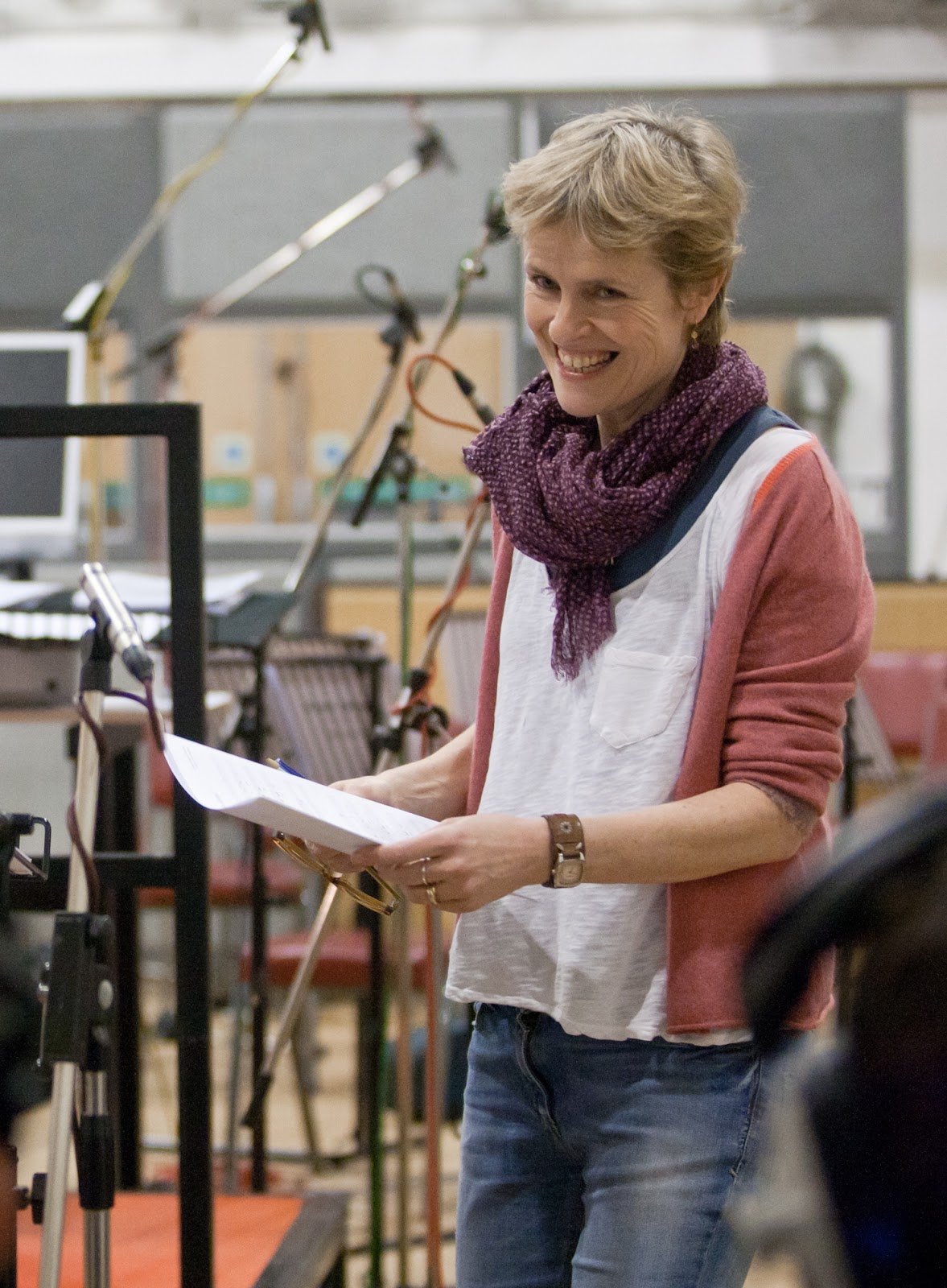
It can often seem as if film composers hide in their studios, so that though we know their work, the person behind the pencil is less known. The composer Rachel Portman wrote the score to the TV series Oranges are not the only fruit and she has gone on to write scores for such films as Cider house rules, and Chocolat. She was the first female composer to win an Academy Award in the category of Best Musical or Comedy Score (for Emma in 1996). Her opera The Little Prince was premiered by Houston Grand Opera in 2003, and her choral work, The Water Diviner's Tale was premiered at the BBC Proms in 2007. 

I was lucky enough that Rachel had time between deadlines to meet up to chat about her career in music, and to talk about her most recent project, writing the score for Marks & Spencer's 2016 Christmas advert. In fact, our wide ranging discussion covered many aspects of writing for film, not to mention Rachel's love of writing opera and her surprisingly traditional attitude to her craft.

I met Rachel at her London home and we chatted over tea in her basement studio; a delightful conversation about films, music and much besides. She was happy to talk about the craft involved in writing film music, and perhaps a little surprised that someone should take so much interest in it.

A complete film in miniature


An extract from Rachel Portman's original score for the short version of the M&S advert
An extract from Rachel Portman's original score
for the short version of the M&S advert
Projects like the Marks & Spencer Christmas ad are indeed a big deal, essentially it is a complete film in miniature. Rachel's challenge was to create a satisfying piece of music whilst supporting the drama and all in the space of a few minutes (there are in fact long and short versions of the advert). In the longer one there is time for each of the main themes to be repeated just once. Whilst she used themes for individuals and events, she comments that did not want to point up every piece of the drama, adding that this isn't Tom and Jerry. Being more like a mini-feature film than a commercial, her work was highly considered. She is very traditional in the way she creates music, she writes using pencil and paper and writes slowly. She writes the sounds that she hears in her head, using just a piano rather than anything more complex.

At this point in our discussion I admitted that I know little about writing film music. As we were in her studio, Rachel went over and switched on her equipment to demonstrate her working methods. She has a monitor, where she watches the video with time-codes, a piano and a microphone. So she tries out ideas at the piano and can record them to video alongside the film. It is this film, with Rachel's live piano accompaniment which represents the first cut of her ideas

For the Marks & Spencer ad what appealed to her was the little boy, and within ten minutes she had the boy's theme. It is up to her how she tells the story in music and as the character was a child she chose a simple theme. (In fact if you watch the ad, the main theme only really gets going when the little boy appears, all the rest is in the nature of a prelude.) After her piano version, the next stage was for Rachel to produce a short score and someone created a synthesised version from this. This version of the film, with synthesised score, was then subject to an amazing amount of critical discussion from the director and others involve in the advert. The final version had a fully scored orchestration production, and this was then recorded live at Abbey Road Studios.

For a full-length feature film, Rachel needs to plot out where in the film music is to go. The Marks & Spencer ad was unusual in having music from beginning to end. Rachel often writes themes for characters or events in films, she likes working melodically and though not every film requires this approach, she feels that you can sell an emotion better using a melody.

Friday, 16 December 2016

Albion Quartet goes Tricycling for Christmas

Albion Quartet - Tamsin Waley Cohen, Emma Parker, Rosalind Ventris, Nathaniel Boyd
Albion Quartet
Rosalind Ventris, Tamsin Waley Cohen, Emma Parker, Nathaniel Boyd
The Albion String Quartet is a relatively new ensemble. Formed this year, it features violinist Tamsin Waley-Cohen with Emma Parker (violin), Rosalind Ventris (viola), and Nathaniel Boyd (cello). There are a number of opportunities to hear the ensemble in London next year, but they have a special Christmas gig at the Tricycle Theatre, Kilburn on Sunday 18 December 2016.

The four young players share a belief in the communicative power of the string quartet, and play a fine group of instruments between them - Stradivarius, Amati, Guarnerius and Grancino. Their programme at the Tricyle Theatre will feature two seminal quartets, Haydn's Quartet in C major opus 20, no.2 and Schubert’s Quartet no 14 in D Minor ‘Death and the Maiden’, as well as a Christmas surprise.

See the Tricycle Theatre website for full details.

Handel House Christmas Showcase

Hunter Coblentz - Handel House composer in residence
Handel House Christmas Showcase; Eleanor Minney, Olwen Foulkes, Mirjam Münzel, John Crockatt, Satoko Doi-Luck, Aidan Phillips, Alice Privett, Kate Conway, BLOCK4, Hunter Coblentz; St George's Church, Hanover Square
Reviewed by Robert Hugill on Dec 15 2016
Star rating: 4.0

Young artists showcase with music old and new, including Hendrix and a world premiere

The Christmas Showcase from Handel & Hendrix in London is an annual celebration of their young artists schemes, providing a showcase for the Handel House Talent, Ensemble in Residence and Composer in Residence. At St George's Church, Hanover Square on Thursday 15 December 2016 we heard the six members of the 2015/2016 Handel House Talent scheme, Eleanor Minney (mezzo-soprano), Olwen Foulkes (recorders), Mirjam Münzel (recorders), John Crockatt (violin), Satoko Doi-Luck (harpsichord) and Aidan Phillips (harpsichord), and the Ensemble in Residence BLOCK4 (Emily Bannister, Lucy Carr, Katie Cowling and Rosie Land), as well as hearing the premiere of a new piece by composer in residence Hunter Coblentz. Beside Coblentz, the composers on offer were highly varied with Handel and Hendrix (of course), plus Corelli, Rameau, Schütz, Bach, Couperin and Fiorenza, plus five carols for the audience to join in.

BLOCK4 with their Paetzold recorders
There had been some drama before the event started as the organist, who was to accompany the audience carols on the Richards, Fowkes & Co organ of St George's, was taken ill but thankfully Satoko Doi-Luck (one of the Handel House Talent) stood in and accompanied the carols (in addition to playing the harpsichord and the smaller Handel House organ).

After an opening carol and a welcome from Elizabeth Nicholson (general manager of Handel & Hendrix in London), we heard from Olwen Foulkes (recorder), who with Satoko Doi-Luck (harpsichord) and Kate Conway (cello) performed Arcangelo Corelli's Sonata in C major, Op.5 No. 10. Originally for violin, Foulkes performance gave no hint of the change of instrument and sounded completely idiomatic. After a nicely fluid Adagio (with some vibrant playing from cellist Kate Conway), there was a perky Allemande where we could appreciate the evenness of Conway's tone. The Sarabande was stately which gave space for plenty of divisions in the recorder part (and leaps too), the finishing with the distinctly lively Gavotta which was very characterful and finished with some spectacular finger-work.

Intriguing and thought-provoking: Don Giovanni

Mozart - Don Giovanni - Teodor Currentzis
Mozart Don Giovanni; Dimitris Tiliakos, Vito Priante, Mika Kares, Myrto Papatanasiu, Kenneth Tarver, Karina Gauvin, Guido Loconsolo, Christina Gansch, MusicAeterna, Teodor Currentzis; Sony Classical
Reviewed by Robert Hugill on Dec 15 2016
Star rating: 4.5

Drama and text to the fore in Teodor Currentzis' latest Mozart opera

Having recorded Le nozze di Figaro and Cosi fan tutte, Teodor Currentzis and MusicAeterna complete the trilogy on Sony Classical with Don Giovanni. The varied international cast (two Greeks, two Italians, a Finn, an American, a Canadian and an Austrian) has Dimitris Tiliakos as Don Giovanni, Vito Priante as Leporello, Mika Kares as Il Commendatore, Myrto Papatanasiu as Donna Anna, Kenneth Tarver as Don Ottavio, Karina Gauvin as Donna Elvira, Guido Loconsolo as Masetto and Christina Gansch as Zerlina.

The completion of Teodor Currentzis's studio recordings of Mozart and Da Ponte's operas with Don Giovanni, was never going to be straightforward. Recorded from 23 November to 7 December 2015 at the PI Tchaikovsky State Opera and Ballet Theatre, Perm, this is very much a studio recording, the sound world it invokes, with the intimacy of the dialogue, is that of a radio play.

From the opening notes of the overture it is clear that Currentzis extracts the maximum drama from his ensemble, MusicAeterna. The orchestra plays on period instruments but Currentzis uses the often to quite modern effect. He clearly relishes the ability to achieve a sharp attack and quick die away which is not the same with more modern instruments. The performance is full of accents, articulation and contrast, and there is some lovely wind playing as they comment and embellish the vocal lines. It is a large band, 42 strings, and probably far bigger than Mozart would have had. But to expect the recording to be about a recreation of what Mozart heard is to mistake Currentzis's intentions.

His performance (and it is very much Currentzis's) might reflect elements of period style but this Don Giovanni is only 'authentic' in the sense that it is a realisation of Currentzis's personal vision.

Thursday, 15 December 2016

A Land so Luminous

A Land so Luminous music by Richard Causton and Philip Hesketh; Mary Bevan, Tamsin Waley-Cohen, Douglas Finch, Lisa Nelsen, Joseph Spooner, the Continuum, Philip Headlam; Prima Facie
Reviewed by Robert Hugill on Dec 8 2016
Star rating: 4.0

Two contrasting contemporary British composers showcased on this disc of instrumental music

A Land so Luminous on the Prima Facie label, is a disc of music by two contemporary British composers, Richard Causton and by Kenneth Hesketh, performed by the Continuum Ensemble conducted by Philip Headlam, with Mary Bevan (soprano), Tamsin Waley-Cohen (violin ), Douglas Finch (piano), Lisa Nelsen (flute) and Joseph Spooner (cello). The disc contains Kenneth Hesketh's A Land so Luminous, Cautionary Tales, IMMH, and Netsuke, and Richard Causton's Threnody, Rituals of Hunting and Blooding, Non Mi Comporto Male, Sleep, Night Piece.

The disc opens with the group of pieces by Kenneth Hesketh. A Land so Luminous, played by Tamsin Waley-Cohen (violin) and Alexander Szram (piano), which is inspired by an episode in a work by Cyrano de Bergerac. Originally composed for violin and ensemble in 2003, it was arranged for violin and piano in 2009. The piece seems to be all about variety of texture, often busy and very vivid, the performers giving great clarity to the busy-ness.

Cautionary Tales is a three movement work arranged in 2002 for violin, clarinet and piano (Marie Lloyd, Marcus Barcham-Stevens, Douglas Finch) from Hesketh's larger piece Netsuke, which is also heard on the disc. The three movements are vivid character pieces, each inspired by a cautionary tale (from Der Struwelpeter, and from Le Petit Prince).

Vibrant music making: Arcangelo in Bach and Telemann

Jonathan Cohen and Arcangelo
Bach & Telemann cantatas, Bach Brandenburg Concerto No. 6; Lydia Teuscher, Alex Potter, Andrew Tortise, Thomas Bauer, Arcangelo, Jonathan Cohen; Wigmore Hall
Reviewed by Robert Hugill on Dec 14 2016
Star rating: 5.0

Early cantatas by Bach with an undeservedly neglected one from Telemann in a range of unusual scorings

In the Church's year Advent is a season for reflection and preparation, rather than jollification and spending money, and it was these themes which seemed to run through Arcangelo's concert at the Wigmore Hall on 14 December 2016. Artistic director Jonathan Cohen had chosen a trio of cantatas, two by Bach and one by Telemann, which reflected on life and looked forward to the life to come. Taking advantage of some relatively unusual scorings, Bach's cantatas Christ lag in Todesbanden BWV4 and Gottes Zeit is die allerbeste Zeit (Actus tragicus BWV106) and Telemann's cantata Du aber, Daniel, gehe hin TWV4:17 were joined by Bach's Brandenburg Concerto No. 6 in B flat BWV1051 with its scoring of violas, violas da gamba, cello, bass and harpsichord. For the cantatas Arcangelo was joined by the singers Lydia Teuscher (soprano), Alex Potter (counter-tenor), Andrew Tortise (tenor) and Thomas Bauer (baritone). The concert was also the first in Arcangelo's residency at the Wigmore Hall.

We started with Bach's early cantata Christ lag in Todesbanden, dating from 1707/1708, which sets verses from Martin Luther's Easter Hymn of 1524 as a chorale cantata, each verse a different variation on the chorale. Scored for relatively simple forces (four voices, two violins, two violas, cello, double bass, lute and organ), the opening sinfonia was grave with a strong textural quality to each of the instrumental lines.

Piano Trios in North London

Dmitri Shostakovich - photo credit Deutsche Fotothek
Dmitri Shostakovich
photo credit Deutsche Fotothek
Readers of this blog with long memories, may remember my opera When a Man Knows which was performed in 2010 and 2011 at Tête à Tête opera festival and the Bridewell Theatre. The instrumental ensemble included a substantial cello part, with a significant opening and closing solo, and this was played by cellist Jon Cottle. Jon is now based in Barcelona but is back in the UK for a brace of concerts with a new piano trio, the Harthan Piano Trio featuring Tony Ingham (piano) and Emma Wragg (violin).

They are performing a programme of piano trios by Beethoven (Piano Trio No. 5, Op. 70 No.1), Schumann (Piano Trio No. 2, Op 80) and Shostakovich (Piano Trio No. 2, Op. 67) at Rosslyn Hill Chapel (7.00pm, 15 December 2016) and Lauderdale House (7.00pm, 16 December 2016).

Wednesday, 14 December 2016

A Comedy Concert: the London Song Festival finale with Nicky Spence & Melinda Hughes

Melinda Hughes
Melinda Hughes
Jonathan Dove, Flanders & Swan, Victoria Wood, Jeremy Nicholas, Mischa Spoliansky, Tom Lehrer, Ty Jeffries, Tim Minchin, Jason Robert Brown, Melinda Hughes & Jeremy Limb; Melinda Hughes, Nicky Spence, Nigel Foster; London Song Festival at the Warehouse
Reviewed by Robert Hugill on Dec 13 2016
Star rating: 4.0

From cabaret to opera, and much else besides, a delightful evening of comic song rounds off this year's London Song Festival

For the final event of this year's London Song Festival, artistic director Nigel Foster was joined by soprano Melinda Hughes and tenor Nicky Spence for an evening of comic songs at the Warehouse, Theed Street on Tuesday 13 December 2016. The evening combined songs by Flanders & Swan, Victoria Wood, Jeremy Nicholas, Mischa Spoliansky, Tom Lehrer, Ty Jeffries, Tim Minchin and Jason Robert Brown with an aria from Jonathan Dove & Alasdair Middleton's The Enchanted Pig, and songs by Jeremy Limb & Melinda Hughes, finishing with 'The song that goes like this' from Eric Idle &  John du Prez' Spamalot.

We opened with a group entitled Wrestling Relationships, beginning Adelaide's aria from The Enchanted Pig by Jonathan Dove and Alasdair Middleton, with a spectacular show of temperament by Melinda Hughes. Then came Nicky Spence, in dinner jacket, black shirt and white tie, to perform Tom Lehrer's Masochism Tango, Highly controlled at first, Spence barely moved but made us hang on every word, which made the moment when he did start to tango really count.The final song in this group was Flanders and Swann's The Warthog with Hughes as a delightful warthog and Spence as the narrator. The duet enabled us to hear the way these two artists approached the comedy, in very different but equally valid ways.

Taking a Trip started with one of Melinda Hughes own songs, written with Jeremy Limb, Country Estate which was notable for the very clever lyrics. Nicky Spence then returned dressed as a boy scout, to give fine account of Jeremy Nicholas's Camping Out in which Spence's totally serious delivery made the double entendres count even more. The group finished with Pigalle by Ty Jefferies (better known as the artiste Miss Hope Springs) sung by Melinda Hughes, a delightful rather wistful song which was rather more character than comedy.

The first half ended with Lamentable Love, a group which started with Melinda Hughes in outrageous form with The Boy From ....., Mary Rogers and Stephen Sondheim's delightful sendup of The Boy from Ipanema. Nicky Spence then sang Lullaby by Tim Minchin, a song which starts out as a simple lullaby but gets progressively more and more unnerving. Finally the two singers gave us their tribute to Victoria Wood, with her duet Barry and Freda, a performance which really demonstrated how clever and how tricky Wood's songs are.

After the interval we had Delusional Devotion, with Nicky Spence singing Jeremy Nicholas's Valentine Card, in which Spence's attention to Nicholas's words paid dividends, and there were some lovely sly musical quotations from Nigel Foster in the piano accompaniment. Melissa Hughes then sang My Guru, another of her songs with Jeremy Limb. The words rather than the music made the song,  full of astute observations about modern Chelsea types.

Womanly Wilds began with Victoria Wood's Pam. Nicky Spence was priceless (in a bad wig and man's suit) as a middle-aged woman rejecting sexual overtures for a cup of tea. Melinda Hughes was equally over the top, in a different way, in Mischa Spoliansky's I am a Vamp, describing someone I would not want to meet on a dark night. The group finished with Jason Robert Brown's bizarre but funny Surabaya Santa in which Kurt Weill's Surabaya Johnny is crossed with Santa Claus (!), and Nicky Spence in a wig as the alarming heroine, the neglected Mrs Claus.

The final group opened with Melinda Hughes singing the final of her songs with Jeremy Limb. Selfie had some nice observations about modern habits, but I was not quite sure that the words were as sharp as some of their other songs. Nicky Spence then sang Flanders and Swann's In the bath with his own distinctive brand of orotund charm. Finally we had the duet from Spamalot, a wonderfully crazy way to end the evening.

There was no planned encore, but the response from the capacity audience was such that Nicky Spence gave us his a cappella rendition of the Scots song The Wee Cooper of Fife, complete with actions and dance!

The problem with a programme of comic songs is that the comedy is often very much about the words. Which meant that both performers had a stupendous number of words to learn. Both did a heroic task but there were inevitable compromises, Victoria Wood's Barry and Freda and the song from Spamalot were done with a music stand, whilst Nicky Spence used a crib in one of his solos and there were one or two moments when Melinda Hughes failed to make the most of the text. However, there also plenty of superbly funny moments. Both singers have fine, yet very different, senses of comic timing and the result was a wonderfully engaging programme.


Shine Forth: Illuminare gives premiere of Barnaby Martin's new piece

Barnaby Martin
Barnaby Martin
Illuminare is a relatively new chamber choir; founded by Jeremy Cole (assistant musical director at the church of St Martin in the Fields) the choir consists of a group of talented young singers who have been giving concerts in Cambridge and London in the last three years. For the group's Christmas concert on Friday 16 December 2016 at Holy Trinity Church, Sloane Street, they pair familiar pieces by RVW, Warlock, Howells, Tavener, Rutter and Lauridsen, with not so familiar seasonal music by Dove, Wishart, Sandstrom, Rathbone, Villette, Walton and John Burt, alongside the premiere of a new piece Shine Forth by the young composer Barnaby Martin.

In Shine Forth Martin sets the Antiphon for the First Sunday in Advent, and extracts from Christopher Harvey's poem The Nativity, with Martin including transformed elements of the antiphon plainchant into the choral texture, with the work being written for choir and solo quartet. Barnaby was commissioned to write a new piece for St Paul’s Cathedral by Choir & Organ Magazine which featured his piece and his work as part of the November/December 2016 issue.

Full information from the Illuminare website.

A case for a new Norma

Cecilia Bartoli and John Osborn in Norma - Photo: Hans Jörg Michel
Baritone Ricardo Panela looks at how the 1950s Bel Canto revival has influenced the way we listen to Bellini's Norma

The year of 2016 was a terrific year for Bellini lovers: the United Kingdom offered three productions of what is considered to be the pinnacle of Bel Canto opera: Norma. We had English National Opera’s production earlier in the year [see the review on this blog], followed by Cecilia Bartoli’s historically informed approach to the role for the Edinburgh International Festival, and ended with the Royal Opera House’s much anticipated new production starring Sonya Yoncheva [see the review on this blog]. I was lucky enough to attend two of these productions (ENO and ROH) and, inevitably, read the reviews of Cecilia Bartoli’s performance at the Edinburgh Festival.

This variety in offering of such an iconic opera leads to much comparison: this is, after all, a role which served as a vehicle for some of the most remarkable leading ladies of the XXth Century - Maria Callas, Montserrat Caballé and Joan Sutherland. From a singer’s perspective, I find the variety of ways in which one can tackle such an enormous role, absolutely fascinating: a woman who’s simultaneously a strong willed leader, a wronged lover and the torn mother of two children whose father she grows to loathe throughout the course of the plot. The emotional range required for this role is huge and that’s where much of its allure lies: the possibilities are endless.

However, what prompted me to write this article wasn’t so much to come up with a guide of ‘How To Sing Norma’, but to reflect about how this opera is perceived by the greater public and how biased we are (or aren’t) when someone tries to do something new with it. Cecilia Bartoli’s Norma is obviously very controversial and everyone has an opinion about whether or not it’s an adequate casting choice. However, focusing on that is missing the bigger picture of what is being attempted here.

Tuesday, 13 December 2016

Sansara at Temple Winter Festival tonight

Sansara, the choir which won the 2015 London International A Cappella Choir Competition (and which we last saw at the Kings Place Festival in September), is performing tonight (13 December 2016) as part of the Temple Winter Festival at Temple Church. Their programme reflects on the human aspects of the Virgin Mary’s story before turning to the mystery of the birth of Christ, presenting a mixture from the Renaissance to the contemporary with pieces by Marco Galviani, Owain Park, Roderick Williams, Cecilia MacDowall and John Tavener.


Full information from the Temple Music website.

Christmas with St John's

Choir of St John's College, Cambridge - photo Benjamin Ealovega
Jonathan Harvey, Robert Parsons, RVW; Choir of St John's College, Cambridge, Andrew Nethsingha; Cadogan- Hall
Reviewed by Robert Hugill on Dec 12 2016
Star rating: 4.5

Fine survey of the Christmas story in contemporary and traditional music

The Cadogan Hall is firmly in Christmas mode with decorations, a huge tree and mulled wine, and the latest Choral at Cadogan concert joined in the fun on Monday 12 December 2016 as Andrew Nethsingha and the choir of St John's College, Cambridge gave us a programme of Christmas music. But this wasn't a straightforward romp through Christmas classics, Andrew Nethsingha had put together a programme which mixed the well known with the lesser known, including two solos from assistant organist Joseph Wicks and organ scholar Glen Dempsey. So the programme moved from Jonathan Harvey and Robert Parsons, through Carl Rütti, Elizabeth Poston and RVW to Ivor Atkins version of Peter Cornelius's The Three Kings and a couple of carols. We also moved from the Annunciation through the Virgin Birth, to the Shepherds and finally the Three Kings.

Whilst the concert's programme had a lot in common with St John's recent disc Christmas with St John's, it has to be born in mind that the disc was recorded almost a year ago, and the choir has changed since then. There has been another academic year, another intake of young men, a moving on of treble whose voices break and a welcoming of new junior trebles. A choir like that of St John's is always in a state of flux, so the striking thing is how consistently the ensemble remains true to its aims.

We opened with Jonathan Harvey's 2011 piece, The Annunciation written for the choir and one of the composer's last pieces.

Telling stories: Sir John Tomlinson in Schubert's Swansong

Sir John Tomlinson at a Masterclass at the Royal Opera in 2014
Schubert Swansong (Schwanengesang); Sir John Tomlinson, Christopher Glynn; The Wigmore Hall
Reviewed by Robert Hugill on Dec 12 2016
Star rating: 4.5

Sir John Tomlinson on vivid form in Schubert's final cycle sung in a new English translation

The Wigmore Hall has been presenting Schubert song cycles in English translations and on Sunday 11 December 2016 we caught Sir John Tomlinson accompanied by pianist Christopher Glynn performing Schubert's Schwanengesang in a new translation by Jeremy Sams.

A song recital by Sir John Tomlinson is very much a thing unto itself, though he scaled down his voice it still filled the Wigmore Hall with ease and his personality was similarly large scale. Even when singing opera, Tomlinson has always showed a superb way with words so it is no surprise that he is a recitalist too. With the new translation Tomlinson sang from crib-sheet, reading the printed words but this never lessened his fine sense of communication with the audience. He also prowled around the stage, physically fully involved in telling the stories in the songs

The last time I heard him in recital, performing Schubert's Winterreise at Middle Temple Hall (see my review), the image of the Ancient Marriner rather came to mind, an old man bearding us with his story. This time it was a different, but no less telling image. Tomlinson's music stand was to the side of the stage, and before each song he would walk over to it and carefully select the correct sheet of words, look at it and then start singing, sheet in hand. After the concert I realised what the image was, that of one's grandfather leafing through photographs and telling the story attached to each one. It made a lovely context for Tomlinson's vivid and vibrant performance.

Whilst not exactly ageless, this was certainly a performance which belied the fact that Sir John celebrated his 70th birthday in September, though it has to be admitted that it was quite a loud performance.

Monday, 12 December 2016

Newly devised: a radical musical re-working of The Winter's Tale

Rehearsal shot taken during the Aldeburgh Music Residency, featuring Louisa Hollway, William McGeough and Héloïse Werner.  Photo: Sam Murray-Sutton
Rehearsal shot taken during the Aldeburgh Music Residency,
Hollway, William McGeough, Héloïse Werner & Marianne Schofield.  Photo: Sam Murray-Sutton
Tomorrow (13 December 2016) sees the premiere of an intriguing new version of Shakespeare's The Winter's Tale. Reduced to around an hour, the performance features four musicians and five actors, not a play with music, but an organic marriage of the two art forms through the plot and words of Shakespeare. The work has been created by director Nina Brazier, composer Kim Ashton and The Hermes Experiment (Heloise Werner soprano (last seen in her one woman show), Anne Denholm harp, Marianne Schofield double bass, Oliver Pashler clarinet), with actors William McGeough, Sadie Parsons, Robert Willoughby, Louisa Hollway and Christopher Adams. The performance takes place at The Cockpit Theatre, NW8 8EH

The work was developed during an Aldeburgh Music Residency in September 2016. The music is in part composed, in part devised, and in part improvised, all in response to the demands of the text and the drama, illustrating the collaborative nature of the project.

Full information from The Cockpit Theatre website.

Popular Posts this month