Friday, 9 February 2018

Wagner: Der Ring des Nibelungen at the Semperoper, Dresden

Wagner: The Ring - Semperoper, Dresden - Andreas Schager (Siegfried), Petra Lang (Brünnhilde) (Photo © Klaus Gigga)
Wagner: Der Ring des Nibelungen; Albert Dohmen, Vitalij Kowaljow, Petra Lang, Christa Mayer, Andreas Schager, Gerhard Siegel, Kurt Streit, Georg Zeppenfeld, dir: Willy Decker, cond: Christian Thielemann; Semperoper, Dresden
Reviewed by Tony Cooper on Jan 2018
Willy Decker’s Ring cycle is truly loved by the opera cognoscenti of Dresden

Born in the 1950s, German theatre director, Willy Decker - who, by the way, staged the world premières of Hans Werner Henze’s Pollicino (Montepulciano, 1980), Antonio Bibalo’s Macbeth (Oslo, 1990) and Aribert Reimann’s Das Schloss (Berlin, 1992) - delivered a stunning, innovative and telling (but spartan) production of Wagner’s Der Ring des Nibelungen.

Produced in partnership with Teatro Real, Madrid, the production - returning to the stage of Dresden’s Semperoper in January 2018, a jewel of a house - featured such acclaimed Wagnerian singers as Albert Dohmen, Petra Lang, Christa Mayer, Andreas SchagerVitalij KowaljowGerhard Siegel, Kurt Streit and Georg Zeppenfeld.

And the man in the pit - and a great statesman for Wagner - Christian Thielemann, took charge of the Staatskapelle Dresden of which he’s the musical director with firmness, passion and gusto. His trade-mark, I guess! A busy man, too, he’s also music director of the Bayreuth Festival and of the Salzburg Easter Festival.

Wagner: The Ring - Semperoper, Dresden - Stephen Milling (Hagen), Albert Dohmen (Alberich) (Photo © Klaus Gigga)
Stephen Milling (Hagen), Albert Dohmen (Alberich)
(Photo © Klaus Gigga)
The Ring, modelled after ancient Greek dramas, was originally presented as three tragedies and one satyr play. Therefore, the Ring proper begins with Die Walküre (The Valkyrie) and ends with Götterdämmerung (The Twilight of the Gods) while Wagner called Das Rheingold a ‘Vorabend’ or ‘Preliminary Evening’ and Die Walküre, Siegfried and Götterdämmerung were subtitled First Day, Second Day and Third Day respectively. The works are loosely based on characters from Norse sagas and the Nibelungenlied (The Song of the Nibelungs), a German epic poem written in the early 13th century by an unknown Austrian from the Danube region.

Dresden, however, harbours a special place in the history of the Ring inasmuch as Wagner first thought about writing about the legend of the Nibelungen while working in the city as Kapellmeister to the Saxon court. In fact, it was at Dresden that the first reading of the draft libretto took place.

Therefore, it seems appropriate to see a Ring production in this city. The production - which is truly loved by the opera cognoscenti of Dresden - worked for me hands down. It was first seen at the Semperoper over fifteen years ago with Das Rheingold and Die Walküre receiving their premières in 2001 while Siegfried and Götterdämmerung followed a couple of years later.

When the curtain went up on Das Rheingold the audience was met by row upon row of theatre-style seating covering the whole area of the Semper’s stage in a wave-like pattern clearly representing the running waters of the Rhine. Here Wotan and his fellow gods were seen scurrying into their seats to witness the unfolding drama of the Rhinemaidens.

Shaven headed and attired in long white-coloured robes they told the legendary tale of the Rhine’s secret treasure portrayed in this production as an enormous golden ball while tantalising and teasing poor old Alberich, chief of the Nibelung, to bursting-point with their seductive and alluring charms. The famed trio - Christiane Kohl (Woglinde), Sabrina Kögel (Wellgunde) and Simone Schröder (Flosshilde) - sung and acted their roles as near perfect as one could get capturing the empathy of their respective characters so well.

Thursday, 8 February 2018

A Heine Song Book - Robin Tritschler and Christopher Glynn

Robin Tritschler (Photo Garreth Wong)
A Heine Songbook - Schumann Dichterliebe; Robin Tritschler, Christopher Glynn
Reviewed by Robert Hugill on Feb 7 2018 Star rating: 4.5
A tour-de-force of Heine settings, with 36 songs by 15 composers

What do you programme with Schumann's Dichterliebe? Different performers have different ideas, but tenor Robin Tritschler and pianist Christopher Glynn came up with a fascinating programme for their recital at the Wigmore Hall on Wednesday 7 February 2018 when under the title A Heine Songbook, for the first half the recital they presented us with a selection of 19 Heine settings by a diverse group of composers, just some of the hundreds of songs based on Heine's poems (there are over 400 different settings of 'Du bist wie eine Blume'). So we heard songs by Giacomo Meyerbeer, Johannes Brahms, Clara Schumann, Carl Loewe, Felix Mendelssohn, Adolf Jensen, Franz Liszt, Anton Bruckner, Camille Saint-Saens, Nikolay Rimsky-Korsakov, Edvard Grieg, Sergey Rachmaninov, Frank Bridge and Pyotr Ilyich Tchaikovsky.

First of all Robin Tritschler and Christopher Glynn gave us a baker's dozen of songs in German by German-speaking composers, performing them without a break and with Tritschler impressively singing everything from memory. After a short break we had a further six songs by non-German composers mainly in translation (Grieg's setting was in German), and then Schumann's Dichterliebe followed after the interval.

Heinrich Heine by Moritz Daniel Oppenheim
We started with Meyerbeer, an engaging account of a charming setting of Komm du schönes Fischermädchen which had hints of Meyerbeer's operatic tendency. Brahms' Sommerabend Op.85 No.1 was dark and hushed with a sense of time suspended, whilst Clara Schumann's Sie liebten sich beide Op.13 No.2 was full of lyrical melancholy with Tritschler bringing out the intensity of the words. In each song, you were conscious of Tritschler really communicating the text, and each song had its own sense of a story to be told.

Carl Loewe's Der Asra Op.133 was a tale full of character which both pianist and singer clearly delighted in. Felix Mendelssohn's Reiselied Op.34 No.6 was fast, impulsive and vividly descriptive, capturing you in a whirl of energy.

We returned to Brahms for the hauntingly lovely Meerfahrt Op.96 No.4, but Brahms adds a complex piano accompaniment which makes the barcarolle into something darker and more complex. I have to confess that Adolf Jensen (1837-1879) was a name that was new to me. His Lehn deine Wang' an meine Wang' Op.1 No.1 was simple but lovely, and in Tritschler's performance became rather touching. Felix Mendelssohn's Auf Flügeln des Gesanges Op. 34 No. 2 is rather better known but Tritschler and Glynn gave us a performance which was anything but hackneyed, with Tritschler's fine-grained tone creating a sense of lyrical beauty, yet still with a feeling of conveying a real story. It is fascinating how Mendelssohn's song, like many of the others, takes the words at face value and few composers seemed to revel in the bitter sense of irony which runs through Heine's poetry.

Franz Liszt's Anfangs wollt' ich fast verzagen S311 was a short, but remarkable song, an unevenness in both piano and vocal line conveying the singers emotion, developing into something powerfully intense. In Brahms' Mondenschein Op.85 No.2, initial intensity gives way to moon-lit beauty of a transcendent nature, whilst his Es Schauen die Blumen Op.96 No.3 was short and impulsive, yet full of wistful passion.

Seven Ages festival places Wigmore Hall's learning programme centre stage

Wigmore Hall Learning - Singing with Friends (photo James Berry)
Inspired by Shakespeare’s take on the seven phases of life, the Wigmore Hall's Seven Ages festival (10-24 February 2018) reflects each stage of life’s journey from birth to old-age, placing the Wigmore Hall's award-winning Learning programme centre-stage for the first time. The festival will include premières of specially-commissioned works by Helen Grime & Joseph Phibbs, recitals with Heath Quartet, Ruby Hughes, Anna Huntley, Joseph Middleton, and Ailish Tynan, workshops, participatory events and concerts for people of all ages, family and schools concerts.

Wigmore Hall’s Learning programme, has long provided a wide body of work for people of all ages, and this now serves as the inspiration for Wigmore Hall’s first major festival celebrating the breadth of the Learning programme, with connections to everyone from babes in arms to care home residents. On Thursday 15 February there is the world première of a new song cycle by Helen Grime (Wigmore Hall composer-in-residence),commissioned for soprano Ruby Hughes and pianist Joseph Middleton, which sets poems about the joy and pain of parenthood from Fiona Benson’s collection Bright Travellers, other works in the programme offer different perspectives on parenthood - Mahler’s Kindertotenlieder, Ives’s Cradle Song and James MacMillan’s The Children.

A recital by soprano Ailish Tynan, mezzo-soprano Anna Huntley, tenor Ilker Arcayürek, bass-baritone Stephan Loges and pianist Graham Johnson on 23 February includes the premiere of a new work by Joseph Phibbs, plus music by Brahms, Britten, Mahler, Poulenc, Schubert, Schumann, Haydn, Wolf, Gilbert and Sullivan, Duparc and Noël Coward.

There is a Come and Sing event on Tuesday 20 February; people living with dementia and their families and carers, regardless of ability or singing experience, will join vocal leader Isabelle Adams for a session of group singing exploring a mixture of music from across the ages. And Seven Ages closes on Saturday 24 February with the Big Sing!, a special opportunity for people of all ages to sing as part of a choir, develop singing skills and explore new music with Isabelle Adams and soprano Milly Forrest, alongside singing groups from across the Learning Programme.

Further information from the Wigmore Hall website.

Garsington 2018 - new opera, new collaboration

Tim Albery's production of Richard Strauss's Capriccio at Santa Fe Opera ((c) Ken Howard for Santa Fe Opera 2016)
This year's Garsington Festival presents four operas on the main stage, including a new opera by David Sawer, and a new collaboration between Garsington Opera and Santa Fe Opera. From 31 May to 22 July 2018, the festival will feature Mozart's Die Zauberflöte, Richard Strauss' Capriccio, Verdi's Falstaff and David Sawer's The Skating Rink.

Sawer's The Skating Rink receives its world premiere on 5 July 2018, Stewart Laing directs and Garry Walker conducts with a cast which includes Lauren Zolezzi, Neal Davies, Sam Furness and Susan Bickley, with the young American baritone Ben Edquist making his UK debut. The opera is based on on the novel by Chilean author Roberto Bolaño, with a libretto by playwright Rory Mullarkey. A skating rink does feature in the opera, and you can't help wishing that Garsington had programmed it with Kander and Ebb's The Rink! [In fact The Rink is coming to Southwark Playhouse in May 2018]

Tim Albery's new production of Richard Strauss' Capriccio is a collaboration with Santa Fe Opera where the production debuted in 2016 [see my review]. At Garsington, Miah Persson is the Countess, with Gavan Ring and Sam Furness as her potential lovers, Hannah Hipp as Clairon and Graham Clark as Monsieur Taupe. Douglas Boyd conducts.

The new production of Mozart's Die Zauberflöte is directed by Netia Jones and conducted by Christian Curnyn, both making their Garsington debuts, with Benjamin Hulett and Louise Alder as Tamino and Pamina, with Jonathan McGovern as Pappageno and James Creswell as Sarastro. The Costa Rican soprano Íride Martínez sings Queen of the Night and the Three Ladies will be sung by Katherine Crompton, Marta Fontanals-Simmons and Katie Stevenson, all of whom are alumnae of the Garsington Opera Alvarez Young Artists’ Programme. There will also be a full performance of Die Zauberflöte, by the present crop of Alvarez Young Artists, for local adults and students from local schools, all of whom will have taken part in a programme of workshops to fire their enthusiasm for opera.

Verdi's Falstaff is directed by Bruno Ravella, with Richard Farnes conducting the Philharmonia Orchestra. Henry Waddington sings the title role, with Mary Dunleavy, Richard Burkhard, Soraya Mafi, Victoria Simmonds, Yvonne Howard, Oliver Johnston, Colin Judson, Adrian Thompson and Nicholas Crawley.

Full details from the Garsington Opera website.

Ibert's Morceaux for bassoon and piano comes to light


Works for bassoon and piano by major composers are not exactly common so the re-discovery of a short piece by Jacques Ibert must count as a significant discovery. Ibert wrote Morceau as a sight-reading exercise for the Paris Conservatoire's annual solo competition for bassoon players in 1921. But following its use there, the work seems to have entirely languished.

It came to light because Ryan Romine, professor of bassoon at Shenandoah Conservatory came across the score in a private collection and realised that it wasn't an arrangement, it wasn't Ibert's only other piece for bassoon and piano (the 1953, Carignane) but was a new piece. You can hear it performed by Romine and pianist Allison Shinninck in the video, taken at the 2017 International Double Reed Society Conference, held in Appleton, Wisconsin.

The work is available from TrevCo Music.

Wednesday, 7 February 2018

new music::new Ireland launched

Launch of new music::new Ireland at the Irish Embassy, London
The Contemporary Music Centre, Ireland (CMC) launched its latest CD, the third album in the promotional recording series new music::new Ireland, at an event at the Irish Embassy in London last night (6 February). The launch was a chance to hear music from four composers on the disc, Elis Czerniak, Kerry Hagan, Garth Knox and Matthew Whiteside, performed live. There is a further showcase tonight (7 February 2017) at Cafe OTO when there will be music by Ed Bennett, Elis Czerniak, David Fennessy (premiere), Kerry Hagan, Garth Knox, Ruaidhri Mannion, Ailís Ní Riain, Kevin O’Connell and Matthew Whiteside.

After an introduction from the Irish Ambassador, Adrian O'Neill, Evonne Ferguson, director of CMC, explained that the CD was intended to be representative of what is going on in Ireland at the moment, including works which are not published and recordings which are not commercially available. CMC, which is an All-Ireland initiative, supports both composers and performers. We were treated to four works by composers featured on the disc. First came two movements from Garth Knox's Cinq Petites Entropies performed by Garth Knox (viola d'amore) and Paul Roe (bass clarinet). Knox is a violist and composer who plays in the Arditti Quartet and works with the Ensemble Intercontemporain. The first movement we heard was for viola d'amore alone and the music seemed to hint at Irish folk influences, whilst the second movement we heard (the fifth in the suite) was a contemplative dialogue for viola d'amore and bass clarinet.

Garth Knox then played the second work on the programme, an extract from Glasgow-based composer Matthew Whitesides' Solo for Viola D'Amore and Electronics. This was a thoughtful, contemplative piece with dark undertones, with the electronics being controlled by Knox via a footpedal. It certainly challenged anything that Vivaldi might have written for the instrument, and chatting to Matthew Whitesides afterwards he explained that his interest in the viola d'amore was partly because of the remarkable sound it has, with its seven sympathetic strings which resonate, and in fact Whitesides electronics seemed to pick up on this.

Before the next work, distinguished composer Kevin O'Connoll talked about the state of contemporary music in Ireland today and the changes that he has seen over time. We then heard Kerry Hagan's Requiem, performed by Paul Roe (clarinet) and Kerry Hagan (electronics). The work is a musical meditation on loss, and created a thoughtful meditative and contemplative piece. Whilst listening to it, I kept wondering what was live and what was electronics, and chatting to Kerry afterwards she explained that this was partly deliberate as the piece is very much about memory, so we hear live clarinet, clarinet re-processed by the electronics and synthesised sounds which closely approximate those of the clarinet. The final work, was Elis Czerniak's Kolo, and improvised piece for soprano and electronics performed by Elizabeth Hilliard in a dxxling performance of an intense and concentrated work.

Interestingly, Contemporary Music Centre, Ireland's premises are in Fishamble Street, Dublin which was the location of the New Music Hall where Handel's Messiah premiered on 13 April 1742.

The Garden of Disguises at the Chiltern Arts Festival

In rehearsal for Mozart's The Garden of Disguises at the Ryedale Festival:Robin Horgan (Podestà) Jessica Cale (Serpetta) Clare Tunney (Arminda) Anna Harvey (Ramiro) Nina Brazier (Director) Kieran Carrel (Count Belfiore)
In rehearsal for Ryedale Festival Opera's production of Mozart's The Garden of Disguises Robin Horgan (Podestà) Jessica Cale (Serpetta) Clare Tunney (Arminda) Anna Harvey (Ramiro) Nina Brazier (Director) Kieran Carrel (Count Belfiore)
In July last year I chatted to director Nina Brazier and soprano Alice Privett about the way they work in rehearsal [see Rehearsal room secrets] in advance of Ryedale Festival Opera's production of Mozart's La finta giadiniera (Garden of Disguises) which was directed by Nina and featured Alice as Sandrina. The production returning and will be featured at the Chiltern Arts Festival on 10 February 2018.

Conducted by Eamonn Dougan and directed by Nina Brazier the production features Robin Horgan (Podesta), Alice Privett (Sandrina), Clare Tunney (Arminda), Jessica Cale (Serpetta), Harry Thatcher (Nardo), Kieran Carrel (Belfiore) and Anna Harvey (Ramiro).

The opera is being performed at:

Performing Arts Centre, Pipers Corner School, Pipers Lane, Great Kingshill, Bucks HP15 6LP

Full details from the Chiltern Arts Festival website.

Intimate and finely judged: Orlando GIbbons complete consort anthems

In chains of gold - Orlando Gibbons - Signum Classics
Orlando Gibbons complete consort anthems; Magdalena Consort, Fretwork, His Majesties Sagbutts and Cornetts; Signum
Reviewed by Robert Hugill on Feb 02 2018
Star rating: 4.5

Gibbons' verse anthems restored to their original intimate, instrumental format in finely judged performances

Orlando Gibbons' verse anthems have rightly become popular with cathedral and collegiate choirs in versions for choir, soli and organ often transposed up from the original keys. This new disc from the Magdalena Consort (director Peter Harvey), Fretwork, His Majestys Sagbutts and Cornetts and artistic director William Hunt on Signum Records presents us with Gibbons' complete surviving consort anthems in a recording which aims to re-capture the more intimate, instrumental accompanied versions of the anthems.

What we know of Gibbons' anthems is relatively limited yet one important manuscript, probably copied for Gibbons' family some time after his death, provides us with verse anthems with instrumental parts. Gibbons worked for King James I and many of these anthems were written for court use, for the relatively intimate confines of the King's chapel. The performances on this disc use the presumed pitch of the period, A466, with a set of English viols (including two original instruments) tuned to this pitch and the vocal parts taken by women (treble and mean), high tenors, tenors and bass, and ensemble of eleven singers and five viols, with sackbutts and cornetts used in some of the grander pieces.

The results are quite intimate, more consort than choral with the solo parts naturally emerging from the tutti vocal textures. Textures which are light and transparent, this is more chamber music than anything else.

Holy Week Festival at St John's Smith Square

Paweł Łukaszewski whose Responsories feature at this year's Holy Week Festival (photo Marta Filipczyk)
Paweł Łukaszewski whose Responsories
feature at this year's Holy Week Festival (photo Marta Filipczyk)
This year's Holy Week Festival at St John's Smith Square, artistic director Nigel Short, runs from 26 March to 1 April 2018. Stephen Layton, Polyphony and the Britten Sinfonia return with their Good Friday performance of Bach's St John Passion with Nick Pritchard as the Evangelist and Neal Davies as Christus, Tenebrae and the Aurora Orchestra will perform Arvo Part's Passio and Gabrieli, conductor Paul McCreesh, will perform Bach's Mass in B minor. The Skylark Ensemble, conductor Matthew Guard, brings a programme of music by William Billings

Other performers include the Gesualdo Six, the choir of Royal Holloway  (conductor Rupert Gough), Ex Cathedra (conductor Jeffrey Skidmore), Chantage (conductor James Davey), Temple Church Choir (conductor Roger Sayer), and the Tallis Scholars (conductor Peter Phillips).

As ever, a special feature of the festival is the nightly liturgical event (Wed-Fri) with Nigel Short and the Tenebrae Consort where music during the services will include Pawel Lukaszewski's Responsories.

Full details from the St John's Smith Square website.

Musicians’ Performance and Wellbeing programme in Liverpool

The health of classical musicians is an on-going issue, as we learn quite how problematic to physical and mental health the profession can be. Jerwood Charitable Foundation has awarded the Liverpool Philharmonic a major grant to enable it to expand its Musicians’ Performance and Wellbeing programme through provision of individual, tailored performance coaching available for the entire orchestra over the next three years.

In 2015, with financial support from Help Musicians UK, Liverpool Philharmonic introduced a Musicians’ Performance and Wellbeing programme relating to the technical, artistic, physical and psychological demands of consistently playing at the very highest level in a professional symphony orchestra, including early intervention and preventative measures such as physiotherapy, tour massage, injury prevention screening, a pilot performance psychology project, and investment in musicians’ training and development. The Jerwood Charitable Foundation grant will allow this to be expanded, and will enable the Liverpool Philharmonic will further develop its work into the psychology of performance.

Tuesday, 6 February 2018

Rare Verdi, mature Mozart and Californian Donizetti: Buxton Festival 2018

Kate Ladner as Lady Macbeth in Verdi's Macbeth at the Buxton Festival 2017 (photo Robert Workman)
Kate Ladner as Lady Macbeth in Verdi's Macbeth
at the Buxton Festival 2017 (photo Robert Workman)
The Buxton Festival runs from 6 to 22 July, and the operatic focus this year is on Verdi, Mozart, Donzetti and Giuseppe Antonio Brescianello. The festival opens on 6 July with a gala evening at Buxton Opera House with Lesley Garrett, soloists from Opera North and the Northern Chamber Orchestra conducted by Nicholas Kok.

Director Elijah Moshinsky and conductor Stephen Barlow continue their exploration of lesser known Verdi operas. Having produced Verdi's Giovanna D'Arco and the original version of Macbeth, Moshinky and Barlow turn their attention to a real rarity for 2018, Verdi's Alzira. Produced in 1845, the opera is based on Voltaire's play Alzire and is set amongst the warring Incas and Spanish. Kate Ladner (who was a memorable Lady Macbeth in 2017, see my review) returns as Alzira, with Gareme Danby as Alvaro, James Clereton as Gusmano and Yung Soo Jun (who sang Macduff last year) returning as Zamoro. It remains one of Verdi's least performed operas, not being successful during his lifetime.

The festival turns to Mozart's first mature masterpiece, Idomeneo for its second opera. Stephen Medcalf directs and Nicholas Kok conducts. The opera is being given in the original version with a mezzo-soprano Idamante (the role was written for a soprano castrato, but Mozart later started to revise it for tenor). Paul Nilon takes the title role with Heather Low as Idamante, Rebecca Bottone as Ilia and Madeleine Pierard as Elettra (both Bottone and Pierard were in the festival's 2017 production of Mozart's earlier opera seria, Lucia Silla, see my review).

A new production of Donizetti's The Daughter of the Regiment is a co-production between Opera della Luna and the festival which sets the piece in amongst Californian biker gangs, with Suzanne Shakespear as Marie and Jesus Alvarez as Tonio.

Adrian Chandler and La Serenissima will be bringing a concert performanc of Tisbe, an opera by Giuseppe Antonio Brescianello written in 1718/19 for the Duke of Wurttemberg and based on the popular tale of Pyramus and Thisbe.

Concerts and recitals at the festival include appearances by the Fitzwilliam Quartet, the Consone Quartet, the Sacconi Quartet, the Fibonacci Sequence,  Christian Blackshaw, Joanna MacGregor, Stephne Kovacevich, Ashley Solomon, Roderick Williams and Iain Burnside. Clare Norburn is bringing her concert/play Vision - The Imagined Testimony of Hildegarde of Bingen, and two BBC New Generation Artists Ashley Riches and Kathyrn Rudge are in recital with Simon Lepper.

Giovanni Croce revealed

Giovanni Croce
Giovanni Croce motets; Voces Suaves, Concerto Scirocco; Outhere Music Arcana
Reviewed by Robert Hugill on Feb 06 2018 Star rating: 3.5
The engaging music of one of Giovanni Gabrieli's contemporaries revived on the important disc

The composer Giovanni Croce is someone whose work I suspect few of us have come across in details. This new disc from Outhere Music's Arcana label seeks to remedy that. The vocal ensemble Voces Suaves, director Francesco Saverio Pedrini, and the instrumental ensemble Concerto Scirocco, director Giulia Genini, have recorded a programme of Giovanni Croce's motets for eight and for five voices, nine in all, along with instrumental music by Croce's contemporaries.

Giovanni Croce (1557-1609) was a colleague and competitor of Giovanni Gabrieli (c1554/57 - 1612), both would work as St Mark's in Venice, the one becoming maestro di cappella and the other organist and principal composer. Giovanni Croce has started as a boy soprano and worked his way upp. Part of this process was regularly publishing works. He seems to have had some sort of understanding with the printer Giacomo Vincenti, a relative newcomer on the scene and keen to establish himself. Finally, in 1603 Croce became maestro di cappella at St Mark's at which point his publishing virtually stopped, having produced 15 collections of sacred music and seven of secular madrigals (he never seems to have written instrumental music).

New anthem to celebrate the centenary of Women's Suffrage

Emmeline Pankhurst
Emmeline Pankhurst
Today (6 February 2018) is the 100th anniversary of the first Act of Parliament to allow women's suffrage (albeit in limited form, granted to women over 30 with restrictions). To celebrate this, the BBC has commissioned a new anthem from composer Lucy Pankhurst with a new text by women’s rights activist and writer Helen Pankhurst. Both composer and librettist are descendants of the suffragette Emmeline Pankhurst, and the text for the anthem is based on her words. The anthem has been recorded by the BBC Singers and conductor Hilary Campbell, and is available as a clip on the BBC website. The anthem will receive its first broadcast on BBC Radio 3 on 9 March 2018.

The BBC is hoping that choirs across the country will perform the anthem, there are versions for SATB choir, for women's voices and for melody and chords, and sheet music and other resources can be downloaded from the BBC Radio 3 website.


Choirs that do perform the work are asked to email 3breakfast@bbc.co.uk and tweet @BBCRadio3 with your comments, photos and links to recordings on social media.

Monday, 5 February 2018

Ealing Music and Film Festival

Ealing Music & FIlm Festival logo
The Ealing Film and Music Festival opens on Wednesday 7 February 2018 with a recital from pianist Emilie Capulet in Debussy, and the festival runs until 11 February. Other events include the Tippett Quartet with violinist Tamsin Waley-Cohen and pianist Julian Gallant in Chausson's Concerto for piano, violin and string quartet, and their concert is preceded by an open rehearsal. 

One of the focuses of the festival is local talent, and the Ealing Youth Orchestra, conductor Leon Gee will be joined by members of the London Mozart Players and cellist Akito Goto for Dvorak's Cello Concerto and Richard Strauss's mammoth Alpine Symphony. The Ealing Symphony Orchestra, conductor John Gibbons, is joined by soprano Gweneth Ann Rand and bass-baritone Keel Watson for Gershwin's Porgy and Bess Suite, plus Delius' Appalachia. Other concerts include Ealing's community choir, Love2Sing, and musicians from the London College of Music Junior College.

There are plenty of other events, in a diverse musical and film programme. Further details from the festival website.

'You still have to make the right line' - Michael Finnissy day at St John's College, Cambridge

Andrew Nethsingha and the choir of St John's College rehearsing Michael Finnissy's Videte Miraculum
Michael Finnissy is currently composer in residence at St John's College, Cambridge and is writing nine pieces for the college, four works for the choir and five for organ. On Saturday 3 February 2018, there was a Michael Finnissy day at the college when Andrew Nethsingha and the choir premiered Finnissy's Videte Miraculum at Evensong, and Glen Dempsey, the Herbert Howells Organ Scholar, premiered Finnissy's organ solos Dum transisset Sabbatum and Videte miraculum at the lunch-time recital. In between the composer gave an illuminating lecture recital in which he talked about his approach to composing, and how the St John's project came about.

At the lunch-time recital, Glen Dempsey performed Michael Finnissy's Dum transisset Sabbatum and Videte miraculum alongside Olivier Messiaen Apparition de l'eglise eternelle, William Byrd's Fantasia in C and Herber Howells' Master Tallis' Testament and Paen. Finnissy's Dum transisset Sabbatum was full of high, transparent textures with a sense of an elaboration around a cantus firmus. Complex yet fluid, there were dense harmonies which had a luminous feel, and hints of the Messiaen piece the use of hieratic repetition. Finnissy's Videte miraculum (which is related to but not the same as the choral piece which was premiered at Evensong) used a similar high, Messiaen-like texture but used silence to create something contemplative. There were moments when you felt a clear echo of the Tallis original, yet filtered through new ears, and there were moments of intense drama, but the quietly contemplative always returned.

The recital opened with a solemn, hieratic and sombre account of Messiaen's Apparition de l'eglise eternelle, and between the two Finnissy pieces were hear William Byrd's Fantasia in C, all elegance and clarity despite the quite full sound of the organ with Dempsey displaying some dextrous fingerwork, and Howells' Master Tallis's Testament, with its lovely warm organ texture creating a very mid-20th century English sound-world through which the 16th century was refracted. The recital ended with Herbert Howells bold and brilliant Paean which used the cimbelstern stop.

We were able to hear Finnissy's organ Videte miraculum again at Evensong that evening as Glen Dempsey performed it as the organ voluntary before the service. We started with Andrew Nethsingha and the choir performing as introit Tallis' Videte miraculum, the work on which Michael Finnissy's choral Videte miraculum is based. The choir sang with a quite a full, luxuriant sound, but still achieved a lovely clarity and flexibility. The preces and responsese were Kenneth Leighton's wonderfully imaginative ones, lovely to hear his music still in liturgical use. The Magnificat and Nunc Dimittis were from Purcell's Service in G minor, accompanied by the small choir organ, finely poised with a nice rhythmic felicity to the details and excellent solo groupings.

Finnissy's Videte miraculum felt that it existed in the same sound-world as the Tallis, with the same sense of intersecting lines, but with a dfferent sense of colour and far more angular harmonies. There were some highly complex details, but there was a sense of clarity and sharp purity.

In between these two events, Michael Finnissy gave a lecture recital in the Old Divinity School. He started by talking about what composing is, listing a series of analogies which people use for composing.

Composing is like:

Sunday, 4 February 2018

Singing to create a national identity: the Estonian Philharmonic Chamber Choir

Esonian Philharmonic Chamber Choir (Photo Kaupo Kikkas)
Arvo Pärt, Jonathan Harvey, Cyrillus Kreek, Veljo Tormis; Estonian Philharmonic Chamber Choir, Kaspars Putninš ; Milton Court Concert Hall
Reviewed by Ruth Hansford on Jan 30 2018
Star rating: 4.0

A hundred years of the land of song: Estonia celebrates centenary in fine choral style

This sold-out concert in Milton Court on 30 January 2018 by the Estonian Philharmonic Chamber Choir, conductor Kaspars Putninš, marked the centenary of the Republic of Estonia and was attended by the Estonian Prime Minister. The first half of the evening was dedicated to the most internationally famous Estonian composer, Arvo Pärt, and the second covered his musical forbears and contemporaries, Cyrillus Kreek, Veljo Tormis and Jonathan Harvey. Nicholas Kenyon introduced the proceedings by saying that Britain and Estonia are bound by a strong tradition of choral singing and in Estonia it is integrated into national life. “Now,” he said, “it is more important than ever”. Several British people I eavesdropped on in the interval were commenting on the fact that it looks set to shrink here.

Meurig Bowen summed up Pärt’s changing style in his programme notes: the standard view is that he started out as avant-garde bad-boy writing “black-note complexity”, went quiet for a decade and came out writing other-wordly “white-note loveliness”. The first piece we heard, from 1962, was Solfeggio – “do re mi fa sol la si…” in C major that starts off simply and builds in complexity. A long way from the Von Trapp Family Singers’ version, and a wonderful introduction.

Saturday, 3 February 2018

From oboe to podium: Leo Duarte on Handel pasticcios, playing the oboe & period singing style

Leo Duarte, photographed during performances of Pergolesi's Adriano in Siria with Opera Settecento
Leo Duarte will be conducting Opera Settecento when the company performs Handel's Amadigi di Gaula at the London Handel Festival on 24 March. Even if you have never seen Opera Settecento performing, there is a good possibility that you have seen Leo in action as he also plays the oboe in a number of period ensembles. Leo is involved not only in conducting and performing in period ensembles, but is involved in creating the editions that they use too. I recently met up with Leo to talk Handel pasticcios and Amadigi di Gaula, the joy of scholarly editions, playing the oboe, conducting Fidelio, period singing style and much more.


Leo Duarte with Opera Settecento and Thomas Foster - Handel: Catone in Utica
Leo Duarte with Opera Settecento and Thomas Foster
Handel: Catone in Utica
Opera Settecento specialises in performing rarely performed repertoire. In the company's early days Leo played the oboe in the orchestra, and was responsible for making the editions which the group used. He had little thought of conducting the company and fell into it almost by chance when the original conductor Thomas Foster had to drop out suddenly. That said, Leo studied conducting as an elective whilst he was at the Royal Academy of Music and had been interested in the subject since his teen years, when he would watch great conductors on DVD. And, of course, as an oboist he had worked with lots of conductors.

A manuscript volume of an opera whose last use
might have been when it was on Handel's music desk


Leo still produces the editions for the company and regards it as one of the joys of the job, going to the British Library and getting out a manuscript volume of an opera whose last use might have been when it was on Handel's music desk. [you can read more in Ruth Hansford's article on the British Library website]. His work on new editions involves not just typing the music into Sibelius, but checking the available librettos and doing detective work. He loves it and admits to being 'a bit geeky' about sources and finds the whole process interesting.

Friday, 2 February 2018

Finely balanced casting: La Nuova Musica in Handel's Orlando

Lawrence Zazzo
Lawrence Zazzo
Handel Orlando; Lawrence Zazzo, Rowan Pierce, Lucy Crowe, Christopher Lowrey, William Berger, La Nuova Musica, David Bates; St John's Smith Square
Reviewed by Robert Hugill on Feb 1 2018
Star rating: 5.0

Handel's late masterpiece in a vividly engaging performance from La Nuova Musica

Handel's Orlando is a slightly strange piece, a pastoral comedy about the pull between love and glory in which the hero goes temporarily mad, giving the piece all sorts of darker undertones. It was all to much for the great castrato Senesino, Orlando was the last role he sang for Handel. But the sheer uncertainty of tone and lack of reliance on formula have made it attractive to modern day audiences. Welsh National Opera performed the work in 2015 with Lawrence Zazzo in the title role [see my review].

Lawrence Zazzo was again the protagonist in David Bates and La Nuova Musica's concert performance at St John's Smith Square on Thursday 1 February 2018, with Lucy Crowe as Angelica, Rowan Pierce as Dorinda, Christopher Lowrey as Medoro, and William Berger as Zoroastro.

Orlando is one of Handel's shorter opera serias, but it is still rather long for a mid-week concert performance and at St John's Smith Square it was performed cut. This was discreetly done, though it did rather emphasise the somewhat telegraphic nature of the recitative and threw the spotlight onto the arias. Thankfully this was very welcome, given the high quality of the performances from a beautifully balanced cast which included four nicely contrasting high voices.

Alpha and Omega: first & last Mozart, plus new technology

Acoustic machine created by Dyson Ltd. for the Orion Orchestra's forthcoming concert
Under the title Alpha and Omega, the Orion Orchestra, artistic director Toby Purser, is starting a concert series at Cadogan Hall exploring the first and last works of great composers.  

Acoustic machine created by Dyson Ltd. for the Orion Orchestra's forthcoming concert
Acoustic machine created by Dyson Ltd.
for the Orion Orchestra's forthcoming concert
On February 18 2017 the orchestra will be focussing on Mozart, performing his first symphony and his Symphony No. 41 'Jupiter', there will also be new music and new instsruments. Alongside the Mozart will be the world première of new work by David Roche, winner of Orion Composers’ Competition 2017-18. The competition was run in association with Dyson Ltd., and David Roche was commissioned to write a piece for orchestra and Dyson technologies. Roche's Acoustic Anatomies uses musical instruments invited by Dyson engineers; Roche has worked extensively with Dyson engineers at the company’s Malmesbury HQ throughout the creative process. 

The machines will also be demonstrated at the concert, let us hope that they sound as amazing as they look!
Toby Purser & the Orion Orchestra in a workshop with Acoustic machine created by Dyson Ltd.
 Full details of the concert from the Cadogan Hall website.

Young artists at the International Opera Awards

International Opera Awards logo
The finalists for this year's International Opera Awards have been announced, and it is nice to see some familiar names amongst the young artists. Conductor Dane Lam is one of the finalists in the Newcomer Award; he conducted Mozart's Don Giovanni at Opera Holland Park last year and will be conducting Handel's Giulio Cesare at Bury Court in March 2018, we caught him conducting Rossini's La Cenerentola at Opera Holland Park in 2016 [see my review].

Finalists in the Young Singer category include Lauren Fagan, Wallis Giunta, Anush Hovhannisyan and Natalya Romaniw. Lauren Fagan was Donna Anna in Mozart's Don Giovanni at Opera Holland Park last year and sings the title role in Verdi's La traviata at Opera Holland Park this year. Wallis Giunta was in Opera North's Six Little Greats in 2017, singing the role of the child in Ravel's L'enfant et les sortileges [see my review] and Dinah in Bernstein's Trouble in Tahiti [see my review]. Anush Hovhannisyan recently sang the title role of Verdi's La traviata with Scottish Opera and we caught her in her recording Rimsky Korsakov's Romances for Stone Records [see my review]. Natalya Romaniw sang the title role in Janacek's Jenufa at Grange Park Opera last year [see my review] and I also interviewed her.

Amongst the re-discovered works is Ginastera's Bomarzo which we caught at the Teatro Real in Madrid last year [see my review], and amongst the complete records is the recent Berlioz Le Troyens [see my review] from John Nelson on Erato, Lully's Armide from Christophe Rousset on Aparte [see my review] and Martinu's The Greek Passion, performed in its original English version on Oehms.

Voting is now open for the Readers Award in the International Opera awards, do visit the website and vote.

Full details of all the finalists from the International Opera Awards website. The final will be at the London Coliseum on 9 April 2018 (and broadcast on the BBC on 15 April)

Thursday, 1 February 2018

Ambroise Thomas' Hamlet re-invented in the Hague

Ambroise Thomas: Hamlet - Opera2Day - Quirijn de Lang, Martijn Sanders, Joop Keesmat (Photo  Ben van Duin)
Ambroise Thomas: Hamlet - Opera2Day - Quirijn de Lang, Martijn Sanders, Joop Keesmat (Photo  Ben van Duin)
Ambroise Thomas Hamlet; Quirijn de Lang, Lucie Chartin, Martijn Sanders, Martine Prins, dir: Serge van Veggel, cond:Hernan Schvartzman, New European Ensemble; OPERA2DAY at the Koninklijke Schouwburg, The Hague
Reviewed by Robert Hugill on Jan 30 2018 Star rating: 4.0
Ambroise Thomas' Shakespearean opera stripped back to its highly expressive bones
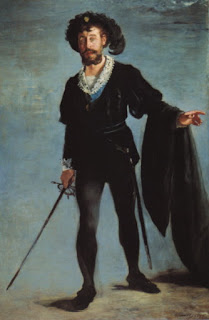
Jean-Baptise Faure as Ambroise Thomas' Hamlet in 1877 by Edouard Manet
Jean-Baptise Faure as
Ambroise Thomas' Hamlet in 1877
by Edouard Manet
Ambroise Thomas' 1868 opera Hamlet takes Shakespeare's play and filters it through multiple layers of influences. The libretto is based not directly on Shakespeare but on Alexandre Dumas, père and Paul Meurice's French version of the play (which included a number of changes and 'corrections'), and then the libretto itself re-shapes the material further to create something suitable for a French grand opera, complete with ballet. Ironically, the opera's most famous scene is a completely invented one, the mad scene for Ophélie. The opera focuses on just four characters, Hamlet, Ophélie, Gertrude and Claudius, and the intention was that they would be taken by the classic combination of tenor, soprano, mezzo-soprano and bass/baritone. As a suitable tenor was not available, Thomas re-worked the role for the great baritone Jean-Baptiste Faure, creating a relatively rare opportunity for baritones to play brooding hero.

The opera tends to be revived once per generation, giving the current lyric baritone a chance to sing the role but it is hardly repertoire stuff. The Hague-based Dutch company OPERA2DAY has decided to take the plunge and the company's director Serge van Veggel has come up with a remarkable re-invention of the piece, discovering something far more urgent and intense underneath the padding of Thomas' grand opera. 


I caught up with OPERA2DAY's performance at the Koninklijke Schouwburg in the Hague on 30 January 2018. Conducted by Hernan Schvartzman, Serge van Veggel's production used designs by Herbert Janse and videos by Margo Onnes, lighting by Uri Rapaport and costumes by Mirjam Pater. The opera was performed in a version by Daniel Hamburger for the 16-piece New European Ensemble (artistic director Emlyn Stam) and sung by a cast of just twelve, Quirijn de Lang as Hamlet, Lucie Chartin as Ophélie, Martijn Sanders as Claudius, Martina Prins as Gertrude, plus Jan-Willem Schaafsma, Patrick Pranger, Joop Keesmaat, Yavuz Arman isleker, Georgi Sztojanov, Judith Pranger, Sonja Volten, and Adelaide Rouyer as an ensemble who provided both chorus and shared the smaller roles.
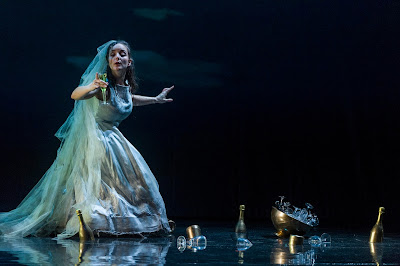
Ambroise Thomas: Hamlet - Opera2Day - Lucie Chartin (Photo  Ben van Duin)
Lucie Chartin  (Photo  Ben van Duin)
Thomas' opera does not take us into Hamlet's mind in quite the way Shakespeare's play does, and Serge van Veggel's solution was to use Shakespeare's own text, spoken (in French) as a voice-over by Jonathan Rouah between the scenes. The combination of text and opera worked surprisingly well, particularly when used over Thomas' instrumental movements. These latter are also one of the most powerful elements of the opera and help to contribute to its remarkable atmosphere. But towards the end of the final act, I thought perhaps that the spoken sections held up the action somewhat.

The opera was cut quite considerably, there was no ballet and other scenes were cut or trimmed. The character of Polonius (a minor one in this opera) was dropped entirely. The result was lithe, focussed and highly dramatic. Not Shakespeare, but something new. The opera exists in two versions, the original expansive grand opera ending with its lieto fine and a more concise tragic one, known as the Covent Garden ending though it is not known if this was used there. In fact, when Nellie Melba sang Ophélie at Covent Garden the evening would usually end after the mad scene. The ending used by Opera2Day was based on Thomas' tragic end but with the choral interjections from the original version.

The production was modern dress, with the main visual element being video. Scenically the opera was quite simple, and centred on the bier of the late King of Denmark. In fact, things started even before the curtain went up as a community chorus and local amateur brass band (the company works with a different group in each location where they are performing the opera), performed the music for Ophélie's funeral but this time adapted for the funeral of Hamlet senior, carrying his bier through the audience members assembled in the foyer. And then once in the theatre this flag-draped bier was at centre stage and that shape stayed there for most of the opera.

Ambroise Thomas: Hamlet - Opera2Day (Photo  Ben van Duin)
Ambroise Thomas: Hamlet - Opera2Day (Photo  Ben van Duin)
Quirijn de Lang's Hamlet was onstage almost continuously, initially slumped in depression against his father's bier as Thomas' prelude played in the orchestra and video images filled the stage. These were filmed by Margo Onnes and throughout the opera, her video of the protagonists of the piece formed a backdrop to the action, sometimes simply a visual record of a remembered scenes and sometimes intense visual details. The effect was to suggest the play of emotions in Hamlet's mind, putting the character at center stage, and helping us to understand the complexity of his actions.

It helped that Quirijn de Lang was such an expressive and intensely dramatic performer. This was not one of those performances which prized beauty of tone above all else, though de Lang sang with a nice flexibility of line and suppleness, but he seemed to prize vivid intensity above all things and this was a Hamlet who we could hear, really suffered. His performance kept you involved from the moment he was on stage to the very end.

Lucie Chartin's Ophélie was a remarkably poised and intense creation, rather brittle at first but entirely comfortable in her coloratura, Lucie Chartin shone in the great showpiece of the mad scene. Again, like Quirijn de Lang she clearly prized expressiveness again simply canary fancying, and gave a remarkably disturbing portrait of the now mad young woman, slitting her wrists. But she did not omit one of the most important elements from the scene, charm; Thomas' music takes a very particular view (rather reductive, it could be argued) of Ophélie and we cannot make it otherwise. Lucie Chartin brought just the right elements of naive charm and wonder to the scene.

Ambroise Thomas: Hamlet - Quirijn de Lang, Martina Prins - Opera2Day (Photo  Ben van Duin)
 Quirijn de Lang, Martina Prins - Opera2Day (Photo  Ben van Duin)
Martijn Sanders was a strong Claudius. He came over as rather a conventional villain in the earler scenes, but when it came to the moment when Claudius is praying in his closet and Hamlet contemplates killing him, Sanders really drew out the power of the music, singing with suave intensity. Martina Prins' Gertrude was troubled from the first time we saw her. Whilst Prins' voice did not always move easily through Thomas' elegant lines, she brought out the innate drama in her final scene Quirijn de Lang's Hamlet.

The remaining singers were all admirably vivid and hard-working, cropping up in a variety of roles as well as creating the chorus, forming a strong backdrop for the protagonists. The scene with the players, with its remarkable saxophone solo in the orchestra, was very vividly mimed, and the short scene with the two grave-diggers (Patrick Pranger and Georgi Sztojanov), here stove-pipe hat Victorians, make a remarkably powerful impact. Jan-Willem Schaafsma sang Laerte, the opera's only major tenor part, not ideally relaxed in tone but with striking vividness.

The opera was played with discreet amplification Arne Bock. This added extra acoustic to the sound, and whilst both voices and instruments were heard with admirable naturalness, it seemed to rebalance them and from my seat in row 12 of the stalls, often favoured the instrument somewhat.

We were always going to lose something, playing Thomas' score with a 15-piece band with just five string players, but under Hernan Schvartzman's direction the remarkable thing was how much was preserved, and how the players made this new lithe version of the score work well.

The style of the performance seemed quite free, with the singers using the music with remarkable expressive freedom. A clue to the performance came from the instrumental contribution where the string portamentos were quite surprising; perfectly in keeping with the music, but a style which is rarely done nowadays. The company has quite an interest in period style, and the choice of Hamlet was partly inspired by the history of the Koninlijke Schouwburg which was an opera house the Theatre Francaise de la Haye until 1919, and where Hamlet was played regularly and the archive of scores and parts still survive. So performances by the company explore elements of how modern singers might relate to period vocal style. There was nothing self conscious about this, but you were aware of the freedom with which the performers felt able to treat the music and this was inspired by the freedom which we know from very early 20th century recordings.

This was the fourth time that I have heard Ambroise Thomas' Hamlet. I first came across it in 1980 at the Buxton Festival directed by Malcolm Fraser with Thomas Allen in the title role, and then in 1995 David McVicar produced it at Opera North with Anthony Michaels Moore, and in 2003 the opera re-appeared at Covent Garden for the first time since 1910 in Patrice Caurier and Moshe Leiser's production with Simon Keenlyside and Natalie Dessay.
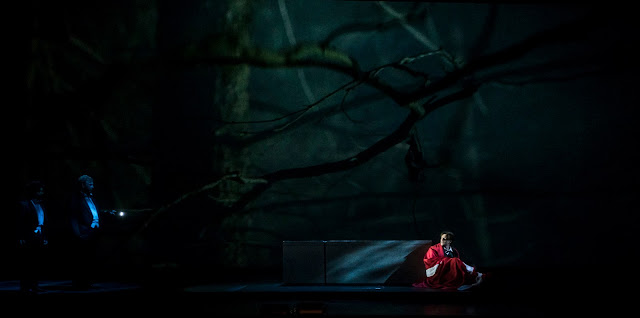
Ambroise Thomas: Hamlet - Quirijn de Lang,  Patrick Pranger, Georgi Sztojanov- Opera2Day (Photo  Ben van Duin)
Ambroise Thomas: Hamlet - Quirijn de Lang,  Patrick Pranger, Georgi Sztojanov- Opera2Day (Photo  Ben van Duin)
This performance could easily have been a creditably sung cut-down version of Ambroise Thomas' grand opera, but it is a testament to the way the company has rethought the entire piece that they have discovered something different, who knew that Thomas' exercise in the grand operatic manner had such remrkably good bones. This was not a performance for those who prize beautiful singing and bel canto technique above all else, but there was indeed plenty of expressive singing and some remarkably intense performances. Despite cuts it was still a long evening, 7.30pm to gone 10.20pm with just one 20 minute interval, but all concerned held our interest with a vividness and sense of real engagement.

I will be writing about this production further, for Opera Now magazine.

Elsewhere on this blog:
  • Music for the Queen of Heaven - the Marian Consort in 21st and 20th century music - CD review
  • Debut treehouse - intimate, innovative and engaging - concert review
  • Classical music with a popular twist: I chat to Lithuanian composer Gediminas Gelgotas - interview
  • Seeing the genre develop: Lully & Quinault's second tragédie en musique, Alceste  - CD review
  • Celebrating Estonian style - the distinctively stylish Estonian Voices - concert review
  • 1768: A Retropective - Chiara Skerath, Katy Bircher, Ian Page, The Mozartists at the Wigmore Hall - concert review
  • The Schuman's at Home - Julius Drake and Sophie Bevan at Temple Music - concert review
  • Eavesdropping on David Pountney rehearsing Verdi's La forza del destino at Welsh National Opera - feature article
  • Chants d'amour - Louise Alder and James Baillieu in Mozart, Bizet, Strauss, Mendelssohn, Faure, Liszt at the Wigmore Hall - concert review
  • The Phantom of the Opera - still going strong after 30 years - music theatre review
  • Hortus Musicus: Jerusalem - Early music and traditional melodies from this Estonian group - CD review
  • Handel's rarely done Lotario emerges as far less of a problem opera in this engaging performance from a young cast at Göttingen festival - CD review
  • A Fancy: 17th century English theatre music from a French ensemble - CD review
  • Home

Popular Posts this month
