Wednesday, 12 June 2019

Nominees in the Sky Arts Award

Gershwin: Porgy and Bess - Nadine Benjamin, Donovan Singletary English National Opera (Photo Tristram Kenton)
This year's South Bank Sky Arts Awards (now in its 23rd year) takes place on Sunday 7 July 2019 at the Savoy Hotel. The awards celebrate every genre of the Arts. This year, in the Opera category nominees are Welsh National Opera's premiere production of Elena Langer's Rhondda Rips It Up! [see my review], English National Opera's production of Gershwin's Porgy and Bess [see Ruth's review] and Garsington Opera's production of Verdi's Falstaff (you can see the production free on OperaVision).

Amongst the nominations for The Times Breakthrough Award is soprano Nadine Benjamin (who starred in the ENO Porgy & Bess and whose own company presented Puccini's Tosca earlier this year, see my review), alongside conductor Alpesh Chauhan, dancer Joseph Sissens and a number of others. The Classical category includes the City of Birmingham Symphony Orchestra's Debussy Festival, James MacMillan's Cumnock Tryst festival, and John Wilson's Bernstein Centenary celebrations.

Full details from the Sky website.

Tuesday, 11 June 2019

Poise, elegance and drama: Carolyn Sampson & Joseph Middleton - Reason in Madness

Reason in Madness - Carolyn Sampson, Joseph Middleton - BIS
Reason in Madness - Brahms, Schumann, Richard Strauss, Koechlin, Debussy, Duparc, Wolf, Schubert, Saint Saens, Chausson, Poulenc; Carolyn Sampson, Joseph Middleton; BIS Reviewed by Robert Hugill on 5 February 2019 Star rating: 5.0 (★★★★★)
An intelligent, intensely focused yet stylish exploration of male composers' depictions of female madness

The concept of female madness is something of a male construct, and has long fascinated men in different ways. Composers have equally returned constantly to the idea, yet bringing a variety of different reactions.

On this new disc Reason in Madness on BIS, soprano Carolyn Sampson and pianist Joseph Middleton explore composers' depictions of female madness with music by Brahms, Schumann, Richard Strauss, Koechlin, Debussy, Duparc, Wolf, Schubert, Saint Saens, Chausson and Poulenc, through characters such as Ophelia, Mignon and Faust's Marguerite.

The disc opens with an unaccompanied version of 'Sie trugen ihn auf de Bahre bloss' from Brahms' 5 Ophelia Lieder, written for an actress and with accompaniments which suggest Brahms intended them to be unaccompanied. The lack of piano heightens the folk-like nature of the song in Sampson's focused and concentrated performance.

Another year over: Genesis Sixteen showcases its current cohort and welcomes the new cohort

Members of Genesis Sixteen
The Sixteen recently announced the 2019/20 cohort of young singers for Genesis Sixteen. Over the course of a year members of Genesis Sixteen take part in a series of week-long and weekend courses led by key figures from The Sixteen, including founder and conductor Harry Christophers and Associate Conductor Eamonn Dougan. Participants receive group tuition, individual mentoring and masterclasses run by some of the world’s top vocal experts. Support from the Genesis Foundation means participants receive free tuition and a bursary to cover all additional costs. The scheme is now in its eighth year and has worked with over 150 participants.

There will be chance to hear the 2018/19 Genesis Sixteen in action on Saturday 20 July 2019 as part of the Sixteen's Sounds Sublime Festival at St Clement Dane's Church. Genesis Sixteen will be giving a lunchtime concert, the culmination of the year-long training programme, beforehand in the morning Genesis Sixteen alumni will be supporting Streetwise Opera in a performance responding to Eric Whitacre’s Leonardo Dreams of his Flying Machine, the culmination of a series of workshops with The Sixteen’s education department and Streetwise Opera.

Full details of the Sounds Sublime festival from The Sixteen website.

Young British conductor Harry Ogg joins WNO as Associate Conductor

Harry Ogg
The young British conductor Harry Ogg reached the finals of the Donatella Flick Competition in 2018, and as a result has been appointed Associate Conductor at Welsh National Opera (WNO) as part of a collaboration between WNO and the competition. Harry has been becoming noticed recently, he also won second prize in the MDR Symphony Orchestra Conducting Competition in Leipzig 2018 and was selected for the Deutsche Dirigentenforum the same year, and he will be working with François-Xavier Roth in Cologne with their resident Gürzenich Orchestra next season.

Harry assisted Tomáš Hanus, Music Director of WNO, on WNO's new production of Prokofiev's War and Peace last Autumn, and he will again be working on the production when WNO perform it at Covent Garden in July 2019. Harry made his debut with WNO conducting the orchestra for a concert at Saffron Hall in March 2019, and his first official engagement as Associate Conductor will be conducting a trio of Summer Opera Classics concerts in Wales featuring songs and arias from Norma to South Pacific, with soloists Joyce El Khouri (who recently sang Elisabetta in Rossini's Roberto Devereux with WNO, see my review) and Jason Howard.

This Autumn, Harry will again work alongside Tomáš as Assistant Conductor on WNO’s new production of Bizet’s Carmen. He will then return to conduct Carmen in Cardiff and on tour during the Spring 2020 season.

Harry was conductor for the Opera Holland Park young artists performance of Mozart's Don Giovanni in 2017 [see my review], and I interviewed him way back in 2013.

Monday, 10 June 2019

Rehearsals for The Gardeners

Julian Debreuill, Peter Brathwaite, Magid El-Bushra, Flora McIntosh, Georgia Mae Bishop in rehearsals
It was great to have all five soloists (Julian Debreuil, Peter Brathwaite, Magid El-Bushra, Flora McIntosh, Georgia Mae Bishop) together at rehearsals for the climactic final ensemble of The Gardeners directed by William Vann. Exciting to hear the music properly, and it will be even more so when we add the instruments.

The Gardeners (libretto by Joanna Wyld) premiers at Conway Hall on 18 June 2019, tickets available from Ticket Tailor.

William Vann in rehearsal

Sheer enjoyment: Verdi's Falstaff at the Grange Festival

Verdi: Falstaff - Nicholas Lester, Rhian Lois, Elin Pritchard, Angela Simkin, Graham Clark, Alessandro Fisher - The Grange Festival 2019 (Photo Clive Barda)
Verdi: Falstaff - Nicholas Lester, Rhian Lois, Elin Pritchard, Angela Simkin, Graham Clark, Alessandro Fisher
The Grange Festival 2019 (Photo Clive Barda)
Verdi Falstaff; Robert Hayward, Elin PRitchard, Rhian Lois, Susan Bickley, Nicholas Lester, Alessandro Fisher, Graham Clark, Christopher Gillett, Petro di Bianco, dir: Christopher Luscombe, Bournemouth Symphony Orchestra, cond: Francesco Cilluffo Reviewed by Robert Hugill on 9 June 2019 Star rating: 4.5 (★★★★½)
A contemporary updating, detailed direction, nimble ensemble and sheer enjoyment

Verdi Falstaff: - Robert Hayward, Nicholas Lester - The Grange Festival 2019 (Photo Clive Barda)
Verdi Falstaff: - Robert Hayward, Nicholas Lester
The Grange Festival 2019 (Photo Clive Barda)
We caught Christopher Luscombe's new production of Verdi's Falstaff at the Grange Festival on Sunday 9 June 2019. Robert Hayward was Falstaff, with Elin Pritchard as Alice Ford, Rhian Lois as Nannetta, Susan Bickley as Mistress Quickly, Angela Simkin as Meg Page, Nicholas Lester as Ford, Alessandro Fisher as Fenton, Graham Clark as Dir Caius, Christopher Gillett as Bardolfo, Pietro di Bianco as Pistola. Francesco Cilluffo conducted the Bournemouth Symphony Orchestra.

Luscombe's amazingly detailed production set the opera in the present day, and Simon Higlett's imaginative set made the maximum use of the Grange's stage. The opera opened in a rather naff modern hostelry full of faux-wood, and this slid sideways to reveal the Ford's house with a dock in front (used for comings and goings by steam launch), and the house swung round to reveal the well-equipped kitchen for interior scenes.

The result created a series of striking settings, with swift scene changes, and very much evoked and updated version of the suburbia of Brian Rix farces, and the Fords were prime candidates for inclusion in such a farce. Though in fact, this was no farce but a highly detailed comedy. Falstaff (Robert Hayward) was an ageing hippy, all hair, beard, loud loose clothes and bare feet, you felt that the present Marquess of Bath was perhaps one of the role's inspirations!

What was delightful about evening was the way that Luscombe's updating and carefully detailed direction made the piece work so well in its present day setting. There were lots of incidental delights; there was a real credit card machine, the 'boys' who shift the laundry basket are in fact workmen there to fit a new washer, Falstaff's damp entry at the beginning of Act Three is made to the inn's riveside patio complete with a classic pub table.

But what made the evening work was the lightness that everyone brought to the performance, the sense of ensemble and the sheer enjoyment that the cast exhibited. The comedy had no particular axe to grind, simply the enjoyment of the vagaries and mores of the world.

A finely balanced cast in Opera Holland Park's 1930s setting for Verdi's Un ballo in maschera

Verdi: Un ballo in maschera - Matteo Lippi, Alison Langer - Opera Holland Park 2019 (Photo Ali Wright)
Verdi Un ballo in maschera; Anne Sophie Duprels, Matteo Lippi, George von Bergen, Rosalind Plowright, Alison Langer, dir: Rodula Gaitanou, City of London Sinfonia, cond: Matthew Kofi Waldren; Opera Holland Park Reviewed by Robert Hugill on 8 June 2019 Star rating: 4.5 (★★★★½)
Strong individual performances in a staging which does not quite have the right impact

Verdi: Un ballo in maschera - Anne Sophie Duprels, Matteo Lippi - Opera Holland Park 2019 (Photo Ali Wright)
Verdi: Un ballo in maschera
Anne Sophie Duprels, Matteo Lippi
Opera Holland Park 2019 (Photo Ali Wright)
Opera Holland Park's second opera of the season was Verdi's Un ballo un maschera in a production by Rodula Gaitanou with designs by Takis which opened on Saturday 8 June 2019. Matteo Lippi was Gustavo, with Anne Sophie Duprels as Amelia, George von Bergen as Anckarström, Rosalind Plowright as Madame Arvidson, Alison Langer as Oscar, Benjamin Bevan as Ribbing and John Savournin as Horn. Matthew Kofi Waldren conducted the City of London Sinfonia.

Despite the use of the Swedish names for the characters Gaitanou's production was relatively unspecific in its location. Re-set to the 1930s,  Takis' sets were based around wooden panelling which could be moved flexibly, though the stage was rarely fully opened out and most of the scenes were played out on a deliberately restricted stage with the wooden backdrop presumably helping the auditorium's tricky acoustics. The period setting gave the opportunity for turning Madame Arvidson (Rosalind Plowright) into a stylish society medium, and meant that Anne Sophie Duprels' Amelia was less passive and had rather more gumption than in many portrayals. But the setting did not seem to specifically add to the the opera's dramaturgy, and significantly weakened it in one way as there was little feel of the gothic.

This gothic element plays an important part in Verdi's opera, but it is something that modern day stagings have difficulty getting right, contemporary audiences' relationship to the gothic is very different to those in Verdi's time. Gaitanou's staging of Madame Arvidson's scene was enormously effective, but it lacked the transgressive feel, the sense of going out of the bounds of normal society. And Act Two was set in a hospital which, despite some dead bodies and alarming shadows, just does not have the same sense of desperation as the original instructions for Amelia to pick the herb in the shadow of the gallows. Functionally Act Two worked pretty well, but it lacked the atmosphere necessary to bring this scene off.

That said, I have to confess that I have yet to see an entirely satisfactory production of Un ballo in maschera and wonder whether David Alden's 1980s gothic fantasy at English National Opera might have come closest. Certainly recently directors have struggled to make the piece work.

At Opera Holland Park the strength of the casting meant that we overlooked any weakness in the staging, and the combination of Matteo Lippi, Anne Sophe Duprels, Rosalind Plowright and George van Bergen really held our attention.

Saturday, 8 June 2019

Something for everyone: I chat to Michael Williams', Buxton Festival's CEO, about ideas and plans for the festival

Michael Williams (Photo Anton De Beer)
The Buxton Festival has cause for celebration this year, it is 40 years since Anthony Hose and Malcolm Fraser put on the first complete performance of Donizetti's Lucia di Lammermoor (in the original keys) at the newly restored Buxton Opera House. Since then the festival has developed enormously, expanding in scope to include a significant musical programme as well as a whole literary side. This year a new team is in charge, Michael Williams, the festival's CEO, took over in 2018, and conductor Adrian Kelly is the new artistic director. I recently met up with Michael to talk about the 2019 festival and learn more of the new team's plans, but also to find out how a South African director and artistic administrator (Michael ran Cape Town Opera for 20 years) has ended up in Buxton.

One of the things that Michael enjoys about the festival is its Friends, there are over 2000 of them and they are highly engaged as well as being critical of the festival. Michael loves the way that the Friends connect with the festival with a sense of passion, something that he finds quite rare.  But whilst he values the Friends and is keen for the festival to serve them, he also wants the festival to respond to the wider area around Buxton and to work with communities and draw them in. He points out that everyone loves stories and loves song, and opera is just telling a story in song.

So Michael wants to make the festival a bit more open. One of the reasons for doing Tchaikovsky's Eugene Onegin this year is that it is an opera about young love, something with which everyone can connect. But the festival has developed a reputation for exploring rarities, and this year is no exception. They are collaborating with La Serenissima to stage Caldara's Lucia Papiro Dittatore, an opera which has not been performed for 300 years (Caldara worked for the Imperial court in Vienna, which is where the opera was premiered).

Buxton Opera House (Photo Richard Hubert Smith)

Friday, 7 June 2019

North London's 'quirky and friendly' Stroud Green Festival starts today

The Bloomsbury Quartet
Today (7 June 2019) sees the start of North London's 'quirky and friendly' Stroud Green Festival. Between now and 23 June the festival will be celebrating women and women composers, with a lively programme of folk, jazz, classical, early music, art, poetry and theatre at eight venues across Harringey. Artistic director Clare Norburn has become known for her concert-plays and four are featured at the festival, varying from the imagined testimony of Hildegard of Bingen, to Beethoven and the late quintets with actor David Timson and the Dante Quintet, to the secret life and love of medieval Amy Winehouse, Beatriz de Dia, and Prosper Merimee's Carmen with music by Bizet and from Spain.

Hildegard of Bingen stays in focus at the festival as ensemble Vox Animae perform her allegorical drama Ordo Virtutum. There will be music and readings from Shakespeare's plays with a focus on Shakespeare's women, whilst guitar and flute duo Flaugissimo's concert will include music by Clara Schumann, Anna Amalia of Prussia and Fanny Mendelssohn Hensel.

Lux Musicae
Lux Musicae
Last year, Stroud Green Festival saw its first ensembles competition in which four of London’s most exciting ensembles won two years of mentoring and engagements in the festival as resident ensembles. This year’s resident ensembles are Lux Musicae London and Bloomsbury Quartet. Lux Musicae's concerts include the story of the roots of Flamenco music, and an exploration of the music and vocal art of Francesca Caccini (1587-1641) and Barbara Strozzi (1619-1677). The Bloomsbury Quartet will perform quartets by Elizabeth Maconchy, her teacher Vaughan Williams and daughter Nicola LeFanu as photographs and Maconchy’s writings are read and projected. Plus, a pre-concert installation will introduce Maconchy through film and photography while the audience is free to interact with musicians and listen to examples of her music.

Full details from the festival website.

A lively new concert season for the orchestra of Opera North

Conductor Ruth Reinhardt makes her UK debut with the orchestra of Opera North (Photo Harrison Linsey)
Conductor Ruth Reinhardt makes her UK debut with the
orchestra of Opera North (Photo Harrison Linsey)
As well as accompanying Opera North's performances the Orchestra of Opera North has a lively existence out of the pit, and the company has just announced details of the 2019/20 concert season which the orchestra is giving in partnership with Kirklees Council. At a time when local authorities are cutting back on provision for the arts it is heartening to see that Opera North and Kirklees Council's partnership is now in its 17th year.

The concert season in Huddersfield Town Hall (with some concerts in Leeds Town Hall and one in Dewsbury Town Hall) will feature the UK debut of German-born USA-based conductor Ruth Reinhardt who is joined by pianist Marc-Andre Hamelin for Beethoven's Emperor Concerto, along with music by Webern and Schubert, Latvian violinist Kristïne Balanas in Korngold's Violin Concerto alongside Max Steiner's music from the film Casablanca and Prokofiev, and the premiere of Arya a new concerto for sitar and orchestra by Jasdeep Singh Degun, alongside music by Turkish composer Ulvi Cemal Erkin and Sibelius, conducted by Harish Shankar. The concerto follows a residency project undertaken by Jasdeep Singh Degun as part of Opera North annual Resonance programme for musicians and composers from BAME backgrounds.

There is opera too, with a concert performance of Bartok's Bluebeard's Castle with Christopher Purves and Karen Cargill, conducted by Anthony Krauss. And lighter items too, a G&S evening, a Viennese waltz evening and Raymond Briggs' animated film The Snowman with Howard Blake's music performed live.

The company is starting a new residency for women conductors, in recognition of the fact that talented female conductors are less likely to find their way into opera than men. The residency, aimed at female conductors who have shown extraordinary potential and who are at the start of promising careers in opera, is spread across a full opera season, and will include observing opera rehearsals, being mentored by Opera North’s Music staff and guest conductors, and engaging with the Company’s Education and outreach programmes.

The first participant is Sonia Ben-Santamaria (whose name will be familiar to regular readers of this blog, and she will be conducting two performances of Opera Holland Park's Un ballo in Maschera later this month.

Full details of the concert season from the Opera North website.

Music Plus Podcast: classical music and issues

Classical Music Podcast
Discussion of classical music tends to skirt away from political issues. The issues are there, certainly, and sometimes rear their heads only to disappear again, but we seem to have no consistent discussion about music, culture and wider issues, whether they be politics, race, gender, sexuality or more.

Now the Music Plus has been launched, in which different musicians talk about themselves and the issues they are involved in, with Christopher Gunness. Current podcasts include Venezuelan pianist Gabriela Montero talking about the ongoing political crisis in her own country, something that Montero continues to address in her own music making, conductor Mark Wigglesworth talking not only about conducting but Brexit and the challenges of a career in the musc industry, and double bass player Chi-Chi Nwanoku on the government's current disastrous policies on musical education in schools and the lack of diversity in the classical music industry.

Whilst the podcasts are issue-led, they are about people as well. Musicians are often involved in issues because of who they are or because of things that have happened to them, and Gunness is an engaging interviewer so that we enjoy and are engage in the narrative of the interviewees journey.

Other interviewees include Julian Lloyd-Webber on universal music education, Nicholas McCarthy (the concert pianist born without a right hand) on disability and stigma, and James Rose (the world's first professional conductor with cerebral palsy) whilst planned is Cayenna Ponchione Bailey, who recently brought the Afghan Women's Orchestra to the UK.

Gunness, himself, has an interesting background. Originally a music journalist at the BBC, he has worked in the Middle-East for UN doing rights-based public advocacy. He created the Music Plus podcast because for years he saw the world of pop music campaigning for all sorts of issues (right back to Live Aid), yet there was nothing comparable in classical music.

Music  Plus is available on Spotify and on iTunes.

You can also see the complete list of podcasts on the Classical Music magazine website.

Verdi's Don Carlo returns to Grange Park Opera in Jo Davies & Leslie Travers stylish & imaginative production

Verdi: Don Carlo - Leonardo Capalbo, Brett Polegato - Grange Park Opera 2019 (Photo Robert Workman)
Verdi: Don Carlo Act 1 - Leonardo Capalbo, Brett Polegato - Grange Park Opera 2019 (Photo Robert Workman)
Verdi Don Carlo; Leonardo Capalbo, Brett Polegato, Marina Costa-Jackson, Ruxandra Donose, Clive Bayley, dir: Jo Davies, ENO Orchestra, cond: Gianluca Marciano; Grange Park Opera
Reviewed by Robert Hugill on 6 June 2019 Star rating: 4.5 (★★★★½)
A miracle of compression, one of the most satisfying productions of Verdi's grand opera around

Grange Park Opera opened its 2019 season with a revival of Jo Davies fine production of Verdi's Don Carlo, one of the last (and finest) productions in the company's old home in Hampshire. [see my review]. The production featured two original cast members returning to their roles, Clive Bayley's Filippo and Ruxandra Donose's Eboli, with Leonardo Capalbo as Don Carlo, Marina Costa-Jackson as Elisabetta, Brett Polegato as Rodrigo, Branislav Jatic as the Grand Inquisitor, David Shipley as the Monk / Charles V and Jessica Leary as Tebaldo. Gianluca Marciano conducted the orchestra of English National Opera.

Central to the production are Leslie Travers stylish and imaginative sets which provide a series of striking backdrops for the intimate scenes yet facilitate creating a remarkable amount of grandeur on a relatively small stage. The production remains one of the most satisfying recent incarnations of Verdi's grand opera that we have seen and the only regrets are that length prevents the five-act version from being performed, and that it is not done in the original French (Leonardo Capalbo will be singing the title role in French with Opera Vlaanderen in the Autumn).

Verdi: Don Carlo - Clive Bayley, Leonardo Capalbo - Grange Park Opera 2019 (Photo Robert Workman)
Verdi: Don Carlo Act 2 'Auto de fe scene' - Clive Bayley, Leonardo Capalbo
Grange Park Opera 2019 (Photo Robert Workman)
Without the Fontainebleau Act, we never see Don Carlo and Elisabetta in their moment of untroubled bliss and the four act version of the opera has inevitably to start in media res.

Thursday, 6 June 2019

Opera Holland Park opens its 2019 season with a striking new Manon Lescaut directed by award-winning Karolina Sofulak

Puccini: Manon Lescaut - Elizabeth Llewellyn, Peter Auty - Opera Holland Park 2019 (Photo Robert Workman)
Puccini: Manon Lescaut Act 2 - Elizabeth Llewellyn, Peter Auty - Opera Holland Park 2019 (Photo Robert Workman)
Puccini Manon Lescaut; Elizabeth Llewellyn, Peter Auty, Paul Carey Jones, Stephen Richardson, dir: Karolina Sofulak, City of London Sinfonia, cond: Peter Robinson; Opera Holland Park Reviewed by Robert Hugill on 4 June 2019 Star rating: 4.5 (★★★★½)
A sophisticated and intelligent updating, presented with impulsive passion

Puccini: Manon Lescaut - Paul Carey Jones - Opera Holland Park 2019 (Photo Robert Workman)
Puccini: Manon Lescaut Act 2 - Paul Carey Jones
Opera Holland Park 2019 (Photo Robert Workman)
I have to confess that I have never really found the character of Manon very fascinating in any of her incarnations (novel, opera by Massenet, opera by Puccini or ballet by Kenneth MacMillan). For any performance, I rely very much on the particular artists to create a reason for me to continue watching. Puccini's opera, with its compressed dramaturgy, remains a somewhat strange beast. Despite being his first major work, the piece has never achieved the sort of performance level that his other pieces have.

So, it was all the more intriguing to find Opera Holland Park opening its 2019 season on 4 June 2019 with Puccini's Manon Lescaut with a pair of extremely fine artists, Elizabeth Llewellyn and Peter Auty, as Manon and Des Grieux, in a production by a director, Karolina Sofulak, who won the European Opera Directing Prize in 2018 (with designer George Johnson-Leigh) with the concept on which this production was based! The cast was completed by Paul Carey Jones as Lescaut, Stephen Richardson as Geronte, and Stephen Aviss as Edmondo. Peter Robinson conducted the City of London Sinfonia.

Sofulak and Johnson-Leigh set the opera in the early 1960s, and Act One opened in a club frequented by trendy young things. It became apparent that Geronte (Stephen Richardson) was not a visitor but the shady owner of the club. At first, it seemed that Sofulak's approach, give or take the setting, was quite traditional but then at the end of Act Two there were no guards, just Geronte and his heavy (Alistair Sutherland), and in Act Three we were back in the club, with Manon (Elizabeth Llewellyn) and other women, Shadow Manons, being looked over by Geronte and the club members (the solo roles in this act being combined up with those of Geronte, Innkeeper and Edmondo). Then in Act Four the action became even more metaphysical, about the fractures in the relationship between Manon and Des Grieux (Peter Auty) rather than a real desert.

The result was a sophisticated and intelligent updating, which cast new light on the piece without doing violence to Puccini's original dramaturgy. It made economic sense too, with the just one flexible set and the removal of the need to have separate soloists in Act Three.

Puccini: Manon Lescaut - Paul Carey Jones, Elizabeth Llewellyn, Stephen Richardson  - Opera Holland Park 2019 (Photo Robert Workman)
Puccini: Manon Lescaut Act 1 - Paul Carey Jones, Elizabeth Llewellyn, Stephen Richardson
Opera Holland Park 2019 (Photo Robert Workman)

Wednesday, 5 June 2019

BCMG: Across the Channel - Outre Manche

BCMG: Across the Channel
Birmingham Contemporary Music Group (BCMG) is joining forces with the French ensemble Court-circuit and the Royal Birmingham Conservatoire for a cross-Channel collaborative project bringing the two new music ensembles together with early career musicians to perform music by five contemporary composers, Hilda Paredes, Mael Bailly, Francois Paris, Rebecca Saunders and Jonathan Harvey.

The project involves a residency and exchange visit, culminating in a concert at the Conservatoire on 14 June 2019, when Jean Deroyer will conduct the two ensembles alongside early career musicians from the Conservatoire.

The concert will feature UK premieres of Siphonophorae by Mexican-born London-based Hilda Paredes, and Six miniatures pour sextuor by the young French composer Maël Bailly. À propos de Nice by French-born Spain-based François Paris dates from 2005 and is inspired by 1929 silent film of the same name by Jean Vigo which will be shown as part of the performance. British composer Rebecca Saunders, who won the 2019 Ernst von Siemens prize, has strong links to BCMG (with two other works being performed by BCMG in 2019) and they will perform her Stirrings Still I in the concert. The programme is completed with Jonathan Harvey's 2009 composition for ten-piece chamber ensemble Vajra .

The exchange is completed in November when members of BCMG travel to Paris to perform with Court-circuit and work with students from the Paris Conservatoire.

Full details from the BCMG website.

Norwegian soprano Lise Davidsen launches her debut CD

James Baillieu and Lise Davidsen at Home House (Photo Dominic Nicholls)
The young Norwegian soprano Lise Davidsen has been causing some excitement in the opera world as she explores the lyric dramatic repertoire, demonstrating the type and calibre of voice which only comes rarely in each generation. She made her UK debut at a Rosenblatt Recital at Wigmore Hall in 2017 [see Ruth's review], and she was Ariadne in Glyndebourne's 2017 revival of Richard Strauss' Ariadne auf Naxos [see Claire Seymour's review on Opera Today]. Davidsen will be back in the UK later this year when she joins Jonas Kaufmann in Covent Garden's new production of Beethoven's Fidelio.

But before then, she is releasing her first CD on DECCA, with the Philharmonia Orchestra conducted by Esa-Pekka Salonen, performing arias from Wagner's Tannhauser and Richard Strauss songs including the Four Last Songs.

Last night (3 June 2019), there was a launch event for the disc at Home House in Portman Square, when Lise Davidsen was joined by pianist James Baillieu (her regular partner, he was the pianist at that 2017 Rosenblatt Recital) to sing Elisabeth's prayer 'Allmacht'ge Jungfrau!' from Tannhauser, 'Cacilie' and 'Ruhe, meine Seele' from Richard Strauss' Vier Lieder Op. 27, and 'Beim Schlafengehen' from Vier letzte Lieder. It was a privilege and a thrill to be able to hear Davidsen performing at such close quarters, she has a remarkable voice and in the Q&A with Edward Seckerson afterwards, it was clear that Davidsen has a clear understanding of both her voice and the care needed in its development (she is only 32).
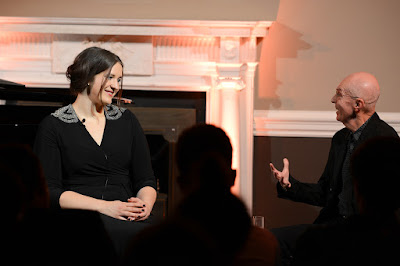
Lise Davidsen and Edward Seckerson at Home House (Photo Dominic Nicholls)
Lise Davidsen and Edward Seckerson at Home House
(Photo Dominic Nicholls)
Davidsen comes from a small town in Norway and grew up playing the guitar and wanting to be Joni Mitchell or Eva Cassidy. A high school her voice was noticed and she was advised to study solo singing rather than being in a choir, and a teacher suggested she look at 'Dido's Lament' from Purcell's Dido and Aeneas. This would be her first exposure to opera; she looked for a recording in the library and ended up listening to Kirsten Flagstad singing it and was blown away. She did not hear her first live opera until she was 19, Strauss' Der Rosenkavalier.

At first she identified as a mezzo-soprano, and studied as one for three years. She loved the baroque repertoire, but a teacher said that she was a soprano. Her initial reaction was 'no that isn't going to happen' but in fact it felt right, and she simply went with what the voice told her. Her singing teacher advised her to listen to bigger voices, such as Birgit Nilsson, as that was where her voice would go.

She is clearly planning her future repertoire with care, taking good advice about roles, as a former mezzo-soprano her voice takes a slightly different path to sopranos who approach the dramatic repertoire from a lighter soprano perspective (Kirsten Flagstad sang operetta and lyric roles for over a decade before moving to heavier ones).

Davidsen will be singing Elisabeth in Wagner's Tannhauser at Bayreuth this Summer.

Lise Davidsen's recital on DECCA is out now. Available from Amazon.

Tuesday, 4 June 2019

Meet the Artist!

Robert Hugill (photo Robert Piwko)
"Texts give rise to melodies in my head, which need to be written down. Harmonies are initially simply shapes which need to be explored"

In advance of the premiere of Joanna Wyld and my new chamber opera The Gardeners at Conway Hall on 18 June 2019, there is a chance to read more about my inspirations and the background to my music as I am the subject of the latest Meet the Artist on Frances Wilson's Cross-Eyed Pianist blog.

I find it tricky writing about music and where it comes from, so was quite pleasantly surprised when reading back the quote (see above) to feel that it rather makes sense!

Catch the article at:
https://meettheartist.site/2019/06/03/robert-hugill-composer/


Tickets for The Gardeners, price £20, are available from TicketTailor

Charles Gounod’s Faust has returned to favour after spending a few years in the wilderness. Planet Hugill’s roving reporter, Tony Cooper, picks up the show in Nice

Gounod: Faust - Opéra de Nice (Photo Dominique Jaussein)
Gounod Faust: Stefano Secco, Nicolas Courjal, Chloé Chaume, Armando Noguera, dir: Nadine Duffaut, cond: Giuliano Carella; Opéra de Nice Reviewed by Tony Cooper on 28 May 2019 Star rating: 5.0 (★★★★★)
Gounod's grand opera in a splendid new production on the Opéra on the Côte d’Azur

Gounod: Faust - Chloé Chaume, Stefano Secco - Opéra de Nice (Photo Dominique Jaussein)
Gounod: Faust - Chloé Chaume, Stefano Secco
Opéra de Nice (Photo Dominique Jaussein)
Charles Gounod’s Faust has returned to favour after spending a few years in the wilderness. Planet Hugill’s roving reporter, Tony Cooper, picks up the show at Opéra de Nice in a grand and rewarding production in a forthright dramatic realisation by Nadine Duffaut, which has been well received by French opera-lovers, with Stefano Secco as Faust, Nicolas Courjal  as Mephistopheles, Chloé Chaume as Marguerite and Armando Noguera conducted by Giuliano Carella

An opera in five acts with the original scenario set in 16th-century Germany, Gounod’s Faust - set to a libretto by Jules Barbier and Michel Carré from Carré’s play Faust et Marguerite and based on Part One of Goethe’s epic poem - was a major inspiration for many composers during the 19th century.

The work first saw the light of day at the Théâtre-Lyrique, Paris, in 1859. A decade later it appeared at the Grand Opéra, Paris. For this production Gounod added a ballet to act five. When it arrived in London it 1863 it was first seen at Her Majesty’s Theatre and a year later at the Royal Italian Opera, Covent Garden.

However, from my perspective, the opera first saw the light of day when I attended a performance of Carl Rosa’s endearing production at Norwich Theatre Royal in 1958 (11th April to be precise). It made a big impression upon me and got me hooked on opera. Faust was sung by Brychan Powell, Méphistophélès (Stanislav Pieczora) and Marguerite (Estelle Valery). Edward Renton was in the pit.

Des McAnuff's 2010 production for English National Opera impressed me, too. I can’t believe it was that long ago! C’est la vie! Conducted by Edward Gardner, Iain Paterson took the role of Méphistophélès, Toby Spence (Faust) and Melody Moore (Marguerite). Recently, David McVicar mounted a new production for the Royal Opera House Covent Garden featuring Michael Fabiano (Faust), Erwin Schrott (Méphistophélès) and Irina Lungu (Marguerite), conducted by Dan Ettinger.

Now the opera comes back to France at Opéra de Nice on the splendid Côte d’Azur. What a come-back, too! A co-production with Opéra Grand Avignon (first seen there in 2017), Opéra de Massy, Opéra-Théâtre de Metz-Métropole, Opéra de Reims and Opéra de Marseille, Nadine Duffaut’s realisation captured so vividly the poor tortured and anguished soul of Dr Faust who has spent a lifetime studying philosophy and is disillusioned about life to the point of madness and suicide. When we first meet him he’s rumbling about in his study littered with a lifetime’s reading tearing pages from a book trying to find the answer to love, lost youth and eternal happiness but to no avail.

Gounod: Faust - Opéra de Nice (Photo Dominique Jaussein)

Deep Light: Weber, Finzi, RVW, Schumann, Francaix

Cristo Barrios - Deep Light
Deep Light - Weber, Finzi, RVW, Schumann, Francaix; Cristo Barrios, Andrew West; Ibs classical Reviewed by Robert Hugill on 4 June 2019 Star rating: 4.0 (★★★★)
An engaging recital which takes us from the serious to the lighter, from Germany to England to the south of France

This new disc of music for clarinet and piano, Deep Light, on the Ibs classical label, comes from the Spanish clarinettist Cristo Barrios and British pianist Andrew West. An eclectic, yet satisfying recital, it moves from Carl Maria von Weber and Robert Schumann, through RVW and Gerald Finzi to Jean Francaix.

One fascinating feature of the recital is that there are no sonatas, all the composers are exploring wider genres from Weber's grand showpiece duo, Grand Duo Concertant, and Schumann's evocatively Romantic sketches, Phantasiestucke, to RVW and Finzi's collections of short pieces, Six Studies on English Folk Song and Five Bagatelles, ending with Jean Francaix variation form, Tema con Variazioni.


Monday, 3 June 2019

Somewhere for the Weekend: the Pelagian Opera Festival

Pelagian Opera Festival
The Salutation hotel in Sandwich, Kent is playing host to a new opera festival which offers the prospect of opera, cabaret, fine gardens and lovely food. The inaugural Pelagian Opera Festival, which takes its theme as As If By Magic, runs from 28 June to 7 July, and there will be afternoon performances of an abridged version of Mozart's The Magic Flute, billed as Die kleine Zauberflöte, as well as opera cabaret in the evenings.

Performed to piano accompaniment, Die kleine Zauberflöte will be directed by Catrin Wyn Davies with young singers from The Royal Conservatoire Den Haag. In the evenings there will be the chance to dine on the terrace and be serenaded by an eclectic mix of opera favourites and less well-known Baroque and Classical arias to a piano accompaniment.

Full details from The Salutation's website.

Music of Today: Philharmonia's 2018/19 Composers Academy

Composers' Academy, Chia-Ying Lin, Alex Woolf, Benjamin Ashby; Philharmonia Orchestra, Geoffrey Paterson; Royal Festival Hall Reviewed by Robert Hugill on 5 February 2019
Three contrasting works for mixed octet from the current members of the Philharmonia Orchestra's Composers' Academy

The Philharmonia Orchestra's 2018/19 Music of Today concert series at the Royal Festival Hall ended on Sunday 2 June 2019 with works from the three composers who took part in the Philharmonia's Composers' Academy, in partnership with the Royal Philharmonic Society. Geoffrey Paterson conducted members of the Philharmonia Orchestra in Chia-Ying Lin's Intermezzo to the Minotaur, Alex Woolf's Octet and Benjamin Ashby's I've been planning for an Impromptu.

All three works were for mixed octet, each taking a slightly different line-up of instruments, and all three had been workshopped in February by Paterson and the musicians as part of the Composers' Academy, allowing the composers to experiment and develop the material in ways which might not always be possible with an official commission. What was fascinating was the three very different routes the young composers took for writing for eight instruments.

Musicianship & sheer engagement: Brixton Chamber Orchestra's Live Lounge at the Department Store

Brixton Chamber Orchestra, Matthew O'Keeffe, Maro Doucoure - Downstairs at the Department Store, Brixton
Live Lounge; Brixton Chamber Orchestra, Matthew O'Keeffe; The Department Store, Brixton Reviewed by Robert Hugill on 1 June 2019 Star rating: 4.0 (★★★★)
Acoustic covers of a wide range of songs from this lively Brixton-based ensemble with a range of talented local vocalists

The Brixton Chamber Orchestra, artistic director Matthew O'Keeffe, is a lively large-scale chamber ensemble which seeks to involve itself in Brixton's diverse cultural life whether it be classical music, gospel, rap, or Michael Jackson. All these styles and more were on display at the ensemble's Live Lounge at the Department Store in Brixton on Saturday (1 June 2019). Directed from the keyboard by Matthew O'Keeffe, they performed acoustic covers of Michael Jackson, Desiree, Adele, Justin Timberlake, Rap, Gospel, Fleetwood Mac and much more with a talented group of local vocalists, Maro Doucoure, Camile Reid, Daniel Lewis, Megan McArthur, Ruth Brown, Terra the Kid and Rowlando Morgan.

Downstairs at the Department Store is an event space linked to the club Upstairs at the Department Store in the Department Store development in Brixton where architects Squire and Partners have revivified an old department store building.

Matthew O'Keefe directed an ensemble of 14 young classically trained musicians, string quartet, double bass, single woodwind, horn, trumpet, trombone, guitar and percussion, with only the guitar, keyboard and vocalists having any amplification. The imaginative arrangements were done by Matthew O'Keeffe and provided a new an intriguing view of some well loved classics.
Brixton Chamber Orchestra, Matthew O'Keeffe, Ruth Brown - Downstairs at the Department Store, Brixton

Sunday, 2 June 2019

Summer Music in City Churches

Summer Music in City Churchess
Summer Music in City Churches returns later this month (20-28 June 2019) with a series of concerts under the theme of Words and Music in some of the City of London's most historic churches, St Giles-without-Cripplegate, St Mary-le-Bow, St Stephen Walbrook, and St Lawrence Jewry next Guildhall plus St Bride's Fleet Street (where there is a festal Evensong).

The festival opens on 20 June 2019 with a concert from the City of London Choir, conductor Hilary Davan Wetton with a programme which references St Giles without Cripplegate where the concert takes place. John Milton, author of the text of Parry's Blest Pair of Sirens, is buried in the church, RVW's Three Shakespeare Songs set Shakespeare who lived in the parish for a while (and his nephews were baptised there) and Britten's Rejoice in the Lamb uses the poetry of Christopher Smart who was confined at nearby St Luke's Hospital for Lunatics. The City of London Choir is joining with the London Mozart Players for the festival's final concert on 28 June, which celebrates Shakespeare in music with works by RVW, Walton, Mendelssohn and Finzi plus dramatic readings of the plays.

Other festival events include soprano Grace Davidson and lutenist David Miller in songs by Campion, Dowland, Purcell and Humfrey, husband and wife team Thomas Humphreys (baritone) and Raya Kostova (piano) in Let us Garlands Bring with music by RVW, Finzi and Britten, and Sam West and the London Mozart Players in Walton's Facade. Pianist Elizabeth Sombart with join members of the Royal Philharmonic Orchestra for arrangements of Beethoven's Piano Concertos Nos. 1 and 5 for piano and string quintet.

Pianst Lucy Parham and actor Tim McInnerny will be performing Parham's portrait of the composer Rachmaninoff, Elegie: Rachmaninoff, A Heart in Exile, and piansit Mark Bebbington's literary themed recital will include music with literary associations from Shakespeare and Victor Hugo to Dodie Smith's I capture the castle (!) including Robert Matthew Walker's piano sonata Hamlet.

Full details from the festival website.

Saturday, 1 June 2019

From period to modern

Oliver Wass
Oliver Wass
It was lovely to see and hear harpist Oliver Wass in period guise in the UK premiere of Gluck's 1769 version of Orfeo with The Mozartists and Ian Page [see my review] at the Southbank Centre on Wednesday. 

You can hear Oliver on a modern harp in Joanna Wyld & my new opera The Gardeners at Conway Hall on 18 June, conducted by William Vann.

Tickets for The Gardeners, £20, available from TicketTailor.

Texture, bite and tang: Thierry Fischer and the OAE in Sibelius


Elgar, Richard Strauss, Sibelius; Alina Ibragimova, Orchestra of the Age of Enlightenment, Thierry Fischer; Southbank Centre
Reviewed by Robert Hugill on 31 May 2019 Star rating: 4.0 (★★★★)
Sibelius revealed, in a performance which explored the sounds and textures of the orchestra of the composer's day, alongside Richard Strauss' youthful violin concerto

Having explored the music of Liszt and Mahler, the Orchestra of the Age of Enlightenment (OAE) continued its explorations with a concert of music by Elgar, Richard Strauss and Sibelius at the Royal Festival Hall on 31 May 2019. The concert was intended to be conducted by Vladimir Jurowski but his illness meant that he was replaced by Thierry Fischer. Alina Ibragimova was the soloist in Richard Strauss' early Violin Concerto, performed alongside Edward Elgar's Serenade for Strings and Jean Sibelius Symphony No. 2.

The concert opened with the Elgar, revealing a string section numbering an impressive 50 or so players. The big difference between the sound world of this performance and that of a modern orchestra was that the OAE play on gut strings, which lends a warmth to the sound whilst offering less brilliance. The performing style is closer to that used by modern players, though the use of vibrato is more sparing. The result replaced the glossy sheen of the modern string section, with something warmer and more textural. This seemed a less violin-led sound, with greater detail in the inner parts. Fischer and the OAE gave us a quite cleanly phrased account of the music, and in the first movement I failed to detect any portamenti at all. These appeared, discreetly, in the second movement where we had a magically transparent sound with often just a thread of sound. The insouciant final movement gave us a lovely interplay between parts.

I have to confess that I spent part of the performance of Richard Strauss' Violin Concerto reprogramming the concert with a more well known middle piece.

Whatever the tradition, people are people and music is music: cellist Matthew Barley on Sir John Tavener, Indian music, collaboration & more

Matthew Barley and Sinfonietta Riga  (Photo Darren Rumney)
Matthew Barley and Sinfonietta Riga (Photo Darren Rumney)
The cellist Matthew Barley brings a sense of adventure to whatever his projects, whether it be performing Bach and Britten cello suites on a UK tour with visual from Yeast Culture [see my review], joining with Indian musicians, or playing Brazilian bossanovas. His latest project involves one of Sir John Tavener's most beloved works The Protecting Veil for cello and string orchestra. Having beeing playing the work for around 25 years, Matthew has now recorded the work for Signum Classics, directing Sinfonietta Riga from the cello. I recently met up with Matthew to chat about Tavener, Indian music, collaboration and more.


Matthew Barley (Photo Madeleine Farley)
Matthew was one of the early adopters of Tavener's The Protecting Veil though he then adds that all cellists were early adopters. Someone he knows who was at the work's BBC Proms premiere in 1989 (played by Steven Isserlis with Oliver Knussen conducting the BBC Symphony Orchestra) commented that it felt as if something extraordinary had happened [see the 2005 article in The Gramophone about the premiere], and word go around. Matthew's first experience playing the work was in the orchestra, when he was played with the London Sinfonietta with Christopher van Kampen in the solo part in the early 1990s.

But playing a work and recording it are two different things, and ever since he started recording solo discs Matthew has only recorded works about which he feels that he has something else to say. So whilst he plays works like Bach's cello suites in concert he has no plans to record them, feeling that at the moment he has nothing to add to recordings that have already been made. Though, never say never, this may change.

Matthew spent a day with Sir John Tavener discussing The Protecting Veil, and during this time Tavener's interest in and influence by Indian music came up.

Popular Posts this month
