Friday, 13 May 2022

Music & Maths: Iannis Xenakis at 100

Birmingham Contemporary Music Group

Birmingham Contemporary Music Group (BCMG) is presenting Music and Maths, a one-day festival at Symphony Hall, CBSO Centre and The Exchange, Birmingham on 29 May 2022, devoted to the beauty of maths within music,  marking the centenary of music theorist Iannis Xenakis. The are two concerts from BCMG, a family drop-in workshop and talks from the University of Birmingham and PRiSM (Royal Northern College of Music). Xenakis' music will be performed alongside especially commissioned visuals created by mathematician Marcus de Sautoy and animator Simon Russell. There are also world premiere performances by Emily Howard and Samantha Fernando.

The festival marks the centenary of Iannis Xenakis, the music theorist, architect, performance director and engineer. In the 1950s, Iannis Xenakis was employed in Le Corbusier’s offices for architecture and was viewed as an outsider by many of his peers for his orchestral, vocal and electronic music. He applied maths, random probability and graphic software to sound, creating worlds previously unheard of. His musical pieces revealed both the inner simplicity and the complexities of music.

Full details from the BCMG website.

The Jubilee Elgar Festival in Worcester

English Symphony Orchestra and Kenneth Woods

What better way to celebrate the forthcoming Jubilee than a festival of English Music. The Jubilee Elgar Festival in Worcester runs from 3 to 5 June 2022, curated by artistic director Kenneth Woods with the English Symphony Orchestra in residence. The music of Elgar is the focus, but there is much else besides including premieres from Ian Venables, David Matthews and John Joubert.

The events begin with baritone Marcus Farnsworth and pianist Eric McElroy in a recital of songs by Elgar, and John Ireland plus some by McElroy and the premiere of one by the late John Joubert. And the centre-piece of the festival is the gala concert in Worcester Cathedral, when Kenneth Woods conducts the English Symphony Orchestra and Elgar Festival Chorus, with baritone Marcus Farnsworth, soprano April Fredrick in RVW's Festival Te Deum, Elgar's The Spirit of England and In the South (Alassio), and the premiere of the orchestral version of Ian Venables' The Song of the Severn.

Other events include Kenneth Woods conducting the English Symphony Orchestra in string music by Elgar, George Walker, and Doreen Carwithen, plus the premiere of a new piece by David Matthews; Worcester based Elgar Chorale presenting O Hearken Thou, psalm settings by Elgar and his contemporaries; George Parris and Carice Singers in a programme of part-songs by Elgar and by Coleridge-Taylor. There is also a family concert from ESO Youth Orchestra and members of the English Symphony Orchestra.

Full details from the Jubilee Elgar Festival website.

Thursday, 12 May 2022

Saffron Hall's new season: from resident orchestras & distinguished visitors to Saffon Opera Group, plus Saffron Sessions, Saffron Foyer, and Saffron Sounds

Saffron Hall
Saffron Hall (Photo from visitessex.com)

Saffron Hall has announced its programme for Autumn 2022, from 11 September 2022 to 2 January 2023, with the return of the hall’s resident orchestras – Britten Sinfonia and London Philharmonic Orchestra – plus visits from the Dunedin Consort, English Touring Opera, Hallé Orchestra, Tenebrae and The Sixteen, with soloists and conductors including Karina Canellakis, Sir Mark Elder, Edward Gardner, Jess Gillam, Isata Kanneh-Mason, Courtney Pine, Zoe Rahman and Anoushka Shankar.

The hall is also launching Saffron Sessions, a programme of creative, boundary-challenging performances including American pianist and composer Chad Lawson, Manchester Collective and Pekka Kuusisto. Also the informal Saffron Foyer nights return with jazz and folk artists including Katriona Taylor, Django’s Tiger and the Dan Forshaw Quartet.

However, performers don't just include distinguished visitors, there is plenty of local talent too. The season opens with Saffron Opera Group in Wagner’s Tannhäuser with tenor Peter Auty in the title role and Samantha Crawford as Elisabeth, conducted by Michael Thorne. Saffron Walden Choral Society perform Haydn’s Creation with Chameleon Arts Orchestra, whilst the Saffron Walden Symphony Orchestra returns with violinist Alex Redington for a programme including Korngold’s Violin Concerto and Shostakovich’s Symphony No.12 commemorating the 1917 revolution.

The hall is launching the second iteration of its education initiative Saffron Sounds. This is a an online resource hub, including filmed performances and demonstrations from the Jess Gillam ensemble, which will be available to all primary schools, and will be the starting point for a programme of workshops and live performances offered to schools across Essex and beyond. Artists from across the programme, including A4 Brass, will visit local primary schools for performances. 

This Autumn will also see the introduction of A morning with… events for secondary schools, featuring performances, masterclasses and Q&A’s from artists including Isata Kanneh-Mason. And Saffron Hall Trust continues to deliver Together in Sound - its music therapy programme for those living with dementia and their carers in Saffron Walden. Together in Sound is delivered in partnership with the Cambridge Institute for Music Therapy Research at Anglia Ruskin University, and a pilot programme is now also underway in Braintree in partnership with Braintree District Museum. 

Saffron Hall is a 740-seat concert hall that opened in 2013 as a sustainable model of arts and community outreach. Sited in the grounds of Saffron Walden County High School, a comprehensive school in North Essex, Saffron Hall’s programme runs alongside an extensive Schools and Community programme. Since opening, the hall has engaged with over 40,000 participants and sold over 205,000 tickets, with 21% of audiences travelling 30 miles or more. 10% of tickets sold were to under 18s. Saffron Hall is a registered charity and receives no regular funding from the local authority or Arts Council England; it is solely reliant on donations from individuals, trusts and foundations and ticket sales.

 Full details from the Saffron Hall website.

Critics' Circle Music Awards for 2020/21

The Critics Circle
The Music Section of the Critics' Circle has just announced the winners of their awards for 2020 and 2021. The Awards are unique as they are decided by the country’s most experienced professional arts journalists and critics on the basis of hearing the widest range of performances across the UK and Ireland. 

And the Young Talent Awards applaud the way award winners have triumphantly overcome the hardships and challenges of the last two years to make significant breakthroughs in their careers. And this year's awards also includes recognition for the outstanding achievements of individuals and organisations in response to the uniquely adverse circumstances of the pandemic.

  • Young Talent (composer): Alex Ho, who has had a determinedly creative lockdown, putting out valuable works and winning major commissions at a difficult time. His AMAZON, one of the most original multi-media works to come out of lockdown, was commissioned by London Sinfonietta and Music Theatre Wales, and created over Zoom using stop-motion animation, narration and ingenious use of ‘found sounds’.
  • Young Talent (conductor): Jonathon Heyward, American by birth, he is proving an indispensable asset to British musical life. In 2020-21, he conducted Hannah Kendall’s The Knife of Dawn at Covent Garden, championed Elgar in Germany, and made a rapturously acclaimed Proms debut with the National Youth Orchestra of Great Britain
  • Young Talent (voice): William Thomas, whose appearances in 2020/21 included Glyndebourne, Seattle Opera, his BBC Proms debut, Colline (La bohème) for ENO at Alexandra Palace and Sciarrone in Tosca for the company at Crystal Palace, and joining BBC New Generation Artists
  • Young Talent (piano): Nicolas Namoradze is a ceaseless hunter-out of unjustly forgotten repertoire – for example his championing of the works of York Bowen – and he is also a composer in his own right. And his neuroscientific research into how the brain processes music may alter the way musicians both practice pieces and learn them.
  • Lockdown Star: St Mary's Perivale, a tiny, Grade 1-listed redundant church in west London – has punched far above its weight with the range and quality of its streamed recitals. Dr Hugh Mather and the team – all volunteers – carried on with their three weekly recitals when Covid hit, providing young artists with paid employment and a platform during this hardest of times, raising their own funds, largely through donations, to pay the artists without any public subsidies.
    • There is also a special mention for Tom Poster and Elena Urioste for sheer joyousness, eclectic musical choices and beautiful playing in their streamed performances
    • And a special mention for the Wigmore Hall, an absolute beacon, and despite all its obvious advantages, the hall went far beyond what it needed to do.
  • Outstanding Achievement, Streaming and Digital
    • OperaGlass Works' Turn of the Screw, a highly creative response to circumstances and a satisfying digital product. Both musical and cinematic values were of the highest standard
    • VOPERA's L'enfant et les sortileges, something fresh and new in its blend of animation and live performance, as well as offering a meaningful and topical response to extraordinary circumstances
  • Outstanding Achievement in Opera
    • We wanted to express our admiration and gratitude to Birmingham Opera, and the late Graham Vick, for their extraordinary achievement over the years. This company, Vick’s brainchild, represents something unique in opera, and not only for the UK: a genuine attempt – and genuinely successful – to do something thoughtful, demanding and different (but not simply for the sake of it) – with huge imagination and energy, seeking to find what opera could mean in and for contemporary society.

Full details from the Critics Circle website.

Composer Joanna Marsh introduces her new piece, SEEN, and the way she worked with live electronics for the first time

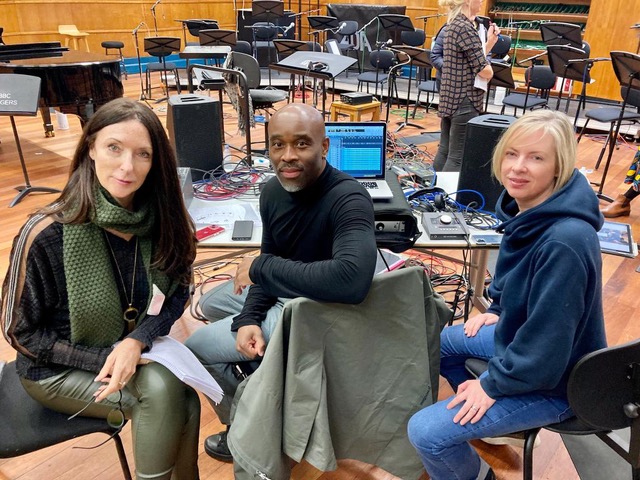
Fiona Lindsay, Glen Scott, Joanna Marsh
Fiona Lindsay, Glen Scott, Joanna Marsh at rehearsals for Marsh's SEEN

Ahead of the 20 May world premiere of her new work SEEN, performed by the BBC Singers and conductor Sofie Jeannin, in this guest posting composer Joanna Marsh discusses a very different approach to her creative process, working with live electronics for the first time for a brand new BBC Radio 3 commission.

I began working on the commission that became SEEN in 2020, although my first conversations with the BBC Singers date from a few years ago. One thing we had loosely talked about was technology, and how it might be integrated into a choral piece. Whenever I have listened to an acoustic piece that has had added elements of electronics, I’ve always found the sonorities particularly mesmerising.

Electronics can create a greater sense of immersion provided by the mixture of sound sources, acoustic performers and amplification, but sometimes it’s the sheer surprise and delight that the actual sounds inspire.

By the time I got to work on the commission, I felt that my own music tech skills needed a brush up! I received an email from the Guildhall School of Music & Drama who were running a number of evening classes during the Covid-19 lockdown. Normally, I miss out on all these opportunities as I live in the Middle East, but when everything moved online I was able to attend a Music Production course run by producer, multi-instrumentalist and sound engineer Glen Scott.

Almost immediately on undertaking this course I realised that Glen had exactly the skill set that would complement mine for this commission. My instincts proved correct, and Glen has been incredible to work with. His ‘musical ear’ is second to none and he has a real vision for what can be achieved.

I also had to think about who might provide the ‘lyrics’ for the piece. I’m always interested in the ways in which themes from the distant past can resonate strongly in our modern lives. A mutual friend connected me with writer and creative producer Fiona Lindsay, who has expert knowledge of classical texts through her work with the Royal Shakespeare Company.

When we first spoke, she had been producing a documentary series for Digital Theatre on themes connecting key women in Greek plays, and I was transfixed! Fiona is particularly interested in the notion of strong female voices in Greek theatre who over time have been marginalised, their voices obfuscated and warped because male writers were control of the narrative.

The characters in SEEN provide a lens to focus on the voices of all those that have been marginalised and is a call to action to reclaim the narrative and be seen. What I particularly like is the way in which the technology used in the piece actually masks the voices, echoing the meaning of the lyrics where the truth has been previously veiled.

There is more harmonic space in the piece than I might normally allow – this enables Glen to add effects that have time to play out without cacophony ensuing. There is a consistent crotchet pulse for the duration of the piece which is 178 beats per minute, inspired in part by the way melody and pulse function together in R&B songs.

Composition can be very solitary work, so this commission provided a refreshing change to the way I normally create music. Somehow, sharing the process with Glen and Fiona made the creation of the piece feel a bit more like a puzzle or a game, rather than solitary labour, and I really benefited from their expertise and input.

Something surprising that came to light when we workshopped SEEN in March was how different the listening experience was, comparing the electronic influences to a purely acoustic work. The live effects added a great deal of space and we felt absorbed into this vastness, as listeners – it was incredibly immersive. The rhythmic heartbeat that runs through the 20-minute piece at times gives it an almost hypnotic feel.

There are so many more ways this work could be performed, and it’s not limited to a small concert hall due to the amplification used. I would love it to take on a new guise in a theatrical setting – perhaps taken on by a dance company, adding movement to the space itself. These are new avenues for my work that I am keen to explore.

It feels quite different having other people be as invested in a work from the early stages of development, and the conversations Glen, Fiona and I had were fascinating, inspiring and often involved a great deal of laughter! Having never worked so collaboratively before, I did wonder beforehand whether it might limit my creativity, but I was absolutely proved wrong. We were all working on completely separate creative pillars within the work and bringing that together for the world premiere later this month will be a real privilege.
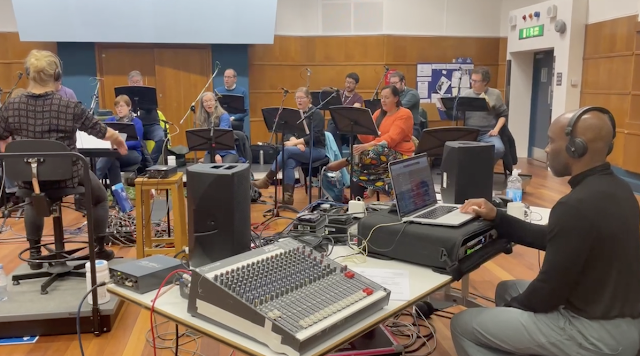
Sofi Jeannin, BBC Singers & Glen Scott rehearsing Joanna Marsh's SEEN

SEEN
receives its world premiere at the Barbican’s Milton Court on 20 May 2022 in a concert by the BBC Singers, conductor Sofie Jeannin. Tickets are priced from £12, available via the Barbican box office

Wednesday, 11 May 2022

A Stylophone Orchestra, an Ondes Martenot, Tea and Cake: Welcome to the amazing world of Arctic Circle's Daylight Music

Kingston University Stylophone Orchestra, Jay Chakravorty + Josh Semans
Playing the Future (21 May, St John on Bethnal Green) 

Arctic Circle's Daylight Music is a concert series that runs at midday on Saturdays in East London. Each event, which welcomes all ages, is an afternoon together with music, tea and cake in a welcoming space in London,  providing audiences with a first experience in music, a re-introduction or just the latest musical matchmaking.

The current season has been running since March, but there is still plenty left to enjoy with a series of concerts at St John on Bethnal Green (E2 9PA) and St John's Leytonstone (E11 1HH), and none of the line-ups is quite what you'd expect, making for an intriguing experience.

Next up is Playing the Future (21 May, St John on Bethnal Green) which features the Kingston University Stylophone Orchestra, Jay Chakravorty and Josh Semans. Believed to be the only ensemble of its kind in the world, Kingston University Stylophone Orchestra (I kid you not) was created in 2019 when Dubreq (the company that manufactures the Stylophone) donated a car boot full of instruments to the University’s music dept. Now expanded to include other hand-held, battery-powered (cheap) synths, the Stylophone Orchestra released their debut album Stylophonika in early 2022. Jay Chakravorty is a Welsh-Indian-Irish composer and multi-instrumentalist, writing emotive post-classical music for pianos, analogue/modular synths, and string ensembles. Josh Semans is an ondes Martenot player, composer, and producer based in the north-west of England. His work is uniquely textured, employing a range of instruments, sound-sources, and processes.

Space In This Place (4 June, St John on Bethnal Green) features Minihi, comprising percussionists and composers Zands and Louise Anna Duggan, Rattle, the drums and vocals duo Katharine Eira Brown & Theresa Wrigley, and improvising recorder player Fatima Lahham. Outside of the Box (18 June, St John's Leytonstone) features Guido Spannochi Quartet, featuring Vienna-born London based saxophonist Guido Spannochi, Tony Bianco, an American jazz drummer and composer, and Khabat Abasis an Iraqi Kurdish artist her work reflects on socio-political circumstances in Iraqi Kurdistan. Lost Map (16 July, St John, Bethnal Green) features three very different vocalists Gordon McIntyre, Emma Kupa, and Alexia Avina.

Full information from Daylight Music's website.

Samuel Barber: The Complete Songs, Dylan Perez & friends survey nearly 50 years of the composer's songs including those unpublished during his lifetime

Samuel Barber (1910-1981) - The Complete Songs - Resonus Classics
Samuel Barber (1910-1981) - The Complete Songs; Fleur Barron, Mary Bevan, Samantha Clarke, Jess Dandy, Louise Kemény, Soraya Mafi, Julien Van Mellaerts, Dominic Sedgwick, Nicky Spence, William Thomas, Navarra String Quartet, Dylan Perez; Resonus Classics
Reviewed 10 May 2022 (★★★) 

An amazing achievement, pianist Dylan Perez and a fine array of young singers in a survey of Barber's complete songs from 1924 through to 1972

This new set from pianist Dylan Perez is almost the record set that you didn't know that you needed. Samuel Barber's songs are much anthologised, we all know a selection of them but few people actually concentrate on the whole corpus and, frankly, when did you last hear a complete performance of his major cycle Hermit Songs.

So, over two discs from Resonus Classics, pianist Dylan Perez is joined by a fine array of young talent, Fleur Barron, Mary Bevan, Samantha Clarke, Jess Dandy, Louise Kemeny, Soraya Mafi, Julien Van Mellaerts, Dominic Sedgwick, Nicky Spence and William Thomas, plus the Navarra String Quartet, for Samuel Barber's complete songs, both those published during his lifetime (with opus numbers) and those only published posthumously. We also get Dover Beach, for baritone and string quartet, and the premiere recording of Knoxville: Summer of 1915 in the composer's own piano version. That is a lot of songs (67 in fact) for a composer whose most famous work, by a long chalk, is a string piece adapted from a string quartet.

But singing and song was threaded through Barber's early life. His mother's sister was the contralto Louise Homer, who was member of the Metropolitan Opera from 1900 to 1929. Her husband was the composer Sidney Homer, a composer who concentrated on song and who wrote extensively for his wife. Sidney Homer would mentor Samuel Barber and many of the early songs (on the second disc) were performed by Louise Homer. Barber's own studies at the Curtis Institute including voice and for a short period he had a career as a professional baritone, making a recording of Dover Beach. The repertoire on the discs spreads right across Barber's compositional life from the mid 1920s (when he was in his teens) right through to 1972. 

Tuesday, 10 May 2022

Ryan Wigglesworth makes his debut as chief conductor with the BBC Symphony Orchestra, launching its 2022/23 season

Ryan Wigglesworth (Photo BBC)

The BBC Scottish Symphony Orchestra's 2022/23 season sees Ryan Wigglesworth take up the reins as chief conductor. Wigglesworth starts things off conducting Ravel's Daphnis and Chloe (the complete ballet) and Messiaen, and then the following evening Wigglesworth is the pianist with principals from the orchestra in Messiaen's Quartet for the End of Time. Marking 30 years since the composer's death, Wigglesworth's Messiaen performances during the season also include The Sermon to the Birds from Saint François D'Assise.

Intriguingly, Wigglesworth is the first composer to direct the orchestra since its founder Ian Whyte, and in an interview with The Scotsman, Wigglesworth said, "My approach to conducting stems from being, first and foremost, a composer. I can only ever approach a work from that perspective: how the composer has put things together, how they did this or that. The flip side applies, too. By conducting the works of great composers, I’m learning how to be a better composer myself. I’ve never really separated the two."

Wigglesworth will also be conducting the UK premiere of Hans Abrahamsen’s Vers le silence, marking the start of Abrahamsen’s role as the orchestra’s new Composer-in-Association. And in the same concert, Wigglesworth conducts his own symphonic adaptation of Wagner's Götterdämmerung with soprano Katherine Broderick. He will also be directing the premieres of two BBC commissions, Cheryl Frances-Hoad's Cello Concerto (with Laura van der Heijden as soloist) and a new work from Jonathan Woolgar.

Other premieres during the season include a new Abel Selaocoe work, whilst principal guest conductor, Ilan Volkov, will give the UK premieres of Øyvind Torvund’s Exotica album and Stefan Prinsunder_current with Yaron Deutsch (electric guitar). Volkov also curates the orchestra's new music festival, Tectonics Glasgow, which returns in April 2023.

Martyn Brabbins, who has been associated with the orchestra for three decades, marks Vaughan Williams' 150th anniversary with his Fifth Symphony and the s score for Scott of the Antarctic alongside a screening of the film. Brabbins also makes his debut as a composer with the orchestra with a short work written for two of the orchestra’s principal violas, to be premiered with another by Sir James MacMillan, as part of an afternoon concert of overlooked Scottish works.

Full details from the BBC Symphony Orchestra's website.

Music at Paxton: ten days of music in a glorious Scottish Borders setting

Paxton House
Paxton House (Photo Paxton House)
Back in 2015, I wrote about Music at Paxton's celebrations for the 10th festival [see my article], then finally last year I was able to visit the house for the first time (alas, not during the festival). This year the festival runs from 22 to 31 July 2022 at Paxton House in the Scottish Borders. Paxton was designed in the late 18th century by the Adam family, has glorious Regency additions (notably a picture gallery where concerts are held) as well as a fine collection of Chippendale furniture.

This year baritone Roderick Williams and pianist Susie Allan open the festival with a celebration of RVW's 150th birthday mixing his songs with a new commission from Sarah Cattley, and as part of the Momentum scheme, Williams will be joined by baritone Jerome Knox (winner of the 2020 Handel Singing Competition) to perform part of the programme. The Maxwell Quartet is in residence, and it will be performing Brahms, Haydn, and Roxanna Panufnik’s The Audience (with tenor Jamie MacDougall as part of Visit Scotland's Year of Stories). Pianist Pavel Kolesnikov celebrates the centenary of Marcel Proust with music by Schubert, Couperin, Hahn (one of Proust's lovers), Fauré and Franck, as well as giving a duo-recital with Samson Tsoy.

Other visitors include Sarah Connolly and James Middleton giving the Scottish première of Mark-Anthony Turnage’s Songs of Sleep and Regret plus music by Samuel Barber, Chausson and Kurt Weill. Pianist Angela Hewitt closes the festival with music by Mozart, Bach and Chopin

Young artists at the festival include Ellie McLaren (fiddle), Ciar Milne (small pipes), Echéa Quartet, Ryan Corbett (accordion), Mithras Piano Trio,  Megan McDonald (accordion),  Calum McIlroy (voice, guitar, mandolin), and Sophie Rocks (harp).

Full details from the Music at Paxton website.

Denys Darlow founded the Tilford Bach Festival to present the music of his favourite composer in his own parish church and 70 years later it is still going strong

All Saints' Church, Tilford, home of the Tilford Bach Festival

The Tilford Bach Festival is 70 this year and the festival is celebrating with a weekend of events from 10 to 12 June 2022. The festival was founded in 1952 by Denys Darlow, who was the organist at All Saints’ Parish church, Tilford, a village in the west of Surrey (famous former residents include Arthur Conan Doyle and Lloyd George). Darlow's personal aim was that all performances should be fully professional and of the highest quality so as to entice soloists of international renown to come to a small church in a tiny village situated several dark, winding miles from the nearest railway station. By 1955, the BBC were broadcasting from the festival. In 1973, Darlow (then 73 years old) decided to share the direction of the festival, but he would not completely hang up his baton until 2002. Adrian Butterfield is now festival director.

This year, the festival takes place at St Luke's Church, Grayshott, GU26 6LF as Tilford Church is in need of repairs. The festival opens with Laurence Cummings (a former festival director) directing the London Handel Players in an evening of concertos, placing Bach's concertos for multiple instruments (two harpsichords; harpsichord and two recorders; flute, violin and harpsichord) alongside concertos by his contemporaries Vivaldi and Leclair.

On Saturday there is Bach's St Matthew Passion performed with the sort of forces Bach would have recognised, using just nine singers with Adrian Butterfield directing the London Handel Players and soloists including Joanne Lunn, Daniel Taylor, Charles Daniels (Evangelist) and Edward Grint (Jesus). Then on Sunday, Ensemble Augelletti bring their programme The Library of a Prussian Princess [also recorded on disc, see my review] featuring music associated with Anna Amalia, Princess of Prussia (1723-1787), whose library included many important manuscripts associated with JS Bach

Boulevard des Italiens: tenor Benjamin Bernheim explores Paris' long love-affair with French composers

Boulevard des Italiens: arias in French by Cherubini, Spontini, Donizetti, Verdi, Puccini, Mascagni; Benjamin Bernheim, Orchestra del Teatro Communale di Bologna, Frédéric Chaslin; Deutsche Grammophon

Boulevard des Italiens:
 arias in French by Cherubini, Spontini, Donizetti, Verdi, Puccini, Mascagni; Benjamin Bernheim, Orchestra del Teatro Comunale di Bologna, Frédéric Chaslin; Deutsche Grammophon
Reviewed 9 May 2022 (★★★★★)

Tenor Benjamin Bernheim bring style and passion to a recital that explores French opera's long love affair with Italian composers.  

With the opening number of his new recital, Benjamin Bernheim firmly sets a stake in the ground. 'Adieu, séjour fleuri' is from the French premiere of Puccini's Madame Butterfly, given in French translation but in a revised version by the composer which was then transferred to become the standard Italian one. This is a disc of music by Italian composers working in France and working in French. 

For Boulevard des Italiens, tenor Benjamin Bernheim joins the Orchestra del Teatro Comunale di Bologna, conductor Frédéric Chaslin on Deutsche Grammophon for arias by Cherubini, Spontini, Donizetti, Verdi, Puccini, and Mascagni. This is a mix of composers working in French and French versions of Italian operas. Both Cherubini and Spontini based themselves in Paris, writing in French and having a significant effect on the development of French opera. Another important visitor is missing, Meyerbeer, though he was Italian trained he was in fact German. Both Donizetti and Verdi had their Italian operas performed in Italian at the Theatre Italiens, but for the Paris Opera and other companies,  French was the norm. And both took some pains with the the creation of specifically French music. 

And the music is often something of challenge to modern tenors as it requires different virtues to the Italian repertoire - a different approach both to emission (thanks to the French language) and to top notes (with the fondness for using what we might call head voice). These are all aspects that Bernheim understands and what is so lovely about the recital is the way he combines technical facility with style, language and a compelling sense of drama.

Monday, 9 May 2022

Winds of Change: a survey of Ruth Gipps' wind chamber music from 1943 through to 1995

Ruth Gipps - Winds of Change - Three Worlds Records
Ruth Gipps - Wind chamber music;  Ben Goldscheider, Huw Watkins, Mary Bevan, Ruth Rosales, Hannah von Wiehler, London Chamber Orchestra; Three Worlds Records
Reviewed 2 May 2022 (★★★½)

An imaginative survey spanning the whole of Gipps career, concentrating on her chamber music for wind right through to one of her last works.

Having recorded her Horn Concerto [see my review], Ben Goldscheider has recorded a disc of Ruth Gipps' chamber music for wind, Winds of Change on Three Worlds Records. Goldscheider is joined by pianist Huw Watkins, soprano Mary Bevan, narrator Ruth Rosales, conductor Hannah von Wiehler and members of the London Chamber Orchestra for a disc which moves across the whole of Gipps career, including the Sonatina for horn and piano, Wind Octet, Wind Sinfonietta, and Sonata for alto trombone (or horn) and piano along with numerous smaller items.

Whilst Ruth Gipps did not live under the radar as far as her career was concerned - she was the first female conductor to conduct at the Royal Festival Hall, and had many other firsts as well - her music was determinedly not aligned to prevailing post-war orthodoxies. Like her friend Malcolm Arnold, Gipps' music fell out of circulation and the struggle that she had because of gender prejudice also played a big role. 

The horn features strongly in her output partly because her son (for whom the Horn Concerto was written) was a horn player. Gipps died in 1999 and last year was her centenary, yet only now is her wonderfully well-made music coming out of hibernation. The music on the disc covers a wide range of her career from 1943 to 1995, a remarkable testament to her strength of mind, continuing to compose and perform even though lacking encouragement from the mainstream. The sound of her teacher, RVW, along with Bliss and Bridge, features strongly in this music. The album is arranged chronologically which means we can hear how her sound-world developed.

The Seven Works of Mercy: a new song cycle inspired by the medieval murals in Pickering church

Children at one of the Easter workshops for Joseph Howard's Seven Mercies
Children at one of the Easter workshops for Joseph Howard's Seven Works of Mercy

A new partnership between the Ryedale Festival and the Richard Shephard Music Foundation is involving school children and community groups in a new song cycle inspired by the murals of Pickering Church. The medieval murals depicting The Seven Works of Mercy are relatively unusual in that all seven survive. The Seven Works of Mercy are a less well-known counterpart to the Seven Deadly Sins: feeding the hungry, giving water to the thirsty, sheltering the homeless, clothing the naked, visiting the imprisoned, visiting the sick and burying the dead. 

Composer Joseph Howard has written a new song cycle, for solo voice and piano, with contributions being made by around 40 children from local primary schools, an adult community-based choir, and the church’s bell ringing society. The words by Emma Howard explore what these seven acts might mean in a 21st century context and offer a hymn of praise to small, everyday acts of kindness and bravery.

The performers include children from three local primary schools, including St Joseph’s RC Primary in Pickering where composer Joseph Howard attended himself, along with mezzo-soprano Kathryn Rudge and pianist Christopher Glynn (artistic director of the Ryedale Festival).

Seven Mercies at Pickering Church (Photo Gerard Collett)

The performance takes places on Saturday 21 May 2022 at the Church of St Peter and St Paul, Pickering. Full details from the Ryedale Festival website.


Up Close and Musical is back with an all-female line-up

Up Close and Musical

In 2021, I chatted to Shiry Rashkovsky about the Up Close and Musical festival [see my article] at the Fidelio Cafe of which she was the artistic director; the festival had been rescheduled twice before it could finally take place in 2021. Now the second festival has been announced for the weekend of 24 and 25 June 2022, again at the Fidelio Cafe. And this time, the festival is presenting an all-female line-up of performers, along with a remarkable number of works by female composers.

There will be five concerts across the two days, and in each recital the artists will have a candid interview with Shiri Rashkovsky,  and following each performance there is a chance to enjoy a meal or drinks at the Fidelio Cafe.

Pianist Clare Hammond opens the festival with a recital of 20th century works including music by Doreen Carwithen, Unsuk Chin, George Walker and Nikolai Medtner. Trio Klein (violinist Kamila Bydlowska, violist Shiry Rashkovsky, cellist Ella Rundle) return to the festival with a late-night recital performing music by John Adams and Duran Duran (in new arrangements) plus trios by Sofia Gubaidulina and Alfred Schnittke. The programme's tongue-in-cheek name is 80's Night as all the music was written in the 1980s!

Trumpeter Matilda Lloyd performs a diverse programme from Hildegard von Bingen to Sofia Gubaidulina and Deborah Pritchard, the all-female Eusebius Quartet performs Bartok and Elgar, and to close the festival violinist Fenella Humphreys plays music by Errollyn Wallen, Freya Waley-Cohen, Grazyna Bacewicz, Roxanna Panufnik, Fritz Kreisler and Niccoló Paganini.

Full details from the festival website.

Sunday, 8 May 2022

One of Hungary's oldest orchestras makes its first UK tour

Concerto Budapest is one of Hungary's oldest ensembles, celebrating its centenary in 2007 (The name Concerto Budapest dates from 2009). András Keller, founder of the Keller Quartet, became the orchestra's artistic director in 2007, and since then the ensemble has undergone a significant period of artistic growth. 

There is a chance to hear for ourselves when Concerto Budapest makes its first tour to the UK. Keller will direct the ensemble in a six date tour, from 6 to 12 June 2022. The itinerary opens at London’s Cadogan Hall and continues with concerts in Guildford, Basingstoke, Birmingham, Manchester and Edinburgh. 

Not surprisingly, Hungarian repertoire is central to the tour's programming. All concerts bar the one in Manchester feature Bartok's Concerto for Orchestra, alongside Beethoven's Symphony No 5 and Mozart's Piano Concerto No.23 in A major (with Angela Hewitt). In Manchester, the orchestra pairs Kodaly's Dances of Galánta and Enescu's Romanian Rhapsody No.1 in A major with the Mozart and Beethoven.

Full details from the orchestra's website.

Saturday, 7 May 2022

A gift to a composer, to be involved in the festival in a more integral way: Helen Grime talks about being Sheffield Chamber Music Festival's first guest festival curator

Helen Grime
Helen Grime

This year's Sheffield Chamber Music Festival (13-21 May 2022), has composer Helen Grime as the festival's first ever guest festival curator. The festival is presented at the Crucible Theatre by Music in the Round with Ensemble 360, the venue's resident ensemble. I recently chatted to Helen by Zoom to find out about what we can expect.

Not only is it the festival's first time using a guest festival curator, but it is the first time Helen has fulfilled such a role and she admits to initially feeling apprehensive. But it has been an exciting opportunity, both to work with Ensemble 360 and to programme music that she loves, both music from the past and more recent music that she feels close to. Also, when the festival takes place she has the chance to be at all the live events, as well as participating in workshops and working with students. She sees this aspect of her role as a gift to a composer, to be involved in the festival in a more integral way, to work with the musicians and get to know them more and to help break down that wariness that can exist between composer and performers.

Crucible Studio (Photo Andy Brown)

One of the most striking features of this year's programme is a pair of concerts at dawn and dusk. The Sunrise concert had originally been planned for the 2020 festival which was cancelled, whilst the 2021 festival took place online. So, the idea of a Sunrise concert pre-dated Helen becoming this year's guest festival curator. They already had a really good programme, with music by Casals, Bach, Akira Nishimura, and Haydn, including some alphorn transcriptions, and Helen added Tansey Davies' Yoik, which is inspired by Sami music, because she thought it fitted well. The idea developed to book-end the day with a pair of concerts, Sunrise and Sunset (with nothing in the middle).

Friday, 6 May 2022

An ensemble like no other: Peter Wiegold and The Third Orchestra at Grand Junction

Peter Wiegold and The Third Orchestra at Grand Junction

Peter Wiegold and the late John Cumming founded The Third Orchestra in 2019, when the ensemble made its debut at the Barbican. Since then there has been extensive crowd-funding, and last night Wiegold and the ensemble gave a triumphant concert to a near capacity audience at Grand Junction. Grand Junction is a community arts space in St Mary Magdalene Church, a G.E. Street designed, gloriously Gothic Church in Little Venice. The Third Orchestra is an extension and development of Wiegold's work with Notes Inégales at Club Inégales. 

Here there were 15 musicians from a variety of countries, traditions, styles and genres, stretching from Western classical and jazz right across the world to China, taking in the Middle East, India and beyond. The aim wasn't so much synthesis as something more syncretic, to make music together and too see what happened, to use dialogue and creative difference for artistic purposes. Each is a significant musician in their own right, and here they were coming together for something new. Wiegold presided over everything, guiding, controlling and enabling.

Crossing cultural boundaries: Britten Sinfonia placed Holst's Indian-inspired opera Sāvitri at the centre of an intriguing evening of Anglo-Indian collaborations

Holst: Savitri - Kathryn Rudge & Pagrav Dance in rehearsal - Britten Sinfonia (Photo Milly March)
Holst: Sāvitri - Kathryn Rudge & Pagrav Dance in rehearsal - Britten Sinfonia (Photo Milly March)

Grace Williams: Sea Sketches, Britten: Variations on a Theme of Frank Bridge, Holst: Choral Hymns from the Rig Veda, Sāvitri; Kathryn Rudge, Anthony Gregory, Ross Ramgobin, Kuljit Bhamra, John Parricelli, Jacqueline Shave, Pagrav Dance Company, Urja Desai Thakore, Britten Sinfonia Voice, Britten Sinfonia, Eamonn Dougan, Mark Elder; Barbican Centre

A wonderfully daring evening, placing Holst's idiosyncratic operatic masterpiece at the centre of an evening that mined the work's English and Anglo-Indian themes.

Of Gustav Holst's eight operas, only one Sāvitri retains anything like a hold on the repertoire. I first saw it in 1978 when Janet Baker sang the title role with Scottish Opera in a triple bill with Purcell's Dido and Aeneas and a new opera by Edward Harper. This points to the problem with Sāvitri, like Rider's to the Sea by his friend Ralph Vaughan Williams both operas are difficult to place in a programme.

For their performance of Holst's Sāvitri at the Barbican Centre on Wednesday 4 May 2022, the Britten Sinfonia came up with the idea of a tri-partite programme which explored aspects both of the the work's Englishness and its mix of English and Indian culture. First, Sir Mark Elder conducted the Britten Sinfonia in Grace Williams' Sea Sketches and Britten's Variations on a Theme of Frank Bridge, then Eamonn Dougan conducted the women of Britten Sinfonietta Voices and harpist Sally Pryce in Holst's Choral Hymns from the Rig Veda (third part).

Holst's Sāvitri followed, with Kathryn Rudge as Sāvitri, Anthony Gregory as Satyavān and Ross Ramgobin as Death, conducted by Sir Mark Elder, plus three dancers from the Pagrav Dance Company choreographed by Urja Desai Thakore. Then, after a second interval, the Britten Sinfonia's long-time leader Jacqueline Shave joined her trio, Kuljit Bhamra (percussion) and John Parricelli (guitar) for a selection of their pieces for violin, tabla and guitar, giving us an entirely different Anglo-Indian cultural boundary crossing.

Holst: Savitri - Pagrav Dance in rehearsal - Britten Sinfonia (Photo Milly March)
Holst: Sāvitri - Pagrav Dance in rehearsal - Britten Sinfonia (Photo Milly March)

The evening was intended partly as a farewell to Shave, who is retiring after 17 years. Unfortunately, COVID meant that she was not able to rehearse the first two parts of the programme, and the Britten Sinfonia was led by Marcus Barcham Stevens, but she was back on-stage and in cracking form for the final part.

Wednesday, 4 May 2022

Classical music at this year's Bath Festival

Bath Festival 2022

The Bath Festival opens in just over a weeks time with a lively programme of music and books, always a great combination, from 13 to 21 May 2022 in a fine range of historic venues

The opening weekend includes the Carducci Quartet and Stephen Johnson exploring Shostakovich's life by interleaving music from his string quartets (very much a personal diary in music) with readings from his letters, whilst guitarist Sean Shibe is mixing transcriptions of Bach's lute music with an early Scottish lute manuscript and 20th-century Latin American music for guitar.

Bach's St Matthew Passion is familiar, perhaps too familiar; Bach's family referred to it as The Great Passion, and James Runcie will be talking about his research for his novel of that name, trying to recapture what it was like to encounter the work for the very first time. And pianist Jeremy Denk will be combining music from Bach's Well Tempered Clavier with readings from his autobiographical book, Every Good Boy Does Fine.

Peter Manning and the Bath Festival Orchestra are exploring the sea, with an imaginative programme of music by Takemitsu (from Japan), Daniel Temkin (from the USA), Grace Williams (from Wales), and Joey Roukens (from the Netherlands). Trumpeter Aaron Akugbo joins organist John Kitchin at Bath Abbey for a programme which moves between Bach and Telemann to Messiaen, McDowall and more. Horn player Ben Goldscheider and trumpeter Matilda Lloyd join Jason Thornton and the Bath Philharmonia for a programme that includes concertos by Mozart and Haydn, plus Copland's Fanfare for the Common Man and Janacek's Sinfonietta. These latter two will feature the combined forces of the Bath Philharmonia and the Band of the Royal Marines School of Music. Should be thrilling stuff! Epic in another way is Steve Reich's Drumming, and the Colin Currie Group will be performing it with Synergy Vocals

The festival's Rising Stars this year include cellist Laura van der Heijden, pianist Jeneba Kanneh-Mason, pianist Ariel Lanyi, violinist Irene Duval and pianist Sam Armstrong, pianist Ryan Corbett, and pianist Jonian Ilias Kadesha

Other visitors to the festival include IF Opera will be presenting a faded Parisian salon, Chez Bullier, evoking memories of classic operas. Soprano Claire Booth will be revisiting her extraordinary solo tour-de-force with Poulenc's La voix humaine performed in an intimate, secret location. Saxophonist Jess Gillam and her ensemble will be performing an eclectic programme of music by CPE Bach, John Harle, James Blake, JS Bach, Piazzolla and Will Gregory. The Tallis Scholars are exploring music by composers who worked at the Sistine Chapel from Josquin to Palestrina and of course Allegri! The Consone Quartet are joined by viola player John Crockatt for a programme that culminates in one of Mozart's wondrous string quintets.

Away from classical, there is the jazz group Empirical, Bristol-based collective Snazzback and London-based Lydian Collective, and Public Service Broadcasting.

Full details from the festival website.

Queen of Heaven: from the hypnotic to the rapturously ecstatic, Nigel Short and Tenebrae explore music written for the Virgin Mary

Tenebrae (Photo Sim Canetty-Clarke)
Queen of Heaven - Plainchant, Parsons, Sulpitia Cestis, Verdi, Bruckner, Grieg, Stravinsky, Bax, Poulenc, Britten, Margaret Rizza, Górecki, Tavener, Giles Swayne, Owain Park; Tenebrae, Nigel Short; Wigmore Hall

Many choral favourites in a finely conceived and beautifully performed programme with Bax's ecstatic Mater Ora Filium as the central climax

Last night (3 May 2022), Nigel Short directed Tenebrae at the Wigmore Hall in a programme of sacred music exploring the enduring fascination of the Virgin Mary in Western sacred music with works by Parsons, Sulpitia Cestis, Verdi, Bruckner, Grieg, Stravinsky, Bax, Poulenc, Britten, Margaret Rizza, Górecki, Tavener, Giles Swayne, Owain Park, alongside plainchant. The programme was organised to allow the music to flow, varying style and era with Bax's Mater Ora Filium as the centre piece and Rizza's ecstatic setting of Hildegard of Bingen as the final closure.

We began with Górecki's Totus Tuus, written for the Pope's visit to Poland and based around a repetition of the name Maria that is by turns ecstatic and hypnotic. Now, I have a confession to make, I have performed Totus Tuus and whilst I do enjoy the work, the ecstatic repetition of Maria's name always induces in me a desire to burst into something inappropriate such as 'How do you sole a problem like Maria?' or the iconic song from West Side Story. Here, Short and the singers of Tenebrae displayed a wonderful control of pacing and tone colour, with a beautiful sense of suspended animation. A leap back 400 centuries followed, with Robert Parson's Ave Maria in a performance that was rather more richly luxurious than some, allowing us to enjoy the imagination in this little gem of a work.

Tuesday, 3 May 2022

Northern Ireland Opera returns to Belfast's restored Grand Opera House for new production of Verdi's La Traviata

Grand Opera House, Belfast

Northern Ireland Opera is returning to Belfast's Grand Opera House for the first time since the theatre was restored when Cameron Menzies, Northern Ireland Opera's artistic director, directs his fourth production for the company, Verdi's La Traviata in September 2022. Following on from the company's highly successful production of Puccini's La Boheme last year, conducted by Rebecca Lang, Lang returns to conduct La Traviata with the Ulster Orchestra in the pit. The cast includes Siobhan Stagg who will be making her role debut as Violetta, and the choreography will be by Isabel Baquero. Full details of cast and creatives will be announced shortly.

Belfast's Grand Opera House opened in 1895, designed by Frank Matcham. During 2020/21 the theatre's auditorium underwent a major restoration whilst the foyers and public spaces were re-imagined and the theatre's technical infrastructure upgraded.

The production debuts on 10 September 2022 with performances until 17 September. Full details from the Grand Opera House's website.

Northern Chords Festival 2022

St James’ and St Basil’s Church, Newcastle upon Tyne
St James’ and St Basil’s Church 
The 2022 Northern Chords Festival will be taking place at St James’ and St Basil’s Church, Newcastle upon Tyne NE4 9XP, over the weekend of 14 and 15 May 2022. Founded in 2009 by cellist and conductor Jonathan Bloxham, this year's festival features young artists from the festival's inaugural Mentorship Scheme as well as the Northern Chords Festival Orchestra.

The festival opens with a gala concert celebrating the festival's Mentorship Scheme. Jonathan Bloxham presents an evening with this year's mentees, Jacob Bettinelli (bass-baritone), Kryštof Kohout (violin), Harvey Lin (piano), Lucy Walker (composer), including a new work by Lucy Walker written for the other mentees. Saturday sees mezzo-soprano Claire Barnett-Jones (winner of the Audience Prize at the Cardiff Singer of the World competition in 2021) and tenor Ben Johnson (one of the festival's mentors for 2022 and winner of the Cardiff Audience Prize in 2013) joining forces with pianist Tom Primrose and presenter Petroc Trelawney for a recital that mixes spoken word and song, with works by Purcell, Liszt, Vaughan Williams, Holub, Shakespeare, and Auden. 

On the Sunday morning, Jonathan Bloxham conducts Voices of Hope and the Northern Chords Festival Orchestra in Haydn's Little Organ Mass given as part of Holy Communion at St James’ and St Basil’s Church, and the festival concludes with Jonathan conducting the orchestra in Vivaldi's The Four Seasons with violinist Benjamin Baker.

Full details from the festival website.

Written as a companion to Brahm's Trio for Violin, Horn & Piano, William Bolcom's trio is a powerful work given a compelling performance

William Bolcom: Trio for Horn, Violin and Piano, Suite No. 2 for solo violin; Steven Gross, Philip Ficsor, Constantine Finehouse; Naxos

William Bolcom: Trio for Horn, Violin and Piano, Suite No. 2 for Solo Violin; Steven Gross, Philip Ficsor, Constantine Finehouse; Naxos
Reviewed 29 April 2022 (★★★★)

Commissioned as a companion to Brahms' trio, Bolcom's powerful new work is a terrific, and here accompanied by the imaginative violin suite written for Gil Shaham.

I first came across William Bolcom as a pianist, accompanying his wife, the mezzo-soprano Joan Morris in incomparable recordings of Gershwin and others. I have since enjoyed his cabaret songs and heard his operas on disc but remain woefully underinformed about his non-cabaret music. On this terrific new disc from Naxos, Steven Gross (horn), Philip Ficsor (violin) and Constantine Finehouse (piano) perform William Bolcom's Trio for Horn, Violin and Piano (2017) and his Suite No. 2 for solo violin (2011).

Brahms' 1865 Trio for Horn, Violin and Piano represents the pinnacle of a genre for which there is not much repertoire. Horn player Steven Gross commissioned William Bolcom to write a new work for the line-up. Gross says of the work, "Bolcom wrote the piece during the 2016 United States presidential election, and the music bears witness to his sense of desperation at the vitriolic discourse that emerged. However, the piece transcends this occasion and stands as a soaring statement about resilience in times of adversity."

Monday, 2 May 2022

Farewells: Jakub Józef Orliński and Michal Biel launch their new album at the Polish Hearth Club

This week, counter-tenor Jakub Józef Orliński's new album is out on Erato. Having recorded albums of (often rare) Baroque repertoire, he has moved in a different direction. Along with pianist Michał Biel, Orliński has recorded Farewells, a disc of songs by Polish composers from Moniuszko right through to the contemporary. This is repertoire which is woefully addressed in the concert hall and Farewells reveals a fascinating repertory that few will be familiar with.

On Saturday, Jakub Józef Orliński and Michał Biel performed a selection of songs from the disc at the Polish Hearth Club in South Kensington, and also talked about their musical partnership and exploring Polish music.

Farewells: Jakub Józef Orliński and Michał Biel
We began with a song from Henryk Czyż (1923-2003) whose centenary occurs next year. We heard a song from his Farewells which gives the album its name; a lyrically melancholy, almost bluesy number that seemed capture a number of interesting influences. Then a group of songs Mieczysław Karłowicz (1876-1909), these were often tiny but intense and the spirit of Tchaikovsky (whose music Karłowicz admired) seemed to be close by, though there was something rather French about some. Then a song by Stanisław Moniuszko (1819-1872), best known for his operas Halka and The Haunted Manor (though he actually wrote nine complete operas, with five more incomplete). His song writing revealed a very distinctive voice, full of plangent melancholy. We ended in the modern day with the stunning Autumn by Paweł Łukaszewski. 

This was only a taster of the complete album, but it made you wonder why we don't know this music more. The idea for the programme has been bubbling under for some years, and Orliński explained how he and Biel had been trying out Polish songs in recital and getting good reactions from the audience. The recording actually came about partly because in September last year, both performers found themselves with gaps in their diaries and decided to go for it.

But the planning had been unfolding, and Orliński had sung songs by Tadeusz Baird as a student. Orliński and Biel knew each other as students in Warsaw and subsequently were both at the Juilliard together. There Biel suggested other Polish songs to Orliński (who admits that he was not always on board with the songs initially), for instance, Karol Szymanowski's folk-inspired songs whilst Henryk Czyż songs are much more often song by lower voices and using a counter-tenor sheds a new light on them. 

Part of their reason for performing and recording the songs was the sheer beauty of the music and the fact that this repertoire is under represented on world stages. As regards the language, a number of people during the evening commented that Czech has become relatively common in the concert hall and opera house, so there is no reason why Polish should not. 

This was all contrary to Orliński's initial ideas about his career, as he had assumed he would be performing Baroque music and opera. He started out as a counter-tenor almost by accident. He sang as a child in an amateur choir and when his voice broke he joined a vocal ensemble of men's voices that performed Renaissance music. He was singing bass-baritone, but the ensemble decided they needed some altos and the two youngest members (Orliński and his friend Piotr) were deputed to sing alto, which led to him experimenting and exploring, listening to the Kings Singers and dreaming that maybe one day he might be good enough to join them (and in fact he was recorded with them).

Further information about Farewells from Warner Classics.

Sunday, 1 May 2022

Introducing Ademdai

Introducing Ademdai

In December last year, I found myself in contact with the conductor, researcher and arranger Dario Salvi in connection with his recording of Meyerbeer's first opera, which was issued on Naxos Music Library [see my review]. We got chatting by email and the idea of a collaboration came up. Dario conducts a lot of 19th century ballet music and operetta [see his discography], and he had the idea of us collaborating on a contemporary operetta.
 

The result is Ademdai or The necessary and the superfluous with a plot is based on a tale from One Thousand and One Nights. The music is gradually working its way through our studies, in London and in Glasgow, but it has been a lovely exercise. For me it felt like casting back to my earliest music writing career, when I wrote musicals and songs for cabaret performers. Again, we were writing songs with a clear beginning, middle and end, and having written a sequence of rather serious operas, from Garrett to When a Man Knows to The Genesis of Frankenstein to The Gardeners, it was lovely to be working on something upbeat, with a positive ending.

You can read more about the work, and sample the libretto, on the Introducing Ademdai page of my website. [https://www.roberthugill.com/introducing-ademdai]

A list of my songs

Robert Hugill: For David on his Birthday

I love lists of things (though I am very bad at keeping the lists up to date). The other day I was tidying my music cabinet and came across my settings of Michelangelo's sonnets, in translations by J.A.Symonds, and I wondered whether I had actually finished the songs. 

This led me to looking at all the songs and song cycles that I had produced. Some were written for specific events or people, whereas others were simply ideas that came to fruition (or didn't).  Below, I have listed all of the songs and song cycles that I am happy to be let out of their confinement in my music cabinet. If anyone is interested further, I am always happy to provide details.

Popular Posts this month