Wednesday, 12 June 2013

These New Puritans - Field of Reeds

These New Puritans - Field of Reeds
When I was sent this disc, I have to confess that my heart rather sank when I read of it being classically influenced. I have listened to too much music which exists in that awkward zone between classical, rock and pop but only succeeds in being bland. Thankfully, when I popped Field of Reeds into the player, I was immediately greeted with the distinctive tones of an indie rock band. Music which had a clear integrity and toughness about it, but also some interesting hints of other influences.

These New Puritans was formed by twins Jack and George Barnett and their friend Thomas Hein. Their debut disc Beat Pyramid came out in 2008, with their second Hidden following. During 2010 and 2011 they recreated Hidden in a series of shows which involved the Britten Sinfonia and a childrens choir, and represented their first collaboration with conductor Andre de Ridder. For Hidden Jack Barnett had taught himself to arrange and notate the brass, woodwind and percussion parts.

Tuesday, 11 June 2013

Around Ariadne

Die schlafende Ariadne auf Naxos (The Sleeping Ariadne in Naxos),
by 
John Vanderlyn.
Richard Strauss and Hugo von Hofmannsthal's Ariadne auf Naxos persistently presents directors with a variety of challenges when it comes to staging. The work originated in a re-working of Moliere's play Le Bourgeois Gentilhomme, which Hofmannsthal translated into German with Strauss providing incidental music plus the musical entertainment at the end. This entertainment consisted of the combination of the opera with a commedia dell'arte troupe. This original version of Ariadne auf Naxos proved to be too long and to have too intransigent a combination of spoken play and opera. Strauss and von Hofmannsthal re-worked the play and Strauss provided it with a simpler entertainment much closer to Moliere's original. The operatic combination of Ariadne and Zerbinetta's commedia dell'arte troupe they felt was worth saving. So a prologue was added and the opera that we know today created.

The piece came about as a sort of thank-you present. The director Max Reinhardt (who worked at the Deutsches Theater in Berlin) had come to Strauss and Hofmannsthal's rescue when rehearsals for the premiere of Der Rosenkavalier had gone badly in Dresden. Reinhardt had worked anonymously so they cooked up the idea of writing him a short operatic work to be performed as an intermezzo during a Moliere play which Hofmannsthal would adapt. The whole to be performed at Reinhardt's Berlin theatre. After batting about ideas, Le Bourgeois genthilhomme was fixed on, with the opera not as an intermezzo but to replace the grand ballet which was in the original.


ETO Autumn Season

Jake Arditti & Paula Sides, ETO 2011, Flavio ®Richard Hubert Smith
Jake Arditti & Paula Sides in
ETO's 2011 Flavio
®Richard Hubert Smith
English Touring Opera's Autumn 2013 season starts on 28 September at the Britten Theatre in the Royal College of Music, where ETO are performing James Conway's production of Monteverdi's Coronation of Poppea (originally seen at the Royal College of Music). The season includes three baroque operas, all of them written for Venice, with Monteverdi's late masterpiece being complemented by Cavalli's Jason and Handel's Agrippina. Cavalli was a younger contemporary of Monteverdi's and Jason was one of the most popular operas in the 17th century. All three operas use the Venetian style of mixing comic and serious characters. Agrippina uses the same characters as Monteverdi's opera, and is regarded as Handel's first major opera, and shows the composer in lively and comic mode.

ETO are working with the Old Street Band who will be accompanying all the operas. All three operas are designed by Samal Blak, with Jason being directed by Ted Huffman and James Conway directing Agrippina. All three operas are being sung in English.

Eugene Onegin at Grange Park Opera

Brett Polegato as Onegin in act 3  of Grange Park Opera' s Eugene Onegin
Brett Polegato as Onegin in act 3
of Grange Park Opera' s Eugene Onegin
Stephen Medcalf's attractive and intelligently traditional production of Eugene Onegin was originally seen at Grange Park Opera last year, performed by the Grange Park Opera rising stars (see my review). The production returned this year with Susan Gritton singing her first Tatyana, Brett Polegato as Onegin, Frances Bourne as Olga, Robert Anthony Gardiner as Lensky, Anne-Marie Owens as Madam Larina, Kathleen Wilkinson as Filipyevna and Clive Bayley as Prince Gremin. Martyn Brabbins conducted the Bournemouth Symphony Orchestra.

Designer Francis O'Connor's two-tier set made good use of the stage, with the upper level allowing Madame Larina and her family to look down on the peasants dancing, and provided a way of making scenes like the ball scene look opulent without being crowded on the relatively small Grange Park Opera stage. Medcalf also used the upper level to isolate his characters, so that Polegato's Onegin was alone up there at the end of the dance at Madame Larina's.


Monday, 10 June 2013

Nimrod Borenstein premieres

The Philharmonia Orchestra and conductor Vladimir Ashkenazy will be giving the premiere of If you will it, it is no dream, by the Tel Aviv-born London-based composer Nimrod Borenstein.  The work, which was commissioned by the Philharmonia Orchestra, will be the opening work in a concert at the Royal Festival Hall on 13 June 2013. The programme also includes Elgar's Violin Concerto with James Ehnes as the soloists, as well as Walton's Symphony No. 1. Borenstein's The Big Bang and the Creation of the Universe was performed by Ashkenazy and the Philharmonia Orchestra in Leicester earlier this year. Borenstein is having a busy time at the moment, at the beginning of July his Concerto for Violoncello and String Orchestra receives its premiere in Belgrade, further information from Nimrod Borenstein's website. Further information on Thursday's concert from the South Bank Centre website.

Summer Music Academy at the Royal Military School

Summer Music Academy 2013 - British Army Website
The Royal Military Academy at Kneller Hall, Twickenham is again holding a Summer Music Academy this year. Running from 4 to 10 August 2013, the event is free to attend and the Royal Military Academy are looking for young people between the ages of 16 to 24, brass and woodwind players and percussionists (though other instrumentalists will be considered) with grade 7+ in their primary instrument. Last year 150 people applied for 60 places and there will be 60 places available this year. The idea is to offer a specialized musical education of the highest calibre combined with an insight to a career in military music. So the academy offers rehearsals with the band and individual lessons with professional musicians alongside a visit to an Army training regiment to learn more about careers in the army, an introduction to physical training (though nothing difficult is promised), career presentations and opportunities to hear the band perform and talk to musicians. There are 22 Army bands across the UK, involving string, wind, brass and percussion players. Army musicians are encouraged to further their musical training by studying for degrees and diplomas, and to play in a wide variety of ensembles.  Further information from the Summer Music Academy website.

I Puritani at Grange Park Opera

Jesus Leon in act 1 of I Puritani at Grange Park Opera
Jesus Leon in act 1 of I Puritani at Grange Park Opera
I Puritani was Bellini's final opera, written in Paris in 1835. Working with an Italian exile in Paris, Count Carlo Pepoli, rather than his usual librettist Felice Romani, Bellini was attracted by the poetry of Pepoli's lyrics. But this was allied to a plot of extreme fragility. Forget the librettist's tenuous hold on English and Scottish geography and history, the basic mechanics of the plot are risible even by Italian bel canto standards. But these are allied to music of great beauty and finely drawn lead roles.

Grange Park Opera's new staging of the work directed by Stephen Langridge, is the first one in the UK for many years. We caught it on Saturday 8 June 2013. A strong cast included Claire Rutter as Elvira, Jesus Leon as Arturo, Damiano Salerno as Riccardo and Christphoros Stamboglis as Giorgio, with Gianluca Marciano conducting the English Chamber Orchestra.

Langridge and his designer, Conor Murphy, clearly felt that the thinness of the plot needed some sort of supplement. Langridge chose to start the work off in a Victorian mad-house with doctors examining a female inmate. Taking his cue from Elvira's mad scene, Langridge seemed to be trying to examine the appalling Victorian attitudes to female mental illness and the way women who did not conform to the norm were locked up. This sort of multi-layered approach can work well and prove highly illuminating (for example, David Pountney's ENO production of Dvorak's Rusalka set in a Victorian nursery). But unfortunately there seemed to be little or no traction between the plot mechanics of I Puritani and Langridge's madhouse setting. The results, as the opera progressed, seemed to be that Langridge and Murphy threw ideas at the piece in apparent desperation, creating a confused mess rather than an illumination of the opera.

The frustrating thing was that Langridge and conductor Gianluca Marciano ellicited performances of great style, brilliance and intensity so that the staging was thrillingly gripping even if you had not the slightest idea what was going on.


Saturday, 8 June 2013

Owen Wingrave at Guildhall School

Owen Wingrave was Benjamin Britten's penultimate opera, written in 1970 and receiving its first performance in a TV broadcast in 1971, going on to have its stage premiere in 1973. Something about the work's TV origins seems to have hung over the work and it only came back into prominence after Glyndebourne's performances (in 1995 by the touring opera and in 1997 at the main festival with Gerald Finley in the title role) proved it could work on stage. For the 2007 performances at the Covent Garden, David Matthews made a reduced orchestration, and it was this version which the Guildhall School of Music and Drama (GSMD) performed for their summer opera. We caught the second performance, on Friday 7 June, the first performance with the alternative cast. Kelly Robinson's production, designed by Madeleine Boyd is a co production with The Banff Centre in Canada. Dominic Wheeler, GSMD's Head of Opera Studies, conducted.


London A Cappella International Summer School

London A Cappella Summer School
To Kings Place yesterday for the launch of the London A Cappella International Summer School. A number of interested parties from journalists to arts professionals and performers came together to learn about the plans to expand the London A Cappella Festival. The festival has become a regular fixture in our diaries in January. Curated by the Swingle Singers, the event is proving an eclectic and essential mix of all types of a cappella singing. Now the festival is expanding and 1-4 August 2014 will see the first London A Cappella International Summer School at Kings Place. The idea is to provide a platform for performance and coaching for groups and individuals. 

Friday, 7 June 2013

Olivier Latry - Trois Siecles d'Orgue at Notre-dame de Paris

NAIVE V5338
On 12 December 2012, after 10 months' restoration work and silence, the great organ of Notre Dame de Paris – the largest in France, with five keyboards, 115 stops and nearly 8,000 pipes – opened the festivities for the cathedral's 850th anniversary. This disc, recorded in the cathedral in January 2013, seems to have been designed to celebrate this fact though in fact the disc keeps the fact of organ's restoration well hidden. Olivier Latry, one of the current organists at Notre Dame de Paris, has assembled an attractive programme of music written by his predecessors. Many of the names are little known, Nicolas Sejean, Guillaume Antoine Calviere, Louis-Claude Daquin, Claude Balbaster, Jean-Jacques Beauvarlet-Charpentier, Alexandre Guilmant, Louis Vierne, Jean-Pierre Leguay, Pierre Cochereau and Olivier Latry himself. The number of names is quite high partly because in the 18th century the cathedral operated a rota system with four organists doing three months duty each.


Laika in Lambeth

Pupils rehearsing for Laika in Lambeth. Production by Reay Primary School and English Touring Opera, music by Russell Hepplewhite, design by Catherine Ryan, original Laika puppet design by Jude Munden. Photo by Sarah Botchway
Pupils rehearsing for Laika in Lambeth.
Production by Reay Primary School and English Touring Opera,
music by Russell Hepplewhite, design by Catherine Ryan,
original Laika puppet design by Jude Munden.
Photo by Sarah Botchway
In January I went to see Laika the Spacedog, English Touring Opera's opera for young people which debuted at the Science Museum (see my review). Now ETO is collaborating with pupils from Lambeth schools on the opera's sequel, Laika in Lambeth. The new piece follows Laika's adventures when she returns to Earth (having been the first dog in space) and lands in Lambeth! Pupils at Reay Primary School have been working with ETO on the piece, which premieres in the Grand Hall at Battersea Arts Centre on Tuesday 11 June. The production will be performed by 175 children with children from St Stephen's, Wyvil and Vauxhall Primary Schools being involved along with the pupils from Reay Primary School.

Music is again by Russell Hepplewhite and Laika herself is played by the puppets, made by Jude Munden, from ETO's production of Laika the Spacedog. The whole of Reay Primary School has been involved in creating and producing Laika in Lambeth. Sarah Botchway, producer of Laika in Lambeth and Principal at Reay Primary School, commented that 'The children are really engaged in the workshops composing the music as well as designing and constructing the set'.  Reay Primary School has a history of working with professional arts organisations, in 2011 they worked with the National Theatre to perform an original nativity play. The school is at the Oval, Lambeth and is ethnically diverse with 75% of students from minority ethnic groups and 50% of students speaking English as an additional language

Laika in Lambeth is being performed on Tuesday 11 June 2013 at the Grand Hall, Battersea Arts Centre, at 2pm for groups of school children and teachers, at 7pm for parents and the general public..

Thursday, 6 June 2013

May on Planet Hugill - Silent lakes, rare Wagner and a great Handelian tenor

May on Planet Hugill was holiday month as we spent nearly two weeks walking in Montenegro to help set us up for what is proving to be a very busy June.
We started the month visiting Cambridge to see Handel's Atalanta performed by Cambridge Handel Opera, the performances being the group's swansong in their present form. And we finished by popping upstairs to the Cock Tavern in Covent Garden for Pop Up Opera's uproarious take on Donizetti's Don Pasquale.
Having heard Handel's L'Allegro, il penseroso ed il moderato at the London Handel Festival, it was fascinating to encounter Handel's setting of Milton again at the opening of this year's Lufthansa Festival of Baroque Music, performed by Paul McCreesh and the Gabrieli Consort and Players. The Tallis Scholars celebrated both their 40th anniversary and Gesualdo's 400th anniversary with the final concert in this season's Choral at Cadogan.

Tutti Verdi - complete songs at the London Song Festival

Verdi caricatured in 1860 by Delfico,
the dedicatee of Sgombra, o gentil
Having given us the complete Wagner songs (see my review), Nigel Foster and the London Song Festival also performed the same service for Giuseppe Verdi (1813 - 1901). On Wednesday 5 June 2013 at St. Paul's Covent Garden, soprano Elizabeth Llewellyn and tenor Nicholas Ransley, with bass-baritone Bozidar Smiljanic, accompanied by Nigel Foster performed all 26 of Verdi's songs.

Verdi wrote songs throughout his life, but the core of his output are the sets of songs he published in 1838 and 1845. After 1845 his output diminished, the songs being occasional single items often quite short. The joy of this recital was that Foster had tracked down all the songs including one which Verdi wrote on 1894. The puzzling thing seems to be that, despite all the advances in scholarship, there is not a single simple Verdi edition of all 26 songs. Some are tiny, occasional pieces written as thank-you presents, but all are worthwhile and many have interesting relations to the operas.


Verdi's Sei Romanze (Six Songs) of 1838 was his first published work, composed in 1836 before any of the operas. The songs don't form a cycle simply a set of songs on the themes of death and loss with piano parts which are rather simplistically basic.

Ransley gave a vibrant and dramatic performance of Non t'accostar all'urna ('Do not approach the urn'). It is not a complex song, but very expressive and dramatic.  Llewellyn captured the sad melancholy of More, Elisa, lo stanco poeta ('Here dies, Elisa, the tired poet') with its very Verdian cast to the melody.


Bach Concertos - Viktoria Mullova & Ottavio Dantone

Bach Violin Concertos, Viktoria Mullova, Ottavio Dantone, Accademia Bizantina - ONYX 4114
Transcription is central to Bach's orchestral music. Many of his keyboard concertos are transcriptions of other works and the well known concerto for violin and oboe is in fact the reconstruction of a lost original based on the concerto for two harpsichords BWV1060. The concerto for harpsichord BWV 1053 has a similar history, it may have been originally intended for oboe d'amore and Bach re-used the music elsewhere as well. Bach was a great re-user of things, many of the standard works in the canon include music from other works.

On this new disc from Viktoria Mullova, Ottavio Dantone and Accademia Bizantina, they pair Bach's surviving violin concertos with two new transcriptions. The concerto for harpsichord BWV 1053 is here given in a version for violin, and the concerto for two harpsichords BWV 1060 is given as a concerto for violin and harpsichord, essentially combining elements from the concerto's two different versions.

Mullova's playing in this style of music is well known. She plays with an admirable sense of line, purity and integrity of tone. There are some lovely dark colours underpinning her essentially strong, almost wiry, tone alongside and easy fluency in the music. To my ear, her playing sounds completely admirable with a lack of bulges on notes and other tics.

Wednesday, 5 June 2013

Slightly mad but rather brilliant

Yamaha have released a new video promoting their Silent Piano. Yes, its a promo video, but it has the pianist HJ Lim floating down the Regent's Park Canal playing extracts from Rachmaninov's Piano Concerto no 2.  It looks completely magical, as for the sound well I'll leave you to decide. The video is available on YouTube or you can see it below, after the break.

Anglo-Japanese fusion

Japan 400
400 years ago the first British ship, The Clove, reached Japan. This event is being celebrated on 11 June with an evening which combines words and music, in the church of All Saints, Fulham which is where the leader of the expedition is buried. The music will mix both Japanese and Western music, classical and folk, and there will be readings of poems inspired by the sea and from the ship's log. Performers will include the ensemble Okeanos, who play on a combination of Japanese and Western instruments, the pianist Noriko Ogawa, soprano Kyoko Murai and the baritone Lt Cdr Peter Nicholson of the Royal Navy, plus UK based Japanese folk musicians, a vocal quartet created by Jason James of the Daiwa Anglo-Japanese Foundation. Things start at 6.30pm with the traditional opening of a sake barrel! With the performance following at 7.30pm. The event is just one of many being promoted as part of the Japan 400 celebrations, further information from the Japan 400 website.

'Cav and Pag' restored

'Cav and Pag', the combination of Mascagni's Cavalleria Rusticana and Leoncavallo's Pagliacci used to be a relatively common sight, a powerful evening of verismo opera. But opera companies nowadays seem to rather fight shy of the pairing, perhaps finding the combination of stylised passion and local colour a rather difficult mix. Certainly the two operas are not equal in the strength of their invention and Mascagni's opera can seem to have rather to much instrumental back-drop to local colour and be rather low on plot. Pagliacci by contrast is almost more worthy of the epithet 'shabby little shocker'. The two operas need careful handling and need to be taken completely seriously. Both work best if left in their original Southern Italian environment. Both are more visceral than sophisticated, what 'Cav and Pag' offers is an evening of unashamed blood and thunder with some rattlingly good tunes.

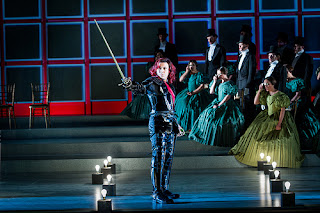
For their new production, Opera Holland Park mounted the pairing with all seriousness. Stephen Barlow's production (designed by Yannis Thavoris) kept the Sicilian setting but moved Cavalleria Rusticana to the 50's and Pagliacci to the 60's. A strong cast featured Peter Auty singing both tenor roles, Turiddu in Cavalleria Rusticana and Canio in Pagliacci with Stephen Gadd singing both baritone roles, Alfio and Tonio, with Gweneth-Ann Jeffers as Santuzza and Julia Sporsen as Nedda. Conducted by Stuart Stratford with the City of London Sinfonia in the pit.


The Perfect American at the ENO

The Perfect American, Zachary James, Christopher Purves & Improbable (c) Richard Hubert Smith
The Perfect American 
Zachary James, Christopher Purves & Improbable
(c) Richard Hubert Smith
In collaboration with the English National Opera, Teatro Real Madrid, and the dance company Improbable, the music of Phillip Glass (1937 -) provides a film-score background to Rudy Wurlitzer’s semi-biographical look at the last few months in the life of Walt Disney. The Perfect American is a delightfully whimsical – yet, despite the humour, it does not shy away from taking a good look at the arrogant, complex man who used people to make his dreams, and that of the cartoon loving world, come true. 

Ripping apart the idea of a ‘perfect American’ someone who is following the American dream, Wurlitzer based his libretto on a book by Peter Stephan Jungk. This novel about Disney uses imaginary dialogue, events and protagonists to illustrate the man and his life. For example, everything that came out of Disney’s studio was credited under the name Walt Disney. Here Jungk invents the character Dantine, a disgruntled ex-animator who, because he wants to receive credit for his work, sets up a union and is fired. Dantine returns several times to haunt Disney – each time Disney responds with violence, evidently struggling between believing that the name ‘Walt Disney’ is necessary for his vision to succeed and that he has lost his own name to a corporation.

Tuesday, 4 June 2013

Summer and Autumn 2013 at Sadler's Wells

Sadler's Wells, circa 1808
Summer and Autumn 2013 sees Sadler's Wells playing host to friends old and new. British Youth Opera makes its annual visit, popular classics like The Snowman and West Side Story feature alongside cutting edge dance from Hofesh Shechter, Sidi Larbi Cherkaoui, Russell Maliphant, Christopher Wheeldon and many others. More traditional ballet companies visiting include both the Birmingham Royal Ballet and Stuttgart Ballet, with Stuttgart giving us a chance to see one of John Cranko's classic ballets.

British Youth Opera makes its annual residency at the Peacock Theatre and this year the company is contributing to the Britten centenary by performing his early operetta Paul Bunyan which was written whilst the composer was in the USA. It was a collaboration with W.H.Auden, premiered in 1941, and the composer put it to one side after its premiere. He did not return to it until much later in life, when he revised the piece in 1976. The companion opera is Domenico Cimarosa's The Secret Marriage, which was premiered in Vienna just months after Mozart's death. The Southbank Sinfonia will be in the pit for both operas. (7 - 14 September)


An encounter with Opera Holland Park's James Clutton

Lucia di Lammermoor, Opera Holland Park 2012
Opera Holland Park's 2013 season opens tonight (4 June 2013) with a production of Mascagni's Cavalleria Rusticana and Leoncavallo's Pagliacci directed by Stephen Barlow and conducted by Stuart Stratford. It is a strong start to a strong season, with six main stage operas and a new family opera. I caught up with producer James Clutton to talk about the new season.

Of the opera's being performed this year (Cavalleria Rusticana, Pagliacci, Les Pecheurs de Perles, L'Elisir d'Amore, I Gioielli  della Madonna, Madama Butterfly , Alice in Wonderland) five are Italian, one is French plus Will Todd's new family opera in English. Clutton admits that the season has a bias towards Italian opera but this isn't so much a deliberate policy as a reflection of taste. Italian opera is what the team at Opera Holland Park (OHP) love. But Clutton also feels that the operas suit the theatre, as its semi-permanent nature in the middle of a metropolitan mark means that not every opera works well there. He cites a recent production of Pelleas et Melisande. OHP were very happy with the production itself, but Clutton felt that the delicacy of the score and its use of silence did not lend itself to performance in Holland Park where there is usually ambient background noise and you cannot rely on there being silence. Clutton thinks that the bigger scale of some of the Italian operas scores is just right for the theatre.

Popular Posts this month