Wednesday, 20 April 2016

Legend - Arsis Handbell Ensemble

Legend Albeniz, Tchaikovsky, Handel, Khachaturian, Brahms and Albinoni; Arsis Youth Handbell Ensembles; ERP
Reviewed by Robert Hugill on Apr 13 2016
Star rating: 3.5

The magical timbres of an Estonian hand-bell ensemble

What comes into your mind when you think of handbell playing? A group of middle aged people practising change ringing, or perhaps the rather rude sketch on The Two Ronnies (available on YouTube)?

This disc, Legend from the Arsis Youth Handbell Ensemble is nothing like either of those. There are seventeen tracks by composers such as Albeniz, Tchaikovsky, Handel, Khachaturian, Brahms and Albinoni played by both the youth and senior ensembles conducted by Aivar Mäe.

Handbell music in Estonia seems to be a relatively young culture, having been introduced in 1993 when the Arsis Handbell Ensemble was founded by conductor and artistic director Aivar Mäe. Today Arsis comprises and eight-member professional ensemble, four youth ensembles with 48 members and two schools. This disc showcases two of the youth ensembles. The bells that they play cover a wide range, with two sets of seven octaves from the biggest to the smallest.

Playing music with a set of hand-bells requires a very particular technique as each note is formed from an individual bell thus requiring co-ordination between the players. Bells have a number of significant characteristics, their distinctive combination of harmonics and overtones and the relatively long reverberation. This means that the music has a lovely aura about it from the vibrating bells, and for really long notes the bells have to be re-struck thus giving a more pulsing feel. A feature of the fact that each note comes from a different bell as the the overall timbre and texture changes with pitch, this enables the composer or arranger to bring a remarkably variety into the sound world.

Reconstructing Garrick's Shakespeare Ode

Mr Garrick reciting the Ode in honour of Shakespeare at the Jubilee at Stratford [London, 1769]. From the collections of the Lewis Walpole Library,
Mr Garrick reciting the Ode in honour of Shakespeare at the Jubilee at Stratford
In 1769 David Garrick organised a Shakespeare Jubilee in Stratford-upon-Avon, and event which went a long way towards cementing Shakespeare's reputation in the national consciousness. The centrepiece of Garrick's festival was his own Shakespeare Ode with music by Thomas Arne, a work which survives incomplete. For their contribution to the 2016 Shakespeare celebrations, the choir Ex Cathedra and conductor Jeffrey Skidmore are performing a re-construction of the Arne/Garrick Shakespeare Ode at Holy Trinity Church, Stratford-upon-Avon on 22 April 2016.

The missing choruses from the work have been composed by Sally Beamish. Beamish has collaborated with poet Carol Ann Duffy to produce the second work in Ex Cathedra's programme, A Shakespeare Masque. Ex Cathedra’s chamber choir and Ex Cathedra’s Academy will be joined by local school children, and accompanied by a consort of period instruments directed by Jeffrey Skidmore. Members of Ex Cathedra’s Consort will take the solo roles in Garrick's Shakespeare Ode which will be narrated by Samuel West, and both works will be semi-staged.

The event will be repeated at Birmingham Town Hall (24/4), Hereford Cathedral (6/5), St. Peter's Collegiate Church, Wolverhampton (7/5), Milton Court Concert Hall, London (12/5), Southwell Minster (28/5). Full information from the Ex Cathedral website.

Tuesday, 19 April 2016

Celebrating the 1050th anniversary of the Baptism of Poland with 16th century poly-choral music

King Sigismund III of Poland
In 966 the reigning Duke in Poland accepted Christianity and was baptised. This date has remained important in Poland as the event became entwined in Poland's sense of nationhood. On Monday 18 April 2016, the Polish Embassy in London hosted an event celebrating the anniversary. The evening also celebrated the release of the fourth volume of The Sixteen's ongoing series of CDs exploring music in Poland from the Renaissance and Baroque. After speeches from the Polish Ambassador, Witold Sobkow, and Anna Godlewska, director of the Polish Cultural Institute, we heard a short recital of music from the Polish Baroque given by Eamonn Dougan and eight members of The Sixteen.

In his entertaining and informative introduction Eamonn Dougan explained that King Sigismund III of Poland had been keen to improve music at court and had asked the Pope for help. The Pope had 'encouraged' a number of Italian musicians to settle in Poland, some spent a long time there and native composers took inspiration.

The names of the Italian composers who worked in Poland are not all familiar, only Luca Marenzio is well known, and some seemed to get a taste for travel as Bertolusi went from Poland to Denmark. The Sixteen performed motets by these Italian visitors, Pacelli's Veni sponsa Christi, Bertolusi's Regina Coeli and Timor Domini, alongside music by later Polish composers, Gorczycki's O rex gloriae and Sepulto Domine, and Pekiel's Resonent in Laudibus and Ave Maria. This is all music which deserves to be better known. The Sixteen's recordings build on scholarship being done in Poland and we can hope that other groups follow suit.

King Sigismund III was very fond of poly-choral music, and the recital ended with a double choir mass by Luca Marenzio, a composer best known for his madrigals. Marenzio's Missa super Iniquos odio habui was premiered in Warsaw in 1596. Though the records of the performance survive, the only complete copy of the mass seemed to have disappeared in World War II, but thankfully was recently rediscovered (having been moved to East Berlin by the Soviet regime). We heard Marenzio's motet Iniquos odio habui and the Gloria from the mass based on it, and I look forward to hearing the whole piece on The Sixteen's forthcoming disc, Helper and Protector: Italian Maestri in Poland.

The Immortal Shakespeare was born in this house

Shakespeare's birthplace
On Thursday 21 April 2016 the Orchestra of the Swan, conductor David Curtis, will give the premiere of Dobrinka Tabakova's Immortal Shakespeare at Holy Trinity Church, Stratford-upon-Avon. Tabakova's work is a cantata for choir and orchestra, written to commemorate the 400th anniversary of Shakespeare's death and performed in his final resting place. 

The piece takes its inspiration from Jaques' 'All the world's a stage', from As You Like It, and the reference to the seven ages of man structures the cantata, encompassing the idea of the lifespan of 'humanity'. Tabakova initially struggled with her choice of words, admitting that she initially tried to avoid as many famous lines as possible (there is an interview with her on the Orchestra of the Swan's blog). The work also takes its inspiration from a series of sketches that the artist Turner made on a visit to Stratford-upon-Avon in 1833 (You can see the sketches on the Tate Gallery website). Tabakova explains that 'the sketches can be arranged to form a journey from birthplace to resting place and on one of these Turner inscribes "The Immortal Shakespeare was born in this house", which gave the title of this cantata'. The cantata's final movement sets the words from Shakespeare's monument in Holy Trinity Church.

The programme also includes RVW's Tallis Fantasia, The Lark Ascending (with Tamsin Waley Cohen), and Toward the Unknown Region.

Full information from the Orchestra of the Swan website.

The Dream Stream - Estonian Philharmonic Chamber Choir

Kaspars Putnins and Estonian Philharmonic Chamber Choir
Arvo Pärt, Helena Tulve, Märt-Matis Lill, Mahler/Clytus Gottwald; Estonian Philharmonic Chamber Choir, Kaspars Putnins; Estonian Music Days at Kultuurikatel
Reviewed by Robert Hugill on Apr 16 2016
Contemporary Estonian choral music from Arvo Pärt and younger Estonian composers

The final concert of the Estonian Music Days was one of the most striking. On 16 April 2015 in the large hall of Kultuurikatel (Cultural Cauldron), the Estonian Philharmonic Chamber Choir under its Latvian conductor Kaspars Putnins performed music by three Estonians, Arvo Pärt (born 1935), Helena Tulve (born 1972) and Märt-Matis Lill (born 1975) alongside four of Clytus Gottwald's arrangements of Mahler. We heart Pärt's Summa and The Woman with the Alabaster Box, Tulve's Lost and Lill's Niehkkoaja (The Dream Stream).

Kaspars Putnins and Estonian Philharmonic Chamber Choir
The choir fielded 25 voices and in Arvo Pärt's Summa (which uses the Latin text from the Creed) they displayed a remarkable combination of strength and vibrancy of line. The singers gave a wonderfully natural sense to the music, as if they had been singing it all their lives. In both Pärt pieces the uneven rhythms and bar-lengths, and pauses were precisely done but in a finely relaxed manner which hardly called attention to itself.

In Pärt's The Woman with the Alabaster Box it was noticeable that the high sopranos did not have the sort of white sound we expect in the UK (think Tallis Scholars or The Sixteen), instead there was a lovely tactile quality to the sound whilst remaining transparent. My only niggle was that the English was not quite as idiomatic as it could have been. Overall the piece had quite a soft grained feel, with the low key naturalism I mentioned above. The climax, when it came, was strong and powerful. As performers the singers were quite undemonstrative, but the performance was mesmerising.

Helena Tulve's Lost as written in 2014 but this was the first performance of the complete work. Tulve set three American poets, David Waggoner's Lost based on instructions given to children by Native American parents, Walt Whitman's Out of the rolling ocean and e.e.cummings i carry your heart with me. All three expressed a sense of connectedness with the environment.

Monday, 18 April 2016

From Bird-song to cleaning up - Estonian Music Days go green

Green life at Kultuurikatel, Tallinn
This year's Estonian Music Days (Eesti Muusika Paevad) had as its theme Green Sound. Composers commissioned by the festival were encouraged to explore themes of ecology, what it means to be green and recycling. These themes took a variety of forms and one of the charms of the festival is the many smaller events, as well as large scale concerts, so the Green theme popped up in all variety of forms from erosion and recycling jazz standards, to cleaning up Tallinn and using recordings of baby voices to create music. During Saturday 16 April 2015 we managed to catch a number of the smaller events which were happening in the festival, from the Bird  Song Disco and The Great Clean Up to Reverbaby and The Bellflower Family.

We missed the Bird Song Disco (dancing to birdsong recordings made by Veljo Runnel) but we did catch one of the performances of The Great Clean Up. We gathered at mid-day in Freedom Square on Saturday 16 April 2015, where it was sunny and clear enough to sit outside with a coffee. A group of women appeared, all dressed in white and each with a broom or a pair of stones (they were students from the Estonian Dance Agency Dance Academy and a team of women composers).

For the next 10 minutes we witnessed a striking dance piece as the women cleaned-up the square, with choreography by United Dancers of ZUGA (Riina Ausma, Kärt Tönnison, Helen Reitsnik and Tiina Mölder) and music by Tatjana Kozlova-Johannes. There was no external sound-track, instead the co-ordinated sound of the brooms and the clicking of stones formed a meditative sound-track to the movement. This meditativeness was deliberate as the clean-up of the title referred not just to physical cleaning but to creating an interior sense of well-being too.

Another project which ran through the festival was Reverbaby. This took place at the top of the medieval tower in the town walls, which is now home to the Estonian Theatre and Music Museum.

Stevie Wishart premiere at St John's Smith Square

Hermes Experiement
The Hermes Experiment
As part of the Park Lane Group (PLG) Young Artist series, PLG artists The Hermes Experiment will make their debut at St John’s Smith Square on 19 April 2016. The programme focuses on the group’s collaborations with living female composers, and includes the world premiere of Stevie Wishart’s Eurostar, Velaro, an experimental piece based on the sounds and journey of the Eurostar from London to Brussels. The composer splits her time between England and Belgium, and the piece will be the ensemble’s personal tribute to the recent Brussels terror attacks, with the piece showing the closeness of the two cities by means of the Eurostar.

The other pieces in the programme include works by young female composers Freya Waley-Cohen, Kate Honey and Josephine Stephenson, and will be completed by a performance of a work by a PLG favourite composer Giles Swayne, Chansons dévotes et poissonneuses.


The Hermes Experiment is a contemporary ensemble made up of harp (Anne Denholm), clarinet (Oliver Pashley), soprano (Heloise Werner) and double bass (Marianne Schofield). Founded in 2013,so far the group has commissioned works from 28 composers.

Small scale, yet intense - Gluck's Iphigénie en Tauride at the Drayton Arms

Turiya Haudenhuyse, Jerome Knox - Gluck's Iphigenie en Tauride - Euphonia - credit: Stephanie Franklin
Turiya Haudenhuyse, Jerome Knox
Gluck's Iphigenie en Tauride - Euphonia - credit: Stephanie Franklin
Gluck Iphigénie en Tauride; Turiya Haudenhuyse, Jerome Knox, Joseph Doody, Samuel Oram, Alisdair Kitchen; Euphonia at the Drayton Arms
Reviewed by Robert Hugill on Apr 13 2016
Star rating: 3.5

Creditable and vigorously intense account of Gluck's tragédie lyrique

Small scale and pub opera seems to be getting more adventurous in the choice of repertory. We recently heard Pop-Up Opera in Bellini's I Capuleti e i Montecchi and on 13 April 2016 we went to the theatre at the Drayton Arms pub for Euphonia's performance of Gluck's Iphigénie en Tauride as part of Euphonia's Spring opera season. Euphonia's artistic director Alisdair Kitchen directed, designed and was music director, whilst Laurie O'Brien was assistant music director and pianist. Turiya Haudenhuyse was Iphigénie, Jerome Knox was Oreste, Joseph Doody was Pylade, Samuel Oram was Thoas with Jennifer Coleman and Sophie Dicks as priestesses and Edward Jowle as a Scythian guard. The opera was sung in French (with English surtitles).

Gluck's opera is remarkably suited to this type of enterprise. With no major action and little reliance on grand ceremonial the opera relies very much on the interaction between the characters (in a poor performance it can seem to be a piece where nothing happens), and reducing it to just seven singers does little violence to the plot.

The theatre at the Drayton Arms is a large, roughly rectangular space with the audience seated at one of the narrow ends (on benches apparently upholstered with old denim). The opera was performed in the black playing area, with no set apart from the remaining Victorian details in the found space, which was dressed with table, chairs, candles (real) and a large ceremonial bowl.

In dramaturgical terms this worked well and Gluck's opera needs little more, but acoustically the opera needed more set dressing. It turns out that the theatre with its bare, hard walls was quite lively acoustically and when the singers got going we regretted the lack of more soft furnishings to dampen the sound. This might sound like a small even trivial point but when performed at modern pitch, the roles of Oreste and Iphigenie sit quite high. Though neither Turiya Haudenhuyse nor Jerome Knox ever seemed to be over singing, the liveliness of the room meant that it seemed as if they were trying too hard. You wanted to say to them 'relax' but I realise that the effect was more acoustical. In the end, though, this as a very loud performance.

Once one adjusted to this there was much to enjoy.

Sunday, 17 April 2016

A salutary comparison

Anu Tali, Leho Karin and the Estonan National Symphony Orchestra at the Estonian Music Days
We have been attending the 2015 Estonian Music Days, an annual festival organised by the Estonian Composers Union when Tallinn explodes with contemporary music. For this year’s festival, artistic directors Helena Tulve and Timo Steiner presented an overview of the state of Estonian music with many of the pieces being written specially for the festival. The Estonian Composers Union, whose membership includes composers and musicologists, has 120 members. To put this in perspective Estonia has a population of 1.3 million (compared to the UK’s 64.7 million). In fact the population of Estonia is only fractionally more than that of the city of Birmingham (1.1 million) and rather less than the population of the entire West Midlands conurbation.

Estonia has a lively and thriving contemporary music scene. In the UK, the best known Estonian composer remains Arvo Pärt and to a certain extent the recognition which Estonian music receives in the UK country reflects his huge influence as well as that of his contemporary Veljo Tormis. But this is to hide the fact that there are a large number of younger composers in Estonia, all busily producing music. To produce them requires an infrastructure too, composers rarely grow on trees. They need training. Which requires a conservatoire, as well as adequate music tuition for school-age children.

I doubt that being in the arts in Estonia is a complete paradise, but the numbers seem to suggest that the arts are rather healthier then they seem in the UK. All this artistic infrastructure costs money, and needs a government willing to spend on the arts. This raises a number of interesting points.

Saturday, 16 April 2016

Fam'd German Masters: Bach motets and Strauss's Deutsche Motette in Pimlico

German masters - Cantus Ensemble
Richard Strauss's fearsome Deutsche Motette is the centrepiece for a concert on Saturday 16 April by the Cantus Ensemble, conductor Dominic Brennan, at St Gabriel's Church, Pimlico. The concert also includes Bach motets and cellist Thomas Wraith performing Bach’s Suite for Cello in D Minor. But it is Strauss's Deutsche Motette which catches the eye and ear, partly because of its sheer complexity, and for the piece the choir will be joined by soloists Rebecca Hardwick, Emma Lewis, Peter Davoren and Alistair Ollerenshaw.

Strauss's setting of Rückert was completed in June 1913, after Der Rosenkavalier and Ariadne auf Naxos and before the Alpine Symphony. So it is Strauss at the height of his powers. It is written for 16-part choir plus four main soloists (and an extra three at one point). The range extends from a bottom B flat in the fourth bass to a top D flat in the soprano part. The four main solo parts are very taxing, with the soprano and tenor placed in a very high tessitura. The piece was dedicated to Professor Hugo Riedel and his choir, the Hoftheater Chor. Riedel later went on to be chorus master at Bayreuth.

Dominic Brennan founded the Cantus Ensemble in 2011 and the choir draws its membership primarily from recent university choral scholars and music graduates. Full information from the Cantus Ensemble website.

Spring in Tallinn - new Estonian orchestral music

Anu Tali, Estonian Voices, Estonian National Symphony Orchestra
Maria Körvits, Mari Vihmand, Mirjam Tally, Ulo Krigul, Lepo Sumera; Anu Tali, Leho Karin, Estonian Voices, Estonian National Symphony Orchestra; Estonian Music Days at the Estonia Concert Hall
Reviewed by Robert Hugill on Mar 13 2016
Five new works including three world premieres in this orchestral showcase of Estonian contemporary music

Anu Tali
Anu Tali
The Estonian Music Days is the oldest music festival in Estonia and was founded in 1979. This year under the artistic directorship of Helena Tulve and Timo Steiner the festival had the theme of Green Sound, bringing into the festival ideas of what it might mean to be green or ecological in music. There are around 60 new works being performed at the festival, with 30 premieres, and an opportunity to hear a range of Estonian composers from students through to the well established.

At the Estonia Concert Hall in Tallinn on Friday 15 April 2016, a concert by the Estonian National Symphony Orchestra, conductor Anu Tali, brought together music by composers born in 1950, in 1987 and a range between. The programme consisted of falling up into the bowl of sky by Maria Körvits, Floreo by Mari Vihmand (born 1967), Erosion for amplified cello, orchestra and electronics by Mirjam Tally (born 1976), Understandards by Ulo Krigul (born 1978) and Symphony No. 6 by Lepo Sumera (1950-2000). The orchestra was joined by Leho Karin (amplified cello), Estonian Voices (Kadri Voorand, Mikk Dede, Mirjam Dede, Maria Vä, Ramus Erismaa and Aar Kü), and Tammo Sumera (electronics and sound engineering).

The concert was preceded by the presentation of a new composers prize, the Au-Tasu award. It was sponsored by the LHV Bank, the first time an Estonian bank as provided this type of sponsorship and sufficiently newsworthy for the event to be recorded for an item on the main Friday evening news on Estonian television. Märt-Matis Lill, chairman of the Estonian Composers Union, presented the prize to Liisa Hirsch for Ascending Descending which premiered at last year's Estonian Music Days (see my review of the work's premiere).

Friday, 15 April 2016

New Dots want to take you to that special place

Image by Cathy Pyle
Image by Cathy Pyle
Where do you go when you think of a special place. For New Dots latest concert, three composers and photographers have explored this concept, which was created by Dan Harding through New Dots #BeOurMuse competition. The three composers are Polish composer Monika Dalach, Nick Morrish Rarity (a doctoral candidate at the Royal College of Music) and Camilo Mendez (an associate composer of the LSO's Soundhub scheme and co-founder of clapTON ensemble) and there will also be a world premiere by Dublin-born composer Sean Clancy, which has been funded by the Workers Union Ensemble audience fund. There will be photographs by Maja Absa Ngom, Richard Davies, and Cathy Pyle.

The concert takes place at The Warehouse, Waterloo. Full information from the New Dots website.

Precision and enthusiasm: the Gesualdo Six at St John's Smith Square

The Gesualdo Six
The Gesualdo Six
Gesualdo, Monteverdi, Schütz, Ligeti; Gesualdo Six; St John's Smith Square
Reviewed by Ruth Hansford on Apr 12 2016
Star rating: 3.5

Italian madrigals, Ligeti & folksongs in a well constructed overview of the madrigal form

The Gesualdo Six – two countertenors, two tenors, a baritone and a bass, plus conductor, plus theorbo – are a very young group specialising in Renaissance polyphony, mixing in some modern works into their programmes. This was the second of three concerts at St John’s Smith Square and it focused on secular works. The first half of consisted of Italian madrigals by Gesualdo and Monteverdi interspersed with Ligeti’s unaccompanied Nonsense Madrigals (in English), and the second half featured some of Schütz’s Italian Madrigals and a selection of folksong arrangements from the four countries of the British Isles. 

It was a well-constructed programme sung with precision and enthusiasm, and it provided an interesting overview of the madrigal form. Spoken introductions would have been a welcome addition, especially as the information in the printed programme was quite tricky to navigate.


Introducing the varioola - Estonia's first electronic instrument

Kirstjan Randalu and the varioola
Mart Siimer, Margo Kölar, Malie Maltis, Marianna Liik; Kirke Karja, Kristjan Randalu, Mart Siimer; Estonian Music Days at the Estonian National Library
Reviewed by Robert Hugill on Mar 13 2016
Estonia's first electronic instrument given new life with four new pieces

Kirke Karja, Kirstjan Randalu and the varioola
You have probably never heard of the varioola, and I suspect that few people in Estonia have heard of it either but the varioola is the first electronic musical instrument to be made in Estonia. As part of this year's Estonian Music Days (Eesti Muusika Paevad), the instrument has been revived and restored and at the National Library of Estonia we heard the instrument played by Kirke Karja, Kristjan Randalu and Mart Siimer in music by Mart Siimer (born 1967), Margo Kölar (born 1961), Malle Maltis (born 1977) and Marianna Liik (born 1997). All four works in the programme were world premieres.

The National Library of Estonia is something of an historical icon itself, built in 1985 towards he Soviet era by an Estonia architect, Raine Karp, it is a monolithic stone building which references traditional Estonian design. The building includes a lecture theatre where the lecture recital took place. The varioola was an impressive looking instrument with fine cabinet work, which included two keyboards, numerous switches and pedal controls. Afterwards a chance to look at the instrument more closely revealed that the interior was a mass of circuitry and valves.

The idea for constructing the varioola arose in 1955 after hearing a German electronic instrument on the radio. Heino Pedusaar and Anatol Sügis did it as the result of a bet, Pedusaar being a musician and Sügis a technician. Sügis was present at the concert and explained that with electronic circuitry extremely difficult to get hold of in Soviet Estonia the instrument had been constructed out of parts left over and unwanted in factories. Once built it was used in popular music, theatre, films and plays but more recently it was in a museum and then in storage until the idea to restore it arose. Sügis has spent the last six months restoring the instrument, though it remains capricious so that the composers and performers not only had to learn new techniques, but had to cope with the instrument's uncertainty and the fact that Sügis had to be on hand to remedy any problems.

Thursday, 14 April 2016

Jazz intersects classical: Kristjan Randalu's Enter-Denter

Kristjan Randalu - Enter Denter
Kristjan Randalu Nach dem Anfang vom Ende, Enter Denter; Kristjan Randalu, Tallinn Chamber Orchestra; ERP
Reviewed by Robert Hugill on Apr 10 2016
Star rating: 4.0

Jazz intersects classical in these two works for piano and orchestra by the Estonian jazz pianist and composer

Kristjan Randalu is an Estonian pianist and composer; I would like to say jazz pianist but that seems limiting yet it is his principal field. This disc on ERP is a live recording of a 2009 concert the Glasperlenspiel Festival in Tartu with the Tallinn Chamber Orchestra. They perform two of Randalu's works with piano (played by Randalu himself) and orchestra, Nach dem Anfang vom Ende (After the Beginning of the End) and Enter Denter.

Though born in Estonia Kristjan Randalu moved to Germany as a child (his father is the pianist Kalle Randalu), and his training included studying with John Taylor in Cologne, at the Royal Academy of Music with Django Bates and at the Manhattan School of Music in New York. Randalu developed the idea for Nach dem Anfang vom Ende whilst living in London in 2001. He wrote three movements there and added a fourth later. Each movement has a title, intriguing and slightly elusive: Der Weg weg (Path of departure), Eine Ahnung in der Vergangenheit (A notion of the past), Spielchen und Rechenschaft (Little games and accountability), Regenbogen (Rainbow).

In writing for jazz piano and orchestra, Randalu did not include percussion in the orchestra so that we have jazz piano set against a more classically oriented orchestra. The piano part is not fully notated in the score, just themes and suggestions, with the orchestra framing the soloist. The resulting work can vary in length and here lasting just over 20 minutes.

Guts and Glory

Spiritato - Guts and Glory
The period instrument ensemble Spiritato is touring the UK with a programme of music for trumpets, drums and strings; military art music written by Biber and Schmelzer. The programme opens at St John's Smith Square on 15 April 2016 and there are further dates at St George's Bristol (9 November 2016), Brighton Early Music Festival (11 November 2016) and Your Early Music Christmas Festival (8 December 2016). The programme includes Biber's Battalia a 10, Schmelzer's Balletto a Cavallo plus music by Vejanovsky and Fux.

A distinctive feature of the concerts will be that the group will be using natural trumpets without any of the finger holes or valves which can help players, an idea which is becoming increasingly common with HIP groups particularly on the continent. The results offer intriguing possibilities in terms of the harmonic qualities and temperaments of the music, and require the players to research playing methods and techniques. The performances of Guts and Glory will follow a series of workshops and conferences, aimed at integrating real natural trumpets and equal tension strings into the ensemble.

Further information from the St John's Smith Square website.

Wednesday, 13 April 2016

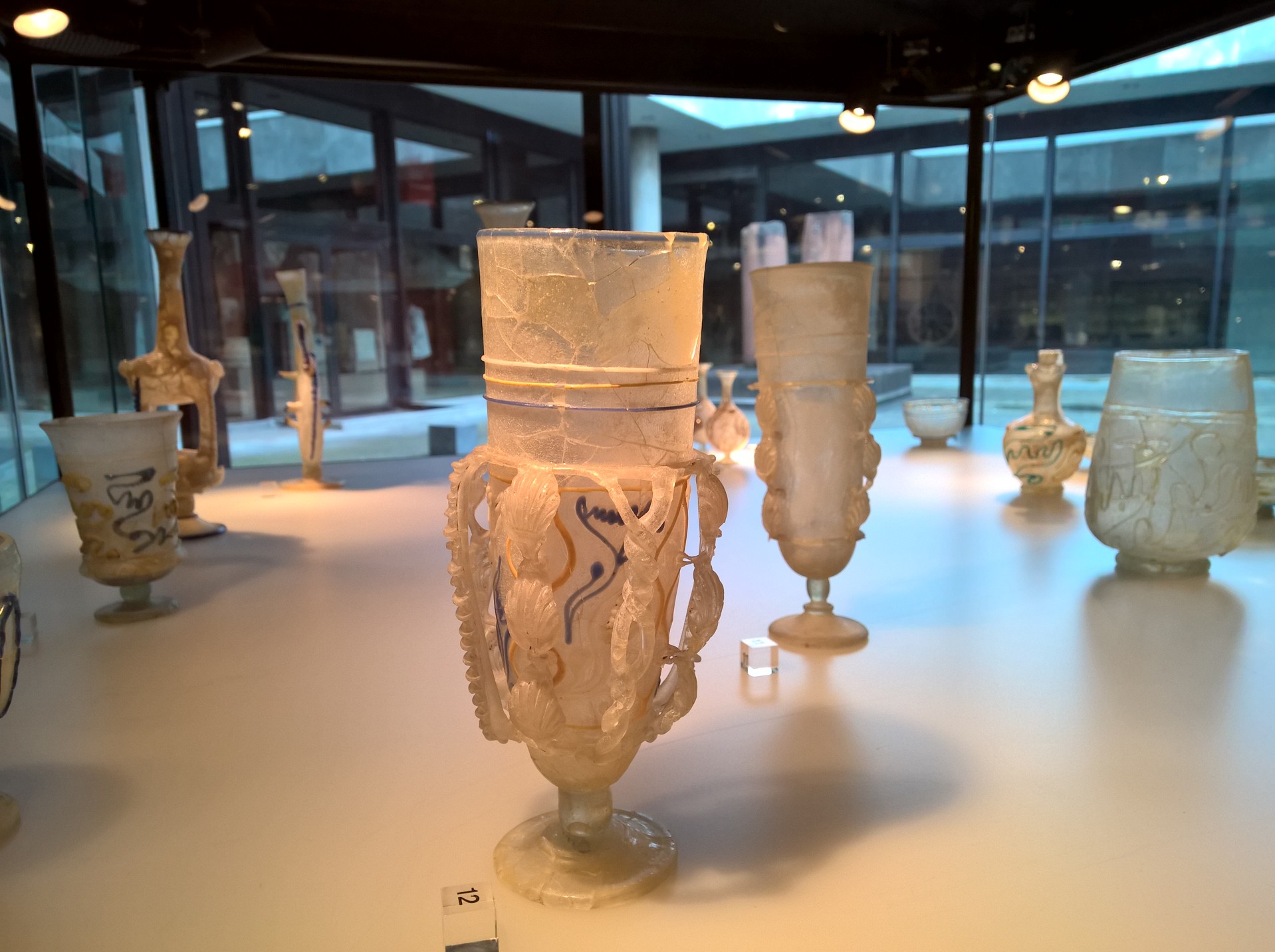
The treasure's beneath - Roman glass and mosaics in Cologne

Roman glass at the Roman-Germanic Museum in Cologne
Whilst in Cologne for Kimiko Ishizaka's performance of Bach's The Art of Fugue (see my review), I was able to do some sight-seeing as well. Cologne's Roman-Germanic Museum might have an unwieldy name but this modern museum houses a wealth of treasures. Built on the site of a Roman villa (with mosaic still in situ), the museum has one of the world's largest collections of Roman glass. My article on the CultureTrip website introduces the museum, its treasures and its history - Read more.

Live Music Now celebrates Menuhin Centenary

Yehudi Menuhin in 1976
This week the celebrations for Yehudi Menuhin’s centenary reach their climax. The finale of the Yehudi Menuhin Competition comes on 16 April but there are other celebrations too. Live Music Now (LMN) was founded by Yehudi Menuhin to support musicians bringing music to those in challenging circumstances, and to provide work for young musicians and the organisation continues to fulfil Menuhin’s aims. 

LMN will be holding its Menuhin Centenary Conference at Kings Place on Saturday 16 April 2016 bringing together LMN musicians, managers and partners together to discuss Menuhin's legacy. The conference is open to the public and it is hoped people will join in to contribute to a wider body of evidence supporting the professional development of musicians in music outreach work focussing on well-being and special educational needs. And on the Sunday morning there is a coffee concert by LMN musicians past and present, including Anne Denholm, Craig Ogden, Tir Eolas and members of the Sacconi String Quartet.

LMN’s other celebratory events include the world premiere of a musical adaptation of children’s story The King, The Cat & The Fiddle performed by Welsh Folk group Calan to schools and venues South Wales. The story was co-written by Yehudi Menuhin, alongside author Christopher Hope with illustrations by Angela Barrett. There is a full list of LMN’s Menuhin Centenary events on the Live Music Now website

Intelligent programming and fine singing: The Evening Hour

The Evening Hour - Signum Classics - choir of Jesus College, Cambridge
John Sheppard, William Byrd, Robert Whyte, Orlando Gibbons, John Blitheman, Thomas Tallis, Philip Radcliffe, Edward Bairstow, Richard Rodney Bennett, Gabriel Jackson, Lennox Berkeley, Henry Balfour Gardiner, Gustav Holst, John Tavener, William Harris, Philip Moore, Edward Bairstow; Choir of Jesus College Cambridge, Mark Williams; Signum Classics
Reviewed by Robert Hugill on Apr 06 2016
Star rating: 4.0

Attractive selection of evening themed works

This new disc from Mark Williams and the choir of Jesus College, Cambridge on Signum Classics is an attractively selection of 16th and 20th century British choral music with a loosely evening theme, under the title The Evening Hour. The 16th century composers included are John Sheppard, William Byrd, Robert Whyte, Orlando Gibbons, John Blitheman and Thomas Tallis, whilst the 20th century composers are Philip Radcliffe, Edward Bairstow, Richard Rodney Bennett, Gabriel Jackson, Lennox Berkeley, Henry Balfour Gardiner, Gustav Holst, John Tavener, William Harris, Philip Moore and Edward Bairstow. The selection of 20th century composers is not really one to frighten the horses, but it showcases the choir very well and within the works performed are some rather striking yet lesser known works.

In fact the disc showcases more than one choir, as Jesus College has a chapel choir and a college choir. The chapel choir is men and boys whilst the college choir is mixed with the men of the tenors and basses in common.

Reminding people why it is good to sing - The Choir with No Name at Chorus 2016:


The Choir With No Name at the Southbank Centre's Chorus Festival

This weekend (19 & 20 March 2016) was the Southbank Centre's Chorus Festival, where choirs from around the UK sing at various locations within the Southbank. Amongst the choirs performing was the fantastic Choir with No Name which deserves a special mention.

The Choir with No Name provides rehearsals with a meal for homeless men and women. Since they started with a single group in 2008, they have expanded and currently there are four choirs, two in London, one in Birmingham and one in Liverpool. Regular gigs help raise money to keep the charity afloat. I first saw them last Christmas, filling the stage at the Royal Festival Hall, and bringing their own indomitable approach to the festive season. Upcoming gigs include a comedy night in London, and a spot at 'Community Spirit 2016', in Birmingham. 

On Saturday (19 March 2016) their fearlessness and enjoyment easily put other choirs to shame. There may have been nerves, but these were well hidden, and with no music to hide behind, the choir infected the audience with their enthusiasm. Well done to the performers, musical directors, and the team for reminding people why it is good to sing.
Hilary Glover

Popular Posts this month