Wednesday, 20 May 2020

Music across the ocean: Chineke! and Sphinx collaborate in digital performance of Samuel Coleridge-Taylor's 'Othello Suite'

Samuel Taylor-Coleridge
Samuel Coleridge-Taylor
From today (20 May 2020 until Sunday 24 May 2020) the Chineke! Foundation and the Sphinx Organization will be releasing a series of films of a digital collaboration between the two organisations, a transatlantic concert performing Samuel Coleridge-Taylor’s Othello Suite, with one movement from the suite being released each day.

72 musicians of the Chineke! Orchestra and Sphinx Organization and 9 conductors recorded their individual parts in their homes in the UK, USA and in Europe. Simon Weir of Classical Media then edited the multi-screen footage to create the unified sound of one ensemble.

Samuel Coleridge-Taylor (1875-1912) was born in London, the son of an English woman and a Creole man from Sierra Leone who was studying medicine in London. Displaying talent from a young age, he was initially taught violin by his grandfather (a farrier by trade), and thanks to family support was able to attend the Royal College of Music, studying composition with Sir Charles Villiers Stanford, Coleridge-Taylor wrote incidental music for a production of Shakespeare's Othello at His Majesty's Theatre in 1910-11, and he subsequently arranged five movements as a suite.

Founded in 1997 in Detroit, Michigan, Sphinx has been a trailblazer in enhancing minority ethnic representation in classical music in the United States, and Chineke! was founded in the UK in 2015 to provide performance opportunities for established and up-and-coming black and minority ethnic (BME) musicians, through the work of its professional Chineke! Orchestra, Chamber Ensemble, the Chineke! Junior Orchestra and a thriving Learning & Participation programme.

The films will be released daily at 3pm (UK time) on the social media channels of both organisations:
Sphinx: YouTube, Instagram, Twitter, Facebook

Tuesday, 19 May 2020

Earth - London Youth Choir goes on-line for the first song from Russell Hepplewhite & Michael Rosen's new collection for Friday Afternoons


Friday Afternoons is a project led by Snape Maltings which aims to connect teachers and young people with contemporary composers, inspired by Benjamin Britten's songs Friday Afternoons which were written for the children at his brother's school.

This year's project involves composer Russell Hepplewhite's collection EVERYTHING, with texts by renowned children’s author and former Children’s Laureate Michael Rosen. Michael completed these texts before he became unwell. The full collection of 12 songs from EVERYTHING will be launched during 2021, and as a taster the London Youth Choir has recorded the song 'Earth' from the collection on YouTube.

Russell Hepplewhite's award-winning opera Laika the spacedog, recently revived by English Touring Opera, was due to be performed at the Opera Comique in Paris this April, and his opera Every Young was performed by W11 Opera in December 2019 [see my article]
Full resources for the song are now available to download for free on the Friday Afternoons website, including scores, lyrics and backing tracks

Going out of their comfort zone: David Nebel and Kristjan Järvi in violin concertos by Philip Glass and Igor Stravinsky

Glass and Stravinsky Violin Concertos; David Nebel, London Symphony Orchestra, Baltic Sea Philharmonic, Kristjan Jarvi; Sony Classical
Glass and Stravinsky Violin Concertos; David Nebel, London Symphony Orchestra, Baltic Sea Philharmonic, Kristjan Järvi; Sony Classical

Reviewed by Robert Hugill on 18 May 2020 Star rating: 3.5 (★★★½)
Two disparate composers and two violin concertos, yet each takes the composer out of his comfort zone

At first sight there does not seem much to link Igor Stravinsky's Violin Concerto of 1931 and Philip Glass' Violin Concerto of 1987. But on this new disc from Sony Classical, violinist David Nebel and conductor Kristjan Jarvi pair the two works, the Stravinsky accompanied by Järvi's Baltic Sea Philharmonic Orchestra and the Glass by the London Symphony Orchestra.

In an intriguing note on the booklet, Järvi argues that there are links between the works. Both composers were in their 50s when the works were written, and each work took its composer out of his comfort zone.

Glass' Violin Concerto was the composer's first large-scale orchestral work and his first work for large concert hall, prior to this Glass' music had been chamber scale or for large ensemble. And it isn't just the orchestral forces, this was Glass' first work which addressed traditional Western symphonic form, and Glass' idiosyncratic take in it would lead to his sequence of symphonies, a second violin concerto and three piano concertos.

Glass dedicated the Violin Concerto to his father, saying "His favourite form was the violin concerto, and so I grew up listening to the Mendelssohn, the Paganini, the Brahms concertos. ... So when I decided to write a violin concerto, I wanted to write one that my father would have liked." So in this piece, Glass the Minimalist approaches the Romantic concerto. Violinist Paul Zukofsky, who was a friend and who premiered the piece, played a significant role in the work's genesis as did its first conductor Dennis Russell Davies, who would encourage Glass to write further large scale orchestral works.

1987 was a fascinating year for classical music, whilst in opera John Adams' Nixon in China and Judith Weir's A Night at the Chinese Opera were premiered, in the concert hall the premieres were all of music which preferred complexity to minimalism, including Nicholas Maw's Odyssey, as well the uncategorisable such as John Cage's As Slow as Possible, so Glass' tribute to the Romantic violin concerto tradition, with its tonal structure and lyrical, melodic solo line, must have struck a very different chord indeed.

Stravinsky was similarly outside his comfort zone, writing in a traditional form which he had so far eschewed. In fact, Stravinsky effectively jumped over the Romantic concerto and as with much else in his neo-Classical period was inspired by Baroque music, particularly the concerto grosso with its alternation of large and small groups, even the movement names refer to the Baroque, 'Toccata', 'Aria I', 'Aria II', 'Capriccio'.

Live in Lockdown: The English Music Festival goes on-line

English Music Festival
In common with many other arts events, the 14th English Music Festival (EMF) which was due to take place this month has moved on-line with a weekend of events from Friday 22 May to Monday 25 May 2020.

A number of EMF artists have live filmed concerts and talks from their homes, so we will hear baritone Roderick Williams on Vaughan Williams’s Willow Wood, conductor Hilary Davan Wetton on British composers, conductor Joseph Fort looks at the English version of Brahms’s Requiem, plus talks from composer Richard Blackford and violinist Rupert Marshall-Luck. In his film, Paul Guinery also delves into his basement archive and shares with us his beautiful and fascinating scores.

The baroque group Ensemble Hesperi will be seen in live footage from recent concerts as well as introductions to the music in question, while pianists Duncan Honeybourne and Paul Guinery invite us into their homes for recitals of music by Bax, Vaughan Williams, Howells, Ireland, Moeran, Scott, Ivor Novello and Noel Coward.  Cellist Joseph Spooner is joined by pianist Nicholas Bosworth in a concert entitled The English Cello at Home and Abroad, while Rupert Marshall-Luck plays a solo violin programme of music by Bach, Elgar and Joseph Phibbs.

Full details from the English Music Festival website.

Monday, 18 May 2020

#staystrong: Laura Wright, choir of Royal Holloway College & Rupert Gough release new single to raise awareness of mental health


Soprano Laura Wright has released a new single, written by composer Thomas Hewitt-Jones and lyricist Matt Harvey, with the choir of Royal Holloway College and conductor Rupert Gough. Can you hear me? is released today to raise awareness of mental health and to encourage people to seek support and donate to mental health charities if they feel able to.

All of the musicians involved gave their services for free and hope that the song can be an anthem for kindness, bringing hope all around the world to those suffering with their mental health. Released by Signum, proceeds from the single will be donated to a number of UK-based mental health charities.

Thomas Hewitt-Jones won the BBC Young Composer Competition in his teens and writes contemporary classical music as well as music for film and TV. His most recent projects include a Divertimento for Strings commissioned by Lucy Melvin to celebrate the 10 year anniversary of her Chamber Players courses, and a new organ piece for the centenary of the Exeter & District Organists’ Association to be premiered by Thomas Trotter in Exeter Cathedral, and a large choral commissionfor Sheringham & Cromer Choral Society.

With the aim to guide people to seek help, the accompanying music video provides links to staystrong.org.uk. The #StayStrong campaign provides invaluable links to numerous mental health charities around the UK.

Can you hear me? on YouTube.

In search of Bach and Handel, and Mendelssohn too: Baroque music aficionado, Tony Cooper, travels to Leipzig and Halle

St Thomas’ Church, Leipzig (Photo: S-kay - Own work, Public Domain, https://commons.wikimedia.org/w/index.php?curid=5196670)
St Thomas’ Church, Leipzig (Photo: S-kay - Own work, Public Domain)
I’m strolling through the lovely and welcoming city of Leipzig and for some reason or other I feel there’s a touch of magic in the air! Maybe it’s because I’m lost in the mists of time in the company of that great German baroque composer, Johann Sebastian Bach. Who knows!

Statue of Bach at St Thomas' Church, Leipzig (Photo: Eric Pancer - I (Vxla (talk)) created this work entirely by myself., CC BY 3.0, https://commons.wikimedia.org/w/index.php?curid=12392521)
Statue of Bach,
St Thomas' Church, Leipzig
Photo Eric Pancer
Leipzig, however, enjoys a rich musical tapestry inasmuch as Richard Wagner was born here, Felix Bartholdy Mendelssohn died here and JS Bach spent the best part of three decades here employed as Kapellmeister at St Thomas’ Church from 1723 until his death in 1750. Robert Schumann also lived here, Georg Philipp Telemann worked here and just up the road in Halle, George Frideric Handel was born. That’s just for starters! And Leipzig’s St Thomas’ Boys Choir is almost as old as the city itself as this world-famous choir was founded in the early 13th century.

Surprisingly, during his lifetime, Bach was not recognised as the great composer he is today until a revival of interest in his music was led in the first half of the 19th century by the young Felix Mendelssohn. He conducted at the age of 20 in 1829 the St Matthew Passion, the first performance since the composer’s death. That started the Bach ball rolling and, thankfully, it hasn’t stopped. And Leipzig plays its role to the full by staging the BachFest - inaugurated in 1904 but held on an annual basis since 1999 - which is nothing but brilliant. Its current artistic director is Sir John Eliot Gardiner who also serves as President of the Bach-Archiv Leipzig.

A frequent visitor to the British Isles, Mendelssohn was truly outstanding becoming conductor of the famous Leipzig Gewandhaus Orchestra in his mid-twenties and going on to found the Leipzig Conservatoire while only in his early-thirties.

Opera Holland Park Open Day

Opera Holland Park open day
Saturday 23 May 2020 is Opera Holland Park's annual Open Day, only this year the Open Day will be a bit different as it is taking place on-line.

There is a Meet the Singers Q&A with three of Opera Holland Park’s principal singers: Alison Langer, Nadine Benjamin and Paul Carey Jones, hosted by Anna Picard, and three Opera Holland Park conductors, Matthew Kofi Waldren, Dane Lam and Lada Valešova, will be giving private and group conducting lessons over the course of the day via Zoom. OHP chorus member, and master of make-up, Ian Massa Harris will be talking about the art of transforming your face for the stage, there is a family workshop based around Verdi's A Masked Ball with the OHP Inspire team, BBC Dancing Town’s Steve Elias leads a fun dance class for all ages and abilities on Zoom, and there will be a tongue-twisting finale with the chorus.

All activities are free and will be available across OHP's social media channels on the day, full details from the OHP website.

Sunday, 17 May 2020

A Life On-Line: Veiled Prophets, Invisible Cities, Swiss Resistance and 'British exceptionalism'

I couldn't resist, this week, another dose of the LouLouBelles, this time in Boogie Woogie Bugle Boy, a song which takes me over 30 years to the period when I was doing arrangements for the cabaret group The Insinuendos.

Two cellists, Urska Horvat and Thibault Blanchard-Dubois, performed Borsarello's Tango [YouTube] in support of the Concordia Foundation's Vital Fund. From the cello to the viola da gamba as Ibraham Aziz accompanied himself on harpsichord in J.S. Bach's Andante from Sonata for viola da gamba and harpsichord no. 2 in D major, BWV 1028 [YouTube]. More Bach from Living Room Live, which has been presenting regular concerts, the most recent was Tamsin Waley Cohen in Freya Waley Cohen's Unveil and J.S. Bach's Violin Partita in E major BWV 1006 [Facebook].

Another group presenting regular live-streamed concerts is Front Room Concerts [Facebook], and any donations made are split between the performers and Help Musicians UK. 12 Ensemble has also started live-streaming, and the first of its events went out this week [Facebook]. The Opera Story was supposed to be giving us a new opera, Pandora's Box, but they continue to be creative in lockdown and are presenting a series of short songs, commissioned and recorded remotely. The first, The One With The Skype Call by Vahan Salorian with Alice Privett, Katie Coventry, Anthony Flaum and Berrak Dyer [YouTube]. Pianist Reiko Fujisawa and actor Crawford Logan are presenting a series Beethoven - pianist, prophet and dreamer exploring Beethoven in words and music [YouTube].

Mezzo-soprano Cecilia Bartoli has been sharing a delightful series of performances [Facebook], accompanying herself on the piano; the most recent in celebration of Mother's Day in the USA [Facebook], and Angus McPhee was in similar sentimental mood with some Ivor Novello [Facebook]. Maddy Holmes, accompanied by Ben Parker, shared another highly apposite song, 'No-one is alone' from Sondheim's Into the Woods [Facebook]. And in lighter mode, Steven Devine and Kate Semmens provided words, music, vocals and piano for Boris has a road map [YouTube]

Paul McCreesh and the Gabrieli Consort & Players' new recording of Purcell's King Arthur [see my review], won the opera and best recording categories in the BBC Music Magazines awards. In celebration, five players and soprano Carolyn Sampson gave us 'Fairest Isle' [Vimeo]. And soprano Barbara Hannigan was due to receive the Glashütte Original Music Festival Award at this year's Dresden Music Festival. As the festival went on-line this year for a 24-hour non-stop event, Hannigan received the award remotely as part of the celebrations.

The British Council School in Madrid has created a terrific on-line version Madness' Our House as Our School [YouTube].

This week we caught up with the Wexford Festival's 2019 performance of Charles Villiers Stanford's first opera The Veiled Prophet which was given in concert with David Brophy conducting Simon Mechliński, Sinéad Campbell-Wallace, Gavan Ring, Mairéad Buicke, John Molloy, Dominick Felix,  and Thomas D Hopkinson. For all its contrived exoticism (the piece was designed to tick all the right Meyerbeerian boxes), the opera is in fact based on a poem, Lalla Roohk by the Irish poet Thomas moore. And whilst Stanford's first opera is not his strongest, it is great to see the Irish composer finally getting a look in at the festival, and performances like this and New Sussex Opera's recent revival of The Travelling Companion [see my review] finally give us a chance to evaluate Stanford as opera composer. [On RTE Player].

And on OperaVision we caught up with the 2012 performance of Rossini's Guillaume Tell from the Pesaro Opera Festival, directed by Graham Vick. Like the performance of Richard Strauss' Die Frau Ohne Schatten from Munich [see my article], the production was somewhat baffling, but the personen-regie was so strong and the musical performance superb so the result was riveting. Michele Mariotti conducted, with Juan Diego Florez as Arnold, Nicola Alaimo as Tell, Amanda Forysthe as Jemmy, Luca Tittoto as Gessler, and Marina Rebeka as Mathilde. The strength of the performance was indicated not so much by the (very fine) performances of the arias but by the sturdy drama of Nicola Alaimo's account of the title role, which has virtual no arias. [OperaVision]. Guillaume Tell is something of a rarity at the best of times, and to hear it performed so well in such a full version was a delight.

Another rarity on OperaVision was Rimsky Korsakov's The Invisible City of Kitezh, a strange late work which people sometimes liken to Parsifal. Dmitri Tcherniakov's award-winning production from Dutch National Opera rather eschewed the religious aspect, but again performances were riveting particularly Svetlana Ignatovich in the terrifically long role of  Fevroniya, with equally strong support from John Daszak, and Maxim Aksenov, conducted by Marc Albrecht [OperaVision]. Like Rossini's opera, this is a piece that we are unlikely to see again soon (and the work has had precious few performances in the UK), so being able to catch it on-line is a boon.


Saturday, 16 May 2020

From the Pillars of Creation to Ely Cathedral: I chat to composer Chris Warner about his Wonders of the Cosmos

Recording The Wonders of the Cosmos in Ely Cathedral
Recording Wonders of the Cosmos in Ely Cathedral
Whilst the name of composer, orchestrator and sound-designer Chris Warner may not be familiar, his work may well be, as this includes orchestrating TV series such as McMafia and the film Common People as well as composing for the Royal Shakespeare Company.

Now he has an album out on Audio Network, Wonders of the Cosmos, the musical description of an interstellar voyage across the universe inspired by images from the Hubble telescope, and by the sound of the majestic Ely Cathedral organ. I met up with Chris recently, via Skype, to chat about being inspired by astronomy, writing production music, story-telling in music and more.

Chris describes Wonders of the Cosmos as depicting a journey from the early beginnings of the universe to almost the present day, starting with the cosmic microwave background, going through galaxies, past a planet being eaten by a star right to the edge of our solar system. Chris has a great interest in astronomy, he shares a friend's telescope and is a member of Ely Astronomy Club. As a result of the 30th anniversary of the Hubble telescope, Chris was inspired by images produced from the telescope.

But the project wasn't simply a fantasy idea, but a clear commercial one. Chris works extensively writing production music (what used to be called library music). This is music written by composers without a specific purpose and made available so that it can be used by production teams working in television, film and such. Most TV music is production music; an example that he gives me is the theme tune for Mastermind. Chris writes for Audio Network, a company which gives its artists quite a free-range so that if composers have a creative idea they can pitch to Audio Network and if the company likes it, the composer runs with it. Hence, Chris' suggestion of Wonders of the Cosmos.

The Pillars of Creation in the Eagle Nebula, original photo taken by the Hubble telescope in 1995
(Photo NASA, Jeff Hester, Paul Scowen - Arizona State University)

A lot of the time production music simply gets released to the film/television industry (this was via CDs in the old days but it is now all on line), but Audio Network chooses selected projects to be released on disc, so that though Wonders of the Cosmos is production music it is also getting a commercial release, and is now on Spotify and 'Whirlpool Galaxy' has reached number 6 on the Spotify Space-Themed Classical Music playlist.

Chris was also keen to involve the fine Harrison & Harrison organ at Ely Cathedral (Chris lives five miles outside the city), so they recorded the organ in the cathedral (played by the cathedral's director of music Edmund Aldhouse), and also recorded soprano Grace Davidson singing in the Lady Chapel, with strings being added at Abbey Road Studios but using some of the acoustic from Ely.

Vale of Glamorgan at Home

Vale of Glamorgan Festival
This weekend, the Vale of Glamorgan Festival is going on-line, with a series of events featuring composers who were to be part of the 2020 festival. The first event, last night, was a mix of discussion and performance with composer and pianist Huw Watkins, composer and festival director John Metcalf, composer and writer Steph Power and harpist Anne Denholm [available on YouTube].

On Monday 18 May 2020, Steph Power will be joined in discussion by composers Mark Bowden, Mared Emlyn, Maja Palser, David John Roche, and director of Ty Cerdd, Deborah Keyser. And there will be performances of each of the composers' music, by David Adams, violin, Robin Green, piano, Anne Denholm, harp, David John Roche, guitar, Matthew Jones, violin, Annabel Thwaite, piano.

Then on Friday 22 May 2020, the festival goes international as John Metcalf and Steph Power will be joined in conversation with Pulitzer Prize-winning composer John Luther Adams to discuss his music and creative process. Musicians George Barton (percussion) and Siwan Rhys (piano), and Anne Denholm (harp) perform music by John Luther Adams and also join in the conversation.

See the Vale of Glamorgan Festival's YouTube channel.

Friday, 15 May 2020

Support in uncertain times: Stephen Emmer's 'Maison Melody' released on line

The composer and music producer Stephen Emmer has today, 15 May 2020, released a new album Maison Melody. The album was written and recorded solely by Emmer whilst in lockdown and explores the idea of isolation, family and solitude.

Emmer describes the album thus:

“After finishing composing and arranging in my own house, I re-recorded the piano and string-quartet outside of the house with some other musicians such as Marcel Worms, Dimitrie Leivici and the West Side Trio in a professional studio. The album got mixed by Francesco Donadello who has previously worked with Hildur Guonadottir, Johann Johannson & Ludovico Einaudi. Mastering took place in Berlin. The 10 compositions are lyrical and meditative piano miniatures, characterized by impressionist elegance with simple and direct melody in an effort to compose calm and soothing music for people with an unspoken voice deep inside.”

The album will be free to provide people with music to support them in these uncertain times, particularly those who would not be able to purchase the album due to the impacts of the pandemic.

Stephen Emmer was a member of the Minny Pops (who made their debut supporting Joy Division), The Lotus Eaters and The Associates but he is also renowned for his, ‘concept,’ albums from a spoken word album with Alan Ginsberg, Lou Reed, Richard Burton & Yoko Ono.

Emmer hopes that listening to Maison Melody will inspire others to create at home.

Listen to Maison Melody on SoundCloud and on BandCamp.

Virtual Evensong from Rodolfus Foundation, Friends of Cathedral Music, ChoralEvensong.org, and many more


On Tuesday 19 May 2020, the Rodolfus Foundation, musical director Ralph Allwood, is presenting a Virtual Choral Evensong, a service of Evensong presented on-line and collated from more than 900 video and audio submissions. Participants include Stephen Fry, Alexander Armstrong, Simon Russell Beale and the Rev’d Richard Coles, plus members of the Rodolfus Choir, members of VOCES8 and of course the many people who have submitted videos.

This ambitious project brings together video and audio submissions from around the world for various parts of evensong including an introit, responses, psalms, the Magnificat and Nunc Dimittis, a hymn, anthem, readings, organ voluntaries and prayers. It is bookended by Cosmo Sheldrake’s Evening Chorus, an improvisation using endangered British birds’ songs recorded in Dorset woodland.

The project, in association with ChoralEvensong.org, is in aid of the Cathedral Choirs’ Emergency Fund, set up by the Friends of Cathedral Music and the Ouseley Church Music Trust. The fund aims to raise £1million to support choirs that might not survive the Covid-19 lockdown. Donations can be made at the project's JustGiving page.

Further information from the Rodolfus Foundation website.

Care pupille: The London Concert 1746 - Samuel Mariño in soprano arias by Handel and Gluck

Care pupille: The London Concert 1746 - arias by Handel and Gluck; Samuel Mariño, Handel Festspielorchester Halle, Michael Hofstetter; Orfeo
Care pupille: The London Concert 1746
- arias by Handel and Gluck; Samuel Mariño, Handel Festspielorchester Halle, Michael Hofstetter; Orfeo

Reviewed by Robert Hugill on 15 May 2020 Star rating: 4.0 (★★★★)
The young Venezuelan counter-tenor sings soprano arias by Handel and Gluck in a debut recital which demonstrates his remarkable poise and technical facility

Samuel Mariño is a young counter-tenor from Venezuela whose voice has the astonishing ability to sing in the soprano register. His debut disc evokes the tantalising relationship between George Frideric Handel and Christoph Willibald Gluck; the two met whilst Gluck was in London but there are conflicting reports of their relationship. The new disc from Orfeo, Care pupille: The London Concert 1746, invokes a joint concert that was given by the two composers. Samuel Mariño sings largely soprano castrato arias from Handel's Berenice, Atalanta and Arminio, and Gluck's Antigono, La Sofonisba, La Corona, Il Tigrane, accompanied by the Handel Festspielorchester Halle, conducted by Michael Hofstetter.

In March 1746, there was a benefit concert for Decay'd Musicians in London, where music by Handel and Gluck was performed, opera arias by Gluck, opera and oratorio arias by Handel. Handel's focus during this period was firmly on oratorio, he would premiere Occasional Oratorio in 1746 and Judas Maccabeus in 1747. His last opera Deidamia, premiered in 1741 and since then Handel rather seemed to have turned his back on opera, even going so far as to refuse to write a new opera for the Earl of Middlesex's operatic venture in London. Gluck, by contrast, was at the beginning of his career and was invited to London to write for the Earl of Middlesex's company at a period when Gluck was a young travelling virtuoso opera composer. It was bad timing for Gluck as in 1745 the theatres were closed owing to the Jacobite rebellion, but two operas were performed in 1746, La caduta de' giganti and Artamene, both essentially pasticcios. What has come down to us of the relationship of the two composers is a wry anecdote from Handel, and a statement from Gluck about how much he learned in London. Handel's comment (that Gluck knew less about counterpoint than his cook) can be read two ways, as a put down pure and simple or as an indication of the compositional gap between the two.

Mariño, Hofstetter and the Halle orchestra do not try to reconstruct the original concert (which probably included one of Handel's organ concertos), instead they give us their own selection of arias, those by Handel selected from his operas from the 1736/37 season and written for the soprano castrato Gioacchino Conti. The Gluck arias are selected from the composer's surviving early Italian operas, dating from 1743, 1744, 1752 and 1755.

Samuel Mariño has an astonishing voice, unlike some men who sing in the soprano register, Mariño does so with ease, bringing a remarkable fluency and fluidity to his singing.

Thursday, 14 May 2020

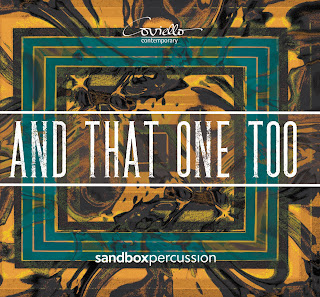
Sandbox Percussion: 'And That one Too' on Coviello Classics

And that one too - Andy Akiho, David Crowell, Amy Beth Kirsten, Thomas Kotcheff; Sandbox Percussion; Coviello Classics
And that one too
- Andy Akiho, David Crowell, Amy Beth Kirsten, Thomas Kotcheff; Sandbox Percussion; Coviello Classics

Reviewed by Robert Hugill on 12 May 2020 Star rating: 3.0 (★★★)
A striking debut disc from the young American percussion quartet, featuring four works written for them

Sandbox Percussion is an American percussion quartet currently making a name for themselves. The group made its UK debut at the 2019 Vale of Glamorgan Music Festival when they premiered a piece by Benjamin Wallace for percussion quartet and fairground organ!

For Sandbox Percussion's debut album, on Coviello Classics, And That One Too, they perform music by Andy Akiho, David Crowell, Amy Beth Kirsten and Thomas Kotcheff. Sandbox Percussion is Jonny Allen, Victor Caccese, Ian David Rosenbaum and Terry Sweeney.

The disc opens with Andy Akiho's Haiku 2, the second of six short pieces he wrote for a contemporary music ensemble in 2011. Akiho has created a new version for percussion quartet, scored for tuned ceramic bowls, metal pipes, wooden slats, a metal pot lid, a glass bottle and a piece of scrap metal. The result is very seductive, as if Ravel's Princess and the Pagodas had come to land in a 21st century percussion quartet. Though wordless, the piece does observe the conventions of haiku with its rhythmic structure.

Sheffield Chamber Music Festival at home

Ensemble 360 at Crucible Theatre, Sheffied (Photo Music in the Round)
This week was supposed to be the Sheffield Chamber Music Festival, presented by Music in the Round at the Crucible Theatre; it would have been the 36th festival. Nothing daunted, Music in the Round is presenting a two-day on-line festival, Sheffield Chamber Music Festival at home (#SCMFhome) with a dozen specially curated performances, talks and family events, on the Music in the Round YouTube channel over two days on Friday 15 and Saturday 16 May.

Musician's from the resident Ensemble 360, will be bringing people closer to the music by inviting them (virtually!) into their own homes. They’ll perform a wide variety of classical music, from Bach and Britten to Biber and Bartok, each performance introduced with some informal chat about the music (just as they would on stage). There will also be guest artists, some of whom were also due to perform in the nine-day Festival, including guitarist Craig Ogden, accordion player Milos Milivojevic, video content from Gavin Bryars, and a set from folk musicians Fay Hield and Rob Harbron.

For families, there is the chance to a recording of Sir Scallywag and the Battle of Stinky Bottom, based on the hugely popular children’s book by Giles Andreae and Korky Paul. Taken from one of Music in the Round’s relaxed concerts for children aged 3 – 7 years, with presenter Polly Ives and Ensemble 360, this was originally live-streamed to Sheffield Children’s Hospital in November last year, and will be publicly available for the first time.

Full details from Music in the Round's website.

Wednesday, 13 May 2020

A disc full of discoveries: the first group of Goethe settings from Stone Records' complete Hugo Wolf songs

Hugo Wolf Goethe Lieder, part 1; Louise Alder, Fflur Wyn, Katarina Karneus, Rowan Hellier, Adrian Thompson, Roderick Williams, Neal Davies, Sholto Kynoch; STONE RECORDS

Reviewed by Robert Hugill on 12 May 2020 Star rating: 4.0 (★★★★)
The complete Hugo Wolf songs from the Oxford Lieder Festival continues with Wolf's Goethe settings including the powerful sequence from Wilhelm Meisters Lehrjahre

Stone Records series Hugo Wolf: the complete songs, recorded live at the Oxford Lieder Festival, has reached volume 10, Goethe Lieder: part one, with Lousie Alder, Fflur Wyn, Katarina Karneus, Rowan Hellier, Adrian Thompson, Roderick Williams and Neal Davies performing 19 of Hugo Wolf's settings of Goethe with Sholto Kynoch (piano).

Hugo Wolf's Gedichte von J.W. v. Goethe dates from 1888 and 1889; Wolf seems to have taken a calendar year to set this cycle of 51 songs on Goethe's texts, during a period when he produced 174 songs in two and half years. On this first disc of the Goethe settings, lyrics from Wilhelm Meisters Lehrjahre (Goethe's second novel, published in 1795-96) feature quite heavily, lyrics which had a long tradition of being set by composers such as Beethoven, Schubert, Schumann and more. If these songs are, perhaps, less well known than some earlier settings its is partly because Wolf is less interested in them as lyrics per se; many are quite free in their settings and Wolf is interested in digging into the complex emotional atmosphere behind the lyrics. After all the story is a strange one, complete with a heroine, Mignon, born of incest.

We start with the Harper, Mignon's father, and the three Harfenspieler sung by Neal Davies. These are masterpieces of introspection and melancholy, even though Wolf's accompaniment sometimes echoes the harper's harp.

The Grounded Conductor: Timothy Henty on At Home with LMP

Timothy Henty (Photo Valters Pelns)
As the London Mozart Player's digital programme, At Home with LMP continues they are being joined by conductor Timothy Henty for a four-part web series, The Grounded Conductor (pun intended I presume), about the issues facing a conductor in today’s world with guests ranging from Sir Antonio Pappano (music director of the Royal Opera House) and soprano Dame Felicity Lott, to jazz singer Clair Martin OBE, Broadway star Kim Criswell and German singer-songwriter Max Mutzke.

The first episode, today 13 May 2020, focuses on what it means to work as a conductor in a theatre, collaborating with stage managers, directors and choreographers. The film includes interviews with Sir Antonio Pappano, Scottish Ballet Director Chris Hampson, Director of the Copenhagen Opera Festival Amy Lane and Cal McCrystal, who directed Gilbert & Sullivan's Iolanthe for English National Opera which was conducted by Henty [see my review].

The idea for the series arose after Henty made a film for At Home with LMP explaining how to sync up a live orchestra with a film rolling in the background. Henty began his relationship with the LMP in 2019, when he made his debut with them at the newly refurbished Fairfield Halls in Croydon, conducting Howard Blake’s score for The Snowman live-to-picture.

Further details from the London Mozart Players' website.

Musical Greetings from Vienna


Violinist Daniel Froschauer and double bass player Michael Bladerer have recorded this lovely duet recital from the (empty) Brahms Saal of the Musikverein in Vienna. Both performers play in the Vienna Philharmonic Orchestra, and this video was originally made for the Vienna Philharmonic Society, an American-based society raising funds for the orchestra.

First the duet play's Reinhold Gliere's 1909 Suite for Violin and Cello (in a version for violin and double bass). A pupil of  Sergei Taneyev and Mikhail Ippolitov-Ivanov, Gliere turned into one of the great survivors. He never visited Western Europe after 1917, and during the 1920s, 1930s and 1940s as the last genuine representative of the pre-revolutionary national Russian school he seemed to be beyond reproach.

Violinist Daniel Froschauer then plays music from Bach's unaccompanied Sonata in G minor, written less than 10 years before Froschauer's 1727 Stradivarius violin was made. Double Bass player Michael Bladerer performs music by Bottesini, performed in memory of Bladerer's teacher, Ludwig Streicher, a former principal double bass player with the Vienna Philharmonic who would have been 100 this year and who played it in the Brahms Saal on his 70th birthday.

Tuesday, 12 May 2020

The Khachaturian International Competition goes fully digital, the first classical competition to do so

15th  Khachaturian International Competition in 2019 (Photo Lusi Sargsyan)
15th  Khachaturian International Competition in 2019 (Photo Lusi Sargsyan)
The Khachaturian International Competition has been held in Yerevan, Armenia, every year since 2003 and this year, focussing on the violin, would have been the 16th competition. Rather than cancelling it, the competition is going on-line, transforming into a unique digital format, becoming the first of its kind contest in the classical music world.

The competition takes place from 6 to 15 June 2020; selection and the first two rounds are via video with piano accompaniment and the final round will be accompanied by recordings of the Armenian State Symphony Orchestra, and its principal conductor Sergey Smbatyan [see my review of the orchestra's recent London concert], thus making an interesting new challenge for performers and judges alike.

The deadline to apply is 25 May and musicians from 16 to 32 years of age can participate. Full details from the competition website.

Ailsa Dixon's Three Fugues on Biblical Subjects multi-tracked on Renaissance lutes by Linda Sayce


The music of the British composer Ailsa Dixon (1932-2017) is being gradually re-discovered, including the premiere of an anthem in the presence of the composer by London Oriana Choir shortly before Dixon's death. The current crisis has (temporarily) prevented live performances of Dixon's music, but to celebrate Ailsa's husband Brian's 89th birthday, lutenist Linda Sayce has recorded Dixon's Three Fugues on Biblical Subjects, performing them for the first time since their composition. The three fugues are:

  • Four-part fugue: Since by man came death
  • Three-part fugue: And I will write my law in their inward parts
  • Four-part fugue: By the waters of Babylon

Ailsa Dixon was herself a lutenist, and one of the fugues was written out in lute tablature with the intention of presenting it to the Lute Society in memory of Dixon's teacher, the Society’s founder, Diana Poulton. Following their rediscovery, Lynda Sayce, has arranged the three fugues for her family of Renaissance lutes in different sizes.

Further information from the Ailsa Dixon website.

Popular Posts this month