Thursday, 14 April 2016

Jazz intersects classical: Kristjan Randalu's Enter-Denter

Kristjan Randalu - Enter Denter
Kristjan Randalu Nach dem Anfang vom Ende, Enter Denter; Kristjan Randalu, Tallinn Chamber Orchestra; ERP
Reviewed by Robert Hugill on Apr 10 2016
Star rating: 4.0

Jazz intersects classical in these two works for piano and orchestra by the Estonian jazz pianist and composer

Kristjan Randalu is an Estonian pianist and composer; I would like to say jazz pianist but that seems limiting yet it is his principal field. This disc on ERP is a live recording of a 2009 concert the Glasperlenspiel Festival in Tartu with the Tallinn Chamber Orchestra. They perform two of Randalu's works with piano (played by Randalu himself) and orchestra, Nach dem Anfang vom Ende (After the Beginning of the End) and Enter Denter.

Though born in Estonia Kristjan Randalu moved to Germany as a child (his father is the pianist Kalle Randalu), and his training included studying with John Taylor in Cologne, at the Royal Academy of Music with Django Bates and at the Manhattan School of Music in New York. Randalu developed the idea for Nach dem Anfang vom Ende whilst living in London in 2001. He wrote three movements there and added a fourth later. Each movement has a title, intriguing and slightly elusive: Der Weg weg (Path of departure), Eine Ahnung in der Vergangenheit (A notion of the past), Spielchen und Rechenschaft (Little games and accountability), Regenbogen (Rainbow).

In writing for jazz piano and orchestra, Randalu did not include percussion in the orchestra so that we have jazz piano set against a more classically oriented orchestra. The piano part is not fully notated in the score, just themes and suggestions, with the orchestra framing the soloist. The resulting work can vary in length and here lasting just over 20 minutes.

Guts and Glory

Spiritato - Guts and Glory
The period instrument ensemble Spiritato is touring the UK with a programme of music for trumpets, drums and strings; military art music written by Biber and Schmelzer. The programme opens at St John's Smith Square on 15 April 2016 and there are further dates at St George's Bristol (9 November 2016), Brighton Early Music Festival (11 November 2016) and Your Early Music Christmas Festival (8 December 2016). The programme includes Biber's Battalia a 10, Schmelzer's Balletto a Cavallo plus music by Vejanovsky and Fux.

A distinctive feature of the concerts will be that the group will be using natural trumpets without any of the finger holes or valves which can help players, an idea which is becoming increasingly common with HIP groups particularly on the continent. The results offer intriguing possibilities in terms of the harmonic qualities and temperaments of the music, and require the players to research playing methods and techniques. The performances of Guts and Glory will follow a series of workshops and conferences, aimed at integrating real natural trumpets and equal tension strings into the ensemble.

Further information from the St John's Smith Square website.

Wednesday, 13 April 2016

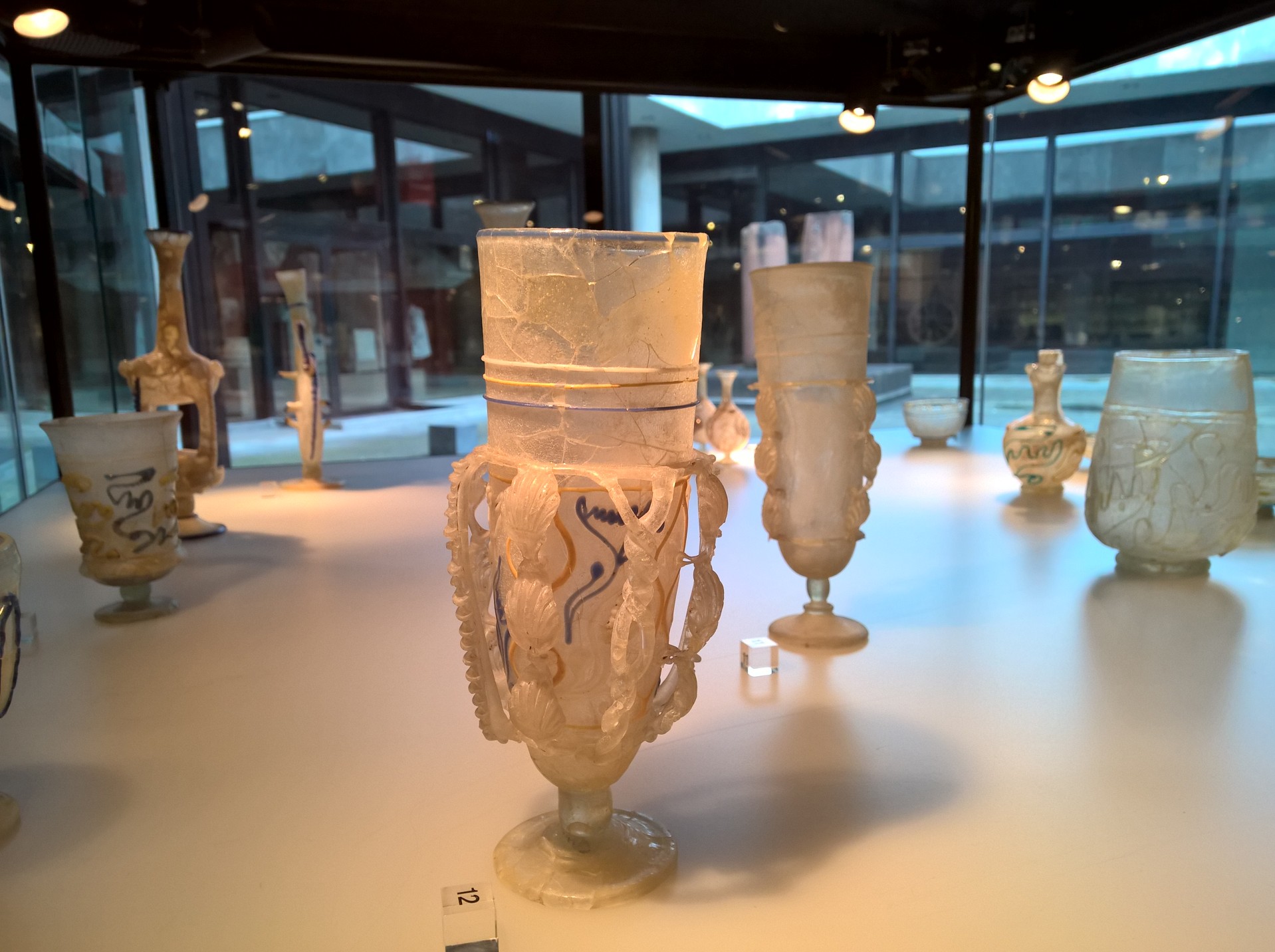
The treasure's beneath - Roman glass and mosaics in Cologne

Roman glass at the Roman-Germanic Museum in Cologne
Whilst in Cologne for Kimiko Ishizaka's performance of Bach's The Art of Fugue (see my review), I was able to do some sight-seeing as well. Cologne's Roman-Germanic Museum might have an unwieldy name but this modern museum houses a wealth of treasures. Built on the site of a Roman villa (with mosaic still in situ), the museum has one of the world's largest collections of Roman glass. My article on the CultureTrip website introduces the museum, its treasures and its history - Read more.

Live Music Now celebrates Menuhin Centenary

Yehudi Menuhin in 1976
This week the celebrations for Yehudi Menuhin’s centenary reach their climax. The finale of the Yehudi Menuhin Competition comes on 16 April but there are other celebrations too. Live Music Now (LMN) was founded by Yehudi Menuhin to support musicians bringing music to those in challenging circumstances, and to provide work for young musicians and the organisation continues to fulfil Menuhin’s aims. 

LMN will be holding its Menuhin Centenary Conference at Kings Place on Saturday 16 April 2016 bringing together LMN musicians, managers and partners together to discuss Menuhin's legacy. The conference is open to the public and it is hoped people will join in to contribute to a wider body of evidence supporting the professional development of musicians in music outreach work focussing on well-being and special educational needs. And on the Sunday morning there is a coffee concert by LMN musicians past and present, including Anne Denholm, Craig Ogden, Tir Eolas and members of the Sacconi String Quartet.

LMN’s other celebratory events include the world premiere of a musical adaptation of children’s story The King, The Cat & The Fiddle performed by Welsh Folk group Calan to schools and venues South Wales. The story was co-written by Yehudi Menuhin, alongside author Christopher Hope with illustrations by Angela Barrett. There is a full list of LMN’s Menuhin Centenary events on the Live Music Now website

Intelligent programming and fine singing: The Evening Hour

The Evening Hour - Signum Classics - choir of Jesus College, Cambridge
John Sheppard, William Byrd, Robert Whyte, Orlando Gibbons, John Blitheman, Thomas Tallis, Philip Radcliffe, Edward Bairstow, Richard Rodney Bennett, Gabriel Jackson, Lennox Berkeley, Henry Balfour Gardiner, Gustav Holst, John Tavener, William Harris, Philip Moore, Edward Bairstow; Choir of Jesus College Cambridge, Mark Williams; Signum Classics
Reviewed by Robert Hugill on Apr 06 2016
Star rating: 4.0

Attractive selection of evening themed works

This new disc from Mark Williams and the choir of Jesus College, Cambridge on Signum Classics is an attractively selection of 16th and 20th century British choral music with a loosely evening theme, under the title The Evening Hour. The 16th century composers included are John Sheppard, William Byrd, Robert Whyte, Orlando Gibbons, John Blitheman and Thomas Tallis, whilst the 20th century composers are Philip Radcliffe, Edward Bairstow, Richard Rodney Bennett, Gabriel Jackson, Lennox Berkeley, Henry Balfour Gardiner, Gustav Holst, John Tavener, William Harris, Philip Moore and Edward Bairstow. The selection of 20th century composers is not really one to frighten the horses, but it showcases the choir very well and within the works performed are some rather striking yet lesser known works.

In fact the disc showcases more than one choir, as Jesus College has a chapel choir and a college choir. The chapel choir is men and boys whilst the college choir is mixed with the men of the tenors and basses in common.

Reminding people why it is good to sing - The Choir with No Name at Chorus 2016:


The Choir With No Name at the Southbank Centre's Chorus Festival

This weekend (19 & 20 March 2016) was the Southbank Centre's Chorus Festival, where choirs from around the UK sing at various locations within the Southbank. Amongst the choirs performing was the fantastic Choir with No Name which deserves a special mention.

The Choir with No Name provides rehearsals with a meal for homeless men and women. Since they started with a single group in 2008, they have expanded and currently there are four choirs, two in London, one in Birmingham and one in Liverpool. Regular gigs help raise money to keep the charity afloat. I first saw them last Christmas, filling the stage at the Royal Festival Hall, and bringing their own indomitable approach to the festive season. Upcoming gigs include a comedy night in London, and a spot at 'Community Spirit 2016', in Birmingham. 

On Saturday (19 March 2016) their fearlessness and enjoyment easily put other choirs to shame. There may have been nerves, but these were well hidden, and with no music to hide behind, the choir infected the audience with their enthusiasm. Well done to the performers, musical directors, and the team for reminding people why it is good to sing.
Hilary Glover

Fyer! Fyer! - the story of the Great Fire of London as you have never heard it before

Fyer! Fyer!
Roll up! Roll up! A group of travelling players is bringing a dramatic, funny and musical tale of the Great Fire of London.

Classes from five inner-London schools will be participating in a series of music, art and drama workshops based around the Great Fire of London, culminating in performances at Wilton's Music Hall.

Working with actor/director John Savournin and musical director Rosamund Savournin and young professional musicians, the children will prepare songs and art work to develop their understanding of the Great Fire of London. The final production will take place at Wilton's Music Hall on 14 April 2016, when children from the five schools, plus an additional school in Croydon will form the audience. The children will take part in this interactive show as well as enjoying a high quality performance by professional actors and musicians in the atmospheric surroundings of Wilton’s historic Music Hall.

The event is organised by the Concordia Foundation, which was founded by singer and broadcaster Gillian Humphreys to encourage and nurture young talent. The foundation provides opportunities via lunchtime and evening recitals, along with a unique educational programme for school-children from under-privileged backgrounds.

Further information from the Concordia Foundation website.

Tuesday, 12 April 2016

Capital Sounds - European Union Youth Orchestra celebrates being 40

European Union Youth Orchestra - photo Peter Adamik
The European Union Youth Orchestra (EUYO) celebrates its 40th anniversary this year and is commemorating the event with the launch of its Capital Sounds project. This summer the orchestra will tour to Bratislava, Ljubljana, Warsaw, Berlin and Amsterdam with a series of performances which see the EUYO giving joint performances with local youth ensembles in each capital city, and each concert will start with a key-note speech from a leading national cultural figure.

The tour starts in Bratislava on 7 August 2016 which will celebrate both Slovakia's assumption of the EU presidency and the EUYO's own 40th anniversary. For the concerts in Bratislava, Ljubljana, Warsaw, & Berlin the orchestra will be conducted by its chief conductor Vasily Petrenko in a programme including Mozart's Double Piano Concerto, Mahler's Symphony No. 1. In Amsterdam the orchestra will be conducted by EUYO conductor laureate Bernard Haitink in Haydn's Sinfonia Concertante and Bruckner's Symphony No. 7.

The EUYO was founded in 1976 and is intended to provide a bridge between music college and the professional music world for young musicians from all the member states. It is the only entity in Europe which represents and presents young cultural performers from all 28 member states at a high level of excellence.

Johnny Herford and James Baillieu at the Wigmore Hall

Johnny Herford - photo Maximilian Van London
Johnny Herford
photo Maximilian Van London
Schumann, Judith Weir, Ravel; Johnny Herford, James Baillieu; The Wigmore Hall
Reviewed by Robert Hugill on April 10 2016
Star rating: 4.0

Three contrasting composers but all with a sense of having a story to tell

For their Sunday afternoon concert (10 April 2016) at the Wigmore Hall, baritone Johnny Herford and pianist James Baillieu combined song cycles by Schumann and Ravel with a selection of songs by Judith Weir, the Master of the Queen's Music. They opened with Schumann's Liederkreis Op. 24 and closed with Ravel's Histoires Naturelles and in between we heard Ständchen, Blackbirds and Thrushes, On Buying a Horse and three songs from Songs from the Exotic by Judith Weir.

If there was a thread linking the songs it was perhaps storytelling. Johnny Herford seemed a natural storyteller on stage using both his voice, his face and his body to involve us in a way which was completely engaging yet never over the top or too operatic. Whilst the Ravel songs, setting prose poems by Jules Renard, seemed the most story like Judith Weir's songs all had an intriguing element of the folk tale about their texts especially in the way that story was told in an indirect and allusive manner, often ending mid-air. Schumann's song cycle, the first that he called Liederkreis, is a group of songs all by Heine and though there was no explicit narrative arc, Johnny Herford made each one seem part of an emotionally dramatic whole.

James Baillieu - photo  Kaupo Kikkas
James Baillieu - photo  Kaupo Kikkas
The Schumann cycle opened with 'Morgens steh'ich auf und frage' (Every morning I wake and ask) which Johnny Herford and James Baillieu made a rather perky, folk-ish piece with Herford making the vocal line really count, and Baillieu giving us the first of a number of lovely postludes (something of a Schumann speciality). 'Es treibt mich hin' (I'm driven this way) was vividly characterised, with Herford singing with fine even tone. 'Ich wandelte under den Bäumen' (I wandered among the trees) had a bleak calmness to it, with a little bit of magic when the poet mentions 'old dreams' and lovely bird moments in the second verse. Herford has a strong natural presence on stage and whilst each song was highly characterised this never meant compromising musical values, throughout there was a lovely evenness and ease to Herford's voice.

'Lieb liebchen, leg's Händchen aufs Herze mein' (Lay your and on my heart, my love) was strange and short, but highly vivid. 'Schone Wiege meiner Leiden' (Lovely cradle of sorrows) was sung with passionate melancholy and a sense of lovely long phrases and a fine long postlude crowning it. 'Warte, warte, wilder Schiffmann' (Wait, o wait, wild sailor) was vigorous and vivid from both Herford and Baillieu, with a strong sense of narrative.

'Berg' und Burgen schau'n herunter' (Mountains and castles look down) had a lovely calmness, with strong musical values. 'Anfangs wollt'ich fast verzagen' (A first I almost lost heart) was short, yet deeply felt and there was a feeling of open-hearted frankness to the final song 'Mit Myrten und Rosen' (With myrtles and roses).

The Mahogany Opera Group: The Rattler

Mahogany Opera Group - The Rattler
Stephen Deazley & Martin Riley The Rattler; Matthew Sharp, Mahogany Opera Group, dir: Frederic Wake Walker; Royal Festival Hall
Reviewed by Hilary Glover on March 19 2016
Star rating: 4.0

Part musical, part interactive play, part puppet show, a whimsically gothic show for children

Starting off their 2016 tour, the Mahogany Opera Group performed 'The Rattler' at the Royal Festival Hall in London's Southbank Centre as part of the Southbank Centre's Chorus Festival. An 'opera' for children, this event made the most of the space available with pre-performance crafts - costume and percussion instrument(rattles and whisks) making - in the big open space behind the bar (Clore Ballroom). This segued into group song learning, led by members of the cast, so that the children (and adults) could join in as everyone paraded into the stalls of the main hall. The songs also appeared during the performance, allowing the audience to be part of the action as townspeople, and to have another opportunity to sing.

Mahogany Opera Group - The Rattler workshop - photo James Berry
Mahogany Opera Group - The Rattler workshop
photo James Berry
The Mahogany Opera Group has existed in its present form since 2014, however it has roots going back to 2003 with Mahogany Opera, and to 1997 with The Opera Group, whose productions such as Kurt Weill’s 'Street Scene' in 2008 have won awards.

Directed by Frederick Wake-Walker 'The Rattler' is a retelling of the story of Rumpelstiltskin. Martin Riley, who provided the libretto, has a solid background in writing for children, having worked on classics such as 'Grange Hill' and 'The Worst Witch', and for stage and opera including 'The Face In The Mirror' and 'Killing Cousins - a Tudor Time Travel adventure', for the Welsh National Opera.

Stephen Deazley, who composed the music, has also had his work performed by the WNO with 'The sleeper' and 'Little book of monsters'. He an exponent of youth music and is the founder and musical director of the Scottish-based music education charity, Love Music. In 'Death's Cabaret - A Love Story'. Both Riley and Deazley have previously collaborated with Matthew Sharp, who in this production played the lead role of Hob of Hobsmoor.

Monday, 11 April 2016

The Goose of Cairo - Mozart completed by Stephen Oliver

London Mozart Players - L'oca del Cairo
Mozart started writing The Goose of Cairo (L'oca del Cairo) in 1783 (the year after Die Entfuhrung aus dem Serail) but did not complete it and the torso was completed by the composer Stephen Oliver (1950-1992) in 1990. Oliver's version was premiered at the Batignano Opera Festival in 1991 with David Parry conducting. Parry will be again at the helm when the work is performed by the London Mozart Players at St John's Smith Square on 14 April 2016 at what will be the work's UK premiere. And it is being performed in English for the first time, in a new translation. The cast includes Fflur Wyn, Soraya Mafi, Ellie Laugharne, Diana Montague, Robert Murray, Christopher Diffey, Alexander Baker and Quirijn de Lang. 

The work is a comic opera setting an Italian libretto of which Mozart complete seven of the ten numbers in the first act. Stephen Oliver extended it into a 90 minute work, by taking the original libretto and not only extending it but changing it. The work is far more than pastiche, but is an imaginative combination of Mozart's music with Oliver's own. Oliver wrote over 40 operas, from his first The Duchess of Malfi in 1971, to Timon of Athens in 1991 and L'Oca del Cairo which was his last real dramatic work

The concert is part of the London Mozart Players series Mozart Explored: 1783.

The Deer's Cry - The Sixteen's Choral Pilgrimage 2016

Seven statues of martyrs, sculpted by Rory Young and installed in the niches of the medieval nave screen, St Albans Cathedral
Seven statues of martyrs, sculpted by Rory Young, in
the medieval nave screen, St Albans Cathedral
The Deer's Cry music by Byrd, Tallis, Pärt; The Sixteen, Harry Christophers; St Albans Cathedral
Reviewed by Robert Hugill on Apr 09 2016
Star rating: 4.5

Vibrant & rewarding - Music from the 16th and 20th centuries in The Sixteen's Choral Pilgrimage

Another year, another Choral Pilgrimage and thankfully The Sixteen's annual concert tour is anything but routine. This year is Harry Christophers and The Sixteen's 16th pilgrimage and we caught their second port of call at St Albans Cathedral on Saturday 9 April 2016. This year is The Deer's Cry taking its title from the work by Arvo Pärt in a programme which mixes music by Arvo Pärt with that of William Byrd and Thomas Tallis, with Byrd's Diliges Dominum, Christ qui lux es et dies, Emendemus in melius, Miserere mihi Domine, Ad Dominum cum tribularer, O lux beata  Trinitas, Laetentur coeli and Tribue, Domine, plus Miserere nostri attributed jointly to Byrd and Tallis, alongside Pärt's The Deer's Cry, The Woman with the Alabaster Box, and Nunc Dimittis.

Both Pärt and Byrd wrote music under unsympathetic regimes (Byrd under the Tudors at the height of the persecution of Roman Catholics, Pärt in Soviet controlled Estonia). Both wrote music which fits well with the acoustic of the large ecclesiastical spaces in which The Sixteen perform the Choral Pilgrimage.

The first piece was Byrd's Diliges Dominum one of a number of works in the programme which came from Byrd and Tallis' 1575 publication Cantiones Sacrae. There was another theme linking works too, the complex mathematical games that Byrd and Tallis loved to play, games which are concealed under a beautiful surface. Diliges Dominum hid its complexity beneath the surface perfection of the performance. The use of canon and palindrome in Diliges Dominum gave it a static quality and Harry Christophers and The Sixteen turned this into a form a magic, giving a wonderfully warm reaxed account with a richness to the texture.

Elegant Bach - Mass in B Minor from Masaaki Suzuki and Bach Collegium Japan

Masaaku Suzuki and the Bach Collegium Japan - photo credit Mark Allan / Barbican
Bach Mass in B Minor; Bach Collegium Japan, Masaaki Suzuki; Barbican Centre
Reviewed by Ruth Hansford on Apr 08 2016
Star rating: 4.5

In a performance that was all of a piece, Suzuki and his forces made the best of a venue not designed for this repertoire.

London is lucky to have had two consecutive weekends of Bach treats. And I was lucky to have been at two very different performances of the B minor Mass in under a week. Though neither venue, Kings Place nor the Barbican Hall, is ideal for the work, it was interesting to hear how performers work with the space they have – and we are grateful that they do. 

Following on from the Feinstein Ensemble's performance at Kings Place (see review), the Bach Collegium Japan and its founder Masaaki Suzuki started their short residency at the Barbican with Bach's B minor Mass on Friday 8 April 2016, followed by a study day and further concerts on the Saturday and a trip to Saffron Hall on the Sunday. This was also a live Outside Broadcast for BBC Radio 3 and will be on the BBC iPlayer for a month.

Above all, it was An Event. Suzuki’s visits to London are rare, and so the fans were out in force. Suzuki himself is clearly steeped in the music and we could feel the love between him, Bach and his mostly Japanese players and singers. There were 19 singers, arranged behind the band, and with a lot of space behind them, which could have made for a lack of intimacy, but we – and they – got over that.

It started off at a very stately tempo with the Kyrie, moving to an elegant ‘Christe eleison’ duet between sopranos Rachel Nicholls, a late replacement who has Wagner on her CV (gorgeous to hear a luxury voice in this) and Joanne Lunn (who was clearly enjoying wearing her very un-Lutheran frock, slinky black number with the back and sleeves made of lace). For the second Kyrie we were back to the slow tempo that emphasised the complexities of Bach’s sound world.

Sunday, 10 April 2016

In case you missed it - May on Planet Hugill: May Night, Streetwise Passion, Romeo & Juliet in the Round

Welcome to a busy and highly operatic March on Planet Hugill, with visits to Manchester for Streetwise Opera, and to Germany to hear a new completion of Bach's The Art of Fugue.
Things kicked off with a strong revival of Richard Jones' production of Il Trittico at Covent Garden. We were treated to two Handel operas, first Iestyn Davies starred in the title role of Orlando with Harry Bicket and the English Concert, then Handel met Game of Thrones in a superbly confident Ariodante from London Handel Festival and Royal College of Music.
Still at the colleges, the Royal Academy of Music gave us Rimsky Korsakov's rarely performed May Night in the industrial space that is Ambika P3. Covent Garden kept the Russian theme with the original version of Mussorgsky's Boris Godunov.
For Easter we were in Manchester and lucky enough to catch something simply remarkable, Penny Woolcock's promenade production at Campfield Market Hall, The Passion from Streetwise Opera and The Sixteen. Another vividly intense evening was Bellini's Romeo and Juliet in the round from Pop-Up Opera

English Touring Opera

ETO opened their Spring season with a welcome performance of Gluck's Iphigenie en Tauride. In another rarity, Pia de'Tolomei, Donizetti's opera was brought convincingly to life on stage in Hackney. A winning trio was rounded off with an enchanting and vividly characterised production of Mozart's Don Giovanni.

Not just charming background music - Handel at Vauxhall

Handel at Vauxhall - London Early Opera, Bridget Cunningham - Signum Records
Handel at Vauxhall, Handel, Arne, Hebden; Daniel Moult, Sophie Bevan, Eleanor Dennis, Kirsty Hopkins, Charles MacDougall, Greg Tassell, Benjamin Bevan, London Early Opera, Bridget Cunningham; Signum Classics
Reviewed by Robert Hugill on Apr 02 2016
Star rating: 4.0

Charm and delight in the programme emulating the music at Vauxhall Pleasure Gardens

Having explored Handel in Ireland (see my review) and Handel in Italy (see my review), Bridget Cunningham and London Early Opera have now released Handel at Vauxhall on Signum Classics, in which Handel's music performed at the Vauxhall Pleasure Garden is set in context with works by his contemporaries. The programme includes Handel's sinfonia and 'Hush, ye pretty warbling choir!' from Acis and Galatea, Organ Concerto Op.4 No.2 in B flat major, the Dead March from Saul, The Advice, The Melancholy Nymph and 'As steals the morn upon the night' from L'Allegro, il Penseroso ed il Moderato, Thomas Arne's Colin and Phoebe, John Hebden's Concerto for Strings and Basso Continuo No. 1 in A Major. Bridget Cunningham and London Early Opera are joined by Daniel Moult (organ), Sophie Bevan, Eleanor Dennis and Kirsty Hopkins (soprano), Charles MacDougall and Greg Tassell (tenor) and Benjamin Bevan (baritone). (Available from Amazon.co.uk.)

During the late 17th century Vauxhall Gardens (or New Spring Gardens as it was then called) was little more than a country ale house, but in 1729 it was taken over by Jonathan Tyers who transformed it. And central to Tyers' transformation was the use of art, with decorations by major artists such as Francis Hayman and William Hogarth, Roubiliac's famous statue of Handel and of course music itself. As far as Tyers seems to have been concerned it wasn't just window dressing, the arts were morally redemptive, a civilising influence in a chaotic world. But the modern view has a tendency to focus on Vauxhall's social charms and be rather dismissive of the music performed, this new disc is something of a corrective.

Rise of the Machines!

Nonclassical
Nonclassical, the club-night and record label founded by the composer Gabriel Prokofiev, is joining forces with the Southbank Sinfonia for Rise of the Machines, the centrepiece of which is a classical club-night at Ambika P3 on Friday 15 April 2016. Rather appropriately, the industrial space of the former concrete testing laboratory will play host to a performance of Alexander Mosolov's ground-breaking 1927 Iron Foundry, the orchestral grandfather of mechanical music. Alongside the Mosolov will be arrangements of electronic wizard Aphex Twin’s Cock Ver. 10 and Blue Calx, as well as Leroy Anderson’s The Typewriter, the fifth movement of Gabriel Prokofiev’s Concerto for Turntables  (one of this year’s BBC Ten Pieces) and the UK premiere of Gabriel Prokofiev's Concerto for Turntables, Percussion, Trumpet and Orchestra.  The Southbank Sinfonia will be conducted by Gerry Cornelius and the soloists include world DJ champion Mr Switch and percussionist Joby Burgess.

The idea behind the concert and associated events is explained by a quote from Nonclassical's press release: 'By enjoying the tension of human performers exploring mechanical rhythms, the series explores the relationship between orchestral music and technology, the future of robotics in music, and the potential of mechanised musical instruments to create innovative new music spanning several genres.'

Other events include an interactive schools’ performance for KS3 students (11-14 year olds) of some of the works involved in the evening performance on the afternoon of Friday 15 April, with a special focus on the BBC Ten Pieces’ Concerto for Turntables and Orchestra. And on Wednesday 13 April, the Nonclassical Monthly Night at The Victoria (Dalston) also adopts the ‘Rise of the Machines’ theme, and features performances focussing on machine-based music and electronics from Tom Richards, Dead Fader and Nonclassical’s 2016 Battle of the Bands winners Ensemble x.y.

Full information from the Nonclassical website.

Saturday, 9 April 2016

The Female Persona

The Female Persona
A concert at The Forge in Camden on 12 April 2016 focuses on works and music written by, for and about women, with music by Sally Beamish, Robert Schumann, William Bolcom and Francis Poulenc.

The Amalie Trio (Catherine Backhouse - mezzo soprano, Alexa Beattie - viola, Elspeth Wyllie - piano) gives the London premiere of a work by Sally Beamish for viola and piano, alongside the work which inspired it, Schumann’s song cycle Frauenliebe und -leben, plus William Bolcom's Let Evening Come which sets texts by Maya Angelou, Emily Dickenson and Jane Kenyon.

In the second half of the concert, Eleanor Janes, soprano and Maya Soltan, piano will perform Francis Poulenc's mono-drama La Voix Humaine, to a text by Jean Cocteau, directed by PJ Harris.

Full details from The Forge website.

Blaze of Youth indeed - Chad Hoopes, Kristjan Järvi and the National Youth Orchestra

National Youth Orchestra of Great Britain at the Royal Festival Hall
Stravinsky Fireworks, Firebird, Michael Daugherty Fire and Blood; Chad Hoopes, National Youth Orchestra of Great Britain, Kristjan Järvi; Royal Festival Hall
Reviewed by Robert Hugill on Apr 8 2016
Star rating: 5.0

Fireworks all round from over 160 young performers

At the reception before the National Youth Orchestra of Great Britain's concert at the Royal Festival Hall on 8 April 2016, it was announced that the orchestra is becoming on of the South Bank Centre's associate orchestras. The concert itself, conducted by Kristjan Järvi featured Stravinsky's Fireworks and complete Firebird ballet along with Michael Daugherty's Fire and Blood with violin soloist Chad Hoopes. Hoopes was the 2008 Junior Prize winner at the Menuhin Competition and the concert formed part of the celebrations for this year's centenary Menuhin Competition.

A very full Royal Festival Hall platform saw more than 160 young performers on stage. They opened with Stravinsky's early Fireworks, a showpiece where the young composer showed both his indebtedness to and independence from his teacher Rimsky-Korsakov. Stravinsky's ear for orchestral colour is certainly striking, and the work encouraged Diaghilev to commission The Firebird from Stravinsky. Fireworks was notable for the fascinating flickering, impressionistic texture which Järvi got from the young musicians. It was a lovely fluid performance, with some brilliant detail.

Diego Rivera - Detroit Industry Murals, North Wall, 1932-33. Detroit Institute of Arts.
Contemporary American composer Michael Daugherty wrote Fire and Blood in 2003. It is a three movement concerto inspired by the car plants of the American motor industry, notably the murals which Ford commissioned from Diego Rivera which are full of machines and men at work. Daugherty's concerto is a large scale, rather romantic piece with some jazz influences in the writing. Whilst often big and vibrant, Daugherty's scoring is often quite neo-classical and very sympathetic to the violin which is often in dialogue with the orchestra.

Popular Posts this month