Friday, 25 February 2022

Celebrating the bicentenary of the death of William Herschel with premiere recordings of two of his trio sonatas

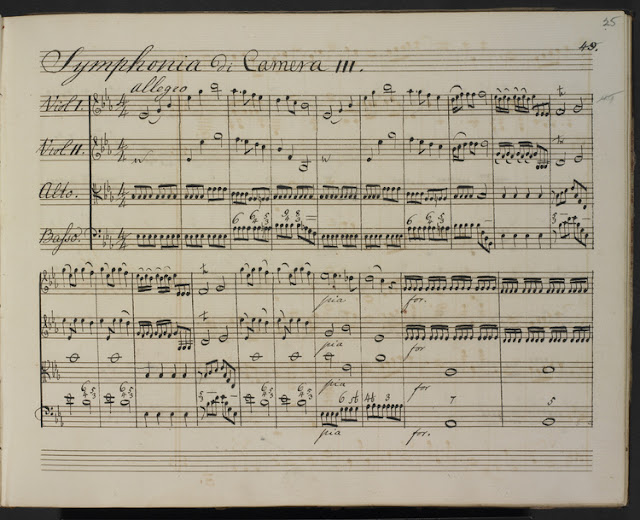
Manuscript of William Herschel's Symphony No. 15 in E-flat major (1762)

This year is the bi-centenary of the death of Frederick William Herschel (1738-1822), the German-born British composer and astronomer who is best known for his discovery of the planet Uranus in 1781. 
But Herschel had a parallel career as a musician though few of his compositions have made it into the record catalogue, and now The Dionysus Ensemble have recorded two of his trio sonatas.
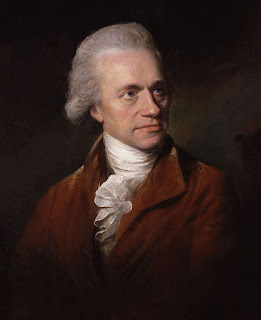
Portrait of William Herschel by Lemuel Francis Abbott (1785)
William Herschel by Lemuel Francis Abbott (1785)
William Herschel came from a musical family. His father was an oboist in the band of the Hanoverian Guards, and both Wilhelm (as he was then) and his brother Jakob were engaged as oboists with the band. But the threat of war and defeat in battle led their father to send Wilhelm and Jakob to England in 1757. Wilhelm was charged with desertion but would be pardoned by King George III (also King of Hanover) in 1782.

Wilhelm naturalised, learned English, and by 1761 was lead violinist with Charles Avison's orchestra in Newcastle, before moving to Leeds then Halifax (where he was the first organist at the church that is now Halifax Minster). In 1766 he became the organist of the newly built Octagon Chapel in Bath where in 1767 he directed a performance of Handel's Messiah (with Paragon Singers in Bath currently having a project to celebrate these performances, see my article). He was also director of public concerts in Bath and by 1780 he was director of the Bath orchestra. The Octagon Chapel survives (albeit in secular form) and is now a bar and restaurant, The Botanist!

In 1772, his sister Caroline arrived in England to live with him. Whilst she would be soprano soloist in his concerts, she also was a partner in his astronomical studies. With her help and that of his brother Alexander he made his own telescopes, constructing his first large reflecting telescope in 1774 and from then on astronomy seems to have been his principal interest. Caroline would spend the next 50 years aiding her brother and you do wonder whether, like Mendelssohn's sister and Schumann's wife, her contribution has been somewhat minimised. 

In 1785, with financial support from King George III, Herschel constructed a 40 foot telescope. The construction of this was a challenge, is was late and over-budget, and it proved cumbersome. Though useful, the images were not as clear as intended and in fact Herschel took the technology to its limits and only with 19th century improvements to the precision engineering of high-quality mirrors would further developments be possible.
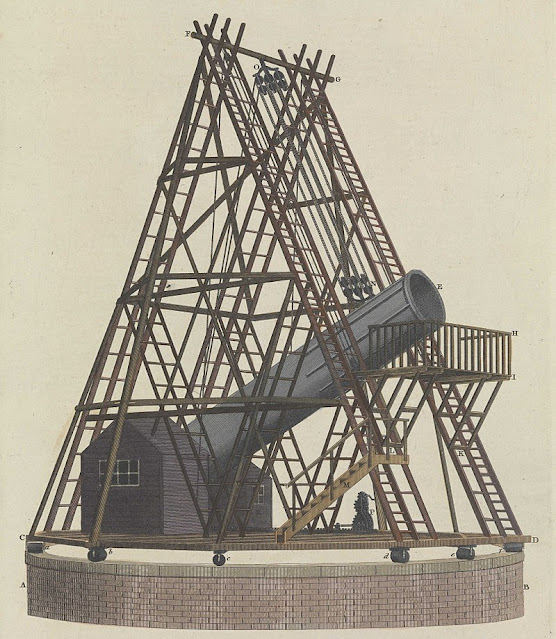
William Herschel's 40 foot Grand Reflecting Telescope

Herschel's musical output largely dates from the 1760s, including six symphonies, 18 symphonies for small orchestra, over a dozen concertos. Matthias Bamert and the London Mozart Players recorded six of the symphonies in 2003 [available from Amazon] but there is remarkably little else of Herschel's in the catalogue.

Herschel died in 1822 in Slough and was buried at St Laurence's Church, Upton, Slough. Now the Slough based Dionysus Ensemble, has recorded two of Herschel's trio sonatas, transcribing them from the original manuscripts. These are available for streaming [Link Tree] and we hope that the recording spurs others to explore this music.

Epilogue from Olovson's Storytelling

Olovson is Jacob Olofsson, known for being one half of the Grammy Award-winning, multi-platinum selling Swedish production duo Jarami. His new neo-classical album Storytelling is out on 4 March 2022, and in advance Olovson has issued a video of the track 'Epilogue' featuring a surreal animation by Russian-born, Paris-based award-winning artist and animator Anna Budanova. The video is described thus:

"Using charcoal and purposefully rough elements, we’re introduced to an ever-changing world that leaves animals and humans alike perplexed and looking for answers. A doorway to the darkness with a gentle swirl of snow outside: Olovson’s neo-classical notes provide the key to figuring it all out."

Watch 'Epilogue' on YouTube. Storytelling is available to pre-order [Link Tree]
     

Thursday, 24 February 2022

Her Day: A new opera presented by a female-led Coventry-based team that shines a spotlight on the lives of ordinary local women

Her Day is a new opera that is being presented by a female-led Coventry-based team at HMV Empire, Coventry from 8 to 12 March 2022.

Her Day
 is a new opera that is being presented by a female-led Coventry-based team at HMV Empire, Coventry from 8 to 12 March 2022. With music by playwright and composer Sayan Kent and words by playwright Vanessa Oakes, the new work is being directed by Lucy Bradley, designed by Nancy Surman and with Berrak Dyer as music director. The cast includes Nina Bennett, Kelly Glyptis, Grace Nyandoro and Claire Wild, with a community chorus of local female singers performing alongside the professional singers and instrumentalists. There is also an accompanying programme of activities exploring opera, including an Opera Buddies Friendship Group.

Her Day is intended to shine a spotlight on the lives of ordinary local women engaged in everyday acts of peaceful protest, and looks at four Coventry women, four different stories but with a common need for connection, all set against the background of a women's friendship group, and the work was developed in collaboration with women's groups around Coventry.

Kent and Oakes are members of the Royal Opera House’s Engender initiative, designed to change the gender imbalance in opera and music theatre, and are mentored by Richard Willacy and Hannah Griffiths at Birmingham Opera Company.

Further details and tickets from EventBrite.

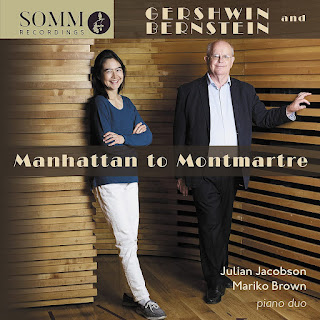
Manhattan to Montmartre: Bernstein and Gershwin transcriptions from Julian Jacobson and Mariko Brown

Bernstein Symphonic Dances from West Side Story, Gershwin Second Rhapsody, An American in Paris, Rhapsody in Blue; Julian Jacobson, Mariko Brown; SOMM

Bernstein Symphonic Dances from West Side Story, Gershwin Second Rhapsody, An American in Paris, Rhapsody in Blue; Julian Jacobson, Mariko Brown; SOMM

Reviewed by Robert Hugill on 23 February 2022 Star rating: 4.0 (★★★★)
Classic American pieces that cross over between jazz and classical come up delightfully sparkling in these transcriptions for two pianists

Transcribing music for two pianists (whether at one or two pianos) can often bring new insights, shorn of the brilliance and colour of the orchestration, the work's bones are often seen better and can place the piece in new light. On this disc from SOMM, Manhattan to Montmartre, pianists Julian Jacobson and Mariko Brown perform duet transcriptions of four iconic works, Leonard Bernstein's Symphonic Dances from West Side Story, and three works by George Gershwin, Second Rhapsody, An American in Paris and Rhapsody in Blue. The Bernstein was transcribed for two pianos by American composer John Musto in 1998. Gershwin's Second Rhapsody, and An American in Paris were transcribed for piano duet by Julian Jacobson in 2014 and 2016 respectively, whilst Rhapsody in Blue was transcribed for piano duet by Henry Levine in 1925, a version that Gershwin used to play with friends.

In 1910, more than three-quarters of the population of New York were either immigrants or the children of immigrants, so no wonder the city's musical culture developed as such a melting pot, combining music from European homelands with African American music and more. Irving Berlin was born in Russia, Vernon Duke was originally Vladimir Dukelsky, George Gershwin was the son of immigrants from Russia, Richard Rodger's grandparents were Russian immigrants whilst Leonard Bernstein's parents were from the Ukraine [I am indebted to Robert Matthew-Walker's admirable booklet note for this fascinating information]. Additional to this Russian factor should be added that many (if not all) these immigrants were of Jewish origins, the Russian pogroms against the Jews in the late-19th and early 20th centuries causing significant problems.

Wednesday, 23 February 2022

London Music Fund celebrating ten years of supporting young musicians across the captital

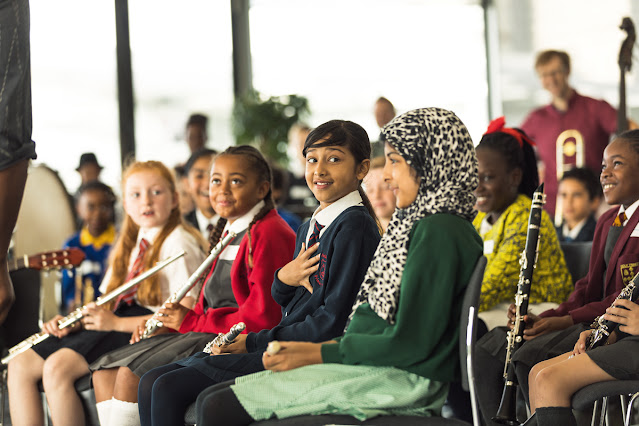
London Music Fund scholars in a workshop

The London Music Fund (LMF) is 10 years old and is celebrating tonight (23 February 2022) with a gala concert at the Queen Elizabeth Hall. The event features award-winning saxophonist and broadcaster YolanDa Brown, and includes a performance of A Celebration by Oscar-winning composer, Rachel Portman OBE, originally commissioned by the charity for the Queen's Diamond Jubilee River Pageant, and young musicians from across the capital will be coming together to showcase their talent and achievements thanks to the LMF's support.

In 2021, the LMF was the winner of the Outstanding Musical Initiative at the Music & Drama Education Awards. It was established in 2011 as an independent charity, with the Mayor of London as patron, to help provide young people from low income families with music education and to enable children in under-served communities to access high-quality music education. Since its founding, the LMF has supported more than 10,000 aspiring young musicians, awarded more than 600 scholarships and helped more than 50 collaborations with professional arts organisations.

One of the soloists at the gala will be Ignacy Stefanowicz. Now aged 18, and a violinist from Hounslow, Ignacy began playing the violin at the age of 7 and received a LMF Scholarship through Hounslow Music Service in 2012. In 2014 he was awarded a scholarship to study at the Yehudi Menuhin School. Other LMF alumni playing in the gala include Eva Serksnaite and Zaki Osahn, both of whom will be playing in the wind ensemble. Eva is an 18-year-old bassoonist from Sutton who her first year as an undergraduate at the Royal College of Music having begun her LMF Scholarship in 2012, going on gain a scholarship at the Purcell School where she came Head Girl. Zaki is 17-year-old clarinettist from Hounslow and he is studying at the Purcell School.

The opening work at the gala will be performed by an ensemble made up of the LMF's new scholars, including Asma, a 9-year-old trumpeter from the Tri-Borough Music Hub. Asma learned the basics of playing the trumpet entirely online, prior to in-person lessons returning due to the pandemic. Playing the trumpet has been a huge comfort to Asma during the past difficult couple of years.

The finale of the concert features the Celebration Ensemble, made up of Scholars from every cohort over the last ten year, representing every London borough. This ensemble includes Bishop, a 12-year-old drummer from Ealing. Bishop started his Scholarship in 2019 and he has superb technical ability and can play very challenging pieces. In 2020 he won the Christmas video competition with a brilliant rendition of Mariah Carey’s All I want for Christmas is you.

The cycle of life: Jamie Manton's new production of Janacek's The Cunning Little Vixen at English National Opera

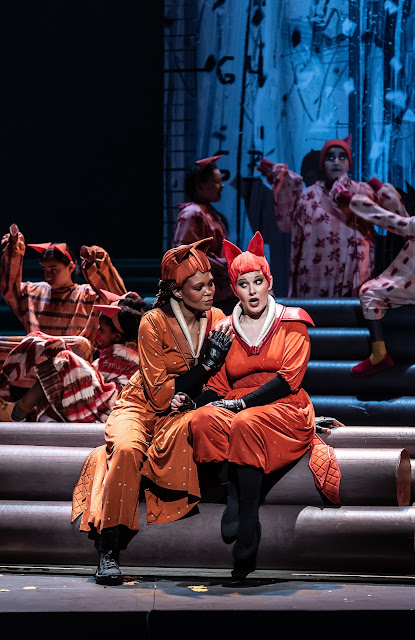
Janacek: The Cunning Little Vixen - Pumeza Matshikiza, Sally Matthews - ENO (Photo Clive Barda)
Janacek: The Cunning Little Vixen - Pumeza Matshikiza, Sally Matthews
ENO (Photo Clive Barda)

Janacek The Cunning Little Vixen; Sally Matthew, Lester Lynch, Pumeza Matshikiza, Alan Oke, Clive Bayley, Ossian Huskinson

Reviewed by Robert Hugill on 22 February 2022 Star rating: 4.0 (★★★★)
Jamie Manton's deliberately low-fi production successfully mixes a sense of melancholy with the feeling of the cycle of life, enlivened by a strong central performance from Sally Matthews

Director Jamie Manton had never seen a production of Janacek's The Cunning Little Vixen prior to being asked to direct the new production for English National Opera (ENO) at the London Coliseum. This meant that he brought a remarkable lack of preconceptions to the work. Manton, who directed the wonderfully inventive outdoor production of Verdi's La Traviata at Nevill Holt Opera last year [see my review], showed a similar imagination in filling the wide open spaces of the Coliseum stage. The production's planned first night was cancelled owing to the storm on Friday, so we caught Jamie Manton's production of Janacek's The Cunning Little Vixen at ENO on Tuesday 22 February 2022. Martyn Brabbins conducted, with Sally Matthews as the Vixen, Lester Lynch as the Forester, Pumeza Matshikiza as the Fox, Alan Oke as the Schoolmaster and the Mosquito, Clive Bayley as the Priest and the Badger, Ossian Huskinson as Harasta. Designs were by Tom Scutt, with illustrations by Anya Allin, lighting by Lucy Carter and movement by Jenny Ogilvie.

There was a deliberate low-fi feeling to the designs as well as a significant lack of the picturesque. This forest was a business-like place, and the sense that we were in a theatre was palpable. We opened on a bare stage, and the main sets were a series of wooden pallets containing logs; the use of logs throughout the work made us aware that this was a working forest, the trees themselves had a limited life. The main visual stimulus came from a remarkable scroll which unfolded downwards. Created by illustrator Anya Allin, it began with a the beginning of life, a foetus, and scrolled through the events till there was nothing at the end, when the scroll dropped and Lester Lynch's Forester took it with him on his final journey. In fact, we saw all the characters leaving the stage/dying, giving us another feeling of the melancholy progress of life.

Tuesday, 22 February 2022

Aria Borealis Bodø: new singing competition and Early Music festival based in the only city within the Arctic Circle

Bodø (Photo Carl Erik Nyvold)

Bodø is a compact city just North of the Arctic Circle in Norway; the Northern-most city in the world and the only one within the Arctic Circle. It is a place to enjoy awe-inspiring natural landscape beneath an Arctic midsummer’s never-setting sun. But this year the launch of a new festival, the punningly named Aria Borealis Bodø, will be drawing Early Music lovers too. From 24 June to 2 July 2022 the city will be hosting the Aria Borealis Bodø International Competition for Early Music Singers and a companion festival of Early Music.

The idea behind the combined competition and festival is to take eight winners of the competition and place them with an ensemble of  historically informed performance specialists and treat them as equal partners in chamber-scale performances. Audiences will be able to follow the creative process as it unfolds from rehearsals to concerts, and discover more about the collaborative art of interpretation as the nine-day event unfolds.

The competition is open to singers born in 1985 or after, and eight singers have been chosen via a digital round that attracted over 100 entrants from 39 countries and the winners were selected by the jury which included soprano Dame Emma Kirkby, harpsichordist and Artistic Director of Concerto Copenhagen Lars Ulrik Mortensen, Theater an der Wien director Stefan Herheim, Finnish soprano Tuuli Lindeberg and Swedish tenor Anders J. Dahlin. 

At the festival the competition will have two live rounds, the first consisting of rehearsals and a concert with a chamber ensemble. For the second, contestants will compete in teams and act together in short scenes from a Baroque opera, oratorio or cantata with full orchestra and stage direction, which will lead to their second-round competition performance in Stormen Concert Hall Saturday, 2 July. Both rounds will be streamed live.

There is also a programme of lectures, concerts, talks, masterclasses and more, including performances from members of the jury, as well as the Aria Borealis Bodø Sessions, a course involving music students and amateur and professional musicians. Concerts and other sessions will be streamed to broaden the audience reach far beyond Bodø.

The inaugural Aria Borealis Bodø represents a pioneering collaboration between Nordic Baroque Scene (NBS), a network formed by the four leading Nordic Baroque orchestras, and Bodø’s Stormen Culture Centre, a concert hall, library and multi-purpose performance space opened in 2014. The competition winners will work with a pool of players drawn from Nordic Baroque Scene’s four constituent ensembles: Concerto Copenhagen, the Finnish Baroque Orchestra, Drottningholm Baroque Ensemble and Barokkanerne (Norwegian Baroque Ensemble).

Full details from the festival website.

Handel Festival Halle celebrates its centenary

Handel Festival Halle 2022

This year the Handel Festival Halle is celebrating its centenary. That first festival in Handel's birthplace in 1922 is one of the defining moments of the modern revival of interest in Handel's wider music. The Hallisches Händelfest in 1922 concluded with a performance of Handel's Orlando, and the 2022 centenary festival, which runs from 27 May to 12 June 2022 will being with a new production of Orlando conducted by Christian Curnyn and directed by Walter Sutcliffe, the new artistic director of Halle Opera. The 1922 festival also included Susanna and Semele, both of which are being performed in 2022 along with a wide range of other works. 

After that first festival, the Halle Handel Society was formed in 1925 and a second festival took place in 1929 with a third in 1935. The fourth festival took place in 1949, and since 1952 the festival has become annual.

Other operas to be presented this year include Ariodante which will be a collaboration between the Carlo Colla e Figli marionette theatre and the Lautten Compagney Berlin. Leo Duarte and Opera Settecento will be performing Fernando, Re di Castiglia, a fragment of an opera that Handel would rework into Sosarme, with a cast including Susanna Fairbairn, Nick Scott, Chiara Hendrick and Jess Dandy. Kobie van Rensburg directs a multi-media production of Siroe, Re di Persia with Erich Traxler conducting L'Orfeo Barockorchester and a cast including Matthias Helm, Clint van der Linde, Nicholas Hariades, Annastina Malm, Amelie Müller and Philipp Kranje, a co-production with the Donaufestwochen im Strudengau festival. Handel's pasticcio, Carlo Fabrice (based on an opera by Hasse) receives its first performance in modern times with Nicholas Kierdorf conducting Concert Royal Köln Baroque orchestra with cast including Lukasz Koniezcny, Julie Vercauteren, Fanny Lustaud, and Anne-Aurore Cochet.

Handel's Brockes Passion is being presented in a staging directed by Walter Sutcliffe and conducted by Michael Hofstetter, with a cast including Romelia Lichtenstein (winner of the 2016 Handel Prize), Robert Sellier and Michael Zehe. The production was planned for 2021 but cancelled, and originally presented in October 2021.

The Portuguese orchestra Divino Sospiro makes its festival debut with Mozart's version of Messiah. MDR Radio Choir and Leipzig Baroque Opera present Susanna with a cast including Marie Lys, Ciara Henrick, Benjamin Hulett, and Benjamin Bevan, conducted by Philipp Ahmann. Howard Arman conducts the Staatskapelle Halle in Semele, in a version which re-constructs the performing edition used (cut and sung in German) for the opening concert of the 1922 festival.

There are 67 events in total including concerts from Jordi Savall, Philippe Jaroussky, Ragna Schirmer or Romelia Lichtenstein, as well as countertenor Axel Köhler, who continued as Festival director after his retirement from the stage.

Full details from the festival website.

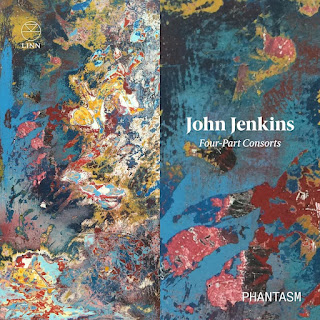
Phantasm completes its survey of all John Jenkins' viol consorts with a disc of his four-part consorts on Linn

John Jenkins Four-Part Consorts; Phantasm; LINN

John Jenkins Four-Part Consorts; Phantasm; LINN

Reviewed by Robert Hugill on 22 February 2022 Star rating: 4.0 (★★★★)
Phantasm brings to a close its project to record all of John Jenkins' consorts with a finely imaginative and engaging disc of the intricate four-part consorts

The composer John Jenkins was long-active and prolific, he is recorded in 1634 as one of the musicians  performed the masque The Triumph of Peace at the court of King Charles I, he went on to successfully weather the Civil War by sheltering in the country with a number of Royalist patrons, and ended his life with a court position after the Restoration. He wrote extensive amounts music for viols and was a noted virtuoso on the lyra viol. The viol consort Phantasm has been exploring Jenkins music for viols and having recorded his five-part and six-part consorts, Phantasm has now recorded John Jenkins' Four-part consorts on LINN records. For the disc Phantasm (Laurence Dreyfus, Jonathan Manson, Emilia Benjamin, Markku Luolajan-Mikkola) are joined by Daniel Hyde (organ).

Monday, 21 February 2022

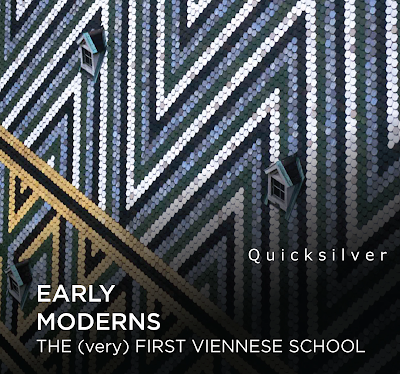
Early Moderns: the (very) first Viennese School

Early Moderns: the (very) first Viennese School; Quicksilver

Early Moderns: the (very) first Viennese School
; Quicksilver

Reviewed by Robert Hugill on 21 February 2022 Star rating: 4.0 (★★★★)
The American Baroque ensemble explores the inventive music written by local composers and visiting Italians for the Imperial Court in 17th century Vienna

Early Moderns: the (very) first Viennese School features the North American ensemble Quicksilver (Robert Mealy & Julie Andrijeski, violins, directors, Greg Ingles, trombone, Dominic Teresi, dulcian, David Morris, viola da gamba, Avi Stein, harpsichord & organ and Charles Weaver, theorbo) in a programme of music by composers associates with 17th century Vienna, Johann Schmelzter, Giovanni Legrenzi, Johann Rosenmüller, Giovanni Battista Buonamente, Johann Caspar Kerll, Johann Joseph Fux, Heinrich Biber, Giovanni Valentini and Antonio Bertali. Composers who, if they are known at all, are often simply names.

In 1622, the Hapsburg Holy Roman Emperor, Ferdinand II married Eleanora Gonazaga of Mantua, and she brought the music of Monteverdi and his colleagues to Vienna. Music continued to flourish under his successor Ferdinand III and reached a high point with the music-loving Leopold I, who came to the throne in 1658. This highly cultured emperor created a court in which the arts thrived, despite constant wars with the French and with the Ottoman Turks. It was one of the few courts in Europe to have a culture that could challenge the brilliance of King Louis XIV's France. 

The composers who came to Vienna were varied, a mixture of local men and Italians come seeking their fortunes. The disc includes 12 works of which 10 are sonatas though these are very different from 18th century sonatas. Instead we have the composer's imagination or fantasy creating whatever they wanted. This was music for show, but also for a small group of friends to play.

Beverley & East Riding Early Music Festival

Beverley & East Riding Early Music Festival 2022

This year's Beverley & East Riding Early Music Festival is presenting an action-packed weekend of events from 27 to 29 May 2022, in a variety of historic venues in this picturesque Yorkshire town. The festival is opened by Florilegium with celebration of the music of JS Bach mixing Brandenburg Concertos with an orchestral suite and violin concerto. Then to close the festival, I Fagiolini present Draw on sweet night,  celebration of the madrigals of John Wilbye, and there will also be a screening to Tony Britten's film Draw on Sweet Night which looks at how John Wilbye spent his working life in the service and home of Suffolk recusants Sir Thomas and Lady Elizabeth Kytson.

You performers appearing at the festival include the Spanish Ensemble Sarbacanes with Music for Garden and Table with music from Haydn, Mozart and Salieri, whilst Prisma recreate the atmosphere of the pubs and bars of 17th century London during the third year of the Civil War when theatres and opera houses were closed. Sarbacanes and Prisma are supported by EEMERGING+ a Europe-wide funding programme for young up-and-coming ensembles in the field of early music funded by Creative Europe. 

Ensemble Molière is the first ensemble to be chosen as the New Generation Baroque Ensemble supported by BBC Radio 3, the Royal College of Music, and the National Centre for Early Music. Their programme The King’s Playlist is a selection of music chosen as a soundtrack to Louis XIV’s daily rituals and includes works by Charpentier, Lully, Couperin Delalande and Marais.

Other performers include Richard Egarr and Alexandra Nepomnyashchaya in four-hand piano duets by JC Bach, Mozart and Dussek.

There is also a programme of talks and lectures, including Dr Jennie England on fascinating local histories connected to St Mary's Church, a workshop with Ashley Solomon, artistic director of Florilegium, and a practical workshop for players of medieval and renaissance instruments.

Full details from the National Centre for Early Music's website.

Bristol New Music 2022

Bristol New Music
Bristol New Music, a city-wide celebration of contemporary music, returns for its fourth edition from 5 to 8 May 2022 with highlights of the programme having just been announced. International artists and collaborations include Hezarfen Ensemble performing a trans-cultural programme of commissions by top young Turkish and British composers, Chicago-based singer, and clarinettist Angel Bat Dawidin in a solo set of futuristic spiritual jazz, Berlin based Norwegian saxophonist Bendik Giske, Belgian-born Angolan producer Nazar in an uncompromising synthetic take on his native country’s Kuduro music, in dialogue with London visual artist Rob Heppell. Beatrice Dillon collaborates with British Asian composer and Bhangra pioneer Kuljit Bhamra,

Swedish composer Ellen Arkbro will perform a new organ piece on the Harrison & Harrison organ at St Mary Redcliffe, Other site-specific pieces include multimedia installation artist Kelly Jayne Jones creating a special piece for the vaults of Clifton Suspension Bridge, and Irish conceptual artist Áine O'Dwyer presenting a new commission that captures the song and instrumentation of time, place and people in the Bristol neighbourhood of Easton. 

Other artists include South London musician Mica Levy performing star star star with an ensemble at St George's Bristol, Bristol feminist interdisciplinary ensemble Viridian Ensemble, and radical noise duo Harrga,

Taking place biennially across Bristol. Bristol New Music is a collaboration between five key organisations in the city: Bristol Beacon, Arnolfini, Spike Island, St George’s Bristol and the University of Bristol. Venues this year include St George’s Bristol, Arnolfini Auditorium, Strange Brew, Spike Island, St Mary Redcliffe Church, and Clifton Suspension Bridge Vaults.

Full details from Bristol New Music website.

Buxton International Festival 2022 - Rossini's La donna del lago, Hasse's Antonio e Cleopatra

Buxton International Festival - 2022
This year's Buxton International Festival runs from 7 to 24 July 2022, and artistic director Adrian Kelly's programme features five operas and a musical including three new productions, along with a wide array of concerts and other events. 

The festival's new productions are Rossini's La donna del lago and Hasse's Antonio e Cleopatra, and the musical Gypsy, and there is also the premiere of a new oratorio.

Rossini's La donna del lago, based on Sir Walter Scott's poem The Lady of the Lake, is directed by Jacopo Spirei and conducted by Adrian Kelly with Máire Flavin as Elena, Nico Darmanin as Uberto, John Irvin as Rodrigo and Catherine Carby as Malcolm. Evangeline Cullingworth directs Hasse's Antonio e Cleopatra the Pavilion Arts Centre with Buxton Baroque Ensemble, music director Satoko Doi-Luck, with Ellie Neate and Thalie Knights in the title roles. The final festival production is Jules Styne's Gypsy, directed by Paul Kerryson,

Visiting productions include Salzburg State Theatre's production of Donizetti's Viva la Diva, directed by Stephen Medcalf, with George Humphreys as Agatha and Jenny Stafford as Prima Donna, Waterperry Opera's production of Jonathan Dove's Mansfield Park, directed by Rebecca Meltzer with Sian Griffiths, Milo Harries, Ellie Neate and Sarah Champion, and Tom Coult's new opera Violet which is a co-production by Music Theatre Wales and Britten Pears Arts, presented in association with the London Sinfonietta, directed by Jude Christian, conducted by Andrew Gourlay with Anna Dennis, Richard Burkhard, Frances Gregory and Andrew Mackenzie Wicks.

Kate Whitley's oratorio, Our Future In Your Hands, is a festival commission; setting a libretto by Laura Attridge, the work examines concerns about climate change, with a community cast featuring choirs drawn from local schools, and orchestral musicians from the Royal Northern College of Music, led by mentors from the Northern Chamber Orchestra.

The Brodsky Quartet and the Manchester Camerata both celebrate their 50th anniversaries this year and the two ensembles will be giving a celebratory concerts including a joint one with saxophonist Jess Gillam. Other performers include the English Concert with soprano Anna Dennis and Joanna MacGregor, Chetham’s School of Music, this year’s Royal Overseas League competition winner, violinist Eleanor Corr, Gould Piano Trio, the Solem Quartet, the Chroma Harp Duo, the Delphine Trio and the Solus Trumpet Ensemble. Iestyn Davies and Christopher Maltman both give song recitals and Fretwork makes its festival debut, 

There is also a new jazz programme, books, walks, talks and other events. Full details from the festival website,

Saturday, 19 February 2022

Most pieces use the dichotomy between tonality and atonality: I chat to composer Eleanor Alberga about writing music

Eleanor Alberga (Photo Benjamin Ealovaga)
Eleanor Alberga (Photo Benjamin Ealovega)
Last Autumn, the Academy of St Martin in the Fields launched The Beacon Project, a digital offering of educational resources and performance films that shine a light on three beacons of contemporary music: Eleanor Alberga, Sally Beamish, and Errollyn Wallen. The first work to be issued in the project was Eleanor Alberga's Nightscape which was premiered in 1993 and a wind ensemble from the Academy gave the first performance since then in November 2020. I recently was lucky enough to catch up with Eleanor to chat about Nightscape in particular and her career in general, the importance of her Jamaican background plays in her music and we look forward to the premiere of her symphony, Strata next month.

Nightscape was a joint commission from the London Mozart Players and the Horniman Museum in 1993 and intended as a pair with Mozart's Gran Partita. Because she was writing a work to act as a companion to Mozart's serenade, Eleanor decided to write a serenade for the same line-up of instruments, but the night time that the work would evoke would be that of the Jamaican world Eleanor knew as a child. The movements include 'Sundown', which evokes the evening with cicadas, party goers, geckos, and other nocturnal creatures, 'Into the arms of Morpheus', evokeing sleep whilst the title of the third, 'Brer Fox and the Dancing Ghost' which refers to a lullaby about a fox that Eleanor's mother used to sing her. 

After the work's premiere in 1993, Eleanor 'locked it in the attic' intending to come back and revise it. Then more recently the Academy of St Martin in the Fields contacted her about the piece. She decided that it did not need much revision after all, and has now come back to life, including being listened to by school children as part of the Beacon Project. Eleanor hopes that children listening to the work will take away a sense of enjoyment and fun, that they will enjoy the jazzy rhythms and that the piece will stimulate their imaginations. She feels that imagination is particularly important for children, and that it would be marvellous if they could imagine what a night in the tropics might be like, what the sounds are saying.

Friday, 18 February 2022

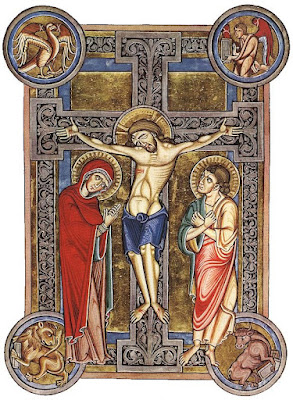
Robert Hugill's Passion to be performed at Chichester Cathedral by the cathedral choir as part of the Good Friday liturgy 2022

Robert Hugill: Passion

I am pleased to be able to announce that Passion, my setting of the passion story from St. John's Gospel, with interpolated poems by Carl Cook, is being performed on Good Friday (15 April 2022) by the choir of Chichester Cathedral, organist and master of the choristers Charles Harrison, as part of the Good Friday liturgy at Chichester Cathedral. This will be the work's first performance since 1999!

Lasting around 40 minutes and written for four unaccompanied voices, the work interweaves the passion story from St John's Gospel with chorales based on poems by the Black American poet Carl Cook selected from his collections Postscripts and The Tranquil Lake of Love which were both published in the 1990s.

Passion was written in 1998 for The Burgundian Cadence, a four-man a cappella vocal ensemble (Rupert Damerell, counter-tenor, Simon Biazeck, tenor, Matthew Woolhouse, tenor, Damian O'Keeffe, baritone) that specialised in music from the 14th and 15th centuries. The work was performed during 1998 and 1999 on a short tour, with an avant premiere in the 14th century Lovekyn Chapel at Kingston Grammar School, and then performances at St Mary Abbott's Church, Kensington, the British Music Information Centre, Lincoln Cathedral and Westminster Abbey. The group issued a recording on their own label in 1999 [still available from tutti.co.uk]

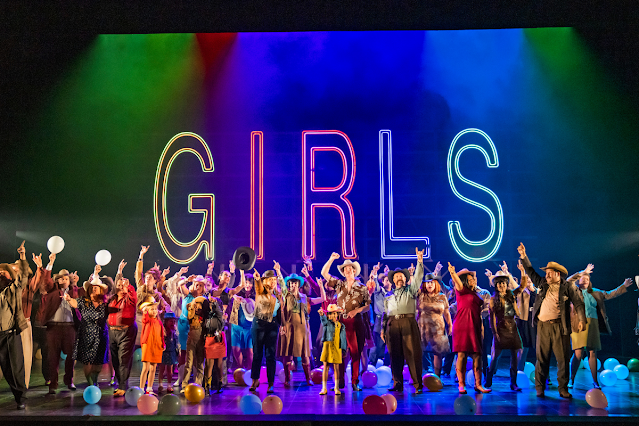
Certainly not traditional, but true to the work's spirit and dramaturgy: Edward Dick's production of Bizet's Carmen returns to Opera North with Chrystal E Williams back in the title role

Bizet: Carmen - Opera North (Photo Tristram Kenton)

Bizet Carmen; Chrystal E Williams, Sébastien Guèze, Alison Langer, Gyula Nagy, dir: Edward Dick, cond: Anthony Kraus; Opera North at the Grand Theatre, Leeds

Reviewed by Robert Hugill on 16 February 2022 Star rating: 4.0 (★★★★)
An imaginative new setting for a production lit up by the luminous performance of Chrystal E Williams in the title role

What would an authentic Carmen staging be, one true to the composer's intention - a French opera, set in Spain, based on a French novel, with a libretto written by two men who specialised in comic operas, and a score by a composer whose previous operas were set in India, Arabia and Bonnie Scotland.

The problem with Carmen is that it takes the Opéra Comique setting and peoples it with characters who speak to us today; Carmen and Don Jose's relationship burns through the form leaving the work's background a scorched mess in that searing final scene. It is not surprising that librettist Ludovic Halévy, who was at the premiere at the Opera Comique in 1875, should describe the first night audience's response getting progressively more tepid till the final act was received in near silence.

Edward Dick's new production of Bizet's Carmen (new last Autumn) has returned to Opera North for a second run. On Wednesday 16 February 2021 at the Grand Theatre, Leeds, I saw Anthony Kraus conducting a cast that included Chrystal E Williams as Carmen, Sébastien Guèze as Don Jose, Gyula Nagy as Escamillo, and Alison Langer as Micaela. Sets were designed by Colin Richmond with costumes designed by Laura Hopkins, lighting by Rick Fisher and choreography by Lea Anderson.

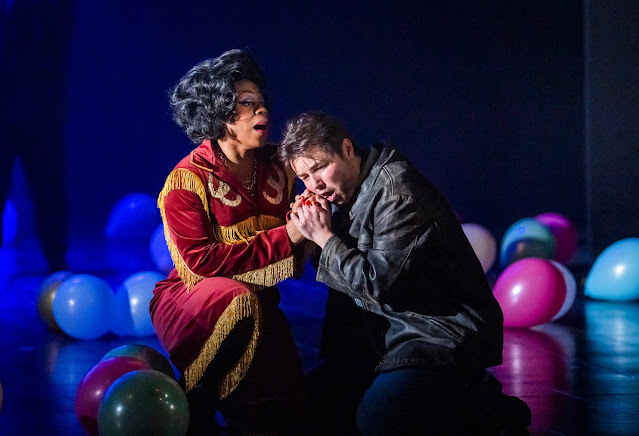
Bizet: Carmen - Chrystal E Williams, Sébastien Guèze - Opera North (Photo Tristram Kenton)


Dick has taken an imaginative leap and with designers Richmond and Hopkins, and has given Carmen a setting that enables the plot and dramaturgy to work in a vivid 20th century context, yet also solves another major issue, the problem that the opera and the title role can easily, fatally fall into two halves, the fun, sexy first two acts and the darker second two.

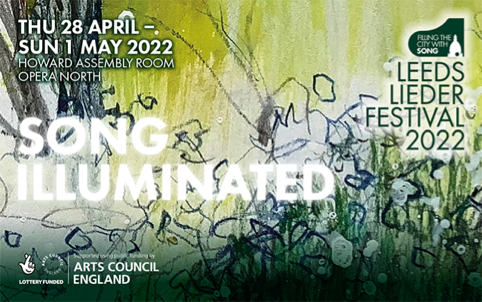
Leeds Lieder 2022: Song Illuminated

Leeds Lieder 2022: Song Illuminated
The Leeds Lieder Festival 2022 runs from Thursday 28 April to Sunday 1 May 2022; four days of song curated by artistic director Joseph Middleton under the title Song Illuminated, exploring how song illuminates our lives. With all of the concerts taking place at the Howard Assembly Room.

Dorothea Röschmann, soprano, opens the festival with Joseph Middleton in Mahler's Des Knaben Wunderhorn and music by Wolf and Wagner. Ian Bostridge, tenor, and Dame Imogen Cooper will be performing Schubert's later masterpiece, Schwanengesang, whilst Robin Tritschler, tenor, is joined by pianist Christopher Glynn for a recital that has moonlight illuminating all the songs. Louise Alder, soprano, joins Middleton to bring the festival to a close with a recital of songs ranging from Fauré to Rodgers and Hammerstein.

But there is much more to the festival than this. There are lunchtime recitals in partnership with Samling Institute, BBC New Generation Artists and Kathleen Ferrier Awards, with recitals from Jess Dandy, contralto and Martin Roscoe, piano, Helen Charlston, mezzo-soprano and Ilan Kurtser, piano, and Konstantin Krimmel, baritone and Joseph Middleton in Schubert's Die Schone Mullerin, plus a new work by Jonathan Dove, Man, Woman, Child, a duet cycle that is receiving its first performance outside London with Shakira Tsindos mezzo-soprano, Dominic Sedgwick baritone, and Ian Tindale piano. The Leeds Lieder 2022 Young Artists will be taking part in masterclasses and performing in a showcase concert.

Late evening recitals include The Revolution Smells of Jasmine, an homage to protest music in the Americas from female artists and composers with Wallis Giunta, mezzo-soprano, Sean Shibe, guitar, and Adam Walker, flute, with music ranging from Ariel Ramirez to Joan Baez and Joni Mitchell, plus Abel Meeropol's Strange Fruit. Ruby Hughes, soprano and Joseph Middleton in music by Errollyn Wallen and Mahler, plus Deborah Pritchard's new song cycle, The World.

The mental health initiative SongPath will be running a musical walking trail around St Aidan's RSPB Nature Reserve, and Jess Dandy's recital is designed to complement this event.

Full details from the Leeds Lieder website.

Thursday, 17 February 2022

St John's Smith Square's Easter Festival 2022

St John's Smith Square, Easter Festival
St John's Smith Square's Easter Festival might be relatively new but it has established itself as a feature of the the liturgical season. This year, Polyphony and the Orchestra of the Age of Enlightenment return for a performance of Bach's St John Passion on Good Friday with Nick Pritchard as the Evangelist and William Thomas as Jesus, whilst Sansara will be performing in a series of late-night liturgical events on Holy Wednesday, Maundy Thursday and Good Friday, and Sansara will also be joining Fretwork for a programme that combines music by Arvo Part including his Stabat Mater with Robert White's Lamentations.

The Choir of King's College, London kicks things off with a performance of Rachmaninov's All Night Vigil conducted by Joseph Fort, and other highlights include the Southbank Sinfonia performing Pergolesi's Stabat Mater and the London Handel Orchestra, conductor Adrian Butterfield, in a programme of Handel and Vivaldi with soprano Hilary Cronin. Organist Martin Baker will be performing Le Chemin de la Croix, the most ambitious organ work of French virtuoso organist and composer, Marcel Dupré; a work written in 1931 depicting the 14 stations of the cross.

Full details from the St John's Smith Square website.

Wednesday, 16 February 2022

Mendelssohn and Schumann from Antonello Manacorda and the Orchestra of the Age of Enlightenment

Antonello Manacorda and the Orchestra of the Age of Enlightenment in rehearsal (Photo: the OAE)
Antonello Manacorda & the Orchestra of the Age of Enlightenment in rehearsal
(Photo: the OAE)

Mendelssohn The Hebrides Overture, Schumann Violin Concerto, Symphony No. 2; Isabelle Faust, Orchestra of the Age of Enlightenment, Antonello Manacorda; Royal Festival Hall

Reviewed by Robert Hugill on 15 February 2022 Star rating: 4.0 (★★★★)
Schumann's highly personal second symphony paired with the less well known and rather experimental late violin concerto in an evening of powerful performances and striking timbres and colours

We have a somewhat complex relationship with Robert Schumann's output and whilst his symphonies are no longer routinely re-orchestrated and 'corrected', we can still be somewhat selective. The latest concert by the Orchestra of the Age of Enlightenment (OAE) as part of their season The Wilderness Pleases, rather demonstrated this, pairing two mature Schumann works, one routinely performed, the other rather less so. At the Royal Festival Hall on Tuesday 15 February 2022, Antonello Manacorda [see my recent interview with him] conducted the OAE in a programme that paired Schumann's Symphony No. 2 in C major (from 1846) with his Violin Concerto (from 1853) with Isabelle Faust as the soloist. The concert opened with Mendelssohn's The Hebrides Overture.

In The Hebrides Overture the young Mendelssohn (just 21 when it was premiered) demonstrated his mastery of small-scale symphonic form. With apparently effortless ease he took the classical concert overture and pushed in the direction of the tone poem, creating a work that is at once classically balanced and highly descriptive. It was very clear from the opening notes that Antonello Manacorda relished the timbres and textures of the period instruments, and the new relationships that these instruments create, so that at the opening it was very much the wind instruments' moment until the violins entered. Manacorda's speeds were on the steady side, allowing plenty of space for detail, and this brought out the works descriptive nature rather than it being simply an orchestral showpiece. There was plenty of excitement and climax, but always within context, and the care with balance and dynamic meant that Mendelssohn's spatial effects in the music came over well.

Schumann's relationship with symphonic form was complex; his symphonies did not quite come out in the seamless manner that their numbering implies, there were also stray symphonic movements and whilst he only wrote three 'proper' concertos, there are in fact seven concertante works. His Violin Concerto was written in 1853, in the wake of hearing violinist Joseph Joachim in Beethoven's Violin Concerto. Joachim was not impressed, and though Joachim gave the work an orchestral play-through with the composer present, it was never publicly performed and was omitted from the collected edition of the composer's works and the manuscript squirrelled away, effectively hidden until rediscovered in the 1930s and performed. It has never achieved the popularity of the earlier concertos, and it is clear from the work that Schumann's view of symphonic form was changing. 

SATARSA: Kamerorkest van het Noorden releases EP of music by Maxim Shalygin

On 22 February, Kamerorkest van het Noorden (the string orchestra based in Groningen, The Netherlands) is releasing SATARSA an EP that features SATARSA by the Ukrainian/Dutch composer Maxim Shalygin alongside Shalygin's string orchestra arrangement of music from Schnittke's Choir Concerto.

Shalygin's SATARSA is inspired by the writings of Argentine-French novelist Julio Cortázar (1914-1984) and his ingenious use of palindromes. The composer describes it thus:

"Palindromes in music are just as normal as the Fibonacci numbers in the structure of leaves on the trees. Therefore, when I read the story of Cortazar "Satarsa", I immediately felt the mysterious musical current in it. Surprisingly, for more than 15 years, I periodically return to his unusually rich work and find sources of inspiration for myself. My SATARSA is a desert of pleasure. A desert with gardens of paradise, crooked mirrors and an endless horizon, from which the melodies of our past lives are heard." - Maxim Shalygin

Shalygin (born in the Ukraine in 1985) started studying composition at the age of 16, and went on to study at the St Petersburg Conservatory and the National Music Academy in Kiev, then at the Royal Conservatory of The Hague (NL), where he studied with Cornelis de Bondt and Diderik Wagenaar. Shalygin now lives in the Netherlands.

The orchestra is a relatively new professional, young, international and dynamic ensemble founded by Guillem Cabré Salagre (violinist and violist) and Teodora Nedyalkova (cellist) in 2016 and based in the city of Groningen, capital of the north of The Netherlands. The ensemble consists of 14 to 16 string players, including occasionally wind and percussion, working without a conductor and sharing the vision of an extended version of a string quartet. Emblematic of this belief is the collaboration with the Spanish ensemble, Cuarteto Quiroga.

Kamerorkest van het Noorden & Maxim Shalygin

The EP is released on all major streaming platforms on 22 February 2022, further information from the orchestra's website.

I've just kept going: David Greed, the leader of Opera North's orchestra since its inception in 1978 is finally stepping down

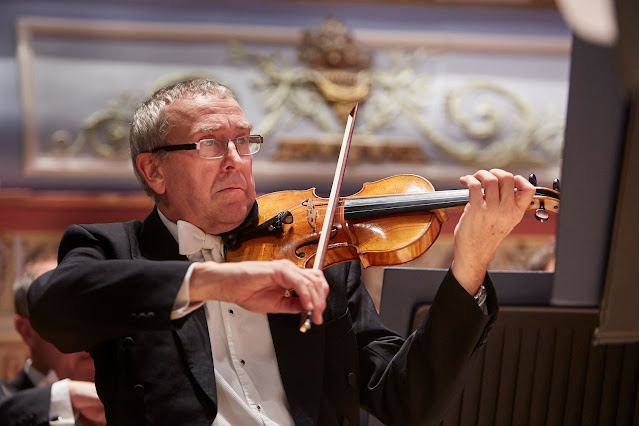
Leader of the Orchestra of Opera North David Greed performing in Huddersfield Town Hall (Photo Justin Slee)

After Opera North's performances of Wagner's Parsifal this Summer, the leader of the orchestra, David Greed, will be retiring. An event made particularly notable by the fact that Greed has performed in that role since the orchestra's inception in 1978, making him the longest-serving orchestral leader in Europe.

Referring to his long service, Greed said "I've just kept going" and referred to his 44 years in post as "a massive accidental record of some sort". As well as leading the orchestra in its regular programme, he will be taking part in two special events. As part of the orchestra's Kirklees Concert Season, Greed will be the soloist in Shostakovich's First Violin Concerto, conducted by Anthony Hermus, in a programme on 27 February 2022 that also includes music by Galina Ustvolskaya (one of Shostakovich's pupils) and Bartók. Further details from the Opera North website.

Then on 16 March 2022 at Dewsbury Town Hall, Greed will be joined by joined by friends and colleagues for music and reminiscence in a lunchtime farewell concert. Commenting about the location of the concert, Greed explained, "My history with Dewsbury is almost as long as my time at Opera North. It’s another thing that I’m really going to miss. In the mid-80s a Dewsbury concert series was set up by the Kirklees Music Officer, the late Aidan Plender, and for the first few years almost every concert was me and group called Capricci. We started in a modest room that held 50 or 60, but eventually the crowds built so we had to move into the main hall, which was a major triumph." Details from the Opera North website.

Tuesday, 15 February 2022

Four different takes on creating new opera: Dutch National Opera's Opera Forward Festival

Dutch National Opera's Opera Forward Festival

Creating new opera involves not simply putting new notes on paper, but re-examining what opera means in the 21st century and how it should be created, asking the question what should opera be in 2022. As part of its Opera Forward Festival in March 2022, Dutch National Opera & Ballet (DNO) is presenting four very different takes on contemporary opera with three world premieres and a Dutch premiere, with work from two different composers, a collective and a VR pioneer.

British readers will, perhaps, be most interested in the fact that Philip Venables' opera Denis & Katya (originally a co-production between Music Theatre Wales and Opera Philadelphia) will be receiving its Dutch premiere in the production directed by Ted Huffmann. The piece is very much a work for our times, an investigation in the form of an opera into how stories are formed and shared in our age of internet voyeurism, conspiracy theories, fake news and being online 24/7.

Manfred Trojahn's Eurydice - Die Liebenden, blind is inspired both by Greek myth and by Rainer Maria Rilke's terrific Sonette an Orpheus. The new opera is directed by Pierre Audi, with Erik Nielsen conducting the Netherlands Philharmonic Orchestra with Andrè Schuen as Orpheus, Julia Kleiter as Eurydice, Thomas Oliemans as Pluto, Katia Ledoux as Proserpina. Trojahn's contemporary take on the story uses the power of music to allegorically describe the attraction of the muse-like figure of Eurydice to the singing artist Orpheus, to describe the love between Orpheus and Eurydice as the love between word and sound, between artistry and inspiration.

When Manoj Kamps and Lisenka Heijboer Castañón premiered FAUST [Working Title] with DNO they introduced a working practice that created new work via a collective of performers, designers, writers and composers from different disciplines and backgrounds worked together intensively, sharing stories, teaching each other songs and choreographies and exchanging skills in workshops and through online channels. Their new work, I have missed you forever, follows the same communal creation process. The result will not be the work of a single composer and librettist, but a communal experience shared with the audience.

Orphée | L'Amour | Eurydice brings technology into the mix as inspired by Gluck's opera, opera director Robin Coops and VR pioneer Avinash Changa went on a journey of exploring, resulting in three separate opera experiences that immerse visitors in different ways into the perspectives of Orphée, Eurydice and L'Amour. 

Full details from DNO's website.

Temple Music's Spring 2022 season

Temple Music

Temple Music's Spring 2022 season is something of an end of an era, as it is the last to be programmed by the long standing director Carol Butler who has just retired. Her successor, Roland Deller, took over last month and he will be responsible for programming the Autumn 2022 season.

Spring 2022 features nine concerts in Temple Church and Middle Temple Hall, mixing chamber music, choral music and song. The season opens with a recital from pianist Imogen Cooper, followed by a recital from the Busch Trio. Song features strongly, bass-baritone Brindley Sherratt will be giving a rare recital with pianist Julius Drake, and Drake returns for two further recitals, partnering Dutch soprano Eva-Maria Westbroek, and two award-winning young singers, mezzo-soprano Ema Nikolovska and baritone Konstantine Krimmel.

Choral music features with concerts from the Temple Church Choir, including a performance of Bernstein's Chichester Psalms, Collegium Musicum of London in Mozart's Requiem, and the Holst Singers, conductor Stephen Layton, in Palestrina's Missa Papae Marcelli.

Full details from the Temple Music website.

Snapshots of a Romance: Elizabeth Llewellyn and Simon Lepper in opera and song at Classical Vauxhall

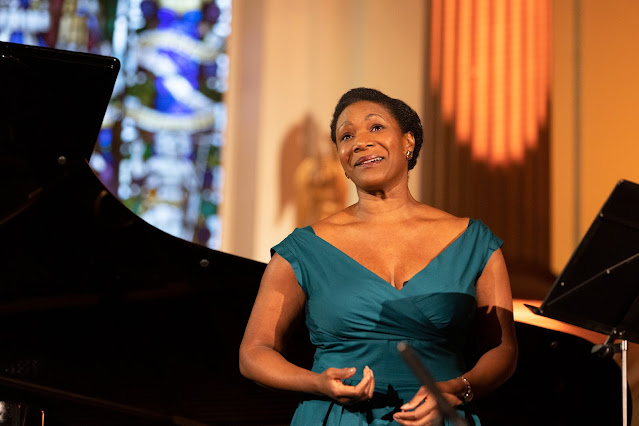
Elizabeth Llewellyn at Classical Vauxhall (Photo Frances Marshall)

Snapshots of a Romance
- Verdi, Chausson, Hahn, Britten, Puccini, Strauss; Elizabeth Llewellyn, Simon Lepper; Classical Vauxhall

Reviewed by Robert Hugill on 13 February 2022 Star rating: 4.0 (★★★★)
Classical Vauxhall comes to a close with Elizabeth Llewellyn in romantic form in an engaging programme spanning song and opera

Having presented a weekend of concerts including a diverse range of chamber music and even a late-night drag recital this year's Classical Vauxhall, artistic director Fiachra Garvey, finished on Sunday 13 February 2022 with a song recital from soprano Elizabeth Llewellyn and pianist Simon Lepper at St Mark's Church, Kennington. Snapshots of a Romance featured songs by Hahn, Chausson, Puccini and Richard Strauss plus opera arias by Verdi and Britten. All of the music touched on love and romance, from the Desdemona's doom-laden solo from the final act of Verdi's Otello which began the recital to the sheer joy of Luisa Miller's entrance aria from Verdi's Luisa Miller.

Monday, 14 February 2022

Northern Chords Festival launches its mentorship scheme

Northern Chords Festival

The Northern Chords Festival was created by cellist and conductor Jonathan Bloxham in 2009 in order to bring artists to the North East and to inspire local young people and amateur musicians to follow their dreams. The festival celebrated its 10th anniversary in 2019, and this year returns with a full weekend of events (13 -15 May) in Newcastle, performs at Kings Place in London on 20 March 2022. The festival has now launched its Mentorship Programme.

Jonathan Bloxham explains "The arts sector, and the music industry particularly, has been hit very hard by political and global events of recent years. Nurturing a new generation of talented musicians, many of whom may have missed out on opportunities recently, is essential for the healthy survival of classical music. This is a unique opportunity to work closely with world-leading artists, and our hope is to provide holistic guidance to people who might not otherwise have the access or financial resources."

In its first year the scheme will support four musicians. Northern Chords are looking for applicants specialising in voice, piano, composition and violin. Successful candidates will benefit from one to one online sessions with their mentors, extra sessions with guests such as renowned saxophonist Jess Gillam and well being sessions with Elena Urioste. The culmination of the scheme is a performance opportunity at the 14th Northern Chords Festival, taking place in May 2022, in which the four mentee's will collaborate and present a programme that they have devised together. 

Applications are invited from musicians from all backgrounds and ages pursuing a career in performance. Thanks to the generous support of the Gillian Dickinson Trust, there is no cost to apply or take part in the scheme. The closing date is 21 February 2022. Full details from the festival website.

Vividly theatrical: Irish National Opera's production of Vivaldi's Bajazet at Covent Garden

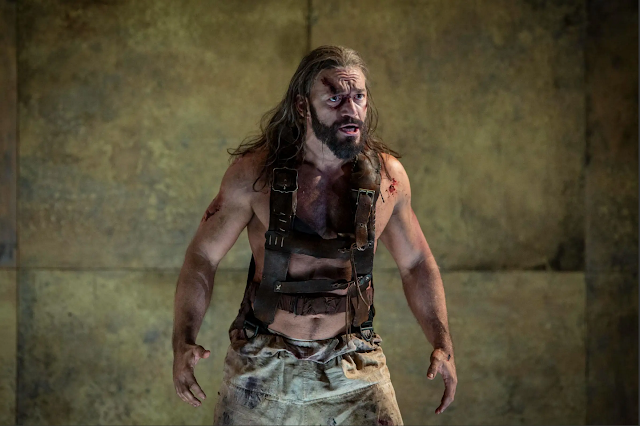
Vivaldi: Bajazet - Gianluca Margheri - Irish National Opera (Photo Kip Carroll)

Vivaldi Bajazet; Gianluca Margheri, Eric Jurenas, James Laing, Niamh O'Sullivan, Claire Booth, Aoife Miskelly, dir: Adele Thomas, Irish Baroque Orchestra, cond: Peter Whelan; Irish National Opera at the Royal Opera House

Reviewed by Robert Hugill on 12 February 2022 Star rating: 5.0 (
★★★★★)
A vividly theatrical evening as the cast of Irish National Opera's production combine brilliant virtuoso singing with highly theatrical performances

Vivaldi's Bajazet (also known as Il Tamerlano) was premiered at the end of his operatic career, in 1735 in Verona. It is in fact a pasticcio, Vivaldi combining elements from his back catalogue and arias from other composers to create a new work, a sort of greatest hits piece where the arias from other composers were ones principally associated with two of the greatest singers of the day, the soprano castrato Farinelli and the contralto Vittoria Tesi. Its the sort of thing common in musical theatre today, but rare in opera. But Vivaldi was a canny operator and the resulting piece is relatively compact and full of engaging music, showy and designed to appeal, yet with some dramatic moments.

We caught the last night of Irish National Opera's production of Vivaldi's Bajazet at the Royal Opera House's Linbury Theatre on 12 February 2022. The production was directed by Adele Thomas, directed from the harpsichord by Peter Whelan with Gianluca Margheri as Bajazet, James Laing as Tamerlano, Niamh O'Sullivan as Asteria, Eric Jurenas as Andronicus, Claire Booth as Irene and Aoife Miskelly as Idaspe, and the Irish Baroque Orchestra in the pit. Designs were by Molly O'Cathain.

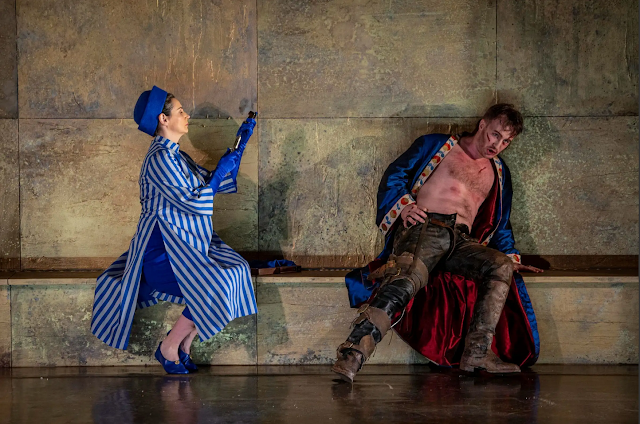
Vivaldi: Bajazet - Aoife Miskelly, James Laing - Irish National Opera (Photo Kip Carroll)

The production (a co-production between Irish National Opera and the Royal Opera House) was something of a little miracle having been planned originally for the period of lockdown. Re-assembling funding and performers to create the production this year was quite an achievement. It opened in Ireland on 16 January 2022, doing a seven date tour before the six performances at the Royal Opera House.

Vivaldi's opera uses Agostino Piovene's libretto which was originally set by Francesco Gasparini in Venice in 1711. In fact Gasparini made two settings of the libretto, the second in 1719 and it was this latter setting which influenced Handel's Tamerlano. [see my review of the recording of Gasparini's 1719 Il Bajazet on Glossa] For Gasparini in 1719, Ippolito Zanella vastly expanded the role of Bajazet in the opera, and this was taken over by Handel. By contrast, Vivaldi's 1735 opera relies on the original 1711 libretto, so the role of Bajazet is more discreet, there is no long, long throne room scene (in Handel, the longest single scene of recitative that he composed) or Bajazet's on-stage death scene, though the outlines of the story are still those familiar from Handel's opera.

It was illuminating seeing the opera in the light of my recent interview with director Dionysios Kyropoulos about applying historical stagecraft to the forthcoming production of Handel's Tamerlano in Cambridge [see my interview], especially as the two productions share the same singer as Tamerlano, James Laing.

Sunday, 13 February 2022

A programme of lesser known 18th century arias demonstrates just how much music we are missing

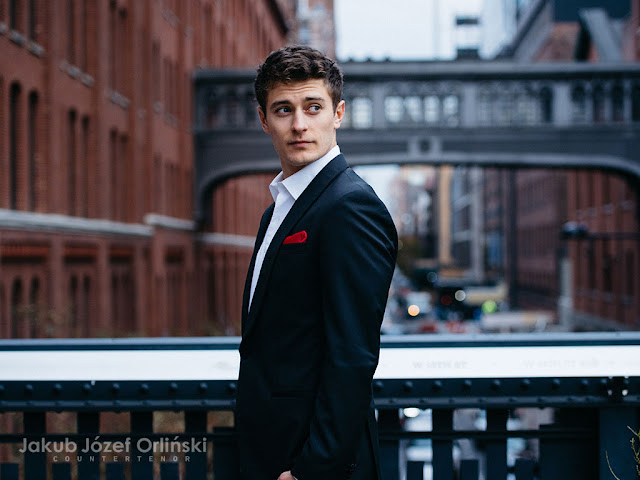
Jakub Jozef Orlinski (Photo Jiyang Chen)

Janez Krsnik Tolar, Georg Reutter, Antonio Lotti, Nicola Conti, Francisco Antonio de Almeida, Baldassare Galuppi, Gaetano Maria Schiassi, Bartolomeo Nucci, Antonio Vivaldi, Giuseppe Antonio Brescianello, Johann Joseph Fux, David Perez, Handel; Jakub Józef Orliński, Il Pomo d'Oro, Francesco Corti; Wigmore Hall

Reviewed by Robert Hugill on 10 February 2022 Star rating: 4.0 (★★★★)
Hot from his triumphs in Handel's Theodora at Covent Garden, the Polish countertenor devastates and dazzles in a programme of music by Handel's lesser known contemporaries.

I think we sometimes forget quite how much music was created in the 18th century. Great swathes have been lost, but much survives. Composers were largely local men, and texts would be pass around, taking different settings in each town. There are composers whose reputation nowadays rests on a single piece, if that. This is something of the back story to counter-tenor Jakub Józef Orliński's recital on Thursday 10 February 2022 at Wigmore Hall with Il Pomo d'Oro, conductor Francesco Corti. It was a programme of instrumental items and arias by composers many of whom who were often merely names, Janez Krsnik Tolar, Georg Reutter, Antonio Lotti, Nicola Conti, Francisco Antonio de Almeida, Baldassare Galuppi, Gaetano Maria Schiassi, Bartolomeo Nucci, Antonio Vivaldi, Giuseppe Antonio Brescianello, Johann Joseph Fux, David Perez and one George Frideric Handel.

It has to be admitted that for many of the pieces, it was the sound of the music, the composer's invention and Orliński's performance which came to the fore, rather than the composer's interpretation of the text. For many of these composers, showing off the soloist's voice came high on the list of requirements. Many of the arias in the programme were stunningly virtuosic, and not all managed to capture the emotion behind the text. Yet this was an engaging window onto a world which is often forgotten. Whilst we might not necessarily want to listen to, say, Fux's oratorio Il fonte della salute aperto dalla grazia nel Calvario every day, getting to sample one of the stunning arias was pure delight.

Saturday, 12 February 2022

György Cziffra: Pianist János Balázs on celebrating the great Hungarian's centenary & continuing his artistic legacy

George Cziffra
George Cziffra

2021 was the centenary of the Hungarian pianist and composer György Cziffra, and there have been world-wide celebrations under the auspices of the György Cziffra Festival. The modern day Hungarian pianist János Balázs, who founded the festival, is determined to keep Cziffra's memory alive and celebrate Cziffra's art, both in organising the festival and in his own concerts and recordings.

János Balázs (Photo Emmer Laszlo0

Born in Budapest in 1921, Cziffra's father was a cabaret artist who had lived in Paris prior to the First World War. Cziffra studied at the Franz Liszt Academy in Budapest but was conscripted during the Second World War and ended up a prisoner of war in Russia. After the war he played in bars and clubs in Budapest, as well as touring Europe with his jazz band. After trying to escape communist Hungary in 1950, Cziffra was imprisoned but finally left in 1956, becoming a French citizen in 1968 and creating the Cziffra Foundation in 1977. He died in 1994.

For János, Cziffra was a totally unique spirit in the 20th century and his style was very different to that of other pianists, classical but always with a style of improvisation and Cziffra's style of pianism comes from the Liszt school. Cziffra was a great grand-pupil of Liszt - at the Franz Liszt Academy, Cziffra studied with Erno Dohnányi (1877-1960) whose teacher was István Thomán (1862-1940), who was a favourite pupil of Franz Liszt. 

And János wishes to celebrate the freedom that Cziffra brought to his music, an improvisatory freedom that 19th century performers brought to the performances but which is not so common now. János wants to show this to the public, and the festival seeks to find artists who can perform in this style. János is also celebrating a proud Hungarian tradition of pianism exemplified not just by Cziffra but by such artists as the pianist Annie Fischer (1914-1995).

Whilst Cziffra never played other than from the score, he did so in a spirit and style that was free and full of colours, and totally himself. He wanted to share this style and energy with the public, feeling that it was important that in each concert the audience got something new. He played a lot of jazz, light music and transcriptions, something that was accepted in the Romantic tradition where performers would play whatever they felt inclined to. Nowadays, János sees performing as often being weighted towards perfection, avoiding risk, and he wants his festival to show the passion and style of performing in the Cziffra tradition.

Popular Posts this month