

Tuesday, 20 March 2007
London Handel Festival
Tonight we are off to the first of 2 visits to this year's London Handel Festival. We're off to see Handel's opera Poro at the Britten Theatre in the Royal College of Music, an ideal sized venue in which to see Handel opera staged. Our second visit to the festival will be to see Handel's Solomon at St. George's Church, Hanover Square.

Monday, 19 March 2007
Sunday afternoon was taken up with our concert at All Saints Church, Margaret Street. This went very well, with no major mishaps. We had a good audience and they were very appreciative. I was particularly pleased with the effect of my piece that we premièred, I'll definitely be scheduling that again.
After the concert we dashed over to Chelsea for Chelsea Opera Group's performance of Bellini's Beatrice di Tenda; a full review of this will appear in due course.
After the concert we dashed over to Chelsea for Chelsea Opera Group's performance of Bellini's Beatrice di Tenda; a full review of this will appear in due course.
MacMillan mass at Westminster
Labels:
diary
To Westminster Cathedral on Sunday for 10.30am mass. The setting was James MacMillan's Mass. The choir sang the Kyrie and the Agnus Dei, but in addition the celebrant included MacMillan's setting of the Ante-Preface, Preface, Prayer of Consecration etc. I have heard these on Westminster Cathedral choir's recording of the entire mass but had never anticipated hearing the sequence live, after all it requires a celebrant who is confident enough to learn MacMillan's new setting for the words. The result was profoundly moving, especially heard in the Cathedral's astounding acoustic.
The choral contributions were highly evocative.. What they lacked in clarity, due to the acoustic, they made up in atmosphere and the choir were in superb form.
The offertory motet was Mozart's Laudate Dominum, with the solo soprano line taken beautifully by a group of trebles.
The choral contributions were highly evocative.. What they lacked in clarity, due to the acoustic, they made up in atmosphere and the choir were in superb form.
The offertory motet was Mozart's Laudate Dominum, with the solo soprano line taken beautifully by a group of trebles.
Friday, 16 March 2007
Mr. Heidegger's House
Labels:
diary
Last week's Country Life included a feature on No. 4, Maids of Honour Row in Richmond, which has just been sold. In the 18th century the house belonged to the theatrical impressario Heidegger, with whom Handel collaborated on a number of occasions. In the 1740's Heidegger had the hall painted by one of his theatrical scene painters. A fascinating link to the rather ephemeral art of theatrical scene painting.
Busy-Ness
Labels:
diary
This is promising to be a busy weekend. On Saturday morning a photographer is coming to do some shots of me, with a new CD being recorded next month we decided that it was about time for me to get some new publicity shots done.
Then in the afternoon we are rehearsing in All Saints Church, Margaret Street for our concert there on Sunday. The first time we'll have sung in the venue. We have a brief run through in the church on Sunday and then our concert is at 3.00pm. All Welcome!
Early that day we are planning to go to 10.30am mass at Westminster Cathedral; being as I'm singing in the concert I'm not singing at church. The Cathedral are doing James MacMillan's Mass, the first time I'll have heard the dedicatees performing it live.
Then in the evening, we're off to the Chelsea Opera Group in the Cadogan Hall where they are performing Bellini's Beatrice di Tenda with Nelly Miriociouiou in the title role. This starts at the early hour of 6.00pm because the Cadogan Hall has strict rules about the time concerts are allowed to finish.
Then in the afternoon we are rehearsing in All Saints Church, Margaret Street for our concert there on Sunday. The first time we'll have sung in the venue. We have a brief run through in the church on Sunday and then our concert is at 3.00pm. All Welcome!
Early that day we are planning to go to 10.30am mass at Westminster Cathedral; being as I'm singing in the concert I'm not singing at church. The Cathedral are doing James MacMillan's Mass, the first time I'll have heard the dedicatees performing it live.
Then in the evening, we're off to the Chelsea Opera Group in the Cadogan Hall where they are performing Bellini's Beatrice di Tenda with Nelly Miriociouiou in the title role. This starts at the early hour of 6.00pm because the Cadogan Hall has strict rules about the time concerts are allowed to finish.
Meltdown, again
Labels:
writing music
The computer I've been using, since my own turned flaky, has hit melt-down and lost its hard drive. My backup habits are a bit intermittent, but I am usually pretty good at printing out music in all the relevant stages of composition. Unfortunately, in the last week I have had a spurt of energy on a tone poem that I'd been writing, based on a Sylvia Townsend-Warner story. I'd not yet got around to printing it out so that the conclusion to the first movement and the entire opening of the second have disappeared into the aether (or wherever the bits and bytes from our hard drives go when they die). Very frustrating. As and when I get my new computer (current e.t.a. 10 days) I'm not sure whether I am going to have the stomach to re-construct the missing bits. We'll have to see.
And of course, until then I have to resort to my old, flaky PC. The one which turns itself off without any notice, thus corrupting whatever you were working on at the time. Ho-Hum.
And of course, until then I have to resort to my old, flaky PC. The one which turns itself off without any notice, thus corrupting whatever you were working on at the time. Ho-Hum.
Wednesday, 14 March 2007
Recent CD Review
Labels:
cd review
My review of the re-issue of the New London Chamber Choir's recording of the Pierre de la Rue Requiem and Josquin's Missa Hercules Dux Ferrariae is here on MusicWeb International.
This is an attractive disc and only occasionally do the choir’s very high standards lapse. Fine musicality ...
This is an attractive disc and only occasionally do the choir’s very high standards lapse. Fine musicality ...
Tuesday, 13 March 2007
Review of Handel's Orlando
Labels:
opera review
My review of Orlando at Covent Garden is here, on Music and Vision.
Saturday, 10 March 2007
Handel's Orlando at Covent Garden
Labels:
opera review
To Covent Garden last night to see Handel's Orlando. It was a pleasant change to go to see one of his works performed as it should be, with not messing about with intervals. The Royal Opera simply bit the bullet and performed 3 Acts (1 hour each) with 2 intervals: in at 7.00pm out at 10.45pm. Over the years we've had a variety of attempts to perform his long 3-Act works in a different way. Hercules at the Barbican was one of a number of presentations which merged 2 acts, to give 2 very unequal halves and a first 'half' of positively Wagnerian length. The alternative seems to be to put the interval in the 'wrong' place in the middle of Act 2. Which I don't like either, so bravo to Covent Garden.
Francisco Negrin's production uses dancers as Mars, Venus and Cupid, to help make obvious the work's theme of the struggle between love and glory. Cupid wears little beyond draping round his mid-section and Venus has bare breasts. For some reason the audience around me seemed to find the dancers amusing. Even when Dorinda was singing about the trouble and perils of love, almost wrestling with Cupid, the audience sniggered at his every move. This is an example of how a producer and designer can scupper a production by underestimating the audiences reaction to something on stage. Its a nuisance, but nice middle class English people (especially women) find nudity uncomfortable and will react with laughter, no matter how serious the intent. The was particularly true when Dorinda seems to skewer Cupid in the groin with an arrow.
But Mr. Negrin is a southern European so probably does not really understand our Northern hang-ups about sex.
A full review of the opera (rather than this little rant) will appear in due-course
Francisco Negrin's production uses dancers as Mars, Venus and Cupid, to help make obvious the work's theme of the struggle between love and glory. Cupid wears little beyond draping round his mid-section and Venus has bare breasts. For some reason the audience around me seemed to find the dancers amusing. Even when Dorinda was singing about the trouble and perils of love, almost wrestling with Cupid, the audience sniggered at his every move. This is an example of how a producer and designer can scupper a production by underestimating the audiences reaction to something on stage. Its a nuisance, but nice middle class English people (especially women) find nudity uncomfortable and will react with laughter, no matter how serious the intent. The was particularly true when Dorinda seems to skewer Cupid in the groin with an arrow.
But Mr. Negrin is a southern European so probably does not really understand our Northern hang-ups about sex.
A full review of the opera (rather than this little rant) will appear in due-course
Friday, 9 March 2007
In this month's Opera magazine
Labels:
opera magazine
Gleanings from this month's Opera magazine.
There is an interview with David Fielding, partly to commemorate the fact that Fielding is doing Strauss's Egyptian Helen at the Met - based on his Garsington production. In the text (by Andrew Clark) both Clark and Fielding give due weight not only to Fielding's work at Garsington but also at Grange Park (where he's doing Prokofiev's The Gambler this summer). But somehow, in the layout of the article, the curse of Opera Magazine happened again (after all they did once describe Grange Park as the most unnecessary of the UK's opera festivals). The pictures include 3 of Fielding's ENO productions, 5 of his Garsington productions but none of his Grange Park one's. Or perhaps I'm being churlish and the Grange Park pictures failed to arrive!
An interesting comment in the Letters, an audience member from the Theatre Royal in Glasgow who sat in the balcony found that the counter tenors in Scottish Opera's Tamerlano were perfectly audible, whilst the critics (sitting in the stalls) found them too quiet. I've always rather liked sitting upstairs and often found the sound quality can be better in some theatres (and I've sat in the Theatre Royal balcony many times).
George Benjamin's new opera, Into the Little Hill was premièred in Paris as part of the Festival d'Automne, along with 2 other Benjamin events. The production is travelling to Amsterdam, New York and Frankfurt, but guess what? There are no solid plans for it to come to London - though it might get to Liverpool. The opera uses just 2 singers and Judith Weir-like, Benjamin conjures a whole cast from them. As one of the singers was the ever wonderful Hilary Summers, I bet the performance was terrific. Though Paul Driver describes her as mannish-sounding.
Another first opera, this time by Bruno Mantovani, premièred in Strasbourg by Opera National du Rhin. (Berlioz Troyens and a première in the same season).
Rodion Shchedrin's new opera Boyarina Morozova uses just chorus, soloists and 3 instrumentalists. The chorus are used instrumentally to accompany the soloists - its very Orthodox Church Music influenced. Sounds fascinating.
It seems that the Berlin Philharmonic has never performed Humperdinck's Hansel and Gretel complete. Surprisingly, they got Mark Elder to do it with them and the results sound to have been fabulous. John Allison comments on how Elder reined thing in in the pit (v. necessary in this opera), but its not how I remember him from his Coliseum days when the orchestra frequently were too loud for the singers words to come across. One nice point in the presentation of the opera; the witch (Jane Henschel) sat incognito in the audience through the first scenes and started her performance by cackling from her seat. Startling if you were sitting next to her!
Meanwhile in Turin Luana de Vol sang Turandot at the age of 64 - something of a record. The production was mega-simple. Cost cutting meant that there was no money for sets, but Luca Ronconi seems to have turned up trumps with just people, lighting and the stage machinery. Shows what you can do when pushed. I wish more theatres would consider this.
It was good to see Sally Matthews garnering plaudits for her Amsterdam Cosi (even if the production was not liked).
Meanwhile, in Philadelphia a self-propelling yellow Hoover seems to have been one of the stars of the new production of Cenerentola, updated to the 50's (again). Reviewer David Shengold complains of updating fatigue, having already seen Semele as Marilyn Monroe, Nemorino as James Dean in Giant and Didno as Evita!
But in Seattle, the new Italiana in Algeri also updates, but wittily makes aviatrix Isabella crash land here aeroplane in North Africa.
In London, Rodney Milnes though that Dawn French, as the Duchess of Crackentorp in La Fille du Regiment marginally underplayed her role - really!
There is an interview with David Fielding, partly to commemorate the fact that Fielding is doing Strauss's Egyptian Helen at the Met - based on his Garsington production. In the text (by Andrew Clark) both Clark and Fielding give due weight not only to Fielding's work at Garsington but also at Grange Park (where he's doing Prokofiev's The Gambler this summer). But somehow, in the layout of the article, the curse of Opera Magazine happened again (after all they did once describe Grange Park as the most unnecessary of the UK's opera festivals). The pictures include 3 of Fielding's ENO productions, 5 of his Garsington productions but none of his Grange Park one's. Or perhaps I'm being churlish and the Grange Park pictures failed to arrive!
An interesting comment in the Letters, an audience member from the Theatre Royal in Glasgow who sat in the balcony found that the counter tenors in Scottish Opera's Tamerlano were perfectly audible, whilst the critics (sitting in the stalls) found them too quiet. I've always rather liked sitting upstairs and often found the sound quality can be better in some theatres (and I've sat in the Theatre Royal balcony many times).
George Benjamin's new opera, Into the Little Hill was premièred in Paris as part of the Festival d'Automne, along with 2 other Benjamin events. The production is travelling to Amsterdam, New York and Frankfurt, but guess what? There are no solid plans for it to come to London - though it might get to Liverpool. The opera uses just 2 singers and Judith Weir-like, Benjamin conjures a whole cast from them. As one of the singers was the ever wonderful Hilary Summers, I bet the performance was terrific. Though Paul Driver describes her as mannish-sounding.
Another first opera, this time by Bruno Mantovani, premièred in Strasbourg by Opera National du Rhin. (Berlioz Troyens and a première in the same season).
Rodion Shchedrin's new opera Boyarina Morozova uses just chorus, soloists and 3 instrumentalists. The chorus are used instrumentally to accompany the soloists - its very Orthodox Church Music influenced. Sounds fascinating.
It seems that the Berlin Philharmonic has never performed Humperdinck's Hansel and Gretel complete. Surprisingly, they got Mark Elder to do it with them and the results sound to have been fabulous. John Allison comments on how Elder reined thing in in the pit (v. necessary in this opera), but its not how I remember him from his Coliseum days when the orchestra frequently were too loud for the singers words to come across. One nice point in the presentation of the opera; the witch (Jane Henschel) sat incognito in the audience through the first scenes and started her performance by cackling from her seat. Startling if you were sitting next to her!
Meanwhile in Turin Luana de Vol sang Turandot at the age of 64 - something of a record. The production was mega-simple. Cost cutting meant that there was no money for sets, but Luca Ronconi seems to have turned up trumps with just people, lighting and the stage machinery. Shows what you can do when pushed. I wish more theatres would consider this.
It was good to see Sally Matthews garnering plaudits for her Amsterdam Cosi (even if the production was not liked).
Meanwhile, in Philadelphia a self-propelling yellow Hoover seems to have been one of the stars of the new production of Cenerentola, updated to the 50's (again). Reviewer David Shengold complains of updating fatigue, having already seen Semele as Marilyn Monroe, Nemorino as James Dean in Giant and Didno as Evita!
But in Seattle, the new Italiana in Algeri also updates, but wittily makes aviatrix Isabella crash land here aeroplane in North Africa.
In London, Rodney Milnes though that Dawn French, as the Duchess of Crackentorp in La Fille du Regiment marginally underplayed her role - really!
Thursday, 8 March 2007
Chelsea Festival 2007
Labels:
preview
Tuesday evening saw the launch party for the 2007 Chelsea Festival. In previous years this has taken place at the historic Royal Hospital (designed by Wren) but this year it was in the ultra-modern top floor restaurant at Peter Jones shop in Sloane Square.
The festival, director Stewart Collins, is an impressively eclectic mix of classical music, jazz, theatre, fashion and all sorts of other things. Notable events, from my point of view, include Sir Andrew Davis conducting the Faure Requiem, with the Joyful Company of Singers; the Southbank Sinfonia doing a programme of English music for voices and Strings with music by Tippett, Berkeley, Leighton, Howells, Finzi and Walton; Mark Padmore and the Schubert Ensemble doing Vaughan Williams's On Wenlock Edge (but you've got to sit through Dvorak's Piano Quintet as well); Purcell's King Arthur, but it has a new book by Kit Hesketh-Harvey; Emma Kirkby and the London Handel Players in a programme of Handel, Telemann, Bach and Vivaldi and, at the closing concert, Mozart's Solemn Vesters and Haydn's lovely Little Organ Mass played in the Royal Hospital Chapel (a lovely venue, despite the uncomfortable seats!).
Technorati tag:classical music
The festival, director Stewart Collins, is an impressively eclectic mix of classical music, jazz, theatre, fashion and all sorts of other things. Notable events, from my point of view, include Sir Andrew Davis conducting the Faure Requiem, with the Joyful Company of Singers; the Southbank Sinfonia doing a programme of English music for voices and Strings with music by Tippett, Berkeley, Leighton, Howells, Finzi and Walton; Mark Padmore and the Schubert Ensemble doing Vaughan Williams's On Wenlock Edge (but you've got to sit through Dvorak's Piano Quintet as well); Purcell's King Arthur, but it has a new book by Kit Hesketh-Harvey; Emma Kirkby and the London Handel Players in a programme of Handel, Telemann, Bach and Vivaldi and, at the closing concert, Mozart's Solemn Vesters and Haydn's lovely Little Organ Mass played in the Royal Hospital Chapel (a lovely venue, despite the uncomfortable seats!).
Technorati tag:classical music
Review of Euryanthe (Dresden Staatsoper)
Labels:
opera review
Weber’s Euryanthe was premiered in Dresden whilst he was working there as Musical Director of the German theatre there. The work is important in the history of the development of German Romantic opera, being a significant precursor of Wagner’s Lohengrin. But the libretto, by Helmina von Chezy, has some significant weaknesses which rather prevent the opera being regularly performed. Von Chezy was the author of the nonsensical play Rosamunde for which Schubert wrote his famous incidental music. Weber seems to have been aware of the libretto (and the librettist’s) shortcomings but let her write it because he felt sorry for her.
The current production at Dresden opera house was new in February 2006 and we saw it on 25th February 2007, this performance was the 7th of this new production. The director was Vera Nemirova, a disciple of Peter Konwitchny, and the designer was Gottfried Pilz.
The setting was abstract modern, in a single flexible set; costumes were contemporary This set consisted of an inner and an outer wall, but various sections of this could be raised and lowered at will so the a variety of settings were created. The most notable was when the two villains, Lysiart and Eglantine were coupling and the entire surrounding set rose as if they were descending into Hell. The colour scheme was black, beige and white with just touches of red for Lysiart and Eglantine.
During the overture we saw the women excitedly preparing for the return of their menfolk from the war. When the menfolk appeared they were less than heroic, being mainly dejected and walking wounded. In a later scene, the King and Lysiart hand out both medals and crutches.
Nemirova seems to have taken a pretty straightforward line with the story, but she has an awkward habit of ignoring things that don’t fit. So that the opening choruses became a simple concert welcoming the men back, the drama only starting later.
Johann Tilli made an impressive King and his height added to his imposing voice. During the first scene Lysiart (Andreas Schmidt) and Adolar (Richard Cox) must raise passions in their argument on fidelity which leads to the fatal wager. Schmidt and Cox did not really do this. Both sang nicely but did not convince that this really, really mattered. Cox was announced as ill and his upper register did suffer somewhat. I generally got the impression that he was husbanding his resources as he improved remarkably in the final dramatic scenes of the opera. Schmidt has a lovely voice and knows what to do with it, his performance was beautifully shaped but never seemed quite intense enough.
Gabriele Fontana made a striking heroine, Euryanthe. She has quite a strong voice and there was a hint of lack of control in her upper register but generally impressed with her way with Weber’s sometimes elaborate vocal lines. Euryanthe is one of those rather drippy heroines of whom Weber seemed to be fond, Agathe is similar. In the opening scenes Fontana made what she could of the heroine’s rather passive role.
As her companion Eglantine Evelyn Herliztius impressed in many ways. She has quite a big voice and sings big dramatic roles but she was able to move her instrument round Weber’s vocal lines in a way which was both impressive but also expressive. Herliztius made the most of Eglantine’s moves between her gentle coaxing of Euryanthe and her displays of her real, evil. Eglantine is a gift of a role and Herliztius made the most of it. She dominated the scenes that she was in without ever making too much of a meal of things.
Where the main inequality lay was in her relationship with Lysiart. Schmidt seemed just a little bit too passive and this made him the weaker one rather than a partnership of equals.
The essentially passive nature of Euryanthe, which Fontana and Nemirova established rather well, was essential for the closing scenes of Act 2 when Euryanthe is falsely accused of infidelity and betraying Adolar’s trust. In a rational world she would have been able to stand up for herself (Eglantine would never have found herself in this situation). So it was important that we believe that she could not, which we did. Just!
In Act 3 things get even worse. Adolar fails to believe in Euryanthe’s innocence and abandons here. Here Cox began to come into his own and these scenes were moving. Nemirova set the opening of this act on a pretty bare stage, resorting to no tricks. When Adolar abandons Euryanthe, she goes mad and enters an insane asylum. (This is Nemirova’s gloss on the plot and is not in von Chezy’s original).
The King visits the insane asylum and discovers Euryanthe, the chorus of Foresters having become the chorus of asylum inmates. The scene ends with Euryanthe beside herself with joy and pretty nigh insane. She dies, mad but happy.
A circus provides the entertainment for Lysiart and Eglantine’s wedding. There were 4 genuine circus performers, who were pretty impressive. Bertha here becomes the ring mistress, Christine Hossfeld sang her aria beautifully.
Herlitzius managed Eglantine’s breakdown beautifully (if that's the right word) and these scenes, where Adolar and Lysiart fight were very impressive dramatically. As I have said, Cox very much came into his own. The scene climaxes with the King announcing that Eglantine is dead.
The curtain then comes down and Adolar has a moving solo scene. Then the wedding celebrations are for Rudolph (Tom Martinsen) and Bertha with Schmidt and Fontana singing their parts from the side of the stage, dressed in evening dress. Again, Nemirova had ignored part of the plot which did not agree with her.
But the overall production did seem to work, mainly because Nemirova seems to have tried to take the plight of the protagonists seriously and to genuinely thing about the role of the 2 women in the opera.
The 2 strongest singers were Fontana and Herlitzius with Herlitzius taking the crown. Hans-E. Zimmer, the Musical Director the Dresden Opera, conducted. Some of the lack of dramatic intensity in the opening scenes could be down to his rather easygoing direction. The orchestra played beautifully and were a joy to listen to.
The production was perhaps not quite as impressive as Glyndebourne’s production, directed by Richard Jones, but Dresden have certainly done their former musical director proud.
Technorati tag:classical music, opera
The current production at Dresden opera house was new in February 2006 and we saw it on 25th February 2007, this performance was the 7th of this new production. The director was Vera Nemirova, a disciple of Peter Konwitchny, and the designer was Gottfried Pilz.
The setting was abstract modern, in a single flexible set; costumes were contemporary This set consisted of an inner and an outer wall, but various sections of this could be raised and lowered at will so the a variety of settings were created. The most notable was when the two villains, Lysiart and Eglantine were coupling and the entire surrounding set rose as if they were descending into Hell. The colour scheme was black, beige and white with just touches of red for Lysiart and Eglantine.
During the overture we saw the women excitedly preparing for the return of their menfolk from the war. When the menfolk appeared they were less than heroic, being mainly dejected and walking wounded. In a later scene, the King and Lysiart hand out both medals and crutches.
Nemirova seems to have taken a pretty straightforward line with the story, but she has an awkward habit of ignoring things that don’t fit. So that the opening choruses became a simple concert welcoming the men back, the drama only starting later.
Johann Tilli made an impressive King and his height added to his imposing voice. During the first scene Lysiart (Andreas Schmidt) and Adolar (Richard Cox) must raise passions in their argument on fidelity which leads to the fatal wager. Schmidt and Cox did not really do this. Both sang nicely but did not convince that this really, really mattered. Cox was announced as ill and his upper register did suffer somewhat. I generally got the impression that he was husbanding his resources as he improved remarkably in the final dramatic scenes of the opera. Schmidt has a lovely voice and knows what to do with it, his performance was beautifully shaped but never seemed quite intense enough.
Gabriele Fontana made a striking heroine, Euryanthe. She has quite a strong voice and there was a hint of lack of control in her upper register but generally impressed with her way with Weber’s sometimes elaborate vocal lines. Euryanthe is one of those rather drippy heroines of whom Weber seemed to be fond, Agathe is similar. In the opening scenes Fontana made what she could of the heroine’s rather passive role.
As her companion Eglantine Evelyn Herliztius impressed in many ways. She has quite a big voice and sings big dramatic roles but she was able to move her instrument round Weber’s vocal lines in a way which was both impressive but also expressive. Herliztius made the most of Eglantine’s moves between her gentle coaxing of Euryanthe and her displays of her real, evil. Eglantine is a gift of a role and Herliztius made the most of it. She dominated the scenes that she was in without ever making too much of a meal of things.
Where the main inequality lay was in her relationship with Lysiart. Schmidt seemed just a little bit too passive and this made him the weaker one rather than a partnership of equals.
The essentially passive nature of Euryanthe, which Fontana and Nemirova established rather well, was essential for the closing scenes of Act 2 when Euryanthe is falsely accused of infidelity and betraying Adolar’s trust. In a rational world she would have been able to stand up for herself (Eglantine would never have found herself in this situation). So it was important that we believe that she could not, which we did. Just!
In Act 3 things get even worse. Adolar fails to believe in Euryanthe’s innocence and abandons here. Here Cox began to come into his own and these scenes were moving. Nemirova set the opening of this act on a pretty bare stage, resorting to no tricks. When Adolar abandons Euryanthe, she goes mad and enters an insane asylum. (This is Nemirova’s gloss on the plot and is not in von Chezy’s original).
The King visits the insane asylum and discovers Euryanthe, the chorus of Foresters having become the chorus of asylum inmates. The scene ends with Euryanthe beside herself with joy and pretty nigh insane. She dies, mad but happy.
A circus provides the entertainment for Lysiart and Eglantine’s wedding. There were 4 genuine circus performers, who were pretty impressive. Bertha here becomes the ring mistress, Christine Hossfeld sang her aria beautifully.
Herlitzius managed Eglantine’s breakdown beautifully (if that's the right word) and these scenes, where Adolar and Lysiart fight were very impressive dramatically. As I have said, Cox very much came into his own. The scene climaxes with the King announcing that Eglantine is dead.
The curtain then comes down and Adolar has a moving solo scene. Then the wedding celebrations are for Rudolph (Tom Martinsen) and Bertha with Schmidt and Fontana singing their parts from the side of the stage, dressed in evening dress. Again, Nemirova had ignored part of the plot which did not agree with her.
But the overall production did seem to work, mainly because Nemirova seems to have tried to take the plight of the protagonists seriously and to genuinely thing about the role of the 2 women in the opera.
The 2 strongest singers were Fontana and Herlitzius with Herlitzius taking the crown. Hans-E. Zimmer, the Musical Director the Dresden Opera, conducted. Some of the lack of dramatic intensity in the opening scenes could be down to his rather easygoing direction. The orchestra played beautifully and were a joy to listen to.
The production was perhaps not quite as impressive as Glyndebourne’s production, directed by Richard Jones, but Dresden have certainly done their former musical director proud.
Technorati tag:classical music, opera
Wednesday, 7 March 2007
Ebenezer Prout
Labels:
feature article
If you’ve heard of Ebenezer Prout at all, its because he wrote the additional instrumental accompaniments which were commonly used in performances of the Novello Edition of Handel’s Messiah. But he was much more than this.
Born in 1835, he was entirely self-taught as a musician, having been taught music by his father, a Congregational Minister. Prout started his working life as a school teacher before moving to music in 1859. In 1876 he published Instrumentation, the first of a number of influential treatises. He eventually became professor of music at Trinity College, Dublin. He also edited music magazines and wrote music criticism.
He produced his edition of Handel’s Messiah in 1902. He based his edition on a thorough examination of the autograph and contemporary copies with the aim of eliminating many of the errors that had been common since Handel’s day. Though he produced an accurate edition, he failed to understand the complex history of the work with the many different variants of some movements. He had carried on a long controversy in print over Franz’s edition of Messiah and his 1902 edition of the work could be seen as his triumphant conclusion to this.
His additional accompaniments for the work were based on those of Mozart. Prout was reputedly unhappy about having to add the accompaniments but was pressured by his publisher. Their edition was being aimed at large choral societies and it was commonplace to use a full symphony orchestra as accompaniment.
Prout has one rather unexpectedly appealing trait, he added words to the fugue subjects of Bach’s 48 to help his pupils remember them. The idea being that not only did the words help them memorise the fugue subject but they also helped delineate when the fugue subject started and finished.
BOOK 1
1. He went to town in a hat that made all the people stare.
2. John Sebastian Bach sat upon a tack, but he soon got up again with a howl!
3. [The Mistletoe] O what a very jolly thing it is to kiss a pretty girl!
4. Broad beans and bacon.
[1st countersubject] ...make an excellent good dinner for a man who hasn't anything to eat.
[2nd countersubject] ...with half a pint of stout.
5. [Subject] Gin a body meet a body
Comin' through the rye,
[Answer] Gin a body kiss a body,
Need a body cry?
6. He trod upon my corns with heavy boots -- I yelled!
7. When I get aboard a Channel steamer I begin to feel sick.
8. [Pear's Soap] You dirty boy! Just look at your face! Ain't you ashamed?
9. Hallo! Why, what the devil is the matter with the thing?
10. Half a dozen dirty little beggar boys are playing with a puppy at the bottom of the street.
11. The Bishop of Exeter was a most energetic man.
12. The slimy worm was writhing on the footpath.
13. Old Abram Brown was plagued with fleas, which caused him great alarm.
14. [The Organist] As I sat at the organ, the wretched blower went and let the wind out.
15. O Isabella Jane! Isabella Jane! Hold your jaw! Don't make such a fuss! Shut up! Here's a pretty row! What's it all about?
16. [The Prodigal Son] He spent his money, like a stupid ass.
17. Put me in my little bed.
18. How sad our state by nature is! What beastly fools we be!
19. There! I have given too much to the cabman!
20. On a bank of mud in the river Nile, upon a summer morning, a little hippopotamus was eating bread and jam.
21. A little three-part fugue, which a gentleman named Bach composed, there's a lot of triple counterpoint about it, and it isn't very difficult to play.
22. Brethren, the time is short!
23. He went and slept under a bathing-machine at Margate.
24. The man was very drunk, as to and fro, from left to right, across the road he staggered.
BOOK 2
1. Sir Augustus Harris tried to mix a pound of treacle with a pint of castor oil.
2. Old Balaam's donkey spoke like an ass.
3. O, here's a lark!
4. Hey diddle diddle, the cat and the fiddle! The cow jumped over the moon!
5. To play these fugues through is real jam.
6. [The Cockney] 'Ark to the sound of the 'oofs of the galloping 'orse! I 'ear 'im comin' up Regent Street at night.
[Countersubject] 'Is 'oofs go 'ammer, 'ammer, 'ammer, 'ammer, 'ammer, 'ammer, on the 'ard 'ighway.
7. Mary, my dear, bring the whiskey and water in -- bring the whiskey and water in.
8. I went to church last night, and slept all the sermon through.
9. I'd like to punch his head.
[Countersubject] ...if he gives me any more of his bally cheek.
10. As I rode in a penny bus, going to the Mansion House, off came the wheel -- down came the bus -- all of the passengers fell in a heap on the floor of the rickety thing.
11. Needles and pins! Needles and pins! When a man's married his trouble begins.
12. I told you you'd have the stomach-ache if you put such a lot of pepper in your tea.
13. Great Scott! What a trouble it is to have to find the words for all these subjects!
14. She cut her throat with a paper-knife that had got no handle.
[Bar 20] The wound was broad and deep.
[Bar 36] The called the village doctor in: he put a bit of blotting-paper on her neck.
15. The pretty little dickybirds are hopping to and fro upon the gravel walk before the house, and picking up the crumbs.
16. Oh, my eye! Oh, my eye! What a precious mess I'm getting into today.
17. I passed the night at a wayside inn, and could scarcely sleep a moment for the fleas.
18. Two little boys were at play, and the one gave the other a cuff on the head, and the other hit back.
[Countersubject] Their mother sent them both to bed without their tea.
19. In the middle of the Hackney Road today I saw a donkey in a fit.
20. He that would thrive must rise at five.
21. The noble Duke of York, he had ten thousand men, he marched them up the hill, and marched them down again.
22. O, dear! What shall I do? It's utterly impossible for me to learn this horrid fugue! I give it up!
[Countersubject] It ain't no use! It ain't a bit of good! Not a bit! No, not a bit!, No, not a bit!
23. See what ample strides he takes.
24. The wretched old street-singer has his clothes all in tatters, and toes showing through his boots.
Born in 1835, he was entirely self-taught as a musician, having been taught music by his father, a Congregational Minister. Prout started his working life as a school teacher before moving to music in 1859. In 1876 he published Instrumentation, the first of a number of influential treatises. He eventually became professor of music at Trinity College, Dublin. He also edited music magazines and wrote music criticism.
He produced his edition of Handel’s Messiah in 1902. He based his edition on a thorough examination of the autograph and contemporary copies with the aim of eliminating many of the errors that had been common since Handel’s day. Though he produced an accurate edition, he failed to understand the complex history of the work with the many different variants of some movements. He had carried on a long controversy in print over Franz’s edition of Messiah and his 1902 edition of the work could be seen as his triumphant conclusion to this.
His additional accompaniments for the work were based on those of Mozart. Prout was reputedly unhappy about having to add the accompaniments but was pressured by his publisher. Their edition was being aimed at large choral societies and it was commonplace to use a full symphony orchestra as accompaniment.
Prout has one rather unexpectedly appealing trait, he added words to the fugue subjects of Bach’s 48 to help his pupils remember them. The idea being that not only did the words help them memorise the fugue subject but they also helped delineate when the fugue subject started and finished.
BOOK 1
1. He went to town in a hat that made all the people stare.
2. John Sebastian Bach sat upon a tack, but he soon got up again with a howl!
3. [The Mistletoe] O what a very jolly thing it is to kiss a pretty girl!
4. Broad beans and bacon.
[1st countersubject] ...make an excellent good dinner for a man who hasn't anything to eat.
[2nd countersubject] ...with half a pint of stout.
5. [Subject] Gin a body meet a body
Comin' through the rye,
[Answer] Gin a body kiss a body,
Need a body cry?
6. He trod upon my corns with heavy boots -- I yelled!
7. When I get aboard a Channel steamer I begin to feel sick.
8. [Pear's Soap] You dirty boy! Just look at your face! Ain't you ashamed?
9. Hallo! Why, what the devil is the matter with the thing?
10. Half a dozen dirty little beggar boys are playing with a puppy at the bottom of the street.
11. The Bishop of Exeter was a most energetic man.
12. The slimy worm was writhing on the footpath.
13. Old Abram Brown was plagued with fleas, which caused him great alarm.
14. [The Organist] As I sat at the organ, the wretched blower went and let the wind out.
15. O Isabella Jane! Isabella Jane! Hold your jaw! Don't make such a fuss! Shut up! Here's a pretty row! What's it all about?
16. [The Prodigal Son] He spent his money, like a stupid ass.
17. Put me in my little bed.
18. How sad our state by nature is! What beastly fools we be!
19. There! I have given too much to the cabman!
20. On a bank of mud in the river Nile, upon a summer morning, a little hippopotamus was eating bread and jam.
21. A little three-part fugue, which a gentleman named Bach composed, there's a lot of triple counterpoint about it, and it isn't very difficult to play.
22. Brethren, the time is short!
23. He went and slept under a bathing-machine at Margate.
24. The man was very drunk, as to and fro, from left to right, across the road he staggered.
BOOK 2
1. Sir Augustus Harris tried to mix a pound of treacle with a pint of castor oil.
2. Old Balaam's donkey spoke like an ass.
3. O, here's a lark!
4. Hey diddle diddle, the cat and the fiddle! The cow jumped over the moon!
5. To play these fugues through is real jam.
6. [The Cockney] 'Ark to the sound of the 'oofs of the galloping 'orse! I 'ear 'im comin' up Regent Street at night.
[Countersubject] 'Is 'oofs go 'ammer, 'ammer, 'ammer, 'ammer, 'ammer, 'ammer, on the 'ard 'ighway.
7. Mary, my dear, bring the whiskey and water in -- bring the whiskey and water in.
8. I went to church last night, and slept all the sermon through.
9. I'd like to punch his head.
[Countersubject] ...if he gives me any more of his bally cheek.
10. As I rode in a penny bus, going to the Mansion House, off came the wheel -- down came the bus -- all of the passengers fell in a heap on the floor of the rickety thing.
11. Needles and pins! Needles and pins! When a man's married his trouble begins.
12. I told you you'd have the stomach-ache if you put such a lot of pepper in your tea.
13. Great Scott! What a trouble it is to have to find the words for all these subjects!
14. She cut her throat with a paper-knife that had got no handle.
[Bar 20] The wound was broad and deep.
[Bar 36] The called the village doctor in: he put a bit of blotting-paper on her neck.
15. The pretty little dickybirds are hopping to and fro upon the gravel walk before the house, and picking up the crumbs.
16. Oh, my eye! Oh, my eye! What a precious mess I'm getting into today.
17. I passed the night at a wayside inn, and could scarcely sleep a moment for the fleas.
18. Two little boys were at play, and the one gave the other a cuff on the head, and the other hit back.
[Countersubject] Their mother sent them both to bed without their tea.
19. In the middle of the Hackney Road today I saw a donkey in a fit.
20. He that would thrive must rise at five.
21. The noble Duke of York, he had ten thousand men, he marched them up the hill, and marched them down again.
22. O, dear! What shall I do? It's utterly impossible for me to learn this horrid fugue! I give it up!
[Countersubject] It ain't no use! It ain't a bit of good! Not a bit! No, not a bit!, No, not a bit!
23. See what ample strides he takes.
24. The wretched old street-singer has his clothes all in tatters, and toes showing through his boots.
Recent CD Review
Labels:
cd review
My review of Naxos's boxed set, The Best of Elgar is here on MusicWeb International.
Not for the library shelves, but definitely one to consider as a present for anyone who is interested in finding out more about one of the towering figures of English music, and hearing some fine performances in the process. ...
Not for the library shelves, but definitely one to consider as a present for anyone who is interested in finding out more about one of the towering figures of English music, and hearing some fine performances in the process. ...
Music Reviewer's Log
Labels:
cd review
For those of you interested in what goes through my mind when I'm reviewing CD's, my latest Music Reviewer's log is here on MusicWeb International.
Tuesday, 6 March 2007
MacMillan ahoy
Labels:
diary
Those of you who were reading my postings from this summer, when we heard parts of James MacMillan's Mass sung at the Edington Festival will know that this is a work of which I am profoundly fond. So I was delighted to discover on the Westminster Cathedral website that they are doing the mass at 10.30am mass on Sunday 18th March. This is the day when my consort have a concert in the afternoon so I'll not be singing at St. Mary's that morning. Instead I'll be listening, at Westminster Cathedral.
PS. We're now back from a weekend in Dresden. My review of the Dresden State Opera's performance of Weber's Euryanthe should be up in due course.
PS. We're now back from a weekend in Dresden. My review of the Dresden State Opera's performance of Weber's Euryanthe should be up in due course.
Recent CD Reviews
Labels:
cd review
My review of Andrea Gabrieli's Missa Pater Peccavi, in a fascinating 1 to a part performance is here.
An entrancing and convincing foray into Gabrieli’s sound-world … should be on everyone’s library shelves. ...
And my review of a recital disc from the trebles of St. Paul's Cathedral is here. Both reviews are on MusicWeb International.
Some superb singing from one of the finest groups of trebles in the UK ...
An entrancing and convincing foray into Gabrieli’s sound-world … should be on everyone’s library shelves. ...
And my review of a recital disc from the trebles of St. Paul's Cathedral is here. Both reviews are on MusicWeb International.
Some superb singing from one of the finest groups of trebles in the UK ...
Thursday, 1 March 2007
Latin Mass Choir
Labels:
diary
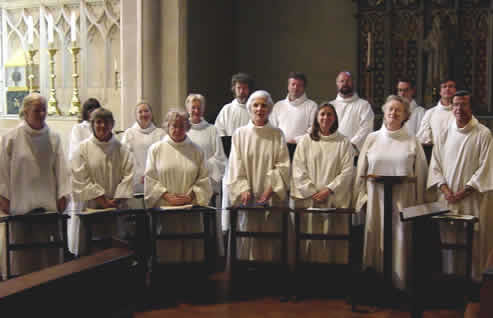
The Latin Mass choir of St. Mary's Church, Cadogan Street, now has its own website here. There's even a music list so you can now see what we get up to on Sunday mornings. And yes, I am in the picture.
Surtitles
Labels:
feature article,
opera magazine
Opera Magazine has long been anti-surtitles and the issue still bubbles under the surface, occasionally to rise up in the letters page. The current issue includes a letter from a foreign national pointing out that non-native English speakers find the surtitles at ENO immensely useful.
But even English speakers can find them useful. I can remember, back in the good old days, that comprehensibility was not always paramount. Conductors of the Mark Elder school always seemed (and still seem) inclined to give the orchestra their head, thus occluding the singers.
I first saw Twilight of the Gods on a very, very warm day at the Opera House in Manchester in 1974 (I think), the ENO production with Rita Hunter and Jean Cox, conducted by Reginald Goodall. Sitting in the Gods it was completely incomprehensible and for large chunks of time I had no idea what these people were singing about, though the singing itself was magnificent.
Later on, when I started taking my Mother to the opera, we found that the surtitles at the Royal Opera House were a boon. She was slightly deaf and found hearing the words very difficult, so for any new opera I welcomed the opportunity to take her to Covent Garden.
I have often wondered whether the critical attitude to surtitles might partly stem from the difficulty of seeing them when in the stalls (you have to lift your head). If you have spent your life hearing opera from the cheaper seats, then the surtitles are effortlessly in your view - a good argument for sitting higher up!
Technorati tag:classical music, opera
But even English speakers can find them useful. I can remember, back in the good old days, that comprehensibility was not always paramount. Conductors of the Mark Elder school always seemed (and still seem) inclined to give the orchestra their head, thus occluding the singers.
I first saw Twilight of the Gods on a very, very warm day at the Opera House in Manchester in 1974 (I think), the ENO production with Rita Hunter and Jean Cox, conducted by Reginald Goodall. Sitting in the Gods it was completely incomprehensible and for large chunks of time I had no idea what these people were singing about, though the singing itself was magnificent.
Later on, when I started taking my Mother to the opera, we found that the surtitles at the Royal Opera House were a boon. She was slightly deaf and found hearing the words very difficult, so for any new opera I welcomed the opportunity to take her to Covent Garden.
I have often wondered whether the critical attitude to surtitles might partly stem from the difficulty of seeing them when in the stalls (you have to lift your head). If you have spent your life hearing opera from the cheaper seats, then the surtitles are effortlessly in your view - a good argument for sitting higher up!
Technorati tag:classical music, opera
Wednesday, 28 February 2007
Recording news
Labels:
music news,
preview
The big news on the recording front is that Paul Brough, who is conducting the forthcoming disc of my music, has just been announced as Principal Conductor of The Hanover Band. Paul has worked with the band since 2004 and is performing with them at the Haydn Festival at Eisenstadt, Austria in September. Paul is also Musical Director at All Saints Church, Margaret Street, London. He conducted the eight:fifteen vocal ensemble last March when they performed The Testament of Dr. Cranmer at Oxford University Church as part of the Commemorations for the 450th anniversary of Cranmer's execution.
On the forthcoming disc, Paul will be conducting the eight:fifteen vocal ensemble in The Testament of Dr. Cranmer, plus a selection of choral works. In addition he will conduct the strings of the Chameleon Arts Orchestra in 2 works for tenor and strings, the tenor is Chris Wilson. More information here, on my recording page: http://www.hugill.demon.co.uk/recording.htm
Technorati tag:classical music, thomas cranmer
On the forthcoming disc, Paul will be conducting the eight:fifteen vocal ensemble in The Testament of Dr. Cranmer, plus a selection of choral works. In addition he will conduct the strings of the Chameleon Arts Orchestra in 2 works for tenor and strings, the tenor is Chris Wilson. More information here, on my recording page: http://www.hugill.demon.co.uk/recording.htm
Technorati tag:classical music, thomas cranmer
Subscribe to:
Posts (Atom)
Popular Posts this month
-
 Gimnazija Kranj Symphony Orchestra I get all sorts of mail, people sending my information on concerts and recordings. Everything gets gl...
 -
 Helen Charlston (Photo: Julien Gazeau) On 8 May, mezzo-soprano Helen Charlston has a new solo disc out on BIS . It is something of a contr...
 -
 James Baillieu (Photo: David Ruano) From this year, pianist James Baillieu and conductor/composer Ryan Wigglesworth begin a three-year tenu...
 -
 Peter Tranchell (Courtesy: Independent Society of Musicians) Peter Tranchell: Tu es Petrus in fuga , Seven Pieces in Alphabetical Order, The...
 -
 Gay Men’s Chorus of South Florida On 12 June 2016, a gunman opened fire at Pulse, a gay nightclub in Orlando, Florida. The attack killed 49 ...
 -
 Suddenly it's that time of year and the BBC Proms programme has been launched again. This year there are 72 concerts at the Royal Albert...
 -
 Verdi: Rigoletto - Royal Opera (© ROH 2023 Photo: Tristram Kenton) Verdi: Rigoletto ; Liparit Avetisyan, Robyn Allegra Parton, Hansung Yoo,...
 -
 Music in Hospitals & Care Music in Hospitals & Care is looking for people to join its Board of Trustees Music in Hospitals & C...
 -
 Anton Reicha was a Bohemia-born, Bavarian-educated, later naturalized French composer, who was a friend and contemporary of Beethoven. Whils...
 -
 The Guildhall of St George in King's Lynn (Image: Matthew Usher ) Founded in 1951, the King's Lynn Festival has a long and distingui...