Wednesday, 14 September 2011

New Queens Hall Orchestra at St. Martin in the Fields

The New Queens Hall Orchestra was founded by John Boyden in 1992; so  this year it is celebrating the start of its 20th anniversary season. At St. Martin in the Fields last night (13th September) , the strings of the orchestra gave a concert which both launched the new season and celebrated Boyden's 75th birthday.

The orchestra was founded to experiment with both instruments and playing styles from the early part of the 20th century. So that the brass instruments are narrow bore and the strings play on gut strings. In terms of playing style, the strings tend to use rather less vibrato than is common today and the performance last night had a gentle sprinkling of portamenti, a technique which can easily be overused but when done with taste, as here, is immensely evocative and expressive. But almost as important as these technical issues is the group's ethos; they deny the tyranny of the metronome and the modern day desire for orchestral players to combine into a single, slick, uniform machine. In common with styles from the early 20th century, players are encouraged to be individually expressive.

The results were obvious from the first notes of conductor Paul Murphy's rather brisk account of Mozart's Divertimento in D, K 136. The tones of the strings were warmer than usual, with an interesting depth of tone and more strength from the inner parts. The combination of the gut strings and the sparing vibrato meant that 1st violin tone was not as all encompassing as usual, leaving the results attractively warm and varied.

In Elgar's short but atmospheric Elegy for Strings, Opus 58, the textures really responded to the sound of the gut strings, giving music an inner glow. The discreet use of portamenti was nicely expressive and perfectly in style, it made you realise how much we miss on the clean, bright lines of the modern orchestra.

Hamilton Harty's arrangement of The Londonderry Air for solo violin, strings and harp was something of a period piece in itself. Written in 1924 it had very much the feel of the Edwardian salon. The way the string players are encouraged to be individuality expressive lent an interesting richness of texture.

This individuality led, at times, to hints of lack of unanimity; this is very much in the period style. This was a different world, a group of characterful players rather than a homogenised single entity, with each player  aiming to play exactly the same as the next. At times of crisis the sound threatened to move from expressive to untidy, but never actually made the leap, thus leaving us to delight in the multifariously varied palate of sounds created.

Puccini's Criantemi was enlivened by some wonderfully Italianate portamenti, worthy of an Italian diva, lending personality to the line. Peter Warlock's Capriol Suite was played in a rather more sober style, the mellow sound world evoking something like the mahogany tones of Arbeau's originals.

At the end of the first half we had a clutch of speeches with a short, but uncompromising one from John Boyden, with a fascinating encore: The 4th movement of Beethovens Opus 130 Quartet, a piece that meant a lot to Boyden.

For the second half there was just one work, Tchaikovsky's Serenade. Here the orchestra surprised by the sheer volume they were capable of, combined with richness of sound. The Waltz had a light dancing feel (Murphy does after all conduct quite a lot of ballet), but combined with a nice mellowness. In the Elegy the textures were magically transparent and all ended in a fine, lively Finale.

Whilst it would have been interesting to hear the full orchestra in a group of chamber works, this concert enabled us to experience what fascination the strings on their own were capable of. The orchestra's concert series continues on Wednesday 23rd November at the Fairfield Concert Hall, Croydon with a programme  including Beethoven's Egmont Overture, Bruch's 1st Violin Concerto (with Lydia Mordkovitch) and Brahms's Symphony No. 4. The concert will be recorded and issued, with minimal intervention, on the orchestra's new record label. It will be interesting to see how much Mordkovtich modifies her tone and style to suit the orchestra's ethos. Further ahead there is a concert of music from Hitchcock films (lots of Bernard Hermann) with verteran actress Tippi Hedren in attendance.

Tuesday, 13 September 2011

The LSO are performing Weber's Der Freischutz in April 2012 at the Barbican, details here. Witha rather more traditionally heavyweight cast than at the Proms, with Christine Brewer as Agathe and Simon O'Neill as Max, conducted by Sir Colin Davis. Though as with any concert performance of an opera with spoken dialogue you wonder what they are going to do about it. Both Midsummer Opera and Chelsea Opera Group have had resort to spoken narrations, which is never a good idea. And when the LSO under Colin Savis performed Berlioz's Beatrice et Benedict the spoken dialogue was performed by actors. So I await the LSO's performance with bated breath. I'd like to think we might get the German dialogue, spoken by the singers as Weber intended, but I wouldn't bank on it.

Monday, 12 September 2011

Cd Review


Sculpting Air – Navona Records, NV5852 
Modern works for Wind instruments

This disc from Navona Records is an interesting assemblage of contemporary chamber music, with the emphasis on wind instruments. But it is far more than a simple compilation of recordings as the CD also acts as a CD-Rom and when inserted into your computer provides extensive information about the pieces along with scores. In the case of the more adventurous contemporary pieces this is a fascinating aide to listening and in fact some of the scores are quite graphic and visually arresting.

The disc opens with Summer Music by Samuel Barber(1910 – 1981) played by the Solaris Quintet, recorded in 2009 at the Gault recital Hall, Wooster College. Barber’s substantial 12 minute work is written for a traditional ensemble of flute, oboe, clarinet, bassoon and horn. It was premiered in 1956 and subsequently shortened by Barber. It is rather rhapsodic and alternates moments of elegiac mood with more lively ones.

Reverie, Interrupted by James Adler (born 1950) is for tenor saxophone and piano, recorded in 2010 at Patrych Sound Studios in New York, with Jordan P. Smith (saxophone) and Adler himself on piano; Adler is a regular performer on the piano with a busy concert schedule. He studied piano performance and composition at the Curtis Institute. Adler’s style here offers lyricism with edge, giving us a lyrical saxophone line with a more rhythmical accompaniment. The work was written for Jordan P. Smith after Adler heard him perform. The score of the piece is included on the disc,

The Answer is No by Russ Lombardi (born 1945) is for flute solo (Michael Feingold) and an ensemble of 3 flutes and 2 alto flutes, recorded in 2008 at Futura Studios, Rosindal, MA. It is an austere, cool work, rather neo-classical in its dissonance. Lombardi has a jazz/rock background, having performed in various rock bands and jazz bands before studying at Berklee College and the New England Conservatory. In this piece he is dramatizing a dialogue between his teenage daughter (the solo flute) and his wife and himself (the flute sextet), I can only say that his daughter sounds a well-behaved sort of teenager. The score of the piece is included on the disc.

Chemical Suite by Jan Van der Roost (born 1956) is a suite of 4 short movements for trombone quartet, here recorded by the Daniel Speer Trombone Quartet in 1990 in Holland. Van der Roost is Belgian, he studied at the University of Leuven and the Royal Conservatoires of Ghent and Antwerp; his studies included trombone, conducting and composition and he now teaches at the University of Leuven. The Daniel Speer Trombone Quartet commissioned the work. The four movements bear the names of chemicals as titles, Kalium Cyanide, Glycerine, Chloroform and Ethanol. Kalium Cyanide is lively with short staccato bursts and aims to represent the chemical as sour and biting. Glycerine inevitably features low glissandi; quiet and uneasy at first it gradually builds. Chloroform is almost a popular song, rather music-hall in style, though its intent is to suggest the gradual narcotic effect of the chemical. Finally Ethanol is quick staccato and intense, reflecting perhaps the effects of alcohol.

The curiously named A Forum for Abandoned Euro Leaders by Barry Seroff (born 1978) is for flute duo, recorded at Futura Studios in 2010 by Zachary Jay and Brandy Blakely. Seroff studied at the Aaron Copland School of Music, but cut his teeth on improvised music at the legendary Knitting Factory. His music, though classical, includes elements of heavy rock and improvisation. He plays the flute in the progressive rock band, Edensong.

The name A Forum for Abandoned Euro Leaders is in fact an anagram. The piece features quite a lot of over-blowing, making the piece distinctive but rather difficult to listen to; these are offset by more traditional sometimes fugal elements. It was written for the Anti-Social Music flautist Andrea La Rose, as Seroff admired her extended techniques. I must confess that at nearly 7 minutes long, it rather out-stayed its welcome. The score of the piece is included on the disc; this is the first score to feature real extended techniques and includes much graphical work, giving the listener a chance to follow the processes which led from graphical score to realised piece.

Perihelion by Bryan Gillett (born 1972) is written for brass quintet and recorded here in 2006 in Romania by the Black Sea Quintet conducted by Gillett himself. Gillett is self taught and studied Medicine in Montreal; he currently resides in Brooklyn where he combines composing with being a doctor. The piece opens harshly, featuring trombone slides, but it develops something of a jazz feel, particularly in the accompanying elements. Like the previous track, this one felt too long at 7 minutes. The title refers to the closest point to the sun in a celestial body’s orbit. The work was premiered by the Black Sea Quintet in 2006 during the International Music Days Festival. The work’s very traditional looking score is included on the disc.

Genelalpaedie by Juan Sebastian Lach Lau (born 1970) features a title which requires transliteration (I have used my own attempt). Lach Lau is Mexican teaches composition at the Conservatorio de las Rosas in Morelia, Mexico; his studies have included periods in Mexico as well as Ghent and Holland. Written for a chamber ensemble of flute, harp, viola, violoncello and double bass, it is recorded by the Moravian Philharmonic Chamber Players in Olomouc in the Czech Republic in 2009.

The work is inspired by the first of Satie’s Gymnopedies, but Lach Lau filtered through experimetns with microtones and spectral music. The work opens with cries and whispers and disjointed notes, Lach Lau seems to be interested in textures rather than harmonic or melodic material. Though there was much of interest, I thought that perhaps Lach Lau was in danger of stretching his material too far. The notes that come on the CD-Rom include extensive information by Lach Lau allowing anyone interested to explore the work deeply. The score, included on the disc, includes quotes from Michael Foucault and features extensive annotations and makes fascinating reading.

With the final work on the disc, the Sonata for Trombone and Piano Opus1 by Richard Crosby (born 1957) we return to more traditional style. The opening movement is upbeat, lyric and melodic with a touch of bravura, the middle one is quietly lyric with a long breathed melody and the finale is a toccata with Spanish hints. Crosby studied at the University of Cincinnati and has been Professor of Music at Eastern Kentucky University since 1986. The work was commissioned by Ken Haddix, one of Crosby’s colleagues at EKU and was recorded by Haddix with Crosby at the piano in 2010 at EKU. The score is included on the CD Rom

This is a fascinating disc. There are some fine and creditable performances but what lifts it above the ordinary is the inclusion of extensive notes and the ability to see the scores of 6 of the pieces on the CD-Rom. If you are interested in contemporary music in its infinite variety, then this disc is for you.

Last Night of the Proms

We managed to catch the end of the Last Night of the Proms on TV where Susan Bullock's performance (visual as much as aural) of Rule Britannia brought back memories of Gwynneth Jones in the same role. Edward Gardner's confident and succinct speech herald's, I would suspect, a long career doing Last Nights, if he cares to.

What always amazes me about the audience at the Last Night is how well behaved they are. Yes, they make a lot of noise, by vocal and other means, but they also know when to shut up. There is a discipline about  their performance which matches that on stage. And judging by the TV broadcast, their performance in Land of Hope of Glory and the two sing along Rogers and Hammerstein numbers was most creditable. All I have to do now is try and find time to hear Susan Bullocks performance of the Immolation scene on iPlayer before it disappears.

Sunday, 11 September 2011

Wilton's Music Hall

It is good news that Wilton's Music Hall seems set to stay open. The theatre is a wonderfully evocative space, but when they failed to get lottery money the venue seemed set to close. But now support has been sufficient for them to be able to plan much needed structural works. More info here.
Over the bank holiday weekend Paul McCreesh and the Gabrieli Consort and Players played Mendelssohn's Elijah at the Proms (we missed it, being in Norfolk for the premiere of my Elegy). They are recording the oratorio (hurrah!) with Simon Keenlyside in the title role. The Recording will be issued on the new label, Winged Lion, which McCreesh is starting. The first CD on the label will be Berlioz's Grande Messe des Morts recorded wth the Gabriel Consort and Players, the Wroclaw Philharmonic Choir and Orchestra and Chetham’s School of Music.McCreesh is artistic director of the Wratislavia Cantans Festival, and they will feature on the label. With two such opening discs as Elijah and the Berlioz Requiem the label looks to be extremely promising.

Review of Der Freischutz at the Proms

For an opera described as Weber's masterwork, Der Freischutz remains a relatively rare visitor to the UK's stages. It's combination of the gothic horror of the Wolf's Glen scene with a heroine of remarkable drippiness perhaps means the work is not as enticing as it might be. In fact Weber's other two major operas remain almost as enticing, even though they present interesting theatrical problems. Oberon with its hobbled plot remains a tantalising what if Weber had lived to revise it, but is rescued by a ravishing score. And Euryanthe with its proto Lohengrin plot and dramatic music almost overcoming the fatal weakness of the libretto.

Rather curiously Der Freischutz's outing at the Proms (Friday 9th September), performed by John Eliot Gardiner and his Monteverdi Choir and Orchestra Revolutionnaire et Romantique, was in a French incarnation revised by Berlioz.  Eliot Gardiner and his forces had performed the opera in Paris at the Opera Comique in a production by Dan Jemmett as part of the Opera Comique's rediscovery of rare 19th century French repertoire. (They are staging Auber's La Muette de Portici next spring). Berlioz's adaptation was done for the Paris Opera where, in order to perform the work, it needed recitatives and a ballet.

So, fearing someone else might do the job a hell of a lot worse, Berlioz set to and added recitatives, a couple of dance movements from other Weber operas and a 3rd Act ballet based on Weber's Invitation to the Dance. Despite Berlioz's participation, the result has curiosity interest only, valuable mainly for the way it illuminates 19th century tastes and for admrining the way Berlioz skill preserved as much of Weber as possible.

But just as Carmen and Les Contes d'Hoffmann change considerably in their dramatic feel when performed wth recitatives, so does Der Freischutz. Inevitably recitative slows things down and we miss Weber's carefully planned contrasts between speech and music. No place more so than the Wolf's Glen scene where the removal of substantial melodrama (in the strict sense of spoken word over music) moves the piece more into the conventional direction.

Performing with a period orchestra Eliot Gardiner took advantage of the rethinking of Weber's orchestral textures to similarly rethink casting. Max is conventionally cast as a jugend dramatisch tenor (even a helden tenor); I saw Alberto Remedios in the role at Covent Garden (with Helena Dose as Agathe). Here it was sung by Andrew Kennedy, a far more lyric voice. In the relatively small confines of the Opera Comique, Kennedy's combination of lyricism and forthright committment would probably have had a strong effect. But in the vast expanses of the Albert Hall there were moments when I longed for the ringing tones of Remedios or John Upperton (who sang the role recently with Midsummer Opera). That said, I have rarely heard Max sung so beautifully and the role must count as a serious triumph for Kennedy and an indication of his seriousness as an operatic performer.

Max's love interest, Agathe, was sung by Sophie Karthauser, again Eliot Gardiner casting a lyric voice where we might expect something more. Karthauser brought great beauty to the role and conveyed Agathe's anxiety with nervous intensity. Agathe is a real drip and when performed by a jugend dramatisch soprano the mis-match between vocal tones and character can be disturbing. So it is a pleasure to report that Karthauser's characterisation was all of a piece, and she sang Agathe's great solo, 'Leise, leise' with dignity and beauty.

Agathe's companion, here renamed Annette, is a gift of a role, calling for a lyric soubrette with a gift for comedy. Virginie Pochon did not disappoint and she charmed and sparkled, providing much needed dramatic contrast.

The villain of the piece Gaspard (renamed from Caspar) was sung (if that is the right word) by Gidon Saks. Saks seemed to compensate for the lack of melodrama by performing in a comically melodramatic manner. His over the top performance, including frequent stage whispered incantations to Samiel, the black huntsman, threatened to push the performance into comedy. For me, he all but ruined the Wolf's Glen scene, indicating that often less really is more.

It didn't help that Christian Pelissier's appearances in the spoken role of Samiel verged into something like the Cabinet of Dr. Cagliari. I began to seriously wonder what the Opera Comique's production had been like.

Samuel Evans made a personable Kilian, the young man who bests Max in the shooting contest at the start of the opera. Matthew Brook provided strong support as Agathe's father and Robert Davies was suitably impressive in the small but important role of the Prince Ottakar.

The Monteverdi Choir were in fine form and their intensely involved performance had obviously benefitted from the run of stage performance. The glory of the evening though was the playing of the Orchestra Revolutionnaire et Romantique. Weber's orchestration seems to respond beautifully period performance practice and here under Eliot Gardiner the orchestra were not exception. Featuring a big ensemble, with 40 string players, the results were substantial yet transparent, with JEG's speeds keeping a lively flexibility. Hearing and seeing them in this I began to dream of the possibility of a proms Lohengrin using period forces.

This was a long but involving evening, over 3 hours including just one 20 minute interval. The singers committment to their roles and the sympathetic semi-staging obviously made us benefit from the run of staged performances. There was nothing stiff and concert-like about this evening.

I could have wished that we'd got to hear the opera in Weber's original, nonetheless the results were vividly dramatic even if the Weber/Berlioz version of the opera remains something of a curate's egg.

Thursday, 8 September 2011

Notation Notation Notation


One of the areas that I often struggle with when writing music is exactly how to write it out. You can be quite clear as to what you want, but still be uncertain as to how best to notate it. Western notation evolved to cope with music written according to the accepted rules of melody and harmony. If you want to veer away from these or stretch things somewhat, then you have to push the notation. There are conventions for some of these, for example if you want to write quarter tones. But if you use too much extra notation you run the danger of having to prefix the piece with a long essay explaining what the signs mean. And if it is an ensemble piece, then you also risk having to prefix each rehearsal with a long discussion as to how to approach the extra notation. This has happened to me a few times and has left me with a desire to keep things simple and straightforward where possible. Also, getting too exotic with notation or too complex might mean that a piece which shouldn't need a conductor will need one, so that there is a single person controlling the complex web of events.

Even when there isn’t anything particularly exotic in your piece, you can find that the way it is notated has a big effect. For instance, if you write using a variety of chromatic harmonies or modes, then it won’t always be obvious whether the notes are sharps or flats and you can end up with a flurry of accidentals which renders and essentially straightforward line as something complex. Poulenc does quite a lot of this in his choral writing, using enharmonic changes so that quite straightforward chords are notated in exotic ways.  Of course there are correct ways of writing things out, but if this involves, say, extensive use of G double flat, it might make more sense to the performer if you use F natural rather than the harmonically correct G double flat.

There is a similar inflexibility in rhythmical notations. Or rather, to get some effects you have to use such complex notation that there is very little possibility of getting the music played accurately. Hence the recourse, to either computers or to using freedom and uncertainty. I must confess that writing most of my music on computer, I sometimes get seduced into rhythmical constructs which are extremely tricky to bring off. Part of the reason why this arises is that we have little concept of stretching rhythm, or at least no satisfactory notation for it.

One piece I am working on at the moment has a triplet crotchet figure over a semiquaver figure. At one point I wanted to speed up the semi-quaver figure whilst keeping the crotchet triplet the same. My first attempt kept the semiquavers, but speeded up the basic tempo and then re-notated the triplet crotchet figure using dotted quavers. I sounded perfect, but looking at the vocal and instrumental lines I realised that there was little chance of it ever being performed with accuracy, the notation was just too fiddly. So I accepted the inevitable and chose a simpler solution which, whilst not perfect, has a far better chance of being performed without stressing the performers out.

For much of his later life Percy Grainger experimented with a series of machines which would enable him to have complete control of pitch, rhythm and duration. In fact his experiments were overtaken by the use of computers to do this. I remain wedded to the notion of using human performers and so must try and find solutions within the notations which are in common use.

Alison Teale - passion for the cor anglais.

If you think about the cor anglais as a solo instrument, then probably a long breathed, melancholic melody comes to mind when the instrument gets a solo moment during an orchestral work, playing something long, slow and lovely. Alison Teale, the principal cor anglais player with the BBC Symphony Orchestra is positive that there is more to the instrument than that and is keen share her enthusiasm with others. To that end she has produced an album of music for solo cor anglais which is coming out at the end of this month. It is probably the first all cor anglais recital record, certainly in the UK.

Called Cor! the album's title is something a pun which hardly translates to other countries (the rest of the English speaking work calls the instrument an English Horn and the expression 'cor' is a particularly English one). But the title reflects Teale's desire to bring the instrument into the lime-light and show it off, to introduce it to a wider, livelier repertoire. We met at the Albert Hall to talk about the new album and her desire to bring the cor anglais to a wider audience.

The cor anglais has a relatively limited solo repertoire; major moments include a concerto by Donizetti and Copland's Quiet City, plus music by Hindemith, Rubbra, and Lennox Berkely. It has been taken up by contemporary composers including Simon Bainbridge, though players usually have to steal from other instruments. Teale has commissioned a piece, Bebop Tango, from David Gordon for the new CD, a deliberately fun piece which reflects the eclectic nature of the works on the new CD with composers ranging from de Falla and Piazzolla to Messiaen and Lucchetti.

Like most orchestra musicians, Teale juggles her orchestra playing committments with other outside work including teaching at the Guildhall and she relishes the variety that this brings. She conveys her enthusiasm for the instrument with passion and is keen to demonstrate that there is far more to the instrument than we currently perceive. Though the cor anglais is very similar to the oboe from a technical point of view and sounds a 5th lower, its tone qualities are very different. Its warm, dark brown tones are immensely seductive, its timbre fruiter than the oboe's. It takes more physical effort to play than the oboe and Teale feels that for her this affects the way she approaches the instrument. If it has a drawback it is that it is not a loud instrument, it does not always easily penetrate the orchestra.

Teale wants to persuade people to experiment more and hopes that the CD and plans to publish an album of pieces for the instrument will contribute to this. To bring a bit of fun to the repertoire, making a change from Dvorak and the Swan in the Carnival of the Animals. Given Teale's infectious enthusiasm, her new CD promises to show the Cor Anglais stepping out in a new light.

Monday, 5 September 2011

Recent CD Review

My review of a disc of Alessandro Grandi's sacred music, themed on the Vespers service is here, on MusicWeb International.

This disc charmed me far more than I could have imagined. 

Sunday, 4 September 2011

Learning Curve

Last weekend was, of course, the premiere of my Elegy for baritone and piano sextet. There were problems from the start because Finale had played a blinder and the first set of parts had random bars missing, not a good way to start the rehearsal process. Another interesting problem, which I had not really thought through, was the difference in doing a piece with singer, orchestra and conductor and with singer, instrumentalists and not conductor. On reflection there were a number of elements in the parts which could be written out differently to make the players life easier, providing clearer signposts in the absence of conductor. So I have to admit that I spent much of the rehearsal process kicking myself and thinking of all the things I ought to have done, different ways of writing the parts out. But ultimately the performance came up trumps and Trunch heard a wonderfully evocative performance of the Elegy.

Rhinegold in Fulham

If you can perform Puccini's La Boheme in the confines of the upstairs room in a pub, then the idea of performing Wagner's Das Rheingold in a church in Fulham starts to sound reasonable. Fulham Opera have done just that, performing the entire Das Rheingold fully staged, with piano accompaniment, in St. John's Church, Fulham. And very creditable it was too, we almost forgot about the extreme discomfort of the church seats, so engrossing was the performance.


St. Johns is a Victorian church which has been modernised, so that the playing space was a plain, modern-ish chancel with undecorated walls on which Fulham Opera were able to project designs, a set of steps led to the raised playing area and the only drawback was the presence of the altar (a modern, marble table) which was, inevitably, unmoveable and rather gave the proceedings the feel of the sacred play. That said, it must be the only production of Das Rheingold that I have ever seen where the back drop includes a substantial stained glass window of the crucifiction - definitely an interesting mix of iconography in this opera.

Fiona Williams directed the piece, Rob Dyer lit it and Gaynor Woodward facilitated the costumes and produced the rather 80's altar cloth which functioned as the river Rhine.

It has to be confessed that the opening was the weakest part. The ambient light was still quite high (no blackout curtains of course) so that lighting effects were not dominant, Wagner's evocative orchestration does not lend itself to piano reduction and the budget restrictions meant that we lacked the coup de theatre possible in bigger theatres.

But things took on an entirely different complexion when the Rhinemaidens appeared; one of the big strengths of this production was the depth of its casting. The Rhinemaidens were a lusty bunch, Elizabeth Capener (Wellgunde) also sang Freia, Sara Gonzalez (Flosshilde) also sang Erda and Zoe South (Woglinde) has Brunnhilde in her repertoire. But they were nicely matched in voice and supremely playful; big voices having fun.

The object of their fun was Robert Presley's Alberich. Dressed as a contemporary wide-boy in garishly flowered shirt, Presley's impressive performance brought out the humour in this scene. He lacked the ultimate feeling of danger that the finest Alberich's bring to the role, but he was thrilling nonetheless and his abjuring of love was fully committed. I feel that in a darker production he would bring out the scarier side of this character.

When the scene changed to Valhalla, we moved from the Rhine to Dallas! Fiona Williams's neat idea was to stage the opera as high-octane family drama and what better family to model the opera on than the Ewings of Dallas. This was in keeping with the vein of humour which ran through the performance, but Williams and her cast never sent the opera up, the laughter helped us see another aspect of the Wagner's opera.

Frankly, the costume and props budget just wasn't bit enough to turn St. John's Church into the Ewing's ranch (Southfork?) and the costumes looked a  trifle make-do. But the cast entered into the idea with a will and with fine committment; you could moan about the details, but sheer committment will get you a long way.

Ian Wilson-Pope made a physically impressive Wotan and captured the right cowboy type swagger the production needed. His was a dominating performance, which something that both opera and concept called for. His voice was the one that suffered most from the restricted acoustic; we were simply not far enough away from him for his vibrato to settle down and at times it became intrusive in a way that probably does not happen in bigger theatres.

Elizabeth Russo as Fricka was in the unfortunate position of having to try and emulate the glamour role in the piece. She did this creditably and is a fine Fricka, albeit in a rather understated way. This was a neatly sung performance, which impressed with its attention to detail. But I couldn't help wishing that she had taken Joan Collins character from Dynasty as her role model; Fricka as power dressed super-bitch.

Of course, the problem with Das Rheingold is that we tend to view the characters from the prism of the later operas, so that it makes sense if Fricka is a bitch in Die Walkure playing Das Rheingold on its own means that the character can be less hard edged.

The third major character was, of course, Loge sung by Brian Smith-Walters. I was less clear how he fitted into the Dallas concept and we seemed to have lost the element of fire. Surely Loge must be tricky and clever, here he seemed in danger of being something of an oaf. Smith-Walters performance carried things through, though his dark tenor added a heroic element to the part which is usually omitted. Simply, though what Smith-Walters did was impressive, I wanted something lither and tricksier. And Fiona Williams really ought to have come up with a concept which allowed this Loge to bring intelligence and fire into play.

Capener was a fine Freia, dressed in lurid pink and rhinstones, she was the baby of the family. But there was, thankfully, no baby in her voice. Her brothers, Froh and Donner, were played as hick cowboys, which rather limited the scope of Stuart Laing and Stephen John Svanholm, but when it came to their set piece at the end when the gods entered Valhalla, then both delivered. But for the remainder of the opera I was a little to aware of how the directors concept of Dallas cowboys was something of a mismatch to the singers natural inclinations.

Fasolt and Fafner were played as besuited business men but Oliver Hunt and John Woods, both providing some fine singing and some neat coordinated movement.  Sara Gonzalez appeared from the audience to sing Erda, though more could have been made of this; but Gonzalez contributed and admirably firm vocal line.

The cast were all admirably hard working, providing the anvils in the descent into Nibelheim as well as playing the Nibelung. Like the Rhine scene, Niblelheim was played pretty straight with some nice physical theatre solutions to the scenes technical problems.

At the end, for the entrance into Valhalla, we were again aware of the budgetary limits but the cast entered into things with a will and the rainbow umbrellas didn't quite look risible.

For the closing moments of the opera we were left with the piano and it was here that the heroic nature of the enterprise made itself felt. The entire opera was played admirably and vigorously by musical director Benjamin Woodward. The sheer physical enterprise of playing the opera in piano reduction (albeit with an interval) added an extra heroic element to the opera.

The group are planning a fully staged Die Walkure next year. On this showing it should be something to watch out for, though I would suggest that they invest in a piano duet version of the accompaniement to try and help do more justice to the bigger moments in Wagner's orchestration

Tuesday, 30 August 2011

Sheena Coote - Mixed Blessings

Sheena Coote's disc Mixed Blessings was issued by Red Admiral Records on11th June. Coote describes Mixed Blessings as a collection of short piano pieces inspired by her own family life and by the great composers.

Red Admiral describe Coote as a semi-professional composer, she wrote this disc over 3 years juggling writing and being a fulltime Mum. She started learning the piano at the age of 2 and studied it until she went to university. A natural musician she is currently writing her second musical; the first was performed in Edinburgh and had a London try-out. She also writes pop-songs.

This disc lasts around 25 minutes and the piano pieces are all short. Coote undoubtedly has a gift for melocy, these are very much songs without words. The problem lies in their very brevity, Coote barely has time to establish a mood than the piece finishes. She is also a little too fond of Alberti-style bass. Perhaps rather than songs without words we should think of these as folk-songs in need of a strong arrangement, the pieces are crying out for further developement.

I think that your opinion of the disc is likely to go in one of two directions. Either you think these are "strong beautiful melodies that touch the heart" or you'll think, 'so what'. These pieces are charming, but need more spice, more development and more depth.

Friday, 26 August 2011

Review of Handel's Rinaldo at the Proms

I had been hoping that most of Robert Carsen's production would get mislayed when Glyndebourne travelled up the M23 to bring Handel's Rinaldo to the Proms. In the event, Bruno Ravella's staging seemed an effective distillation of Carsen's original; it certainly wasn't a semi-staging, all the action took place on a substantial platform behind and above the orchestra.

Carsen's basic premise was the the entire opera was the dream of an idle school-boy, with the his school friends as the Crusaders, the teachers turned into the Saracen King, Argante, the evil Sorceress, Armida, and the friendly Christian Magician. Armida was supported by a group of female furies who were obviously from the local equivalent of St. Trinians.

Seeing diminutive Italian mezzo-soprano Sonia Prina dressed so convincingly as a school-boy you began to wonder what came first, the concept or the casting of the singer. As a concept, Rinaldo's school-days wasn't all bad, it certainly helped solve a number of problems and provided the audience with a hook into the action, which the traditional crusaders and saracens might not have done. In terms of dramaturgy my only serious complaint was the way the the final battle was turned into a joke football match.

But this was indicative of a general attitude because Carsen just doesn't seem to have taken the opera at all seriously and at every turn has added details which essentially made the piece a comedy. Which it certainly isn't. Rinaldo isn't the most sophisticated of Handel's operas; its a romping good yarn designed to dazzle and entertain. He put into it many of his finest arias from his Italian period and created a piece which is one of the most approachable. Whilst it doesn't dig as deep as his later masterpieces, he does give the characters some superbly dramatic music and they demand to be taken seriously, on their own terms.

But instead of using the setting to seriously re-think the opera, Carsen has been content to entertain, throwing in everything (including references to E.T.). Even in this reduced version it was one of the most hyper-active Handel productions I've seen in a long time. The problem wasn't the school-days setting, but the fact that there was always something going on. Virtually all the arias took place against a backdrop of busy activity, as if Carsen constantly felt pressed to keep the punters entertained. What could be achieved was shown by Prina's superb rendition of Cara Sposa where for virtually the first time she was alone on stage for the entire aria.

It was Prina's energy and vital performance which carried the show. The role of Rinaldo has a significant number of arias and when Prina was singing, her vividness and involvement in the characterisation were little short of brilliant. Granted, we had the disadvantage of the Albert Hall so that even from the stalls the entire opera sounded distant; but the ear learns to cope and Prina's personality shone forth.

As her love interest, Almirena, Anett Fritsch had rather less to work with and though she sang beautifully, she did not engage quite as much. Almirena does, however, get the opera's best known aria, Lascia ch'io pianga and this Fritsch sang superbly.

Brenda Rae presented Armida as an evil, pvc clad dominatrix. Visually this was a triumph, but the concept completely overshadowed the musical values and Rae's Armida never really created a dominatrix in the music. Rae has an attractive soprano voice, and sang the notes quite charmingly; in fact she would have made a fine Almirena. But she didn't create the sort of musical personality needed. Just listen to Cecilia Bartoli on the Hogwood recording to hear what can be done with this role. Handel did well at conflicted evil sorceresses and Armida is the first in that line, somehow Rae never brought this over.

Thankfully, Luca Pisaroni as Argante got rather closer and it was sheer pleasure to listen to the way he brought his lovely bass-baritone voice round Handel's fioriture and then used them to create drama.

The other roles were all nicely taken. Varhudi Abrahamyan made a fine Goffredo and Tim Mead impressed in Eustazio's arias. William Towers popped up as a demented Chemistry Master (the Christian Magician), his voice almost competing with the fright wig he had to wear.

Under Ottavio Dantone, the Orchestra of the Age of Enlightenment brought character and richness to Handel's extravagant orchestration.

Musically this was a fine evening and it was a complete joy, providing you kept your eyes closed.

Recent CD Review

My review of Rossini's opera La cambiale di matrimonio on Naxos, recorded at the Rossini in Wildbad festival, is here

Lively and involving … a fine addition to the expanding list of Rossini operas on Naxos.

Tuesday, 23 August 2011

Recent CD Reviews

My review of Messiah from King's College Cambridge (recorded in 1993 with a fine cast) is here,

Return to this with pleasure.

And my review of a disc of Hummel's operatic transcriptions for piano, Hummel at the Opera, is here. Both reviews are on MusicWeb International.

A charming recital.

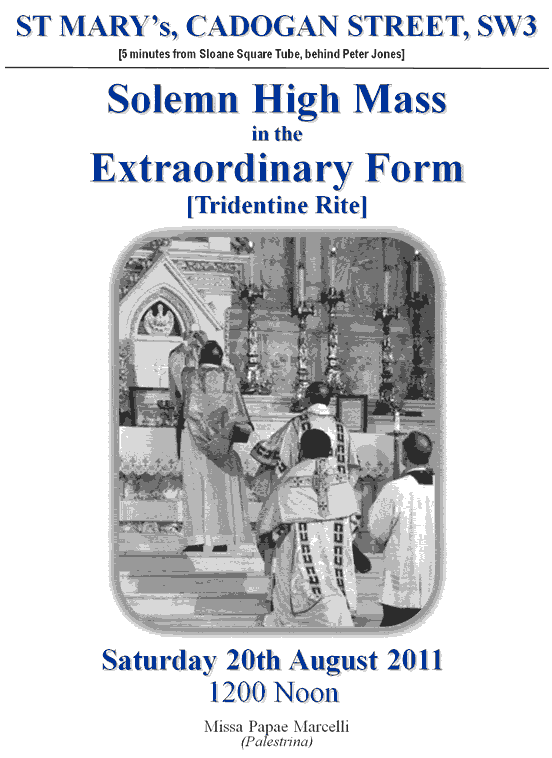
Tridentine Mass

This link, has pictures and a sound extract from Sunday's Tridentine Mass at St. Mary's Cadogan Street where I was part of the choir singing the plainchant and Palestrina's Missa Papae Marcelli

Monday, 22 August 2011

I see from this month's Opera Magazine that Terry Gilliam is going to direct a new production of Berlioz'z Benvenuto Cellini at ENO in 2014. Its great that Gilliam is coming back for more and brilliant the Benvenuto Cellini will be getting a new London outing. But I'm not really sure about what Gilliam's take on the opera will be, after all Cellini does actually have a plot!

Also, Covent Garden are doing their first production of Szymanowksi's King Roger in 2014 with Mariusz Kwiecien in the title role. Again, another opera that has been crying out for a London outing. Interestingly the production will be directed by Kasper Holten, who is obviously going to be a different type of opera director than Elaine Padmore.

Yet another interesting London outing. This time Charpentier's Medea which David McVicar will be directing at ENO in 2012-13, with Sarah Connolly in the title role and Christian Curmyn in the pit.

And as had been widely predicted, Covent Garden is doing a new Guillaume Tell in 2015, with Pappano in the pit and with John Osborn as Arnold.

Thursday, 18 August 2011

CD Review

Dreams
Craig Madden MORRIS - Violin Concerto [34:27]
Craig Madden MORRIS - Piano Trio [8:15]
Craig Madden MORRIS - Dream Songs [9:24]
Craig Madden MORRIS - Cello Rhapsody [15:26]
Craig Madden MORRIS - Tropical Dances [11:40]
Christine Kwak (violin)
Nan-Cheng Chen (cell0)
Eduard Laurel (piano)
Martha Locker (piano)

RAVELLO RECORDS RR7813 [78:00]

Craig Madden Morris is a contemporary American composer, one of those toilers at music's coal-face whose well-constructed neo-romantic music does not always get the exposure it deserves. Morris is actually a child psychologist and an associate professor at Columbia University and a New York resident. This new disc from Ravello Records offers a selection of Morris's recent chamber music. Ravello are a New England based label who offer an eclectic selection of contemporary music.

This disc features music for voilin, piano and cello played by Christine Kwak, Nan-Cheng Chen and Eduard Laurel, with Martha Locker contributing piano solos. The programme opens with Morris's Violin Concerto played in his reduction for Violin and Piano. This is a substantial work, three movements of around 10 minutes each (some 35 minutes in total) originally written in 2002 and revised in 2010.

It is a big-hearted romantic work with a nicely rhapsodic solo part, beautifully played by Christine Kwak with sterling accompaniment from Eduard Laurel. Their confident performance gives a good idea of the work, but I'm not convinced it quite works as a violin sonata, there are just a few too many moments where you want more than the piano can give, especially when it comes to intertwining instrumental lines.

You can get some of idea of what we are missing by listening to the lovely interaction between the violin, piano and cello in the Piano Trio also on this disc.

The full version of the Violin Concerto includes a second cadenza for cello, so I can't help wishing that Morris had chosen to present the piece with one or two other instruments.

The Piano Trio, played by Kwak, Laurel and Nan-Cheng Chen) is for me the stand-out piece on the disc, showing Morris's give for rhapsodic writing and long lyrical interchanges between instruments. it is a single movement work lasting just over 8 minutes, written in 2008.

The final large scale piece on the disc is the Cello Rhapsody, played in the reduction for cello and piano, by Nan-Cheng Chen and Martha Locker. A lovely elegiac work (the central section is an elegy for his teacher Shirley Bloom). The rhapsody lasts over 15 minutes in one movement. Like the previous Violin Concerto, the work rather strains in the piano reduction.

In style, Morris is unashamedly Romantic, but with a thoughtfulness and care in construction. In composing style he hovers between John Corigliano and Samuel Barber. Though Morris's lyrical impulse never quite reaches the memorableness of Barber's tunes.

The disc is completed by two groups of smaller pieces, played by Martha Locker, Dream songs - a trio of lyric songs, and the Caribbean inspired Tropical Dances

Tuesday, 16 August 2011

Premiere in Norfolk


My Elegy for Baritone and Piano sextet is being premiered on Saturday 27th August 2011 at St. Botolph's Church, Trunch (NR28 0PS, near North Walsham). The concert is being presented by the London Schubert Players as part of their 2nd Norfolk Schubertiade. The programme includes Mozart's Piano Quartet in E flat, Faure's Dolly Suite, songs by Schubert, Reginald King's Meditation and premieres of pieces by Sviatlana Rynkova and yours truly.

The Elegy sets part of Rilke's 2nd Duino Elegy (Every Angel is terrifying); it is related to my Elegy for Baritone and Orchestra which was premiered by David Greiner and the Salomon Orchestra, conducted by Adrian Brown, at St. John's Smith Square. But the Elegy being premiered next week uses only part of Rilke's poem and re-works the original piece to create a rather more satisfying work.

Monday, 15 August 2011

Tridentine Masses


Next Saturday at 12.00pm I'll be singing in the Tridentine Mass at St. Mary's Church, Cadogan Street, Chelsea. The music includes Palestrina's Missa Papae Marcelli, Bruckner's Os Justi and Vittoria's Sitientes.

The mass is an annual event at St. Mary's and it is usually the only Tridentine mass that I get to sing in. Unusually, this year whilst we were away (hence the radio silence), London Concord Singers sang mass at the lovely Chapelle des Penitents Noirs in Avignon. There, at a well attended service on Sunday 7th August we sang Rubbra's Missa in Honorem Sancti Dominici (which was actually written for the feast of St. Dominic on 4th August).

Wednesday, 3 August 2011

Recent DVD review

My review of the DVD of Verdi's Don Carlo (4-act version) from Amsterdam is here on Music and Vision (subscription site)

Sunday, 31 July 2011

Recent CD Reviews

My review of Cirque a disc of French song with works by Sauget, Poulenc, Auric and Milhaud sung by Celini Ricci is here.

Admirable programme, intelligently put together and including some lesser-known works but Ricci’s performance is simply unsatisfactory.

And my review of a disc of organ and choral music from Ely Cathedral is here.

A slightly awkward mix but highly attractive and intelligently and finely performed.

Saturday, 30 July 2011

Tempus per Annum - Volume 3 is here


Volume 3 of Tempus per Annum is now available. Containing 18 motets for 5-part choir (varying between SSATB, SAATB, SATTB, SATBB), setting the Latin Introits for the first 18 Sundays in Ordinary Time.

Further details and on-line sales are here

Tango - Gianluca Paganelli

Tango
Oscar Hammerstein II/Richard Rogers – No Other Love [3:08]
I Gado – Jealousy [3:04]
R Adler /J Ross – Hernando’s Hideaway [2:36]
A Villaldo /J.C.M. Catan/E.S.Discepolo /Trad/Arr M. George /L Mullen/D Dott/G Paganelli– El Choclo [2:44]
M George /L Mullen /D Ott /G Paganelli – Just for Tonight [4:18]
B Kampfert /E Snyder /C Singleton – Spanish Eyes [3:08]
JM Rodrigues /P Contursi /E.P Maroni – La Cumparsita [2.38]

F Schreier / A Bottero – Tango of Roses [2:23]
C Gardel / A Le Pera / Trad/arr M George / L Mullen / D Ott - Por una Cabeza [2:23]
J Gade – Jalousie [3:05]

F schreier / A Bottero - Tango Delle Rose
[3:15]
M George / L Mullen / D Ott / G Paganelli - Shine

Gianluca Paganelli (vocalist)

Mark George (Piano and Programming)

Daniel Ott (strings and programming)

Produced by Daniel Ott, Mark George and Lou Mullen

Recorded at Fairlight Mews, Kingston

MISCD004

Gianluca Paganelli isn’t a name that I’d come across before. He evidently won the Italian equivalent of “Britain’s Got Talent” and now, under the watchfully eye of Harry Cowell (who was responsible for signing Katharine Jenkins) is now aiming for the UK. This, his first UK disc, is entitled Tango and its theme is obvious; clearly the idea is to generate interest based upon Paganelli’s good looks and evident abilities to smoulder on camera.

But, before we get a little too disparaging, it has to be emphasised that he can actually sing; rather well indeed. Amongst the credits at the back of the booklet, Paganelli thanks his uncle, the baritone Ludovico Malavisi with whom he studied. That Paganelli has had some significant training is evident not just from the way he produces his voice, but that he sings with a fine sense of line and evident musicality. Given the nature of this disc, recorded in a studio with close miking, it is impossible to tell what Paganelli’s voice would be like live, without a microphone, but he certainly makes a nice product on disc.

Paganelli sings most of the songs in more than creditable English, with just enough of an Italian accent to make it delightfully attractive but without any awkward manglings. The remaining numbers are sung in Spanish and in Italian; texts and translations are helpfully provided.

The songs on the disc are rather a varied bunch; including a Rogers and Hammerstein number No Other Love from the 1953 show Me and Juliet, though I know it from Cinderella as I think it was used in some of the different versions of this show. Here Paganelli sings nicely enough but he and the arrangement rather over-do the tango which should, I think be more languid and relaxed.

Listening to this first track highlights one of the discs relative disappointments. Though the advance publicity makes something of Paganelli’s classical training, he has not been given a classical band as backing, simply a group of musicians with sequencers. The result is a little lacking in the tonal variation and subtlety that you’d get from a bunch acoustic instruments played live, here the backing sounds a little too resolutely intense in tone all the time. To get an idea what I mean, you only have to listen to one of any number of groups doing Piazolla, i.e. genuine tango rather than the synthetic Hollywood version.

The remaining tracks on the disc, by and large get the same treatment. I found some of them a little too short – I wanted more light and shade, and more time to listen to each song. Ultimately, despite Paganelli’s classical credentials, this is a high-end pop album aimed at a market where short bursts of high intensity music are what is required. This is a shame, because on this showing Paganelli would seem to be capable of a great deal more.

Friday, 22 July 2011

Recent CD Review

My review of Mozart's Requiem from Novosibirsk, conducted by Teodor Currentzis is here on MusicWeb International.

I will certainly be playing this again.

Thursday, 21 July 2011

Recent CD Review

My review of John Nauman's disc of Ricky Ian Gordon's piano music is here, on Music and Vision (subscription site).

Charming and Lively - 'Nauman plays ... consummately ...'

Tuesday, 19 July 2011

Havering

I am currently going back over the 18 motets in the latest instalment of my Tempus per Annum project (washing their faces as RVW would have called it). This is when I get terminal indecision. Not about the notes, but about dynamics, barring, keys and tempi. Tempi are the worst. As the motets all inhabit a world which is influenced by my singing of Renaissance polyphony and plainchant, none are really slow or really fast and I worry incessantly about their metronome and other markings. Ditto dynamics, though I am usual more decisive here.

I keys and barring can also be a problem, as you want to notate the piece in a way that makes it easiest to sing and my use of en-harmonic changes etc can be problematic. Still, we are getting there though I am sure that there will be things that I want to change a year from now

Monday, 18 July 2011

Brian's Gothic Symphony at the Proms

I remember listening to BBC Radio 3's broadcasting of all of Havergal Brian's Symphonies, probably sometime in the 1980's. And I have a tape of the BBC Broadcast of his opera The Tigers. But I have to admit that Brian's music does not feature heavily in my listening habits. I was certainly unfamiliar with his first symphony.

The forces that the BBC had assembled were truly stupendous, 4 children's choruses (Eltham College Boys, CBSO Youth, Southend Boys, Southend Girls), 6 choirs (Brighton Festival, Huddersfield Choral Society, London Symphony Chorus, BBC National Chorus of Wales, Bach Choir, Cor Caerdydd)and two orchestras (BBC National Orchestra of Wales and BBC Concert Orchestra). The personnel overflowed the usual performing area. The adult choristers filled the whole of the rear stage area up to the top level, the orchestra overflowed onto extra platform area which extended into the arena, the children were in the stalls either side of the orchestra, then came the 4 platforms with the extra brass and timpani (organised into 4 brass groups, each with their own timpani). There were also a dozen off stage trumpeters and David Goode on the organ. Oh, and 4 soloists - Susan Gritton, Christine Rice, Peter Auty and Alastair Miles. In charge of all this was Martyn Brabbins.

For the first 45 minutes we had 3 purely orchestral movements, which were tautly written and logically symphonically argued, closes perhaps to Rubbra. Impressive but not necessarily loveable and certainly not with the emotional tug which someone like RVW can bring to the symphony. It was only towards the very end of the third movement that Brian actually used anything like his huge forces.

Now the orchestra was slightly oddly constituted. If we ignore the 4 extra brass bands and timpani, then we had an orchestra with a large number of most things (including 2 euphoniums and 2 tubas), something like 9 horns, 8 trumpets, 2 cornets and 1 bass trumpet. But in the clarinet section (10 or so of them) there was only 1 bass clarinet, 1 contrabass. Similarly there was only 1 bass oboe. I am not sure that I was aware of hearing the contrabass clarinet at any point. I began to wonder whether it was needed. What would be the effect on the orchestration if it went missing? (see Beecham's story about the Joseph Holbrooke piece and the Heckelphone which goes missing) Brian's intention was to create a symphony emulating a Gothic cathedral and you could not help thinking that the sheer size of the orchestration was its point; that like many a Gothic structure, there were many elements which would be perfectly formed but never be seen/heard by ordinary mortals.

Brian's final 3 movements, the choral ones, set the Te Deum and lasted well over an hour. The structure was the sort of omnium gatherum, whole world in a single movement type which is familiar from Mahler, in fact we even got the odd popular sounding melody. The textures were often detailed and complex, I'm not sure that we got all of the detail in the Albert Hall. And Brian used his full forces relatively sparingly. There was a thrilling moment, during the Non Confundar section, when all of the 6 sets of timpani set off, but such moments were rare and tended not to last long. The choral section opened and closed with the choruses singing unaccompanied, something that Brian did a lot of. If his construction reminded me of Mahler, his tendency to juxtapose blocks reminded me of Bruckner.

Brian splits his main choral forces into two double choirs, and some of the choral writing sounded pretty tricky. Communication was obviously difficult across the vast expanses (the rear-most chorenes were a long way from Brabbins; I know, I've sung in a Mahler 8 at the Proms many years ago where the conductor was a dim, distant figure). One or two of the choral entries sounded a tad raw, mainly through over enthusiasm and anxiety for the gesture to tell rather than carelessness. Overall the choral singing impressed immensely.

But I keep coming back to the single worry; what was it all for?

You might have noticed that I've not mentioned the soloists. Susan Gritton provided some lovely singing, particularly in her off-stage moment. Peter Auty seem taxed by the intensely complex solo her was given and Alistair Miles thundered with commitment. Christine Rice's role seemed to be to provide the alto line in the soloists ensembles, she got no major solo. But none of the solo passages were large and you felt that the soloists were not the most important part of the event.

Ultimately, I'm glad we went, it was a truly stupendous experience. But it got me no closer to Brian's music and I am not sure that I feel I need to hear the symphony again sometime soon. (Near to use, one group of people included a guy who proclaimed that he'd last heard the work 40 years ago!).

Review of Guillaume Tell

My review of Rossini's Guillaume Tell from the Proms, given by the Accademia di Santa Cecilia under Antonio Pappano is here on Music and Vision (subscription site).

Sunday, 17 July 2011

Proms opening night

We manage to catch most of the 1st night of the Proms in its delayed broadcast on BBC2, though we missed the opening works and started with Benjamin Grosvenor's stupendous performance of Liszt's 2nd Piano Concerto (with the BBC Symphony Orchestra conducted by Jiří Bělohlávek).

The Liszt seemed to hold few technical difficulties for Grosvenor who played both with power and dexterity. It was also a remarkably mature account for one only 19; it wasn't as dark as some performances, but Grosvenor certainly brought nout the chiaroscuro of the work's interesting corners.

I certainly hope that he manages to keep his career on track and that doing so much so early is not problematic. And he certainly needs to get some visual advice; his choice of shirt was unfortunate, far too heavily styled.

The concluding work was Janáček's Galgolitic Mass with the BBC Symphony Chorus, the BBC Singers, Hibla Gerzmava, Dagmar Pecková, Stefan Vinke and Jan Martiník. In the orchestral intro Bělohlávek brought out both the work's lyricism and the punchy, fan-fare like qualities.

Soprano Gerzmava and tenor Vinke both gave strong service in the opening moments. Gerzmava's voice having an attractive Slavic edge without too much vibrato beat which can cause problems in this work, she was powerful but nicely lyric as well. Vinke managed the impossible tenor park brilliantly, giving a creditable heroic edge to the music rather than an edgy bleat.

Both Pecková and Martiník were underused by Janáček, but made short but telling contributions.

Organist David Goode played superbly and gave the Royal Albert Hall organ its head.

Of the chorus I am less certain. Bělohlávek used the BBC Symphony Chorus and BBC Singers without any extra choruses, so numerically they were less than I would have expected to be used at the Royal Albert Hall. Their performance was technically spot on, in a tricky work but lacked the punch, edge and weight that I would have liked. Perhaps this lyrical quality was what Bělohlávek wanted but it sat oddly with the way he encouraged the huge brass department to knock out Janáček's lie and fanfares.

Even so, this was and engrossing and exciting performance and good to see such a work on prime time TV>

Thursday, 14 July 2011

Recent CD Review

My review of volume 2 of the Carus Volkslieder collection is here, on MusicWeb International.

You could just sit back and listen.

Wednesday, 13 July 2011

Rubbra in Primrose Hill

Tomorrow London Concord Singers are making a return visit to Primrose Hill with a concert in St. Mary's Church, Ellworthy Road. The centre piece is Rubbra's Missa in Honorem Sancti Dominici which we will be performing again in August as part of sung mass in Avignon at the Chapelle des Penitents Noirs. Also in the Primrose Hill programme is a group of Villette motets and Elgar part songs plus a selection of renaissance motets.

Tempus per Annum

Having finished the 18 motets in the latest volume of Tempus per Annum I am going back over them, checking them, playing them through and generally tidying things up. I am the world's worst proof-reader so can never do this often enough. Writing the motets has taken rather longer than anticipated so that I have forgotten the details of some of the earlier motets and this process is an interesting voyage of discovery. They are never going to be a concert work with all motets used together, nonetheless they are surprisingly varied.

Sunday, 10 July 2011

Cendrillon at Covent Garden

My familiarity with Massenet's Cendrillon is relatively limited. I remember reading glowing reviews for the 1993 production by WNO and I eventually got to see the opera at the Royal Academy of Music in 2005, notable for Julia Riley's Prince Charming. Chelsea Opera Group also did a notable concert performance in 2008. Laurent Pelly's production at the Royal Opera House (seen 7th July) was the first there. The production was originally performed at Santa Fe in 2006 and has been revived by Pelly as a co-production between Covent Garden, the Liceu, the Monnaie and Lille. At Covent Garden, the title role was played by Joyce DiDonato who had appeared in the Santa Fe production.

Barbara de Limburg's sets were all based around the idea of a story book, telling the original Perrault tale. There was no curtain, just the pages of a book which opened to reveal the whole stage, All the action was wittily contained within the words of the book; words were a feature of the whole production, Cendrillon's coach was formed from the word Carosse, the chairs all had initials on the back which were eventually lined up to spell Cendrillon, etc. But within this concept, the stage area was in fact quite large and bare; it is perhaps significant that the Covent Garden stage is rather bigger than that at Santa Fe.

The first half culminated in the ball and Cendrillon's precipitate exit, but the majority of time was spent in her house. Though Massenet's music delineates the characters nicely, this made for a rather slow start. Jean-Philippe Lafont was a disappointing Pandolfe (Cendrillon's father), with a fine stage manner but a rather obtrusive vibrato. In contrast Ewa Podles was a delight as Madame de la Haltiere, the wicked stepmother. Wearing an outrageous costume, with heavily padded hips to give her a caricature like figure. The step sisters, Madeleine Pierard and Kai Ruutel, had similarly over the top outlines, looking rather like wrapped boiled sweets.

Joyce DiDonato's Cendrillon made her first appearance out of a cupboard door in the scenery and created an appealing figure. But frankly I was quite pleased when the Fairy Godmother appeared. Sung by Eglise Gutierrez, the role is full of coloratura and Gutierrez looked ravishing but did not quite seem at complete ease with the passage work.

The majority of the ball scene was taken up with a long dance sequence which showcased Pelly's costumes with outrageous silhouettes. But eventually we did get to the lovely duet for DiDonato and Alice Coote's Prince Charming. For the first time we got a taste of the Massenet familiar from his big romantic operas.

In the second half things got a little darker, with Cendrillon leaving her home and going off to the enchanted forest to die. This forest seemed to be a roofscape and here Cendrillon meets the Fairy Godmother who allows her and Prince Charming to hear each other and sing another passionate duet. Reaching the climax took a little time but all reached a satisfying conclusion.

As you have probably gathered, I was a little less than charmed with the performance of the opera. It seemed to have rather less substance to it than when I heard it earlier. Somehow there were longeurs between the passionate sections. And whilst Podles seemed to have a nice gift for comedy, a little of her Madame de la Haltiere went a long way.

Ultimately, for me, the production was a little to cute and clever for its own good, though there were some lovely moments mainly the scene between DiDonato and Coote. The Royal Opera orchestra under Bertrand de Billy provided a stylish account of Massenet's score.

I'm still sure that there is a charming opera in Cendrillon, but I don't think that I saw it at Covent Garden.

Saturday, 9 July 2011

Finished at last - Volume 3


I have just put the finishing touches to the last motet in Volume 3 of Tempus per Annum. This volume contains 18 motets covering the first 18 Sundays of Ordinary Time. It has taken far longer than I anticipated, Volume 1 (Advent and Christmastide) was finished in 2004 and Volume 2 (Lent, Passiontide and Pentecost) was finished in 2008. There is just one more volume to go, covering the remaining 16 Sundays of Ordinary time plus All Saints and the Feast of Christ the King. The entire set will consist of 71 motets or which 54 have already been written.

In Volume 3 I have moved from 4-part to 5-part choir, using all 4 different combination (SSATB, SAATB, SATTB, SATBB), finishing with a motet for 4-part choir and tenor solo (Deus in adjutorium) which was commissioned by London Concord Singers. One or two of the motets in Volume 3 are more substantial than in earlier volumes, with nos. 10 and 11 forming two parts of a single longer motet (Dominus, illuminatio mea) of which each part can be performed separately.

I am now starting work tidying up the motets preparatory to printing. Then I will turn my attention to Volume 4; this has already started as it opens with Respice in me which was commissioned by London Concord Singers. I'd like to think that I'll finish Volume 4 next year, but if things intervene then it might be 2013.

Friday, 8 July 2011

Recent CD Review

My review of Handel's pasticcio, Alessandro Severo from George Petrou is here, on MusicWeb International.

Handel’s pasticcio functions well as a dramatic entity and as an omnium gatherum of his music, plus the performances are terrific.

Tuesday, 5 July 2011

QUIDDITIES

On Saturday we went to King Place for the last in the concerts billed as John Woolrich and friends. This one was given by members of the Britten Sinfonia; a string sextet led by Thomas Gould plus Christopher Cowie on oboe and cor anglais. There were a couple of themes running through the concert. The first was the string sextet plus oboe. We had the full sextet in Strauss's Prelude to Capriccio and Schoenberg's Verklarte Nacht, then a subset plus oboe in the Mozart Oboe Quartet. But only in Woolrich's Quiddities did all 7 performers come together.

But there was a literary subtext as well. Capriccio is of course famously based in the words or music dilemma and the prelude is supposedly the work of a composer whom the Countess Madeleine is dallying; her dalliance with both the composer and a librettist forms the engine of the plot. Then Schoenberg's piece is based on a poem by Richard Dehmel. Finally Woolrich's Quiddities is inspired by a Robert Walser short story, Lake Greifen.

This was an intelligent and involving programme, all beautifully played with some stylish Strauss and Mozart and a beautifully textured account of the Schoenberg. Woolrich's piece, with solo cor anglais rather than oboe was ellusive and I felt a little frustrated that the literary references were not familiar to me, so that I could not place how they linked to Woolrich's music. This latter was fascinating for his use of textures, with much plucking from the strings.

The programme booklet was admirably inexpensive (£1) but the information about the music itself was brief, evidently deliberately so; presumably encouraging us to listen rather than arrive with preconceptions.

Saturday, 2 July 2011

Review of Vuyami Mlinde recital

My review of Vuyami Mlinde's recital as part of the Rosenblatt recital season at St. Johns Smith Square is here, on Music and Vision (Subscription site).

Wednesday, 29 June 2011

When a Man knows - DVD

Well, the DVD of When a Man Knows has arrived and very handsome it looks too!

Monday, 27 June 2011

Review of Nico Muhly'sTwo Boys

Nico Muhly's first opera Two Boys has received a great deal of advance publicity and interest, partly because the young composer (he's 29) has made such a stir with his instrumental and vocal music. But the path from instrumental and vocal composer to opera composer is not necessarily straightforward. In advance of the premiere I had a couple of reservations. Firstly, why was English National Opera supporting new work by an American composer, no matter how talented, instead of a British one; surely ENO should be nurturing British talent in this area. Secondly, having one's first opera premiered in a joint production between English National Opera and the Met in New York seems entirely too high profile an event, no matter how much of a whiz kid you are. First operas should be produced in an arena where it is OK to fail, to experiment, to not make things work.

Muhly's new work, written to a libretto by playwright Craig Lucas, is an enormously creditable, capable and engaging work. It shows much promise and some flashes of brilliance which hopefully should encourage Muhly to work further in the genre. It is not a masterpiece and Muhly may feel he needs to revisit the work before allowing to have greater circulation following the initial performances in London and New York.

The plot is written in a slightly complex form of flashback, whereby Brian (Nicky Spence) is telling DI Anne Strawson (Susan Bickley) how Jake (Jonathan McGovern) came to be murdered. Brian's narration is played out before us, thus allowing Lucas and Muhly to freely mix narration, flashback and Strawson's interventions in a fluid way. The case involves the internet and depends for its interest on the fact that Strawson is not internet savvy, so must have things explained to her. Muhly punctuates the narrative with choral interludes which depict the myriad chatter of internet chat-rooms.

It is these interludes which form the highlight (musically and dramatically) of the operas. Here Muhly's music manages to achieve the excitement which is missing in the narrative and approaches best the example of John Adams who is patently such an influence on Muhly.

For the main narrative Muhly contrasts the expressionistly lyrical outbursts for Bickley with the plainer narratives for Spence and the other characters. His vocal writing is lyrical, evidently singer friendly and expressive but not yet completely memorable. His passionate arias for Bickley are intended to be some of the highlights of the opera, but these do not quite achieve memorableness. But thanks to Bickley's tireless and generous performance, her arias were profoundly moving. For the rest of the narrative, things were more mundane, despite the rather highly coloured nature of what was unfolding.

It turns out that the real Jake is a 13 year old (treble Joseph Beesley) and he has invented a whole raft of internet characters with whom Brian interacts in the belief that these are real people. The characters are incarnated for us by singers (Mary Bevan as Rebecca, Jonathan McGovern as Jake, Heather Ship as Fiona and Robert Gleadow as Peter). It is only part of the way through the second act that Strawson (and we) realise that these characters are not real, but created by Jake. The actual transition to the realisation is handled well as Beesley initial doubles and duets with the characters before singing their roles in his treble voice alone. But for the first act and more, we seem to have no clues that these are not real characters.

It may be that Muhly has given musical clues to the fact the Rebecca et al are all constructs, but these are not apparent. Brian reacts to the characters as if they are real, but I feel that for the drama to work we need to experience more than just Brian's genuine belief. As it is, despite a cracking plot, the actually narrative bits feel too deliberate. Muhly's musical lines feel a bit pedestrian (perhaps deliberately so) and the main music interest appears to be in the orchestra. In fact, at times, the balance was such that the orchestra seemed to threaten to take over.

Bartlett Sher's production was nicely fluent, though a little too reliant on the constant shifting of furniture on and off stage. Michael Yeargan's set was relatively plain, simply flexible panels which moved and onto which the projections and animations from 59 Productions could be projected, thus meaning that the stage setting could change at an instant. For the narrative bits, things were realistic, but for the choral interludes the stage came alive with letters and numbers, matching the excitement of the music and giving a hint at what the production could have been.

The performances from all concerned were impressive and confident, with Bickley and Spence standing out. There were quite a lot of small roles which barely made a presence and during the choral interludes where were people playing named roles which did not really register at all.

Rumon Gamba conducted with enthusiasm, though he could have kept the orchestra a little more under control given the balance problems. Muhly has written for quite a big ensemble and the ENO Orchestra did him proud.

My gripes notwithstanding, this was a powerful evening of drama. Even if Muhly's music only showed us glimpses of what he is capable of, he and Lucas have created an enormously fluent piece which certainly deserves revisiting. The piece seemed to have attracted an audience slightly different to ENO's regular crowd, with younger people far more in evidence. I certainly hope that this encourages them to repeat the production, especially if Muhly can be tempted into revising it.

Sunday, 26 June 2011

Tempus per Annum - Suscepimus, Deus

The next Tempus per Annum motet, for the 14th Sunday in Ordinary Time, set for 5 part choir, SATTB. This means that there are only 2 further motets to complete before Volume 3 is finished. Volume 4, the final volume, will contain the remaining motets for Ordinary Time plus the Feast of All Saints.

Suscepimus, Deus, misericordiam tuam

We have received Thy mercy, O God, in the midst of Thy temple, according to Thy Name, O God, so also is Thy praise unto the ends of the earth; Thy right hand is full of justice.
Great is the Lord, and exceedingly to be praised, in the city of God, in His holy mountain.
Psalm 47

Saturday, 25 June 2011

Review of Mozart's Last Aria

Former Middle-Eastern correspondent Matt Rees is best known for his Palestinian based crime novels featuring the detective Omar Yussef. But for his latest book he has turned to an altogether more different milieu. Mozart’s Last Aria (published in hardback by Corvus), is a detective fantasy woven around the very real events surrounding Mozart’s death in 1791. Rees has taken many of the known facts, added some twists of his own and created a very absorbing thriller about the great composer’s sudden death.

Rees has taken the slightly risky strategy of having the book narrated by Nannerl, Mozart’s beloved sister; it is Nannerl herself who travels to Vienna to investigate the mystery surrounding Mozart’s death. That Nannerl had been estranged from Mozart and had not visited Vienna for some time means that she can explore events, persons and surroundings as a new comer and Rees is thus able to provide descriptions and explanatory details without having to overburden the narrative too much. Rees has a nice ear for dialogue and a neat way with scene setting, so that Nannerl’s Vienna becomes, quite believably, the Vienna of 1791.

The drawback is that this device requires the various characters, many of whom are aristocratic men, to open up to Nannerl in a way that might not have happened in the real Vienna of 1791, as Nannerl was neither aristocratic nor a man. But Rees creates a believable fantasy and providing we accept that we are reading fiction, not history, then all is well. After all Nannerl did not visit Vienna just after Mozart’s death and, so far as we know, never doubted that his death was from natural causes.

There is one other slight drawback in having Nannerl as the narrative voice; she is inclined to bring a vein of sentimentality into the proceedings. But this is entirely apt, after all women’s voices during that period could incline to the sentimental. But Rees also imbues his heroine with a degree of feistiness which is rather appealing as she wanders round Vienna, quizzing aristocrats, playing Mozart’s music, having numerous assignations in dubious places, learning a great deal about her brother’s final weeks.

Rees’s plot is full of delightful twists and turns and though it all turns out satisfactorily, it does so in a way which this reader could not have predicted. Inevitably there is quite a bit of Freemasonry in the book, but it is to Rees’s credit that his Masons are not automatically villains and that he has quite a nuanced view of the craft and the way it was practised in 18th century Austria.

Music plays a big role in various ways; Rees has written in the Epilogue how he based the structure of the book on a Mozart piano sonata. This type of recapitulatory structure works admirably well for such a work as a detective novel as we expect the closing sections to echo and re-work themes raised in the beginning section. But you can enjoy the novel whether or not you follow the work’s structure. Mozart’s own music forms another thread running through the book, with Nannerl constantly thinking of or playing her brother’s music. Rees uses the different pieces to cunningly suggest mood and you could imagine the book playing out to a live sound track. In fact it struck me that the publishers had missed a trick in not issuing the book with a companion CD.

There is a final musical element, one which takes the book away from straight detective fiction. Rees uses Mozart’s music and Nannerl’s memories to help explore what it was like for Mozart’s contemporaries to suddenly lose such a genius from their midst. Rees does this gently, without mawkishness and without ever endangering the book’s strong roots in classic detective fiction.
This is a most enjoyable novel, one which develops into a real page turner; so much so that, having read it once quickly to see how the plot develops, you feel you want to go back and read it again slowly so that you can savour the way Rees invokes Mozart’s Vienna.

Monday, 20 June 2011

When a Man knows - DVD


Yesterday we had our first look at the DVD recording of When a Man Knows, made live at the 2nd performance on Friday 1st April, filming and post-production was done by post-graduate students from Greenwich University, with sound by Maproom Recordings. Despite problems on the night, notably the lighting desk crashing 2 or 3 times necessitating parts of the lighting plot being done by hand and requiring the opera to be re-started 3 times, the results are highly effective and atmospheric, capturing the production and the performance well.

Tempus per Annum - Omnes Gentes

Recently completed - number 13 from volume 3 of Tempus per Annum, the introit for the 13th Sunday in Ordinary Time, set for 5 part choir (SAATB)

Omnes gentes, plaudite manibus:

Clap you hands, all ye nations: should unto God with the voice of joy.
For the Lord is most high, He is terrible; He is a great King over all the earth
Psalm 46

Thursday, 16 June 2011

Review of Rigoletto at Grange Park Opera

Sunday 12th June saw the picnic-ers at Grange Park Opera deluged with rain, but inside the opera house there was a nicely warming perfomance of Verdi's Rigoletto. Daniel Slater's production was first seen at Grange Park Opera's other home at Nevill Holt.

Slater and his designer Angela Davies set the opera in 1950's Los Angeles with the Duke as a corrupt Police chief. Inevitably the production owes a lot to Jonathan Miller's Mafioso production of the opera for ENO. And like Miller's production, Slater does not really find a convincing role for Rigoletto though Damiano Salerno's performance did much to help. Salerno is a young Italian baritone with a nicely focussed, quite light but with a lovely top. His Rigoletto was well worth the entrance fee on its own. Perhaps he had a tendency to sing over loudly at the top, but he gave Rigoletto a darkness and intensity which was compelling. I suspect that his voice still needs time to fully grow into itself, but in a small-ish house like Grange Park it was perfect.

His Gilda was Laura Mitchell, tall and attractive she sang Gilda's fioriture with apparent ease and confidence, ensuring that the role was more than a canary. She and Salerno manage to make something touching of their duets and their relationship gave the performance some impetous.

The Duke was Marco Panuccio, a suitably swaggering character, clearly with a nice line in chatting up girls. His voice had a bit of a tendency to spread at the top which gave him character and intensity, but wouldn't be to everyone's taste. He made a highly personable Duke, and brought clarity and differentiation between his roles as the Duke and the Duke as student.

The smaller roles were well taken with Andrew Greenan's Monterone impressing with both force and intensity. I am not sure whether it made sense to have Monterone as an orthodox Jew, with Rigoletto's home displaying a prominent menorah. It didn't seem to be developed enough, though no damage was done to the drama either.

Under Toby Purser's lively direction the orchestra were on good form.

The production was attractive and serviceable. Whilst Slater didn't quite convince me that it made sense setting the opera in the milieu of a 1950's Los Angeles police station. That said, Slater drew some strong performances from his cast with Damiano Salerno standing out in the title role.

Interference

Some days extraneous events conspire to run interference with your appreciation. Last night we were due to go to the concert as part of Spitalfields Music, where I Fagiolini and the English Concert were performing Purcell's King Arthur. We arrived at Christ Church Spitalfields to find the church closed up. A small huddle of puzzled people stood in front of the railings wondering where the concert was. After a little research we found it was at Shoreditch Church. Rather frustratingly, the tickets gave no venue information, which is a lesson to us all.

We managed to find a cab, and arrived at St. Leonard's Church, Shoreditch in plenty of time. The seating was pre-numbered and we were sitting in the centre of the nave. There was quite a bit of confusion, it looked as if someone was sitting in our seats and of course, in the confusion I managed to spill a glass of wine! It turned out that the seats had been allocated rather ambitiously regarding spacing, which meant that the audience had to sit alarmingly, uncomfortably close.

So what of the performance. Well, its a bit difficult to be certain as even when the performance started the lively and vocal enjoyment of one of my neighbours rather inhibited my own. So I felt rather grumpy and found it difficult to concentrate on the rather fine Purcell. Though it didn't help that the spoken drama had been replaced by a humorous narration by Kit Hesketh Harvey; Dryden and Purcell's King Arthur isn't a comic piece, but inevitably the audience found Hesketh Harvey rather funny and this spilled over into the performance. Exit one rather grumpy critic!

Popular Posts this month