Monday, 14 February 2022

Northern Chords Festival launches its mentorship scheme

Northern Chords Festival

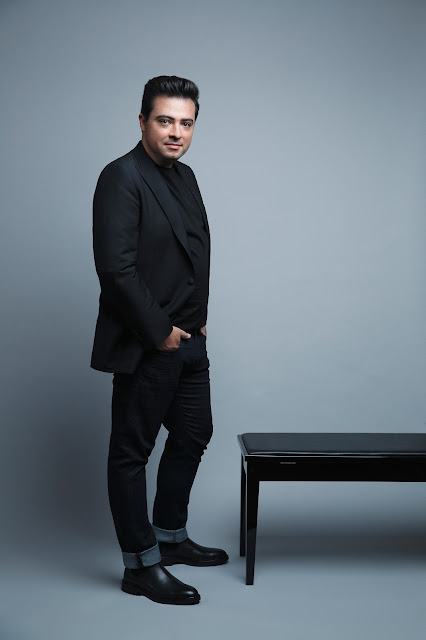
The Northern Chords Festival was created by cellist and conductor Jonathan Bloxham in 2009 in order to bring artists to the North East and to inspire local young people and amateur musicians to follow their dreams. The festival celebrated its 10th anniversary in 2019, and this year returns with a full weekend of events (13 -15 May) in Newcastle, performs at Kings Place in London on 20 March 2022. The festival has now launched its Mentorship Programme.

Jonathan Bloxham explains "The arts sector, and the music industry particularly, has been hit very hard by political and global events of recent years. Nurturing a new generation of talented musicians, many of whom may have missed out on opportunities recently, is essential for the healthy survival of classical music. This is a unique opportunity to work closely with world-leading artists, and our hope is to provide holistic guidance to people who might not otherwise have the access or financial resources."

In its first year the scheme will support four musicians. Northern Chords are looking for applicants specialising in voice, piano, composition and violin. Successful candidates will benefit from one to one online sessions with their mentors, extra sessions with guests such as renowned saxophonist Jess Gillam and well being sessions with Elena Urioste. The culmination of the scheme is a performance opportunity at the 14th Northern Chords Festival, taking place in May 2022, in which the four mentee's will collaborate and present a programme that they have devised together. 

Applications are invited from musicians from all backgrounds and ages pursuing a career in performance. Thanks to the generous support of the Gillian Dickinson Trust, there is no cost to apply or take part in the scheme. The closing date is 21 February 2022. Full details from the festival website.

Vividly theatrical: Irish National Opera's production of Vivaldi's Bajazet at Covent Garden

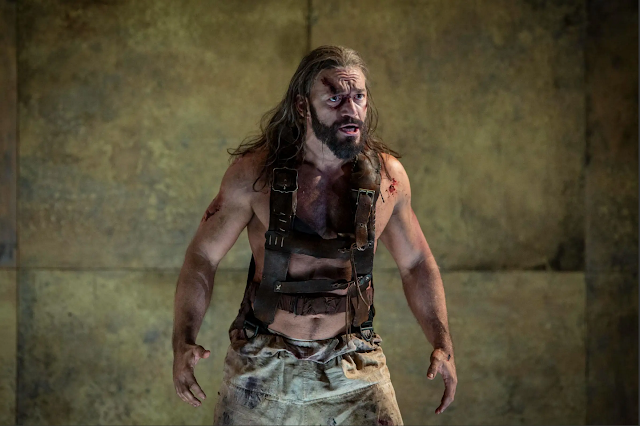
Vivaldi: Bajazet - Gianluca Margheri - Irish National Opera (Photo Kip Carroll)

Vivaldi Bajazet; Gianluca Margheri, Eric Jurenas, James Laing, Niamh O'Sullivan, Claire Booth, Aoife Miskelly, dir: Adele Thomas, Irish Baroque Orchestra, cond: Peter Whelan; Irish National Opera at the Royal Opera House

Reviewed by Robert Hugill on 12 February 2022 Star rating: 5.0 (
★★★★★)
A vividly theatrical evening as the cast of Irish National Opera's production combine brilliant virtuoso singing with highly theatrical performances

Vivaldi's Bajazet (also known as Il Tamerlano) was premiered at the end of his operatic career, in 1735 in Verona. It is in fact a pasticcio, Vivaldi combining elements from his back catalogue and arias from other composers to create a new work, a sort of greatest hits piece where the arias from other composers were ones principally associated with two of the greatest singers of the day, the soprano castrato Farinelli and the contralto Vittoria Tesi. Its the sort of thing common in musical theatre today, but rare in opera. But Vivaldi was a canny operator and the resulting piece is relatively compact and full of engaging music, showy and designed to appeal, yet with some dramatic moments.

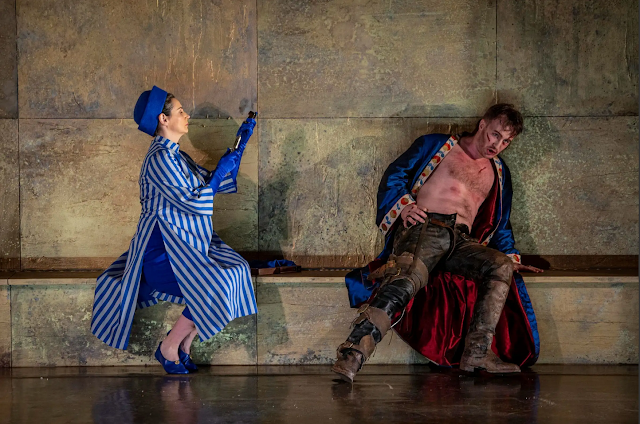
We caught the last night of Irish National Opera's production of Vivaldi's Bajazet at the Royal Opera House's Linbury Theatre on 12 February 2022. The production was directed by Adele Thomas, directed from the harpsichord by Peter Whelan with Gianluca Margheri as Bajazet, James Laing as Tamerlano, Niamh O'Sullivan as Asteria, Eric Jurenas as Andronicus, Claire Booth as Irene and Aoife Miskelly as Idaspe, and the Irish Baroque Orchestra in the pit. Designs were by Molly O'Cathain.

Vivaldi: Bajazet - Aoife Miskelly, James Laing - Irish National Opera (Photo Kip Carroll)

The production (a co-production between Irish National Opera and the Royal Opera House) was something of a little miracle having been planned originally for the period of lockdown. Re-assembling funding and performers to create the production this year was quite an achievement. It opened in Ireland on 16 January 2022, doing a seven date tour before the six performances at the Royal Opera House.

Vivaldi's opera uses Agostino Piovene's libretto which was originally set by Francesco Gasparini in Venice in 1711. In fact Gasparini made two settings of the libretto, the second in 1719 and it was this latter setting which influenced Handel's Tamerlano. [see my review of the recording of Gasparini's 1719 Il Bajazet on Glossa] For Gasparini in 1719, Ippolito Zanella vastly expanded the role of Bajazet in the opera, and this was taken over by Handel. By contrast, Vivaldi's 1735 opera relies on the original 1711 libretto, so the role of Bajazet is more discreet, there is no long, long throne room scene (in Handel, the longest single scene of recitative that he composed) or Bajazet's on-stage death scene, though the outlines of the story are still those familiar from Handel's opera.

It was illuminating seeing the opera in the light of my recent interview with director Dionysios Kyropoulos about applying historical stagecraft to the forthcoming production of Handel's Tamerlano in Cambridge [see my interview], especially as the two productions share the same singer as Tamerlano, James Laing.

Sunday, 13 February 2022

A programme of lesser known 18th century arias demonstrates just how much music we are missing

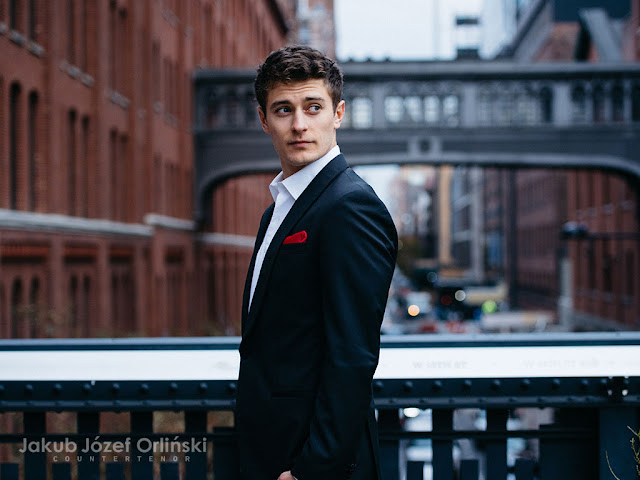
Jakub Jozef Orlinski (Photo Jiyang Chen)

Janez Krsnik Tolar, Georg Reutter, Antonio Lotti, Nicola Conti, Francisco Antonio de Almeida, Baldassare Galuppi, Gaetano Maria Schiassi, Bartolomeo Nucci, Antonio Vivaldi, Giuseppe Antonio Brescianello, Johann Joseph Fux, David Perez, Handel; Jakub Józef Orliński, Il Pomo d'Oro, Francesco Corti; Wigmore Hall

Reviewed by Robert Hugill on 10 February 2022 Star rating: 4.0 (★★★★)
Hot from his triumphs in Handel's Theodora at Covent Garden, the Polish countertenor devastates and dazzles in a programme of music by Handel's lesser known contemporaries.

I think we sometimes forget quite how much music was created in the 18th century. Great swathes have been lost, but much survives. Composers were largely local men, and texts would be pass around, taking different settings in each town. There are composers whose reputation nowadays rests on a single piece, if that. This is something of the back story to counter-tenor Jakub Józef Orliński's recital on Thursday 10 February 2022 at Wigmore Hall with Il Pomo d'Oro, conductor Francesco Corti. It was a programme of instrumental items and arias by composers many of whom who were often merely names, Janez Krsnik Tolar, Georg Reutter, Antonio Lotti, Nicola Conti, Francisco Antonio de Almeida, Baldassare Galuppi, Gaetano Maria Schiassi, Bartolomeo Nucci, Antonio Vivaldi, Giuseppe Antonio Brescianello, Johann Joseph Fux, David Perez and one George Frideric Handel.

It has to be admitted that for many of the pieces, it was the sound of the music, the composer's invention and Orliński's performance which came to the fore, rather than the composer's interpretation of the text. For many of these composers, showing off the soloist's voice came high on the list of requirements. Many of the arias in the programme were stunningly virtuosic, and not all managed to capture the emotion behind the text. Yet this was an engaging window onto a world which is often forgotten. Whilst we might not necessarily want to listen to, say, Fux's oratorio Il fonte della salute aperto dalla grazia nel Calvario every day, getting to sample one of the stunning arias was pure delight.

Saturday, 12 February 2022

György Cziffra: Pianist János Balázs on celebrating the great Hungarian's centenary & continuing his artistic legacy

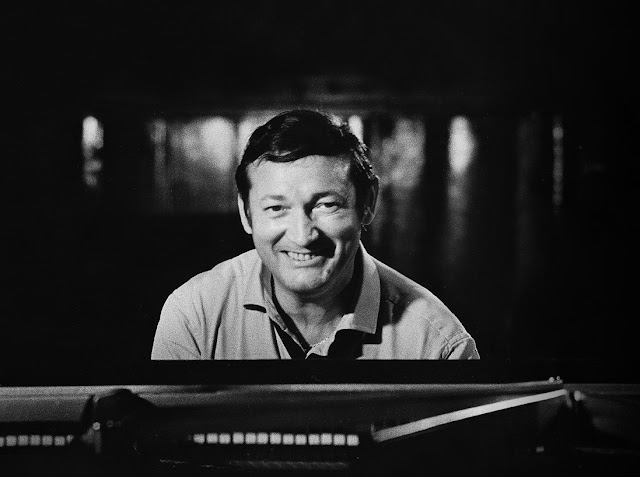
George Cziffra
George Cziffra

2021 was the centenary of the Hungarian pianist and composer György Cziffra, and there have been world-wide celebrations under the auspices of the György Cziffra Festival. The modern day Hungarian pianist János Balázs, who founded the festival, is determined to keep Cziffra's memory alive and celebrate Cziffra's art, both in organising the festival and in his own concerts and recordings.

János Balázs (Photo Emmer Laszlo0

Born in Budapest in 1921, Cziffra's father was a cabaret artist who had lived in Paris prior to the First World War. Cziffra studied at the Franz Liszt Academy in Budapest but was conscripted during the Second World War and ended up a prisoner of war in Russia. After the war he played in bars and clubs in Budapest, as well as touring Europe with his jazz band. After trying to escape communist Hungary in 1950, Cziffra was imprisoned but finally left in 1956, becoming a French citizen in 1968 and creating the Cziffra Foundation in 1977. He died in 1994.

For János, Cziffra was a totally unique spirit in the 20th century and his style was very different to that of other pianists, classical but always with a style of improvisation and Cziffra's style of pianism comes from the Liszt school. Cziffra was a great grand-pupil of Liszt - at the Franz Liszt Academy, Cziffra studied with Erno Dohnányi (1877-1960) whose teacher was István Thomán (1862-1940), who was a favourite pupil of Franz Liszt. 

And János wishes to celebrate the freedom that Cziffra brought to his music, an improvisatory freedom that 19th century performers brought to the performances but which is not so common now. János wants to show this to the public, and the festival seeks to find artists who can perform in this style. János is also celebrating a proud Hungarian tradition of pianism exemplified not just by Cziffra but by such artists as the pianist Annie Fischer (1914-1995).

Whilst Cziffra never played other than from the score, he did so in a spirit and style that was free and full of colours, and totally himself. He wanted to share this style and energy with the public, feeling that it was important that in each concert the audience got something new. He played a lot of jazz, light music and transcriptions, something that was accepted in the Romantic tradition where performers would play whatever they felt inclined to. Nowadays, János sees performing as often being weighted towards perfection, avoiding risk, and he wants his festival to show the passion and style of performing in the Cziffra tradition.

Friday, 11 February 2022

The Politics of Polyphony


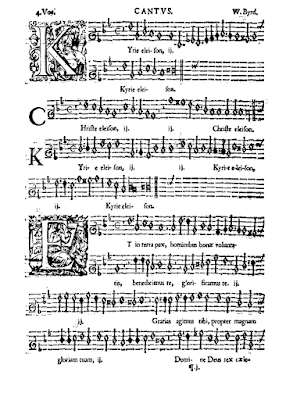
Front cover of the "Kyrie Eleison" from the Mass for Four Voices by William Byrd (c.1540–1623), probably published in London by Thomas East
Front cover of the "Kyrie Eleison" from Byrd's Mass for Four Voices
probably published in London by Thomas East

In 1605, Charles de Ligny, a French aristocrat visiting London, was arrested and imprisoned as a spy.  The evidence against him was a book of music he was carrying with him.  How could music be so dangerous that mere possession of it could get you thrown into prison?

This is the fascinating background to The Fourth Choir's forthcoming concert, The Politics of Polyphony at the church of St Bartholomew the Great on Saturday 19 March 2022. Conducted by Jamie Powe, the choir will be performing music from the earliest beginnings of polyphony through the complexities of the Reformation and the Counter-Reformation, including a music from one of William Byrd's masses which were written for masses celebrated covertly and illegally by England's proscribed Roman Catholics and were published without title pages and in a way that made concealment easier.

The choir will also be performing music by more recent and contemporary composers in the same tradition including works by Judith Weir, Kerry Andrew, Rosephanye Powell, R. Nathaniel Dett and Francis Poulenc.

The Fourth Choir was founded in September 2013 by a group of LGBT + singers aspiring to sing classical and modern choral works to the highest possible standard. Our goal is to represent the LGBT + community on London’s world-class classical music scene.

Full details from the choir's website.

Celebrating Pauline Viardot

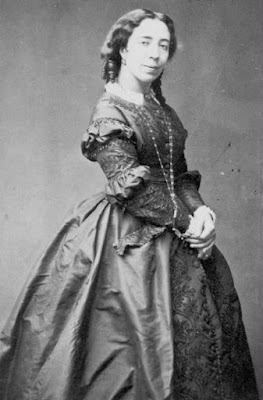
Pauline Viardot
Pauline Viardot
Pauline Viardot's bi-centenary occurred last year (she was born in 1821). She is a performer the magnitude of whose career it is difficult to grasp without any recordings, and it is still complicated for us to understand quite how significant it was that she managed to carve out a significant career for herself as singer, teacher, composer, salon-iste as an independent woman. Saint-Saens' dedicated Samson et Dalila to her, but she declined to perform the work saying she was too old, Meyerbeer made sure the premiere of Le prophete took place at a time which meant that she could create the important role of Fides, and Berlioz created his version of Gluck's Orfeo ed Eurydice specifically for her. Her own songs do not always seem to reach the intense heights that of these operas, but it is only through her song that the voice of Pauline Viardot can speak to us today.

A weekend of events celebrating Viardot's bi-centenary is being held in Oborne, Dorset from 1 to 3 April 2022. VIARDOT200: Prima Donna, Composer, Muse and Inspiration is being presented by Cameratina, and will feature Viardot's final opera, Cinderella in a new translation by Jeremy Sams performed by a cast of young singers including Claire Lees, Katy Thomson, Georgia Mae Bishop, Alison Rose, Liam Bonthrone, Robert Lewis, and Kieran Rayner, with pianist Susanna Stranders (artistic director of Cameratina), driected by Cecilia Stinton. Mezzo-soprano Katie Bray will be giving a recital of Viardot's songs along new work by Dani Howard and Lilly Vadaneaux setting words by Ivan Turgenev, who had a long running affair with Viardot.

The Turgenev connection is an interesting one, Viardot would set a number of Russian poets in her own songs and she and Turgenev collaborated on several operas. These were written for her students, as well Cinderella, though this latter had no involvement from Turgenev. 

Full details from the Cameratina website.

Michael Wilmering & Daan Boertien in 'Gute Nacht' from Schubert's Winterreise

Schubert was just 30 when he wrote Winterreise yet such is the music's power and depth that we tend to associate the cycle with the experience of older performers, yet in many ways this is young man's (or woman's) music. And the cycle is wide enough and deep enough to warrant any number of performers and recordings. 

The Dutch record label TRPTK produces acoustically sophisticated recordings and they have ventured a new recording of Winterreise with two young performers, Michael Wilmering (baritone) and Daan Boertien (pianist). They have produced three one-take videos of songs from the cycle, 'Gute Nacht' (above), 'Die Krähe' and 'Erstarrung' recorded at Westvest90 Church in Schiedam, and they make an excellent taster for the complete recording.

See TRPTK website for more details.

Mélodies: French song and Czech rarities from two young Czech singers

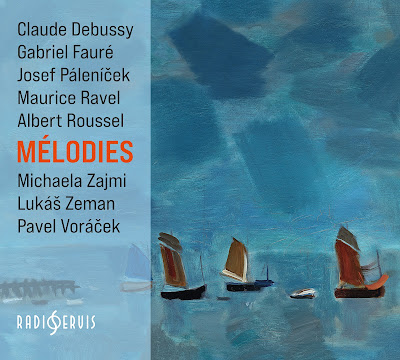
Ravel, Faure, Roussel, Debussy, Josef Páleníček; Lukáš Zeman, Michaela Zajmi, Pavel Voráček; Radioservis Reviewed by Robert Hugill on 9 February 2022 Star rating: 3.0 (★★★) Songs by the 20th century Czech composer Josef Páleníček alongside those of his teacher Roussel and other French composers  Radioservis is a record label owned by Czech Radio (Český Rozhlas), and a recent disc from them is an engaging recital which features two young singers, Lukáš Zeman (baritone) and Michaela Zajmi  (mezzo-soprano) with pianist Pavel Voráček in a programme that mixes songs by Ravel, Faure, Roussel and Debussy with songs by the Czech composer Josef Páleníček including his Songs of Ancient China.

Ravel, Faure, Roussel, Debussy, Josef Páleníček; Lukáš Zeman, Michaela Zajmi, Pavel Voráček; Radioservis

Reviewed by Robert Hugill on 9 February 2022 Star rating: 3.0 (★★★)
Songs by the 20th century Czech composer Josef Páleníček alongside those of his teacher Roussel and other French composers

Radioservis is a record label owned by Czech Radio (Český Rozhlas), and a recent disc from them is an engaging recital which features two young singers, Lukáš Zeman (baritone) and Michaela Zajmi  (mezzo-soprano) with pianist Pavel Voráček in a programme that mixes songs by Ravel, Faure, Roussel and Debussy with songs by the Czech composer Josef Páleníček including his Songs of Ancient China.

Josef Páleníček (1914-1991) studied in Prague and then in Paris in the 1930s, where his teachers were Albert Roussel (composition) and Alfred Cortot (piano). He is a name that is not particularly well known in the West though Páleníček composed a significant body of work. On the disc his song cycles are interleaved with the French ones in a way that works perhaps because there was something a little traditional about Páleníček's style, though the fact that after the war he lived in Czechoslovakia under Communist domination would explain an element of conservatism (and according to Wikipedia he became a member of the Communist Party).

Thursday, 10 February 2022

Les Salons en musique 2022

Les Salons en musique at the Institut Français being their 2022 season with a fascinating concert that blends old and new. On 17 February 2022, Ensemble Hope will be performing a programme that mixes Purcell, Bach, Handel, Satie, Falla, with Dorothea Hoffmann, Roger Steptoe, Gualtiero Dazzi, Frédéric Bousquet, Harmonice Mundi, J  Horrocks , Jean-Michel Hasler, Marc Antoine Million, and Bruno Giner. What makes the trio fascinating, however, is their instrumental line up - Armelle Marq, soprano, Frédéric Bousquet, euphone, Marc Antoine Millon, bass euphone. A Euphone is a development of the glass harmonica and the ensemble uses a modern Titanium Euphone, but the promise also a Crystal Organ, and the Baschet sound sculptures.

The 2022 series at the institute has a particular contemporary focus with music in the season by Arthur Sajas, Marc Antoine Millon, Dorothea Hofmann, Roger Steptoe, Gualtiero Dazzi, Frédéric Bousquet, Jean-Michel Hasler, Karol Beffa, Camille Pépin, Kaija Saariaho, Thomas Keck, Sofia Gubaidulina and Raphaël Imbert.

For the second concert in the series, on 10 March 2022, the French ensemble L'hostel dieu transports us to 17th century London. With mezzo-soprano Axelle Verner they perform music by Purcell, Playford, Lanier, Eccles, and Locke. Then on 14 April, Ensemble Diabolus in Musica conducted by Nicolas Sansarlat and Ensemble Alla Francesca conducted by Brigitte Lesne, join forces to transport us to 12th century Paris with Notre-Dame, the voice of cathedrals, mixing plainchant, music from the 12th century Notre Dame school with other music from the period.

Further ahead, there is a tribute to Marcel Proust on the centenary of his death, a concert that mixes French contemporary and 20th century music with traditional music from the British Isles, and a song recital from soprano Marie-Laure Garnier and pianist Célia Oneto Bensaid.

Full details from the institute's website.

In the shadow of men? Germaine Tailleferre's four little comic operas get a rare outing at Shenandoah Conservatory in the USA

Germaine Tailleferre
She lived to be well over 90 and continued to compose until a few weeks before her death, yet the name Germaine Tailleferre is only ever associated with one thing, that she was the only female member of Les Six. Her surviving output is large, and there might have been even more; she was forced to abandon many scores when she fled France during the War and kept track of neither her manuscripts nor her royalties.

She studied at the Paris Conservatory against her father's wishes, and she had two husbands (one American in the 1920s and one Frenchman in the 1930s), neither of whom wanted her to compose music and the second was also abusive. And it should be noted that her modern style of composition in the 1920s, when she was associated with Les Six, only really came about after her father's death in 1917 when she had more freedom. And she changed her name to Tailleferre from Taillefesse in order to spite her father!

Yet throughout she continued to compose music (with some inevitable gaps), at one point taking to film music to earn much needed income. She would say of this "I know that it is not grande musique. It is light and gay music, which explains why sometimes I am compared to the petits maitres of the 18th century, and I am very proud of this". And a fellow member of Les Six, Georges Auric would say of her, "She had little flair for the politics of success". (And indeed Auric himself turned to film music and would write music for such films as Passport to Pimlico).

Before the War she wrote the operas Zoulaïna and Le marin de Bolivar, and her masterwork, La cantate de Narcisse, in collaboration with Paul Valéry. Then after the War there were at least two ballets, plus the operas Il était un petit navire (with Henri Jeanson), Dolores, La petite sirène (with Philippe Soupault, based on Hans Christian Andersen's story The Little Mermaid), and Le maître (to a libretto by Ionesco), the musical comedy Parfums,

In 1955 she and librettist Denise Centore would create a cycle of five little operas, Du style galant au style méchant. Perhaps there was something in the air as another member of Les Six, Darius Milhaud would be rather fond of creating tiny operas too. Tailleferre's were written for French radio and each one was written in the style of an earlier composer. Only four survive, they are La fille d'opéra (a parody of Rameau), Le bel ambitieux (a parody of Rossini), La pauvre Eugénie (a parody of Charpentier), and Monsieur Petit Pois achète un château (a parody of Offenbach) and they still do not seem to be well known. These are charming pieces, designed to amuse and the writing is vastly different from Tailleferre's 1920s style. 

Germaine Tailleferre in old age with baritone & actor Mario Hacquard

The director Ella Marchment (who will be familiar to British readers through her roles with SWAP'Ra, the International Opera Awards, the Helios Collective and many, many more) is currently director of opera at Shenandoah Conservatory in the USA and will be staging Tailleferre's four operas with her students next month (22-24 April 2022).  Each of the four operas will be augmented by inclusion of overtures from the composers on which the four operas are styled, and Marchment comments "Is it ironic that even now in order to be remembered a woman had to attach herself to men (to Poulenc and Milhaud through Les Six), and to these other composers through these operatic works. Was Tailleferre forced to live in the shadows or others or was this a box that she consciously chose to put herself in time and time again under a false belief that she was her own agent."

And Marchment's approach to the staging will be firmly focused on Tailleferre herself, "The show opens as Tailleferre struggles to complete her four operettas in time to make her deadline set by Radio France. She has moved to the South of France and is under pressure to support her daughter Françoise through her composition. She is no longer composing art for arts sake, but accessible music that is guaranteed to please and earn her enough money to support her family ... It is only when these operas are finally completed does Tailleferre free her imagination to live as she truly wishes too, and the closing scene of the opera sees her entering her imaginative world and reclaiming it for her own true self. "

Ella Marchment will be directing Germaine Tailleferre's four comic operas from Du style galant au style méchant at Shenandoah Conservatory of Music, 22-24 April 2022.

Further ahead, Ella will be back in the UK to direct the UK premiere of Mark Adamo's Little Women at Opera Holland Park.

Wednesday, 9 February 2022

Orchestra of the Swan celebrates the centenary of Walton's Façade on SOMM

Walton Facade, Henry V; Roderick Williams, Tamsin Dalley, Kevin Whately, Orchestra of the Swann, Bruce O'Neil; SOMM

Walton Façade, Henry V; Roderick Williams, Tamsin Dalley, Kevin Whately, Orchestra of the Swann, Bruce O'Neil; SOMM

Reviewed by Robert Hugill on 8 February 2022 Star rating: 4.0 (★★★★)
Celebrating the centenary of Walton's Façade, a lively and characterful new recording alongside the music for Henry V

William Walton's Façade, the entertainment using poems by Edith Sitwell, premiered in 1922 and to celebrate the Centenary, SOMM Recordings has issued a new disc which pairs Walton's Facade with his music from Henry V performed by Roderick Williams, Tamsin Dalley, Kevin Whately and the Orchestra of the Swan, conductor Bruce O'Neil, musical director of the Royal Shakespeare Company.

It is difficult to quite fathom the fuss the surrounded the premiere of Façade in 1922. Partly it was because the Sitwells were great self-publicists and loved to generate a stir, but there were boos and catcalls at the first public performance (in the Aeolian Hall) and press was generally condemnatory. But within a decade the music had been turned into a ballet (by Sir Frederick Ashton) and the piece was turning into something of an icon. Those first performances had Edith Sitwell reciting (through a type of megaphone invented for Fafner in the 1876 Ring Cycle at Bayreuth) and Walton conducting. In 1930, Leslie Heward conducted the work for the BBC with the reciters being Sitwell and Constant Lambert. Walton would later say that Lambert was the best reciter, closely followed by Sir Peter Pears.

Ryan Summers: Deeply Divided

Ryan Summers is a musician based in Marshfield, Wisconsin. His album, Deeply Divided, is his latest instrumental release, and it blends his musical first love, the piano, with an arsenal of modern synthesizers. Written during the 2020 pandemic chaos, he intends the music to serve as a metaphor reflecting the divided reality we now face. The video we feature is the last track from the album, Unplanned Escape, available on YouTube.

Deeply Divided is available from Bandcamp, and more information about Ryan from his website.

English Symphony Orchestra launchs its 2022 concert season

English Symphony Orchestra & Kenneth Woods

Having been extremely busy online, the English Symphony Orchestra has announced the launch of its 2022 concert season under conductor Kenneth Woods, with concerts during March to June 2022 in Hereford, Great Malvern, Cheltenham, Leominster, and Worcester.

One of the threads running through the season is Mozart, with three of the late symphonies plus the Adagio and Fugue. There are two concertos by Philip Sawyers, his Double Concerto with Daniel Rowland (viola) and Maja Bogdanovic (cello), and the Viola Concerto with Daniel Rowland. Whilst concerto lovers can also catch Zoe Beyers as the soloist in Tchaikovsky's Violin Concerto. 

Other contemporary pieces include Bob Chilcott's St John Passion (written for Wells Cathedral in 2013), with Academia Musica Choir. Twentieth century music includes a couple of relative rarities, Poulenc's Sinfonietta, a lovely work that does not come out as often as it should, and Schulhoff's Suite for Chamber Orchestra. The Schulhoff features in a concert which also includes The Great Caruso, tenor Mark Milhofer's tribute to the great tenor.

Next week (18-22 February 2022), the orchestra's online season includes a concert that pairs Robert Saxton's The Resurrection of the Soldier with Philip Sawyers' Octet and Remembrance for Strings.

Full details from the English Chamber Orchestra's website.

Tuesday, 8 February 2022

Celebrating the BBC orchestras and the BBC Singers

Sir Adrian Boult & the BBC Symphony Orchestra in 1932 (image from a Pathe newsreel)
Sir Adrian Boult & the BBC Symphony Orchestra in 1932
(image from a Pathe newsreel)

There is sometimes a general tendency to take the BBC's performing groups for granted, only really taking notice of them when their existence is threatened. But across the country, they do amazing work, both live and broadcast, supporting a wide range of contemporary composers from Jonny Greenwood to Sir Harrison Birtwistle, and providing a core backbone of performance that it is sometimes easy to take for granted. This weekend (11-13 February 2022), the BBC is celebrating its centenary with BBC 100 and as part of that is celebrating its performing groups, with each one being broadcast in a celebratory performance. And there is plenty of excitement ahead too, as Ryan Wigglesworth has been announced as the BBC Scottish Symphony Orchestra's next chief conductor.

They have a long history (though interestingly, the oldest broadcasting orchestra in the world is in Japan). But the majority of the performing groups have their origins in the 1920s and 1930s. There have been losses, the BBC Northern Singers for instance, but the track record is strong. 

In 1922 the 2ZY Orchestra, the precursor to the BBC Philharmonic, gave its first performance on the 2ZY radio signal in Manchester, one of two frequencies used to launch the BBC. The BBC Wireless Singers, who later became the BBC Singers, were formed in 1924 and the BBC National Orchestra of Wales gave its first performance in 1928. The BBC Symphony Orchestra came into being under the direction of Adrian Boult in 1930, whilst the BBC Concert Orchestra traces its roots back to the BBC Theatre Orchestra formed in 1931 and the BBC Scottish Symphony Orchestra was established in 1935.

The BBC Wireless Singers in 1934 (Photo BBC)

So there are concerts from each group over the weekend: 

  • Semyon Bychkov conducts the BBC Symphony Orchestra in a programme that includes the UK premiere of Bryce Dessner's Mari and Richard Strauss' Burleske with soloist Kirill Gerstein
  • Ryan Bancroft conducts the BBC National Orchestra of Wales in a concert that includes music by Sebastian Hilli and Grace Williams' Elegy for String Orchestra
  • Anna-Marie Helsing conducts the BBC Concert Orchestra in a programme that ranges from RVW, Eric Coates and Malcolm Arnold to Anne Dudley and Xia Sloane, with vocalist Claire Teale
  • Omer Meier Welber conducts the BBC Philharmonic in music by Hindemith and Tippett plus the UK premiere of Aziza Sadikova's Marionettes and Schumann's Piano Concerto with  Eliso Virsaladze
  • Andrew Gourlay conducts the Ulster Orchestra in a programme that combines Sir Hamilton Harty's Piano Concerto (which the composer premiered as soloist with Sir Thomas Beecham conducting the Halle Orchestra) and Conor Mitchell's Democracy Dances
  • Howard Goodall conducts the BBC Singers in RVW's Mass in G minor plus music by Judith Weir, Melissa Dunphy, Roxanna Panufnik, Philip Cooke, Errollyn Wallen and the European premiere of Goodall's Unconditional Love
  • Ryan Wigglesworth celebrates his forthcoming role with the BBC Scottish Symphony Orchestra by conducting them in a programme of Strauss and Berg, plus his own Five Waltzes with soprano Katherine Broderick and viola player Scott Dickinson

Ryan Wigglesworth takes over as chief conductor of the BBC Scottish Symphony Orchestra in September 2022. He returns to Glasgow in May 2022 to conduct the orchestra in a programme of Mozart (directed from the piano) and Jörg Widmann (the orchestra's artist in residence). His debut with the orchestra as chief conductor will be on 22 September 2022.

Full details from the BBC website.

Razor sharp satire and full-blooded passion: English Touring Opera's Spring Tour

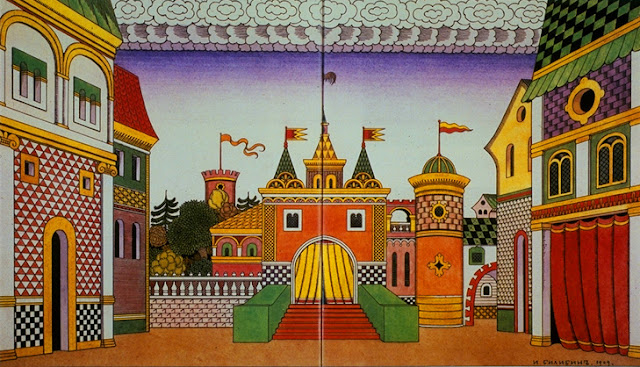
Ivan Bilibin's 1909 stage set design for Act 2 of Rimsky-Korsakov's The Golden Cockerel

Rimsky Korsakov's operas tended towards the large-scale, with subject matter inspired by Russian folklore. He regarded The Legend of the Invisible City of Kitezh and the Maiden Fevroniya (which premiered in 1907) as his final opera, a summation of his art and it has been compared to Wagner's Parsifal. But the political situation in Russia with the disastrous Russo-Japanese war, led Rimsky-Korsakov to complete one last opera. This was rather different to his earlier operas, this is a compact piece and a "razor-sharp satire of the autocracy, of Russian imperialism, and of the Russo-Japanese war".

Based on a poem by Alexander Pushkin, the work debuted in 1909, after the composer's death. There were some censorship problems with the work, and it became known in the West when Diaghilev's Ballets Russes staged it (performing it as an opera ballet). 

I first came across it in the late 1970s when David Pountney's delightful production was a staple at Scottish Opera. So much so, that it was something of a surprise to realise that it was actually a relatively rare work. The Royal Opera staged it in 1998 at Sadler's Wells, Theatre in a rather grim production by Tim Hopkins, but I am not sure whether the piece has been done much in London since.

One of the work's challenges is its casting, whilst the Queen of Shemakha's aria is often in coloratura soprano's repertoires, the opera also has a spectacularly high tenor part for the Astrologer (Scottish Opera experimented with both tenors and counter-tenors in this role).

Now we are going to get a chance to see it again, as English Touring Opera's Spring tour features a new production of Rimsky Korsakov's The Golden Cockerel directed by James Conway (who steps down as artistic director this year) and conducted by the company's music director, Jerry Cornelius with a cast including Paula Sides, and Grant Doyle. Alongside this, the company will be touring a revival of James Conway's 2015 production of Puccini's La Boheme conducted by Dionysis Grammenos with Francesca Chiejina / Paula Sides, Luciano Botelho / Thomas Elwin, Jenny Stafford / April Koyejo-Audiger, and Michel de Souza / Jerome Knox.

The company will also be touring its staging of Bach's St John Passion with professional soloists and the Old Street Band, conductor Jonathan Peter Kenny, with contributions from 30 regional choirs.

The tour opens at the Hackney Empire on 26 February 2022, and continues until 3 June 2022, full details from the English Touring Opera website.  A tour which features 21 performances of La Boheme, and performances of The Golden Cockerel in 13 venues across the country.

In the midst of things: chamber music by Karl Fiorini

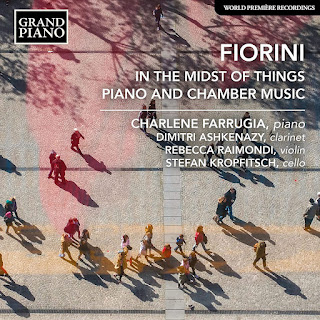
Karl Fiorini In the Midst of Things - piano and chamber music; Charlene Farrugia, Dmitri Ashkenazy, Rebecca Raimondi Stefan Kropfitsch; Grand Piano

Karl Fiorini In the Midst of Things - piano and chamber music; Charlene Farrugia, Dimitri Ashkenazy, Rebecca Raimondi Stefan Kropfitsch; Grand Piano

Reviewed by Robert Hugill on 7 February 2022 Star rating: 3.0 (★★★)
A retrospective of piano and chamber music by Karl Fiorini, Maltese by birth, European by instinct

In the Midst of Things, on the Grand Piano label, is a retrospective of piano and chamber music from the last 20 years by composer Karl Fiorini, featuring his Trio Lamina for clarinet, violin and piano, Two piano etudes, Piano Trio, Piano Sonata and In the Midst of Things for clarinet, violin, cello and piano, performed by Charlene Farrugia (piano), Dimitri Ashkenazy (clarinet), Rebecca Raimondi (violin) and Stefan Kropfitsch (cello).

Maltese by birth, Karl Fiorini studied in Malta with Charles Camillieri and Joseph Vella, and in London with Diana Burrell and Michael Zev Gordon. He founded the Valletta International Spring Festival in 2007, and now lives in Paris. His output includes two violin concertos, a symphony, opera and song, as well as chamber music. The works on this disc span nearly 20 years, and he describes them as all being composed during transitional moments in his life, both personal and artistic.

Monday, 7 February 2022

A Merry Mikado

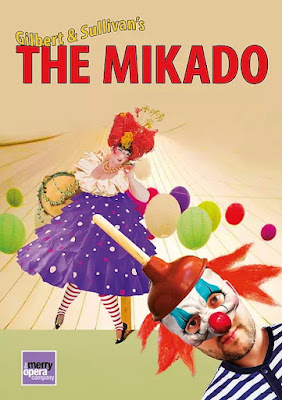
The Merry Opera Company - The Mikado
There seems to be quite a lot of Gilbert & Sullivan around at the moment, which is rather a good thing. The Merry Opera Company debuted its exuberant new production in Autumn 2021, and they are beginning a tour across Southern England with a residency at the Chelsea Theatre (15 to 27 February 2022). 

The production is directed by John Ramster with musical direction by Bradley Wood, and a strong cast including Anna Sideris, Christopher Faulkner and Susan Moore, and we are promised much good-humoured frivolity, and what could be better!

Full details of the London performances from the Chelsea Theatre website, and full details of the tour to Tunbridge Wells, Loughton, Chipping Norton, Broadstairs, Petersfield, Beccles, from the company's website.

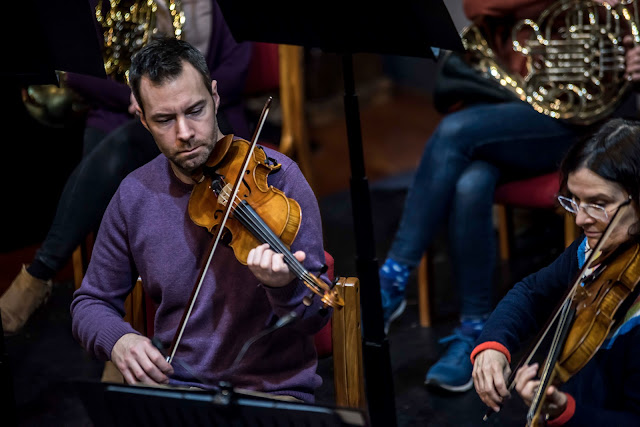
Principal string players of Northern Chamber Orchestra in the ensemble's first visit to Chester

Northern Chamber Orchestra in Macclesfield in January 2022 (Photo Chris Payne)

Over the weekend there is a chance to hear musicians from the string section of the Northern Chamber Orchestra in more intimate mode, as the principal string players, led by artistic director Nicholas Ward (violin), perform a programme of string quartets, Haydn's String quartet in C op. 33 No. 3 Bird, Beethoven's String quartet in F op. 135, and Dvorák's String quartet op. 96 American in Christ Church in West Didsbury, Manchester (12/2/22) and Storyhouse, Chester (13/2/22), the ensemble's first visit to Chester.

Further ahead, in May, they return to both venues with a larger ensemble performing Rossini's String Sonata No. 3 in C, Mozart's Horn Quintet in E flat major, Richard Strauss's Till Eulenspiegel, Einmal Anders op. 28, Franz Hasenöhrl brilliant de-construction of Strauss' tone poem for quintet, and Beethoven Septet in E flat major op. 20.

Full details from the Northern Chamber Orchestra's website.

Hareflight celebrates the dramatic potential of the irreconcilable.

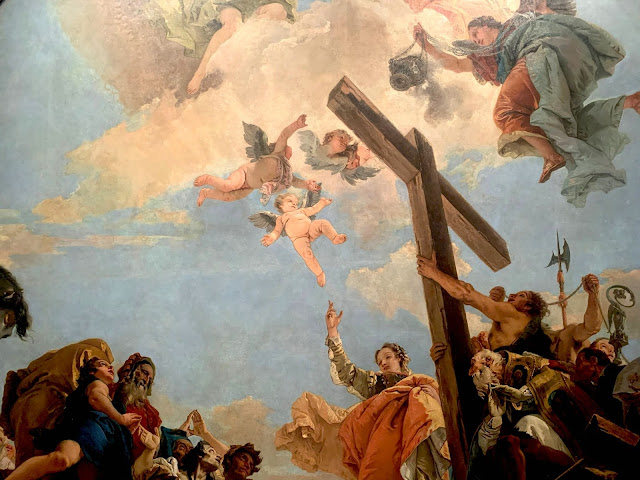
Tiepolo: The Discovery of the True Cross

Composer Alastair White, having completed his trio of fashion operas ROBE, RUNE, and WOAD [see my review of the recent recording of WOAD], has a new opera debuting later this month. Hareflight, a new opera for tenor and flute, debuts at Leicester Guildhall on 25 February 2022, performed by flautist Jenni Hogan and tenor Niki Zohdi.

White explains, "Hareflight explores the relationship between truth and knowledge, dramatising motion, light and even affect to propose an aesthetic of the thought or dance which moves faster than its crystallisation into sentence or gesture. The team and I were very much inspired by The Discovery of the True Cross by Tiepolo, taking the painter’s radical apprehension of both the infinite and the apparent, an idea we’ve tried to unpack through a language of developmental speed, interpretive complexity and paradox.

The opera hopes to offer evidence of the imperceptible (or that which is beyond the listening individual’s apprehension) as a significant aesthetic force. And, in turn, to prove the hypothesis that certain relations exist as material instances external to musical objects. In opposition to trends that sanitise collisions of meaning between opposing models, Hareflight celebrates the dramatic potential of the irreconcilable."

Hareflight is part of UK New Artists' City Takeover which brings over 75 artists to the Leicester between 25 and 27 February 2022 to present work and share ideas, celebrating some of the very best of contemporary arts being made in the UK today 

Love Island? Tim Albery at Opera North takes an intense, modern look at Handel's Alcina

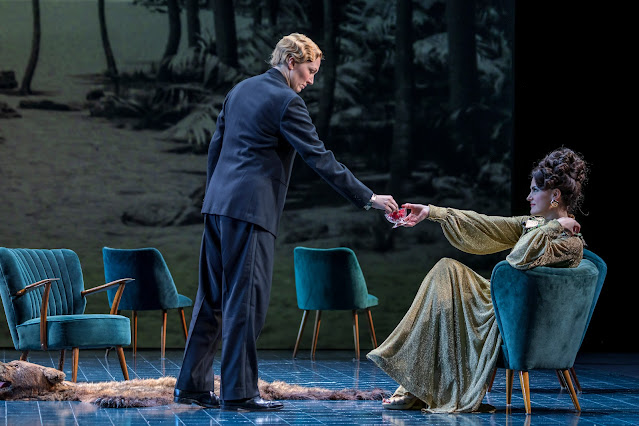
Handel: Alcina - Mari Askvik, Máire Flavin Flavin - Opera North (Photo James Glossop)
Handel: Alcina - Mari Askvik, Máire Flavin - Opera North (Photo James Glossop)

Handel Alcina; Máire Flavin, Fflur Wyn, Mari Askvik, Patrick Terry, Nick Pritchard, dir: Tim Albery, cond: Laurence Cummings; Opera North at Grand Theatre, Leeds

Reviewed by Robert Hugill on 5 February 2022 Star rating: 4.5 (★★★★½)
Proudly sustainable and highly imaginative, Tim Albery's new production of Alcina brings out the characters' intense emotional journeys

Handel was rather fond of enchantresses; they pop up in his operas both early and late. It wasn’t the power per se that seems to have interested him but the ability it conferred for the character to be whatever she wanted to be. Sorcery, enchantment gave female characters agency so Handel’s enchantresses are always interesting and usually transgressive, ‘bad girls’ if you will. Alcina is one of Handel’s last enchantresses, and since the Handel opera revival of the early 20th century she has been on regular display.

Tim Albery’s new production of Handel’s Alcina for Opera North opened at the Grand Theatre, Leeds on Saturday 5 February 2022 with Mari Askvik as Bradamante, Claire Pascoe as Melissa, Fflur Wyn as Morgana, Máire Flavin as Alcina, Patrick Terry as Ruggiero and Nick Pritchard as Oronte. Laurence Cummings conducted, designs were by Hannah Clark, lighting by Matthew Richardson and video by Ian William Galloway.

Like most modern directors, Tim Albery was uninterested in Alcina’s magic for its own sake, there was none of the vivid theatrical display beloved by Handel’s contemporaries. Instead, this magic enables Alcina to live a life of isolated contentment, indulging herself as she pleases. A production of Alcina set in an oligarch’s luxury villa would, in many ways, work dramaturgically, though sometimes I do long for a production with the theatrical dazzle of the 18th century and an ending completely true to the libretto.

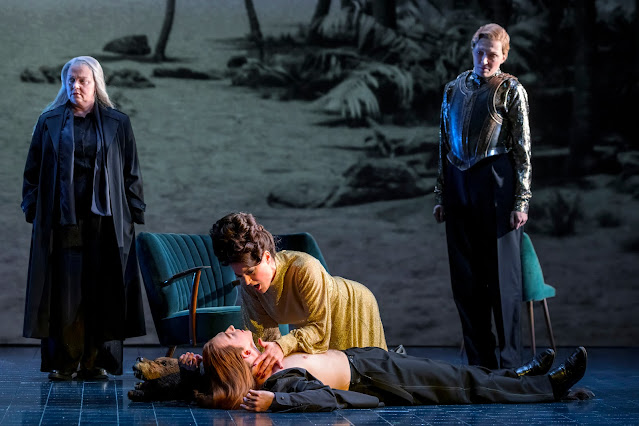
Handel: Alcina - Claire Pascoe, Patrick Terry, Máire Flavin, Mari Askvik - Opera North (Photo James Glossop)

Here we were in the realm of the imagination. The production is proudly sustainable, so the costumes were pre-loved, with 1950s and 1960s glamour a key theme, the women creating their own magic. At the opening there was a bare stage with just lighting rig and chairs (1960s style velour bucket seats), then as Melissa entered, the lighting rig raised up and the video started. This created the journey to Alcina’s island with its lush tropical vegetation, which made a big contrast with the velour chairs. But that is the idea; Alcina’s enclave is not at all natural.

Popular Posts this month