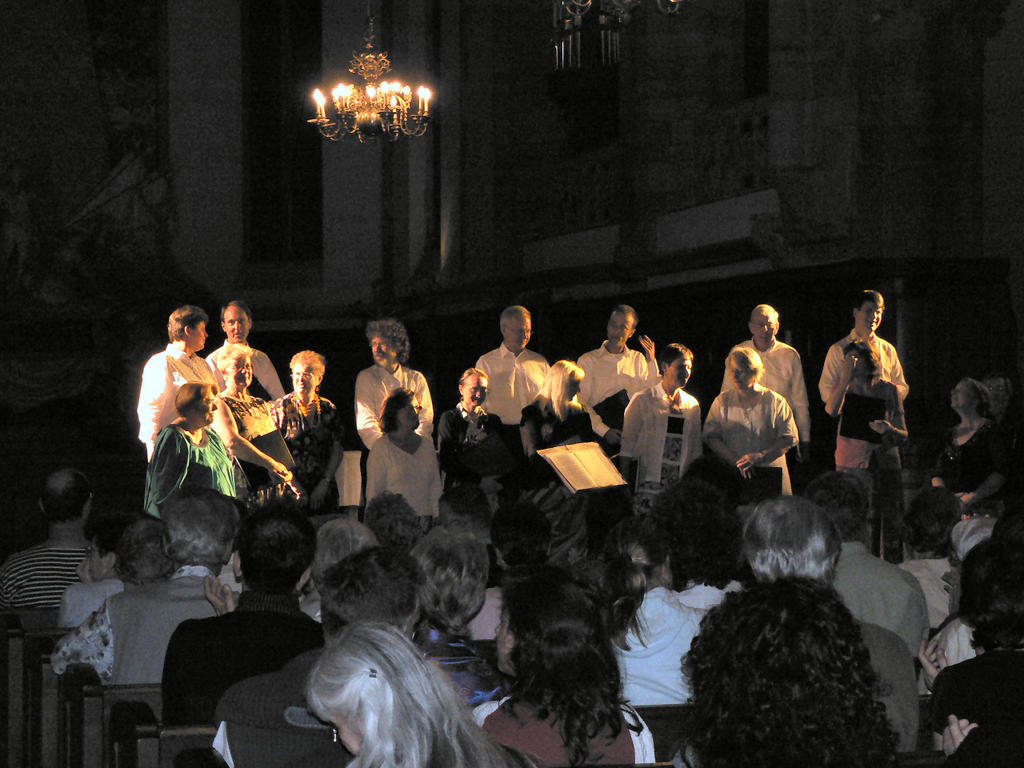
Monday, 28 November 2005

Authentic Britten

Reviews have just hit the UK press for the new production of Britten's A Midsummer Night's Dream in the Linbury Theatre at the Royal Opera House. This is a production that I have Not seen, mainly due to lack of time. But reading the reviews made me think over the productions that I have seen in the past few years. I've noticed a tendency for opera companies to cast counter-tenors in the role on the basis that they are a counter-tenor tout court rather than looking at their tessitura.


The idea of the tessitura of a counter-tenor voice is something that would probably have puzzled Alfred Deller, the first Oberon. But counter-tenors nowadays sing higher roles; David Daniels started on the world operatic stage with Sesto in Handel's Julius Caesar and only more recently moved up (down?) to the title role. This is partly down to the way the voice has developed. All counter-tenors use a mixture of of head voice/falsetto and chest voice, the exact nature of the voice is down to the mix, what notes you sing in which voices. Deller had very much the type of English voice which has a strong cutting edge and the feel of a tenor voice with upward addition. Inevitably, because this is the sort voice needed by the English repertoire that Deller was singing. More recent counter-tenors, especially those in the American mould, seem to take their head voice/falsetto down further creating a softer edged, sometimes rather feminine sound. So I think we must come to accept that there are different types of counter-tenor with different suitabilities.


What I keep feeling is that the more modern high/feminine/American style of voice sounds so unsuitable for Oberon. One or two counter-tenors I have know have commented that Oberon is so Low for them; one pointed out that the part is written with C (and 8ve above middle C) treated as a High Note. So not only does this voice type sound wrong, but the role is low for them. The physical notes lie at different points in their voices. Notes which are effortless for Deller can be effortful, and notes in the strong part of Deller's voice often occur in trickier parts of more modern counter-tenor voices.


As Oberon is one of the major roles for counter-tenor, inevitably if someone is offered the role they accept and find a way to perform it. The result can be moving and creditable, but quite often the sound is such a long way from that of Alfred Deller on Britten's own recording. How long before we accept that this role is written for a certain type of voice and that not all counter-tenors have the right sound quality.

Friday, 25 November 2005

Sightreading surprises

There's a nice story in The Times in the birthday interview with Sir Charles Mackerrass (link), in which he describes recently conducting the Berlin Philharmonic Orchestra in Elgar's Enigma Variations and the orchestra had never played it before, so they had to sight-read it and Mackerras had to tell them how the piece went.


I remember in the 1980's when I sang in the London Philharmonic Choir, we did a performance of Mendelssohn's Elijah. It was not a piece I'd sang, but I had heard quite a few performances as a student in Manchester, and subsequently in Scotland. I was surprised to find that not only had the choir not sung the piece in the life-time of any of the present members, but the majority of the singers had never heard it and had no idea how it went. They soon got the idea, but it was fascinating being at the first rehearsal with the choir struggling a little to find their feet when they were used to zapping through pieces.

Thursday, 24 November 2005

Chelsea 2006

Well, plans are inching forward for our concert at next year's Chelsea Festival. The conductor, Paul Ayres, and I have agreed a programme and I have confirmed that our proposed venue, St. Mary's Roman Catholic Church, is available. So it looks as though we might have a concert! I have also started confirming the willingness of people to sing, so we might have a choir! Both of which are a great relief. I have also started booking rehearsal venues; this is a potential nightmare as we tend to decide when conductor and singers can manage a rehearsal and then look for somewhere to rehearse.


I have also made concrete steps towards writing my new piece for the concert. I've provisionally called it Crossing after the collection from which the Tagore poems come, but this may change. I'm experimenting with a slightly more formal structure than usual. Its a Passacaglia which stays in one key, rather than wandering about as is my wont; mind you the key in question is A minor with an added G sharp which might cause problems with the singers, ho hum!

Monday, 21 November 2005

Review of Xerxes at the London Coliseum

To the London Coliseum on Saturday for a performance of Handel’s Serse (or Xerxes, to give it the English title). Nicholas Hyntner’s production is 20 years old but it has been spruced up and David Fielding’s designs look as handsome as ever. The title role was taken by Katerina Karneus, singing her first Handel role in the UK. Karneus looked handsome and fully inhabited the role; her stage demeanour reminded me of Ann Murray in the original production, but that might be memory playing tricks. Karneus has a warm, attractive voice and was suitable expressive in Handel’s fioriture. She got the character’s changeability but I though that the dangerous edge was lacking; something that Anne Sofie von Otter caught well in the concert performance at the Barbican.

Serse’s brother, Arsamene was played by the counter-tenor du jour, Lawrence Zazzo; an American based in the UK he has a warm, attractive voice in the American mold (rather than the cool English one), thankfully he does not overdo the vibrato. His Arsamene was suitably virile and very much the attractive lover. You wanted him to get the girl (Romilda) so his jealous rage in Act 3 was all the more shocking, and believable. Zazzo is an expressive actor, though he came perilously close to breaking the musical line for expressive purposes.

As their love interest, Janice Kelly was in fine vocal health; despite singing a wide range of roles in recent years she showed no signs of finding Handel’s virtuoso vocal line a problem. She was her usual communicative self, finding much pathos and humour in the part. Her voice has a cool, silvery quality (shading to a more steely tone when under pressure high above the stave) which she uses intelligently to such great effect that I did not miss the sheer beauty of tone that other singers have brought to the part.

As her sister, Atalanta, Sarah Tynan contributed her third stunning performance this season. Having found her moving in Jephtha and sympathetic in Carmelites I was very impressed by her poised, selfish and self-confident Atalanta. If she keeps this up and does no try to go too far too quickly, then Tynan will go far.

Serse’s betrothed, Amastris, who spends virtually the whole opera disguised as a man, was played with aplomb by Lucy Schaufer (who previously appeared in On the Town, how's that for versatility). Schaufer has a lovely voice, aptly suited to this part but she has not yet got the knack of managing to fill the Coliseum with her voice.

Graeme Danby was the comic servant Elvino; Danby managed the character’s swift transitions from serious to comic rather well. Neal Davies played Atalanta and Romilda’s father, a role that seems to be rather underwritten given that it was designed for the great bass Montangnana.

Noel Davies conducted the much reduced orchestra, the result was sparkling and sprightly. The players capturing much period feel on their modern instruments. We were sitting in the Upper Circle and much of the dialogue was perfectly understandable. A fabulous evening, I only wish we had time to go back for the alternative cast (Robin Blaze as Arsemenes and Sarah-Jane Davies as Romilda).

Friday, 18 November 2005

Recent CD Review

My review of Cantor Simon Spiro's disc in the Naxos Milken Archive series is on MusicWeb here

Wednesday, 16 November 2005

Musical Falconry

19th century French operatic repertory is littered with female roles which require a voice of a particularly distinctive type, hovering between soprano and mezzo-soprano. French composers seem to have had a fascination for betwixt and between voice types in roles such as Melisande and Didon; this sort of role is particularly common in French Grand Opera (think Auber and Meyerbeer). Nowadays there is a particular type of pushed up mezzo-soprano voice described as a falcon-soprano; a voice capable of going above the stave, but with the depth of a mezzo. Roles which are in this fach can encompass grand opera written for Paris, Pauline in Donizetti’s Les Martyrs, Valentine in Meyebeer’s Les Huguenots and Alice in Meyerbeer’s Robert le Diable. But singers nowadays also might sing Lady Macbeth, Abigaille in Verdi’s Nabucco plus 20th century roles such as Kostelnicka.

The name derives from Cornelie Falcon who sang at the Paris Opera where she specialised in a particular type of role. In the 1830’s the new operas, the first of the 5 Act French Grand Opera type, developed 2 types of soprano role. The first, associated with virtuous, maidenly simplicity sang with commensurate vocal simplicity in a style which was considered French; these roles were often humble people. In contrast to this, providing a degree of virtuosity, were the more aristocratic roles who sang with a more Italianate bravura; such roles provided the audience with the element of show which they could get from Italian opera. These latter, showy roles were often decadent and rather unsympathetic.

So we have demure heroines such as Fenella (La Muette de Portici, in fact a mute role), Alice (Robert le Diable), Valentine (Les Huguenots), Rachel (La Juive); and the ‘other women’ such as Elvire (La Muette de Portici), Isabelle (Robert le Diable), Eudoxie (La Juive) and Marguerite de Valois (Les Huguenots). 3 of these 4 latter ‘other women’ were created by singers with Italian names which must have associated this type of role in the public mind with foreign characters.

The singer Cornelie Falcon (1812 – 1897) created the roles of Valentine and Rachel. Though she did not create Alice, she became Meyerbeer’s favourite in the role. In fact she became the Paris Opera’s favourite ingénue; because, of course, that is exactly the type of role she was singing. Falcon carried this impression of virtue into her private life. Just as nowadays celebrities can find that the characters they play infect the public’s perception of their persona, so Falcon came to embody virtue and modesty in both her public and private personas. She sang for only 5 years, but such was her reputation that such roles were associated with her for ever, hence the name falcon-soprano.

She had a voice of some 2 octaves compass from b to d. Described as silvery with a brilliant timbre sufficient to dominate over the chorus, but never losing its charm or purity. She was described as having a voice ‘full of soul’. Examining the roles written for her suggests that though she could sing delicate high notes she had trouble with smooth transitions over the break.

Her decline was swift and immediate, her voice simply suddenly stopped working. The cause could have been one of a number of things; she made her Paris Opera debut at the age of 18, singing in a large opera house doing too much too quickly. But Meyerbeer’s music was extremely taxing and there is also the sheer stress caused by her life in the public arena.

Reading the description of the voice type and the subject of her vocal decline, it is interesting to see some remarkable parallels with Maria Callas. But what is more remarkable is the way that, with the decline of French Grand Opera, the falcon-soprano voice has lost its association with the virtuous ingénue. Readers wanting to explore her repertoire will have to do some digging. Whereas Opera Rara have mined the rich vein of early 19th century Italian Opera, nobody seems to be doing the same from French Grand Opera.

New Songs

Well, I've finally got to the end of my new song, setting Robert Duncan's poem The Lover. When I say that I've got to the end, I mean in the first draft; my pieces have a tendency to increase in length in the revision process. I revise by simply playing through, bashing away on the piano until I am satisfied. I also use the playback in Finale, but this is most use for checking what you've just typed in. There is nothing like trying a piece under your fingers for getting the feel of it.


The problem with the new piece is that I can't quite manage to play and sing it, so my play back is rather halting and probably does not sound nice. Since living with my partner, I have managed to cure myself of the embarassment of banging away at a song with him wandering about the house; I no longer worry about what it sounds like. But whilst we had lodgers it was a different matter, I was always horribly conscious that the sounds coming out of my piano and my vocal chords were not always a delight to hear. And of course, that embarassment made matters worse.


I've started jotting down ideas for my new piece for FifteenB to be sung at next year's Chelsea Festival. I can now get down to this properly, which is good.


We have recently got the music for a couple of Gavin Bryars's Laude, which I discovered when reviewing a disc of them. It looks as if we are going to be able to perform one, Oi me Lasso, at the Chelsea Concert which is good news. The texture of just 2 voices, soprano and tenor soli, will contrast well with the rest of the programme of choral and organ music. Though I also hope to repeat my 5-part Salve Regina with just 1 voice to a part.


I also have some long overdue corrections to do to my Elegy for Baritone and Orchestra, which David Greiner will be singing with the Salomon Orchestra next year. This, of course, means more banging away on the piano until I have the vocal line in a satisfactory state.

Recent CD Review

My review of Thomas Hampson's disc of Mozart, Haydn, Schubert and Beethoven arias is here on MusicWeb. It is a highly recommendable outing from Hampson, with a group of undeservedly neglected arias.

Tuesday, 15 November 2005

Review of Midsummer Marriage

We went to see Tippett's opera The Midsummer Marriage last week that the Royal Opera House. My review is now here, on Music & Vision.

Wednesday, 9 November 2005

The Midsummer Marriage

The audience for last night's performance of The Midsummer Marriage at the Royal Opera House was not quite as good as might have been expected; it was respectable but certainly not full. The other curiosity was the rather mixed nature of audience, presumably these are what Tippett enthusiasts look like. We had the guilty thought that quite a few looked as it they might have been at the work's premiere in 1955.A review of the performance will appear in due time, I'll keep you posted.

Tuesday, 8 November 2005

Tagore's Crossing

I've just come across this on the web, its the first of the 2 Tagore poems that I plan to set:-


"Traveller, where do you go?"
"I go to bathe in the sea in the redd'ning dawn, along the tree-
bordered path."
"Traveller, where is that sea?"
"There where this river ends its course, where the dawn opens into
morning, where the day droops to the dust."
"Traveller, how many are they who come with you?"
"I know not how to count them.
They are travelling all night with their lamps lit, they are
singing all day through land and water."
"Traveller, how far is the sea?"
"How far is it, we all ask.
The rolling roar of its water swells to the sky when we hush our
take.
It ever seems near yet far."
"Traveller, the sun is waxing strong."
"Yes, our journey is long and grievous.
Sing who are weary in spirit, sing who are timid of heart."
"Traveller, what is the night overtakes you?"
"We shall lie down to sleep till the new morning dawns with its
songs, and the call of the sea floats in the air."

We're off to Covent Garden tonight to see Tippett's opera A Midsummer Marriage. I missed the production when it was new so look forward to seeing it with interest. My only previous stage experience of the work was David Pountney's luminous and overheated production at the Coliseum. I hope that the Royal Opera's efforts are an improvement; I'll keep you posted.


We've put together a draft programme for the Chelsea Festival concert in June 2006 and assembled a team of singers and a conductor (Paul Ayres). So it looks as though we may have a concert. I want to write a new piece for the choir (and organ) and have been looking at texts. I've completely failed to find something which appeals and fits in to the concert's theme of the Virgin Mary. So it looks as if I'll be going for something completely different. I turned to a couple of tried and trusted sources, the poems of Helen Waddell and of Rabindranath Tagore. The Waddell poems that appealed were all a little too gloomy so I've opted for Tagore, a pair of poems from Crossing on the theme of the Traveller. I find them beautifully evocative, but I worry that people will find them gloomy. We'll see!

Monday, 7 November 2005

All Saints

Yesterday we went to High Mass at All Saints Church, Margaret Street; an Anglican Church with a tradition of elaborate, High Anglican worship. A friend sings in the church choir and we had been meaning to go for ages, but usually I sing at St. Mary's Roman Catholic Church, Cadogan Street, Chelsea.


The service was long (nearly 2 hours) and elaborate, partly because it was the culmination of the celebrations for their annual patronal festival (Tuesday 1st November was the feast of All Saints). The choir sang Bruckner's Mass in E minor, it was rather strange to hear it with organ accompaniment rather than wind instruments, but it worked pretty well and the choir was in good form. It is quite a taxing piece, especially when singing with just 12 singers. The offertory motet was Harris's Faire is the Heaven; simply one of my favourite pieces and beautifully sung.


I stumbled somewhat trying to sing the Credo and Pater Noster to the plainchant with which I am familiar, but this time with English words rather than Latin. The sermon, by the Archdeacon of Durham, was excellent.

Friday, 4 November 2005

La pudeur des icebergs

On Wednesday we went to The Place to see a dance piece, La pudeur des icebergs by French-Candian choreographer Daniel Leveille. No sets (just black curtains), no costumes (dancers were all naked), just lighting, movement and music. Quite stunning. Except....


The choreography was quite vigorous and so there was quite a lot of noise from the dancer's feet on the sprung floor. The music (Chopin Preludes) was played rather quietly so at times the noise of the dancers obscured it totally. The programme notes credited the sound treatment, but did not actually say who was playing the music. The sound treatment seemed to consist of eratic gaps between the movements, occasional movements breaking off in mid air and two thirds of the way through a sound treatment which sounded as if all the notes from the preludes were being played simultaneously.


I could not have helped thinking that how much more evocative and effective it could have been if we'd had someone playing live. But I sometimes think that the actual musical experience does not always seem important to choreographers


For those who are curious, there's a review with pictures here of a New York performance

Longevity

Whilst listening to an Emma Kirkby disc, first issued in 1984, for one review I was looking at another by Licia Albanese for another review. Both artists have in common a remarkably longevity. Albanese appeared in the 1937 Coronation Season at Covent Garden when she appeared as Liu to Eva Turner's Turandot, conducted by John Barbirolli, extracts of which were recorded live. Albanese had a long association with the Metropolitan Opera House in New York and went on to sing in the concert performance of Stephen Sondheim's Follies which was recorded at Carnegie Hall in 1985 (when Albanese was over 70).

Thursday, 3 November 2005

Recent CD Review

My review of the complete Vivaldi sacred music, all 11 discs of it from Robert King and the King's Consort on Hyperion, is here.

Wednesday, 2 November 2005

Review of Salome at London Coliseum

My review of last Saturday's performance of Richard Strauss's Salome at the London Coliseum is here, on Music and Vision.

Tuesday, 1 November 2005

Chelsea Plans

Having agreed to do a concert at next year's Chelsea Festival, I now have to come up with a suitable programme which will be interesting enough to sing and will attract Chelsea audiences. Current thinking is a programme constructed like our 2004 concert; only this time it will be themed around the Virgin Mary. With plainchant, Marian motets from various eras and a group of contemporary pieces. Already lined up are motets by Liszt, Faure, Saint-Saens, Byrd and Elgar; names which should look pretty well on the poster. Regarding my own contributions, we're going to repeat my one to a part Salve Regina which we did in the FifteenB Consort concerts earlier this year. But I don't have a substantial piece up my sleeve and I think that I'll write something specifically for the occasion. It won't be on the Marian theme (we need some variety) and leafing through my poetry books at home I came up with some poems by Rabindranath Tagore. I set his poetry in my cantata The Young Man and Death and have not set any since, so I think its about time. His poems often have a serious edge without being specifically religious (at least to my ears), which I think would work well in a predominantly sacred programme.

Monday, 31 October 2005

The Cut and Patch of Opera Production

Re-reading the reviews of WNO's new production of Verdi's Don Carlos on the admirable Opera Critic web site, I was struck again by the sheer oddity of the way people go about producing a text for this opera.


The journey from the 5 Act French Grand Opera performed in Paris to the 5-Act Italian Modena version was quite a long one for Verdi. The only constant was the French language, something that tends to be forgotten nowadays. He always regarded the Italian version as a translation and that the French libretto had primacy. But the 5-Act Italian version of the opera was premiered nearly 20 years after the opera's original premiere in Paris (in 1867).


So the later version of the opera is a finer, tauter thing; more dramatic, less leisurely, closer to later Verdi. The earlier opera is discursive (it was too long even for Paris and was cut prior to its premiere there), and Verdi's ultimate take on the genre of French grand opera. That particular art form which was developed specifically for the Opera in Paris.


For those interested in the opera's history then, it would make a lot of sense to try performing the original version of the opera (even in a cut version). This was done by the BBC in a concert performance in 1976. This is going to be re-issued by Opera Rara in their Verdi Originals series and I can't wait for it to come.


But most opera companies and comentators cannot bear to perform, in unrevised form, passages which were subsequently revised and tautened up by Verdi; the master's final thoughts are paramount. There is, of course, no problem with this; it is as it should be. But there is a lingering fascination with the bits Verdi cut when creating his later versions of the opera. So WNO, like the Royal Opera before them, perform the Modena version with bits of the original Paris version inserted. The result makes a mockery of Verdi's cutting and tautening and causes tension between the two eras of the opera's performance.


Any performance of Don Carlos is an event and one in French is very special, no matter what the edition. But I wish that opera houses would stick to a version of the opera which bears some resemblance to one that Verdi intended.

Recent CD review

My review of Emma Bell's lovely disc of Handel arias is here, on MusicWeb.

Friday, 28 October 2005

Chelsea Festival 2006

FifteenB have been invited to perform at next year's Chelsea Festival. Further details later, but we'll probably be doing a programme of unaccompanied choral music mixing my pieces with music by more well known composers.

Thursday, 27 October 2005

I've made some corrections to the Siegfried review; a rather embarassing number of typos seem to have crept in, but then I am not the best of proof readers. My apologies.

We are currently going to quite a few London Film Festival events, so there is slightly less musical activity than usual. That said, tonight is the annual autumn soiree for the Friends of the Chelsea Festival, hosted by the Mayor of Kensington and Chelsea at Kensington Town Hall. We've performed at 3 festivals over the years and keep in touch just in case there is space for us at a future one. Also, we're Friends anyway as there are usually some interesting musical events on. (That said, I don't think we managed anything this year but that was down to problems of timing more than anything else).

Then tomorrow we're off to Salome at the London Coliseum; ENO's revival of David Levaux's production with Cheryl Barker in the title role, her first stab at the role I believe. I've never seen Levaux's production and David has never seen Salome staged so it seemed a good moment to catch up with the production. I'll report back after we've seen it.

I'm still working on songs (well, a song); my second this autumn. I am also trying to find some more poetry to set. The local bookshop did not have any books by poets that I'd identified, so it looks as though a trip to the library is in order. That way, at least I might find some poems which I like which aren't about love.

Tuesday, 25 October 2005

Recent CD Review - Georgian Journey

Here, on MusicWeb is my review of a lovely disc of Georgian music (both sacred and secular). The Georgian musical tradition is very old and rather special in that they sing polyphonically, the results are completely entrancing.

Monday, 24 October 2005

Review of Siegfried at Covent Garden, Sat. 22nd October 2005

Episode 3 of the Royal Opera's new Ring Cycle opens in a bleak, black and white space with just the stray detritous of living and a crashed plane. Quite what relevance the plane has to the story of Siegfried and Mime I'm not sure but it did provide a concrete place in which they could interact. The act had opened with something of a coup; a drop curtain covered with equations, Mime frantically scribbling and a series of Siegfrieds (baby, toddler, teenager) who constantly break swords. This aptly sets the scene for the relationship between the grown-up Siegfried (John Treleaven) and Mime (Gerhard Siegel). The interplay between the 2 was one of the best aspects of this new production of Siegfried. Whereas Phyllida Lloyd at the London Coliseum, created a Siegfried who was a believable sulky teenager, at Covent Garden Treleaven and Siegel created a relationship closer to that of Steptoe and Son.


Treleaven makes an impressive Siegfried; whilst not conceivable as a teenager he made a believable, young and naive hero. His voice is silvery rather than golden or brazen. He does lack the ringing top that would be ideal, but he is convincing enough with silver steel tones. And he had reserves of power enough to carry him through the entire opera with a consistency of voice that was entirely admirable (though he did understandably tire towards the end). He is indeed quite a find and you wonder why he has not sung such roles in his native country before.


Siegel is an impressive Mime, struggling in a situation where he feels he has no control. The third, important person in this act is of course Wotan as the Wanderer. Here John Tomlinson, looking wonderfully down at heel, created a shabby, but powerful personage with superb charisma. Whilst it was a disappointment not to be seeing Terfel in the role, it was a such a pleasure to encounter Tomlinson's Wanderer again. He is such a vivid, theatrical performer that Terfel will be hard put to fill his shoes in this production (if he ever does). Granted, Tomlinson's voice is not quite what it once was, but somehow the traces of effort in the upper reaches chimed in with the fatalism and world-weariness of his performance.


Having 2 such strong, physical performers together meant that the '20 questions' scene was so tremendous that you stopped wondering why thy were sitting on opposite sides of a wing from a damage airplane!


The forging scene sounded admirable, but Treleaven was given lots of detailed business to do with spare plane parts, pots, pans etc. The result was indeed a forged sword, but given that the action was so detailed I could have wished for a little more realism, or more abstraction. You can understand Phyllida Lloyd's desire to stage this scene abstractly for ENO, even if that staging did not quite work.


Act 2 took place in a cavernous, dark space with the staging area disappearing into the rear of the stage. Peter Sidhom was a strong Alberich (I hope he reappears the next time Das Rheingold is given here), so the sequence of scenes between Sidhom, Tomlinson and Siegel were brought off with enviable ease. Less gripping was the attempt by director Keith Warner and designer Stefanos Lazaridis, to give the Forest Murmurs scene a trendy gloss. Siegfried disappeared down a hole in the stage, the whole floor then lifted up to reveal Treleaven reclining on a grassy surface atop a group of hospital trollies. As he sang and the orchestra played, 2 supers wheeled on first a stag and then a doe and finally the wood-bird arrived; white clad Sara Fox with a model wood-bird at the end of a rope on a stick. (During Act 1 there had been much by-play with bits of paper (contracts?) and the Wanderer had kept making origami model birds out of paper, presumably to emphasise to us that he is in control of the Woodbird).


Fafner was pretty well done; for most of the time we saw the singer clad as he was in Das Rheingold with the tarnhelm next to him. Only when he attacks Siegfried does he turn into a most convincing dragon. Once fallen, the dragon disappears and when Siegfried lifts off the tarnhelm he takes Fafner's head with it; the final dialogue between Siegfried and Fafner was wonderfully done with Siegfried talking to Fafner's disembodied head - quite magical.


Act 3 opened in an abstract space with a huge spinning platform with the troubled Wanderer on it. Erda (Jane Henschel) appears in her armchair, and floats past in almost disembodied manner, barely impinging on the Wanderer's trouble.


Then the stage re-assembled itself into a simplified version of Act 3 of Die Walküre, i.e. huge metal spiral and the white, moveable wall with just one door. It was this door that the Wanderer barred to Siegfried; Tomlinson and Treleaven were tremendous in this scene; it more than made-up for the rather low-key version of this encounter at the Coliseum. Whatever you think of Warner's staging, he is certainly alive to the mythic elements in the opera (even if he does tend to over-egg the pudding).


The Wanderer gone we waited with bated breath for the final scene.


We never saw Brunnhilde on her rock, she remained behind the white wall; for some reason Warner had Siegfried simply describe what he could see each time his disappeared from our view. Granted, this meant we were spared the more embarassing bits, like when Siegfried has to cut Brunnhilde's armour off her. But it also meant that we never saw Siegfried's first proper reaction to Brunnhilde nor did we see her waking up. In previous productions in this house, Gwynneth Jones was mesmerising as she gradually came to life, you really did believe she'd been asleep for 20 years!


Here, our first sight of Lisa Gasteen's Brunnhilde was a dramatic back-lit one as she stood in the door. From then on, Warner seemed to take a rather down-beat view of this final duet. The dramaturgy, singers' demeanour and rather gloomy setting all conspired to emphasise Brunnhilde's troubles and doubts rather than the couple's overwhelming love. Not for this couple the joyous discovery of young love, the throwing up of Brunnhilde's armour into the air like children, which made the scene between Gwyneth Jones and Alberto Remedios so memorable in 1982. Perhaps I would have felt more joyous if Gasteen had been in more radiant voice; her vibrato seemed more pronounced and her Heil dir as she wakes up was less than radiant. Perhaps she was reining herself in so that she did not overwhelm Treleaven. Certainly the 2 were well balanced and ultimately the opera came to a radiant conclusion albeit through troubled territory.


I look forward to the final instalment of the Cycle next year, but still find the look and feel of this staging rather PUZZLING.


Friday, 21 October 2005

Ronald Stevenson

To the Royal College of Music last night for a symposium celebrating the life and work of Scottish pianist and composer extraordinaire Ronald Stevenson. But first, one had to find it! The symposium took place in the Durrington Room which seems to be in the attics at the very back of the building. Still is was certainly worth the walk and climb.


The symposium was a joint celebration of the publication, by Toccata Press, of the book Ronald Stevenson-The Man and His Music and the forthcoming release, on APR Records of Ronald's 1976 piano recital recorded in Vancouver by Canadian Broadcasting Corporation.


Speakers included Colin Scott-Sutherland, who edited the book, and Ronald himself, who introduced the Canadian recital. We heard the Grainger Ramble on Love from the disc; a magical fantasia on the final love-duet from Der Rosenkavalier, it is one of Stevenson's signature works. The disc also includes the Bach/Busoni Chaconne, another of the works which I associate with him.


Whilst living in Scotland in the late 70's I developed a circle of friends and acquaintainces who were all associates of Ronald Stevenson. So I came to meet him quite often and hear a number of his recitals; in fact, I acted as chauffeur on a number of occasions, running him back to Edinburgh after recitals. Someone who combines legendary charm, pianistic brilliance and great composing ability in enviable quantities, his lecture recitals were a joy.


The evening also included live performances of Ronald's music; a Royal College student played music for unaccompanied violin and a RNCM student played the Recitative and Air for Cello and piano. The evening concluded with a social glass of wine.

Impressions of the seaside, linked musical sketches depicting a seaside resort; starting with dawn over the sea and ending with sunset. The title refers to a seaside area of my home town, Cleethorpes.
Recorded live at the Tabernacle Arts Centre, London, 2001. The Salomon Orchesta conductor by Malcolm Cottle

Thursday, 20 October 2005

AudioBlog - a short prelude, toccata and a kind of fugue

My orchestral piece, in 3 linked movements; the title explains it all really.
Recorded live at the Tabernacle Arts Centre, London, 2001. The Salomon Orchesta conductor by Malcolm Cottle

Thoughts on Reviewing Dialogues of the Carmelites

We went to Poulenc's Carmelites on Saturday at the London Coliseum, ENO's revival of their 1999 production, with a largely new cast; Josephine Barstow carried over from the old cast but is, I think, getting to the limits of her present voice in this sort of role. My full review is on Music and Vision here.


The problem with Carmelites is that the concentration of female role means that each revival has to be, in some way, outstanding. For myself, I have to keep ensuring that I live in the present rather than the past and don't just regurgitate the comparisons with the marvellous Royal Opera revival which had a cast that included Felicity Lott (Blanche), Pauline Tinsley (Mother Marie), Regine Crespin (Old Prioress), Valerie Masterson(New Prioress) and Eiddwenn Harry. This ROH performance was one of the landmark performances of my career listening to opera. But I can't simply complain of a more recent performance because a particular Blanche does not sound like Felicity Lott in the role. It might be true, but it is hardly helpful for a reader who was not there at the time; when writing about such pieces you've got to try and comment on what you actually heard and try and explain it in a current context.

Recent DVD review

Here's my review of the DVD of Handel's Rodelinda in the Glyndebourne Festival Opera production, the one visually inspired by early cinema.

Wednesday, 19 October 2005

AudioBlog - Collect for Choir and Cello

Here's the Collect for Choir and Cello recorded live at St. Giles Cripplegate on 1st July 2005, the performers are the eight:fifteen vocal ensemble, conducted by Malcolm Cottle with Jonathan Cottle Cello. The motets sets the collect for peace from the Book of Common Prayer.


Tuesday, 18 October 2005

Yet more activity on the concert front: tonight I'm meeting with the soloist for the orchestral concert at St. James's Church, Piccadilly in March 2006. I know it seems early, but he needs to learn the part, I might need to make changes and convey them to the conductor etc. In fact, from our brief email and telephone contacts (he lives in Italy) I know that changes are in order. A suggestion that some passages be transposed bodily would seem to be rather tricky given that this would then put some instruments into keys with 6 or 7 sharps - I can't see that going down well with the players. On other occasions I have already had experience of the comment from a player, C sharp major? We don't play in that key very often. Something I'd like to avoid if possible


Newsletter distribution continues, my email contact lists are always woefully out of date so I end up sending emails to address which people no longer user, don't exist etc. I always vow to be more organised but never am. Ho hum, perhaps next year, when I have more time!

Monday, 17 October 2005

See new avenues

Well, we have failed to get Arts Council funding for our Cranmer concert in Oxford. This is not a surprise as it was quite a small, specialised event and FifteenB is too small to be able to include elements such as out-reach and education into a neat package around a concert. But all is not lost; we still have plenty of time and other avenues to explore. It just means that I'll have to do a batch of letter writing.

Friday, 14 October 2005

Tuesday's Salomon Concert

We went to the concert by the Salomon Orchestra on Tuesday at St. John's Smith Square, London. Conducted by Mark Forkgen, the orchestra played the overture to Wagner's Die Meistersinger, Tchaikovsky's Violin Concerto and Sibelius's 1st Symphony.


The violinist in the Tchaikovsky was Thomas Gould, a young man who has only recently graduated from the Royal Academy of Music but who has a something of a future ahead of him. His performance of the Tchaikovsky was fabulous, he made short work of the taxing virtuoso passages, particularly the notorius string crossing. He and Mark Forkgen worked well as a team so the orchestra provided fine support and there were few, if any, moments of instability between soloist and orchestra (again, something of a problem in the work if the soloist is inclined to be wayward.). After the interval there was a fine performance of the Sibelius; I was going to say rousing, but thought Forkgen and the orchestra created some glorious moments the general atmosphere was of something far more subtly troubling.


It is quite some years since I have heard the Tchaikovsky and even longer since hearing the Sibelius. It was rather pleasant to revist the works live, especially in such confident performances.

Autumn Newsletter

Its Newsletter time again, when I sent out a batch of newsletters to friends and contacts giving details of my exciting (!) musical activities. Currently the electronic versions are going out with the print ones later next week. Here's a copy to read here.


Recent Performances


De Profundis, was performed by the Latin Mass choir, conductor Malcolm Cottle, at St. Mary’s Roman Catholic Church, Cadogan Street, Chelsea at High Mass on Sunday 9th October. The motet was commissioned by the choir and is one of a number of my pieces in their repertoire.


As part of my 50th birthday celebrations the eight:fifteen vocal ensemble, a new group of professional choral singers, gave a concert at St. Giles Cripplegate in July 2005. Conducted by Malcolm Cottle they sang a programme themed around the death of Archbishop Thomas Cranmer. My cantata The Testament of Dr. Cranmer for unaccompanied chorus, setting extracts from Cranmer’s final speech, was premiered as were the 4 Advent motets from Tempus per Annum, the collection of motets for the church’s year. Cellist Jonathan Cottle joined the choir to perform my Collect for choir and cello. The concert was very well reviewed on The Classical Source web-site (http://www. classicalsource.com) and by Roderick Dunnett in The Church Times.


The Cranmer concert was recorded and I am happy to supply demo discs to anyone who is interested. Recordings of the 4 motets from Tempus per Annum have been posted on my web site (http://www.hugill.demon.co.uk/midi.htm) and further postings will be happening in due course.


Respice Me, Domine, a motet based on the text of the Introit for the 19th Sunday in Ordinary Time was premiered by London Concord Singers, conductor Malcolm Cottle, at a concert at St. Michael’s Church, Chester Square, Victoria, London. The motet is part of my on-going collection Tempus per Annum and was commissioned by the choir for performance at Strasbourg Cathedral in a liturgical context.

Future performances


On Thursday 15th December 2005 at 7.30pm at the Grosvenor Chapel, South Audley Street, Mayfair, London, London Concord Singers under conductor Malcolm Cottle are giving a programme of music dedicated to St. Cecilia. My motet I Vespri di Santa Cecilia will be receiving its second performance, the choir having first performed the motet as part of their 30th anniversary celebrations in 1996. The motet sets Latin texts from the vespers antiphons for the Feast of St. Cecilia. Also included in the programme is music by Gabriel Jackson, Benjamin Britten, Peter Phillips, Morten Lauridsen and Orlandus Lassus.


March 21st 2006 is the 450th Anniversary of the execution of Thomas Cranmer at the University Church in Oxford. The church is marking the Anniversary with a number of events. On the day, the present Archbishop of Canterbury will be preaching; on the previous Saturday, 18th March 2006, the eight:fifteen vocal ensemble will be repeating their Cranmer themed programme at 7.30pm in the University Church. They will be performing my Testament of Dr. Cranmer, music by William Mundy, John Sheppard, Christopher Tye and Thomas Tallis plus motets from Tempus per Annum and the Collect for choir and cello. It is an immense privilege to be able to perform my setting of Cranmer’s last words in the setting where they were spoken. Further information from http://www.hugill.demon.co.uk/cranmer.htm


On Thursday 23rd March 2006, the Salomon Orchestra under Adrian Brown will be giving concert at St. James’s Church, Piccadilly, at 7.30pm. The programme will include Elgar’s Serenade for strings and Haydn’s Symphony No. 100, the Military. Also in the programme will be the premieres of my tone-poem In the Barbarian’s Camp and Elegy for baritone and orchestra. In the Barbarian’s Camp is based on Helen Waddell’s translation of a Latin poem in which the Roman poet complains of his inability to write verse whilst he his living with the over-friendly but smelly barbarians. Elegy is a setting, in German, of Rainer Maria Rilke’s long poem, the Second Duino Elegy. The singer will be the young German baritone, David Greiner, the work’s dedicatee.


Publication News


I have recently completed a cantata based on the journey of the Magi. Setting extracts for a sermon by the 17th century divine Lancelot Andrewes, the work is written for double chorus. Andrewes was fond of using Latin phrases in his sermons and a feature of The Magi is the use of bi-tonality to express the pull between the Latin and the English phrases. The work opens with a brilliant exposition of the text from St. Matthew's Gospel, in Latin and in English. Each movement then follows part of Andrewes's sermon and considers one aspect of the Magi's journey - the distance they came, the way that they came and the time of their coming. Further information, including musical extracts, available from http://www.sphericaleditions.co.uk/magi.html

Volume 2 of Tempus per Annum will consist of 30 motets for Lent, Holy Week, Eastertide and Pentecost; each motet based on the text of the Latin introit for the particular Sunday or Feast Day. The motets are being published in parallel English and Latin versions. Volume 2 will be available early next year; Volume 1 covering Advent and Christmastide is already available. Further information from http://www.sphericaleditions.co.uk/tempus-per-annum.html When complete, the Tempus per Annum collection will run to over 70 motets for the church’s year.

Monday, 10 October 2005

Wagner and Handel, a director's dream

Friends have just been to see an instalment of Wagner's Ring Cycle at Esbjerg in Denmark and also caught up with the latest instalment of the Ring at Covent Garden, where Siegfried has just premiered. He commented that they had loved the production at Esbjerg, the singers were not always superb; whereas the singing at Covent Garden was superb but they did not like the production, finding it too busy and confusing.


There seems to be some sort of strange parallel between productions of Wagner and productions of Handel's Italian operas. Both need singing of a supremely high order. And in productions of both, good singing is not necessarily going to be combined with clarity of production. There is something about the wide open spaces in both types of opera that causes producers and designers to fill the time with busy silliness, or profound philosophising which does not sit easily on the stage.


Too often in Handel, the producer displays a failure of nerve in the long arias and keeps throwing in entertainment for the audience. Similar problems happen in Wagner, where the immensely long paragraphs can be difficult to sustain; producers often replace good personnen regie with gimickry.


In both cases the most striking productions that I have been to have been the most direct, those without too many axes to grind. Or else those by the few producers who have such brilliant theatrical flair that you will forgive them almost anything.

Friday, 7 October 2005

Recent CD review

My review of Sunleif Rasmussen's Symphony No. 1, a wonderful atmospheric piece, is here on MusicWeb.

Thursday, 6 October 2005

Review of Nielsen's Maskerade

We went to see Nielsen's Maskerade at the weekend at Covent Garden; musically superb but a rather wacky technicolour production; my review for Music and Vision is here.

Recent CD review

My review of the Naxos disc of Virtuoso Timpani concertos (I kid you not!) is here, on MusicWeb

Tuesday, 4 October 2005

Recent CD review

My review of a recent disc of masses and motets by Jachet of Mantua and Adrien Willaert is on Music Web, here.

Holiday time

A few days leave from work, so all the normal routines get interrupted. I missed Concord rehearsals last night and I've been remiss in my attention to this Blog. Still, I have started writing songs again. Finding words is always a trouble, but I leafed through an old Penguin anthology of Homosexual verse (whatever that is) and found one or two poems, notably one by Adrienne Rich which comes from a collection of love poems (I must track that one down).


Once I've found a text I like the next problem is the piano; piano accompaniments never flow as freely as choral music for some reason and I am always worried about how interesting the piano part might be. Still, I am tolerably pleased with the new song and plan to do more


Whilst working in the garden yesterday it lovely to hear a programme on Radio 3 devoted to the art of Robert Russell Bennett; Bennett worked as an orchestrator on Broadway with all of the major names. He was a bit of a musical snob and had studied with Nadia Boulanger, but for a generation he effectively defined the Broadway sound.

Thursday, 29 September 2005

Always read what it says on the box

I recently took delivery of a batch of CD's for review. Some of them found their way into our CD player in the car when we went away for the weekend; we often do this sort of pre-review listening. One disc gave us a real shock, expecting a soothing stream of Gregorian Chant what we got was wonderfully raucous and vibrant, polyphonic Georgian folk music (and sacred music). The disc is entitled Georgian Journey but of course, I'd read the title as Gregorian Journey. I'm glad I made the mistake as we both love the CD all ready. So some mistakes do have a happy ending. (The disc is on RAUMKLANG, RK-2304 1/2, the company's website is here, its title is Georgische Reise in German.

Wednesday, 28 September 2005

Recent CD review

My review of the William Primrose performances of Walton and Casadesus Viola concertos, plus Harold in Italy by Berlioz is now on Music Web here.

Tuesday, 27 September 2005

Season starts

Last night was the 2nd London Concord Singers rehearsal of the new season. Amongst the St. Cecila themed works that we are rehearsing is my motet, I Vespri di Santa Cecilia written in 1995 for the choir's 30th anniversary celebrations. Its strange re-visiting works as a performer, especially when you wrote them some time ago. My memory of the motet was that it was quite complete, but seen in the light of things I've written since, it is relatively straightforward; mind you there are some tricky corners, it is certainly needs working on. Currently we are working just on the chorus part (8 parts), later on we will then add the 6 soloists making a grand total of 14 parts. The main problem with learning the piece is that it is bi-tonal (and then some). I'll report back later on progress when we start to put it together.


I celebrated the new season by doing lots of web admin, I got all our web-pages up to date with concert dates and works to be performed plus sending off our concert information to the various useful sites which list them:-

www.cadenza.org

www.gerontius.net

www.concert-diary.com

Monday, 26 September 2005

La Fanciulla del West

To Covent Garden on Saturday to see Puccini's opera, La Fanciulla del West. Based on Belasco's play The Girl of the Golden West, which was made into a film starring Barbara Stanwyck, the opera is an unlikely amalgam of Italian operatic sentiment and the American Wild West.


The Royal Opera's production was new in 1977, it was intended to celebrate the American Bicentennial but arrived a year late. At the time he worked on the production, designer Kenneth Adam had also been working on production design for the James Bond movies. He and director Piero Faggioni came up with a hyper realistic setting. The production was heavily refurbished for this outing, in fact there had been rumours of its demise. The good news it that it still looks good and that the production values remain high.


It is easy to send up Puccini's spaghetti western and over-do all the character acting in the small roles and it is a tribute to the Royal Opera that the production still remains firmly realistic, taking itself seriously and never sending itself up. This sort of opera, with a host of small roles, is one that Covent Garden does well. The characters who inhabit Minne's bar were all strongly cast from Young Artist Robert Murray playing Harry to Robert Lloyd as Ashby and Francis Egerton as Nick. Egerton has been performing at the Royal Opera almost as long as I have been going and I am pretty sure that he played the barman Nick in the first performances of this production. His voice is certainly showing signs of age, but his performance remains a strong one.


But of course, not only needs a strong supporting cast but strong principals. As the bandit Dick Johnson/Ramirez Jose Cura might not have looked sufficiently dangerous, Gary Cooper he ain't, but his voice was another matter; for the entire evening he produced a gorgeous stream of sound, truly sexy. As Minne, Andrea Gruber looked a bit Mumsy, which is perhaps a valid view of Minnie. In the more dramatic scenes her big, vibrato laden voice paid off and she was a fine partner for Cura; but in the opening act, when Minnie has to be more low key, her voice was less suited to the part and you missed a greater sense of line.


As the sheriff, Mark Delavan made a very human villain so that in the early parts of the opera one could be sorry for him. Delvan cut a very impressive figure on the stage and turned Rance into the larger than life figure that he should be. All in all the three principals made a finely balance team, which is something that you can't always say in opera nowadays.


The disadvantage of this production were obvious from the beginning of Act 1, the wooden floor of the bar might be realistic but it is also noisy, any major chorus movement was accompanied by the creak of floorboards. Goodness knows what it sounded like on Radio 3 (Saturday's performance was a simultaneous broadcast). The opera is a substantial 3 act affair, but the problems changing the scenes meant that the intervals were billed to last 35 minutes each and in fact over-ran. After the first interval we returned to our seats to find that we could still hear the whine of an electric drill.


My partner David, who was seeing the opera for the first time, commented that he felt that designer and director could have been a little more imaginative and used the revolve somewhat, to give us a production which was realistic but whose scene changes were rather simpler. Still, it was a great evening. The orchestra, under Pappano, played well and from the opening notes Pappano gave us a performance which combined impetus with flexibility. I'm not sure that I need to see this production again in a hurry, but it has made me think about buying a recording again. I must see what is available.

Saturday, 24 September 2005

Redemption through Love

I've been listening to bits of The Ring again, having reviewed the entire thing earlier this year for Music and Vision. One snippet was the Immolation scene recorded by Frieda Leider in 1927. She has a wonderfully lyric voice, with fabulous shapely phrasing so you start to wonder how big her voice really was. Is has that sort of pre-war focus which makes it tricky to assess; in real live did she sound like Anne Evans or Kirsten Flagstad? Perhaps we'll never know, but her live records do give you the impression that she did not quite have the sheer power of Flagstad and Nilson.


The scene reminded me again how, for me, one of the most moving parts of the entire Tetralogy is not a vocal scene, but the orchestral section after Brunnhilde has stopped singing when the Rhine innundates the stage. The Rhinemaidens' theme in the orchestra is counterpointed with other themes from the cycle, providing almost a potted summation of the Ring. I find the moment when the 'Redemption through Love' theme returns most magical.


We're off to see La Fanciulla del West tonight at Covent Garden; more redemption through love. After all, the opera is about a barmaid who loves a bandit.


I've been updating my own web site (http://www.hugill.demon.co.uk) so it now has all the correct news. It was woefully out of date. Having been experimenting with Audioblog, the 1st 4 audio blog tracks are now published on the site here.

Tuesday, 20 September 2005

Petra von Kant

We went to see the premiere of Gerald Barry's new opera Petra von Kant at the London Coliseum on Friday. My review for Music and Vision is here.

The audience was distressingly thin, especially as this was the first night of the new season and the premiere of a new opera by a popular composer. Whilst I did not enjoy the opera as much as some of the other reviewers, Sean Doran's season is full of good things and it would be a shame if further goodies were jeopardised by poor audience. So we must hope that attendance picks up; there were a significant number of people there who were very enthusiastic at the end.

Saturday, 17 September 2005

Recent CD Reviews

2 more CD reviews have come on line

The first is a fine disc of Tallis from the Oxford Camerata. Not unnaturally this includes Spem in Alium in a performance which was probably highly reminiscent of the one we heard at the Edington Festival only, on the disc I was less enamoured of the way the engineers had caught the acoustic of All Hallows Church, Gospel Oak, where the pieces were recorded


The second is fascinating, if not for everyday listening, a complete performance of the Jewish service, the First S'Lihot, sung by Cantor Benzion Miller. For someone brought up in an entirely different religious tradition, this is fascinating indeed.

Thursday, 15 September 2005

Orchestral Manoevres

We are planning another orchestral concert next year to showpiece my orchestral music. As before (September 2003) The Salomon Orchestra will be playing but at a new venue, St. James's Church, Piccadilly, London


We are planning performances of 2 of my pieces, In the Barbarian's Camp and Elegy; this latter is a substantial setting, for Baritone and orchestra, of Rilke's Second Duino Elegy. I have set it in the original German so am relieved that a German baritone friend is going to sing the solo-part; perhaps having a native speaker will help correct some of the errors I have made in setting the German. Despite singing in German and speaking it (very badly), I found setting it surprisingly difficult; hard to get it feeling natural without losing my own distinctive voice.


So I have just been back to the scores; having sent a set off to the conductor and I preparing a piano reduction so that the baritone can try the piece out with a pianist. I generally work directly into short score, so any piece I write has to be re-transcribed for piano reduction - a rather tedious but necessary process. Finale can do this automatically, but I generally find that the results do not look very well on the page nor lie easily under the fingers; not that my own efforts in reduction are likely to be too much better.


Revisiting the score has made me realise how much work there is to do to tidy up the full score so that I can produce well ordered instrumental parts. Much of it needs phrasing added and there are parts which need distributing between 1st and 2nd wind players to allow players time to breathe etc. I have found in the past that the more work I put in at this stage, the more time we save later. The problem with having an electronic music publishing system is that it is easy to produce badly thought out and badly laid out parts at the touch of a button. I'm hoping not to do this.

Wednesday, 14 September 2005

Recent CD reviews

Two reviews have recently been posted on music web. A pleasant disc of Gregorian chant from the all male group Pro Cantione Antiqua, review is here


More problematically, a rather disappointing disc of Jewish choral music from the Vienna Boys Choir is here.

Tuesday, 13 September 2005

A dose of the clap - the irresistable rise of applause

Last night we finally caught up with the South Bank Show's film about Margot Fonteyn, the English ballerina with the Royal Ballet. Regarding the Royal Ballet's first visit to America, where the reaction of the New York audience was astounding, one of the now elderly participants recalled the unbridled way that the audience applauded. Nowadays were are acustomed, in ballet, to the audience applauding whenever a dancer does something astounding. This is behaviour which would not commend itself to Dame Ninette de Valois, the founder of the Royal Ballet. In one of her books she makes it quite clear that she dislikes applause because it breaks into the theatrical magic; I seem to remember that she would even have liked to stop applause at the end of a ballet because it turns the theatrical characters back into actors playing a part.


This feeling that an audience has a right to applaud whenever they are impressed is now creeping into orchestral music. It is becoming more common for audiences to applaud at the end of a movement, completely ignoring the composer's intentions regarding dramatic structure; as if the acknowledgement of the listener's presence and appreciation is more important than the composer's intentions.


Effectively audiences are asserting their right to participate in a performance rather then dumbly sitting there. Unfortunately many audience members are thereby displaying their lack of understanding of some of the fundamentals of musical construction. This is nowhere more obvious than in 19th century opera with the pairing of cavatina and cabaletta. This construction, where a slow-ish short-ish solo number is followed by/interrupted by some dialogue which changes the mood leading directly into a bravura cabaletta, has its origins in opera seria. The structure was developed by composers like Handel as a means of keeping the leading singer on stage for longer. In opera seria the convention was that the singer left the stage after each major aria; by introducing a short, strophic number before the main aria the singer was thus kept on stage for longer. That the construction was statisfactory is shown by its large-scale adoption by 19th century Romantic opera composers. Unfortunately audiences repeatedly disregard the music's structure and applause after the cavatina, thus completely breaking the mood. Understandable in less familiar operas, this is profoundly annoying in more familiar operas such as Verdi's La Traviata, where the majority of the audience must surely know what is coming.


It would of course, be unfair to artists to ban applause entirely. But I do feel that we should start to try and educate audiences rather than blindly letting them clap whenever they want to. Unfortunately this sort of education treads on the toes of current concerns, raising issues of audience rights and the spectre of elitism as it is becoming increasingly unfashionable to know something about anything. Or am I just being cynical

Monday, 12 September 2005

Recent CD Review

Here's my latest CD review on MusicWeb, Grieg's Peer Gynt complete with a cut down version of Ibsen's text - quite, quite fascinating.

Thursday, 8 September 2005

Recent Article

Here's a new article of Music and Vision, thoughts on staging Handel operas arising from having seen ENO's stagings of both Semele and Jephtha last season.

Washing the Magi's Face

I've now reached the stage with my new choral work, The Magi, that I feel confident it does really exist and have produced a Web Page. So I'm now at the stage of washing its face (or perhaps washing their faces) - a term used, I think, originally by Vaughan Williams. In my case, this means that I am constantly thumping out bits of the score on the piano, usually very slowly, and occasionally alter odd notes. Its rare for a piece to reach this stage and then require major surgery, but it does happen. I sometimes have radical re-thinks about endings; in fact I am still not sure about the end the The Magi but I'm sitting on that at the moment.


I am also working on a leaflet to publicise my collection of motets, Tempus per Annum; I'm hoping to send these out during this month along with CD's of the 4 advent motets, recorded at my birthday concert this July. I am also putting these recordings on the web. I've already posted 2 to this blog, using AudioBlog and will be doing the rest this week, or early next. They will also go on my own website as I plan to have a radical overhaul of the midi and mp3 files, in the light of the facilities provided by AudioBlog (http://www.audioblog.com)

Wednesday, 7 September 2005

Failure

I had intended to be writing about Peau d'Ane, the 1970 film directed by Jacques Demy which is being shown in the National Film Theatre's Catherine Deneuve Season. Unfortunately we had one of those tedious evenings that you occasionally have when you live in a city, travel by bicycle and are as forgetful as I am. Having left my bag at a stop en-route from work, we ended up spending a happy hour or more cycling round central London to little effect (though I was re-united with my bag). The end result, we retired home shattered and had cauliflower cheese instead!


The cultural Season starts next week. We are off to the opening night of Gerald Barry's The Bitter Tear's of Petra von Kant at the London Coliseum on Friday 16th. I'm looking forward to it, though my only reservation is that Barry has evidently set Rainer Werner Fassbinder's play uncut, which means that the opera is likely to be rather wordy.


I found this with The Silver Tassie, even though Amanda Holden had done a superb job filleting the Sean O'Casey's play. Turnage set the words in a naturalistic manner and the result came over, to me, as more of a radio play with musical accompaniment than real opera. I'll be reviewing Barry's opera and will report back.

Tuesday, 6 September 2005

Gaudete

The second motet from Tempus Per Annum, performed by the Eight:Fifteen Vocal Ensemble conducted by Malcolm Cottle, recorded live at St. Giles Cripplegate in July 2005

Monday, 5 September 2005

Last Prom

We went to our final Prom of the season on Saturday, an orchestra of students from the Royal Academy of Music and from the Julliard School, conducted by Sir Colin Davis. The programme opened with a thrilling performance of Copland's Fanfare for the Common Man, then went on to Vaughan Williams's Sixth Symphony. The 1st 3 movements worked very well, and I could hardly fault the orchestra or Davis's direction, but was not so certain about the final movement. The symphony was written in the 1940's and the final movement, which is played pianissimo throughout, is commonly held to refer to Hiroshima though the composer always denied this. The student players were technically in command and played beautifully, but never seemed to quite plumb the depths, or perhaps Davis's direction was too laid back. It can't have helped that the audience were constantly coughing, almost as if people wanted to sabotage the performance.


We were sitting at the top of the circle in a very full Royal Albert Hall; I'm not really sure why this particular Prom was so popular. But as the concert progressed, the heat became intolerable and I found it increasingly difficult to concentrate. Whatever else they have done whilst renovating the Hall in recent years, they have not introduced cooling to the upper reaches. So, for the first 3 movements of Berlioz Symphonie Fantastique I could only intermittently enjoy the performance, but in the last 2 movements the students relished the more outrageous of Berlioz's demands and the performance seemed to take off, or perhaps just my interest in it.


The orchestra had a huge string section, which sounded brilliant, but I was slightly worried about balance; something that I have felt in other Colin Davis performances. When strings were playing full pelt the completely dominated the woodwind, and I am not sure that either Berlioz or RVW would have wanted this.

Sunday, 4 September 2005

Audio: Ad Te Levavi

My motet Ad Te Levavi from Tempus per Annum, recorded Live at St. Giles Cripplegate, London on 1st July 2001; the eight:fifteen vocal ensemble conducted by Macolm Cottle

Saturday, 3 September 2005

A little experiment, I'm publishing some of my recordings on the web. Here's a track from my Passion, recorded in 1999 by The Burgundian Cadence

MusicWebLog

I've been keeping a log of my CD reviewing activites for MusicWeb over the last Month, its here.

Friday, 2 September 2005

Recent CD Reviews

Mantovani, by Special Request volume 2

Last Night's Prom

We went to the Late Night Prom last night; the Sixteen conducted by Harry Christophers in a programme of music by Robert Wylkynson, William Cornysh and Thomas Tallis. The attraction, for me, was that they were opening the concert with Wylkynson's amazing 13-part canon,Jesus autem transiens/Credo in unum deum. Few of Wylkynson's works survive but some do in the Eton Choir Book, which is were the music for the canon comes from. Wylkynson was keen on numerical symbolism, his Salve Regina setting is for 9 voices, each part labelled with the name of one of the 9 ranks of angels (Angels, Archangels, Thrones, Dominations, Princedoms, Powers, Seraphim, Cherubim, + 1 more). For the creed, the 13 part canon represents Christ and the 12 Apostles. It is written for just 13 men and is rather taxing; the vocal line is rather high in places for the basses and rather low in places for the tenors. I have sung in it twice, with London Concord Singers, and it was interesting to hear the men of the Sixteen having similar problems as we did, though being professionals they disguised it far better than we. The result was stunning, particularly the middle section when all of the 13 parts are going; wonderful chaos really.


The concert finished with a performance of Tallis's Spem in Alium so Harry Christophers had quite a large choir to play with and play with it he did. Rather than thinning it down for the other items, he used quite a large group and selected voices from it for the different sections of the pieces. So that in Cornysh's Salve Regina we had small scale semi-chorus sections contrasted with large scale pieces. This approach worked wonderfully in the echoing spaces of the Albert Hall. Where it became a little annoying was in the performance of Tallis's 9 Psalm Tunes from Archbishop Parker's metrical Psalter; the most famous of which was the tune used by Vaughan Williams for his Tallis Fantasia. For the Psalm Tunes, all short pieces, Christophers had the members of the choir constantly on the move into different groups, for no apparent reason.


Still, all was redeemed by a sublime performance of Tallis's Gaude Gloriosa, but the reason why the hall was so very full was the final item in the programme, Spem in Alium. Interestingly, the performance included at least 1 singer who sang at Edington last Saturday (the choir also included 2, if not 3 pregnant women). Whereas Jeremy Summerly at Edington used 1 soprano, 1 alto (male or female) with male voices on the lower parts in each choir, Christophers uses 2 sopranos, 1 alto (male), 1 tenor, 1 bass; I think they sang the piece in a higher key I think, though nothing was said in the programme. They also used 2 chamber organs for continuo (which is probably authentic). The performance seemed lighter, swifter (and higher) than at Edington. Lovely, but not as moving but then Edington was a far smaller venue. Christophers and his group seemed to be moving their interpretation more in the direction of the Clerkes of Oxenford and their astonishing performances.

Thursday, 1 September 2005

More plans

Well, I got a nice surprise at last night's committee meeting; London Concord Singer's December concert will have something of a St. Cecilia theme and one of the works planned is my motet I Vespri di Santa Cecilia. It was written for the choir's 30th anniversay in 1996 and is in 14 parts (8-part choir and 6 soloists) and sets various antiphons for St. Cecilia's Day from the Roman Missal. Its one of those pieces which plays with bi-tonality and with the sense that one group in the ensemble lead the others astray as one tonality dominates over another. This sense of dynamic in the voicing is something that I rather like. In my early cantata Vocibus Mulierum, the final movement opens with the choir singing a setting of the Latin Litany of the Blessed Virgin. The mezzo-soprano soloist enters, singing my translation of a speech by Maria Deraisnes, a French 19th Century Feminist, 'I decline to be an angel'. By the end of the movement she has seduced all the women into her way of thinking, leaving just the men chugging through the litany on their own.


I look forward to revisiting I Vespri, though I'm not planning any changes; I'll leave looking at it till the first rehearsal when it will be a nice surprise. When so much time has elapsed it is almost as if the music was written by some other guy, and whilst he gets some things wrong, he gets some things right as well! The piece also exists in a 30 part version, but I'm not holding my breath about getting that performed.

Wednesday, 31 August 2005

New Season Looms

We might be just back from the holidays and the sun is, for once, blazing outside but the new season is looming ahead. I have already been busy with the time-tables for the auditions for my choir, London Concord Singers; over the next 2 weeks the entire choir is being re-auditioned. Given that quite a number of members have been having voice lessons, its probably a good idea that our musical director listens to us all again. It makes me feel that I ought to have a course of lessons again, but I know that I just won't make the time to do the practice in between lessons and it this that makes them worthwhile.


Tonight we have a choir committee meeting to put the finishing touches to the forthcoming season and confirm general details. We will also be trying to work out where we go on tour next year. This year's trip to Strasbourg was such a success that we have engendered high expectations of next year.

Recent CD review

Stephen Hartke's fascinating piece, Tituli, setting inscriptions from Roman stone fragments, sung by the Hilliard Ensemble, here on MusicWeb.

Tuesday, 30 August 2005

Edington Diary

We arrived at the Edington Festival of Music within the Liturgy on Thursday, in time to catch the evening’s Sequence of Music and Readings. The Festival as based around a daily sequence of services at the 13th century Priory Church in Edington, Wiltshire. There are 3 choirs, a choir of men and boys (directed by Robert Quinney) a mixed voice consort (directed by Jeremy Summerley) and a schola(directed by Robert Carwood); the schola only ever sings plainchant. The day starts with Matins then there is a morning service (Choral Matins or Solemn Eucharist), an evening service (Choral Evensong, Solemn Eucharist or a Sequence of Music and Readings) and the day closes with Compline by Candlelight – a wonderful way to close the day.


The Festival has a unique atmosphere partly because of this round of services. But also because the Festival format allows the performance of music which is more elaborate than would be possible every day. The choir members are drawn from Cathedral and College choirs and attain a very high standard, considering that they have not sung together before. Entry to all the services is free, you just contribute to the collection. You have to arrive an hour early if you want to get a decent seat; which means that the service is preceded by your eaves dropping on whichever choir is rehearsing in the church at that time.


Thursday Evening’s sequence was memorable for the performance, by the consort, of Tippett’s Negro Spirituals from A Child of Our Time; the soprano soloist gave a lovely performance despite being heavily pregnant. As a concert piece I find the spirituals very moving, but they are rendered even more so when performed in context. The evening started with a stunning motet, Verbum caro factum est by John Sheppard.


Friday morning’s service was choral matins: the consort sang the 3 canticles from Byrd’s Great Service. It was wonderful to hear these substantial settings in context of a service, but they are very long and this is only possible in such a festival setting. The choir of men and boys contributed Elgar’s lovely The Spirit of the Lord from The Apostles.


The Friday evening service was Solemn Eucharist with the setting being Josef Rheinberger’s Mass in E Flat for unaccompanied double choir. This was quite a find and given Rheinberger’s dates (1839 – 1901), was full blooded Romantic music. I am not sure it was quite suitable for a choir of men and boys, but they gave it a brave shot and I was pleased to have heard it.


Saturday morning’s service was another Solemn Eucharist, the setting this time being Palestrina’s Missa Brevis sung by the consort. This is a mass that we sing at St. Mary’s Roman Catholic Church, Cadogan Street, Chelsea and it was lovely to hear it sung so beautifully here.


Saturday evening was another Sequence; but this was a very special service. This week is the 50th Festival (the first took place in 1956) so the congregation contained a great many ex-members - the Festival Companion listed all of the participants over the years and a great many well known names seem to have performed there either as children or young adults. Both the men and boys and the consort joined together to perform Bach’s Jesu, mein Freude and the consort were joined by ex-members for a truly memorable performance of Tallis’s Spem in Alium, sung 1 voice to a part with the choirs distributed round the church in a circle, Jeremy Summerly directing from the middle of the nave. The opening alto solo was taken by Robin Blaze and the choir included Andrew Carwood, Robert Quinney and Julian Thomas (the present festival director). We were sitting quite close to choirs 5 and 6 (situated in front of the West Door), but the result was still stunning as the sound approached and receded. After that, we needed the quietness of Compline to calm down.


Finally, Sunday morning’s Solemn Eucharist was the last service of the Festival. Mozart’s Spaur Messe received a lively performance from the choir of men and boys, the consort sang two Russian Orthodox pieces (by Nikolai Kedrov the Elder and by Tchaikovsky). Finally, all choirs gathered together to sing Robert Parsons’s Ave Maria


So now life returns to normal and all we can do is wait for next year’s Festival.

Tuesday, 23 August 2005

Moments with Weber

We were listening to the repeat of the Prom yesterday afternoon and it included the overture to Weber's Die Freischütz which rather took me back. In the 1970's I played in the Grimsby and Cleethorpes Youth Orchestra and after I went to university used to try and attend their concerts. At one of these, the orchestra were celebrating the retirement of Arthur Morley, the Horn tutor. He was not someone I knew very well, but his elder sisters had been at school with my aunt so that within our family he was referred to as Young Arthur Morley, even though middle-aged!


For the concert GCDYO had brought back many of his ex-pupils. Jonty Harrison had written a piece for a ridiculous number of horns, 4 horn players played the Schumman Konzertstuck for 4 horns and Orchestra and Arthur himself had produced a lovely piece called Moments with Weber for a rather large no. of horns and orchestra. A magical evening.


We were listening using Broadband rather then the Radio. Radio 3 reception here in Brixton is pretty poor so its a joy to be able to get a good signal view my trusty PC. Though it is rather un-nerving that the Internet programme is not quite in synch. with the radio, so you can't have both on at the same time in different parts of the house.


Tonight we'll not be listening to the radio we'll be there for Julius Caesar, our first prom. of the season.

Friday, 19 August 2005

Ancestral Voices

I'm currently listening to a disc of Grieg for review (the complete music for Peer Gynt), which reminded me that his family was Scottish - his grandfather, I think, was a Scotsman called Greig, who settled in Norway. Funny that, if that hadn't happened would the young Edward Greig have still been a talented composer?


Which reminds me again, of the programme notes in this year's Grange Park Opera programme book. In an article about Donizetti, the writer asserted that Donizetti's Grandfather had been a Scotsman called Izett who had taken an Italian wife and Italianised his name. Is this true, it sounds so far fetched. I must pop to the library and see if they have a Donizetti biography!

Wednesday, 17 August 2005

Lost in Translation

I am currently putting finishing touches to the 3 motets which I originally wrote in manuscript, without aid of computer or keyboard, whilst away. One is the Introit for the 5th Sunday in Lent, Judica Me and the other 2 are an antiphon and a responsory for Palm Sunday. Having written the first in English and the latter 2 in Latin (because I did not have translations to hand) I am now in the process of creating the parallel versions so that each motet exists in English and Latin. This is a tricky process, rather akin to writing crosswords. Sometimes things fall out beautifully, but at other times there is such a mis-match between English and Latin that a major re-write is called for. I want each version to flow naturally without seeming like a translation, so there is much fiddling about with stresses; trying not to lose the main elements of the motet. In one passage in Judica me, when Latinising the English I have had to be at great pains to preserve the triplet/duplet opposition in one passage, when the Latin lent itself more to simple duplets with no triplets.


I am also becoming horribly aware that I have been rather inconsistent in my English version, lurching between modern-ish English and King James-esque. In one of the Palm Sunday pieces, I have just noticed that I use Blessed is he that cometh, but stick to you, rather than thou. I can see that much tidying up will be required.


I've taken a quick look at my Liber (which I brought home from Church after the Tridentine Mass on Saturday) and once through Holy Week, I will have a substantial part of Volume 2 done. The problem is that Tempus Paschale goes on rather a long time afterwards. I can see me missing my Autumn deadline for the completion of this Volume of Tempus per Annum. Ho-hum.

Recent CD review

My review of Volume 10 of Schnabel's Beethoven Society recordings has hit Music Web here.


Its a disc for those who want explore beyond the Sonatas and is illuminated by Schnabels intention to treat all the music with great seriousness, even the smaller pieces.

Tuesday, 16 August 2005

All quiet

The Tridentine Mass at St. Mary's went well, we had a choir of 16 which was brilliant - it was a mixture of regular choir members and extras. Apart from that, we are pretty quiet on the musical front at the moment. We normally take advantage of the summer to wind down our musical activities and the big project at the moment is decorating.


Mind you, we have just submitted an Arts Council Grant Application for one of the concerts we're planning next year, so fingers crossed on that one.

Sunday, 14 August 2005

Interview

I recently did an email interview with the Irish composer, Ian Wilson, who is the featured composer in this year's Presteigne Festival. Doing an interview by email can be a little stilted as you are denied the ability to ask any follow up questions, or to encourage someone to expand on an answer. But in this case Ian was wonderfully fluent in his answers to my questions, so the interview expands nicely on thoughts about composing and recent works. It is published in Music and Vision.


Unfortunately we'll miss the Festival itself. We're on holiday the week of the Festival (25th to 30th August) and will be at the Eddington Festival of Music and Liturgy, which takes place in the lovely 13th Century Priory Church at Eddington in Wiltshire. More on this festival anon.

Friday, 12 August 2005

Tridentine Mass

Tomorrow, I'm singing at the the Tridentine Mass at St. Mary's Church, Cadogan Street. St. Mary's is the Roman Catholic Church where I sing at Latin mass on Sundays. This mass is according to the modern, Latin rite but once a year we do a mass according to the older Tridentine Rite. This is the format of service which was standard up until the reorganisations after the 2nd Vatican Council. More information is available at the website of the Latin Mass Society.


The major difference between this older form and the modern mass is that the older form is more elaborate and the priest is by and large inaudible, standing with his back to the congregation. The result is that more emphasis is placed on the choir and we usually have a substantial amount of plainchant to sing in addition to the mass setting. This year, I think we are doing Palestrina's Aeterna Christi Munera mass, a regular in our repertoire but one of my favourites. I think it was the first Palestrina mass that I ever sang at St. Mary's, and probably my first Palestrina mass ever.

Thursday, 11 August 2005

Strasbourg Diary (2)


Sunday morning we were singing at the Cathedral, at the 11.00am mass. There was a mass at 9.30am, a rather elaborate one with much incense and music sung by the Cathedral's Schola Gregoriana. Whilst this mass was going on, we rehearsed in a side chapel with rather variable results; frequently it was difficult for us due to the noise of the Grande Orgue and, according to friends in the congregation, at quiet moments in the service the congregation could hear us. Not an ideal situation.


There was confusion also about what we were to sing at the service. This was all resolved, with us singing a Gradual (Bruckner's Os Justi), a communion motet (Byrd's Ego sum panis vivus) and the Kyrie, Gloria, Sanctus/Benedictus and Agnus Dei of the Mass (Harant's Missa super Mater Dolorosi, quite substantial programme. Unfortunatly, due to time constraints we had to drop my motet, which was a shame.


We sang from the choir stall in the 19th century Chancel, raised high above the nave over the crypt. We had a good view of the altar (luckily) but not much of a view of the congregation, who in their turn could not see us very well. The service unfolded without mishap and we sang rather well. Though opinions from our friends in the congregation were varied as different people had differing attitudes to the sound quality in the nave; the choir were amplified and so the congregation heard a mixture of amplified sound and the natural sound of the choir - very odd.


Afterwards everyone went sightseeing and relaxing. We drove out to the European Parliament buildings. Finally on Sunday evening we had a group meal at the restaurant L'Alsace a Table.


Monday was a long day for us, a drive back all the way from Strasbourg to London. All we have to do now is plan next year's trip.

Tuesday, 9 August 2005

Strasbourg Diary (1)

We chose to drive to Strasbourg, so though were were away for over 4 days, half of this was spent speeding across England and France, listening to CD’s in the car (a 30 year old Alfa Sud). There’s too much background noise to hear music properly but it gives you a good opportunity to re-acquaint yourself with old favourites. 2 discs stand out, David Wulfstan’s astonishing version of Spem in Alium, transposed up so that the 1st soprano part is in the stratosphere and Kent Nagano’s account of the first version of Strauss’s Ariadne auf Naxos, complete with spoken text and all of the music for the play. Sumi Jo plays Zerbinetta and in this version the role is even more difficult than in the revised version, Jo copes with great aplomb and style.

Being as the trip to Strasbourg was a choral trip (with my regular choir, London Concord Singers), there was much eating and drinking involved. We spent Friday evening in conviviality with the rest of the choir, sitting by the river under a huge tree, drinking local wine.

Saturday was spent exploring Strasbourg, I’d been before so we did things like visiting the flea market (none of the fleas appealed) and looking at the astrological clock.


Rehearsal was at 6pm, but seemed to clash with a rehearsal for a Christening (I didn’t know you had to rehearse christenings, we didn’t do so in my day). Still, St. Thomas’s Church (Protestant) is a lovely space and the resonant acoustic was very generous. Though slightly smaller than the group who gave the programme at our London concert, we managed a fine account of the programme (Harant, Rihards Dubra, Saint-Saens, Schicht, Vagn Holmboe, Kodaly, Gorecki, Bruckner, Marenzio). The church was full (we handed out over 150 programmes) and the audience very appreciative, particularly of the French pieces. Needless to say we all ended up sitting under a tree (a different one to Friday), by the river drinking local wine and eating croque monsieur.

Recent CD review

My review of the disc of Gavin Bryars's Laude has just appeared on Music Web internation, it is a lovely disc of some fascinatingly beautiful music.

Thursday, 4 August 2005

Whilst I'm away ....

We start the long drive to Strasbourg tonight, so I'll be off line. Whilst I'm away Music and Vision will be publishing my review of the recent re-issue of the Barenboim Ring, in 5 parts, so do check the site.

Tuesday, 2 August 2005

Strasbourg bound..

So, last night was the final rehearsal and on Friday, London Concord Singers will be travelling to Strasbourg for the weekend. We're doing 2 appearances. First St. Thomas's Church, 8.30pm on Saturday doing our Musical Tour of the EU programme, then mass at the Cathedral a 11.00am on Sunday. Final arrangements have been made, last minute hitches with my credit-card company over paying the choir's hotel bill have been sorted out so all we have to do is hope the weather is kind and that we have an audience!.

Monday, 1 August 2005

News from Away

Whilst away for the weekend we were sans PC, sans email and sans internet, which is always rather refreshing if a little frustrating at times. At least I did remember to take some music paper with me and sketched out a group of motets without the aid of computer or piano. When writing music, I invariably fall back on using a piano or Finale software to try out sounds, melodies and harmonious. But it is always good to kick away the crutch and I was quite please at how quickly and easily I managed the musical sketches. I have only just started transcribing them, so will report back on how satisfactory they are.


We caught up on a couple of BBC Proms on the BBC 3 television channel. We can't get it at home, but my Dad has a Freeview box. I enjoy watching the odd concert, but am I the only person for whom the TV presentation does little to enhance the aural experience. I can manage to live with the odd bit of hyperactive camera-work, but I found the spoken contributions and instant reviews of what we'd just heard profoundly annoying. And I certainly don't want to hear interval interviews with the performers hot (and sweaty) from their triumph. Or is this just me being an old grouch.

Popular Posts this month