Ensemble 360 at Crucible Theatre, Sheffied (Photo Music in the Round)
This week was supposed to be the Sheffield Chamber Music Festival, presented by Music in the Round at the Crucible Theatre; it would have been the 36th festival. Nothing daunted, Music in the Round is presenting a two-day on-line festival, Sheffield Chamber Music Festival at home (#SCMFhome) with a dozen specially curated performances, talks and family events, on the Music in the Round YouTube channel over two days on Friday 15 and Saturday 16 May.
Musician's from the resident Ensemble 360, will be bringing people closer to the music by inviting them (virtually!) into their own homes. They’ll perform a wide variety of classical music, from Bach and Britten to Biber and Bartok, each performance introduced with some informal chat about the music (just as they would on stage). There will also be guest artists, some of whom were also due to perform in the nine-day Festival, including guitarist Craig Ogden, accordion player Milos Milivojevic, video content from Gavin Bryars, and a set from folk musicians Fay Hield and Rob Harbron.
For families, there is the chance to a recording of Sir Scallywag and the Battle of Stinky Bottom, based on the hugely popular children’s book by Giles Andreae and Korky Paul. Taken from one of Music in the Round’s relaxed concerts for children aged 3 – 7 years, with presenter Polly Ives and Ensemble 360, this was originally live-streamed to Sheffield Children’s Hospital in November last year, and will be publicly available for the first time.
Hugo Wolf Goethe Lieder, part 1; Louise Alder, Fflur Wyn, Katarina Karneus, Rowan Hellier, Adrian Thompson, Roderick Williams, Neal Davies, Sholto Kynoch; STONE RECORDS Reviewed by Robert Hugill on 12 May 2020 Star rating: 4.0 (★★★★) The complete Hugo Wolf songs from the Oxford Lieder Festival continues with Wolf's Goethe settings including the powerful sequence from Wilhelm Meisters Lehrjahre
Hugo Wolf's Gedichte von J.W. v. Goethe dates from 1888 and 1889; Wolf seems to have taken a calendar year to set this cycle of 51 songs on Goethe's texts, during a period when he produced 174 songs in two and half years. On this first disc of the Goethe settings, lyrics from Wilhelm Meisters Lehrjahre (Goethe's second novel, published in 1795-96) feature quite heavily, lyrics which had a long tradition of being set by composers such as Beethoven, Schubert, Schumann and more. If these songs are, perhaps, less well known than some earlier settings its is partly because Wolf is less interested in them as lyrics per se; many are quite free in their settings and Wolf is interested in digging into the complex emotional atmosphere behind the lyrics. After all the story is a strange one, complete with a heroine, Mignon, born of incest.
We start with the Harper, Mignon's father, and the three Harfenspieler sung by Neal Davies. These are masterpieces of introspection and melancholy, even though Wolf's accompaniment sometimes echoes the harper's harp.
As the London Mozart Player's digital programme, At Home with LMP continues they are being joined by conductor Timothy Henty for a four-part web series, The Grounded Conductor (pun intended I presume), about the issues facing a conductor in today’s world with guests ranging from Sir Antonio Pappano (music director of the Royal Opera House) and soprano Dame Felicity Lott, to jazz singer Clair Martin OBE, Broadway star Kim Criswell and German singer-songwriter Max Mutzke.
The first episode, today 13 May 2020, focuses on what it means to work as a conductor in a theatre, collaborating with stage managers, directors and choreographers. The film includes interviews with Sir Antonio Pappano, Scottish Ballet Director Chris Hampson, Director of the Copenhagen Opera Festival Amy Lane and Cal McCrystal, who directed Gilbert & Sullivan's Iolanthe for English National Opera which was conducted by Henty [see my review].
The idea for the series arose after Henty made a film for At Home with LMP explaining how to sync up a live orchestra with a film rolling in the background. Henty began his relationship with the LMP in 2019, when he made his debut with them at the newly refurbished Fairfield Halls in Croydon, conducting Howard Blake’s score for The Snowman live-to-picture.
Violinist Daniel Froschauer and double bass player Michael Bladerer have recorded this lovely duet recital from the (empty) Brahms Saal of the Musikverein in Vienna. Both performers play in the Vienna Philharmonic Orchestra, and this video was originally made for the Vienna Philharmonic Society, an American-based society raising funds for the orchestra.
First the duet play's Reinhold Gliere's 1909 Suite for Violin and Cello (in a version for violin and double bass). A pupil of Sergei Taneyev and Mikhail Ippolitov-Ivanov, Gliere turned into one of the great survivors. He never visited Western Europe after 1917, and during the 1920s, 1930s and 1940s as the last genuine representative of the pre-revolutionary national Russian school he seemed to be beyond reproach.
Violinist Daniel Froschauer then plays music from Bach's unaccompanied Sonata in G minor, written less than 10 years before Froschauer's 1727 Stradivarius violin was made. Double Bass player Michael Bladerer performs music by Bottesini, performed in memory of Bladerer's teacher, Ludwig Streicher, a former principal double bass player with the Vienna Philharmonic who would have been 100 this year and who played it in the Brahms Saal on his 70th birthday.
15th Khachaturian International Competition in 2019 (Photo Lusi Sargsyan)
The Khachaturian International Competition has been held in Yerevan, Armenia, every year since 2003 and this year, focussing on the violin, would have been the 16th competition. Rather than cancelling it, the competition is going on-line, transforming into a unique digital format, becoming the first of its kind contest in the classical music world.
The competition takes place from 6 to 15 June 2020; selection and the first two rounds are via video with piano accompaniment and the final round will be accompanied by recordings of the Armenian State Symphony Orchestra, and its principal conductor Sergey Smbatyan [see my review of the orchestra's recent London concert], thus making an interesting new challenge for performers and judges alike.
The deadline to apply is 25 May and musicians from 16 to 32 years of age can participate. Full details from the competition website.
The music of the British composer Ailsa Dixon (1932-2017) is being gradually re-discovered, including the premiere of an anthem in the presence of the composer by London Oriana Choir shortly before Dixon's death. The current crisis has (temporarily) prevented live performances of Dixon's music, but to celebrate Ailsa's husband Brian's 89th birthday, lutenist Linda Sayce has recorded Dixon's Three Fugues on Biblical Subjects, performing them for the first time since their composition. The three fugues are:
Four-part fugue: Since by man came death
Three-part fugue: And I will write my law in their inward parts
Four-part fugue: By the waters of Babylon
Ailsa Dixon was herself a lutenist, and one of the fugues was written out in lute tablature with the intention of presenting it to the Lute Society in memory of Dixon's teacher, the Society’s founder, Diana Poulton. Following their rediscovery, Lynda Sayce, has arranged the three fugues for her family of Renaissance lutes in different sizes.
Vivaldi Concerti per violino VII 'per il castello'; Alessandro Tampieri, Accademia Bizantina, Ottavio Dantone; naive Reviewed by Robert Hugill on 11 May 2020 Star rating: 4.0 (★★★★) A group of Vivaldi's late concertos, sold by the composer in one of his final transactions a month before his death and destined for a Moravian castle
In June 1741 in Vienna, Antonio Vivaldi signed a receipt for 12 Hungarian ducats for the supply of music to Count Vinciguerra Tommaso Collalto, a sinfonia and 15 concertos. A month later the composer was dead. We don't know that much about Vivaldi's final Viennese trip, but this new recording from Ottavio Dantone and Accademia Bizantina with soloist Alessandro Tampieri brings together the six surviving concertos of the 15 supplied to Count Collalto for the seventh volume of Vivaldi's violin concertos in the complete Vivaldi edition on naive, the 62nd volume of the edition.
Vivaldi seems to have travelled to Vienna in May 1740 in connection with performances of his operas, unfortunately the sudden death of Emperor Charles VI closed theatres and left Vivaldi at something of a loose end, and rather destitute. The Collalto family, though Venetian, was based at Brtnice Castle in Moravia, the 'castello' referred to in the disc's title, with of course a base in Vienna too, the Palais Collalto where the Count would host seven-year old Mozart's first Viennese performance. The Collalto family's surviving music inventory lists 15 concertos by Vivaldi, presumably the ones bought by the Count. They were not written specifically for the Count though all are late works, presumably sold by Vivaldi to generate much needed income. Rather frustratingly, whilst the Collalto's music inventory survives, not all the music does, alas, and the disc brings together the six surviving concertos from the group presented to Count Collalto.
The Orchestra of the Age of Enlightenment has launched a new on-line resource, an Illustrated Theory of Music, a series of short, informal videos created by musicians from the orchestra which are intended to animate the stories behind Western music theory. Topics to be covered will be broadly based on the Grade V music theory syllabus, but the structure of the series of videos will not be linear, the topics will zoom in and out on interesting and pivotal moments in music history, from intervals and ornamentation to the structure of the trio sonata, challenging the notion that history is a straightforward timeline with one right answer for everything. The material should be relevant to UK GCSE and A level music students and the American APs (Advanced Placement) equivalent level of education.
The first video, What are barlines? has already been released and it covers material as diverse as 12th and 16th century manuscripts, Lully and Bach, Stravinsky and Howard Skempton. All the videos will be available on the orchestra's YouTube channel.
(And apologies for managing to type entirely the wrong ensemble in the first version of the piece)
Célestine Galli-Marié as Bizet's Carmen (Photo Nadar)
What should Carmen sound like?
This is a question that has long fascinated me; as Bizet's opera was taken over by grand opera mezzo-sopranos (and sopranos) during the early 20th century was something lost in terms of its original performance tradition? What, in fact, do we know about the performance of the first Carmen, Célestine Galli-Marié, who sang the role from 1875 to 1890?
There is no recording of Galli-Marié in the role, if you want an early French mezzo-soprano singing it then you have to jump to Emma Calvé, 20 years Galli-Marié's junior and a rather grander singer (Calvé work at the Paris Opera, Galli-Marié at the Opéra-Comique). You can catch her interpretation of the Seguidilleon YouTube (recorded in 1902, with piano accompaniment).
Bizet's Carmen was written for the Opéra-Comique, a company which had a tradition of performing operas with spoken dialogue, both comic and serious. It staged first performances of such important French works as Berlioz's The Damnation of Faust (1846), and Thomas' Mignon (1866), and would give the posthumous premiere of Offenbach's Les Contes d'Hoffmann in 1881. By the 20th century it would even premiere Debussy's Pelléas et Mélisande (1902). But though opéra comique had never been a completely comic genre, the Opéra-Comique in mid- to late 19th century implied a certain sort of style as its audience was mainly middle-class. And the repertoire included a large number of old and established classics (one of Bizet's problems in getting a new work performed there was that with so many popular revivals there just wasn't room for anything new).
The general opinion seems to have been that Prosper Mérimée's novel, on which Carmen was based, was too obscene to be staged and with characters of an antipathetic nature. And then, Galli-Marié's performance in the title role of the opera was described by one critic as 'a very incarnation of vice' with 'something licentious even in the tone of her voice'.
Despite the unsatisfactory premiere on 3 March 1875 [see my article about the premiere] and the distinctly mixed reaction to the opera, the initial production ran to a total of 48 performances with the final one on 15 February 1876. The work would not be performed in Paris again until 1883, but in the meantime it travelled Europe, becoming a fixture at such theatres as La Monnaie in Brussels, and often Galli-Marié was involved in these performances.
Shortly before he died (on the day of the 33rd performance of the opera at the Opéra-Comique), Bizet had signed a contract to perform Carmen at Vienna Court Opera. This would entail replacing spoken dialogue by recitative, thus Carmen had always been going to have a dual life as an opéra comique and as a grand opera. This was something which happened to Ambroise Thomas' opéra comique Mignon which premiered at the Opéra-Comique in 1866 with Galli-Marié in the title role. In 1870, Thomas adapted the work for London where it was sung in Italian (!) with recitative rather than dialogue, and it was in this version that Mignon conquered non-French speaking countries, notably the USA. It is only since the Wexford Festival's 1986 production of the original opéra comique version of Mignon that the balance was restored.
After the 1883 performances at the Opéra-Comique, Carmen was always presented there in the version with spoken dialogue. We can get glimpses of this tradition in two recordings, both with forces from the Opéra-Comique. That from 1950 with André Cluytens conducting with Solange Michel and Raul Jobin, is the last gasp of a dying tradition. Yet the singers are all Francophone and the performance very much a company affair, and this remains one my go-to recordings when I want to listen to Carmen. A more important historical document is the recording of Carmen from 1911 (originally on 54 sides of 78rpm discs). Here we have Marguerite Mérentié and Augustarello Affre conducted by François Ruhlmann; plenty of dialogue, voices which are characterful rather than great and the voices often lightly inflected in a manner we associate with classical French light comedy [you can hear excerpts from this recording on YouTube]. So whilst we can never re-create that first performance of Carmen, we can get an idea of the tradition which it created.
Borodin: Prince Igor - Ildar Abdrazakov - Metropolitan Opera (Photo Metropolitan Opera)
As with performers, with lock-down composers are having to find new ways of communicating with their audiences. The composer Edward Nesbitt has collaborated with ethnomusicologist Thomas Hodgson (both colleagues in the Music Department at King's College, London) and with counter-tenor Michael Wood (in Edinburgh) to create Acalantida, a new piece about a nightingale setting a riddle by the 7th Century English bishop, St Adhelm. The result, combines Wood's counter-tenor with Hodgson's keyboards and with a nightingale singing outside Hodgson's window. It is available on SoundCloud.
Violinist Linus Roth has been tempting us on Instagram with excerpts from his new recording of the original version of Tchaikovsky's Violin Concerto, which is going to be issued on Challenge Records. Over on Facebook, pianist Charles Owen was performing one of Schumann's Arabesques, and soprano Natalya Romaniw joined soprano Nadine Benjamin on Facebook Live to chat about the creation of Romaniw's new disc, with pianist Lada Valesova, Arion: Voyage of a Slavic Soul [see my review]
Counter-tenor Clint van der Linde, in Belgium, [van der Linde sang the title role in English Touring Opera's recent production of Handel's Giulio Cesare, see my review] joined pianist Charles de Villiers, in Zurich, to perform Schubert's Nacht und Traumeon YouTube. Soprano Clare Norburn has been singing a May song each day since 1 May, all from her window. On 6 May, she moved away from Early Music to give us something from Camelot! And continuing the non-classical theme, baritone Jamie Hall gave us a lovely version Leonard Cohen's Hallelujahon Twitter.
It was pianist Nigel Foster who pointed me in the direction of this delightfully barmy version of Eric Satie's Gymnopedie No. 1, as performed by a choir of cats, sheep and cows, on YouTube.
Borodin's Prince Igor is one of the great problem operas, too good to throw away yet never quite satisfactory. That Borodin never quite finished either music or words means that what survives is a collection of tantalising fragments which various people have fitted together. Whilst the music has been dismissed as colonial orientalist fantasy, and as such deserving of oblivion, that Borodin was himself Georgian (the illegitimate son of a Georgian nobleman) and that the piece is full of such good tunes means that there is much to consider in the work. Last time I saw it in London, it was in a very traditional Russian production, taking the piece at face value and cutting it heavily. The big advantage of the edition of the opera created by director Dmitri Tcherniakov and conductor Gianandrea Noseda for Tcherniakov's production at the Metropolitan Opera in 2014 was that the piece had been entirely re-thought, returning to Borodin's original sketches and including material, such as Igor's Act Three monologue, which had been discarded by Rimsky-Korsakov and Glazounov when creating their version of the opera.
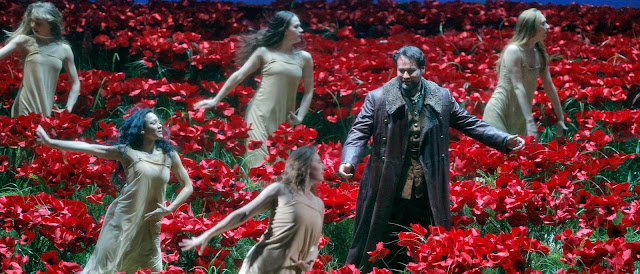
We caught up with Tcherniakov's production of Prince Igor on Monday when the 2014 performance was broadcast by the Metropolitan Opera. Gianandrea Noseda conducted with Ildar Abdrazakov in the title role, with Mikhail Petrenko, Sergey Semishkur, Oksana Dyka, Anita Rachvelishvili and Stefan Kocan. The performances were terrific, with Abdrazakov really making the most of the more introspective nature of the title role in this edition. Tcherniakov staged the Polovtsian Act as pure fantasy as Igor lay unconscious after battle. But the other acts were all constricted by the rather plain fixed set, and a tendency to have the chorus in serried ranks. But, set in the 1920s or 1930s it was an admirable attempt to make the piece's tensions work without the orientalising aspect.
On Tuesday it was the turn of another rarity, Rossini's Ermione in a performance from the Teatro San Carlo in Naples, courtesy of OperaVision, celebrating the 200th anniversary of the work's (unsuccessful) premiere there. Ermione is one of a sequence of works that Rossini wrote for Naples, where he had a stable, well-funded company and he was able to experiment. Not every experiment succeeded, and Ermione pushed the bounds some-what with its focus on the title role, written for Rossini's mistress Isabella Colbran, including the way that the entire second half of the second act is focussed solely on Ermione. Jacopo Spirei's production was contemporary yet neo-classically inspired. It did not light any fires, but made a very elegant setting for the vocal set pieces and here Spirei and conductor Alessandro De Marchi drew out some fireworks. Ermione seems to be a role that Angela Meade was born to play and she produced fireworks of every type, and she and John Irvin as Pirro (the man she loves and whom betrays her or not, the plot is complex) really knocked sparks off each other. Terrific stuff, with great support from Antonino Siragusa as Oreste, Filippo Adami as Pilade and Teresa Iervolino as Andromaca.
Friday, we celebrated VE day by watching an opera premiered in Munich in 1942, and apparently a conversation about art. But, as productions such as that by Stephen Medcalf at Grange Park Opera, have shown Richard Strauss' Capriccio is far more complex than that. Interestingly, whilst I have seen Strauss' other period operas, Der Rosenkavalier, Ariadne auf Naxos and Arabella, in productions set during the periods that Strauss and his librettists intended, it seems that Capriccio is fated always to be set during the 20th century. John Cox's production of the opera is iconic, versions of it have been seen at Glyndebourne, La Monnaie in Brussels, Covent Garden and a number of American opera houses. I saw Cox's production at La Monnaie in the 1980s conducted by John Pritchard with Felicity Lott as the Countess in a performance that remains burned in the memory, and Lott was again the Countess with Bernard Haitink conducting when I saw it at Glyndebourne a few years later, with Hugues Cuenod as Monsieur Taupe! In fact there wasn't one John Cox production but many, with various designers.
The Metropolitan Opera's production started out life in the 1990s but for the 2011 revival, there were entirely new sets but in the same traditional mould. Renee Fleming made a delightful Countess with Sarah Connolly stylish and sharp as Clairon, and Peter Rose as a very sympathetic La Roche. Andrew Davis conducted, and there was much indeed to enjoy. I would probably have found the auditorium at the Met rather too big for my taste for this opera (I prefer it on a relatively small scale), but the video version brought the right degree of intimacy to it.
On Saturday, we caught up with Verdi's Don Carlos from l'Opéra Royal de Wallonie, which is based in Liege, courtesy of France TV.. The company was 200 years old this season (the Theatre Royal de Liège was inaugurated in 1820, and the Opéra royal de Wallonie created in 1967 based on the former opera company of the Théâtre royal de Liège and that of Verviers) and the production was part of the celebrations. A grand affair, using Verdi's 1867 original version in French with the prelude and opening scene restored, but without the ballet. This featured a strong cast, with Gregory Kunde as Don Carlos, Yolanda Auyanet as Elisabeth, Ildebrando D’Arcangelo as Philippe, Kate Aldrich as Eboli, Lionel Lhote as Rodrigue (the only major role sung by a Francophone singer) and Roberto Scandiuzzi as Le Grand inquisiteur, conducted by Paolo Arrivabeni. Stefano Mazzonis di Pralafera's production was very tradition, with Fernand Ruiz's rich costumes emulating the images from paintings of the era, and Gary McCann's imaginative realistic sets. The result had, perhaps, a little stiffness to it, inevitable given the social mores of the era being evoked and the heaviness of the costuming. But Mazzonis di Pralafera's direction did have an element of stand and deliver about it, but this was compensated for by the fine performances from all concerned, an impressively balanced cast in what was a very full version of the opera with nearly 4 hours of music.
Tomorrow (Sunday 10 May 2020), I was scheduled to give my talk In search of Bach's cello suites at Conway Hall in advance of a performance of Bach's Cello Suites by cellist Robert Max. This live event, alas, is not happening, and we will have to wait for a future date to hear Max's performance of these icons of the solo cello repertoire.
Instead, Conway Hall will be presenting an event on-line, hosted by the hall's director of music, Simon Callaghan. I will be giving my talk In search of Bach's Cello Suite, live from my study in Brixton (thanks to the wonders of technology), whilst pianist Maria Canyigueral will be performing Bach, Mompou and Beethoven's Piano Sonata Op. 27 No. 1.
Full details from the Conway Hall website, and we look forward to seeing you on Sunday 10 May at 6.30pm
Ian Page and The Mozartists recording volume one of Sturm und Drang
In the midst of their Mozart 250 project (exploring the output of Wolfgang Amadeus Mozart (1756-1791) year by year, and which this year reached 1770), Ian Page and The Mozartists are embarking on a survey of music by Mozart's contemporaries, specifically the style known as Sturm und Drang. This month [May 2020] the ensemble has the first of a planned seven Sturm und Drang discs out on Signum Classics. For the first disc, Ian and The Mozartists are joined by soprano Chiara Skerath for a programme of music by Christoph Willibald Gluck (1714-1787), Niccolò Jommelli (1714-1774), Franz Joseph Haydn (1732-1809), Franz Ignaz Beck (1734-1809) and Tommaso Traetta (1727-1779). I recently chatted to Ian, via Skype, to learn more about the disc and the project, but first of all 'what is Sturm und Drang?'.
Chiara Skerath recording volume one of i
Ian explained that Sturm und Drang (usually translated as 'storm and stress') is a late 18th century movement which was a reaction again the calm, understated nicety of the rococo. Though the name itself, Sturm und Drang, is somewhat contentious as it came after the movement, but nowadays it makes a convenient way of referring to this movement which was an explosive reaction to rococo, with music aiming to deliberately provoke shock and terror, and extended emotions.
It is more than a musical idea, and initially was linked to the resurgence of the works of Shakespeare. The name Sturm und Drang comes from the name of a play by Friedrich Maximilan von Klinger (1752-1831), and whatever the art-form, Sturm und Drang involved turbulence and heightened drama. And music rather prefigures the literary works; the main literary Sturm und Drang dates from the 1770s whilst the music on Ian's first disc is from the 1760s.
They begin with music from Gluck's ballet Don Juan, which was premiered in Vienna in 1761 with a libretto by the Italian poet Ranieri de'Calzabigi (1714-1795), who would go on to write the librettos for Gluck's reform operas, Orfeo ed Euridice, Alceste, and Paride ed Elena. Don Juan was an important pre-cursor, significant perhaps of something being in the air, a desire to find extremes of emotion in the arts. Here Ian mentions studying Shakespeare's Hamlet when he was in his late teens and finding the piece extraordinarily visceral with its quest for what it is to be human. And for Ian, Sturm und Drang is mining the same emotions.
Musically, this means works in minor keys, fast tremolandos, stark orchestrations often with horns to the fore, exploring extremes and contrasts. The recording project started as quite a small idea, that there were quite a lot of minor key symphonies from the 1760s, 1770s and 1780s, many of which are not well known of often recorded, and Ian thought it would be interesting to put them in context. So there will be six discs featuring one of Haydn's great minor key symphonies, and one disc featuring Mozart's Symphony in G minor, No. 25. These are works where the faster movements are clearly Sturm und Drang whilst the slower movements still have extremes of pathos. To make a disc satisfying Ian is aware that you need variety of texture, tempo and mood, though he was still looking for music with heightened emotions.
La bella Habana;Camerata Romeu, Zenaida Castro Romeu Reviewed by Robert Hugill on 8 May 2020 Star rating: 3.0 (★★★) An all-women string orchestra from Cuba in a delightful selection of of Cuban and Brazilian music evoking the streets of Havana
The Camerata Romeu is an all-women string orchestra founded in Cuba in 1993 by Zenaida Castro Romeu. The orchestra specialises in playing Latin American music but with a European slant, and the group was founded to have high production values with a specific aesthetic.
On this new disc La Bella Habana, Zenaida Castro Romeu directs the Camerata Romeu in music which is intended to evoke the city of Havana, Brazilian and Cuban music heard every day in the city. The disc includes a final track which was the sound-track to Alejandro Reyes film celebrating the 500th anniversary of Havana.
Southbank Sinfonia was planning Family Concert on Saturday (9 May 2020), and so nothing daunted the orchestra is going ahead. On the basis that we may be all stuck on lockdown, but that doesn't mean we can't go on an adventure together, the orchestra will be presenting its first Virtual Family Concert. Players from the orchestra will present and perform music of their native countries, from their living rooms to yours, via the magic of YouTube. The concert is ideal for children aged 5–11 years, but parents and grandparents can have just as much fun too; perfect for those seeking homeschooling inspiration.
Southbank Sinfonia's Virtual Family Concert is at 11.30am on Saturday 9 May 2020, on its YouTube channel. The event is free to view, but if you'd like to support Southbank Sinfonia, please do check out their Music Director's Appeal.
The Baltic Sea Philharmonic and Kristjan Järvi had been due to be performing Shostakovich’s Symphony No. 7, the ‘Leningrad’ today, 8 May 2020, at Berlin's Konzerthaus, one of five simultaneous Music for Peace events across Europe marking VE Day, the 75th anniversary of the end of World War II in Europe. But, with the cancellation of concerts, 108 musicians from Baltic Sea Philharmonic each made their own recording at home of a 20-minute excerpt from the symphony’s first movement, and all these were then brought together with Kristjan Järvi conducting, to create a video Music for Peace.
Shostakovich completed his epic Seventh Symphony in December 1941, having been evacuated from his home city of Leningrad, which was under siege by Nazi forces. A microfilm of the score was smuggled out of Russia and the symphony quickly became popular in the Soviet Union and the West as a symbol of freedom and defiance in the face of oppression and occupation. The symphony was heroically performed in Leningrad amid the direst of conditions on 9 August 1942.
The Music for Peace video from the Baltic Sea Philharmonic and Kristjan Järvi will debut at 2pm, 8 May 2020 (Berlin time, 1pm UK time) on the orchestra's Facebook and YouTube pages.
The Aurora Orchestra is releasing new on-line content with its digital series Aurora Play. From Sunday 10 May 2020, the orchestra will be featuring the best of its recorded content on YouTube along with new interactive content. The series starts with the orchestra's landmark Orchestral Theatre staging of Berlioz’s Symphonie fantastique from the 2019 BBC Proms, and other highlights include memorised performances of Beethoven’s 'Pastoral' and 'Eroica' symphonies (from the 2015 and 2017 BBC Proms) and works by John Adams, Anna Meredith, Brett Dean and Nico Muhly, with further content to be announced.
The series will also include new introductions from Nicholas Collon (the orchestra's principal conductor) and other special guests, and its workshop leader-in-residence Jessie Maryon Davies has created a series of interactive films which take a sideways look at the music being performed each week, (see her introductory video to Berlioz' Symphonie fantastiqueon YouTube) and encourage the audience to create and share their own responses online.
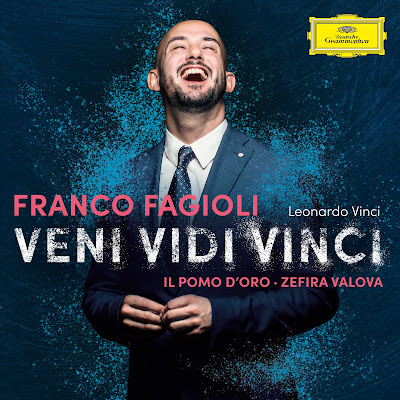
Arias by Leonardo Vinci; Franco Fagioli, Il pomo d'oro; Deutsch Grammophon Reviewed by Robert Hugill on 6 May 2020 Star rating: 4.0 (★★★★) Franco Fagioli brings his distinctive style to a disc of arias by the early 18th century composer whose material was an important precursor of the galant style
Leonardo Vinci belonged to the generation of Italian composers younger than Handel, and Vinci played an important role in the development of Italian opera in the 1720s, creating a style which focused on the elaboration of the vocal line, and his work would play an important role in the development of the galant style. His early death paved the way for Johann Adolph Hasse's European-wide success. Vinci's operas have been slowly emerging into the lime-light, counter-tenor Filippo Mineccia issued a disc of arias back in 2014 [see my review], whilst Vinci's 1726 opera Siroe received its premiere recording in 2019 with Antonio Fori conducting forces from the Teatro San Carlo in Naples [see my review].
On this new disc with the delightfully punning title of Veni, Vidi, Vincifrom Deutsche Grammophon, counter-tenor Franco Fagioli performs a selection of opera arias by Leonardo Vinci with Il pomo d'oro directed by Zefira Valova, and we hear music from Il trionfo di Camilla (1725), L'Ernelinda (1726), Siroe (1726), La Rosmira fedele (Partenope) (1725), Gismondo Re di Polonia (1727), Alessandro nell'Indie (1729), and Medeo (1728), with Fagioli singing arias originally written for both castratos and star sopranos.
The operas span quite a narrow time-range, as Vinci initially worked in comic opera, only moving to opera seria in 1724, and he died in 1730. He was Neapolitan trained, and one of a group of Italian composers of the period with strong links to the major castrati, many of whom had similar Neapolitan training. These are arias sung the by major singers of the day, and those on the disc include material sung by Faustina Bordoni, Francesca Cuzzoni, Carlo Scalzi and Farinelli amongst others.
I have been visiting the Dresden Music Festival since our first visit in 2014, highlights have included the 40th festival in 2017 with Beethoven's Leonore (the 1805 version of Fidelio) in concert [see my review] at the restored Kulturpalast (a new concert hall created within the restored shell of the Soviet-era building), and a new cello concerto for the festival Intendant, cellist Jan Vogler, written jointly by Nico Muhly, Sven Helbig and Zhou Long in 2019 [see my review]. The festival provides an opportunity to hear music in some of Dresden's historic buildings, and part of the charm of our festival visits has been watching the reconstruction of the city.
On our first visit, in 2014, we were able to visit the newly restored Grünes Gewölbe (Green Vault) in the Residenzschloss, a reconstruction of the spectacular early 18th century settings for the Electors of Saxony's Kunstkammer, and since then more of the Residenzschloss has been restored and reconstructed. For our visit this year (2020) we were looking forward to hearing an 18th century opera by one of the Saxon princesses (a pupil of Carl Maria von Weber), and for exploring the recently restored State Apartments in the Residenzschloss, the grand early 18th century reception rooms which were burned out during World War Two.
However, this year's Dresden Music Festival (the 43rd) takes a totally different format to previously and intendant Jan Vogler has put together an on-line festival on 16 May 2020, for 24 hours from 6pm (Central European Time). This non-stop live-stream festival is presented in collaboration with Music Never Sleeps NYC, Jan Vogler's New York based initiative which was presented in March. For the Dresden festival, more than 50 of the festival’s musicians along with artists that have been connected to the festival for years will carry the unique festival atmosphere to living rooms across the globe.
The programme will be co-hosted by Jan Vogler and Ute Lemper. As with previous editions of the festival, the artists span the popular and classical worlds, with some major names including conductor Fabio Luisi, jazz singer/songwriter Jamie Cullum, singer/songwriter Aoife O’Donovan, conductor/composer Omer Meir Wellber, jazz trombone player Nils Landgren, soprano Simone Kermes, pianist / composer Francesco Tristano, counter-tenor Valer Sabadus, mandolin player Avi Avital, violinist James Ehnes, cellist Mischa Maisky, pianist Martin Stadtfeld, tenor José Cura and violinist Gil Shaham. Recordings from previous festivals will feature the period instrument Dresden Festival Orchestra, conducted by Ivor Bolton and the Orchestra of the Mariinsky Theatre, conducted by Valery Gergiev.
Beethoven: Leonore - Dresden Music Festival - Ivor Bolton, Michael Kupfer-Radecky, Ann Kern, Dresden Festival Orchestra (photo Oliver Killig)
The stream will be broadcast on the Dresden Music Festival’s website, YouTube and Facebook channels, along with the channels of Music Never Sleeps NYC. The latest news regarding the program can be found with the hashtag #musicneversleepsdmf or on the festival’s website.
Rihards Dubra Symphony No. 2, Mystery of his birth; Liepāja Symphony Orchestra, Atvars Lakstigala, Eriks Kirsfelds; Skani Reviewed by Robert Hugill on 5 May 2020 Star rating: 3.5 (★★★½) A serious, large-scale symphonic work from the Latvian composer known for his sacred music
I first came across the music of Latvian composer Rihards Dubra in the early 1990s when I was given a copy of one of his small-scale Latin choral works. Since then, it is for his sacred choral music that the composer has become best known. But a new disc from the Latvian label Skani (an offshoot of the Latvian Music Information Centre) introduces us to Rihards Dubra on a larger scale with performances of his Symphony No. 2 and Mystery of his Birth, for cello and orchestra, performed by the Liepāja Symphony Orchestra, conductor Atvars Lakstigala (the orchestra's chief conductor) with cellist Eriks Kirsfelds. [The disc is released on 8 May 2020].
Dubra's Symphony No. 2 is a large scale work, well over 30 minutes long and written for an orchestra with triple woodwind, four horns, three trumpets, three trombones, tuba, four timpani and percussion players and harp [see the sample score from Musica Baltica]. It is in three movements, 'Visio', 'Cantus', 'Et vidi...'. The interview with the composer in the CD booklet is illuminating when it comes to the composer's general philosophy, but we are given little concrete information about the work itself.
It is a large, serious work and though a secular piece, as with a lot of Dubra's work you sense that the sacred is never far away. Raised a Roman Catholic in Soviet Latvia when such things were if not proscribed then highly restricted, as a musician Dubra has continued to relate to the sacred, not only writing a substantial body of music setting sacred texts, but he was also a founder member of the Schola Cantorum Riga as well as being cantor in church in Riga and singing with a number of other ensembles.
Dubra takes an intense and serious view of the symphony, saying in the CD booklet "I don’t think a symphony should speak about small, everyday things and issues; it should speak of global, fundamental and substantial things. Only then does it justify
the name ‘symphony’. It must be something serious." The inspiration behind the work seems to be the Book of Revelation, "If we take the New Testament, Revelation is my favourite book in it. And precisely because it has so much mysticism in it. I really like mysticism as a phenomenon; I like things I cannot immediately explain".
Dubra is very much linked to the Baltic minimalist school, this music is often a long way from minimalism, with complex textures and music which strays a long way from the purely tonal, "Now and then I use the twelve-tone technique, but I use it in this same way, so that the result sounds quite melodic. When I feel like playing around, I try to build a twelve-tone melody so that it doesn’t sound like a twelve-tone melody. I do that with a lot of things."
The symphony is a sober, serious and rather intense piece.
Next week, the Institut Francais' literature festival Beyond Words goes on-line (from 11 to 24 May 2020). Amongst the events, is a performance from pianist and composer Karol Beffa amongst whose specialities is improvisation on themes provided by members of the public such as when Bach meets Scarlatti [see Beffa's improvisation on YouTube].
The festival has launched an open call to collect suggested themes for Beffa's improvisation at the festival. They want people to sent two nature-related subjects to musique@institut-francais.org before 10 May 2020, and Beffa will improvise on selected themes at his recital at the festival on 14 May 2020.
Beffa was a child actor from the age of 7 to 12, working with Giorgio Strehler at the Piccolo Teatro di Milano, and playing the young Mozart in a TV film directed by Marcel Bluwal. He studies included doing a master degree in Philosophy at Cambridge, as well as studying at CNSM in Paris. His compositions include a violin concerto for Renaud Capucon, and a piano concerto for Boris Berezovski. He has also written around 20 film scores (including Mehdi Ben Atta's 2017 film L'amour des hommes), and three opera-ballets. The France Musique website has a good 30 minute programme from 2019 where Beffa talks about himself [in French] and his music alongside performances of three of his pieces: https://www.francemusique.fr/emissions/l-invite-du-jour/karol-beffa-est-l-invite-de-musique-matin-73904
The Get Creative Festival, the UK's biggest celebration of have-a-go creativity, returns this year for its fifth instalment but this year the festival has moved on-line. As part of its contribution, the BBC is forming the BBC Lockdown Orchestra, featuring musicians from the BBC Orchestras and the Ulster Orchestra, each recorded in their own home. The new orchestra's first 'gig' will be providing the backing to a new Get Creative initiative, a national collaborative rendition of the 1986 anthem of hope You Got The Love by The Source featuring Candi Staton - which Florence + The Machine brought to renewed fame in 2009 with their cover version, You’ve Got The Love.
From Monday 4 May to Sunday 10 May as part of the Get Creative festival, members of public are invited to download the specially made backing track or musical score of You Got The Love from bbc.co.uk/getcreative, and to then film themselves singing or playing a musical instrument to the track. Once the public have uploaded their videos the BBC will be making a track and video to go out across BBC Radio on Thursday 14 May, on-line and on BBC Four at 8.55pm later that day.
Ed Hughes Cuckmere: A Portrait, Sinfonia; Orchestra of Sound and Light, New Music Players, Ed Hughes, Nicholas Smith; metier Reviewed by Robert Hugill on 4 May 2020 Star rating: 3.5 (★★★½) Two recent major works by composer Ed Hughes take inspiration from the landscape of the River Cuckmere, and from the music of the past
Time, Space and Change is a disc of three large-scale pieces by composer Ed Hughes on Divine Art's metier label. The disc includes two of Hughes' recent orchestral scores, Cuckmere: A Portrait performed by the Orchestra of Sound and Light conducted by the composer, and Sinfonia, performed by the New Music Players conducted by Nicholas Smith. In between there is Hughes' early work, Media Vita performed by the New Music Players Piano Trio, Susanne Stanzeleit (violin), Joe Giddey (cello) and Richard Casey (piano).
The disc opens with Cuckmere: A Portrait, an eight movement suite from 2016-18 which was originally written as a live score for a film. Hughes studied with Michael Finnissy and Robin Holloway, and is now Professor of Composition at the University of Sussex. He has a great interest in music for film and has written scores for silent films by Sergei Eisenstein and Yasujiro Ozu. Cesca Eaton's film Cuckmere: A Portrait, with aerial photography by Fergus Kenney and Hughes score, was commissioned for live cinema performance at the Brighton Festival. Depicting a year in the life of the River Cuckmere, it uses the combination of music and moving images to create a poetic, contemporary silent film.
The Stoller Hall in Manchester is three tomorrow (5 May 2020) and the hall is celebrating, on-line of course, with a virtual gala concert hosted by the hall's artistic director Timothy Redmond. The celebration takes the form of a live-stream with performances from some of the best classical music performed in the north of England in recent years, all recorded at The Stoller Hall, including Manchester Collective, Manchester Camerata, Northern Chamber Orchestra and Chetham’s Symphony Orchestra star alongside global artists such as Soweto Gospel Choir.
Highlights include Manchester Collective’s performance of Messiaen's Quartet for The End of Time, part of Manchester Camerata’s Mozart series, Iyad Sughayer in the second movement of Khachaturian's Piano Sonata in Eb Mayor [see my review of Sughayer's disc of Khachaturian] and celebrating the hall's links to Chetham's School of Music, Chetham’s Symphony Orchestra performs Tchaikovsky’s Romeo and Juliet Fantasy Overture, conducted by Franz Krager, from a concert in 14 April 2020.
Alan Bush at his home in Radlett, taken from Anna Ambrose's 1983 documentary Alan Bush: A Life
Thanks to someone on my Twitter feed, I found out about Anna Ambrose's 1983 documentary about the composer Alan Bush on BFI Player, Alan Bush: A Life. Just over an hour, it contains a fascinating interview with Alan intercut with his music, archive footage and other interviews including the composer Michael Tippett whose life very much intersected with that of Alan Bush in the 1930s particularly. I met Alan Bush twice, at his home in Radlett, in connection with him providing music for the Pink Singers, and he and his wife Nancy (who was librettist to some of his operas) were full of remarkable reminiscences. Alan Bush's music still seems underrated, and his opera Watt Tyler is very high on my want to see list.
On YouTube, Stile Antico has been having fun creating an on-line version of Tallis' glorious 40-part motet, Spem in Alium [YouTube], performing a work rather larger than their regular repertoire. Pianist Tom Poster and violinist Elena Urioste's #UriPosteJukebox continues including, this week, the premiere of new pieces Bloom by Cheryl Frances-Hoad [YouTube], and Arietta by Huw Watkins [YouTube]. Baritone Jake Muffett has been posting a series of Corona-Projects, involving his own singing and instrumental talents, I was particularly taken with his version of Handel's duet 'The Lord is a man of war', featuring himself on baritone (x2), and multiple clarinets, with Benedict Williams on keyboard [YouTube]
Jake Muffett may be familiar to readers from his year at the National
Opera Studio (he also kindly sang in the chorus for my opera The Gardeners last year), and you can catch up with what the current crop of Young
Artists are doing there on the NOS website.
Clarinettist Anthony Friend (who also played in the premiere of my opera The Gardeners) posted a lovely video of some Gluck, performed by himself, Bridget O'Donnell (violin), Anthony Tress (violin) and Misha Mullov-Abbado (double bass) originally broadcast by the Tait Memorial Trust [Instagram]. Viola player Lawrence Power
Composer Adrian Sutton, who wrote the score to the National Theatre production of War Horse [see my interview with Adrian], has posted a lovely version of Polperro Beach from the show with himself on vocals, guitars, keyboards and more [YouTube]
Guitarist Andrew Keeping (who premiered one of my song cycles more years ago than either of us care to remember), gave a live recital for May Day, which is still available on Facebook, and composer Alison Willis (who won London Concord Singers' 50th Anniversary
Composition Competition in 2016) also posted a lovely track in celebration
of May Day [Facebook]
English Touring Opera's lively sequence of instructional videos continues on YouTube, I was particularly taken with harpist Aileen Henry and theorbo player Toby Carr [who performed in ETO's recent production of Handel's Giulio Cesare, see my review] talking about the use of theorbo and harp within baroque opera [YouTube].
Record company Orchid Classics has created its own blog page, The Lockdown Sessions 2020 with its own selection of postings of artists performing in the own homes around the world. Violinist Tasmin Little was due to be retiring from live concerts this Summer, instead she has been busy fundraising [Instagram], making e-greetings to send to people who cannot visit loved ones and if you visit her website you can ask her to make one for as little as £35, which goes to Help Musicians UK.
If you have enjoyed any of these performances, then please do think about making a donation to Help Musicians UK.
On Monday, we caught the Wigmore Hall live-streaming of counter-tenor Jakub Józef Orliński and pianist Michał Biel's 2018 recital originally given to celebrate 100 years of Polish Independence, so that the recital mixed Handel, Purcell, Schubert and Hahn, with Polish composers Karol Szymanowski, Tadeusz Baird, and Pawel Lukaszewski. This was a recital we missed live, so lovely to catch up on it. Orliński's way with Purcell was very creative, and it was lovely to hear a counter-tenor in Schubert and Hahn (including the Baroque-inspired A Chloris) on the hallowed Wigmore Hall stage.
Over at the Metropolitan Opera, last week was Tudor Queen in Italy week as they broadcast their productions of Donizetti's Anna Bolena, Maria Stuarda and Roberto Devereux. Commonly referred to as Donizetti's Tudor Queens trilogy, this rather ignores the fact that Donizetti did not write the operas as a trilogy and that there is a fourth opera about Queen Elizabeth I which is rarely done (the early Il Castello di Kenliworth, written the year before his first big success with Anna Bolena).
In 2016, the Met performed all three operas with Sondra Radvanovsky in the three leading roles, but the broadcasts featured each production's debut. Anna Bolena from 2011 with Anna Netrebko and Stephen Costello, Maria Stuarda from 2013 with Joyce DiDonato, Elza van den Heever and Matthew Polenzani, and Roberto Devereux from 2016 with Sondra Radvanovsky and Matthew Polenzani.
David McVicar's productions were all traditional and Anna Bolena and Maria Stuarda seemed to use the same selection of sets (design's by John Macfarlane), though Roberto Devereux (with set designs by McVicar himself) seemed to be set in a version of the Sam Wanamaker Playhouse at the Globe Theatre. McVicar opted for a sort of stylised naturalism, which might work well on a smaller stage but at the Metropolitan Opera, where everything was writ large, it seemed to simply blow things up. And the result made some of the costumes seem unflattering in the extreme (for both men and women).
These operas are not history, but are based on Italian and French plays and romances, and I read a very illuminating article about Maria Stuarda which explained that in early 19th century Italy, Mary Stuart was very much the heroine and Elizabeth I the villain; Elizabeth being seen through very different eyes than the English Good Queen Bess.
In production terms, I rather found Alessandro Talevi's approach more convincing in the Anna Bolena [see my review] and Roberto Devereux [see my review] he directed for Welsh National Opera's Tudor Queens trilogy. Still the singing was superb, and it was a chance to hear these three operas performed as a trio by some of the finest bel canto singers of the day.
Rimsky-Korskov, Tchaikovsky, Rachmaninov, Dvorak, Janacek, Novak; Natalya Romaniw, Lada Valesova; Orchid Classics Reviewed by Robert Hugill on 2 May 2020 Star rating: 4.0 (★★★★) Touching melodies, and intense passion in this emotional journey through Slavic song dedicated to the Welsh soprano's Ukrainian grandfather
For all that soprano Natalya Romaniw has been exploring Puccini's heroines recently [including Mimi and Butterfly at English National Opera, and Tosca at Scottish Opera], it is perhaps with Russian and Czech roles that she most identifies notably Tchaikovsky's Tatyana (Eugene Onegin), and Lisa (Queen of Spades) and the title roles in Janacek's Jenufa [see my review of her 2017 performance at Grange Park Opera, and my interview with Romaniw] and Dvorak's Rusalka, not to mention her striking Marenka in Smetana's The Bartered Bride at Garsington Opera [currently available on YouTube].
Perhaps this sympathy with Slavic roles is not surprising, Romaniw's grandfather was Ukrainian and emigrated to South Wales during the Second World War. And though brought up in Swansea, Romaniw's biggest musical influence as a girl was Ukrainian folk-song.
For Natalya Romaniw's new recital disc on Orchid Classics she is joined by with pianist Lada Valesova (who should have been conducting Opera Holland Park's 2020 Young Artist performance of Tchaikovsky's Eugene Onegin). Their recital Arion: Voyage of a Slavic Soul is dedicated to the memory of Romaniw's Ukrainian grandfather and explores her sympathy with Slavic composers, with songs from Nikolai Rimsky-Korsakov, Antonin Dvorak, Pyotr Il'yich Tchaikovsky, Sergei Rachmaninov, Leos Janacek and Vitezslav Novak.
Matthew Sharp is both a cellist and a baritone, and he brings both these talents together in his show Tommy Foggo - Superhero, designed for families and about a boy who finds a talking cello, with words by Martin Riley and music by Stephen Deazley.
During lockdown, Sharp has created his own theatre, The Garage Theatre and is broadcasting an episode of Tommy Foggo per day with two so far. [you can read more about Matthew in my 2015 interview with him where he talks about the development of Tommy Foggo]
Matthew describes the piece as 'A magical multi-media tale of a life saved by music for 7+ and their guardians, based on a true story.' whilst the Scottish Herald thought it was 'As though Tom Waits and Stephen Sondheim had come together with Roald Dahl'
The 2019 Oxford Lieder Festival presented RVW's On Wenlock Edge in a performance by tenor Daniel Norman, the Brodsky Quartet and pianist Sholto Kynoch with an accompanying film created and directed by Jeremy Hamway-Bidgood [see my review].
The film was created with live performance in mind, and in a concert setting, Hamway-Bidgood edits the film to fit the nuances of each individual performance. Now a film version has been produced edited to a recording of On Wenlock Edge by Norman, the Brodsky Quartet and Kynoch which is available for download from Stone Records.
Hamway-Bidgood has woven a story around the six disparate songs in On Wenlock Edge. Two young men in search of work, a farm, a farmer's daughter, love for the daughter, an intimate relation between the men, war, one is lost, the other comforts the girl, leaves her, all shot through with the memories of the man, now old and living in London, complete with a characterful dog. It is a poignant tale, effectively told, and brought out themes in On Wenlock Edge, and I think manages to make the work accessible to both adults and young people.
The film is available for a limited time only, in association with Positive Note Films [the group which is also producing the St John Passion in an on-line series from Oxford Bach Soloists], on YouTube, and the festival website includes more information, including a 'Making Of' film, and Hamway-Bidgood's story board for the film.








.jpg)

.jpg)

.JPG)

.jpg)
