Tuesday, 18 January 2022

Carnet de voyages: exploring the music of Simon Bertrand

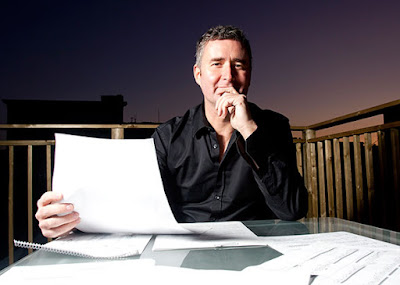
Simon Bertrand (photo Jean Vailhe)
The Société de musique contemporaine du Québec (SMCQ) is continuing its concert series devoted to portraits of Quebec composers, and that these concerts are available online means that we can explore in the comfort of our own homes. SMCQ's concert on Sunday 30 January 2022 is a particular chance to explore as Carnet de voyages is dedicated to the music of Simon Bertrand, a composer who has traveled much.

Trained originally as a multi-instrumentalist at the Montreal Conservatoire, Simon Bertrand decided to dedicate himself to composition after experiencing a workshop with Henri Dutilleux. Since then, Bertrand has had periods of residence in Japan (where he wrote almost exclusively for traditional Japanese instruments) and in Denmark, in total spending more than 15 years away from his native land.

This is reflected in his music and the programme for Carnet de voyages will include music written in Japan as well as a world premiere, Blues de Saint-Adolphe for two clarinets, a viola concerto as well as inspirations from rock, pop and jazz. Samy Moussa conducts Ensemble de la SMCQ, with Trio Fibonacci, Virginie Mongeau, soprano, Brian Bacon, viola, Louise Bessette, piano, Annabelle Renzo, harp, Josée Poirier, flute, Claire Marchand, flute, Simon Bertrand and Jean-Guy Boisvert, clarinet. 

Full details from SMCQ's website.

Comedy with violence: a chance to stream the German premiere of the original French version of Donizetti's Deux Hommes et une Femme

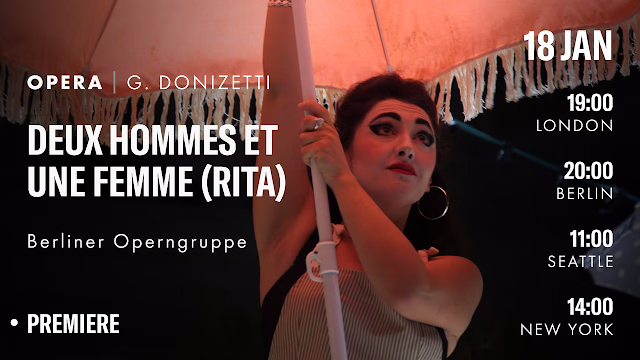
Donizetti's Rita (or Deux Hommes et une Femme) from Berliner Operngruppe on CuteTV

Donizetti's Rita (or Deux Hommes et une Femme) is a somewhat problematic work, essentially it is a delightful comedy featuring a spousal violence. Written, in French, in the 1840s the work dates from the period when Donizetti was working on the French version of Lucia di Lammermoor for Paris and uses the same librettist. But the work remained unperformed until the 1860s (well after Donizetti's death) and became known in an an Italian version which made significant changes to the work. Opera Rara restored the original French and went back to Donizetti's manuscript for their 2014 recording [see my review]. The work occasionally pops up on stages, after all a comedy from Donizetti's mature period is quite a draw, and directors approach the challenges of the plot in a variety of ways.

In September 2021, the Berliner Operngruppe gave the German premiere of this original French version of Donizetti's Deux Hommes et une Femme at the Konzerthaus, Berlin in a production directed by Lorenzo Fioroni, conducted by Felix Krieger and starring Elbenita Kajtazi, Alasdair Kent and Pablo Ruiz.

The production was filmed and the opera is being streamed by CueTV starting tonight (18 January 2022) and available until 25 January. Full details from CueTV.

The Art of Transformation: inspired by a Scottish Border ballad Alistair White's Woad is very much an opera for our times

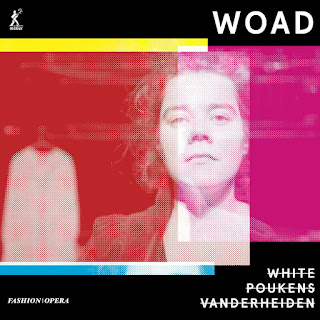
Alastair White Woad; Kelly Poukens, Suzy Vanderheiden; Metier

Alastair White Woad; Kelly Poukens, Suzy Vanderheiden; Metier

Reviewed by Robert Hugill on 16 January 2022 Star rating: 4.0 (★★★★)
A metaphysical meditation on the art of transformation, White's latest opera is a dazzling tour-de-force for just two performers

Alastair White's Woad is the third in his fashion|opera cycle [see my interview with Alastair for his thoughts othe philosophical underpinning of the cycle], following Wear and Rune. Alastair White's Woad: A Fashion - Opera, Seven Scenes from the Tale of Tam Lin is performed by soprano Kelly Poukens and saxophonist Suzy Vanderheiden on Metier.

In the medieval Scottish Borders, a young boy is bewitched – into the form of an ape, an adder, a speck of dust. But is it his shape that twists and churns, or that of the world around him? These are the questions considered by Woad. The piece is inspired by the Scottish Border ballad Tam Lin a tale as much about the idea of transformation whilst retaining one's true qualities. It is this aspect of the ballad that White has picked up on. In dramatising Tam Lin, he boils the idea of opera down to its essentials, just a voice and an instrument. Soprano Kelly Poukens does not play a particularly character, instead White's seven scenes (the libretto is his own) are a meditation on different aspects of transformation.

Monday, 17 January 2022

Celebrating Charles Burney: King's Lynn Festival's first Early Music Weekend

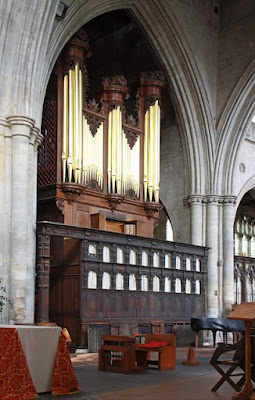
The Snetlzer organ case at King's Lynn Minster, installed during Charles Burney's time there as organist
The Snetlzer organ case at King's Lynn Minster,
installed during Charles Burney's time there as organist

The King's Lynn Festival has announced its first Early Music Weekend, from 1 to 3 April 2022 they will be presenting a series of concerts celebrating musicians associated with the town and with West Norfolk.

Charles Burney was organist at St Margaret’s Church (now King's Lynn Minster) in for eight years and promoted concerts in the town, and there will be a walk exploring Georgian King's Lynn and A Teatime Concert for Dr Burney where violinist Dominika Feher and harpsichordist Jack Gonzales Harding will be performing music by JS Bach, CPE Bach, Haydn and Mozart. The 17th century composer and viol player John Jenkins and his patron Sir Roger Le Strange lived in West Norfolk, and the Rose Consort of Viols will be performing music by Jenkins alongside that of Byrd, Robert Parsons, Tallis, Ferrabosco, Thomas Tomkins, Purcell and William Lawes. 

Other concerts include The Trials and Triumphs of Oriana, a programme of Elizabethan madrigals performed by sopranos Penelope Appleyard and Angela Hicks with lutenist Sam Brown and viola da gamba player Harry Buckoke, and Ibrahim Aziz, from the Rose Consort of Viols, is joined by harpsichordist Petra Hajduchov for Virtuoso Variations with music by Nicolas Hotman, Purcell, Christopher Simpson, Handel, Couperin and Marais.

Before then, one of the festival's Spring coffee concerts (on 11 March 2022) features the Passacaglia Trio in music from the Royal Court of Frederick the Great for flute, viola da gamba and harpsichord. 

Full details from the King's Lynn Festival's website.

A sense of ritual: Edward Jessen's Syllable, a work of complex musical theatre, is premiered by Trinity Laban Opera

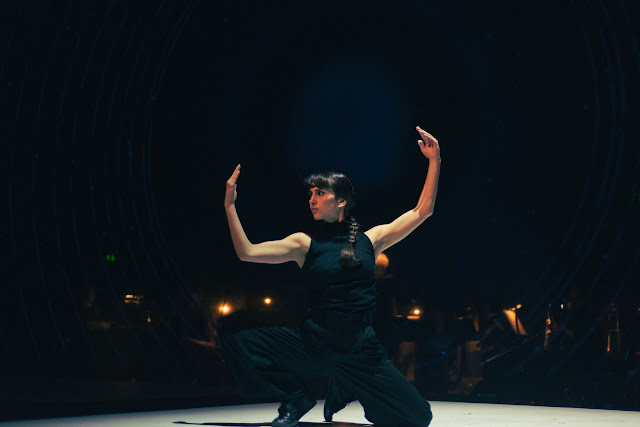
Edward Jessen: Syllable - Claudia Hilda Rodriguez Pozo - Trinity Laban Opera (Photo John Hunter at RULER)
Edward Jessen: Syllable - Claudia Hilda Rodriguez Pozo - Trinity Laban Opera (Photo John Hunter at RULER) 

Edward Jessen Syllable; Conductor Gregory Rose, director Joseph Alford; Trinity Laban Opera at Laban Theatre

Reviewed by Robert Hugill on 15 January 2022
Trinity Laban Opera in a brand new piece of experimental music theatre created by composer Edward Jessen from the conservatoire's music staff

Rather impressively, Edward Jessen's new music theatre piece, Syllable, is an ambitious and experimental work created in-house by Trinity Laban Opera. The work debuted on Friday 14 January 2022 and we caught the second cast, performing on Saturday 15 January 2022 at the Laban Theatre in Deptford. Composed by Edward Jessen and directed by Joseph Alford, the performance featured Claudia Hilda Rodriguez Pozo, Juliet Wallace, Miranda Ostler, Amy Kearsley, Imogen Burgess, Sholto Biscoe-Taylor and Niall Windass, with a vocal and instrumental ensemble conducted by Gregory Rose. Designs were by Molly Einchcomb, projection design by Akhila Krishnan, sound design by David Sheppard and Ian Dearden of Sound Intermedia, lighting design Malcolm Rippeth. The production also featured a recorded spoken narration created by Bastard Assignments.

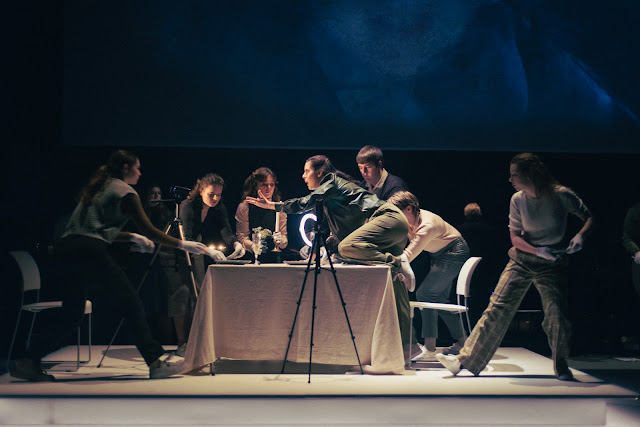
Edward Jessen: Syllable - Trinity Laban Opera (Photo John Hunter at RULER)
Edward Jessen: Syllable - Trinity Laban Opera (Photo John Hunter at RULER) 

Billed as an operatic sonic work, Jessen's piece was much more a work of experimental music theatre than a conventional opera as it pushed a number of boundaries of conventional operatic story telling. As such it was much more the sort of work one might come across in a low-budget production at Tête à Tête: The Opera Festival rather than in the handsome Laban Theatre at Trinity Laban, and given in an impressively thought-through and technically complex production.

Plenty to enjoy: Verdi's Nabucco returns to Covent Garden

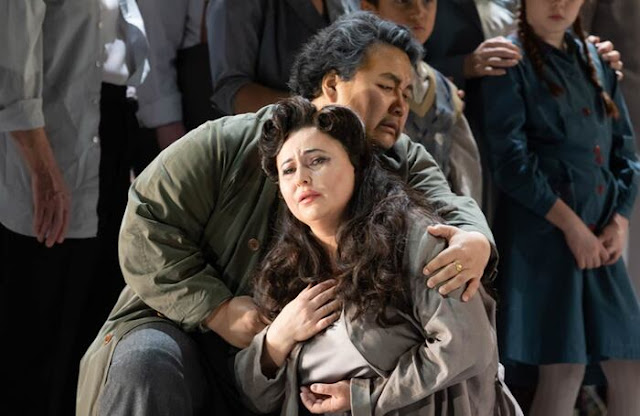
Verdi: Nabucco - Amartuvshin Enkhbat, Liudmyla Monastyrska - Royal Opera House, 2022 (Photo Bill Cooper)

Verdi Nabucco; Liudmyla Monastyrska, Amartuvshin Enkhbat, Alexander Vinogradov, Vasilisa Berzhanskaya, Najmiddin Mavlyanov, Renato Balsadonna; Royal Opera House

Reviewed by Robert Hugill on 14 January 2021 Star rating: 4.0 (★★★★)
Still on cracking form, Nabucco returns with a strong musical cast

It was going to feature Anna Netrebko as Abigaille with Daniel Oren conducting and cameras were to be there to capture the evening. In the event, Friday 14 January 2022's performance of Verdi's Nabucco at the Royal Opera House, featured Liudmyla Monastyrska as Abigaille with conductor Renato Balsadonna, plus Amartuvshin Enkhbat as Nabucco, Alexander Vinogradov as Zaccaria, Vasilisa Berzhanskaya as Fenena, Najmiddin Mavlyanov as Ismaele. So that is a cast made up of one Ukrainian, one Mongolian, two Russians, and one Uzbekistani, which perhaps gives an indication of where the big Verdi voices are coming from at the moment. And we must be grateful that the performance happened at all, some performances in December had to be cancelled and on the first night the chorus sang in masks, so all credit to everyone for making this happen.

Saturday, 15 January 2022

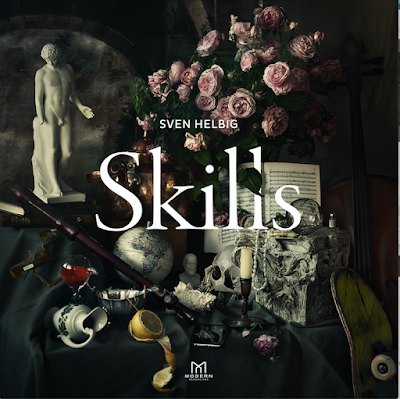
The sense of eternity that can be found in the simple doing of something: Sven Helbig's Skills

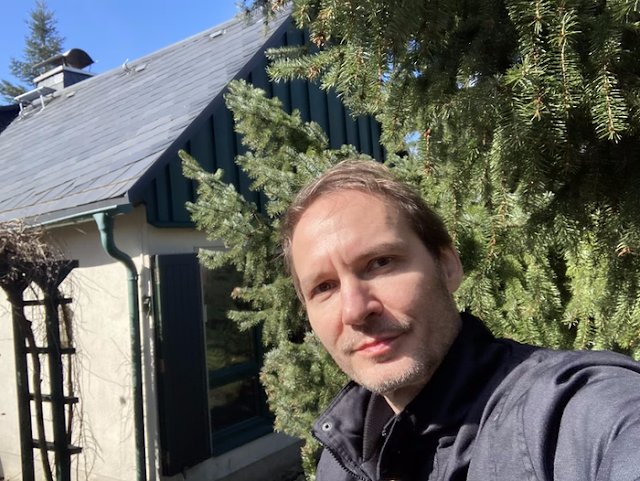
Sven Helbig (image posted on Kickstarter in March 2021)
Sven Helbig in an image he posted on Kickstarter in March 2021

German composer and music-producer Sven Helbig and my paths have crossed several times over the years. I first came across him at the first UK performance of his Pocket Symphonies [and I also caught them in Hamburg at the 2013 Reeperbahn Festival, see my review], and most recently, in 2019, I heard the premiere of his work for cello and orchestra commissioned for the Dresden Music Festival as part of a new concerto with each movement written by a different composer, the others being Nico Muhly and Zhou Long [see my review]. In between we have managed to cross paths in various ways including my interview in 2016. Now he has a new album, Skills, that comes out next month and we met up over Zoom to chat about it.

Sven Helbig: SkillsSven's musical style is very much a product of his background, as he was born in East Germany in 1968, in Eisenhüttenstadt in the Eastern part of the DDR close to the Polish border. In our 2016 interview he talked about how in 1982 if you found a disc which you liked, a recording by Anne Sophie Mutter say, there was little opportunity to find out more information about her or the music, all you could do was ask your friends, and wait until someone came across something. He never really had a network of musical friends, so that his music came from the radio and the two channels which he could get, one classical and one the American radio station in Berlin, so that he absorbed both classical and RnB without knowing what was what. Never having seen an orchestra, he didn't know what is was, it was just a sound. It was many years before he saw an orchestra and it was some 20 years after first falling in love with the sound that he came to understand the details behind it. So Sven's music was created without the idea of musical conventions, crossing boundaries because he did not know they were there.

His new disc, Skills comes out on 22 February 2022, and in many ways it is a very personal disc. For a start the disc's subject matter has its origins in Sven's family background, whilst producing the disc this year, with few live concerts, meant trying out a new way of financing the disc using crowd-funding.

Friday, 14 January 2022

23 Strings

The composer Paul Reade (1943-1997) wrote music for film, television, the theatre and the concert hall. Whilst many will be familiar with his music for popular TV shows, his ballets including Hobson's Choice for choreographer David Bintley remain highly popular. He wrote a number of pieces for the Manchester Camerata including a flute concerto which was premiered in 1985. A 1988 performance of with flautist Philippa Davies led to composer and soloist marrying.

There is a chance to hear Philippa Davies in Paul Reade's Flute Concerto on 20 January 2021 when the ensemble 23 Strings, conductor David Cutts, performs the work at Cadogan Hall in a programme that includes Richard Strauss' Metamorphosen and music by Tchaikovsky and Sibelius.

David Cutts formed 23 Strings (the name comes from the forces required for Strauss' Metamorphosen) in 2019 to draw on the pool of extremely fine string players in the UK.

Full details from the 23 Strings website.


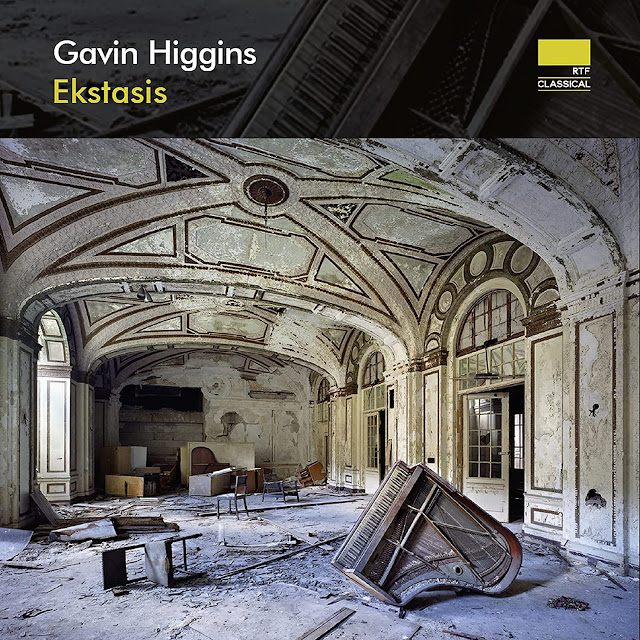
In stunning control of his material: Gavin Higgins' Ekstasis from Piatti Quartet, Fidelio Trio, Thomas Gould, David Cohen, Sara Roberts

Gavin Higgins Gursky Landscapes, Ruins of Detroit, Seven Welsh Folk Songs, Ekstasis; Piatti Quartet, Fidelio Trio, David Cohen, Sara Roberts; RTF Classical/Nimbus Alliance

Gavin Higgins Gursky Landscapes, Ruins of Detroit, Seven Welsh Folk Songs, Ekstasis; Piatti Quartet, Fidelio Trio, Thomas Gould, David Cohen, Sara Roberts; RTF Classical/Nimbus Alliance

Reviewed by Robert Hugill on 14 January 2021 Star rating: 5.0 (★★★★★)
From the eerie to the ecstatic, Gavin Higgins' recent chamber music constantly intrigues and fascinates with its combination of sophisticated instrumental writing and magical textures

This disc from RTF Classical, distributed by Nimbus Alliance, features the chamber music of Gavin Higgins, four substantial works, Gursky Landscapes for string quintet and Ekstatis for string sextet performed by the Piatti Quartet with David Cohen (cello) and Sara Roberts (viola), Seven Welsh Folksongs for solo violin performed by Thomas Gould, and Ruins of Detroit for piano trio performed by the Fidelio Trio.

Whether by accident or design, none of the pieces on the disc is completely abstract, each takes its inspiration from somewhere or something, each is in a sense a depiction or recreation in music. Both Gursky Landscapes and Ruins of Detroit are based in images that Higgins has seen, the resulting music becoming not so much a depiction of the image as Higgins' response to it. Seven Welsh Folksongs is more concrete, each of the movements is an arrangement of a folksong, whilst Ekstatis features five movements each of which evokes a different type of ecstasy. The result is a terrific disc of contemporary chamber music, and a programme which certainly has a real life of its own. There is nothing pictorial about Higgins' music and it is perhaps significant that the two photographers whose work he has been inspired by both produce images that have a significant emotional charge.

Gursky Landscapes for string quintet (David Cohen with the Piatti Quartet) is a five movement work based on five images by German photographer Andreas Gursky - 'Dolomites, Cable Car', 'Les Mées', 'Kamiokande', 'Utah', 'Kathedrale' [the links go to the images on Gursky's website, well worth exploring]. 

Thursday, 13 January 2022

Burghley Sessions: Eboracum Baroque explores the Earls of Exeter's music collection at Burghley House

Eboracum Baroque: Burghley Sessions
During the 17th and 18th centuries musically inclined aristocrats and gentry would compile books of favourite pieces of music. Whilst people did acquire printed music, with the most enthusiastic often subscribing to new music publications, it remained common to copy (or have copied) pieces that appealed. Sometimes such collections can bring forth gems, pieces hitherto unknown (we have both Handel and Vivaldi pieces that are known in this way), but even when the music is known there is the sense of dropping in on someone's personal preferences, very much like idly browsing over someone else's record collection.

One such collection was assembled at Burghley House in Lincolnshire by the Earls of Exeter, descended from the eldest son of William Cecil, Lord Burghley (Queen Elizabeth I's chief advisor). There is a chance to leaf through the collection, as it were, on Saturday 22 January 2022 when Eboracum Baroque present their online concert the Burghley Sessions.

Recorded in the Great Hall of Burghley House, the performance includes music from the Earls of Exeter's collection with arias by Handel, a recorder concerto by Vivaldi, a trumpet concerto by Capel Bond (an 18th century English composer based in Coventry), a sonata by Corelli and theatre music by Purcell.

Eboracum Baroque's Burghley Sessions will be streamed online via Youtube and Facebook on Saturday 22 January 2022 at 7.30pm.

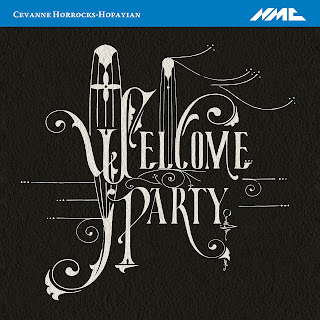
Personal Stories: Cevanne Horrocks-Hopayian's Welcome Party on NMIC

Cevanne Horrocks-Hopayian Welcome Party; Ziazan, Trish Clowes, Tim Giles, London Symphony Orchestra, Jon Hargreaves, Ausias Garrigos Morant, Choir of Girton College, Cambridge, Gareth Wilson; NMIC

Reviewed by Robert Hugill on 11 January 2021 Star rating: 4.0 (★★★★)
Telling a series of interconnected stories, Horrocks-Hopayian's music delights in crossing boundaries; it intrigues and delights.


The music on composer Cevanne Horrocks-Hopayian's Welcome Party, her portrait disc on NMIC, tells a series of interconnecting stories. There are thirteen tracks performed by Cevanne Horrocks-Hopayian (voice), Ziazan (voice), Trish Clowes (saxophone), Tim Giles (drums), London Symphony Orchestra, Jon Hargreaves (conductor), Ausias Garrigos Morant (clarinets), Choir of Girton College, Cambridge and Gareth Wilson (conductor).

The stories range from Horrocks-Hopayian's Armenian heritage, her life as a composer and a performer, her links to members of her family, her participation in the London Symphony Orchestra's Panufnik Composers Scheme and her LSO Soundhub residency at 575 Wandsworth Road, the former home of Khadambi Asalache (1935-2006) with its interior decorated with a profusion of Asalache's fretwork, with Horrocks-Hopayian using Asalache's carvings, paintings and his own stories as inspiration.

We begin with Muted Lines which was written for saxophonist Trish Clowes and where Horrocks-Hopayian's own smoky voice interacts in a bluesy manner with Clowes' saxophone, until the music goes up-tempo with a terrific saxophone solo. Then comes the title track, Welcome Party which is dedicated to Susie Thomson (Khadambi Asalache's partner) and Horrocks-Hopayian's family. It is an extrovert orchestral piece which seems to be channelling Percy Grainger at his most up-beat and inventive.

The Cave Painter takes as its inspiration one of Asalache's poems. First Horrocks-Hopayian reads the poem and then we hear the work, for violin, viola and bass clarinet, sustained, evocative and thoughtful with the solo violin to the fore. Text is also the inspiration for Swallows and Nightingales but here it is fragments of Armenian author Gevork Dodokhian and Saphho. Performed by Ziazan and a string quintet, the result is an evocation of birdsong with an elaborate dialogue between voice and strings.

The Ladies returns to 575 Wandsworth Road, specifically the bathroom where Asalache's paintings include images of an eclectic mix of women from Bessie Smith to Cleopatra to Madame Pompadour. It combines an exciting orchestral contribution with Ziazan's bluesy voice including some extensive scat singing. Aslache's carved images inspired Dancing Birds, though here the music is sustained and thoughtful with sliding lines in the strings giving the whole a very aerial feel.

Another text by Asalache's follows, and Horrocks-Hopayian's Inkwells uses a graphic score inspired by the text. The physical look of Horrocks-Hopayian's scores is important to her, so that Muted Lines uses a text written as eye-music, whilst both Inkwells and Ways and Ways have cutouts in the score, mirroring Asalache's fretwork. Inkwells uses found sounds, from 575 Wandsworth Road, so we begin with recorded hammering which develops into intriguingly complex poly-rhythms over which Ziazan's voice floats almost as an invocation.

2015 marked the centenary of the Armenian genocide, and Horrocks-Hopayian's Ser is one of her responses, a choral setting of a single work, 'Ser' which is the Armenian word for love. Performed by the choir of Girton College, it is a considered work full of fascinating harmony.

Walls and Ways returns us to found sounds, this time the tick of the grandfather clock in 575 Wandsworth Road and the sound of birdsong. Over this, the clarinet combines with Asalache's intriguing story, Parting of Ways, read by Ziazan to create a sense both of place and of timelessness.

The choir of Girton College return with Lullaby Between Two, a work that uses the same material as Welcome Party but in intriguingly different ways, and the piece is a tribute to an aunt who died during the pandemic.

There is an engaging approachability to Horrocks-Hopayian and, along with a delight in telling stories there is a clear sense of her love of crossing stylistic boundaries. The results are intriguing and often seductive.

Cevanne Horrocks-Hopayian Welcome Party
Cevanne Horrocks-Hopayian (voice)
Ziazan (voice)
Trish Clowes (saxophone)
Tim Giles (drums)
London Symphony Orchestra, Jon Hargreaves (conductor)
Ausias Garrigos Morant (clarinets)
Choir of Girton College, Cambridge, Gareth Wilson (conductor)
Recorded at All Saints, Tooting, 19-20 July 2021, St Georges' Chesterton, Cambridge, 28 June 2021
NMIC D268 1CD [57:48]


Never miss out on future posts by following us

The blog is free, but I'd be delighted if you were to show your appreciation by buying me a coffee.

Elsewhere on this blog

  • Panache, intensity and vivid story-telling from Claire Booth and Christopher Glynn in Modest Musorgsky: Unorthodox music at Wigmore Hall - concert review
  • A joy in complexity of texture and rhythm: Sinfonietta Riga in four recent works written for them by Lativan composers - record review
  • We live in a world where nothing has been left untouched by humanity: composer Jan-Peter de Graaff chats about the inspirations for his new cello concerto - interview
  • Colour and movement: Patrick Allies and Siglo de Oro transport us to 17th century New Spain - concert review
  • Full of the joy of Christmas: music by Heinrich Schütz and his contemporaries from Arcangelo at Wigmore Hall - concert review
  • Hymns to the Virgin: the Tallis Scholars at St John's Smith Square's Christmas Festival - concert review
  • The Other Erlking: Songs and Ballads of Carl Loewe, from Nicholas Mogg and Jâms Coleman - record review
  • Focused intensity and sheer joyful elan: John Butt and Dunedin Consort perform Handel's Messiah at Wigmore Hall  - concert review
  • Music and meaning: Handel's Messiah from Choir of Jesus College, Cambridge and Britten Sinfonia with conductor David Watkin at the Barbican - concert review
  • Something more raw, that goes back to the origins of the stories: I chat to composer Glen Gabriel about his new album, Norse Mythology - my interview
  • The comfort of the familiar mixed with the intriguing, the lesser known and the downright unfamiliar: The Sixteen at Christmas - concert review
  • Poetic imagination: Andri Björn Róbertsson and Ástríður Alda Sigurðardóttir in songs by Árni Thorsteinson & Robert Schumann - record review
  • Home

Wednesday, 12 January 2022

Celebrations continue: two world premieres as part of London Chamber Orchestra's centenary season

London Chamber Orchestra and Christopher Warren-Green

The London Chamber Orchestra, conductor Christopher Warren-Green, continues celebrations of its centenary with concerts at St John's Smith Square, including two world premieres. Nicholas Korth's Inscapes debuts on 22 February 2022, when Christopher Warren-Green conducts a programme that also includes Britten's Serenade for Tenor, Horn and Strings with Toby Spence (tenor) and Pip Eastop (horn), plus music by Mozart. Whilst on 21 June 2022, violinist Pekka Kuusisto directs the orchestra in a programme that includes a premiere from Freya Waley-Cohen celebrating the end of her residency with the orchestra.

Waley-Cohen's song-cycle, Happiness is performed on 18 March 2022 alongside music by Sondheim and Beethoven, whilst an all-Mahler programme on 26 April 2022 includes the baritone and tenor version of Das Lied von der Erde.

Full details from the London Chamber Orchestra's website. Highlights from all concerts will be available online following each performance, for viewers to enjoy free of charge.

Panache, intensity and vivid story-telling from Claire Booth and Christopher Glynn in Modest Musorgsky: Unorthodox music at Wigmore Hall

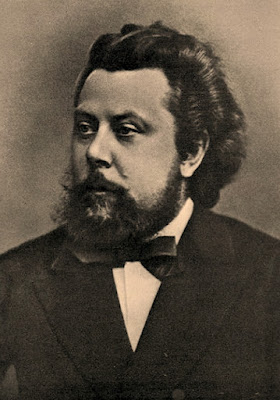
Modest Musorgsky in around 1870

Modest Musorgsky: Unorthodox music
; Claire Booth, Christopher Glynn; Wigmore Hall

Reviewed by Robert Hugill on 11 January 2021 Star rating: 5.0 (★★★★★)
A mix of well-known and lesser known songs plus piano pieces spun into a remarkable sequence that highlighted the way Musorgsky pushed and transcended boundaries

Musorgsky wrote nearly 70 songs and we just don't hear enough of them in the concert hall. So it was a great treat that soprano Claire Booth and pianist Christopher Glynn followed up their October 2021 disc on Avie, Modest Musorgsky: Unorthodox Music with a lunchtime recital at Wigmore Hall on Tuesday 11 January 2021 that mixed Musorgsky's songs with piano pieces. The programme was organised around a thematic arc of an imagined life, with sections on Nursery, Youthful Years, Marriage, and Loneliness. Songs from the great song-cycles were here, The Nursery, Songs and Dances of Death and Sunless, but also individual songs that deserve to be better known and complimentary piano solos.

In her spoken introduction, Claire Booth said that one of the surprises that came out of her and Christopher Glynn's exploration of Musorgsky's output was quite how many strong women there were in his songs (in contrast to his operas), and of course in the Russian tradition Death can be female, and indeed Musorgsky referred to his song-cycle Songs and Dances of Death as her.

There is another thing about Musorgsky's songs, even the ones best known in orchestral guise, and that is their sense of imagination, boundary-crossing freedom. Katherine Broderick and Sergey Rybin's 2016 disc of Musorgsky songs on Stone Records [see my review] made a strong case for the links between Musorgsky's song output and French impressionism, notably Debussy. It is worth re-iterating what we know, as the timeline is intriguing. 

The young Debussy spent the summers of 1880, 1881 and 1882 touring Europe with Tchaikovsky's patron Nadezhda von Meck, acting as teacher and pianist for her daughters. Musorgsky's cycle Sunless was finished in 1874 and published that year, whilst Songs and Dances of Death was finished in 1875 but not published until 1882, though a number of Musorgsky's songs were published in the 1870s. And the Paris Conservatoire bought a copy of Musorgsky's Boris Godunuv in 1874. So, it is worth listening to these songs with new ears.

Tuesday, 11 January 2022

A joy in complexity of texture and rhythm: Sinfonietta Riga in four recent works written for them by Latvian composers

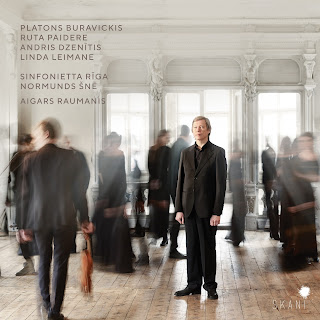
Ruta Paidere, Andris Dzenītis, Platons Buravickis, Linda Leimane; Aigars Raumanis, Sinfonietta Riga, Normunds Šnē; SKANI

Ruta Paidere, Andris Dzenītis, Platons Buravickis, Linda Leimane; Aigars Raumanis, Sinfonietta Riga, Normunds Šnē; SKANI

Reviewed by Robert Hugill on 11 January 2022 Star rating: 4.0 (★★★★)
Four recent works by Latvian composers written for Sinfonietta Riga and displaying the full range of brilliance and complexity in their orchestral writing

Sinfonietta Riga is a relatively young ensemble, founded in Latvia in 2006. On this disc from the Latvian label Skani, Sinfonietta Riga and conductor Normunds Šnē perform four works written for the ensemble by Latvian composers, Ruta Paidere’s Tempera, Andris Dzenītis' Euphoria, Platons Buravickis' The Temperature of Plastics with saxophonist Aigars Raumanis and Linda Leimane’s Ray-Bows.

For much of the 20th and 21st centuries, music in the Baltic countries has remained intimately intertwined with the complexities of history. The composers represented on this disc are amongst the generations that grew up able to work freely, without persecution by totalitarian regimes or clashes with even older political ideologies. In fact, two of the composers on the disc were born around the time that Latvia regained its independence. Not that musical life was all sweetness and light. Political ideology in the newly independent Latvia saw the profession of composer as almost completely superfluous and unnecessary, official rhetoric, said the country already had one composer – as well as one famous pianist, one award-winning violinist, and so on – so it did not need any more. For this reason, many of the composers from these early generations found themselves needing to live and work elsewhere. 

All four pieces on the disc are a world away from the minimalism and spirituality embraced by Latvian composers such as Rihards Dubra. All four works here celebrate a sort of maximalism and a joy in complexity of texture and rhythm, along with technical challenge. 

Monday, 10 January 2022

Inspired by Serbian wedding traditions, Ana Sokolovic's opera Svadba comes to the screen in a collaboration between Boston Lyric Opera and Opera Philadelphia

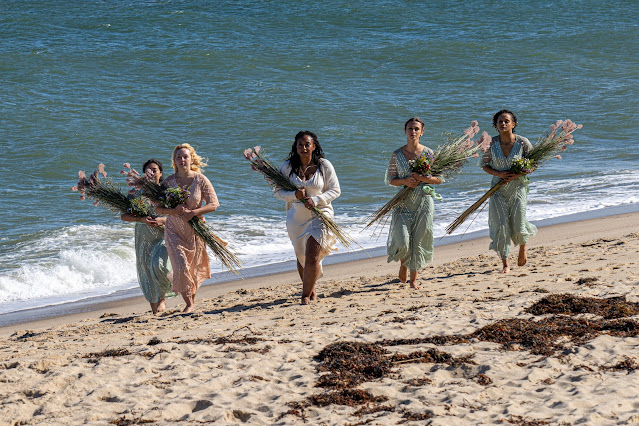
Dancers in the cast of Ana Sokolovic’s Svadba on Ballston Beach in Truro, Massachesetts
Sarah Pacheco, Sasha Peterson, Victoria Awkward, Emily Jerant-Hendrickson, and Jay Breen.
(Photo by David Angus)

Quebec-based composer Ana Sokolovic was born in Serbia and emigrated to Canada as a young adult, where she studied at the University of Montreal (where she now teaches). She was the first woman to write an opera for Canadian Opera Company (in 2015). Her earlier opera Svadba-Wedding, which focuses on the day before a Serbian wedding, was premiered in Canada in 2012 and then toured both Canada and Europe.

There will be chance to see the piece online at the end of this month as Boston Lyric Opera and Opera Philadelphia collaborate on a film of Svadba, directed by Shura Baryshnikov and conducted by Daniela Candillari. Ana Sokolovic's music is for six unaccompanied singers, and in live performance these embody the six characters, but for the film there are six dancers and actors performing to the soundtrack created by the six singers.

Svadba debuts on 28 Januar, 2022 on Boston Lyrica Opera's operabox.tv and the Opera Philadelphia Channel streaming services. On-demand viewing is $15. Subscribers to either service may access the film two days earlier on 26 January 2022. Full details from the Opera Philadelphia website.


Crouch End Festival Chorus in cantatas by Felix and Fanny Mendelssohn.

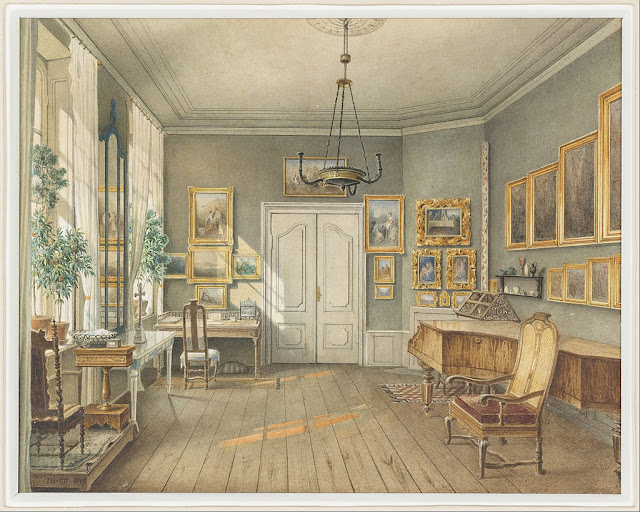
Fanny Mendelssohn's music room at her home with her husband in Berlin (Julius Eduard Wilhelm Helfft)
Fanny Mendelssohn's music room at her home with her husband in Berlin
(Julius Eduard Wilhelm Helfft)

How much of Felix Mendelssohn's choral music do you know? He wrote a significant amount from unaccompanied sacred anthems right through to the great oratorios and choral symphonic music. Yet choirs only occasionally explore beyond Elijah. And what about his sister, Fanny Mendelssohn? Whilst her songs and chamber music have become more commonly performed, her choral music lags behind.

A concert from the Crouch End Festival Chorus and the London Mozart Players, conductor David Temple, aims to get us exploring. At Alexandra Palace Theatre on Sunday 23 January 2022, with soloists Julia Doyle, Rebecca Afonwy-Jones, Ronald Samm and Ashley Riches they will be performing Felix Mendelssohn dramatic cantata Die erste Walpurgisnacht along with his setting of Psalm 42 and his chorale cantata Vom Himmel hoch. Alongside these will be Fanny Mendelssohn's cantata Hiob (Job) and her part-song, Lockung.

Felix's Die erste Walpurgisnacht sets a poem by Goethe. Goethe wrote it to be set to music but his friend Carl Zelter had two goes (in 1799 and 1812) and failed, it would be the young Felix who set it in 1833. His large-scale setting of Psalm 42 dates from 1838; setting Luther's German translation of the Biblical text, the piece is one of a number of psalm settings that Felix wrote both for unaccompanied choir and for choir, soli and orchestra. In the late 1820 and early 1830s, Felix wrote a series of small scale chorale cantatas, many of which feel like dummy runs for the choral writing that he would use in Elijah. Crouch End are performing Vom Himmel hoch, dating from 1831.

Fanny Mendelssohn only wrote a relatively small group of choral pieces, besides her partsongs (including the best known, Gartenlieder), there are four cantatas of which three date from the year 1831. Lobesgesang was written to celebrate the first birthday of her son, and her cantata Hiob dates from the same year and was finished in time for her second wedding anniversary. The difficult birth of her son seems to have inspired Fanny to branch out, and instead of songs and chamber music (pieces deemed suitable for a woman to write) she created four cantatas and other large-scale works. The cantatas were not published, they were performed by Fanny at one of her salons and then after her death sat in archives until their rediscovering in the late 20th century.

Full details from the Alexandra Palace website.

Saturday, 8 January 2022

We live in a world where nothing has been left untouched by humanity: composer Jan-Peter de Graaff chats about the inspirations for his new cello concerto

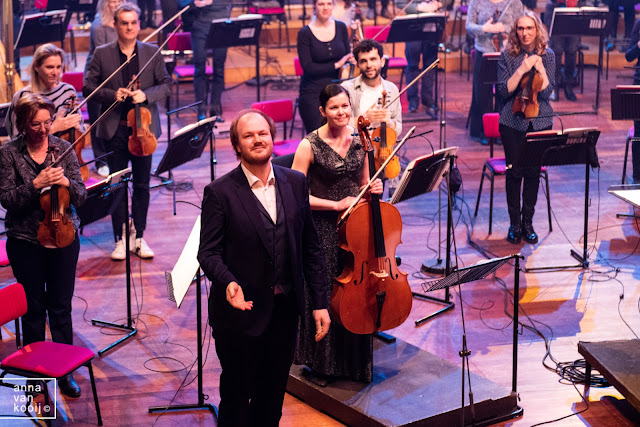
Jan-Peter de Graaff, Maya Fridman and North Netherlands Symphony Orchestra after the premiere of The Forest in April, live-streamed from Tivoli-Vredenburg in Utrecht in March 2021 (Photo Anna van Kooij)

In November 2021, Moscow-born Netherlands-based cellist Maya Fridman released The Forest in April, a disc of cello concertos by the Dutch composer Jan-Peter de Graaff, recorded with North Netherlands Symphony Orchestra and conductors Sander Teepen and Nicolò Foron on the TRPTK label. The disc features Jan-Peter's Concerto No. 5, The Forest in April, which was written for Fridman, alongside his Concerto No. 4, Rimpelingen (Ripples). Jan-Peter's music is often inspired by nature and by physics, and The Forest in April is inspired by man's relationship to nature. The work was premiered in March 2021 in a live-streamed performance. I recently spoke to Jan-Peter to find out more.

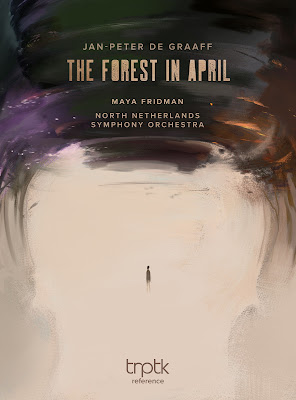
Jan-Peter de Graaff: The Forest in April - Maya Fridman, North Netherlands Symphony Orchestra, Sander Teepen & Nicolò Foron - TRPTK
The project began when Maya Fridman heard Jan-Peter's cello concerto Rimpelingen (which was written for the cellist Hans Woudenberg in 2017) and she asked Jan-Peter to write her a concerto. Before writing for people, Jan-Peter likes to get to know them as he wants to tailor pieces for the people they are written for. So he and Maya Fridman had lots of conversations and lots of coffees. They found common ground in their love of nature and interest in the interaction between humans and nature. What interested them both was the way humans tend to shut nature out, living in urban environments, and the realisation that we live in a world where nothing has been left untouched by humanity; how is this possible? 

The ideas for the concerto were also affected by small details that Jan-Peter discovered, such as a documentary about lyrebirds which talked about them being able to imitate the sounds made by modern technology. Whatever we do creates an effect, but it might develop into something different. Jan-Peter felt that this was something he could use in the concerto. With concertos, from the Baroque through to the Romantic, there is a long tradition of call and response, the soloist plays something and the ensemble reacts, perhaps accompanying it or perhaps going against it. So, Jan-Peter conceived the concerto as a metaphor for how humans (the cello soloist) react to the environment (the orchestra), with each movement looking at a different aspect of this abstract idea.

Friday, 7 January 2022

noisenights are back

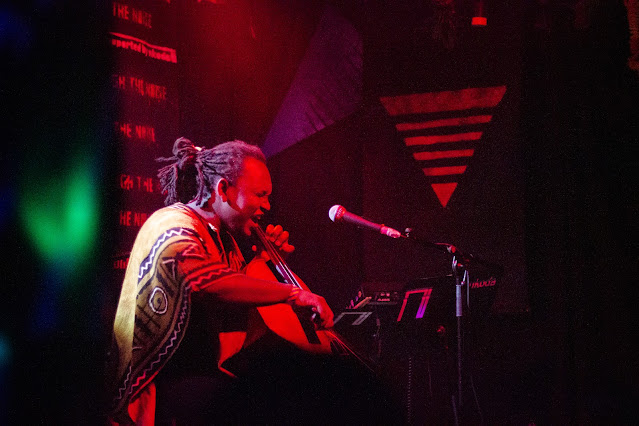
Abel Selaocoe at noisenight three (Photo Jack Bazalgette / through the noise)

noisenights
, the classical club nights from through the noise, are expanding following four sold-out events across London last year. Four events have been announced for the first half of this year in collaboration with a variety of venues across London.  

Soprano Héloïse Werner, cellist Colin Alexander and Her Ensemble will be appearing at the the Old Sorting Office (OSO) Arts Centre in association with the Barnes Music Festival (9 & 12 March 2022), BBC Young Musician finalist Toril Azzalini-Machecler presents a programme for solo percussion at The Jago in Dalston (30 April 2022), the Jess Gillam Ensemble will be performing at Well Seasoned, a new club set within Peckham Levels, a repurposed multi-storey car park (14 May 2022) and Abel Selaocoe returns with his band Chesaba for a performance of African, jazz, and classical-inspired music at Oslo, in the converted old Hackney railway station, (18 June 2022). 

Each night features two classical sets at the beginning of the evening, with the second followed by live jazz, funk and afrobeat bands accompanied by a late-licensed bar. The concerts will all be crowdfunded using through the noise’s crowdfunding platform. Full details from their website.

Music and Migration in Georgian Edinburgh

Yaniewicz & Green square piano

Last year The Friends of Felix Yaniewicz presented two recitals in Edinburgh to celebrate the return of the restored 1810 Yaniewicz & Green square piano associated with the Polish-Lithuanian violin virtuoso and composer, Felix Yaniewicz who founded the first Edinburgh Festival in 1815. There is a chance to catch excerpts from these in a short documentary that The Friends of Felix Yaniewicz have produced about the piano, available on the Friends' website.

Later this year, an exhibition at the Georgian House in Edinburgh, Music and Migration in Georgian Edinburgh  (25 June - 22 October 2022) will explore Yaniewicz' life in more detail with musical and personal artefacts associated with Yaniewicz along with letters from correspondents such as Nicolo Paganini and Angelica Catalani. Further details from the Friends' website.

Thursday, 6 January 2022

Call all aspiring young composers - ORA Singers Composer Competition

ORA Singers Composer Competition

ORA Singers has launched its third Composer Competition - its free mentoring scheme for young composers from UK State Schools. 10 Finalists will be selected to receive free one-to-one mentoring by professional composers in order to write an original choral work. These pieces will pieces then performed and recorded by ORA Singers, and adjudicated by a panel of industry experts.

A further 40 40 Apprentices will receive behind-the-scenes access to the Competition, and 8 hours of online compositional masterclasses, introducing them to many aspects of choral history and compositional technique. At the end of these masterclasses, the Apprentices will write their own choral work which will be looked over by the Workshop Leaders.

Applications to the ORA Singers Composer Competition are now open for young aspiring composers born on or after 1 September 2003 and attending a UK non-fee paying secondary state-school. Applications close on Monday 7 February 2022, full details from the ORA Singers website.

Popular Posts this month